January 31, 2003
Bush: State of Union Speech
President Bush's State of the Union Message was great on rhetoric and cleverly crafted to foster the public image of compassionate conservative with a folksy touch. It would have gone down very well in Middletown America.
But not with liberal America. Thus Bob Herbert says that:
"The president ....is leading a hard-right administration here at home that is seriously eroding the economic security, the access to health care, the civil rights and civil liberties and the environmental protections of the American people....
....As the most powerful nation on earth, and the world's only superpower, the United States has a particular obligation to use its might wisely abroad and to distribute its benefits fairly at home.
That is not an easy mission for a hard-right-wing administration, which is why the Bush administration puts such a premium on the rhetoric of compassion.
Behind the veil of rhetoric is a [social?] Darwinian political philosophy that, if clearly understood, would repel the majority of Americans."
This is how rouughly the lines along which social democrats in Australia would intepret President Bush's State of the Union Message speech.
What Herbert does not do in this op.ed text is to spell out the political philosophy underpinning the Bush Administration's view of international relations in the global states system. Underneath the rhetoric Bush sees the nation state as a a unified entity whose primary purpose is to promote and defend its national interest. The state is the means/instrument for securing national and international order through the exercise of national power.
The international system of sovereign states is anarchic in nature and in the absence of any international regulator to enforce ethical conduct and abide by international codes, states pursue power politics to attain their national interests.
After S11 American reasserted its military might in response to terrorism and the Bush adminstration argued that the logic of international relations required that such an assault on its sovereignty could only be met with decisive retaliation. America had to act quickly to sustain its hegemonic position, defend its national interest and protect its strategic and geo-political interests.
The international order would now be determined by the US as the most powerful state in the intestate system and not the United Nations. The key assumption in this understanding of interational relations----that nation-states are the key actors on the global stage---led to a deep scepticism of the United Nations. The UN is largely ineffectual and irrelevant because world order is shaped by powerful states like the US.
Crudely speaking, this is social Darwinian political philosophy applied to international relations.
Posted by Gary Sauer-Thompson at 9:37 PM | Comments (4)
Politics in SA
The steady erosion of the major political (Lib/Lab) parties in a globalised world continues in SA. A clear marker of this was yesterday's decision by Kris Hanna, the state Labor MP for Mitchell, to quit the Labor Party, join the Greens and give the fledgling Greens their first state seat in Parliament.
For the story see IT IS EASY BEING GREEN
Hanna confirms this weblog's account of the Rann Government that, though it is popular, its governing style concentrates on media management at the expense of good policy so it can win the next election.
The point of the media management or spin is to engineer consent of citizens to be governed by Rann & Co. The spin aims to show that the Rann Government is doing something more than keeping the economic machine ticking and massaging the voters.
The classic example of this spin and posturing is SA blaming the upstream states for the state of the River Murray by engaging in media stunts to highlight the illhealth of the river. They are replaying the strategy of the Olsen Government, which Mike Rann and John Hill savagely criticized at the time.
This political posturing hides the lack of action by the SA Government to fix up the problems in its own backyard. It is doing very little to developing a river health strategy for the Eastern Mt Lofty Ranges, nothing about renewal energy in the Upper Spencer Gulf, unwilling to confront the need to cut Adelaide and SA's dependence of River Murray water.
Of course, these environmental policy considerations did not play a role in Kris Hanna's decision to leave the ALP. This left-liberal is joining Greens because of his opposition to the war with Iraq, Labor's policy on refugees and his anger at other Government policies in areas such as law and order. See here
This move will change state politics though not in the sense of undermining the Rann Labor Government's hold on power in the Lower House. It will change things more in the sense that this gives the Greens a toehold in parliamentary politics. This toehold provides a platform to build their electoral support at the expense of the embattled SA Australian Democrats. The Greens are outpolling the Democrats in SA, just as they are doing in the other states. Thats a big turn around because SA was the home and stronghold of the Australian Democrats.
The SA Greens Charter is more of a vision statement that sets out the general principles. It has no concrete policies for SA. Has the hard thinking about SA's future as a sustainable state yet to be done? Or are the local Greens not good at putting their polcies online? Do they have green policies for the economy?
Once dissident MPs like Kris Hanna would have joined the Australian Democrats. His move to the Greens on classic left liberal grounds is another indication of the sorry state the Democrats are in after their implosion during 2002.
These days the Democrats have little political cred. After their moment of self-destruction they are now seen to be a spend political force by the electorate. Do they need to hire some good spinners and publicists for their media management?
And a big quesion: Is this local example of a shift in politics exemplify the reconfiguation of politics of the nation-state, due to the pressures of globalization? Has Kris Henna actually put his finger on something quite important: that regional governments in a global world can no longer deliver the goods and services to their citizens? Their political legitimacy is this compromised and they cover up their incompetence or eroded capacity with media management?
Posted by Gary Sauer-Thompson at 9:51 AM | Comments (11)
Being cyncial
THe war with Iraq is not popular in Australia without a UN mandate. There is widespread opposition to going it alone with the US and Britain, even though many Australians would like to see Saddam Hussein 'taken out' and Iraq become a democracy.
And John Howard has not made the case for Australia's involvement in terms of Australia's strategic interests. The case that has been made is that we are going to war to protect 'international security' because Australia is a close friend and ally of the US.
In what way are Australia's strategic interests threatened by Iraq? How are they threatened by Iraq's attacks on Iran and Kuwait, or Iraq posing a threat to Israel? Or Iraq being a destablising influence in the Middle East? Iraq is not a credible threat to the US let alone Australia. Does there not have to be a threat of some sort to justify a pre-emptive military invasion in the name of anticipatory self-defense?
In case you missed it this article by Scott Burchill, goes through the various justifying arguments for war.
The case for war is not made by Howard, we go to war, the hawks continue to call the critics of war appeasers and pax America becomes the new global reality.
The domestic disquiet remains. Howard then porkbarrels as he did in the last election to retain his hand on the levers of power. Little is said about sound economic management ---balancing the books or running a budget surplus---being overruled by clever political strategy based on running a fiscal deficit in a flat economy.
What the heck, lets spend up big and save the Murray while we have the chance. The moment may not come again. Lets defend the decision in the name of national security and call the critics of porkbarrelling defeatists, who are selling out the national interest for a strong and resilent agriculture.
Posted by Gary Sauer-Thompson at 8:04 AM | Comments (4)
After the War
The invasion of Iraq is now well nigh inevitable, either with the mandate of the UN to invade Iraq or the US acting unilaterally with a rag tag of allies to ensure stability in the region---preventing Iraq from nuking its neighbours.
Iraq then becomes a client state of the US. The US in turn becomes an imperial power, as its troops are now stationed in northern Asia (remember North Korea) and the Middle East. It has become an imperial power under the Republican conservatives who were once isolationists.
As an imperial power---it is now the sole superpower---it turns away from its celebration of winning the cold war for the West and turns to imposing its pax America on the territory under its influence in the name of liberty, democracy and free markets. We now live in the New American Centuryin which U.S. power is used in an aggressive and unilateral way to secure American dominance of world affairs by force if necessary.
The Rebuilding America's Defenses involves hikes in military spending, locating American military bases in Central Asia and the Middle East, the toppling of recalcitrant regimes, the violation of international treaties, the militarization of outer space, control of the world's energy resources, and the willingness to use nuclear weapons to achieve American goals.
What then for the Middle East? Well the US, in acting to remove Saddam Hussein, now has an expensive garrison of US military personnel in a volatile and unstable region keeping an eye of the oil reserves in Saudi Arabia. Some of the oil from Iraq is used to rebuild Iraq whilst the rest flows into the US to help reduce, or fund, the deficit.
The permanent presence of the US in the Middle East as a force for the status quo creates increasing instability in the region, fuels what it and Israel proclaim to be terrorism, and leds to the collapse of many current Arab regimes.
This is called the era of American peace in a globalised world.
Posted by Gary Sauer-Thompson at 6:37 AM | Comments (4)
January 30, 2003
Pall over Deregulation
In establishing a national electricity market neo-liberals have learned from the Californian experience of having volatile wholesale prices and fixed retail prices. The neo-liberals have deregulated wholesale and retail prices in Australia so that the cost charges at the wholesale level can be passed onto retail customers. Hence the 30% hike in retail electricity prices in South Australia this year.
Alas, another problem has emerged. The Rann Government does not like the excesses of the market in electricity.
The sequence we are at, with the ongoing shift to a deregulated national electricity market, is that the volatile wholsale price can go through the roof due to the interplay of supply and demand.
This happened recently in Adelaide. It was so obvious that the Rann Government's public response was one of 'we are shocked' and the journalists who wrote about this event echoed them.
The Rann Government had informed NRG of the Santos gas plant shutdown on Saturday. Within five minutes of being advised, NRG withdrew 170MW of electricity generated at its Port Augusta power plants and re-priced it. NRG increased the price of its electricity from $269 a megawatt hour to $9697 during South Australia's gas crisis.
Deputy Premier Kevin Foley said yesterday that it did so in in a bid "to gain a huge profit windfall". The story is here Gas shut-off led to `profiteering'
The Rann Government is not pleased with this market excess. However, it has little comeback because under national electricity market rules, generators are allowed to charge up to $10,000 a megawatt hour – and withdraw electricity and re-price it if supply conditions change. So the NRG price spike is all within market expectations.
Within a deregulated market the incentive for increased investment in power assets comes from the price spike, rather than the marginal price usually charged. This is the whole rational. Higher prices bring for the new supplies of electricity through the construction of new generating plants. Until this happens SA can purchase additional electricity from the eatern states connected through the power grid.
Has the Rann Government reached the limits of the neo-liberal mode of governing through the market and is re-discovering politics? I doubt it. It is another cog in its publicity campaign to blacken NRG so as to get itself off the hook. "Our hands are tied", they can say, then add, "its the price gouging of the nasty NRG that is the problem."
This way of managing the political fallout means that it can avoid having to confront its neo-liberal mode of governance and its tacit faith that the deregulated market will lead to the upgrade of infrastructure, new plant construction and cheaper retail prices.
Of course, there is nothing in all of this about a shift to renewable energy. Why should there be: a shift to new electricity plants based on renewable energy requires government intervention and being proactive. This distorts the operation of the free market because renewable forms of energy are not commercially competitive. And Australia has large reserves of oil and is self-sufficient in natural gas and coal. These industries should be protected in the name of national security.
And Australia has little political will to meet its Kyoto commitments to take a more proactive stance stance towards supporting renewable energy by limiting its carbon emissions to 108 per cent of its 1990 emissions in the period 2008-12. It is going to continue its heavy reliance on oil and natural gas rather than reduce this reliance through fostering the development renewable energy power plants.
What is displaced in this sort of "public debate" is the public interest in the shift to sustainability in South Australia and the most appropriate form of government intervention to promote renewable energy in South Australia.
Posted by Gary Sauer-Thompson at 8:47 AM | Comments (3)
Countdown to war.
This editorial by The Guardian was written a day or so before the Blix Report was made public; before the interpretations of this key text scattered in all directions and the politicians made it mean whatever they needed it to mean. "I was right all along' etc. etc.
Called Endgame it clearly outlines the next steps will be taken over the next week or so and the momentum of events. It offers good advice: don't listen to the politicians, watch the military buildup.
President Bush's State of the Union speech can be found here For the European reaction see Security Council remains unswayed. For an interpretation of this speeech that raises good questions, see In George we trust, or do we?
For a very critical account of John Howard by a senior Australia journalist see Michelle Gratten's Talk to us honestly, Mr Howard; for the Howard deceptions see President comes clean and Time Howard stopped playing deadly game of charades;for Carmen Lawrence's response How many dead Iraqis will it take?
I fear the die is cast.
The public's distrust of politicians has deepened. The politicians will now begin the diplomatic and publicity campaign to get international and domestic backing for a war with Iraq.
Nowhere did I see mention a concern for building a liberal-democratic, multination Iraq.
Posted by Gary Sauer-Thompson at 12:30 AM | Comments (0)
January 29, 2003
Bush fires: lets not forget volunteers
Today is a day of extreme fire danger with temperatures over 40 degrees, low humidity and strong gusty north winds in both SA and north western Victoria. Tomorrow, Thursday, is expected to be worse, expecially for the Victoria Alps.
The recent fires---more like infernos---that devastated Canberra, and are currently causing havoc in the Victorian Alps, have been, and are primarily fought by volunteer fire fighters. They are part of organizations such as the Victorian CFA or the CFS in SA.
The volunteer fire fighters provide this public service on their own time, with the support of their employers. When they are fighting bush fires for extended periods, such as the three weeks in the Victoria's north west, they do so by taking annual leave or rostered days off. Often they have bought the second fire truck through their own fund raising.
The Commonwealth and State governments celebrate them as heroes and the public is thankful for saving their porperty and lives.
But no compensation is forthcoming. This is volunteer work, even when SA volunteers travel to Victoria or NSW to help fight bush fires. Something more is needed than admiration, celebration and gratitude. Why not some financial compensation for a public service performed by taking annual leave or rostered days off?
No sir, say the employers, such as Steven Smith of the Australian Industry Group. This is an additional cost to business and is unfair to business. The Commonwealth Government calls on business to treat volunteer fire fighters leniently. Why so?
Unless the boss is lenient and generous workers are docked for time off the job when they are emergency volunteers.
Its a simple matter of justice. It should be a condition of employment that emergency volunteers pay continues they they are fighting bush fires to save lives and family homes. Gvoernments should help to pick up the tab.
Posted by Gary Sauer-Thompson at 3:05 PM | Comments (2)
Its a hostile world
Janet Albrechtsen, The Australian journalist, says that the church leaders are caught up in the fog of peace. She says here that 'Australian churchman are caught up in moral surrender to the new secular God, the UN'. They are part of the compassion industry that has become a tool of the Left.
Underneath her criticism of 'the peace not war' position of the Australian churchman ----the basic criticism is the standard one that the making of independent moral decisions has giving into politics of appeasement of utopian pacifism----is a particular conservative assumption.
The UN is held to an inept organization, not much different from the old League of Nations, because the world consists of hostile nation-states engaged in power conflicts because they are all seeking to further their national interest at the expense of their rivals. Its a mean Social Dawinian world out there and nation-states have to fight to protect their self-interest. Power is all that matters, and since international law does not really exist, war is the best means of ensuring peace. History is then introduced to say that Saddam is the new Hitler. This view of the world, as an anarchic world dripping with blood and slaughter is called being realistic.
What is not acknowledged by neocons, such as Albrechtsen, is the challenge to the anarchic assumption by way that international law and international institutions are evolving to regulate the conduct of nation-states and to develop new modes of goverance. THe WTO, the International Criminal Court and the UN are examples of this.
This global mode of regulation and governance is rejected by neocons on the grounds that nothing should impinge on the negative freedom of the nation-state. Might is right. Justice is the rule of the strongest. No decision making should be given to the United nations.
This is the geopolitical assumption that the neocons regard as an unspoken truth and it is behind their attacks on the United Nations as a corrupt body. Votes are bought and sold in the name of self-interest whilst Germany and France in opposing the war with Iraq are merely acting to protect their lucrative business deals with Baghad. All that exists is self-interest and power.
This assumption is never defended publicly by the necons because it is taken to be the truth, even though it is very questionable assumption.
Posted by Gary Sauer-Thompson at 11:24 AM | Comments (7)
Richard Butler talks sense
The former UN chief weapons inspector, Richard Butler, spoke to the Sydney Institute last night. He comments are interesting because we do not hear this perspective on the US from our politicians who prefer to work within very narrow horizons in public debate.
Mr Butler said that the US claim that the purpose of the Iraqi conflict was to get rid of weapons of mass destruction lacked credibility.
"If they were so deeply concerned about weapons of mass destruction, what are they doing about the situations around the world that are no less dangerous and involve weapons of mass destruction?" Why are they permitting the existence of such a shocking double standard?"
Richard Butler went onto say that it was hypocritical that Israel's weapons of mass destruction were off limits to US concern, and that it is acceptable that India and Pakistan have weapons of mass destruction and threaten to use nuclear weapons.
What we have are goods guys and bad guys with weapons of mass destruction. Iraq and North Korea are the bad guys--the forces of evil-- whilst Israel, India and Pakistan are the good guys--on the side of the forces of good.
There is a touch of unreality in all of this. I heard a war strategist from a big Washington think tank on Radio National yesterday morning. He is the one credited with a war plan that is being taken seiously by the Pentagon---well, thats how he was introduced by the presenter of the Breakfast programme on Radio National. His war plan centred on hitting Iraq very, very hard so as to awe them with US military prowess and so break their will to resist a US-led invasion. Short, swift and sharp.
Whilst talking it up with enthusiasm he said that Australia ought to be careful because Iraq could take out Brisbane. It was a blatant attempt to whip up fear and anxiety.
There was nothing about the US helping to build a democratic regime after the massive destruction. There was nothing about the consequences in the Middle East of the US going it alone with Britain and Australia with the United Nations.
In the light of that sort of talk Richard Butler talks sense.
Posted by Gary Sauer-Thompson at 7:44 AM | Comments (0)
January 28, 2003
Roman Forums
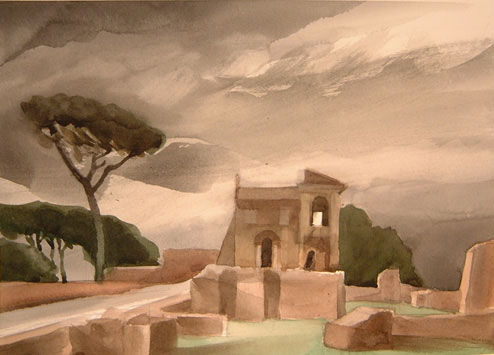
Posted by Gary Sauer-Thompson at 11:38 PM | Comments (1)
Debate over the war?
Christopher Hitchens
This debate over war with Iraq may be academic after Hans Blix, the Chief UN weapons inspector, told the UN Security Council that Iraq has not accepted international demands that it disarm and Washington immediately said there was no sign Iraq wants to cooperate. Washington is going to war no matter what happens at the United Nations.
Then again, maybe its not academic as we are not at war yet. The article by Christopher Hitchens, 'Wake Up, Peaceniks!' has a more interesting angle than most as he maintains that the 'government and people of the United States are now at war with the forces of reaction.' The response by Steven Lukes, Sorry, Hitchens, this time it should be ‘no’ to war is critical of the way Hitchen's classifies the opponents of war as " ‘peaceniks’, ‘smart-ass critics and cynics’, who lack ‘self-criticism’, make ‘doom-laden predictions’ and exhibit ‘self-satisfied isolationism’. Our ‘past form’ is, apparently, one of opposing interventions in the Gulf, Bosnia, Kosovo and Afghanistan."
Though I am against Australia's involvement in the US go it alone war I have no doubts that Saddam Hussein's regime is totalitarian, repressive and brutal. For an insight, see Torture stories.
It is pretty strong.
Posted by Gary Sauer-Thompson at 11:33 PM | Comments (2)
Political shuttlecock
Many do not dip into Margo Kingston's Webdiary because they think that no pearls of wisdom can be found buried in what they see as journalist dross. So they may have missed this.
It is a site called, NSW Election 2003, and you may still find it of interest, even though it is hosted by the liberal Sydney Morning Herald
There is good material there particularly on the way that the 'crime card' is being used by politicians as an election strategy. It involves responding to the public fear of crime by Scaring up the votes. The aim of the strategy is not to explore answers or solutions but to exploit anxiety for political advantage. The politicians then identify problems they promise to "fix" via sentencing changes, such as "truth in sentencing", "three strikes and you're in", hard-drug pushers would die in jail", "hoodlum patrols would reclaim the streets for our citizens and make them safe again".
And Paolo Totaro here asks, why, are there no properly evaluated studies to measure the efficacy of equally radical proposals such as mandatory sentencing, when the evidenced-based approach was the nom for a medically supervised heroin-injecting room put in place by the State Government? Paolo then makes a good observation:
"Our political leaders do not explain how they translated the public's often justifiable fears about personal safety or crime rates into a demand for expensive, untested policies that, to date, have done absolutely nothing to pre-empt or curb crime - and even less to rehabilitate or educate offenders before release. Rather, the law and order auction that began with Nick Greiner's 1988 "truth in sentencing" legislation and continues today with mandatory sentencing has simply added to our already bursting jails."
And in this piece Paolo refers to a group of international crime experts who have called for an end to the use of law and order as a "political shuttlecock", proposing reforms to safeguard the legal system from electioneering politicians.
These experts observe that the politicisation of law and order has had a "profound effect on the traditional separation of powers between the Parliament, the executive and the judiciary ... [that] hallmark of the Westminster system of government ... appeared to be breaking down at the close of the century in Australia."
And thats a good judgement.
Posted by Gary Sauer-Thompson at 11:22 PM | Comments (5)