« May 2004 | Main | July 2004 »
June 30, 2004
remember the illusions
The principles that underpinned the Iraq invasion are in tatters. Pre-emption has been quietly dropped (it's not being suggested for Iran or Syria); unilateralism is being replaced by the multilateralism of alliance building in Europe; and Iraq as the frontline of terrorism has failed. Only democratising the Middle East remains.

Francis Fukuyama has an interesting article in The Australian about nation building in Iraq. The article will disappear in a few days and it is not yet published in The National Interest.
So I will pick up a few of his ideas as they undercut the tired cliches of this kind of conservative commentary by Tony Parkinson. Fukuyama says that:
"The Bush administration went into Iraq with enormous illusions about how easy the post-war situation would be: it thought the reconstruction would be self-financing, that Americans could draw on a lasting well of gratitude for liberating Iraq, and that we could occupy the country with a small force structure and even draw US forces down significantly within a few months."
We should not forget that the Iraq war was a manipulated get-up job and there has been a cynical use of the "war on terror" to erode the basic civil liberties of Australians and Americans.
Fukuyama then goes on to make an important point about the US and its hsitory. He says:
"True, there is vast disparity of power between the US and the rest of the world, vaster even than Rome's dominance at the height of its empire. But that dominance is clear-cut only along two dimensions of national power, the cultural realm and the ability to fight and win intensive conventional wars. Americans have no particular taste or facility for nation-building; we want exit strategies rather than empires.
So where does the domestic basis of support come for this unbelievably ambitious effort to politically transform one of the world's most troubled and hostile regions? And if the nation is really a commercial republic uncomfortable with empire, why should Americans be so eager to expand its domain? In Iraq, since the US invasion, we Americans have been our usual inept and disorganised selves in planning for and carrying out the reconstruction, something that should not have surprised anyone familiar with American history."
The key idea here is the tension in the US over the conflict between republic and empire. The US America has built an empire of bases rather than colonies, creating in the process a government that is deeply concerned with maintaining absolute military dominance over the rest of the world. Yet the nation is uneasy with empire and concerned with the lack of democratic control over the imperial administration.
Posted by Gary Sauer-Thompson at 06:16 AM | Comments (3) | TrackBack
June 29, 2004
A new Iraq born?
So the big day for Iraq came and went. Sovereignty has been given to Iraq--well sort of.
The reality is that the Americans will continue to prop up the undemocratic Ayad Allawi transitional/caretaker/interim Iraqi government with money and muscle. They have to. There is not enough money from oil to reconstruct Iraq, the Allawai government does not have a functioning military force whilst the constitution limits the interim government's power to basic civil administration and preparations for national elections.
The Americans spin the event as the handover of power, and they say that it is another landmark in Iraq's arduous and bloody journey to achieving democracy, prosperity and viability. The reality is that the Allawi government is not capable or ready to run Iraq. I cannot see how it is ready to handle the situation, whether it's security or the economy. The reality is that Iraq’s “interim government” is the outward face of a client regime.

What we have is a similar situation to Afghanistan. U.S. presence maintains a facade of stability and it protects an inner group that is designated as having sovereignty. As in Afghanistan the government's authority does not extend beyond the inner circle itself. Does that mean a unified state cannot be built and Iraq becomes a number of local baronies?
Personally I think we will have more of the same. More violence. More bloodshed. Only worse. A majority of Iraqi's do want the Americans to leave. Unsuprisingly, because the Bush administration has badly mismanaged post-war Iraq. The guerrilla insurgency will continue and grow because the Americans are still seen as the occupiers.
Will the symbolic images of the transfer of sovereignty be able to counter the negative images of Iraq and turn around the Bush administration's bruised credibility over its rationale for the war? Will Saudi Arabia and Pakistan continue to wobble. Will the region be increasingly in turmoil. A panel discussion.
A geopolitical storm is brewing in the region. I fear the worst.
Posted by Gary Sauer-Thompson at 09:27 PM | Comments (0) | TrackBack
June 28, 2004
CoAG & Water in 2004
At last Friday's CoAG meeting the Basin states and the Commonwealth signed up to two agreements: one to establish a national water initiative, the other to recover water for environmental flows for the Murray-Darling river system. These agreements have been heralded as a historic step towards a sustainable water future for the Murray-Darling Basin and Australia.
Are they? We have good reason to be sceptical.
Peter Cullen is a good guide on this complex issue of water reform. On the latter agreement, the Living Murray Agreement, Cullen says:
"The first of the agreements repeated all the great pledges they made last year to commit $500million and to return 500 gigalitres of water to the Murray River in its first stage of restoration. This was an agreement between the lower basin states NSW, Vic and South Australia and only concerned recovery of water to rehabilitate the Murray. There was not much new in this, and progress has been glacial."
Very true. Not much actually happened here. It was old news being recycled to make the states look good---to be seen doing something. Cullen says:
"What has been agreed is that all proposals (to clawback over-allocated water resources) will be judged by the Murray Darling Basin Ministerial Council and have to be agreed as eligible measures if they are to be funded from the $500million pool. The deal pledges to set targets for water recovery. Much of this was agreed last year, and not much water has been delivered to the Murray. Environmentalists and those living along the lower sections of the river are certainly impatient with the rate of progress. They need to keep expressing their concern to governments, otherwise political attention will move on to some other issue."
Nor was any extra money actually put on the table to recover water. Little by way ofactual proposals to recover the promised 500 gigalitres of environmental flows was put on the table. Apart from Victoria, the states are doing the barest minimium in the longest possible time. The lowest common denominator thinking still rules; even in SA, the state make the loudest noises about the pressing need to save the Murray.
It was better news on the other agreement, the National Water Initiative, signed by all states other than Western Australia and Tasmania. This agreement lays out the sorts of principles that need to guide water management in the 21st century, and repeats some of the ideas developed in the Murray arguments. Cullen says that this involves some complex matters, which he outlines as follows:
"It seeks to give farmers security for their water rights so they can invest in some certainty. It wants to provide legally secure water for the environment and lay out principles as to how it should be recovered, managed and reported.
It does agree that water can be recovered through a variety of means, including purchase on the market by a tender, infrastructure improvements or regulation, and agrees that whatever means are used they must be cost effective. It seeks to establish a nationally consistent water market so water can move to its best uses. It also met farmers' concerns about sharing risks of less water in the future due to improved knowledge and government policies.
This agreement also commits states to a transparent water planning framework and provides a commitment to return all over allocated river and groundwater systems to sustainable levels of extraction. It recognises the connection between groundwater and surface water in many systems. And it acknowledges indigenous interests in water and seeks to engage them in water planning.
The deal establishes a National Water Commission, funded solely by the Australian Government to review states' progress under COAG agreements and to provide advice to COAG on water issues. This is an important step to developing an overdue national water strategy. As a federal body, it will not be held hostage to the lowest common denominator thinking that drives most of the ministerial councils we have in Australia."
That is a significant step forward. However, the governments have only committed to the broad principles. Yet very little has been achieved in terms of of recovering water for the Murray. Not a drop of new water seems to have been delivered as yet, and it is not clear when any will be.
We are still talking about recovering the water. We are not actually delivering it. Nor are we providing the resources to do so.
Posted by Gary Sauer-Thompson at 03:01 PM | Comments (0) | TrackBack
June 27, 2004
living with the squeeze
This report by Glenn Milne captures the squeeze the ALP is currently finding itself in. Milne is addressing the issue of clear felling of Tasmania's old growth native forests in a corporatist state. He writes:
"So there we have it. Garrett is recruited to the ALP to galvanise the Green vote in favour of Labor, particularly by way of preferences. But privately Latham assures the loggers [in Tasmania] there'll be no change in policy to accommodate Garrett. In other words, Garrett is just window dressing.
Garrett and Green voters thinking about opting for Labor should study Latham's published words carefully. When he walked with Brown through the Tasmanian forests, Latham left no doubt that jobs should not and would not be lost. There was no reason to tamper with current Regional Forests Agreements, he said. Nor was there any reason to cease all old growth logging; that would end the arts and the crafts industries."
Latham is not even interested in retraining the forestry workers to work in the growing tourist industry. Latham is not even talking about a change in forestry practices in Tasmania.
Bob Brown's position is one of an immediate halt to all logging, not just clear felling, in 240,000ha of the most sensitive Tasmanian forests in the Styx Valley and the Tarkine and Blue Tier forests. Rightly so.
With Brian Harradine announcing his retirement the way is opened up for the Australian Greens to capture his seat. I hope they do.
It is the only way to destablize the corporatist state run by the ALP in Tasmania.
Posted by Gary Sauer-Thompson at 11:55 PM | Comments (4) | TrackBack
June 26, 2004
Israel: racism
Racism is never far from the ongoing debate about how to bring about peace between Israel and Palestine. The history of the birth of Israel is one of European racism towards the Jews, the Nazis attempted genocide of the Jews and the racism of the Israeli's towards those Palestinians who were expelled from their land.
Today criticism of Israel's occupation of the Palestinian land through the tactic of settlements is generally and routinely dismissed as lefty anti-Semitism; whilst Palestinians and Arabs are seen to racist when they say they want Israel wiped off the map.
It's a hot topic. Let me illustrate. If you claim that only the total destruction of Israel will satisfy the Arabs, then you imply that compromise is impossible. Consequently, if such claims are right, then the struggle between the Israeli Jews and the Palestinian Arabs cannot end as long as Israel exists - or until the power of Arabs to threaten Israel is destroyed. Hence some Israel hawks come close to calling for the bombing of Syria, Iran and Eqypt. Presumably, they would have held that Iraq deserved to be bombed.
Racism is one of greatest obstacles to peace. Some even go so far to say that [ethno]nationalism is racism. This kind of misplaced critique says that to preserve the Jewish character of the Israeli state is racist because nationalism is racism. Instead of that understanding of racism we can say that Israeli racism against Arabs is based on a feeling of racial superiority of Israel's over Arabs. An oft-expressed example is that it is impossible to reason with Arabs because they didn't share the same faculties of thought and reason that "civilized human beings" possess.
That is the background. The focus of the Arab- Israeli conflict is mostly on Palestinians of the Occupied Territories. But what about those Palestinians who live inside Israel? How do they fare?
This article in Haaretz explores the topic of racism in Israel from the perspective of the racism of Jews towards Arabs. It says:
"As members of a nation that went through the Holocaust and suffered racial discrimination more than any other, they [Israeli's] wouldn't be willing to be exposed as Arab haters, as people who have no trouble trampling the rights of the Arab citizens of the state, to the point of expelling them from their homeland."
There are Jewish Israeli and Arab Israeli citizens in the functioning democracy of Israel.
However, the article says that some of the former often express racism towards the latter to the point of desiring to have the Arab Israeli citizens expelled from the State of Israel.So racism would be excluding 20% of Israel's citizens who are not Jewish on the grounds that they are not Jewish.
Posted by Gary Sauer-Thompson at 05:57 PM | Comments (8) | TrackBack
June 25, 2004
Meanwhile....
While federal Parliament frothed and bubbled all week to clear the legislative decks for the forthcoming election, people around the nation noticed other things:

Leunig
Is it about values?
The politics and the values are connected though. Here is a quote from Don Watson's book, Recollections of a Bleeding Heart, which I read on the road. I find the quote rather appropriate to the events of last week:
"People talk about the 'political landscape', but it changes too quickly and unpredictably to be a landscape. Every time you look it was different. An event beyond the horizon, or too deep to comprehend, changed the mood from benign to beligerent in a flash. You would look back on a week or a month and wonder where the change began, but there was no saying. The experts would say they saw it coming but they had to say it if they were to remain experts.The truth was no-one really knew. "
I reckon the big ALP backflip on the PBS was one of those events that changed the political mood or the vibe. The ALP is being belted in the House of Representatives this week and Latham is now represented as a clown doing stunts by cartoonists.
My judgement is that the PBS backflip is a defining moment in the election campaign. It is the moment we can point to when the tide stopped flowing out from the Howard Government and started to flow out on the ALP. The latter's latter's political optimism drained away as it was seen to be turning its back on social justice in favour of accepting the inequality of the free market.
Watson finishes the quote by going on to say:
"It was not a landscape so much as a seascape. Politics was like the sea, though it also looked very like one of those television weather charts that show fronts swirling across the continent at a million times their real speed."
That was certainly was the case for the Keating Government. They were never able to include people into their big picture.
Does the current ALP see the current bad weather coming towards them? The front of swirling bad weather is on the way. You can feel it in your bones.
26 June
Shaun Carney concurs with the above account of the fallout from the ALP's PBS reversal. He says:
"Without doubt, the decision by Labor to drop its opposition to the Government's proposed increase in prices for medications has hurt the ALP. Latham will have lost support, not just among those on low incomes who will be most affected by the rises, but among those who are looking to Labor to chart a different policy course from the Coalition."
Is this the first sign of weakness from the ALP? Or a clever tactical move to find a cool billion?
June 27
Michelle Grattan, in her column in The Age says that "Latham may still be on the path to victory but it doesn't seem the almost inevitable trajectory that it did for a while. His vulnerabilities are increasingly exposed." She identifies some of them:
"The "money" argument, about saving and spending, is getting messy. Managing the release of major policies is tricky. His "alliance" credentials, poor already, have become entwined with the FTA argument...And does the pharmaceutical benefits turnaround mean people can't rely on Labor's word? In dramatically changing its stance on the PBS charges, Labor borrowed from its political credibility bank account to pay the insurance premium on its economic credentials."
The values rather than the policies approach is undercut by the PBS backflip.
Posted by Gary Sauer-Thompson at 11:58 PM | Comments (3) | TrackBack
June 24, 2004
endangered species
My guess about the implications of recent events is that they signified the ALP in policy retreat. Labor has backflipped on the PBS and is also giving tactical ground on the US trade deal. They will backflip on energy going for market efficiency at the expense of sustainaility, a strong regulator and open acountability.
My judgement is this. The socially conservative authoritarian ALP will continue to backflip until it becomes like the Coalition. Then they are not vulnerable to the Coalition's attack. That is what is meant by being a small target----repudiating the social and cultural agenda of the Keating Government in the early 1990s.

David Rowe
On this account they are showing that they are fiscally responsible. They too are sound economic managers using the utilitarian calculus to achieve the greatest happiness of the greatest number of individuals. They too can make the tough economic decisions that please the money markets. They too have what it takes to run the country. So say the neo-liberals in the ALP.
You can kiss social liberalism goodbye. Social liberalism's ethical state concerned wth the public good should be placed on the endangered species list.
What we have is market freedom, easy-going on state interference, light regulation of the market, user pays, self-reliance and individual responsibility.
Pity about the public good and citzenship. Of course, the public good does not exist, does it?
Posted by Gary Sauer-Thompson at 10:45 PM | Comments (5) | TrackBack
June 23, 2004
yeah
This is how I feel about politics at the moment.
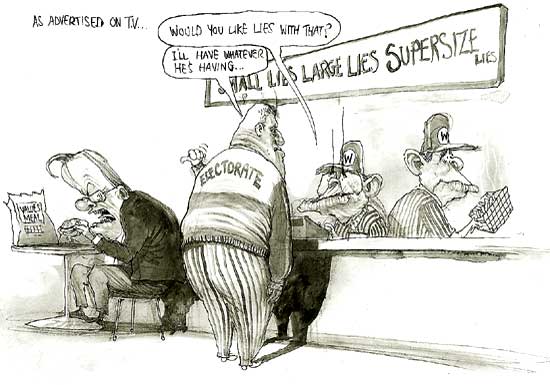
David Rowe
It's a cynical view. I know. But I'm feeling a bit jaundiced.
Posted by Gary Sauer-Thompson at 08:03 PM | Comments (4) | TrackBack
June 22, 2004
if I had the time
I'm just far too busy to post much today.
I was going to post on how Australia's Free Trade Agreement with the US places constraints on Australia's democratic governance. The argument would have been that most of the disputes about economics and environmental conflicts would be decided by a trade disputes committee. This makes the decisions in terms of trade considerations and it declares that a law should be changed or compensation paid. Most environmental regulation is seen as a restriction on trade.
The implications are explored here.
I mention the the FTA because the rumors are that the ALP is starting to waver on the issue and back the US free trade agreement. And they are crumbling ling under pressure without even a commitment to renegotiate the Agreement.
Waver waver, then buckle.
That's the ALP. Look at the backlip on the PBS. The ALP has said it would now support legislation that increases the co-payment by 30 per cent. Patients face rises of up to $4.90 in prescribed drugs charges.
And this is from a party that says it stands for social justice and universal health care. Remember the ALP had once opposed the PBS increases because they would hit the "sickest and poorest Australians".
Posted by Gary Sauer-Thompson at 11:40 PM | Comments (6) | TrackBack
June 21, 2004
Energy market
The Australian Financial Review has an an editorial on energy(subscription required, 21 6 04, p. 62). At the risk of boring people with energy yet again, I want to briefly mention it because of what it does not say. The arguments are poor in economic terms.
The editorial says:
"These facts stare us in the face. Cheap and abundant fossil fuel energy is the linchpin of our economic success, a competitive advantage that offsets the historic disadvantages of distance from the major rich-country markets and our small home market. We would be insane to sacrifice it prematurely."
Well, no one is suggesting that. They are suggesting cleaning up coal and encouraging a shift to a greater use of renewable energy. The editorial goes on to address renewables:
"Wind and solar undoubetdly have a supporting role to play in our energy future. But they remain too costly, lacking in scale and unreliable---when there is no wind or sun--to power base-load electricity generation for major industries, towns and cities."
Who is suggesting renewables will perform base-load electricity generation? Their value is different. Solar cuts in during the heat of the summer when the airconditioners are turned on in Adelaide. The value of the service provided by renewables is different from the base load.
An analogy to highlight the outmoded thinking of the AFR on energy from telecommunications. The base line is the old landline, fixed handset and fixed call charge. Mobile phones are far more expensive and they are largely supporting. But we use them and pay extra, even though they are unreliable and lacking in scale.
Why?
Because mobile phones provide a service that the old landline does not. The service is instant contactibility.
Similarily with solar power. We switch it on to deal with the sunny days. And we pay a bit more to do it becaue we value the service provided.
I reckon its about time the AFR dumped its prejudices---it even canvases nuclear power--and started thinking in market terms. After all, we are in the process of creating a national energy market that provides differently valued energy services.
Posted by Gary Sauer-Thompson at 10:13 PM | Comments (1) | TrackBack
June 20, 2004
Israel: some thoughts
Here are a few ideas gleaned from some articles.
The first by Gideon Levy is about the settlements in the occupied territories. Here the Palestinian people are subjected to military occupation with a de-facto apartheid already existing in the West Bank. Levy says:
"...the settlement enterprise from the start... was established to undermine any and every chance for a peace agreement and to erect a defensive barrier against any just solution...One government after another - left and right - carried on funding their whims and inflating the settlement enterprise to monstrous proportions....Now there is a possibility, for the first time, that a tiny part of this hapless enterprise will come to an end. Shockingly late in the day, we must now hold them to account for the blood they shed in vain. Now is the time to say to them - you extorted enough, you cost us too much, you deserve nothing more."
In the long run the Israeli settlements in the Palestinian lands are unsustainable -- difficult to defend militarily, impossible to defend legally. Jeffrey Goldberg argues that these settlements, as much as Islamic radicalism, threatens Israel. The latter (Islamic radicalism) feeds off the former (settler occupation).
The article by Glenn Frankel is about torture of Palestinians in the Israeli prison system:
"The accounts of physical abuse of Iraqis by American guards at Abu Ghraib prison outside Baghdad sounded achingly familiar to Anan Labadeh. The casual beatings, the humiliations, the trophy photos taken by both male and female guards were experiences he said he underwent as a Palestinian security detainee at an Israeli military camp in March of last year."
There is a difference between the two torture regimes in that the Israel's techniques for breaking down prisoners are far more sophisticated than the Americans. Frankel says:
"In the early days... crude physical and sexual abuse was commonplace...Now the emphasis is on psychological pressure...The latest report by the committee against torture, covering the period from September 2001 to April 2003, alleged that detainees faced a new regime of sleep deprivation, shackling, slapping, hitting and kicking; exposure to extreme cold and heat; threats, curses and insults; and prolonged detention in subhuman conditions."
If you do nothing else do read the Jeffrey Goldberg article about the settler movement. As he says "the hard-core settlers---the Jewish religious nationalists--- and their supporters make up perhaps two per cent of the Israeli populace, but they nevertheless have driven Israeli policy in the occupied territories for much of the past thirty years." The settlers have been the spearhead of the Israeli occuaption of Palestinian lands.
Posted by Gary Sauer-Thompson at 02:48 PM | Comments (24) | TrackBack
June 19, 2004
Iraq: it gets worse
The neo-con dream - the road to Jerusalem going through Baghdad plus democracy, once established in Iraq, would sweep the Middle East - is now in tatters. Here is part of the case:
1.The second major justification for the Iraq war has been rejected by an independent commission investigating the September 11, 2001 attacks, dismissed claims of a link between Saddam Hussein and al Qaida held by the imperial presidency. The 9/11 commission said there is no evidence that Saddam Hussein's regime was involved in the September 11 attacks against America. And there is no credible evidence that Iraq and Al Qaeda cooperated on attacks against the United States.
2.The first major justification for invading Iraq--- the weapons of mass destruction possessed by Iraq-- has long been discredited, due to the failure to to find any.
There go the central justifications for the invasion of Iraq.
3.What we are left with are the consequences of the invasion. Australia is part of a bloody occupation, with rising dislike and antagonism of the US occupation force. The latter is facing an insurgency, which it is trying to crush.
4.Let us not forget the repressive side of the occupation associated with the the siege of Fallujah, provoking the uprising of Muqtada al-Sadr's militia, and then the Abu Ghraib scandal that made publci the underside of operation Iraqi freedom:

The caption says that an unmuzzled dog appears to be used to frighten a detainee at Abu Ghraib prison in Iraq. Two military dog handlers told investigators that intelligence personnel ordered them to use dogs to intimidate prisoners.
Another photo from the Washington Post indicates that this abuse of prisoners amounts to inflicting physical pain:

It is unclear whether these wounds were caused by dogs. What we do know is that use of stress positions and dogs at Abu Ghraib — were approved by the "highest levels" of the officer corps and civilian officials at the Pentagon. This regime was a way to control the other, the Arab. This regime of mastery over the other would use the disorders of the prisoners sexuality to humiliate them, in order to destroy their attachment to the Islamic principles and values that gave their life meaning.
These are images of sado-masochistic activity and of brutalization and suffering repeated. The cruelty and humiliation evoked glee from the American guards at their mastery over Arabs through forcing them to perform perverse actions.
5.The upcoming transfer of sovereignty in Iraq is nothing like full sovereignty. Juan Cole reckons it is a publicity stunt - without substance.
Iraq is a political disaster that undermines the carefully-crafted image of John Howard as the Anzac PM and father of the nation. The father stands exposed: he has a contempt for the Islamic world and disdain for the conventions Geneva that would restrain the thrust of Empire.
The political father through his ministers (eg. Senator Hill) is busy defending the pleasure gained by Americans from the cruelty and humiliation of Arabs who have threatened the homeland.
By covering up what it knew about the regime of cruelty in Iraq, the Howard government is defending the desire to exploit the suffering of Iraqi's for sado-masochistic pleasure. This discloses the Australian political unconscious: Orientalism.
Posted by Gary Sauer-Thompson at 02:46 PM | Comments (28) | TrackBack
June 18, 2004
do you hear the echo?
There is a paragraph in an article on Iraq by Tony Walker in the Australian Financial Review (subscription required, 18 06 04, p. 27) that describes the Howard Government's foreign policy. Tony says:
"...the Howard government will trim its sails to correspond with whatever tack Bush embarks upon. Thus, if Bush is for pre-emption, Howard and Downer are for pre-emption; if he's for the United Nations role, then Howard and Downer are for a UN role, then Howard and Downer are for that too; if Bush wanted to give every Iraqi $1 million then that would probably be okay, as well."
It is pretty accurate don't you think? Of course the Bushies continue to imply that Australia is obliged to support everything that the US says and does. Not doing this is being anti-American. Howard and Downer just follow the script that has been written for them in Washington.
And Bush? Well he has changed tack from America excluding the UN in Iraq to now including the UN. That tack brings the Bush administration close to the original ALP position, does it not? Yet Howard accuses the ALP of increasing the risk of a terrorist attack by promoting a foreign affairs policy of isolation and retreat:
"The narrowly defined defence doctrine that would circle the wagons and deny Australia a capability to co-operate with allies beyond our shores. The tired and deeply-flawed view that implies some inconsistency between a close alliance relationship and good relations with Asia."
The position of those who are critical of Howard's foreign policy is misrepresented as putting a fence around our country or our region. They are deemed to running back to the illusion of Fortress Australia.
It is campaign rhetoric. Like Bush Howard's re-relection game plan had assumed the Iraq war would be a huge plus that would sweep aside the domestic issues of health, education and the environment. Iraq has turned out to be bad news because the occupation is going badly.

Leunig.
So Howard, like Bush, is setting out to undermine his opponents by challenging their patriotism. The aim is to neutralize and destroy the opposition whilst pufffing up Howard's courageous actions in defending the homeland from the international terrorists.
Posted by Gary Sauer-Thompson at 11:35 PM | Comments (2) | TrackBack
June 17, 2004
strange happenings
The Federal Health Minister, Tony Abbott, has been trying to give parents access to teenagers' Medicare records. It would raise raise from 14 to 16 the age of children whose parents can access Medicare information about their contact with doctors and prescriptions.
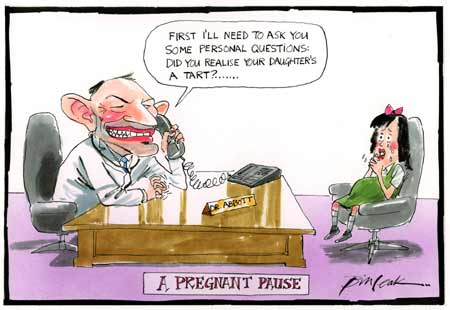
Bill Leak
This "families first" measure was aimed at preventing teenagers under 16 from seeing doctors without the knowledge of their parents. Sounds like control of teenage sexuality to me.
Abbott is also trying to return the morning- after pill (Postinor-2) to prescription-only status. He wants to reverse the National Drugs and Poisons Schedule Committee recommendation that made the emergency contraception available without prescription, from January 1.
What in heavens name is Abbott up to with this sexual politics? This bio-politics is trying to control the sexual activity of teenage women in the name of preventing promiscuousness.
Is he trying to appease the Christian right who presume that Australia is a Christian nation. Is that why there was such hostility to gay marriage? What next? Banning abortion? Blocking stem cell research? Oh, the Liberals want to ban any mention of homosexuality on kids' TV.
It is strange. Are the Christian conservatives saying that the liberal secular political principles such as justice, equality and liberty are inadequate? Are they saying that we also need Christian values if our earthly political order is to achieve good and desirable ends? Are they saying that liberty is not the supreme virtue of our political order?
Posted by Gary Sauer-Thompson at 09:32 PM | Comments (2) | TrackBack
June 16, 2004
Reinventing the energy wheel
A lighthearted moment:

Bill Leak
There has been a lot of hot air. The rhetoric of the Howard Energy white paper--Securing Australia's Energy Future--- is all about sustainability and solar-cities, but it is actually about paying the polluters (coal users) via various handouts to help the old energy industries clean up their mess by pumping it underground. The rhetoric is about the virtues of not subsiding an expensive solar energy. The reality is subsiding expensive technology needed by the coal industry and pandering to vested interests.
The cheerleaders were the coal industry and the aluminium industry. The found the energy white paper sane and sensible because it said that the future is to be based on the coal-based industries. Of course, the cheerleaders defending their patch forget to mention that coal is priced at the price for digging it out of the ground with the cost to cover greenhouse and other environmental costs borne by the public. That means higher electricity costs from fossil fuel generators.
This is a pathway backwards as it has little to do with securing Australi's energy future. Going backwards could have been avoided by introducing reasonable targets on renewable energy use, introducing emission trading certificates and other market-based policies to help reduce greenhouse gases. So Australia makes no real moves to shift away from its pollution-producing energy regime. Nothing was done to get more renewable energy into the national electricity market even though other countries are accelerating the uptake of renewable technologies.
When around 70 per cent of Australia's total greenhouse gas emissions still come from driving the industrial machine----burning coal, gas, petrol and diesel for our homes and businesses, and to fuel our cars---- it is no longer possible to talk about energy without talking about its environmental impact.
As Gavin Gilchrist writing in The Australian observes:
"....the overwhelming flaw in this statement is that it lacks the one element that without any doubt should have been the centrepiece of any national statement on energy and climate change: an aggressive national strategy to make Australia more energy efficient."
He goes on to say that:
"You only have to look around our cities at night to see how much energy we waste. And that's just the waste you can see. There are all sorts of reasons we don't build our factories, office buildings, shopping centres and houses so they are highly efficient in the way they consume energy. That must change. No advanced nation should be planning its energy and environmental future without an aggressive energy efficiency strategy. Australia is one of the few that's not."
Adelaide lags way behind in the energy efficiency stakes. Not even its houses are energy rated when you buy them.
If we reading the Energy statement politically, then it is clear that it seeks to undermine the green movement and the Labor Party. As Louise Dodson in the Sydney Morning Herald says:
"It is cleverly crafted and highly political, promising fuel tax cuts worth a whopping $1.5 billion to households, farmers, small and big business at a time when petrol prices are high. Just as one of Australia's most high-profile green activists, Peter Garrett, joins the Labor Party, the policy sets out to show voters that the green agenda for protecting the environment would be economic folly for Australia and would cost jobs."
The emphasis is on cleaner fuels not green energy.
17 June
Kenneth Davidson in The Age nails the diesel fuel aspect of the energy package. He says:
"The Howard Government is repeating its oldest trick: buying the rural vote on the never-never with a piece of pork wrapped in green paper....And the money for this exercise came, not from the proceeds of the sale of Telstra shares, but from savings on other environmentally related spending, notably the winding up of the National Energy Efficiency Program and the Energy Research and Development Corporation (whose activities were designed to reduce greenhouse gas emissions), the withdrawal of Commonwealth involvement in urban and regional development, and a one-third cut in expenditure on the national estate and parks.... the excise cuts are pure pork. They have nothing to do with energy security or the environment...The green wrapping is the $500 million low-emission technology fund. It is theoretically open to renewable energies, but is in effect a gift to the big coal miners (BHP Billiton, Rio Tinto and Xstrata)."
What we have are static, short-term cost advantages that effectively undermines innovation and dynamism in the energy industry. Australia is effectively shutting itself out of an important growth industry based on natural advantage.
Posted by Gary Sauer-Thompson at 07:52 PM | Comments (3) | TrackBack
June 15, 2004
something to chew over
This article by Tim Flannery makes some good points about the probable effects of climate change and global warming. Flannery says:
"The way we respond to climate change this decade will shape Australia into the foreseeable future....Declining rainfall has cost Perth two-thirds of its surface water supply, and in 1998 the rainfall deficit began to spread east, parching the western plains. Now Sydney's dams are at an all-time low."
Global warming also means less rain in the south-eastern Murray-Darling basin, less run-off and less flows in the River Murray.That is bad news news for the Murray's floodplains and wetlands. And not only in Australia.
Flannery then asks two good questions. The first is:
"So, what would Australia look like in a world that is two degrees warmer? Two degrees of additional warming is sufficient to kill about half the world's coral reefs....Extinctions of its unique fauna will start at one degree of warming, and after two degrees will accelerate rapidly....At two to three degrees of warming, Australia's alpine zone will become restricted to six peaks, and many of its species will become extinct."
The second question is:
"Why should we care about our biodiversity? First it's of great economic importance. Imagine tourism without the reef, rainforests and Kakadu. Imagine the world without the $30 billion yielded each year by coral reefs. Of course, biodiversity is much more important than that, for it feeds and clothes us, gives us clean air and water, and protects us from illness. Who knows, for example, where the next cancer cure is coming from?
I fear what future generations will say of us if we don't act, because two degrees of warming will gut our nation, destroying its greatest treasures and deeply compromising its capacity to support us."
Flannery then spells out what needs to be done.
June 17
There is a lot of nonsense about climate change in the media. Most of it is little more than the outpourings of the public relations arm of the fossil fuel industry. This public relations seeks to deny that climate change is man-made and that it is essentially [caused by] the burrning of fossil fuel. It seeks to undercut the forming consensus on the scientific issues by making the lack of scientific certainty a primary issue. Not even the Pentagon buys that kind of spin.
Posted by Gary Sauer-Thompson at 09:14 PM | Comments (18) | TrackBack
June 14, 2004
Energy: the future is coal
 Steve Lewis, writing in The Australian, gets the election interplay on environmental politics about right.
On the one hand, we have the symbolic politics of greenie Peter Garrett joining the ALP. On the other hand, we have Howard's black energy statement to be announced tomorrow. Lewis says:
"But at least his [Garrett's] political elevation brings a frisson of excitement to federal politics. It also provides a nice juxtaposition to John Howard's address to the National Press Club. In case you didn't know, the Prime Minister and his senior ministers (notably Industry and Resources Minister Ian Macfarlane and Environment Minister David Kemp) have been beavering away for months on an energy and environment white paper. Howard was forced to broker a deal between the two ministers, whose portfolio allegiances saw them often arguing over aspects of the package."
Lewis doesn't say it explicitly, but Kemp was rolled by McFarlane. Consequently, Australia's energy future does not include a serious commitment to renewable energy. Lewis goes on to say that:
"Howard...will argue the [energy] package strikes a sensible balance between the competing interests of Australia's big fossil-fuel energy suppliers and an emerging renewables sector which argues solar, wind and tidal are the green technologies of the future. He will present the statement as a 10-year plan to deal with Australia's energy challenge, and to show the Government has not run out of policy puff after more than eight years on the treasury benches.... And tomorrow the Prime Minister will confirm the Government is resisting calls to embrace a mandatory renewable energy target of 5per cent. That is the minimum level the renewables sector claims is necessary to provide the market conditions that would require the likes of Rio Tinto to source a greater percentage of their energy needs from green power."
Lewis does not say it explictly, but the Howard government has been captured by the energy intensive industries (such as Rio Tinto & the aluminium industry)are big exporters of coal and users of electricity produced by dirty coal-fired power stations in Australia.
As Lewis says, Howard has not disappointed them. His Government has resisted international calls to ratify the Kyoto Protocol, which requires developed countries to reduce their greenhouse emissions. And he will go softly softly on energy reform tomorrow to avoid giving a stronger emphasis on renewable energy.
Posted by Gary Sauer-Thompson at 01:27 PM | Comments (0) | TrackBack
June 13, 2004
Farewell
There has been a lot hype about this American conservative. Media adulation and myth-building by the conservative cheerleaders is everywhere. A lot of the commentary in the US is mostly gush and nonsense.There is little being said about the illusions fostered by his sunny messages delivered with a folksy charm. These were designed to help Americans feel better about themselves.
Domestically, a media-savvy Reagan signified the rupture with the New Deal since he delegitimized the federal government, slashed the social safety net, hugely increased the budget deficit through doubling military spending, targeted a big tax cuts for the rich, broke the unions, massively deregulated businesses, and deregulation the Savings and Loans sector. These are indicators of "trickle down" economics, an anti-government and market-fundamentalist philosophy that has since become hegemonic in American political thought.

The conservatives are magnifying Reagan through conflating the war on communism with the war on terrorism. They are campaigning as if America is watching TV with the sound turned down.
Michael Leeden says that:
"The Left truly hates Reagan, and those who worked with him, because he demonstrated the emptiness of their greatest conceit: that the ideals embodied in the Communist revolution were both just and destined to triumph. The Leftist intelligentsia will never forgive him and his people for destroying the Soviet Empire, and they still strive desperately to pretend that he didn't do it. But it won't work."
Not at all. The Soviet Empire deserved to collapse. Most of the momentum for change came from within that empire.
It is the war that Reagan waged by proxy in Central America that is Reagan's legacy. Reagan pretty much fostered and funded fascism in Latin America. That proxy war was a perversion of the goals of freedom and democracy. The US supported the El Salvador military slaughtering hundreds of peasants, mostly women, children and the elderly. The US funded the aggression against the Sandinista government by terrorists (Contra death squads) who murdered upwards of 40,000 civilians. Freedom-loving Reagan supported the genocidal regimes of Guatemala
The Iran-Contra affair disclosed how deeply corrupt and rapacious his Republican administration was.
Posted by Gary Sauer-Thompson at 05:19 PM | Comments (15) | TrackBack
June 12, 2004
Iraq: caged by fear
This is the document that concluded that, as commander in chief in time of war, President George W. Bush is bound neither by federal law nor the tenets of the Geneva Conventions that ban torture as a means of extracting information from detainees. So we have the imperial president saying that torture is okay when it is used to fight terrorism.
There is a lengthening shadow cast by torturing people in the name of freedom; a shadow called legalizing torture.

You can understand why the strategists of the Bush-Cheney re-election team are now trying to benefit from the memory of Ronald Reagan--ie., Bush is the true heir of Reagan. Bush is trying to bask in Reagan's legacy.
At the G8 Seal Island summit Bush talked in terms of undermining "the appeal of terror by supporting the advance of liberty and prosperity throughout the world, especially in the broader Middle East. The momentum of freedom there is building. A free Iraq is rising in the heart of that vital region. "
Below are two extracts that describe everyday life in Baghdad from the perspective of Christopher Allbritton, who writes the Back to Iraq 3 weblog. He says:
Baghdad is also an incredibly stressful place to live and work, especially as a westerner, as I’ve mentioned. We’re targets, and when you look very western, like I do, you’re constantly aware of eyes on you and the hostility. At restaurants, the waiters sullenly clear your table, sometimes being none too careful about keeping chai or food from spilling on you. The kindness I encountered last year is absent; a western face brings a sullen welcome, calibrated to the bare minimum."
And again:
"...this war defies comprehension. It’s so stupid and there seems to be no point to anything that happens here. People die on a daily basis in random, terrifying attacks. And for what? Freedom? Stability? Peace? There is none of that here and it’s likely there won’t be after the Americans leave. Iraq has spiraled into a dark place, much worse than where it was a year ago during the war. There is no freedom from the fear that is stoked by mutual hatred, cynicism and an apprehension about the future. So what if one side has superior firepower? Every bullet fired helps kill souls on both sides of this war, whether it hits flesh or lands harmlessly."
The war in Iraq has gone awry.
The G8 Seal Island summit highlights the way that the Bush adminstration's aims to nurture democracy in the Middle East is a set of principles rather than a plan of action. The reality is legalized torture.
Posted by Gary Sauer-Thompson at 05:05 PM | Comments (0) | TrackBack
June 11, 2004
burning the midnight oil
I just couldn't pass by this Leak cartoon about the Coalition banging away at Peter Garrett from Midnight Oil, after he accepted a safe seat in the ALP and a fast track to a possible ministry. (Indigenous Affairs?).The cartoon is too good:

Bill Leak
The Coalition needs to defuse Garrett, since Garrett gave the ALP good press all last week. It was a very good media campaign and the press liked the food being feed to them by the ALP spinners. If
Garrett was the story of the week, then the other story was a big "ALP is anti-American" media campaign based on more attacks on Latham from the Bush administration. Armitage made implied threats about the US hurting Australia economically and withholding intelligence from a Latham government. He also suggested that Australians might wish to reflect on what life would be like without the US alliance. The Bush administration counterattack on the ALP is being done for John Howard as part of an effort to counter the big shadow cast by Iraq.
These stories are froth and bubble. As Laura Tingle in the Australian Financial Review (subscription required, 11, 06 04, p. 75) pointed out, we are inside the false election period, where a feverish political atmosphere is building. It will be stoked by Parliament returning to pass around 66 pieces of legislation in 7 days before the winter break ends. The legislation will take a backstage to the polemics.
I presume the ALP is taking Garrett on board to try to stop the drift to the Greens in the inner-city seats of Melbourne and Sydney. Let us be realistic about all of this. When the crunch comes Labor and Liberal will join forces to prevent the Greens from gaining seats. It has happened before. It will happen again.
However, a lot is riding on Garrett for the ALP. Judging from the comments I've read, the ALP is trying to save seats from the surging Greens, shore up the Senate vote against the Greens, revitalize the party, and appeal to younger voters along the coast. It's a big ask.
The Garrett story keeps growing. We have personal advice from a rock star concerned about Garrett's welfare. Others see celebrities as a response by the political elite to a decline in political parties---"a crisis of faith demonstrated by failing membership and a decline in old-fashioned dedication."
My judgement is that after Garrett became the star ALP recruit, the Coalition looked decidely less green than they did before Garrett signed on. Their energy statement, which is a pitch for the green vote based on energy efficiency, is to be announced early next week. The Coalition is now seen to be placing obstacles in the way of the renewable energy industry, and being too beholden to the coal and aluminium industry. The Industry Minister, Ian McFarlane, has more or less become the spokesperson for the protection of the energy intensive industries. The energy future is locking the greenhouse gases produced by coal-fired powerstations deep underground so as to make coal more viable for power generation.
Howard's big energy statement next week is an attempt to capture the political agenda. It will offer the renewable industry some cash handouts, some funding for commercialisation and for getting access to the grid, but reject increasing the MRET target to 5% or beyond. This MRET scheme would create a market by bringing new renewable projects into play, as it requires energy users to use renewable energy sources for their share of power.
Maybe the Coalition needs to have some substantive green policies? They are still riding on the Natural Heritage Trust of the distant past. So how green does the Coalition need to become to be re-elected? They reckon not very, since Garrett will play badly in the regional marginal seats.
On the other hand, the ALP continues to ease into safe mode. It is waiting for the government to fall over and it is avoiding making any mistakes. It's public environment policy was limited to plastic bags.
The two stories--Garrett joining the ALP and the attack on the ALP for being anrti-American---became one story for the Coalition. Garrett is a symbol of anti-Americanism for the conservatives.
June 12
Michelle Grattan in The Age is also saying that the Howard Government has launched a media campaign based around the ALP policy having "increasing overtones of anti-Americanism".
June 13
As expected, Colin Powell, the United States Secretary of State, has his two bobs worth on Australian television. He plays nice guy. He says that the withdrawal of Australian forces from Iraq under a future Labor government would be a political disaster. Sensibly, Powell stopped well short of suggesting such a move would have consequences for the Australia-US alliance.
What next in the anti-ALP campaign? Senior figures in the Bush Administration quoting midnight oil lyrics?
Posted by Gary Sauer-Thompson at 08:28 PM | Comments (14) | TrackBack
June 10, 2004
US/Australia alliance
The US/Australia alliance has become an election issue in Australia as a result of the interventions by the imperial president and Richard Armitage, the US Deputy Secretary of State.
The significance of these remarks is that Bush administration is not prepared to accept that the US and Australian governments can differ over Iraq, and yet still maintain a strong and mutually beneficial alliance. Those remarks by the Bush adminstration about the fragility of the alliance---it will fall apart because of the withdrawal of several hundred troops ---are nonsense. As Geoff Kitney points out in the Australian Financial Review (subscription required, 10, 6, 2004, p. 14) Latham's policy does not pose a dangerous threat to Australia's national security, or a threat to the alliance.
The political significance is that the remarks by the Bush administration enable John Howard to play 'the ALP is anti-American card' to help him get re-elected. He is strongly asserting the significance of Australia's alliance in an attempt to neutralize the electoral damage from the emerging public unease about the Iraq fallout. Bush has given him what he needs.
Hugh White digs a little deeper on the ground of the escalating conflict between the ALP and the imperial presidency. He says:
"Fault lies on both sides. Latham's policy on troop withdrawal has always been flawed. But it is Bush who has escalated the dispute to this level. By declaring Australian willingness to keep forces in Iraq a make-or-break issue, he has raised a fundamental question: does our alliance with the US require us to send forces wherever and whenever the US asks? Bush's strident response to Latham's policy suggests he thinks it does. That would be in line with the views of some of the President's neo-conservative advisers, who are fond of saying there is no such thing as an a la carte alliance - one where you can pick and choose what bits you want and what bits you do not."
I presume this is also the position of Australian neo-conservatives. They would claim that it is the price that Australia has to pay for its security insurance policy. The fervered imaginations of the gut reacting, knee jerk conservatives would say that those who think otherwise are fools, anti-American, appeasers and supporters of Al Qaeda.
The strength of High White's piece is that he looks at the strategic implications of the neo-con understanding of the alliance. He says:
"....that model of the alliance is unworkable. In Australia, neither side of politics could sign up to it. Many Liberals, for example, doubt Australia would want to send forces to help America fight China over Taiwan. So the alliance must allow scope for disagreements about individual policies and issues. That is the way the alliance has always been understood - until now."
In other words the alliance is bigger than Iraq, or Taiwan or North Korea for that matter.
We can add to White's piece by saying that the US has made it perfectly clear that it will only put the lives of its soldiers on the line where it reckons it has a strong national interest in doing so. Consequently, Australia cannot expect US military assistance in the event of a major threat to Australia's national interest but not that of the US.
It is time to drop the fantasy about expecting US protection if Australia is threatened and get real.
June 12
Alan Ramsay puts his finger on the "ALP is anti-American" media campaign. Chris at Backpages fingers Murdoch's Australian. And Shaun Carney, writing in The Age, asks a good question:
"But the truth is that the Bush Administration has no interest in hearing Australia saying "no" to anything at all. And those who trumpet the American cause on the Australian political stage and in our media have so far failed to produce a credible answer to this question: at what point is it OK to differ with the US, or to simply say "that's enough, we've done our bit"?
Carney goes on to say that:
"The subtext of Armitage's comments in an interview with ABC TV's Lateline, in which he said allies could not pick and choose the parts of their relationship they liked, suggested that if Australia wanted a close relationship with the US it had to accept that it would have to go along on any military adventure America chose to undertake. There is no other way to interpret the comments."
He then makes the point that Australian governments have an central "responsibility to protect and further Australia's interests ahead of any other country. As in any relationship, nations pick and choose the parts that most benefit them. When they stop doing so, they cease to be genuine sovereign nations and instead become client states."
The central question is:“would an Islamic regime in Indonesia be tolerated by Australia? Would it be tolerated by the United States? If not, then is the only way for Australia and America to proceed is to exert military authority, force and occupation in an Islamic Indonesia that is held to be dangerous to the national interests of Australia and the United States? Yes is the answer of those neo-conservative hawks who advocate preventive wars.
Posted by Gary Sauer-Thompson at 07:47 PM | Comments (15) | TrackBack
June 09, 2004
plain bad politics
I'm afraid that this cartoon does capture the style of Alexander Downer, Australia's Foreign Minister in the context of this.

David Rowe
Downer is tactily permitting what most people would consider to be torture. He probably knows that this was done on the basis of the US president's position as commander in chief in wartime. He also knows that the US has been in the torture business for many a long year. But he is a faithful servant of the imperial president, just like this one.
I have to admit that I once thought that Downer was in the process of becoming a good foreign minister---until 9/11 came along. Before that you could say that Downer was growing in the job after his disastrous 15 minutes as Opposition leader. After watching Downer's various performances after 9/11 I think that he is little more than the echo chamber of the Bush Administration's foreign policy.
As a result of his lack of independence of thought Downer has become incapable of seeing the contradiction in the heart of what he is defending. On the one hand, he supports the imperial president's implementation of the neo-con project for democracy in the Middle East. On the other hand, he supports the American desire to throttle a free Arab press--eg., the broadcast network Al Jazeera--- which the Bush administration has accused of inciting anti-American violence in Iraq. Do not a free press and democracy go hand and hand?
Oh, is not torture and democracy also a contradiction? The Washington Post thinks so. What we have is legalizing torture.
Maybe our Foreign Minister is starting to have difficulty distinguishing reality from fantasy these days?
Posted by Gary Sauer-Thompson at 07:55 PM | Comments (13) | TrackBack
June 08, 2004
political celebrity
Is this a marriage made in heaven? Or one that will end in tears?

Moir
It's a spot on the front bench (a minister even) in return for having the opportunity to make a political difference. Will Garrett make a difference?
I cannot see it myself. I cannot see Garrett delivering on renewable energy, saving the River Murray and the end of clear felling of old-growth Tasmanian forests (the Tarkine, the Styx and the Huon and Picton valleys) within the ALP.
Can youGarrett persuading the ALP to lose go green and seats in Tasmania?
The power of the factions will overwhelm the environmental passion. After all Kingsford Smith is a traditional NSW Right seat in their heartland, yet it is being given to a greenie who has little connection to the politics of Right faction. That cannot please the factional heavies of the NSW Right. They expect you to do you time and kiss the feet of the boss if you want to become their hack.
Garrett as an independent voice in the ALP? That would be a rare exception from what I've seen in Canberra. Something has to give. After all Garrett is just another voice in a Labor caucas.
Some comments by Susan Brown. More comments over at Backpages. This a celebrity story. The danger in celebrity stories is that they can become a form of entertainment. Is this the new postmodern ALP?
June 9
Whilst on the road in the Riverland I kept on catching bites of news on the radio and television. The rank and file more or less imploded. The Garrett story was everywhere. It was abuzzing on talkback. It was more low key amongst the Press gallery. Apart from Alan Ramsay and Barry Cohen who says that "Garrett has nothing to offer Labor."
June 10
Tim Blair goes on and on about the issue. It is good entertainment. So is this piece by Greg Sheridan.
On the other hand, I always took Garrett to be an ALP type, given the way the ACF runs its line that Australia's environmental problems will be sorted once the ALP regains the Treasury Benches. That means a Latham-style ALP will sort out Australia's environmental problems? Who's fooling whom?
It is more likely that Garrett will trim his sails to fit in with the ALP. Garret admitted he would have to moderate some of his earlier views on a range of issues, such as the US spy base at Pine Gap, after becoming a Labor Party member.
"I think it's really a recognition that the whole strategic environment has changed. I'm still as concerned about nuclear weapons as I ever was and I will raise those issues really strongly within the caucus. In the age of terrorism I think (Pine Gap) is playing a really important function in terms of eavesdropping and checking out what terrorists are doing."
I wonder how he will moderate his views on the saving the River Murray? Moderate them he will.
Posted by Gary Sauer-Thompson at 07:58 AM | Comments (4) | TrackBack
June 07, 2004
FTA: selling Australia short
There was an article in the Review section of the Australian Financial Review on Friday (subscription required), which argues that Australia's FTA with the US is very lopsided. It actually means a lessening of Australian sovereignty.
This is the argument:
*Australia grants the US total and immediate access to our markets in areas in which it is strong (manufactures and services) whilst the US effectively shuts Australia out of markets where it is strong (fast ferries, beef and dairy, stone fruits).
*Australia is obliged to harmonize its institutions, procedures and laws with the US counterparts without any reciprocity.
*quarantine regulatons and restrictions, which are essential for Australia's biosecurity, are to be treated as trade barriers when they impinge on US exports. Thsi is already happening with Biosecurity Australia's rejection of the science about the diseases in Philippine bananas and California grapes and allowing their importation.
*the use of the FTA by US pharmeceutical companies to raise drug prices in the Australia to US levels. This means either winding down the PBS system, or chaanneling resources from other parts of the health system to pay for the increased prices.
*the Australian government has abandoned any "Buy Australia" clauses or conditionalities even through the US retains their "Buy America" policies to bolster its own industries.
The FTA has less to do with free trade and more to do with integration with the US. This is power politics in which Australia surrended some of its ability to act in the national interest.
So what some would say? Well think of the impact of this selling Australia short on the National Party seeking re-election. The Costello Budget gave their electorates very little. Their is climate of discontent in regional Australia, the NATs are not travelling well in the Bush, and they are facing further ongoing decline. Even if they lose one seat that makes it just so much harder for Howard to hang onto the eight seats needed to retain government.
Another consideration is that the big in the knowledge intensive industries the American companies are likely to overwhelm their small Australian opposition, wipe out local competition and take profits offshore. As the National Institute of Economic and Industry Research (NIEIR) Report for the Australian Manufacturing Workers Union said:
"The US is a first class knowledge-based economy. Australia is not. The loss of sovereignty provisions in the agreement will probably ensure that Australia will never become a knowledge-intensive economy."
Australia needs to pass a series of pieces of legislation with in the next six months so that the agreement can come into operation on January 1 next year.
Posted by Gary Sauer-Thompson at 09:42 AM | Comments (4) | TrackBack
June 06, 2004
little Johnny
I guess that when John Howard returns to Australia we will all hear the "John Howard is an international statesman" and the "ALP is anti-American" script circulated through the Canberra Press Gallery and the shock jocks. Along with 'only John Howard can protect the Australia/US alliance.'
As they say, "well, he would, wouldn't he?" What else can Howard do? Iraq beginning to hurt him, and he has nailed himself so securely to the Bush Administration's mast. He has to play the Bush card.
When we hear the above script we should remember the political realities of Howard's conception of Australia as the Deputy Sheriff of the US:

Bill Leak
Being critical of the above Howard rhetoric is less about having a joke at Howard's expense than keeping our wits about us as democratic citizens. After all, the recent US interventions into the Australian domestic politics means that the ALP's disagreement with the Bush Administration is not about Iraq any more. It is now about the US-Australia alliance itself. Bush has put the alliance on the line over Iraq. The imperial presidency is not willing to accept that the US and Australian governments can differ over the specifics of Iraq. and yet still continue with a strong and mutually beneficial alliance. Its all or nothing now.
Posted by Gary Sauer-Thompson at 02:54 PM | Comments (7) | TrackBack
June 05, 2004
OPEC
I know that OPEC is putting the price of oil up and we consumers in the West are paying heaps for our petrol these days. It was a $1.07 a litre in Adelaide today for unleaded petrol when we filled up early this morning to cruise down to Victor Harbor for the weekend. I reckon we consumers are being gouged by the oil companies. The era of cheap motoring is well and truely gone.
I know, from reading the financial press, that the reasons given for the high petrol prices are terrorist threats to foreign workers in Saudi Arabia, China's booming economy and American demand.
I do have a little grasp of the history of Saudi Arabia. After the 1930s, when the discovery of oil thrust the insular Saudi state into an uncomfortable but lucrative proximity with a Western world, the US claimed in 1943 that Saudi Arabia was vital for the defence of the USA. On the other hand, many members of Saudi Arabia regard the US with a complex mixture of admiration, suspicion and loathing.
But I struggle to make sense of this cartoon:

Anybody the wiser? Can anyone interpret this? All interpretations welcome.
Posted by Gary Sauer-Thompson at 07:53 PM | Comments (0) | TrackBack
June 04, 2004
we wish them well
We now discover that Australian Secret Intelligence Service (ASIS) officers in Baghdad would have probably worked out what was happening in some of the US interrogations conducted with prisoners in Abu Ghraib prison. Being good public servants they would have reported the intelligence back to Canberra.
Canberra then decided that nobody needed to know what was going on in Iraq. It is a very secretive political culture we have in this country. In this political culture we citizens don't need to know much, and we are told to keep our place as consumers who occassionally vote.

Leunig
The imperial Presidency breaks with diplomatic convention and intervenes in domestic politics through an unprecedented attack on the ALP'S policy to withdraw Australian troops from Iraq. The proposed pull-out would be "disastrous", would embolden terrorists and reveal the West as weak. The imperial President implied that Mark Latham should not be elected prime minister. I guess Bush reckoned he was doing Howard a favour in his battle to retain power
Silly me, I though it was up to Australian citizens to decide who is to be our next government.
We know that the Americans have felt uncomfortable with the ALP, as they have said so directly through the US ambassador to Australia, Tom Schieffer. Tom Schieffer's line is that the alliance depends on supporting the Bush administration. You are with us or against us, is their line. Since the ALP is not with us they are against us. That is the way Bush and Schieffer reason.
Schieffer's interventions and those of his boss can be interpreted as a gross interference in our domestic politics and condemned as such.
June 9
And more US intervention. This time from Richard Armitage, the US Deputy Secretary of State, who says:
"Mr Latham said he looked to the day that a Labor government could work with the US to further strengthen intelligence, strategic and cultural relations. Apparently economic and political relations were not so important. Now, you either have a full-up relationship or you don't. I would argue that the US has spent a lot of time and energy trying to develop a free trade agreement with Australia, but these are things the people of Australia have to decide for themselves."
My my. That is not saying that the Free Trade Agreement with the US is dependent on Australia staying in Iraq is it? It sure looks like it to me.
Posted by Gary Sauer-Thompson at 08:00 PM | Comments (10) | TrackBack
June 03, 2004
on how to mess things up
John Quiggin has an op-ed in the Australian Financial Review on water (subscription only) in the Murray-Darling Basin. He rightly identifies the core problem and solution : the over-allocation of water licences across the basin (but particularly in NSW) and the need to claw these back. John says:
"We have made commitments, which in total have exceeded the amount [of water] available.These commitments include water for existing irrigators, promise of access to new entrants, urban water supply for Adelaide and elsewhere and the preservation of sufficient flow to sustain the natural environment. As with all unbalanced budgets, the only resolution is for some users to take less. The problem is to determine who should go without and who, if anyone, should bear the cost of compensating the losers."
Spot on. The solution adopted by the state and federal governments is a market one. Convert water entitlements (licences) into property rights and establish a water market so that irrigators could trade water.
Alas, the state governments meerily continued on their incompetent and corrupt ways. They neglected to buy the water licences that they had issues but irrigators had not used (sleepers and dozers) before setting up the water market. The federal government was looking elsewhere.
John points out the problem:
"Thanks to the property-rights approach these "sleeper" rights have been converted into tradeable entitlements for which the holders, naturally enough, want comenpsation at full market value. As a result, the simplest and neatest solution to the problem of overallocation, that of buying out enough users to bring supply and demand into balance, is considerably more expensive than it mght have been. The conflict over who should bear the costs has therefore become sharper."
Rightly said.
It's a mess. The National Water Initiative talks in terms of "firm pathways and open processes for returning overallocated surface and groundwater systems to environmentally sustainable levels." But it says little about this is to be done.
Quiggin offers a way. He says:
"One way to resolve some of the conflicts ...might be to make payments to irrigators now in return for relinquishment of water rights in the future. This could be a step towards a fully-fledged futures market in water entitlements...As part of the reform proccess, existing licences with fixed terms of 10 and 15 years are to be converted to perpetual entitlements It would make sense to see if some licence holders were willing to forgo this conversions in return for an upfront payment."
It's a good idea. It would be a step to help bring supply and demand into balance.
However, it does not return water to the Murray-Darling rivers to ensure ecosystem health. That is not happening. It should be since the state of the River Murray's wetlands is very poor.
Posted by Gary Sauer-Thompson at 02:35 PM | Comments (5) | TrackBack
June 02, 2004
Energy: threadbare policy
I've been working all day trying to get my head around energy. It's a tough policy area. Then late in the afternoon I had a moment to glance through the papers and saw this cartoon in the Australian Financial Review.
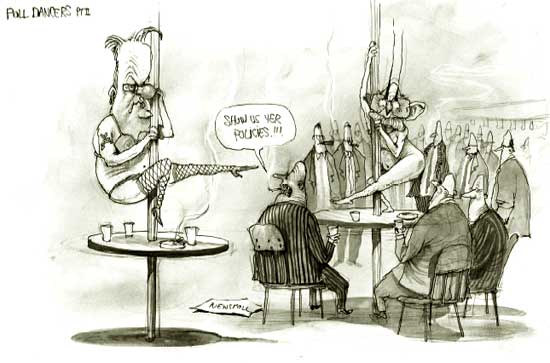
Rowe
I smiled. How true. The Howard Government doesn't have an national energy policy, apart from protecting the coal and aluminium industries at all costs. There was little in the recent Budget.
From what I have been able to gather McFarlane's Industry Department has been captured by the energy intensive industries. McFarlane cannot see beyond coal. They are in favour of an efficient and competitive national energy market, but they remain utterly opposed to renewable energy.
It is not providing effective policy leadership, does not have a game plan apart from protecting coal, and has little in the way of energy market reform.
Maybe the Howard Government is going to announce its national energy policy in the near future? At the moment it is not clear how its energies policies will satisfy the objectives of sustaining the environment and also maintaining economic growth.
Posted by Gary Sauer-Thompson at 08:12 PM | Comments (8) | TrackBack
June 01, 2004
Gotcha
It is good to see that the Australian Senate is doing its job of using estimates to keep the dissembling defence bureaucrats on their toes. Go the Senate.
The Defence Department statement that, "No Defence personnel were aware of the allegations of abuse or serious mistreatment [at Abu Ghraib prison] before the public report of the US investigation in January 2004", looks very shaky. It was an attempt to defuse the situation. Yet they knew since bureaucrats brief upwards. And they--the Defence Department and the military--- knew several months before that. But they sat quiet. Very quiet.
As human beings they cannot have agreed with what they were told about what was going on at Abu Ghraib prison. Were not the military in Iraq to defend human rights. By not coming clean they were complicit.
The body language of General Cosgrove, Chief of the Defence Force, was very uncomfortable on the television clip I saw on The 7.30 Report. Cosgrove made it clear that it was the Minister who was calling the shots on this. Is the Defence Department going to be the fallguy for the Howard government politicians again?
The politicians are saying they knew nothing, yet again. There is anxiety all round in the inner circles of government. Will Defence be able to keep the firewall up? Or will they crumble. Those in the PM's office must be having an real anxious time with Senate estimates. Those prison photos do not play well in the electorate.
The Defence boys are also uncomfortable because they now defending an intervention that is turning out to be quite different from what thought they were supposed to be doing. Have a look at Juan Cole's good essay on the Shi'ite insurgency in Irag. He concludes:
"In pursuing al-Sadr and the army of the Mahdi, the U.S. military has fought in close proximity to the most sacred shrines of Shiite Islam, desecrating holy cemeteries and destroying at least one historic mosque. This desecration, coming on top of the siege of Fallujah and the revelations of prison torture, has made the United States increasingly unpopular in the Shi'ite south, which before March had been relatively quiet. Whatever victory the United States finally achieves against al-Sadr will almost certainly be a Pyrrhic one. At best, the Americans and their allies will face an ongoing low-grade Shiite insurgency. At worst, they will be hated by a majority of the Shiites in the south and demands for an immediate U.S. withdrawal will proliferate."
It is difficult to see how the Americans can prevent the situation from becoming a national liberation struggle against a foreign occupying power. At the moment they appear to be doing everything to ensure that the situation becomes an insurgency against occupation, rather than a stable, independent, pluralistic Iraq.
What is not wanted by the US is an independent, Shi'ite dominated Iraq that would perhaps refuse permanent military bases to the US, but would still be friendly to the U.S, then fine.
Surely the US aim is not to keep Iraq subservient to the U.S? Make Iraq a weak state, that would follow U.S. orders on foreign policy, help the U.S. militarily, and leave oil under control of U.S. companies? Surely not?
So Defence must be increasingly uncomfortable with what is happening in Iraq as well with the horrors of the prison photos.
Ric Smith, the head of the Defence Department, faces another day of grilling at Senate estimates by Senator Faulkner. How long can Smith and Cosgrove hold the impossible line for a government in crisis?
Update
Defence knew. Around lunch time today the defence chiefs finally acknowledged that six Australian military officers were aware of serious abuse allegations at Abu Ghraib prison as early as October last year. And they would have briefed upwards.
Gotcha.
Don't you just love these rituals of accountability. More power to the Senate I say.
And the Howard Government politicians? Why, they knew nothing, of course. Defence neglected to inform them yet again.
More over at Backpages, at Southerly Buster and Road to Surfdom.
A question: So why did Defence sit quiet about the torture in Abu Ghraib? Because they were told to?
May 2
Miclelle Grattan has a good article on this in The Age. She says that it is clear that the timing of the grovelling retraction of Smith and Cosgrove was on political orders. But the tactical thinking behind the initial denial and the retraction was obscure. The result was to further discredit a pair already impaled on their swords.
May 3
Day 3 of the Senate questioning. Both the Foreign Affairs and Attorney-General's departments acknowledge that they also received copies of "situation reports" filed by Australians serving at coalition headquarters in Iraq. So they also knew what was happening in Abu Ghraib prison. They too stayed quiet.
May 6
Margo Kingston on the new system. She says:
"Here's how the new system works. A minister lies or misleads to score a point. His public servants do not advise him of the error. If the lie is discovered, the minister says he won't resign because his public service didn't tell him. The head of his department takes the rap and gets a gold star. Public servants down the pecking order quickly learn that unwelcome information is to be bottom-drawered."
That means the watchdog media can no longer just report what the ministers say as fact any more. Everything the ministers say must be reported as a claim unless they can state what their evidence is and have confirmed the facts with the public service.
Posted by Gary Sauer-Thompson at 09:42 AM | Comments (3) | TrackBack