« February 2005 | Main | April 2005 »
March 31, 2005
Garnaut on economic reform
I see that Ross Garnaut has an op.ed in The Australian entitled 'Cracking our Complacency.' It is an edited extract from his address to the Sustaining Prosperity: New Reform Opportunities for Australia Conference. Garnaut has been an important economic voice in economic governance in Australia, and he is more of an independent voice than many of our economists, who are content to recycle the dogmas of libertarian politics that provide good economic analysis. So we should listen to what he has to say.
What does good economic analysis look like? What does it offer us?
Garnaut says that for 14 years following the 1990-91 recession, Australia had experienced strong economic growth. Lately that growth has been built on a property boom fuelled by cheap money and cheap credit. Garnaut avoids the widespread Panglossian self-congratulation (the "miracle economy") to point to the signs over the last year of a slowdown on the side of supply capacity. He spells out the signs and interprets them as a deterioriation in economic growth:
The imbalance between growth in domestic demand and supply capacity is being reflected in shortages of labour, goods and services that threaten to re-ignite inflation. It is being reflected in extraordinarily high current account deficits and rapidly increasing net external liabilities as a share of gross domestic product, despite external circumstances that in the past have been associated with lower external deficits - exceptionally favourable export prices and terms of trade.
All this is restating what is known. But it needs restating as the current account deficit is not taken seriously. Garnaut then says that we need to ask the following questions:
What went wrong? What is the remedy? And what are the prospects if Australia takes corrective action?
Garnaut's diagnosis is that Australia has turned away from rational economic analysis and reverted to having popular politics in command of resource allocation and economic policy-making. Only the Reserve Bank stands strong against the re-embrace of the 'traditional approach to economic policy-making that favours the ad hoc and expedient over the economically rational.'
That is a good diagnosis. It gently highlights the way the Howard Government has been captured by economic interests. I can think of energy, agriculture, media, environment. If so, then what corrective action do the rational economists reckon is needed to turn this situation around? What does a professional economic analysis suggest has to be done to ensure ongoing development? What policy instruments do the econocrats reckon they need to ensure the smooth adjustment away from the current market disequlibrium?
Now we know the answer from the Australian Financial Review. Bold reform to restore strong economic growth is what is required. And the Howard Government now has the political power to establish its creditionals as a bold economic reformer.
Garnaut says that we need to retrieve what was done in the 1980s. Okay, so what does that mean today? For Garnaut it basically means tax and social security reform, squeezing excess demand through high interest rates and running budget surpluses. More specifically it means improving:
...the trade-off between generous provision for the disadvantaged and economic efficiency. To fail in this task will lead to continued economic underperformance as well as poor outcomes on employment and equitable distribution.....The most urgent task is to reduce considerably the effective marginal tax rates for social security recipients, the high levels of which contribute to relatively low labour force participation and high levels of part-time employment.I note that there is nothing in the address about reskilling those shifting from welfare to work. Does that mean Garnaut is pushing for a low wage economy? Does it mean that it's an old paper? Garnaut says that tax reform also means:
A reform of taxation rates that established a flat 30 per cent marginal effective tax rate for all corporate and personal income, including capital gains, would be most advantageous for people at the bottom of the income range, and most disadvantageous for Australians on the highest incomes and with the greatest wealth.Garnaut then justifies this as progressive. This reads like a defence for the Business Council of Australia position. On the need for higher interest rates Garnaut says that:
It is always difficult to judge how much fiscal and monetary tightening is required to bring excessive demand expansion back within prudent limits. But the extent of excess demand is so large that several more interest-rate rises may be required.He connects this monetary policy to fiscal policy thus:
Further to raise the requirement of monetary tightening through additional fiscal expansion at this time would increase the risk of recession. Recession would be damaging for long-term reform, long-term growth and equity. It is much better to save the growing budget surpluses until the growth in demand has fallen back below the growth in productive capacity. By then we will have a clearer view of the extent to which the recent improvements in the terms of trade can be expected to continue for a long period.So the economic reforms are linked to belt tightening. Tough times lie ahead.
Now I do not see the Howard government undertaking the welfare to work reforms by reducing the high marginal tax rates for social welfare recipients. Their reforms will be more coercive as they will aim to shift people off welfare, rather than help them to reskill so they can get jobs. And the flat 30% tax rate has been pushed to one side by the Treasuer. So that leaves belt tightening through monetary and fiscal policy. That means increases in interest rates, and big budget surpluses despite big flows of revenue into the government's coffers from the resources boom.
Posted by Gary Sauer-Thompson at 12:08 PM | Comments (0) | TrackBack
March 30, 2005
Cancer: treatment pathways
Our general medical health care system is faced with ever-increasing incidence of cancer. The standard treatment is based on expensive, radiation and/or toxic remedies having serious side-effects, and severely impairing the quality of life.
In the previous post on cancer I suggested that we should avoid the current situation of either orthodox biomedicine or alternative treatment. Rather than this mutually exclusive approach we need a middle pathway in which the rigorous approach of an evidence-based medicine is used to assesse and evaluate the different treatment pathways to see how effective they are, and what side effects they have.
I then added that this basic information should be publicly available. If there is a politics of cancer then it should focus on the public's rights to know about the different treatment pathways, the different treatments, their effectiveness and their negative effects.

My reason for this taking this position is that a number of so called alternative treatments are really complimentary ones. The psycho-social approaches, for instance, help patients deal with the stress of going from being a healthy person to cancer patient for the rest of their life. The need for stress management is now widely accepted because it compliments the bio-medical model's lack of nurturing and lack of care. The bio-medical model does not deal with the life of a person, since it deals only with the bodily system or the organ.
What is not readily accepted by the biomedical cancer institution is the use of dietary treatments including the use of vitamins, mineral and herbs to help the body recover from the toxic effects of conventional radiation and chemotherapy treatments. The usual reason given for the widespread no is that these treatments have the potential to pose a risk to the patients's physical well-being by interfering with the effectiveness of the drugs involved in conventional treatment.
The quick response is: 'well, what does the research on this say'? Shouldn't we looking for the best treatment package to ensure the patient's wellbeing?
We know the answer in Australia. There is no research being done. Why? Because there is no funding? Why is there no funding? At this point the excuses run out and the appeal to evidence-based medicine is quietly put to one side and an ethical principle is pulled out. It is said that we should avoid those treatments that harm the patient.
Well, what about treatments such as radiation and chemotherapy? Do not these harm the patient? Why do we not avoid those?
SO what is the solution? It is simple.
There ought to be a publicly funded national centre to:
# co-ordinate and enhance research as it relates the prevention, diagnosis and treatment of cancer, cancer-related symptons ad side-effects of conventional cancer treatment;
# help identify promising non-conventional treatments for further research
# explore non-conventional treatments in the context of evidence-based medicine.
Such institutes exist in the US. Why not Australia? Why is there not similar institutional mechanisms to fund research into complimentary treatments in Australia?
What does appears to be off the radar is immunotherapy as a treatment pathway that uses uses certain parts of the immune system to fight cancer. We understand that our immune system is effective in combating infectious diseases caused by such invading agents such as bacteria and viruses. So why cannot the body's immune system play a central role in protecting the body against cancer, in combating cancer that has already developed, and in slowing down the growth and spread of tumors?
Does not the immune system recognize and destroy even large quantities of established tumor? Can we not treat malignant diseases either with immune cells or immune-active agents that are genetically or chemically modified to optimize their cancer-fighting properties?
Posted by Gary Sauer-Thompson at 12:03 PM | Comments (0) | TrackBack
March 29, 2005
just a thought...
As it is a slow news day I have some space to play a little 'what if.' This kind of speculation is much loved by philosophers as it helps to concentrate the mind on the essential order of things. The 'what if' below has been gleaned from reading the US economic blogs, such as General Glut's Globblog and Brad Setser, over the Easter break.
I wonder if anyone in the Australian Treasury has given any thought to a future scenario in which the declining US dollar reduces the necessary dollar inflows needed to prop up the US trade deficit and finance the US consumption binge.
What if the dollar inflow dried up from East Asia? What if central banks, European or East Asian, started putting their reserves in (rising) euros instead of (declining) dollars? Is that beginning to happen?
What if the exporters of oil (Russia say) cease to price it in ever-devaluing dollars, and instead make some money by switching to the rising euro? Isn't that the economic rational thing to do in the long run? Isn't this already beginning to happen? Isn't East Asia already begining to shift to developing its own reserve basket?
If that gains some traction, would not that mean that the owners of dollars would cut their losses by selling off as many dollars as fast as they could? Would that not mean that other countries' central banks would switch their reserves out of dollars and away from Uncle Sam's no-longer-safe haven?
Would not that drive the dollar down even more, and reduce the dollar inflow to US from those East Asian countries running trade surpluses with the US? Does that not mean that the US dollar is no longer a safe haven? What happens if the United States lose its monopoly privilege of being the world's reserve currency?
I know it's only a what if. But it seems to me that the US is delicately balanced on a tightrope over an abyss and there is no safety net. However, this is no circus even though the Republicians run Washington.
Methinks, in the light of this 'what if,' that Australia's economic future lies with China and East Asia not with a heavily indebted US.
For those interested, you can find a debate in the econoblog of the Wall Sreet Journal Online and some background (left click on 'International Financial System', then on 'Is the US Current Account Sustainable',then right click on 'Will the Bretton Woods 2 Regime Unravel Soon? The Risk of a Hard Landing in 2005-2006'.)
Posted by Gary Sauer-Thompson at 01:54 PM | Comments (2) | TrackBack
March 28, 2005
living high on the hog?
From what I can gather the US Federal Reserve is worried about inflation in the US economy, and it has signalled that it could well quicken the pace of interest rates rises. That is what the Australian newspapers --eg., the Australian Financial Review---tell me.
Is this the beginning of the end of cheap money in a highly levered and dependent system? You don't enough information in the AFR these days to be able to make such a judgement.
Stephen Roach tells me a lot more. He says that we have a confluence of rising interest rates, a record current account deficit (6.3% of GDP), a disaster from General Motors (the demise of US manufacturing?) and another new high for oil prices ($56 a barrel with a declining dollar).
The significance of this? Roach says that the US is continuing to extend its imperial military reach at time when its economic power base is weakening. Of course Washington is not going to acknowledge this. It is much easier to point the finger at China. They are the ones upsetting the established order of things.
And there are other indications of economic weakness in the US.
The US is taking on external debt, not to invest in new export industries, but rather to fund its budget deficit. And as the East Asian financing of the US current deficit continues, low US interest rates allow US consumers to borrow against their rising home values to keep on living high on the hog. What's more, US consumers are withdrawing their mortgage equity in their homes to finance their taste in foreign consumer products and automobiles.
And this is the dynamic economy that Australia had, of necessity, to plug into in order to ensure continued economic growth?
Remember all that El Dorado rhetoric about the time of the signing of the FTA with the US? More wealth is better, the politicians said. The US economy will enable us to have a higher standard of living.
Now the economic story has had a new twist added. The so-called Liberal backbench tax ginger group says that we now need income tax cuts to reward us for our hard work and initiative.
The Liberal backbench ginger group, led by Mitch Fifield and Sophie Panopou are pushing to use the Senate majority to deliver a great big personal tax cut that would bring the top tax brackets of 42 and 47 per cent down to 30 per cent. That will cost $13 billion a year, and it would benefit everyone earning more than $63,000. They need more incentive for them to work harder.
Only some of the 'we' will be included, as this kind of tax cuts would give nothing to the four out of five taxpayers below that threshold. And some of the backbenchers are aiming to reduce the big $13 billion cost of the top end tax cut by making it more cost neutral.They are saying we need to reduce, or even eliminate, tax free threshold. Removing that threshold would save $9.6 billion, and people would rightly pay tax on every dollar they earned.
No need to worry though. We have a FTA with the US. So we too can max the credit card, withdraw the equity on the home to buy a new car, and cut some property deals. Money is cheap and plentiful. Preumably that means there is no need to worry about spending public money on fixing some of Australia's chronic social problems---mental health, Aboriginal health---- and investing in major infrastructure projects.
Posted by Gary Sauer-Thompson at 01:36 PM | Comments (0) | TrackBack
March 27, 2005
easter politics
Okay, so this Leunig cartoon is pretty quirky (Jesus as a Jewish nationalist resisting the Roman imperialists), but it is rather neat, don't you think?

But where is the national security state? The imperial Roman state of Caesar Augustus and Tiberus is invisible. The Romans occupied Palestine as an imperial power sometime before Christ----63 B.C. when the Roman army under Pompey took control of Judea. So why the absence of imperial political power in the cartoon?
Was not Israel feeling the weight of the oppressive Roman occupation? Did not the Jewish resistance to the Roman conquest and Roman occupation result in three wars between the Jews and Rome during 66-74, 115-117 and 132-135.
Were there not numerous messianic prophets appearing in Palestine during the first decades of the first century? Was not Judaism deeply concerned to prepare for the messianic liberation of Israel? Did not the Jews dream to be politically free of foreign occupation?
And the Jews? Where are the representatives of the nation, religion and state who collaborated with the Roman Governor and occupiers?
These are odd silences.
Posted by Gary Sauer-Thompson at 06:11 AM | Comments (0) | TrackBack
March 26, 2005
GST, federalism, state bashing
Doesn't this strike you as odd.
In the late 1990s the Howard Government praised the GST on the grounds that it gave financial autonomy to the states in our federation. This reform, it was said, saved federation, as it gave the states their own growth revenue base.It counter balanced the centralists giving the Commonwealth income tax powers in the 1940s. This fiscal dominance effectively crippled the state's financial autonomy. So the GST was a progressive tax in a federal sense.
Now the Howard Government is engaged in state bashing across a wide front (health, education & vocational training, infrastructure), and it openly desires to do away with the states.
A strange reversal isn't it. And it has happened so quickly---in five years. This grab for centralized power should make Australian conservatives very uneasy. However, I doubt that they will passionately protest on the streets. They are a wimpy lot. I reckon that they will pretend that they are all for responsible government British style and not federalism American style--and that have been all along.
So why repudiate federalism? What is going on? What is Howard up to?
Is it just party political politics arising from the Coalition being in power in Canberra and the ALP being in power in all the states and territories.
Is it a case, as Laura Tingle suggests in the Australian Financial Review, that the commonwealth and states need to bash each other to legitimate their activities, or their lack of action?
Is it a case of the old state righters being closet centralists. Or being reborn as fervent centralists?
Or is a case of the nationalists working to bolster and enhance national power to deal with the effects of globalization on the Commonwealth's power?
You can see that Howard & Co are chafing at the bit at coming up against the federal limits on the power of the Commonwealth. The States are not going along with the Commonwealth's centralizing push. So far federalism is working as it is continuing to provide checks and balances on political power.
Will the checks and balances of federalism hold under the impact of globalization?
I just wish that the ALP states would become a little more active in looking after Australian citizens, would loosen the death grip of their ideologically fixated Treasuries, and stop being negative when it is suggested the states ought move beyond the mere administation of the economic machine. The states are doing very little apart from producing media releases and plans.
Surely with the ALP being in power in the states, they will rethink their traditional assumptions about making the Commonwealth the over-riding body of government in Australia and then acting to reduce any impediment to Commonwealth power?
Can we expect those on the left to start rethinking their assumptions that the Commonwealth should be based on a UK-style of responsible government system. When will they start to question their taken-for granted beliefs that all power, money and authority is located in Canberra with the states being mere administrative units?
Posted by Gary Sauer-Thompson at 02:23 PM | Comments (5) | TrackBack
March 25, 2005
The politics of medicine in the US

Tough cartoon huh? It does capture the emotion of the commentary I've been reading today. The Republicans may lose the Terri Schiavo battle, but their values campaign (eg., abortion and gay marriage etc) against the Democrats is going well.
More here at Tapped.
Posted by Gary Sauer-Thompson at 04:16 PM | Comments (0) | TrackBack
March 24, 2005
the poverty of ethical thinking
I've been watching the reverberations in the media in Australia of the Terri Schiavo case in the US. In this tragic case, because the family has split on the decision to "pull the plug", the case has gone to court, where there is a well-established body of law on the subject. The Schiavo case has been litigated for seven years, with the verdict to pull the plug upheld at every level (including the U.S. Supreme Court, by refusing to hear arguments).
So what do we have now? The US Congress and the US President have intervened in the medical treatment of Terri Schiavo in Florida. They have kicked the case to a Federal judge after the state courts had all ruled in favor of the husband. But what on earth is the federal government doing intervening into a private family matter about painful personal decisions? Surely it is not intervening on behalf of, and defending, Terri Schiavo's Roman Catholicism?
The Florida state is also intervening big time. It has gone another round in taking on Florida's courts so as to gain custody of Terri Schiavo. Jeb Bush, the Florida Governor, has relied on a medical opinion by a neurologist from the Mayo Clinic, who had not examined the dying woman, but believed she was not in a vegetative state after watching a video.
We can only infer from this that Terri Schiavo has become a political pawn in a Republican Party values campaign. Is not the US all about keeping politics and state-endorsed religion out of the private lives of individuals?
So what is going on in Australia by way of commentary?
The less said about the op.ed. by Doug Bandow The Australian downloaded from the Cato Institute the better. That piece attacked the character of the husband.
I heard Bernadette Tobin, director of the Plunkett Centre for Ethics in Health Care at Sydney's St. Vincents Hospital and Rosanna Capolingua, Perth GP and chair of the Australian Medical Association's Ethics and Medico-Legal Committee on Radio National Breakfast on Wednesday morning and read Tom Noble's 'The Hardest Choice' in The Age on Wednesday. This was the better of the two commentaries, even though the photo implied that Terri Shiavio was a conscious person, even though she has irreversible brain damage from fifteen years ago.
I was suprised at the absence of philosophers in this issue in Australia. Ethical issues are involved in this case, including the value and purpose of life, the moral obligations among family members, the significance of personal autonomy, and what it is to be a person etc.
Instead we had doctors doing ethics and they doing public philosophy very badly. None of the presuppositions were addressed.
The two doctors who were presented as experts on Radio National were pushing a right-to-life position on an euthanasia issue. This presupposed Terri Shiavo was a conscious person who could respond to those around her.
I was struck by this dishonesty, as Terri's life as a person ended long ago, and she would have no awareness of suffering from the lack of food and water. I was also shocked by the ignorance of the American legal situation about the patient having a right for her medical treatment to be guided by the court's judgement of her wishes.They ignored the principle of autonomy!
My ears picked up on that. I started sniffing the wind for a campaign? The case was being presented as medical neglect and as euthanasia, with both being judged to be wrong. The "culture of life" language was being deployed to say that pulling the plug on human life was wrong ---akin to a death sentence. The two doctors implied that consciousness was still present in a patient after 15 years in a persistent vegetative state,(meaning she cannot think, emote or remember; and they dismissed the viewpoint and expertise of the American doctors who had examined Terri Shiavo.
It was falsely implied that Terri was a young woman who lives with a very serious disability. So why would Australian medical experts dismiss the judgement of American medical experts who had examined the patient? Politics surely. It is the right-to life crowd pushing their barrow.
The ABC just went along with the Catholic right-to-life push. Now why didn't that suprise me? Still there should have been some form of balance to counter the tacit claim that the left are a bunch of moral relativists who can't be trusted to do what's right.
Posted by Gary Sauer-Thompson at 08:44 PM | Comments (4) | TrackBack
easing mandatory detention?
Are we seeing the beginnings of a more compassionate approach to those asylum seekers who come to Australia's shores without authority? Though the vast majority of whom have been found to be refugees the tough policy of border protection remains firmly locked in.
But are there signs of changes in the treatment of those asylum seekers who are still detained? What of those rejected applicants awaiting removal who are in Australia's detention centres, but who have no realistic prospect of being sent to any other country?
Two events have opened up Australia's mandatory detention policy to questioning once the fears eased, and it was realized that the illegal flood of migrants into the country was not happening.
First, the Rau affair disclosed that an Australian citizen could be placed in effective solitary confinement because they suffered from mental incapacity. That is deemed to be wrong, and the harshness of the Department of Immigration treatment an Australian citizen as an illegal immigrant placed the Howard Government on the back foot.
Is it legal to lock up an Australian citizen in this way under the Migration Act?
Secondly, a 2004 High Court ruling found that stateless people can be locked up for the rest of their lives in mandatory detention. As Carmen Lawrence says the High Court ruled that this indefinite detention was lawful:
The Court determined that a stateless person, who has committed no offence against any law of Australia, and who has requested deportation following the failure of his application for refugee status, "could be detained here indefinitely, and if necessary for life, if no foreign country were willing to receive him".
That is seen to be untenable. Those who are stateless can be held indefinitely in detention centres under the laws Parliament passed. The finger can be pointed directly and squarely at Parliament on this issue. And because of executive dominance, it can be pointed at the Howard Government.
It is the Government who continues to keep them in maximum security without public scrutiny; who threatens them with deportation; who offers the stateless a choice between staying or going that ignores the possibility that the stateless may be genuinely terrified of retribution in their homeland.
So we have two pressure points building around mandatory detention. Hence the recent political shift that has taken place in the way the Australian state governs the stranger or alien as the Other.
The shift is that a bridging visa will now allow long-term, failed asylum seekers to live in the community, rather than detention centres, until the time is right for them to be deported to their country of origin. These are for detainees who have exhausted all legal avenues of appeal, but cannot be removed from Australia.
So why has the shift taken place in the tough line? Bill Leak has a suggestion:

Leak implies that the emotional template in the community is softening towards the detainees, now that the boats have stopped arriving. It was not from a concern for the protection of fundamental human rights in Australia, or from Australia's international treaty obligations.
The bridging visa is a small step. How about the next step being an amnesty for those refugees on temporary protection visas? What about Australia doing something about the 50 asylum seekers on the Pacific island of Nauru?And the 38 Vietnamese detained on Christmas Island for 20 months. These detainees are denied effective access to legal help.
Is not this indefinite detention also wrong?
Posted by Gary Sauer-Thompson at 02:20 PM | Comments (0) | TrackBack
March 23, 2005
Cancer Inquiry#3: some what ifs
I've been meaning to pick up on the previous posts on the newly formed Senate inquiry into cancer here and here. From what I understand submissions are currently being received by the Senate Community Affairs Committee. The first public submissions will be in Perth next week.
What I have noticed from reading some the public literature is how much the treatment of cancer operates within, and presupposes, the particular scientific paradigm of biomedicine. This relies on an essentially mechanical understanding of causation in which repairing a body is analogous to fixing a machine. Each disease has a specific cause that can be discovered by medical research.
This biomedical model or paradigm assumes that the cancer as the tumour is the disease; and not a sympton of a more systematic disease in the body.It holds that the tumour as disease starts locally, then slowly spreads through our body. Consequently, the treatment addresses the turmour by cutting it out (surgery); killing it or shrinking it (radiotherapy) or by poisoning it(chemotherapy). The aim is to eliminate the disease as tumour and achieve a cure.

The biomedical model provides a clearly articulated scientific framework for understanding the disease process and mechanisms of remedy, and it excels at treating infectious diseases and acute or traumatic injuries.
Mechanism (ie., the "body as machine" metaphor) and reductionism (ie., the reduction of illness to a set of physical symptoms) dominate biomedicine. Disease is seen as an outside invader that atacks a particular part of the body; treatment repels the invader. Thus, some cancers are known as "malignant" tumors; chemotherapy aims to "attack," "fight," or "beat" the cancer. The metaphor of fighting and wining the war on cancer justifies the toxic side effects of some of the treatments.
What if our health deteriorate to near death from the war? What if cancer is not just the tumour? What if cancer is a chronic, multifaceted illness having multiple causes amenable and multiple therapeutic interventions? What if we are not winning the war against cancer? What if the number of Australians getting cancer each year has risen over recent decades, while our ability to treat and cure most common cancers has remained virtually unchanged? Should we talking in terms of "cure" rather than recovery?
Should we not be moving treatment towards non-toxic drugs that can tell the difference between healthy cells and cancer cells and so avoid the situation of chemotherapy drugs destroying all cells? Why not starve the tumour but fed the body so that the body environment is less favorable for tumour growth? Why not have treatments that rebuild our body and its immune system?
An alternative model, a healing paradigm, understands the tumour to be a symptom of an underlying disease that causes the symptons. So the tumour symptoms spread throughout the most suspectible body tissue. This approach places an emphasis on boosting the body's immune system and on some aspects of psychotherapy because human beings are not just physiological mechanisms. We have social and emotional bodies that interact with the environment.
What is needed in this situation is not an either or: it is a rigorous approach of an evidence based medicine to assess and evaluate the different treatments, to see how effective they are and what side effects they have. That basic information should be publicly available. If there is a politics of cancer then it should focus on the public's rights to know.
Posted by Gary Sauer-Thompson at 03:58 PM | Comments (2) | TrackBack
March 22, 2005
none are so blind as ....
Alan Moran from The Institute of Public Affairs.
He has an op. ed. in the Australian Financial Review about how the national electricity market is working well in terms of the price mechanism ensuring the synchronisation of supply and demand. He says the problem we need to be aware of is government intervention and regulation. It is the standard free market economics that we have come to expect from the very economic rationalist IPA.
Now, we do need people (Platonists) to cut reality according to the utopian cloth of perfectly competitive markets (Forms) as they usefully remind us that a degraded reality in inferior to the purity of the ideal (understood in terms of mathematical entities).
Problems start when Moran unpacks what he means by government intervention and regulation. He says:
The green power measures introduced by some states and the commonwealth can also suppress incentives for efficient new [energy generation] plant, as can the environmental barriers put in the way of the most efficient new generators (those fuelled by coal) in NSW and Victoria.
One problem here is that 'efficiency' is the only value recognized or accepted by Moran. Yet the Australian liberal state also recognizes sustainability as a value and public policy goal. Moran seems to have forgotten the constant Canberra spin that Australia is on target to meet its obligations under Kyoto. In fact it is one of the few nation states to do so. Is that not is a recognition and acceptance that public policy is concerned with both efficiency and sustainability.
Seccondly, Moran does not understand the workings of markets. He justifies very high peak pricing in summer conditons as the market doing its job when demand exceeds supply. Solar power on household roof tops can easily perform this function, feed the excess power into the national grid, and provide the reserve power that is needed in SA. So green power measures are not barriers to the generation of energy.
Thirdly, the faith that reality can be cut at its joints by the utopian logic of perfectly competitive markets ignores the negative externalites. The efficient coal-fired power stations pollute the atmosphere with CO2 and other particles, thereby causing global warming and global dimming. The green power measures have been introduced to deal with the externality problem, which is a case of market failure.
We can give a bit of help to Moran here by reminding him of Plato's Syracuse option.
Posted by Gary Sauer-Thompson at 12:47 PM | Comments (0) | TrackBack
Israel: more settlement expansion
Though Israel intends to quit the 17 settlements in occupied Gaza Strip, Haaretz reports that Israel plans to build 3,500 new homes in the West Bank to cement its hold on Jerusalem. So the Sharon Israeli government, like the previous Israeli governments of both left and right, remains committed to, and continues to pursue a Greater Israel.
Contrast this with the paragraph below from the editorial in The Australia/Israel & Jewish Affairs Council's (AIJAC) Review about the end of the four-year conflict between Israel and the Palestinians written by Colin Rubenstein. It says:
Israeli Prime Minister Sharon's plan for unilateral disengagement from Gaza and part of the northern West Bank also factors into the equation. The withdrawal plan has demonstrated to Palestinians that Israel has viable alternatives to simply enduring terror or conceding all Palestinians demands. It also proves to Palestinians, the Arab world, and international mediators that Ariel Sharon is a leader who can deliver politically painful concessions on settlements and territorial compromise. But Palestinian terrorism remains the critical issue.
So the Review interprets the roadmap peace plan as calling for dismantling terror infrastructure as one of the first obligations on the Palestinian side.
Is not the continued expansion of Israeli settlements in the occupied territories a critical issue also? The Palestinians certainly think so. Should not Israel evacuate them? The Review is silent on that expanisonism.
What Rubenstein does highlight is the issue of the right of return of the Palestinian refugees to their homeland. He says that:
The most important [unresolved issue]is the legally baseless, but iconic, "right of return" for the descendants of Palestinian refugees from the 1948 war to Israel. Abbas has committed himself to the achievement of "right", but it is universally viewed in Israel as a formula to destroy the Jewish state through demographic means. Israel is not about to commit national suicide in order to accommodate Arab demands or Europe's instinct for appeasement. As long as the extremist Palestinians continue to dream of the day they will be able to either wipe Israel off the map, or demographically convert Israel into a second Palestinian state, no real peace will be achievable.
All the fault is on the Palestinian side. If the road ahead is long and strewn with obstacles, then it is the Palestinians who are putting the obstacles in the way of peace. No mention is ever made of Israeli settlement expansionism that prevents the viability of a Palestinian state.
Why the silence on the settlements in the occupied territories?
The Israeli Government's key problem is to hold on to effective control of the Occupied Territories by annexing as much of the land as it can without absorbing too many Palestinians. This would ensure a Greater Israel and a Jewish state. What then happens to Arab Jews in a Jewish state? Do Arab Jews have to choose between being Jews and being Arabs?
So we have the continuation of settlement-building in the West Bank, (118 settlements so far) which Israel will not be withdrawing from.
Can we infer that Colin Rubenstein takes a hard line on Palestinian demands and security issues, and supports the expansion of settlements?
Posted by Gary Sauer-Thompson at 08:51 AM | Comments (0) | TrackBack
March 21, 2005
redesigning the telco market
Allan Fels and Fred Brenchley have an op ed. in todays Australian Financial Review that addresses the issue of the regulation of the telecommunications market. This it is a benchmark article. They pose the issue directly, their diagnosis of what has gone wrong to date is sharp, and their cure is politically astute and reasonable.
Since this AFR op. ed. is not online, I will outline their argument. The issue is stated thus:
It's time to remove the blinkers on Australia's telecommunications industry. How long can we live with with the poverbial 800 pound gorilla dominating it? How long can we expect rural dwellers to go without modern-living essentials such as access to broadband?
Their judgement, like mine, is that T3 is probably the last opportunity to get the regulation of the telecommunications market right.
Their diagnosis states that the last 15 years of telecommunications has not delivered competition:
Today we have an industry in which Telstra has an estimated 89 per cent of directly connected lines, 81 per cent of local call revenue and 95 per cent of industry profits. Either the competitive model has failed or the supposed special regulation of Telstra by the Australian Competition and Consumer Commission has failed. Or both.
This gives us a distorted telecommunications market that stifles competition and innovation, and has inherent service failure built into it.
So why not push for the structural separation of Telstra? That would do away with the 800 pound gorilla dominating and distorting the market.
Fels and Brenchley say the only politically acceptable reform path is operational separation. The full structural of Telstra separation has been ruled out by John Howard's government. So:
The issue now will not be whether there should be operational separation, but how it is done and whether separate boards are involved .... This would allow Telstra [to] retain many of its integrated tentacles such as its half share of Foxtel.
They add that:
The solution to such continuing integration across markets is to give the ACCC divestment powers---or at least the threat to invoke such powers---in cases of extreme anti-competitive behaviour.
So getting it right minimally means an equitable playing field and an armed regulator. It is what consumers need.
Posted by Gary Sauer-Thompson at 01:28 PM | Comments (0) | TrackBack
the life and times of....
Tis a tabloid cartoon style that expresses Senator Ross Lightfoot's recent tabloid politics quite well:

The Senator's tabloid politics wears contradictions easily. Who cares about them? They are fictions are they not? Truth? Well, that is a matter of opinion, is it not? Lots more sensible comment over at DogfightAtBankstown, and Kick and Scream and Bartlett's Blog.
Woodside Petroleum for one cares. It would also be hard for those in the Liberal Party to have a good long laugh at the gun-totting Senator's acting out of a boys-own adventure fantasy in the dark world on the edges of western civilization.
The good Senator is one of those politicians who does not really understand Australian federalism. In his first speech in the Senate he says:
There are no practical limits to the legislature; it is ultimately all powerful, and should be so. Where constitutional limits as checks and balances do not evolve with the nation's aspirations, then referenda can be resorted to. Governments must not lose their nerve to the judiciary.
In his enthusiasms the sartorial Senator from WA seems to have forgotten about the little things, such as the rule of law, the limits placed on Parliament by the constitution, and the constitutional duty of the judiciary to uphold the Constitution. These little things suggest that in the last resort it is for the judiciary to determine the powers of the Parliament and of the executive.
In contrast, the honourable Senator from WA reckons that the foundation of our liberal political system is arbitrary political power. See why he is such an embarrrasment in the Senate?
Posted by Gary Sauer-Thompson at 11:19 AM | Comments (0) | TrackBack
March 20, 2005
shifts in the mediascape
I started reading Catharine Lumby's Gotcha: Life in a Tabloid World on the way back to Adelaide from Canberra on the Thursday shuttle service. The text feels dated--1980s--despite its easy style and its successful bridging of the academic/popular divide.
The text is basically a defence of the tabloid world and a criticism of the elitist views of the old liberal quality media who see themselves acting as watchdogs for democracy. Lumby highlights, and defends, the television-style tabloid rhetoric--emotion over abstract reasoning, images over discursive analysis, narrative over analysis, entertainment over information etc. Lumby displaces high culture in favour pop culture, and she celebrates the diversity of voices, forms, readers and ideas created by the tabloid media.
Fine. We now live in a postmodern world where tabloid is everywhere, the old modernist values are crumbling, populism drives the content of showbiz politics and we are all fans of celebrities. The text looks old fashioned because it underplays the way the media landscape is changing, as the underpinnings of the old media order weaken. Some indications:
#the big mainstream free-to-air media is losing its dominance, due to challenges from the new media technologies of cable TV and the Internet.
# weekly magazines such as The Bulletin are declining.
#the understanding of journalism is changing as its classic definition of objective, neutral reportage gives way to the partisan politics (rightwing) ideology (free market + one nation nationalism) of Murdoch's Fox News and Australian.
This shift in the mediascape is more than tabloid versus broadsheet, television versus print. A new mediascape is in formation. This is going to be deepened and broadened by the forthcoming changes in media ownership.
Update: 21/2
Les Carlyon has an op.ed. on journalism in The Age entitled, 'The write stuff'. He says:
The main troubles with journalism are sloppy writing and sloppy editing, advocacy masquerading as reporting, gossip masquerading as reporting, stories that abound in loose ends and cliches, stories that are half-right, stories that insult the reader's intelligence..In other words, most of the problems of journalism are our fault. They're matters of craft, not ethics.
Carlyon, a former editor of The Age, says that the problems of journalism come from the inside not from outside.
The op.ed makes no mention of the way that the changes from reportage journalism to political weapon journalism are being driven by the new kind of media and the partisan practices currently exemplified by Murdoch. Carlyon's op.ed. also looks dated.
Posted by Gary Sauer-Thompson at 07:31 AM | Comments (2) | TrackBack
March 19, 2005
anti-terrorism & the national security state
The national security state's preferred approach to anti-terror legislation is to detain foreign terror suspects without trial on the nod of the intelligence services.
The next step is accept the detention of citizens on similar grounds of needing to be tough on terrorism.

Thus Australian citizens suspected of involvement in terrorism would be placed under indefinite house arrest without trial, and without having been fully informed of all the details of the allegations against them.
That is the current situation in Britain.
The argument against this position is that such laws call into question the very existence of a fundamental democratic liberty---freedom from arbitrary arrest and detention.
Posted by Gary Sauer-Thompson at 01:20 PM | Comments (0) | TrackBack
March 18, 2005
the men from the government
The conservative account of student unionism conflates it with political activism, unbridled excesses and nefarious student goings-on.
The stereotypes employed are the partisan student activist more interested in the next election than the wellbeing of fellow students; and the battler studying part-time who has to pay for the services they do not use.
Well, there are other sterotypes:

It is difficult to accept the 'trust me I'm from the government' on this issue. They are about confrontation not compromise.
Seriously though. The men from the government cross their hearts and say they are market liberals who are in favour of negative (not positive) liberty. Yet they are imposing their solutions upon the universities, rather than letting the educational market sort out what student services are to be provided. They want it both ways.
See why we should not trust the men from the government? They are obsessed centralizers who have seduced by Leviathan.
Of course the men from the government will touch their hearts and say that their heavy hand and tough line was forced on them by their backbench, which is deeply opposed to a softly, softly compromise approach. We wuz was saddled with it they will say. What else can we do?
Posted by Gary Sauer-Thompson at 02:34 PM | Comments (0) | TrackBack
A crisis of legitimacy
I read the editorial in Thursdays Australian Financial Review yesterday, whilst having my morning coffee at Aussies in Parliament House. It was a bit of a suprise. The Howard Government's economic record and policies were placed under the micoscope. That is not new, as the AFR advocates a tough reform agenda.
What was new was the AFR's judgement that the Howard government was found wanting bigtime. My my. That is an indication that the political wind is now blowing from a different direction.
The editorial starts thus:
Who would have thought that just six months after the coalition's sweetest victory of all, the Howard Government would be facing questions over the directions of its reform agenda?
The issues are then listed:
Most of the problems the government is now wrestling with, or trying to duckshove the state's way, have been gestating for years. The government, and the rest of us, have had plently of warning about: the sorry mismatch of skills shortages and surplus unskilled labour; the moral hazard of a tax and welfare system that penalizes people for moving from welfare to work; the failure of telecom competition due to Telstra's bulked-up dominance; infrastructure shortages; and the lack of meaningful commonwealth-states co-operation in health, education and transport.
I would add a few of my own: the failure to shift the economy to an ecologically sustainable knowledge economy.
Then the AFR criticism begins. It says:
These are complicated, intractable problems requiring deep considerations and the courage to overturn lazy but popular institutions. But the government's allergy to anything resembling independent research has left it ill-equipped to tackle them....The Howard government much prefers to keep such work inhouse, the better to keep awkward conclusions to a minimum.This is then illustrated in relation to teleccommunications, Treasury, and the current skills shortages. Then we have this:
It may seem premature to be talking about a crisis of legitimacy so early in the government's fourth-term....[but]national government's must initiate action on national problems-- that is what they are there for. The Howard Government cannot go on forever resting on well-deserved laurels for past successes. It needs to do better now.It has been said politely.But it has been said. Decoded it says that the Howard government is now caught up in a crisis of legitimacy. That is a criticism with a sting in its tail.
The spotlight has shifted away from the turmoil within an ALP that has turned inwards, is fighting amongst itself and is crippled with despair. The light cast by the spotlight on the Howard Government is a harsh one that exposes the flaws.
Posted by Gary Sauer-Thompson at 12:58 PM | Comments (0) | TrackBack
March 17, 2005
tabloid politics
I've came across an article written by Piers Ackerman in the Sunday Telegraph (March 13, 2005, p. 9) on the Macquarie Fields riots in Sydney.I read it whilst having a glass of wine in Manuka, Canberra, after I flew in on the shuttle service from Adelaide.
Entitled 'We must never tolerate the mollycoddling of criminals' it is, as you would guess, a criticism of the kid-glove approach to the police to the Macquarie Fields riots, and the political authorities in the ACT to the Rebels bikie gang.
The piece is more than a loud beating of the law and order drum.Piers says:
History is littered with the wreckage created by those who have said it is better to appease evil than confront it. The graves of millions have been dug by smug handwringers who believe that good intentions will prevail but strength will alway fail.
Goodoh. I can follow that. Then we are off talking about Churchill and Hitler, Stalin, Arafat and so on. Huh? Oh, I see the tacit link. Those rioters in Macquarie Fields are the new brownshirts.Piers goes explicit:
The ignorant gang tossing molotov cocktails in the streets of Macqauarie Fields is not that different from the gangs that gathered in the beer halls of Munich to support Hitler.
Similarly with the Rebels bikie gang in Canberra. Why fascist rather than thug? An argument is not required. Emotion is what counts.
Ackerman then says that these fascists have to be confronted with force and the most severe penalties because there can be no excuses for those who choose to break the law. The fight will be tough. But it is a fight for freedom and the prize is worth it, etc etc. It's the Iraq line. One quickly gets the drift.
This, I take is an example of political sense-making in the tabloid world: what Catherine Lumby in Gotcha calls a visual montage of paragraphs and emotional outbursts within a fragmentary, contradictory and discontinous discourse.
I read it as entertainment. I had a good laugh over my chardonnay. It lightened my depression. People looked at me. 'It's Piers Ackerman', I said, and pointed to the newspaper. Everybody smiled.
Posted by Gary Sauer-Thompson at 02:16 PM | Comments (0) | TrackBack
where's the greens?
Brendan Nelson, the Education Minister, has proposed to ban compulsory unionism because of the conservative dislike of lefty student politics:

The voluntary union legislation was tabled yesterday in the House of Representatives. Why? The Senate knocked the legislation back in 1999, 2002 and 2003. Why not wait until after June 30th when the Government has control of the Senate?
Why stir things up with substantial fines for a university that charge a fee for any amenity, facility not of an academic nature?
Especially when a compromise was on the table: the monies raised by student union fees could not be used for political activities, but could be used for key services, such as childcare, health services, study skill programs and counselling services. This is where the bulk of money goes.
What is to be gained from the newspaper headlines?
Posted by Gary Sauer-Thompson at 11:33 AM | Comments (0) | TrackBack
March 16, 2005
Electricity: here we go again
There was another severe power blackout in South Australia on Monday, plunging nearly half the state into chaos and severing a key supply link to Victoria. The blackouts were due to a failure by NRG to fix equipment (generator protection devices) at its Northern Power Station at Port Augusta. The sudden loss of power from the system caused the Victorian interconnector to overload and shut down.
In SA demand for power is outstripping its network capacity and the state's ageing infrastructure will not cope with the higher loads. So it is likely that the infrastructure will fail at the critical times of peak summer demand. South Australia is in a difficult situation.
Firstly, electricity bills have gone up, not down. Householders are paying an average 25 per cent more for their power since Labor took office. A 2003 welfare report found 20 per cent of people asking for help did so primarily because of higher power costs. The report also found people were skipping meals, pawning possessions or showering only every second day because of the extra expense.
Secondly, SA has neither the base-load generating capacity, nor sufficiently robust transmission links through which to draw down excess capacity from the east-coast states, to meet its demand.
This event and situation highlights the growing problems in infrastructure investment and the national electricity grid. The state government is underinvesting in infrastructure: it is not even investing in new transmission infrastructure to enable the shift to power generatiuon from renewables.
The money is continuing to go to producing budget surpluses and repaying debt, even though a modern and efficient infrastructure is essential to productivity and economic growth. Failure to do this puts the brakes on economic growth.
Posted by Gary Sauer-Thompson at 08:07 AM | Comments (0) | TrackBack
March 15, 2005
After June 2005: co-operative federalism?
Nicolas Gruen over at Troppo Armadillo has a post on cooperative federalism. The post displaces the standard perspective of the consequences of the Howard Government controlling the Senate after June 2005. Instead it looks at what can (may?) be achieved from the opportunities opened up by the current alignment of ALP state governments. The post is a list of what people hope can be achieved in a federal polity based on the geographical version of the separation of powers.
Nicolas does not mention the historical irony of the reversal of the federal history of the 20th century: today it is the ALP defending the states in a federal polity whilst the conservative Howard Government are the centralists. For the next 6 years federalism is going to be the site of intense political conflict between friends and enemies; a site where the gears of our political machinery will continue to grind against one another--as they always have.
Cooperative federalism is usually associated with Bob Hawke's early 1990s conception of improving and streamlining the administrative machinery of government before the arch centralist Keating killed it off. This was later remodelled as COAG and competition policy by Prime Minister Keating, and it continues today under Prime Minister Howard. That reworking was the Commonwealth holding a competition gun to the head of the states. However, cooperative federalism was ably defended by Senator Robert Hill when he was the Federal Environment Minister.
The history of federalism, cooperative or otherwise, has been a history of continual intrusions by a central government in the affairs of the states. That intrusion has been legitimated by the High Court--that keystone of the federal arch. Simply put, the High Court failed to protect the states through the long centralist march. The GST just might give the states the financial lifeline they so desparately need to prevent them from becoming beggars on main street.
Today the ALP understands the new cooperative federalism as one in which the Commonwealth works with the States to get good outcomes for Australian citizens in areas like education and health. For Peter Beattie cooperative federalism means a partnership within Australia's system of government based on dividing roles within a subject area (concurrent federalism). For Bob Carr it means dividing responsibilities between levels of government by allocating discrete subject areas (coordinate federalism),eg., the comonwealth takes over health whilst the states retain teaching.
Co-operative federalism for the ALP is not an argument for States’ rights as it was for the conservatives throughout the 20th century. The Alp's understanding of co-operative federalism stands for an attempt to make the machinery of Federal system of government function more smoothly. Instead of subsidiarity it represents the future promise of the possibility of the states and the Commonwealth acting jointly in the national interest.
However, federal Labor is not in power in Canberra and probably will not be for 6 yers. Their enemies are in power. The new centralists are full of reformist zeal and they desire to roll back the props of the old welfare state institutions the ALP is still willing to defend. Greg Craven observes:
John Howard's new majority in the Senate will produce a Commonwealth Government with unparalleled confidence. The ambitions in the area of industrial relations, water, defamation law and education are likely to aggravate federal-state relations, leaving them like a brawl in a pub.
This is what I see as well.
An example. The Federal Treasurer, Peter Costello, is currently waving the centralist stick, without mentioning that he is going beyond the GST's intergovernmental agreement.
Will there be co-operation as well as a brawl? Honestly I see creeping centralism not cooperative federalism. But centralism is the neo-liberal agenda is it not?
Posted by Gary Sauer-Thompson at 06:02 PM | Comments (0) | TrackBack
Telstra: holding the line?
In Queensland they know all about the poor level of tele-communications service offered by Telstra:

In an op.ed in todays Australian Financial Review Barnaby Joyce, the National's Senator-elect for Queensland, writes that:
Only half of the Estens recommendations are in place...If curent regulations do not address the key concerns of the Nationals---parity of service, parity of price--and if there is no quip pro quo for regional Australia on the sale of a huge public asset other than a proposed reinvestment in the sharemarket, then the argument to sell Telstra is very unconvincing.
Though the Nationals are keenly aware of Telstra's market power, they will not succeed in gaining a full breakup of the telco as argued for by Barnaby Joyce. Will they succeed in cutting it down to size? Will they succeed in ensuring the the ACCC has enough fire power to prevent Telstra ridding roughshod over the market?
Will they succeed in directing a significant proportion of the $35 billion sale proceeds to infrastructure development beyond rural Queensland? Will they succeed in ensuring Telstra's rivals have access to its network at a reasonable price?
Will the Nationals be appeased without derailing the sale? Of course.
Update
What is of deep concern has been the failure to erode Telstra's market power. The Howard government has a deep resistance to decreasing Telstra's market power, makes attempts to strengthen that power so as to minimize the threat of competition, and is offering an easy regulation regime post-privatisation. So a privatised Telstra will be able to continue to use the control of its network to frustrate competitors.
What will the Nationals do about that?
Posted by Gary Sauer-Thompson at 01:44 PM | Comments (0) | TrackBack
March 14, 2005
strange economic thinking
The Howard Government has finally acknowledged that economic growth has slowed sharply since December. It couldn't do otherwise, given the public figures. However, it has also has acknowledged that the threats to the national economy are greater than anticipated: including thoe threat of destablisation caused by the adjustment of the US dollar, due to the US's budget and current account deficits. About time.
It made these acknowledgements in its economic assessment contained in its submission to the national safety net wage review. That acknowledgment is good to know, given this kind of future scenario.

Despite this acknowledgement of economic reality, the old "retro" economic thinking of the 1980s continues to be voiced from the Treasury benches. An example can be found in this report by John Garnaut in the Sydney Morning Herald. He reports Senator Minchin, the Finance Minister, as saying:
The Government should sell its Telstra shares to buy a portfolio of other income-earning investments....Government money should not be spent on infrastructure, despite several reports recently arguing that inadequate railways, ports, utilities and other facilities have hampered exports and are acting as a handbrake on the economy.
Instead of using the proceeds of Telstra to invest in infrastructure Senator Minchin proposed that much of the Government's estimated $30-35 billion from selling its half share in Telstra should be poured into its Future Fund---an investment vehicle to be controlled by private sector fund managers.
I find that proposal odd since it disconnects government from governing development, which is what national governments normally do.
Some questions: 'Who should invest in the nation-building infrastructure then?' Private industry? 'Did not the government (the states) do this kind of nation building in the past?' 'Why is this wrong for the commonwealth to do it now?' 'Does not building infrastructure add to the productive capacity of the economy and improve the long-run growth potential of the country?' 'Why should this be left to the market?'
Now, as we know, what is being rejected by Senator Minchin is a progressive (or social)liberalism that is committed to building the Australian nation and its resources; a liberalism with its conception of politics as a noble profession and a means for collective endeavour to further the common good. What Minchin is rejecting is the Menzies heritage of the Liberal Party.
However, Minchin's neo-liberal approach also represents a triumph of ideology over science. He does not regard his economics as a changing systematic theory in the pursuit of knowledge about how the economy works. His economics is assumed to be the right viewpoint from which to look at economic phenomena.
Posted by Gary Sauer-Thompson at 12:02 PM | Comments (2) | TrackBack
March 13, 2005
deconstructing the US foreign policy narrative
This is the easy bit:
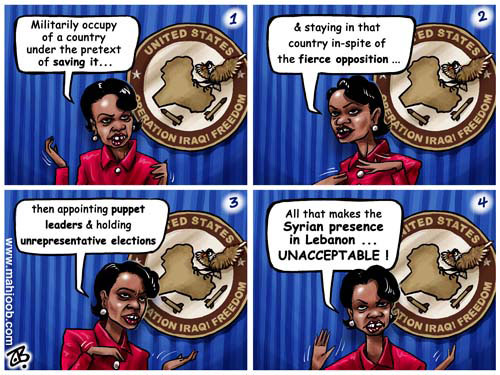
The irony is easily spotted. As Robert Fisk observes:
The irony is extraordinary: 140,000 American troops occupy Iraq--we shall leave the Israeli occupation forces in Palestinian lands out of this equation--while their President demands the withdrawal of 14,000 Syrian troops from Lebanon.
It is far more difficult to find some middle ground between the Lebanese opposition and Syria. How do you do that, if you are Lebanese?
Many in the Lebanese democratic opposition just want Syria out of their country. This was interpreted by Washington and Canberra am long the lines of the simple grand narrative constructed by the neocons.They held that the January 30 elections in Iraq were a overwhelming success and signified the march of democracy in the Middle East. The anti-Syrian demonstrations in Lebanon were then interpreted as a yearning for democracy inspired by the Iraqi elections.
But the anti-Syrian movement do not speak for Lebanon. Lebanon is still a deeply divided nation-state.
So which kind of democracy in Lebanon are we talking about?
Posted by Gary Sauer-Thompson at 10:56 AM | Comments (0) | TrackBack
meanwhile in London
In London the Tory opposition and the Labour Government are battling over who is going to go the furtherest in implementing Australia's asylum and immigration policy. This is going to be a central issue in the forthcoming general election since people are pouring into the UK from Eastern Europe, now that the Eastern European countries are a part of the Economic Union.

Meanawhile the fallout from the weakening human rights in the name of the war on terror continues.We have the moves to detain suspects without trial and the use of torture, or the practices of sexual humiliation and other abuses uncovered at US-run prisons for foreigners.
At the moment the Blair Government is battling to impose tough new anti-terror laws that severely restrict the right of suspected terrorists to move was rejected by the House of Lords. It appears that the remaining foreign terror suspects detained in Belmarsh prison and Broadmoor hospital without charge or trial since the 9/11 attacks may be released after spending up to more than three years in jail.
Posted by Gary Sauer-Thompson at 09:27 AM | Comments (0) | TrackBack
March 12, 2005
the winds of political change blow as...
With the Senate coming under the control of the Coalition after June, the jostling within the Liberal camp has begun.

The money is on Costello to succeed Howard with Downer, Abbott and Nelson angling for the Deputy Leader's position. This is now becoming the main game within the Coalition.
The conflict/battle over the economy has settled into firing shots from entrenched positions. These were dug in last week. Mark Davis in today's Australian Financial Review (p.22) describes the opposing positions in the economic warfare well.
The ALP is saying that:
...the good times fo the past decade are a result of Hawke and Keating government reforms. But the Coalition has failed to embark on a new round of reforms. The reform fatigue has led to skills shortages and infrastructure capacity constaints. These bottlenecks have produced a double whammy of slowing economic growth and rising interest rates which are hurting families.
Therefore the ALP is the only political party with good economic creditionals.
Really? We are going to see a lot of reform after June 30th. And what about the current account deficit and the need to build a knowledge economy? The silence on this means that the ALP's political arrows, which are being fired at the Coalition's citadel, are only designed for newspaper headlines, not for good economic policy.
And the Coalition's position? Costello's defence has three fronts.
[First] The labour shortages... are signs of the government's success in getting unemployment down to levels not seen in more than a gentration...[Secondly] only the government has the solutions for the current economic problem of demand outstripping supply..the governments plans to further deregulate the industrial relations system will relive the supply side constraints by lifting the economy's productivity and ensuring that labour shortages do not spill over into inflationary wage rises.
Not the Costello talk about the shortages of labour not the shortages of skilled labour or the need to invest in vocational and tertiary education to enable a knowledge economy.
Costello's third front is a diversionary one. Mark Davis says that Costello:
....has mounted a foray deep into his enemy's flank, accusing the state and territory Labor governments of squandering a multi-billion-dollar windafall of GST revenue and failing to invest in improving the nations's post and transport infrastructure.
Conveniently forgotten is the Commonwealth's failure to invest in education and infrastructure.
So what has been sidelined is the need to foster a "Silicon Valley"in Australian: to start a culture of real innovation and real value creation based around smart engineers, clever thinking, technology geeks, investors, R&D, innovation etc. Australia will continue to import technology and intellectual capital and pay for it by continuing to dig minerals out of the ground.
Posted by Gary Sauer-Thompson at 11:54 PM | Comments (0) | TrackBack
March 11, 2005
automatic markets
I see that we have a new line coming from Canberra about the skills shortages in the economy. The shortages are now a product of a strong economy and presumably low employment. So says the PM.
It is a temporary glitch in the automatic workings of the economic system. Things will be back to equilibrium as soon as the capacity constraints are cleared:

The new 'growth created the skill shortages' line absolves the federal government from any responsibility about Australia running out of skilled workers due to its failure to invest in education and training during the 1990s.
The new line implies a notion of automaticity within market processes. Things will come right at some future stage, because markets are all about equilibrium, and disequilibria is only a temporary blip.
Posted by Gary Sauer-Thompson at 01:31 PM | Comments (0) | TrackBack
March 10, 2005
the skills crisis
Everyone is now discussing the skills crisis, capacity constraints, the blockages to economic growth caused by the lack of a skilled workforce and the need to boost productivity. There is some very dubious reasoning on this issue.

Dyson
John Spierings has a good article in The Age today about the causes of the skills crisis. He says:
Since at least 1999, Australian governments, state and Commonwealth, have been aware of widespread shortages in key areas. Between 1993 and 2002 there was an overall 16 per cent decline in the training rate in the metals, building, construction, vehicle and electrical areas compared with the previous decade. This means that our national training effort has not been sufficient to replace and maintain the level of skilled workers in these vital sectors of the national economy.
This indicates that the cause of the current skills crisis is not the lack of ongoing micro-economic reform, as claimed by some government ministers. The cause is the cuts in both school spending during the early 1990s by both the Commonwealth and state governments, and in post school education in the latter 1990s by the Commonwealth.
The move by the cost cutters to reduce investment in vocational and university education was a bad one.
Spierings says that:
The lesson from successful OECD countries is to lift our commitment to all aspects of education and training - secondary, vocational and tertiary education - rather than playing one pathway off against another.
He adds that at a time when we have a shortage of skilled workers more than 78,000 school leavers were not in full-time learning or work six months after leaving school, of whom 40,000 had not completed year 12.
The link is obvious: educate our unskilled school leavers to become skilled workers. Does the Government know how to do this? I reckon a question mark can be kept there, given its track record in the New Apprenticeship Scheme that subsidises employers in areas where there are no skill shortages.
Posted by Gary Sauer-Thompson at 09:15 AM | Comments (0) | TrackBack
March 08, 2005
Media and critical thinking
This article in The Age suggests a poor understanding of how the media works by the Australian Broadcasting Authority. In upholding some of the claims of former communications minister Richard Alston's that the ABC was biased and "anti-American" in its Iraq coverage.
David Nolan comments:
Take the ABA report, for example. If one follows its logic, journalists should present information from press briefings, but should not question the motivations behind them."Spin", so central to modern warfare, can only be presented as information, even in a current affairs program - if, that is, it comes from our side.Presenters cannot, it appears, ask probing critical questions to elicit information and analysis from those "on the scene", whether guests or journalists. Rather they must ask them to simply describe what they see, without touching on critical issues at stake.
That implies that critical thinking is not a part of the media.It cannot critically comment on what others are saying.
Nolan draws this conclusion as well. He says:
Most disturbing, however, is what the ABA deems to be illegitimate journalism. Journalists cannot ask critical questions of reporters "on the ground", even if they reject what the interviewer proposes.As the ABC argues, this finding "has the potential to seriously undermine the role and practice of current affairs broadcasting". And, we might add, informed public debate.
Today critical thinking is suspect. Have you noticed the recent trend of attacking critical thinking and celebrating the prejudices and bigotry of commonsense.
That view bodes ill for our liberal democracy. Our democracy depends on the critical and enterprising journalism of a public broadcaster willing and able to make a major contribution to democracy.
Strange how very little is said about the mass marketing assault every 10 minutes on commercial free to air television and its mass deception.
Posted by Gary Sauer-Thompson at 06:41 PM | Comments (0) | TrackBack
March 07, 2005
economic wisdom as a fashion
As the pennies start to drop about the need for infrastructure investment in road, rail, water and energy, we have a 'blame the states' campaign being run from Canberra. The states now stand accused of squandering their GST revenue on recurrent rather than capital spending.

What is not being said is that the economic wisdom for the 10-15 years has been fiscal restraint---budget surpluses, paying off public debt. So public infrastructure was run down, and there is now a huge backlog of work that needs to be done.
You will not hear that argument stated, as the Costello campaign is designed to shift public attention away from yesterday's bad economic news of low economic growth and big current account deficits.
In this political campaign the neglectful Labor states are seen as a handbrake on economic growth and as strangling the private sector. So argue Tony Smith and Greg Hunt in an op.ed in the Australian Financial Review(p.55)
Today the economic wisdom is 'spend up big' on infrastructure. Reinvest in infrastructure big time is the new line.
Funny how the Commonwealth's hands are so clean on all of this. Have they been investing in infrastructure? Should they not have been investing in infrastructure as well?
Posted by Gary Sauer-Thompson at 07:44 PM | Comments (0) | TrackBack
March 06, 2005
welfare-to-work
There is a good article by Adele Horn in the Sydney Morning Herald on welfare-to work-reform. She makes several good points.
The first introduces the way that a punitive Victorian morality (Protestant ethic) has made a comeback in relation to welfare reform:
The system treats unemployed people as the undeserving poor, and pensioners as deserving poor, and pays them accordingly. And until that unfairness is addressed, there will be little incentive for disability pensioners to seriously test themselves in the job market, and no prospect of a major reduction in the disability pension rolls.
Anyone who thinks otherwise is a bleeding heart. Horne's second point rejects the harsh, punitive pathway that is publicly justified in the name of getting rid of the bludgers and rorters:
The answer is not to drive the pension to the level of the unemployment payment. It is not to make life more onerous for people with physical or mental problems who are willing to work but fear the poverty of Newstart. It is to tackle the disparity in rates and conditions, and end the divide between deserving and undeserving. It is not an easy task. But after all the advice, work and effort expended on welfare reform, it would be a pity if a government in control of the Senate took the easy way out, and simply changed the rules to push more and more people with disabilities and impairments and marginal employment prospects onto the onerous unfair unemployment benefit.
The better pathway is that suggested by the McClure Report, whose main recommendations:
..tackled ways to lessen the divide between pension and benefits: a single core benefit for working-age people with add-ons to support those with higher costs, including disabilities. Same rules, same concessions, same indexation. Later the Government put out the Building A Simpler System discussion paper in which it acknowledged the work disincentives of such a complex system with its different rates of pensions and benefits, income tests, free areas, and conditions, and floated a single working-age payment.
Now why do I think that the Howard Government is going to avoid this reform in favour of more mutual obligation designed to weed out the bludgers with bad backs?
Posted by Gary Sauer-Thompson at 07:46 AM | Comments (0) | TrackBack
March 05, 2005
Health care-American Style
The fear is that Australia's health system will become increasingly privatised and more like the American model:
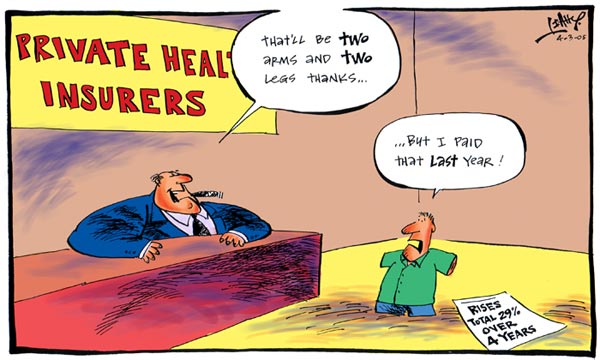
We are already on a pathway of creating cost inflation and greater inequity in health care. There is a lot of rhetoric to ensure that this pathway is made politically acceptable.
In Australia we have to subsidize the private health industry.It is a classic example of an industry that offers a poor product and depends on corporate welfare.
The justification? People do not appreciate what is offered unless they pay for it.So say the neo-liberal policy makers and politicians.
Of course, what is forgotten is that we citizens have already paid for a public health system through our taxes.
Posted by Gary Sauer-Thompson at 11:44 PM | Comments (1) | TrackBack
March 04, 2005
dubious economic reasoning
Laura Tingle in the Australian Financial Review has a good eye. She links a school leaver called Melanie, who is working as a casual waitress to earn money to pay for a uni course, with the bad economic news---a record current deficit, a declining economy and rising interest rates---that has surrounded Canberra like a fog.
Tingle asks a good question:
What does Melanie have to do with this week's main events?...Well, everything actually...Even the government concedes its sudden rush of bad news is all to do with skills shortages and bottlenecks. The Treasurer's answer to skills shortages? Radical industrial relations reform, apparently.
She then asks:
What does that mean? Cutting the minimium wage, he says, along with a range of still ill-defined "reforms" about a uniform industrial-relations system...But how does cutting the minimium wage help skills shortages?
It doesn't. We need dentists, allied health workers, plumbers etc not unskilled wage workers. As Tingle points out a lot of public money for training goes into subsidising unskilled laabor in restaurants.
So the Treasurer's economic reasoning is flawed. You have to watch this guy's reasoning as the rhetoric is disconnected from good arguments.
Now what about skilled labour? Well, next to nothing has been done by the Howard Government to address the skill shortages in the regions, even though jobs are available there. It adopts a short-term fix of turning on the immigration tap. It is turn on the immigration tap to dig more minerals out of the ground. Regional development is kissed goodbye because that involves the federal government intervening into the market.
Posted by Gary Sauer-Thompson at 01:46 PM | Comments (1) | TrackBack
March 03, 2005
the poverty of economics
Another economic post. This one looks at the economic profession who are accepted to be the expert commentators on this kind of event:

This may well have a big political fallout as Howard and Costello grapple with economic forces outside their control and go increasingly on the defensive.
How do the experts frame economic policy? What is in their frame and what is outside? We know that ecological sustainablity is outside the frame. We can look at the economist Alex Robson as he's written an op ed in The Australian.
Robson rightly says that despite Labor's best efforts, most voters won't suddenly conclude that the Coalition's key campaign themes were incorrect, that John Howard and the Coalition "lied" about interest rates. He then says Labor's recent policy statements and past actions have created the impression that it refuses to accept or does not understand four key points regarding economic policy.
These points are:
First, the only goal of monetary policy should be to maintain low inflation...Second, the focus on inflation should be accompanied by a commitment to refrain from political interference in, and micro-management of, the RBA board's decision-making processes...Third, the monetary policy framework should be supported by sound industrial relations policies. Heavy labour-market regulation tends to result in nominal wage rises in excess of productivity improvements...Finally, there should be a commitment to budget surpluses, reducing government debt and reducing the size of government as a proportion of overall activity.
Robson says that Labor's record gives the impression that it has performed poorly on all four policy fronts.
I'm not going to contest this charge in this post.
My concern here is with the way Robson frames economic policy. It is very narrow understanding. It is a neo-liberal one that is silent about infrastructure renewal, regulation to ensure competitive markets, a sustainable market, boosting research and development to build technological clusters, and reducing the trade deficit though more high tech exports.
Are not these issues the concern of economic policy? I would have thought so myself.
Posted by Gary Sauer-Thompson at 07:37 AM | Comments (4) | TrackBack
March 02, 2005
things are sliding, badly
It's all bad news. This week's balance of payments numbers were horrible, interest rates have risen by 0.25% with more on the way and the Australian economy is barely growing. And there is negative productivity growth.
Is that not policy failures on several fronts? So why is Peter Costello still given a tick as federal Treasurer when a cross is more appropriate? Are not the economic managers really saying that Australia is a successful economy because we borrowed a lot of money?

Australia does not have a booming economy anymore.
Costello is not looking good as an economic manager, and his justifications were thick and fast. Yesterday it was all the state govenments fault. Today the bad news of low economic growth is really good news.
Honestly, the strategic flaws are serious. As John Ducie in the AFR (the Chanticleer column) points out, in the last year Costello has
committed...[himself] to channelling $65 billion worth of budget surpluses over the next 5 years to boosting income and spending; and almost none to long-term reform or projects.
Costello has committed himself to little capital investment infrastructure renewal, or increasing productivity through knowledge and research and development rather than through creating more flexible labour markets.
That is a pretty devastating indictment. Now, whose responsibility is that?
Costello is diverting attention from this marked failure by deploying his 'blame the states' tactics. The states have been very slack---Costello is right about this. The states have also cried poor when the GST revenue has been rolling into their coffers, and they have continued their old 'blame the commonwealth 'game.
But Costello is evading the Commonwealth's own serious shortfalls. It has failed to face the problems of infrastructure developmentit is now going on about. Costello still talks about using the proceeeds of the T3 Telstra sale on repaying debt, and not on infrastructure development.
Costello's creditionals as an economic manager are tarnished indeed.
Posted by Gary Sauer-Thompson at 12:05 PM | Comments (0) | TrackBack
March 01, 2005
security v freedom
The Terrorism Prevention Bill is currently going through the British Parliament. Before being amended it granted ministers powers to detain suspects within the UK without judicial approval.


This is Tony Blair's justification for security overriding freedom. Blair said that the police and intelligence services were saying:
"You have got to give us powers in between mere surveillance of these people--there are several hundred of them in this country who we believe are engaged in plotting or trying to commit terrorist acts--- and being able, being sure enough of the proof, to prosecute them beyond reasonable doubt...And these will be restrictions on their liberty that we will use only in the most limited circumstances. But we genuinely believe that they are necessary in order to protect the country."Members of the Labor Party were prepared to cross the floor.
We don't, nor would we expect to see, that kind of rebellion within the ranks of the Howard Government. They would be more willing to sacrifice freedom for security. You can just hear them saying that security is the necessary justification for the breach of a fundamental principle that underpin our liberal democratic system--freedom from arbitrary detention.
Posted by Gary Sauer-Thompson at 11:05 PM | Comments (0) | TrackBack
The economy: plugging the gaps
The news today is that Australia has recorded its worst current account deficit on record. The current account deficit as a proportion of GDP rose to 6.5 per cent, and that means increasing foreign debt, which used to be a bad thing. This terrible external account comes at a time when the economy is slowing (meaning lower imports) and the terms of trade are very positive (meaning increased exports).
The Howard Government is not that concerned about this policy failure. It's line is the economy is strong, 'don't worry the resources boom will plug the deficit', and the proposed industrial relations reform will make the economy more competitive. It does not seem to matter that Australia remains a quarry rather than becomes a knowledge nation or becomes a banana republic.
The standard response from the Treasurer was that the states are to blame for the decline in manufactured exports. The commonwealth is not responsible for its lack of an industry policy. Does not this provide an opening for the ALP to place the federal Treasurer on the defensive with a full frontal attack?
And there is another policy failure. What has also been forgotten is that there are lots of vacant jobs and lots of people who are unemployed with the jobless not fitting the vacancies. As Tim Colebatch observes the unemployed, underemployed, or prematurely retired have relatively low skills and education levels, whilst we have have more jobs vacancies for skilled jobs.
So why not a national investment in eduction and training to plug the gap? Does not this investment increase our future ability to earn income? Are not real educational courses to equip workers with generic trade skills, literacy, numeracy and computer skills a better way to address the gap than the proposed welfare-to-work reform to get the disabled into the workforce?
Posted by Gary Sauer-Thompson at 04:32 PM | Comments (3) | TrackBack