« January 2008 | Main | March 2008 »
February 29, 2008
Rudd's 2020 Summit
Unlike William F. Buckley Australian conservatives are not known for their love of ideas, enthusiatically engaging with ideas or debating their opponents ideas. They are a practical lot with little tolerance for the intellectual life. Biffing is more their style not civility in political discourse or intellectual honesty.
They basically see Rudd's 2020 Summit as a talk feast in which a lot of wild and dangerous ideas will surface. It smells too much of participatory democracy and the mob, who have no place in the political governance of the nation state. Governance is the terrain for the political elites--- elected representatives and their deliberation in parliament in a liberal democracy. That place is the clearing house of ideas in the nation.
If there is a disengagement from democracy by citizens then so be it. If democracy is premised on the exercise of power by and for a demos, then democracy is procedural not substantive. Effectiveness of governance is what matters especially around the economy, wealth creation and national prosperity. No one wants to be a hostage to bad ideas, especially those from the political agenda of the cosmopolitan, social liberal Left.
This conservative's position is one in which policy is, and should be, shaped by powerful economic interests behind the scenes and not by any consideration of a wider public interest. On their account everyone in public life is self-interested, and dishonest about their real motives. So no-one is believed to advocate a course of action because it is right, but only because it will benefit them. Politics is an elaborate charade whereby private interests masquerade as the public interest.
The Howard Government's resistance to the need to respond to climate change in order to protect the intensive energy users is a classic example of this. These energy users and lobbyists wrote the Howard Government's greenhouse policy. The aim was to keep everyone else powerless and in a state of subjection, and to push the traditional democratic processes of deliberation and consent into the background as irrelevant and unnecessary.
Parliament is no longer the clearing house of ideas: the executive dominates parliament, what happens in parliament is increasingly stage managed, whilst the media has embraced infotainment with enthusiasm. So how do we enrich deliberative democracy? Is the 2020 Summit a step in this direction? If so, how?
Posted by Gary Sauer-Thompson at 4:41 PM | Comments (13) | TrackBack
health in the headlines
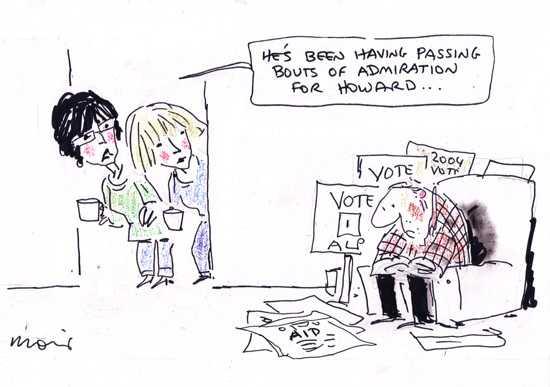
Whilst the health ministers meet to discuss the new healthcare agreements Morris Lemma, the Premier of NSW, says that people in NSW is trust their own experience over hysterical headlines. And their experience is of a health service system that is making real progress, a government that is listening to the people who gave the Lemma government a mandate to make changes, and that they can trust Lemma + Co to continue to focus on improving services for families.
Alan Moir
Others argue that we live in a culture of complaint and there is no finer terrain for indignation, loathing and strident sanctimony than the embattled field of health care, despite the fact we are living longer, better and easier, constantly benefiting from advances in surgical science.
The states want an extra $3 billion a year over the next five years to address what they say was a funding shortfall under the previous government.There is also disagreement over what conditions the Commonwealth might attach to any funding to drive reform.
George Jelinek addresses the issues behind the headlines in The Age. He says that for too long we have denied that there is anything wrong with the health system and that there is a need for an open acknowledgement that these problems exist.
Our complex health system is under enormous pressure and these failures happen at the fault lines. At the heart of the problem are the twin pressures generated by a decrease in capacity because of the progressive reduction in the number of inpatient beds in our hospitals, and the increase in demand caused by a pandemic of chronic illness because of unhealthy lifestyles.
So what can we do?
On the demand side, it is time we as a community addressed the growing problem of unhealthy lifestyles. Our reliance on medical care to undo problems once they have developed will be unsustainable as the projected increase in chronic conditions occurs. Our reliance on pharmaceuticals is proving enormously costly to our community and mostly they don't resolve the problems anyway. Prevention is our most effective weapon. Healthy eating, exercise and finding some balance in work and leisure will, in the long-term deliver better results. We need to increase funding for public health programs. We need to promote wellness as an important aim, not just absence of disease. On the capacity side, we have gone too far with rationalising hospital bed numbers. We urgently need more hospital beds, and soon. And we urgently need more alternatives to hospital care. Hospital in the home programs need support and we need many more aged care places.
Posted by Gary Sauer-Thompson at 6:36 AM | TrackBack
February 28, 2008
access
Last night's 7.30 Report discussed the problems of restricting access to the Underbelly series, currently banned in Victoria because there are trials pending. Naturally Victorians are very happy about being able to circumvent the ban via the internet. Writer and journalist John Sylvester points out that while journalists are prevented from naming names, the name in question gets 7,500 Google results and a whole Wikipedia entry.
Margaret Simons noted a similar situation when media bending Corey was facing charges and she wasn't allowed to mention his name, yet all of us internet types were wondering whether to call him Delaney or Worthington and his MySpace was roaring along.
The disappearing of Tim Dunlop's piece from his News Ltd blog all that time ago excited more interest at the time than the piece itself, which was probably read and commented on by more people than it otherwise would have, and despite the fact that it didn't say anything that hadn't already been said hundreds of times over.
The demise of Napster saw the emergence of Kazaa and naughty file sharing has proliferated regardless, just a bit more sophisticated than holding the old tape deck up to the radio speaker to make gritty, amateur compilation tapes.
Via Cam, Dans Data has the pathetically low uptake of the previous government's porn-blocking software offer, which turned out to be 1.2 percent of the target 2.5 million anticipated wholesome, porn-hating Australian households. The estimated cost of that adventure is cranky-making.
Is it just me, or is there a pattern emerging here? Is the boot of access and surveillance now on the other foot, or do The Authorities and us lumpenproles now have one boot each? If so, The Authority boot seems to have a few stones in its sock. Although the analogy's a problem given that the proles' foot seems to be streets ahead. Maybe the prole foot has amputated the Authorities' foot and made off with the body.
It's hard to imagine any solution that will restore the power distribution to its old shape. Would it even be possible to hold bloggers to the same legal requirements as journalists? What of commenters? Are they not also publishing in this textual environment?
What do you do when it's impossible to find a jury that doesn't know something possibly prejudicial to a case? What do you do with a nation that refuses to deny itself access, which is essentially what kiddie-safe filters and other contraptions are asking us to do? It's not about the porn or the copyright protected music and movies, or the Victorian underground or, astoundingly enough, Corey's innate fabulousness. It's about our newfound ability and perhaps expectation that we can access these things, whether we actually do or not.
Truth be told, it would probably turn out that most of us are not all that interested in the stuff we're not supposed to see. Until someone tells us we can't.
There's a small sense of getting away with something a bit naughty just watching the Sydney ABC news, in daylight savings free zone Qld, an hour earlier on pay TV, even if we already know what's going to be on because we read about it when it happened on the internet. I can only imagine the thrill of explaining to a jury selection panel that I'd already made up my mind having seen the documentary and learned the accused's mother's maiden name at Wikipedia and just by the way if you ever need advice on jury selection I know of this fantastic website. And did you know of the blog run by the bloke who lived next door to the accused for the past 5 years that's been documenting his movements all along? And one of the regular commenters there is a friend of the accused's wife's sister who says they're also running a porn site that gets around filtering software and selling pirated music and movies at eBay.
Posted by Lyn Calcutt at 5:39 PM | Comments (4) | TrackBack
US Presidential primaries: West Wing
An interesting look at the uncanny coincidences or similarities between the current Democratic Presidential race and that represented on the Aron Sorkin created West Wing (in Season Six). That series gives great depth to the political process of a presidential campaign in the US.
Mike Thompson's cartoon shows the difficulty that Clinton, trailing in the delegate count, is facing as the official candidate:
The decaying industrial towns of north-eastern Ohio form the backdrop for the final shootout.
A decade ago, General Motors was Ohio's largest employer, with well-paying unionised jobs. Today it is Wal-Mart, the union-busting retail chain.
Clinton needs to convince these voters that she can create jobs in these dying steel towns, protect people from a terrifying rise in home repossessions, and somehow make amends for the North American Free Trade Agreement (Nafta) signed into law by her husband in 1993.
It's a tough ask.
Posted by Gary Sauer-Thompson at 5:29 PM | Comments (5) | TrackBack
William F. Buckley RIP
William F Buckley, the father of modern American conservatism in the form of National Review, died today. Unlike the screeching conservatives clustered around The Australian Buckley was willing to engage in debating ideas, which he took seriously. Buckley treated his interlocutors with a courtesy and erudition that today's shrill, movement conservatives---in both Australia and America---lack.
Buckley's primary intellectual achievement was to fuse traditional American political conservatism with libertarianism, laying the groundwork for the modern American conservatism of U.S. President Ronald Reagan. The groundwork included being a leading proponent of the Vietnam War, being a vociferous Cold Warriors, and a vocal opponent of both the feminist and civil rights movements.
Unlike the Quadrant/IPA/CIS conservative cluster in Australia, Buckley explicitly distinguished the conservatism he founded from what it became under the Bush-led Republican Party. He opposed the war in Iraq and the neoconservative hubris around the war on terrorism.
Posted by Gary Sauer-Thompson at 4:28 PM | Comments (3) | TrackBack
Conservatives in cloud cuckoo land
What 's up with the Conservatives gathered around The Australian these days? They are still carrying on about the culture wars and doing so in a way that has little resemblance to the new political realities. Consider what Janet Albrechtson wrote in her latest op-ed:
The so-called progressive Left has given Prime Minister Kevin Rudd his riding instructions. Conveniently gathered in a single book entitled Dear Mr Rudd, Australia's leading left-wing voices offer a blueprint of what they expect from the Rudd Government. On climate change, the economy, human rights, the republic, water and so much more, each letter to Rudd is, according to the blurb, "passionate and imaginative". No doubt true....
That sums up the essential problem with many on the Left. Their desire for passion - read emotion - tends to unhinge their ability to reason. Brimming with passion and imagination, their prescriptions are often divorced from realistic, sensible outcomes. Perhaps that explains Rudd's gigantic talkfest in April. Giving them their own circus, perhaps, is Rudd's way of buying off the elites in the short term, allowing him to get down to real business of government.
The claim that the progressive left are all emotion and unhinged from reason ( they're just dumb romantics) bears no resemblance whatsoever to the work on managing water shortages in the Murray-Darling Basin by Mike Young and Jim McColl.
One explanation is that the Right desire to continue the culture wars. On their account Rudd's pre-election position is one where he lined up on the Right side of the culture wars and that Federal election represented some kind of culture war victory for the Right. This Howard-Lite interpretation leads them to argue, as Denis Shanahan does, that the ideas of the Left, which are an attempt to foist a radical and unrealistic agenda on an unwilling new Prime Minister, represent a death wish for Rudd Labor:
Like survivors from the carpet-bombing of the culture wars, a number of academics and commentators have emerged from the shelters and debris holding a wish-list of progressive thinking for the Labor Government. It is also a political death list....There are two barriers to the implementation of most of these grand ideas: they are political suicide and Rudd doesn’t agree with them. Even before the election, he made it clear he didn’t want the republic on the agenda; he didn’t want a constitutional preamble on indigenous Australia; he was reluctant on a charter of rights; and he was prepared to “turn back the boats’’ of refugees. This isn’t someone who was foxing about his conservative political and social nature. Labor people who voted for Rudd thinking he would be different to what he said were dreaming.
With Rudd Labor there has been ratification of the Kyoto Protocol, an apology to the Stolen Generations, the end of the Pacific Solution, the settlement of compensation for Cornelia Rau, clearing the way for Mohamed Haneef to return to Australia, relaxation of some of the more onerous restrictions on David Hicks, a pledge to bring combat troops home from Iraq, and the introduction of legislation to repeal Work Choices.
The Australian's editorial response to the 'Dear Mr Rudd' book assumes that the Federal election represented a culture war victory for the Right. It says that:
The uncomfortable truth for such [Leftist] intellectuals is that Mr Rudd owes them nothing. Anyone who has seen the internal Labor Party polling on the election results, as The Australian has, knows that he owes his victory to Howard's battlers and the self-employed tradesmen, particularly in the outer suburbs of Brisbane and the provincial Queensland and NSW coastal towns, people whose middle-Australian values are despised by the academic Left. Both groups supported Mr Howard's social conservatism but responded strongly to Mr Rudd's siren song about food and petrol price rises. They also responded strongly to the unions' anti-Work Choices campaign and became disaffected with the Coalition's welfare-to-work policies, which forced one million people, principally single mums, back into the workplace.
Funny, I though that the academic left intellectuals, whom The Australian terms 'political fringe dwellers with utopian prescriptions' supported the anti-Workchoices campaign, opposed the welfare-to work policies as well as being in favour of the ‘root and branch’ reform of the health system for clinical and not fiscal or political imperatives.
Posted by Gary Sauer-Thompson at 6:13 AM | Comments (8) | TrackBack
February 27, 2008
rain, water plans, Murray-Darling Basin
It hit me when I flew into a lush and green Brisbane on Monday. The heavy coastal rains that have fallen on eastern Australia have fallen outside the Murray-Darling Basin catchment. Though there has been some rain in the catchment, it is not enough to alleviate the chronic water shortages. Climate change needs to shift to the top of the agenda for managing the Murray-Darling Basin.
Since the future is one of significantly less water, and a drying of the southern rivers, the old issue of the over allocation of water entitlements--especially in NSW--- remains to be addressed. A new regime is needed.
Howard's old water plan for the Murray-Darling Basin was biased to assisting irrigators to improve the efficiency of existing irrigation infrastructure, whilst the buying back of water entitlements was more or less an afterthought that was never acted upon. That irrigator friendly plan, based on unfettered irrigation, was all about protecting the regional power base of the Nationals in Victoria and NSW.
The emphasis needs to be reversed. The buy-back process must be the core of any water plan. It must target the dairy farmers in the Goulbourn and Murray River catchments and give the environment an equally secure share of the water.
So it is good to see that Mike Young, the water economist, advocating that the 10-year Howard plan to hand out nearly $6 billion to irrigators for efficiency improvements should be scrapped. He proposes that $5 billion of this would be spent during the first term of the Rudd Government to compensate the 15,500 irrigators in the basin for the permanent restructuring, and in most cases cutting of their permanent water entitlements. About $1 billion would be spent on efficiency upgrades but only after the reallocation of water to deliver equal property rights to irrigators, the environment and all other direct and indirect users of water in the system.
Posted by Gary Sauer-Thompson at 8:08 AM | Comments (6) | TrackBack
February 26, 2008
digitally depraved
Two tenuously related issues have generated some interesting comment over the past couple of days.
The Federal Government is apparently thinking about introducing an R rating for video games. At the moment anything designated anywhere above an MA rating is banned. Not very effectively though - you might as well try stopping weather from entering the country.
Some of the comments point out that your average gamer is over 18 and that playing games hasn't generated an irresistable urge to "rump robots from playing Sonic Hedgehog" or "beat people up and decapitate them from playing Mortal Kombat".
This is going to be an ongoing problem for arguments like the one the Australian Family Association offers - that gaming can "change people's brain structures" or that society will generally slide into a chaos of depravity and violence if people are allowed to play interactive games which involve activities other than sipping tea and munching Iced VoVos with the kidlets.
As Steven in comments points out, it's already easier and more convenient to access games and anything else you might want online than from offline, ban-observing shops. So introducing an R rating amounts to not much more than officially letting people do what they're already doing.
The other issue generating some heated comment is adolescent boys accessing pornography on the internet. Not girls, just boys. The author uses some fairly emotive language in the article, suggesting that todays 16-17 year old boys' consumption of internet porn could render them unable to recognise women as fellow human beings.
"Will mass porn consuming countries like Australia become uninhabitable for women and girls?"
I guess that depends on your understanding of mass porn consumption, and your estimation of Australian women and girls. Nevertheless...
It's reasonable to expect men to take exception to the suggestion that exposure to pornography will turn them all into raging testosterone slaves, and they did take exception. You'd also expect some to express concern at the endless waves of gin-soaked godlessness currently drowning our society, which some did. Predictably enough, others backed the claim that pornography, rape and murder go hand in hand.
All of this is the standard response to porn, violence and horror, which is no help at all on the issue of access. I'm no expert, but violence, pornography, horror and 'adult themes' generally have been facts of life since long before the digital age. Solutions like bans and filters are, and will be, as effective as they've ever been. Which is to say, minimally, if at all. They're the same old response adapted for a new medium.
Surely we've reached a point in history, and a point of maturity, when we're capable of undertanding that:
a) a few people do bad things to other people regardless, but may or may not be encouraged by violent, pornographic or horrific material:
b) a lot more people than a) enjoy violent, pornographic or horrific material but are not moved to imitate what they consume on other people in real life, and;
c) the continuation of our largely unremarkable society with it continuous accompaniment of violent, pornographic and horrific material, previously assisted along the way by technologies from the printing press to the internet, suggests that a) continue to be the tiny minority, even if b) might becoming the norm.
Many of the current debates have the medium mixed up the the message. Game consoles can be used to play Scrable, Gran Turismo, Mortal Combat, Simon and Garfunkel cd's or The Sound of Music either audio or video. While it's true that porn sites are only one click away from anything else on the internet, porn, violence and horror are only a Drama or Comedy section away at your local video store. They're a click away from the Australian Family Association website as well.
There doesn't seem to be much point urging legislation against the world we live in, when it's not all that different from the one we've always managed to negotiate, since evil was thought to periodically block out the sun and some naked tart bearing promiscuous fruit had us all kicked out of paradise. Various prohibitions have demonstrably failed, if not encouraged consumption probably via another basic urge in the form of curiosity.
But more salient than at any other time in human history, your average Joe or Josephine has more capacity in a democratic society to access whatever they want and arguably more motivation to queer attempts to stop them than would-be stoppers could possibly anticipate. Maybe the contested ground has shifted from porn/horror/violence as such to the ground of access, which is ground not currently being won by The Authorities whoever they may be.
While I agree wholeheartedly that we need to keep trying to understand the relationships between exposure and real life enactment of yucky stuff, it seems ridiculous to keep insisting that the only answer to our problems is restricting access. Particularly at a time when the young and therefore, according to conventional wisdom, most vulnerable, are among those most likely to circumvent restictions just for the hell of it. Do we know how many of those 16-17 year old boys check out porn sites just because they can, as opposed to because they're planning a future career as serial killers or curiosity about sex? Do we know how many of those gamers who play Mortal Kombat have gone on to decapitate people, as opposed to people who've never heard of the game but decapitate people anyway? Decapitation does seem to have a much longer history than Mortal Kombat. And rape certainly has a much longer history than internet porn.
As far as really gross stuff is concerned, like snuff and kiddie porn, would we not be better off leaving it there as a policing resource for tracking both producers and regular consumers? I'd rather see a dozen producers of that kind of thing brought to justice than any number of horny teenagers or bored 20-somethings punished for being pretty average. We seem to have confused both the medium and the message, as well as the average and the extreme.
Posted by Lyn Calcutt at 5:31 PM | Comments (4) | TrackBack
health reform
Nicola Roxon, the federal Heath Minister, says the Commonwealth will not follow through with a two-year deadline to take over state hospitals across Australia if genuine reform can be delivered through negotiation.
We don't have any intention to take over the hospital system if we can get that sort of reform by negotiations with the states. Of course, the states want more money into the system and, of course, that is something we are prepared to consider. But we are not prepared to consider it as a blank cheque
Roxon warned that hospital funding is a “two way street”and that the new reform commission announced yesterday to develop long-term solutions to health funding was designed to end the blame game between the states. It was also designed to provide a blueprint for a health and hospital system capable of dealing with the challenges of the 21st century.
The Rudd Government has knocked back a recent move by the states--led by the NSW-- for more no-strings attached heath funding
Posted by Gary Sauer-Thompson at 10:13 AM | Comments (4) | TrackBack
February 25, 2008
The BCA speaks
So the Business Council is calling for substantial budget cuts--- the Government must reduce expenditure by $31 billion over the next three years to match the government’s promised $31 billion in tax cuts.This requires taking an axe to welfare, slash the public service jobs, cutting back on health expenditure and reducing defence spending. It calls for government spending to be targeted at education, infrastructure skills and workforce participation and for wage restraint to fight inflation.
How about reduced subsidies to business? Why isn't business spending on education, both vocational and university? Why does business attack the welfare state and public health ---crowding out expenditure its called--- yet call for government to spend much more on vocational education? Doesn't a workforce need to be g healthy to work? Why is the BCA calling for a reduction in the corporate tax rate? Why the exemption of wage restraint for executives in corporate Australia?
Corporate Australia primarily concerned about corporate Australia is it not? At least the BCA is willing to fire a few shots at the Howard Government for its failure to use the cash from the resources boom to invest in the future to enhance future productivity and underpin longer term social and economic prosperity.
Posted by Gary Sauer-Thompson at 5:51 AM | Comments (2) | TrackBack
February 24, 2008
coal industry's future
In the Sunday Age Jason Koutsoukis makes the following judgement:
....no matter how much spin the Liberals put on last week's poll results, the numbers are brutally honest. Brendan Nelson's leadership is finished before it has really begun.....The tumbril is ready and Nelson will doubtless be carted off to the guillotine when those jockeying to succeed him see fit.The question is, who will be next on the list?
Matt Golding
If these are the bad days of opposition, then what of Australia and global warming? They are bad days for the coal industry, despite all the hype about technology coming to the rescue in the form of pumping carbon dioxide underground. The coal sector is in peril until carbon capture is a commercial reality.
At least Garnaut had the sense not to advise that emissive intensive firms should not be given free emission permits when Australia's Emissions Trading Scheme is introduced in 2010:
"There is no tradition in Australia for compensating [businesses] for losses associated with economic reforms of general application [for example, general tariff reductions, floating of the currency or introduction of the goods and services tax] ... the business community has been aware of the risks of carbon pricing for many years."
This implies selling all the permits, rather than just some of them and giving the rest away free to selected businesses.
Posted by Gary Sauer-Thompson at 9:16 AM | Comments (6) | TrackBack
February 23, 2008
Festival time in "solar city" Adelaide
'Tis festival season time in "solar city" Adelaide. Whilst Kevin Foley, the Treasurer in the Rann Government, was lambasting the critics of his government's vision for the future as being a bunch of bloody whingers, Adelaide was hosting the Solar Cities Congress last week. Along with the Council for the Australian Federation followed by the Clipsal 500 and Fringe Then we have the Adelaide Festival of Arts.
The claim is that South Australia is fast emerging as the Australian leader in renewable energy. With 1.6 million people – or less than eight per cent of Australia’s population overall – South Australia today has almost half of our nation’s wind power and grid-connected solar energy. There is little evidence of this on the ground in terms of energy efficiency, solar power, rolling back cars, making the city more people friendly and providing green shade from the summer heart.
The Rann Government in South Australia is mostly about symbolism re Adelaide being a solar city.
The talks given by the keynote speakers are not online at the Solar City Congress website. So we ciitzens cannot pick up, sift and debate the ideas presented at the Congress. How then do the citizens have a public discussion about Adelaide can become a solar city in reality?
Posted by Gary Sauer-Thompson at 10:50 AM | Comments (1) | TrackBack
Ross Garnaut on climate change
Ross Garnaut issued an interim report on Thursday on his climate change review. This suggested that Australia should cut its greenhouse emissions by 70-90% by 2050, rather than the Rudd Government's 60% and it begins the debate about cutting emissions.
Tandberg
The reaction was as I'd expected. The Rudd Government confirms the 60% target to protect the Australian economy; whilst the energy industry is wanting subsidies (compensation) for its old coal-fired power generators that will stranded with the shift to renewable energy sources, and it is warning of an increase in the cost of electricity by 50%.
Behind the public face the corporate coal/energy industry is probably fighting to prevent mandatory cuts to greenhouse gases, advocating the expanded use of coal, pushing for more coal-fired power stations to be built and running a fear campaign about climate change making it too expensive to cool our homes, power our lives and run our cars.
Posted by Gary Sauer-Thompson at 8:13 AM | Comments (9) | TrackBack
February 22, 2008
universities + the 'education revolution'
Does the Rudd Government's rhetoric of "education revolution" include the universities? If so, what does it mean? Do we have a picture of this? Does it involve a rejection of the one size fits all model, in favour of increased diversity in terms of function and performance? Does it mean a substantially increased public investment in the higher education system?
Presumably, it does mean that the old ritual stand-off between the universities and Canberra under the Howard regime has gone. Under that regime the universities were a political problem to be controlled, not a site for economic, social and cultural investment in an information society. Hence the wedge politics, underfunding of the universities and a lack of concern about domestic student participation. The education says no more.
What next? Australian universities are not world class. Should they be? Will they be? How many? How will that be achieved? Through takeovers? Or amalgamations? Should the elite universities merge? Can Australia sustain 40 stand alone higher eduction institutions?
What we know is that Rudd Labor sees continually improving education and research as the key to increased productivity and long-term prosperity. Unlike the Coalition, Rudd Labor realizes that Australia cannot live on highly favourable commodity prices from the China boom forever. Like the other OECD nation-states the goal is for Australia to become a leading knowledge economy.
Simon Marginson says that the Rudd education revolution is rhetorical because in the first instance it is about changing attitudes:
...Howard left the private cost of university at unprecedented levels. Community demand is flat. Only when there is stronger public support can the Government invest in education and research at internationally competitive levels. After all, the community has to pay for this investment through taxation.The other crucial constituency yet to come fully on-side is federal Treasury, which has yet to buy the mainstream OECD knowledge economy argument. Some still see universities as a cost, not an investment.
These are the political constraints on the Government.Then there are economic constraints of needing to cut public expenditure to squeeze excess demand so as to ease inflationary pressure.
Posted by Gary Sauer-Thompson at 5:55 AM | Comments (1) | TrackBack
February 21, 2008
dennis the peaceful
It seems fair to say that one of the best ways to attract bloggers' attention is to say something about them in mainstream media, preferably The Australian. Even better, say something inflammatory about one of the better known ones.
If you were looking for notoriety though, you'd pick one that was both well known and well respected. And you'd do it in a blog format in plain, accessible language so everyone could participate in the riot you'd started.
It's not as if he could pretend he didn't anticipate the result. This sort of thing does wonders for what used to be called circulation figures. William Bowe's not doing too badly out of it either, except he won't be selling advertising on the basis of hit counts.
Kim over at LP sees this and Janet (Planet) Albrechtson's recent venom spits in the context of the recently declared peace. Australia is now being treated to a new order of civility in public debate, and this is apparently how it's going to work.
Civility aside (obviously), if they were starting to feel a bit irrelevant, successfully baiting the very people who'd been seeing them that would would be a pretty sure-fire plan, would it not? Assuming of course, that they do plan. Another way would have been to engage with bloggers, maybe even on their own turf, instead of hiding behind the Great Wall of Murdoch. But public debate in media is about selling advertising first and last. Debate is incidental.
A few of them have ventured into independent comments threads under their own names, but that's still rare. So what passes for public debate is still conducted largely in controlled space where there's no real opportunity for public participation. Public debate remains a misnomer.
Still, it's tremendous fun, as a lot of largely pointless things are. And I suppose that if stirring up the blogosphere is the only way they can maintain their relevance, more power to them. Compassion requires some sympathy for them, within limits. And besides, making fun of Brendan Nelson was getting a bit boring.
Posted by Lyn Calcutt at 1:48 PM | Comments (4) | TrackBack
bloc by bloc
There are some odd goings on in the upcoming Gold Coast City Council election, although it would be really, really unusual if there weren't.
Back in May 2006 a Crime and Misconduct Commission inquiry found that group of councillors who won seats in the 2004 election misled voters when they ran as independents. They'd met at a resort in 2003 to form a pro-business bloc within council and of course developers flocked to fund their campaigns. Very naughty. Pro-business actually means pro-development around here, where development is of the mindless frontier variety.
This year we have two blocs officially running as such. Rob Molhoek heads up a group of independents calling themselves UniteGC with the slogan 'Locals to lead our city'. Whatever else they have in common is anyone's guess, but a lot of people are under the impression it's religion.
The other bloc is running as a Liberal team led by Tom Tate, mayoral candidate and owner of the resort which hosted the naughty 2003 meeting. Tate says he was there but didn't go along with the plan. It would be his Brian Burke if anyone cared. A genuine independent who doorknocked my house a couple of weeks ago said I'd be shocked at the number of people who think John Howard is still running the country. At that rate Tate's got nothing to worry about.
A letter to the editor in the local paper worries that the Tate team "don't even live here" and are "asking people to vote for the Liberal ticket so that they can rebuild the Liberal Party in Queensland". Not a bad way to go about it. The conservative Gold Coast should be easy pickings.
Another one argues that they'd be more concerned with party unity and state level politics than the needs of their own divisions, and that being up against Federal and State Labor is not in the Gold Coast's best interests. But then, neither is the current arrangement where an assortment of sworn enemies spend most of their time scheming to uncover one another's corruption.
Meanwhile, the current Mayor Ron Clarke has unsuccessfully been trying to get the State Water Commissioner to lift water restrictions here before the overflowing dam washes the whole place away. But assuming the rain lets up and we all survive, it would be an easy and cheap, if long term, way for the Liberal Party to knock itself back into shape. One suburb at a time.
Posted by Lyn Calcutt at 8:35 AM | TrackBack
governing inflation
So inflation is going to be above the Reserve Bank's band until 2009/10, by which time the recession in the US will have had a negative impact on the Australian economy. And the next two interest rate rises will only counteract the tax cuts. In a two speed economy the interest rate increases will have little impact on the boom states of WA and Queensland, but they will impact on NSW and Victoria, especially western Sydney.
Alan Moir
Senior Rudd Government ministers say they are very concerned by any proposal that would lead to election promises not being kept. Labor insiders want to avoid an electoral backlash if they do not deliver on their election promises. That means no support for the idea of completely scrapping the tax cuts - and turning them into retirement savings or superannuation. So any attempt to squeeze demand to bring it into line with supply is going to have to come from the cuts to the federal budget.
The talk in Questrion Time is that the Rudd Government is going to be tough on slashing the budget but the programmes that have been cut is tinkering around the edges of the Howard Government's excess--the regional rorts and less funding for Canberra. Rory Roberton on the ABC's 7.30 Report says:
I think you need much bigger spending cuts than are in prospect to have any major effect on the outlook for rates. I think the Reserve Bank would be impressed maybe with something of the order of $10 or $15 billion, one and 1.5 per cent of GDP. But I am not sure that's what's been flagged and some of the things that have been flagged are things that won't actually dampen inflationary pressure much at all. Cutting back on embassies offshore and cutting back spending on military equipment, that's not exactly going to dampen the pressures that the Reserve Bank sees pretty well across the board.
And Chris Richardson conforms this.He acknowledges that the Rudd Government has inherited a lot of extra spending in the Howard administration in its last handful of years and a lot of it is middle class welfare. But to get the $10 billion a year or even the $15 billion a year, is a very difficult thing to do.
... the maths certainly point to a major problem, we have existing inflation pressures and still chances are that demand will grow faster than supply in Australia. The net of an extra $25 billion over the coming year. Now, if that's the problem if you like, if that's the addition to the inflationary stresses we face, each interest rate rise of a quarter point out of the Reserve Bank is only taking about $3 billion away from a $25 billion problem and that's what the Government's up against. It's giving up $7 billion of tax cuts on 1 July. In a sense, it's handing us on the one hand pressures on the Reserve that add up to two interest rate increases. The question is what they can deliver on the spending savings to take that back out again.
Posted by Gary Sauer-Thompson at 3:43 AM | TrackBack
February 20, 2008
water flows in the Murray-Darling Basin
As I suspected the flood waters coursing down some of Australia's big inland river systems in the upper Murray Darling Basin have identified old cross-border feud between Queensland and NSW as most of the water is staying in Queensland.
The cotton irrigators in the St George irrigation area in south west Queensland have taken much of the water that's flowed down the rivers from the St George weir since late last year. Queensland Government figures show that little more than 25 per cent of the water finally made it across the border. But landholders in New South Wales claim it's closer to 17 per cent.
The problem is that the flood water belongs to everyone in the Murray Darling Basin and doesn't belong to favoured few cotton irrigators in one state. The water needs to be managed for the future of the Basin. How can that be done with much reduced water flows in the Basin, due to global warming?
We have the $10 billion plan to save the important Murray-Darling system in place. So what now? Peter Cullen says:
We've got the framework for a plan that will take us forward but there are still some critical decisions. We've got to work out how much water can we take from the rivers and still have a healthy river. Governments have been committing to do that since the 1984 reforms but haven't really done it yet. Then we've got to work out how we share that water between the competing users. All the farmers would like to have access to it, cities are now wanting to delve into it. So whilst we have the framework in the new bill and a commitment to develop a Murray-Darling Basin plan, we've got a fair bit of detail still to work through.
However, priority of the Howard $10 billion plan---- most of the money was to go to cutting back water wastage with more infrastructure--- needs to be changed. The bullet needs to be bitten:
We've got a situation where the inflow into the Murray are perhaps dropped about 40 per cent over the last decade and that really means, I think we've got to reduce the entitlements and I don't think we've been getting very far over the last decade by incremental improvement in the system and I think it's now time to accept the reality that we are in a dryer climate in the Murray-Darling basin and reduce the entitlements appropriately probably by 40, 50 per cent and compensate people who we are taking licences away from. So I would give that a priority for the money.
Reducing the water allocations by up to 50 per cent, that would dramatically change the farming landscape in the basin.
Posted by Gary Sauer-Thompson at 6:04 AM | Comments (3) | TrackBack
US Presidential Primaries: Wisconsin
Voting takes place in the primary in snow covered Wisconsin today, with the emphasis of Obama and Clinton on the issues that John Edwards had made his own: the effect of the economic downturn on middle-class families and the working poor.
Wisconsin Democratic primary voters are not big fans of globalization judging by the exit polls. A majority (7 in 10) hold that U.S. trade with other countries takes more jobs from Wisconsin whilst a minority (fewer than one in five) said it creates more jobs for the state.
Mike Thompson
Will Wisconsin make the difference on the road to the White House by confirming Obama's front runner status? Will Clinton manage to minimize the losses? Will Clinton hopes to regain momentum be realized? Or will the race still go down to the convention? What role will the super-delegates play?
Obama's presidential campaign is having a very good run lately; they've taken victories in the last eight Democratic contests, they're getting super-delegates to defect from Hillary Clinton, and they are getting endorsements from major labor unions. Wisconsin's open primary rules are expected to play in Obama's favor because he has been courting independents and even disaffected Republicans. The polls say Barack Obama is the likely winner, though they don't show him that far ahead.
Paul Krugman worries about the backlash against Obama. When will his bubble burst? McCain is already launching daily and fairly harsh attacks on Obama.
Posted by Gary Sauer-Thompson at 6:04 AM | Comments (5) | TrackBack
February 19, 2008
in one day
It's been an extraordinary day following Howard's End last night.
The poll we contemplated over breakfast this morning, conducted following the apology, was dreadful news for the Liberals and anyone still tinkering with the notion that Nelson is even remotely viable. The poor sod has the honour of being the first leader since Newspoll started to score a single digit of support. As Possum eloquently observed, it's partly indicative of the difficulties anyone leading the opposition will have to overcome.
Nelson had better hope that this Preferred Prime Minister rating has a lot of short term feedback caused from the Stolen Generation apology he made on behalf of the Opposition in Parliament, for if it is actually representative in large part of what is playing out on the ground with these twin Coalition support bases - the problem may not be Nelsons alone, but could simply be a sign of things to come for any opposition member that takes on the Leadership position.
The twin support bases being the silver spoon set and Howard's battlers.
Then shortly after lunch poor Julie Bishop was wheeled out to announce that the Coalition is backing Labor on AWAs. They'll keep niggling about extending interim agreements, but it must be killing The Rump (thanks Nan) to have to back down on the centrepiece policy of Howard's political life. One can only surmise that Bishop is being punished for something, or that Nelson doesn't understand that he had an opportunity to improve his single digit rating if he'd spun the back down properly. Someone ought to tell him that a fabulous hairdo does not a fabulous politician make.
For afternoon tea Chris Evans shared his concerns about ministerial discretion on immigration issues, observing that it's inappropriate for one human being to have the power to decide the fate of another. It inevitably results in stuff ups of the Cornelia Rau and Haneef kind, which tend to upset people previously under the impression that the rule of law trumps in this country.
For nibbles during the day we had Kevin Andrews spending $130,000 on news clippings following the Haneef debacle, and Liberal Senator Concetta Fierravanti-Wells alerting us to the unthinkable possibility that the new PMs pets could be fouling the lawns at the Lodge. Perhaps Kevin Andrews could be put in charge of the lawn problem. All that newspaper should be put to some good use now that he doesn't have to worry about monitoring the response to the abuse of ministerial discretion while he was in charge of immigration.
It would be an understatement to say the opposition hasn't been faring well. In a few months Labor has managed to undermine most of what fed Howardism, but Howardism still informs the worldview of The Rump, which is still the centre of gravity on that side of politics. There's an important distinction between Howard's personal support and Howardism which The Rump seem yet to understand - you won't get support for Howardism without Howard. Simple.
Meanwhile, the more they focus on Swan's knowledge of arcane economic notions, the more time Rudd has to whittle away at what remains of Howardism and their own battler support base. Perhaps their best option would be to install Andrew Bolt as leader and go for broke until Turnbull's had downward vernacular elocution lessons.
Posted by Lyn Calcutt at 3:54 PM | Comments (8) | TrackBack
conservatives rewrite history
It is interesting to watch the conservatives--politicians and media---trying to find their feet in the new political order to ensure their political credibility. How many changes in their position are they going to make? How much dogma will they retain? How much adjustment will need to be made? How much of the conservative Howard legacy will be retained? How many will just man the barricades and hurl thunderbolts like Andrew Bolt? How many will rediscover, and make the shift to liberalism?
The dispirited Liberal Party politicians are struggling to find their feet in parliament as economic modernists and they have embraced the confessional mode as a way to break with the Howard heritage. Outside Parliament, one way tactic being deployed is to rewrite the history of the last decade.The Australian is doing contortions on this with its call for It's time to restore civility to the national discourse. The Australian says that it now embraces the open society, civic debate and fostering democracy through enlightened public discourse. It is the leftists who are unreasonable, spit and engage in terror as they dance on Howard's grave.
You can see the rewriting in Gerald Henderson's op-ed in todays Sydney Morning Herald, where he writes:
The likes of Rundle and Faine seem to believe that, following Howard's defeat, the conservatives have been routed in the culture wars and that reparations are now due. In fact, the culture wars were very much an invention of the left intelligentsia which was concerned that, finally in Australia, its hegemony was being challenged.
Henderson then gives the game away with on his cultural wars tribunal run by the left when he says that if Howard was waging a culture war against the ABC, he suffered a significant defeat: the organisation is effectively run by much the same types as was the case in March 1996 when Keating was defeated. Oh dear. Henderson cannot stay on message.
Some rewriting of history is needed if only to realize that many on the right are not liberals, in the sense that their conservatism has meant adopting illiberal positions, and that there is a big gap between The Liberal Party and the liberalism of free markets, open society, lower taxes, individual responsibility, and small government despite all the rhetoric of economic growth. The Liberal Party embraced statism, whilst the authority of the state was the touchstone, not the free market or the open society.
However, it is likely that libertarianism and its Nanny State rhetoric will continue remain a minor current, faction, or strand, within the Conservative Liberal Party despite the efforts of the IPA. And their confusions about the contradictory mix of classical liberalism, social conservatism, and neo-conservatism mix will continue to dog them.
Maybe they will follow Jennifer Marohasy and the IPA and cover up the contradictions with a reworking of their old chestnut of environmentalism being the religion of urban atheists who are anti-development and anti-industry. Others, such as John Roskam cover over the contradictions by saying say that only political science aficionados care about the precise definition of "liberal" and "conservative".
Posted by Gary Sauer-Thompson at 6:40 AM | Comments (6) | TrackBack
February 18, 2008
at Howard's end
Is the Liberal narrative in the Four Corners Howard's End programme a rewriting of Liberal Party history? All these hairy chested minsters are saying that they realized they were doomed, and that they reckoned Howard should have gone around 1996. But then they confess they couldn't do anything about changing the captain of the Liberal ship, so they quietly went down with the ship Stoics one and all. A question of loyalty you understand.
Howard wasn't ready to go and these Ministers didn't think that it was right for them to tell Howard to go, let alone force him out. Of course, they realized that Howard had to go. Change was needed as they had been their too long. But they did nothing. They couldn't do anything on their account. Few could even bring themselves to raise the issue; or even had the access to speak to Howard in person. He was the emperor, and they mere courtiers in the sun king's realm.
None had the courage to challenge Howard on crucial issues like Kyoto or Workchoices. The emperor ruled with an iron fist. In fact they are now confessing on public television----on ABC--- that they really knew nothing about these issues in terms of the negatives or the suffering they caused.
Really? Who is kidding who here? That they were so caught up in the sun king's regal bubble that they had no idea what was happening in the country or the rest of the world? That all the negatives swirling around their court was the hallucinations, paranoia and delusions of the barbaric left?
Saying it all on Four Corners is meant to signify that the confession is to be taken in the serious mode and not as a comedy routine.
Posted by Gary Sauer-Thompson at 8:05 PM | Comments (14) | TrackBack
fighting terrorists in Afghanistan
According to the new Defence MInister Australians are fighting the Taliban in Afghanistan to prevent it from becoming a failed state. If it becomes a failed state then western civilization collapses as the terrorists will take it over and we will all be doomed. Hamid Karzai, the Afghan president, has rejected suggestions that his country was in danger of becoming a failed state.
All that Australia asks, says Joel Fitzgibbon, is that NATO shares its war planning and intelligence with Australia, and that Australia is at the table when makes its decisions to take up the fight against the Taliban enemy. Australia is not even a member of NATO.
Disagreements over Nato's mission in Afghanistan are intensifying as the US and the UK criticise some countries( Germany, Italy and Spain) for not providing troops prepared to "fight and die" against the Taliban. Australia is also calling for France and Germany to deploy more troops in southern Afghanistan and to take the fight up to a resurgent Taliban.
Steve Bell
What is not being questioned by the ALP is the conservative's 9/11 mentality of waging an apocalyptic War of Civilization against the Uniquely Evil Enemy. The grand narrative is one of Right wing warriors defending Western Civilization from the greatest threat it has ever faced; there has never, ever been a war like the one they are waging; and none of the old rules apply. Fitzgibbon's call for more resolve feeds into, and is structured by this grand narrative.
There should be a questioning of this narrative should be, as the conservative mentality within the grand narrative is an expression of what Richard Hofstadter described as the paranoid style in his 1964 Harper's essay,The Paranoid Style in American Politics:
The paranoid spokesman sees the fate of conspiracy in apocalyptic terms -- he traffics in the birth and death of whole worlds, whole political orders, whole systems of human values. He is always manning the barricades of civilization. He constantly lives at a turning point.
Shouldn't this paranoid style with its eternal orange alerts be replaced with more strategic accounts of Australia's national interest. Instead of accepting delusions shouldn't we be asking, how is Australia's national interest actually threatened by the Taliban in Afghanistan? In what way is it threatened? What sort of threat is this?
Posted by Gary Sauer-Thompson at 6:35 AM | Comments (5) | TrackBack
February 17, 2008
Saunders on capitalism and happiness
Peter Saunders in the CIS latest issue of their Policy magazine continues his debate with Clive Hamilton on capitalism and happiness. He says in his Why capitalism is good for the soul that Hamilton's argument that capitalism is bad for the soul, which is:
aimed mainly at a disaffected intellectual middle class, is that we have become preoccupied with the pursuit of wealth and are increasingly unhappy and unfulfilled as a result of our materialistic lifestyles. Clive believes we have broken our ‘magical relationship with the natural environment,’ and that the pursuit of money is getting in the way of our ability to reconnect with our ‘true selves.’
Saunders reckons otherwise-- capitalism is good for the soul, by which he means that it enhances our capacity to live a good life.
He notes the disaffected intellectuals have consistently attacked capitalism in modernity for its failure to meet human needs. Since that claim is unfounded, according to Saunders, we need to ask what is it about capitalism that so upsets the intellectuals.
Saunders answers thus:
But the best explanation for the intellectuals’ distaste for capitalism was offered by Friedrich Hayek in The Fatal Conceit... Hayek understood that capitalism offends intellectual pride, while socialism flatters it. Humans like to believe they can design better systems than those that tradition or evolution have bequeathed. We distrust evolved systems, like markets, which seem to work without intelligent direction according to laws and dynamics that no one fully understands.
Nobody planned the global capitalist system, nobody runs it, and nobody really comprehends it. This particularly offends intellectuals, for capitalism renders them redundant. It gets on perfectly well without them. It does not need them to make it run, to coordinate it, or to redesign it. The intellectual critics of capitalism believe they know what is good for us, but millions of people interacting in the marketplace keep rebuffing them. This, ultimately, is why they believe capitalism is ‘bad for the soul’: it fulfils human needs without first seeking their moral approval.Saunders conceit, along with Hayek's is that capitalism is natural--- it is a system that tradition or evolution have bequeathed; an evolved system, which seem to work without intelligent direction according to laws and dynamics that no one fully understands.
Really? Neo-liberal governments seem to me to spend a lot of time, energy and money creating markets--in education, energy, water, aviation etc. Capitalism bears the mark of human design.
Posted by Gary Sauer-Thompson at 6:03 PM | Comments (8) | TrackBack
February 16, 2008
money markets' bubbles
Remember David Coe and the Allco Finance Group?
They are the private equity crowd that almost took over Qantas a year ago. It was Coe and his financial engineers who spearheaded that $11 billion takeover bid. Remember the plan? It was to take Qantas private, load it up with debt, and everybody would win. The magic pudding. The financial wizard's plan, based around borrowing heavily to invest in assets that increased in value that allowed them to borrow more to invest in more assets, foundered on share holder resistance.
Now Coe's in trouble from the credit crunch. He is desperately trying to offload assets from his multi-billion financial empire ahead of several debt headlines to keep the banks happy and allow the shares of Allco to resume trading. They were seen to have borrowed to much money and were carrying a lot of debt with the financial crisis in the US last year arising from the sub-prime and liquidity crisis.
I do not comprehend the complicated corporate financial structures and network constructed by the financial wizards, or the way they developed these complicated financial structures to take advantage of loopholes in American and European tax laws. But I know that Allco is rapidly running out of options. to address its short term cash flow issues that leave it short of cash for funding commitments, including the acquisition of a portfolio of 29 North American power generators from US energy giant ConEdison. Allco is looking for a buyer to take on the cash and debt commitments.
I do know that the global financial system's financial bubble, which was based on more and more loans with a high risk of default, has burst. Credit continues to contract, debt deflation is happening in the US, there are lots of loses from the bursting of the US housing bubble and the recession in the US has begun.
Posted by Gary Sauer-Thompson at 10:38 PM | Comments (4) | TrackBack
February 15, 2008
more sorry business
It must be horrible being Andrew Bolt at the moment. Or any of the other members of the media who had so much invested in Howardism.
After a decade of feeding off their prefered political configuration, then assuring themselves that Rudd was a Howard clone, Rudd ruins everything by being the same bloke who wrote those esssays in The Monthly. If only they'd paid more attention back then. They must be utterly, utterly miserable.
So it's nice to see some sympathy from the Left. Ben Pobjie offers Andrew Bolt an apology for the pain and suffering he's going through at the moment.
"I am very, very sorry, Andrew, that you were so upset by the national Sorry. I'm sorry that the sight of the welcoming ceremony cut so deeply into you. I'm sorry for all those deeply offensive tears of joy. I realise now how the spirit of unity and pride, although entered into with good intentions, was in fact unpardonably objectionable and hurtful to the traditional owners of the Herald Sun opinion pages."
While the nation's in the mood, Tony Jones should offer Gerard Henderson an apology as well. In the spirit of bipartisanship now required of the ABC Jones asked Henry Reynolds and Gerard what they thought of Rudd's apology. As silly Lefty ideas so often do, the interview resulted in unintended and unfortunate consequences. Jones let Henderson have his head. As a result Henderson talked himself into a state of dreadful agitation. There were hints of expression on the poor man's face.
If only those stupid Lefties hadn't insisted Aboriginal labour had the same value as non-Aboriginal labour back in the sixties everything would have been hunky dory. You tell 'em Gerard. Couldn't think of a more appropriate observation to make on such a moving occasion.
Bad Tony Jones. He should have known better.
Posted by Lyn Calcutt at 3:20 PM | Comments (10) | TrackBack
bad words
Tim Dunlop has declared war on the common misuse of the word 'war'.
"I’m sick of the symbolism of every bloody societal issue being described in terms of a “war on this” or a “war on that”.
Good on him. I daresay most people would agree with him, but we seem to have adopted it anyway, like unconsciously mirroring someone else's nervous tic.
Ken Lovell has sensibly resolved to quit using the term 'weapons of mass destruction' or 'WMD'.
The truth is that every country in the world possesses WMDs. Hundreds of thousands of people were massacred in Rwanda not long ago with nothing more than good old-fashioned axes and machetes. Are we going to accept that their deaths are somehow less important than if they had been killed with nerve gas or a nuclear bomb? Like it or not, any nation with an army equipped with guns and tanks and bombs and all the rest of the wonderful death-dealing devices the human race has invented already possesses a fearsome weapon of mass destruction if it chooses to use it.
'Ilk' and 'bloviate' have also been banished from Road to Surfdom, the former on the grounds that it's hackneyed and largely meaningless, and the latter because it's one of those words that's currently fashionable because nobody knows what it means. It's not designed to communicate but to make the speaker sound clever.
According to Urban Dictionary bloviate means "to discourse at length in a pompous or boastful manner". A useful word, except that using it is pompous and boastful. Look at me everybody - I know obscure words like bloviate, which makes me worth listening to.
The common use of 'undergraduate' in a derogatory sense has to go as well. It's one thing to suggest that someone still has a lot to learn, it's another thing altogether to suggest that someone is inferior, illogical, hysterical or otherwise crap because they don't yet have a framed degree on the wall. Worse, it's routinely used as an insult by people who do have tertiary qualifications, who were once undergraduates themselves, and whose livelihood and position depend on a steady supply of undergraduates.
Posted by Lyn Calcutt at 12:36 PM | Comments (2) | TrackBack
Canberra watch
Remember when Workchoices was announced to be dead by Brendon Nelson? The Liberal Party and the business community thought otherwise. No surrender. Intransgience was the only response possible. No ground should be given, Nelson had to do a flip flop.
So the Rudd Government's plans to scrap AWA's is to be opposed, and the Government's IR legislation was sent to a Senate inquiry by the Coalition controlled Senate.The inquiry will report back late April. Gillard will have to wear it.
Pryor
The business community really wants flexible labour markets and working conditions ---for the bad times--- but reduced minimum standards and safety nets is a difficult to sell politically, as the election showed. Hence the political conflict continues both inside and outside Parliament.
Posted by Gary Sauer-Thompson at 7:43 AM | Comments (4) | TrackBack
February 14, 2008
living with sharia law?
In the foundation lecture at the Royal Courts of Justice Dr. Rowan Williams, the Archbishop of Canterbury, argued for the possible use of sharia law to resolve some civil matters as a way of engaging with the world of Islamic law on something other than an all or nothing basis. It is an interesting and complex lecture.
Martin Rowson
The general reaction in the UK has been intermperate and hostile, despite Williams' main argument being about ensuring the tolerance of the civil law towards religious concerns. It looks as if there has been a media overreaction drive by sensationalism, given the renewed strength of religion in politics.
However, religion playing a prominent role in public discourse and in politics does not necessarily undermine the principle of the unity of the law. Moreover, much of the UK law's attitudes towards sex, gender, drugs etc are rooted in the Christian moral code.
What Williams is saying is quite reasonable: that sharia law might be negotiated into a niche in the gothic facade of the English legal system. He says the general issue is one:
about what degree of accommodation the law of the land can and should give to minority communities with their own strongly entrenched legal and moral codes. As such, this is not only an issue about Islam but about other faith groups, including Orthodox Judaism; and indeed it spills over into some of the questions which have surfaced sharply in the last twelve months about the right of religious believers in general to opt out of certain legal provisions – as in the problems around Roman Catholic adoption agencies which emerged in relation to the Sexual Orientation Regulations last spring.
He adds that there is a recognition that our social identities are not constituted by one exclusive set of relations or mode of belonging – even if one of those sets is regarded as relating to the most fundamental and non-negotiable level of reality, as established by a 'covenant' between the divine and the human (as in Jewish and Christian thinking; once again, we are not talking about an exclusively Muslim problem).
The archbishop considers that it was part of his job to stand up for the place of, and space for, religious faith within the framework of the laws of an increasingly secular society. Islam cannot be arbitrarily excluded from that discussion and so it is necessary to debate how some of its moral traditions can be accommodated.
Posted by Gary Sauer-Thompson at 6:44 AM | Comments (4) | TrackBack
February 13, 2008
from sorry to reparation
First is 'Welcome to Country' with the opening of Parliament. Today it is Sorry. An apology by the federal government to the stolen generations of indigenous Australia.

Leunig
An official apology was the first recommendation of the Bringing Them Home report. The text apologises for "the laws and policies of successive parliaments and governments that have inflicted profound grief, suffering and loss", and "especially for the removal of . . . children". It refers to "the mistreatment of those who were stolen generations" as "this blemished chapter in our nation's history".
Mick Dodson says in The Age that the apology will provide a foundation of respect on which we can build a proper relationship and work together to make things better. The next step is reparation:
Reparation is a concept that is broader than compensation. It means trying to repair the damage caused by removal, trying to give back at least some of what was taken and lost. It is trying to make up for the hurt. We must understand what people have lost and how those things might be returned. For example, helping people to return to their country, to reunite with family and community and to learn about the culture and heritage that were taken away from them.The healing process for indigenous people must also include rehabilitation. Removal has had an enormous impact on people's mental and physical health, their relationships, their parenting skills and their ability to get by in the world.
He adds that the final component of reparation is compensation. The suggestion of compensation is controversial for some people, yet most of the categories of harm for which people would be claiming compensation already exist under Australian law — such as physical, sexual and emotional abuse, economic loss and pain and suffering. Money cannot bring back the years of lost childhood, but justice demands that stolen children should be treated equally by the law.
Posted by Gary Sauer-Thompson at 6:12 AM | Comments (20) | TrackBack
February 12, 2008
the elephant in the room
"On the current outlook, and allowing for the inevitable uncertainties in forecasting the risk of inflation remaining uncomfortably high for some time is considerable." So says the Reserve Bank of Australia.
That means more interest rate increases, sooner rather than latter as the judgement is that the underlying inflation will be between 3 and 3.75% until 2010 — unless rates rise higher. There's heartbreak ahead for some.
Bruce Petty
As Tim Colebatch says in The Age the Reserve Bank's
explicit aim is to slow Australia's rate of economic growth to well below average levels, with rising unemployment, so that harsher times can wring inflation out of the system. The Reserve's argument is that Australia has overshot its capacity in that demand has grown so fast for so long, and supply has not kept up.
So the policy focus needs to be on increasing on lifting supply — eg, training more skilled workers — not squeezing domestic demand. The Coalition largely ignored this, whilst Labor is trying to have it both ways — giving us tax cuts, taking away some of our services and talking about increased productivity and easing capacity constraints.
Putting on the brakes is the short term option. So is the razor gang cutting back on government spending. That's the options as we enter a boom bust situation.
The long term scenario is one of booming growth in China and India for the next couple of decades and that means a big demand for Australia's resources. The monetary brakes is not going to deal with the effects of this global growth. Nor is increasing interest rates to make it very expensive to buy the plasma tv, Apple computer, overseas holiday and digitial camera on the credit card.
Increasing the capacity to supply the booming demand is one policy option. Another is to develop smarter ways to manage inflation than squeezing demand.
Posted by Gary Sauer-Thompson at 3:01 AM | Comments (2) | TrackBack
February 11, 2008
US Presidential Campaign: After super Tuesday
Obama wins Nebraska. Obama wins Louisiana. Obama wins Washington. And Obama wins the US Virgin Islands. Obama is riding a surging wave, and he is raising more money than Clinton. If the rest of the primary season is to be a long stretch of trench warfare and there is no one better at trench warfare than the Clintons, then it sure looks like the waves are now breaking for Obama's insurgent campaign.
There is a silence around the issues raised by this Peter Brooks cartoon. The Iraq war has faded, along with CIA torture. Americans are otherwise preoccupied these days.
Obama wins Maine's caucus. It's all Obama. On Tuesday we have the crucial Maryland and Virginia primaries. Will the pattern repeat; namely Obama does well in caucuses whilst Clinton does well in primaries? It is assumed that Obama will own the rest of the month for the most part until he runs up against the contests in early March in Rhode Island, Texas and Ohio.
If, as seems likely, the race goes down to the wire, then an undemocratic elite contingent of superdelegates--the party establishment of unpledged party operatives and elected officials not chosen by primary voters--could play a decisive role. The party establishment's favorite at this stage is Hillary Clinton.
The dynamic of the race is changing and it is beginning to look a matter of whether a hard-won close victory by Obama can be blocked by the Clintons' super-delegates. However, the superdelegates committed to Clinton could well jump ship, and rally around Obama, if he wins enough primaries and establishment support.
Both Clinton and Obama are saying that government is not the problem, unchecked corporate capitalism is, and that the era of big government isn't over. However, there are differences between Clinton and Obama on how they would run the government.
Surprise surprise. On the Republican side John McCain, only days after declaring himself to be the Republican nominee, suffered defeat in Kansas and Louisiana at the hands of Mike Huckabee. Yet another sign of Republican dissatisfaction with McCain? Huckabee trails McCain the overall race for delegates by a long way:---John McCain has a commanding lead in the delegate race with 719. Huckabee had 234. It will take 1,191 delegates to secure the Republican nomination. Will the GOP would rally behind McCain in the end.
Posted by Gary Sauer-Thompson at 5:35 AM | Comments (8) | TrackBack
The Australian: water politics
Water politics brings out some strange views doesn't it? Here is an editorial in The Australian:
Politicians like to hide behind climate change, but the root cause of the water crisis in Australian cities has been the failure of successive governments to build dams. They also like their water authorities to make money, and while consumers endured tough restrictions last financial year, the water utilities of Perth, Adelaide, Melbourne, Sydney and Brisbane paid dividends to state authorities totalling $857 million. It's time the profits were reinvested in infrastructure.
In case you missed it the root cause of the water crisis is repeated:
For householders and businesses across the nation, the water crisis has been a wake-up call against water waste. Tanks, grey water systems and recycling plans mean that water usage per capita is unlikely to climb back to pre-restriction levels. Governments, unfortunately, have not been as efficient over the years and until adequate dams are built, cities and towns, especially in growth areas, will remain vulnerable to the protracted droughts that are a normal part of the Australian climate.
How this applies to southern Australia is beyond me. There have been no rains and the dams in the Murray Darling Basin are at very low levels.
On the Australian's account the lack of water in southern Australia has little to do with rain or the over-allocation of the water that is available to subsidize irrigated agriculture.
This little snippet indicates that The Australian, in continuing to advocate conservative politics will run with the most dubious views---politicians hide behind climate change (a smokescreen) to cover their inaction over building more dams. Dam-building is what is needed to drought proof the country. It sounds like the 1950s voice of the irrigated agriculture doesn't it; one that has updated itself to speak as a climate change denialist.
Posted by Gary Sauer-Thompson at 4:54 AM | Comments (3) | TrackBack
February 10, 2008
Victoria Police: corruption
The police union boss Paul Mullett is in the spotlight. He faces serious criminal charges arising from a report by the Office of Police Integrity and former Federal Court judge Murray Wilcox into top-level leaks in Victoria Police. Wilcox held that Mullett undermined a murder investigation and recommended serious criminal charges be laid against Sergeant Mullett, former police assistant commissioner Noel Ashby and former police media chief Stephen Linnell.
Matt Golding
The OPI report found that Ashby, Sergeant Mullett and \Linnell were part of a chain of leaked confidential information that helped undermine a murder investigation, Operation Briars. The OPI report alleged Sergeant Mullett headed a plot to undermine force command and install Mr Ashby as a "puppet" police commissioner instead of Victoria Police Chief Commissioner Christine Nixon. Wilcox recommended that the Office of Public Prosecutions consider four charges against Mullett, including perjury, providing false evidence, breaching confidentiality obligations and perverting the course of justice.
Mullett made no secret of his dislike for Nixon's attempts to clean up and modernise the force or the reform agenda driven by Nixon and Deputy Commissioner Simon Overland.
The Victorian police force is struggling to persuade a sceptical public that corruption is not endemic. Will the report by the OPI and its delegate, retired Federal Court judge Murray Wilcox, spark fresh calls for an all-encompassing royal commission into corruption?
Posted by Gary Sauer-Thompson at 10:45 PM | Comments (1) | TrackBack
February 9, 2008
Paul Keating's Redfern speech
The hard drive on my Toshiba laptop has died, as has the old computer at the weekender in Victor Harbor. So I'm writing this post from the public library at Victor Harbor and not much that I'm writing is getting through. I've wasted an hour or so on posts that never went public for some reason. So this post has to be brief, as I am only allowed an hour community access by the library
So I will make do with a quote from Paul Keating's influential and important Redfern speech:
...the starting point might be to recognise that the problem starts with us non-Aboriginal Australians. It begins, I think, with the act of recognition. Recognition that it was we who did the dispossessing. We took the traditional lands and smashed the traditional way of life. We brought the disasters. The alcohol. We committed the murders. We took the children from their mothers. We practised discrimination and exclusion. It was our ignorance and our prejudice. And our failure to imagine these things being done to us. With some noble exceptions, we failed to make the most basic human response and enter into their hearts and minds. We failed to ask - how would I feel if this were done to me?
It is a good point is it not---we have failed to make the most basic human response? Have a read of the speech, when you have a moment.
It's a good speech and a long way from the current conservative obsession about blame, individual responsibility, and the black armband of history. Keating is about asking asking Australians to imagine what it would be like to be suffer from the events he describes.
His speech writer is kind. He attributes these events to our ignorance and our prejudice. It's the old Enlightenment story; one that ignores the workings of power.
Posted by Gary Sauer-Thompson at 10:13 AM | Comments (13) | TrackBack
February 8, 2008
adjusting history
Historian John Hirst has an interesting piece in the The Monthly on his own part in John Howard's attempts to rewrite Australia. Hirst took part in the History Summit which was supposed to produce a linear narrative suitable for inclusion in the school curriculum, then was charged with the task of writing a history suitable for migrants preparing for citizenship tests.
Hirst makes some good arguments against the way history is currently taught in schools, but also says that straighforward narratives don't work either. Perspective has a habit of insinuating itself regardless of an author's attempts at objectivity. Another problem is that the circumstances that result in an outcome are themselves the result of something that happened before, and so on back to the big bang.
"Howard's mistake was to think that narrative would necessarily give him the history that he wanted". Hirst is too polite to say so, but narrative wasn't the only problem.
Howard rejected the Summit's draft and another one was produced in time for the election.
The document intended for aspiring citizens fared better, but the final product is missing a few bits that were disappeared somewhere between Kevin Andrews' and John Howard's offices. In the current debate over the merits and wording of Rudd's apology to the stolen generation it's interesting to consider what those missing bits were.
Hirst's original is online here (pdf) along with the officially sanctioned version. The missing bits appear in italics in Hirst's version.
Posted by Lyn Calcutt at 2:51 PM | Comments (10) | TrackBack
Canberra watch
So Brendon Nelson is able to pull things together on the sorry business and in the process show his great leadership skills that are much admired by senior Liberals.
Alan Moir
And yet Malcolm Turnbull's call last year for the Coalition to support an apology to the stolen generations cost him the leadership of the Liberal Party.
The great leadership line sounds like spin to me. The Liberals had backed themselves into a corner ands were seen to be turning on themselves. They had to find a way out to retain political legitimacy. Their economic credentials are no longer rolled gold studded with diamonds due to inflation and the RBA's tough new stomping on inflation line. So they were, and still are, on the back foot.
Posted by Gary Sauer-Thompson at 4:35 AM | Comments (5) | TrackBack
February 7, 2008
hospital reform
John Dwyer, in his op-ed in the Sydney Morning Herald--- Hospitals' health depends on reform - and dollars ---argues that the the inadequacies, and solutions, of NSW hospital system are obvious. On the problem side he says that though the vast majority of patients seeking help from our public hospitals receive a high standard of care, the incidence of misadventure, and the inequity that results when hospital services are rationed, are unacceptable.
These nationwide problems are a product of a work force crisis, (we have trained too few clinicians), increasing demand for hospital services from ever sicker patients (public hospital admissions increase by 2 per cent a year) and episodes where the clinical needs of a patient are not met by skilled staff....Each evening many hospitals have staff phoning medical agencies frantically competing for doctors who might help them out during the coming night. It is a lottery in which the doctor you "win" may or may not have the experience needed for the tasks required.
And the solution?
An individual hospital should be an invaluable asset for a "networked" hospital system with the services it offers and, equally important, does not offer, based on its ability to guarantee quality and safety. Role delineation is essential.Not all emergency departments are equal. Some should be rebadged as acute care centres and their capabilities explained to the public. Small hospitals near each other should act as "one hospital" on two sites offering excellence at both, but not duplication of services.He says that nurses, allied health staff and doctors are devoted to the system but feel disenfranchised. So upfront bonuses may attract nurses back to public hospitals. But unless more flexible working conditions, support and mentoring replace bullying and excessive work loads, retention will remain a major issue.
And:
We must follow international trends and focus on disease prevention, the maintenance of wellness, and the earlier diagnosis and treatment of potentially chronic diseases.The states must introduce new models of primary and community care. The most important reform is to build integrated clinical teams around general practitioners so doctors can care for those now being sent to hospital.
Posted by Gary Sauer-Thompson at 8:22 AM | Comments (3) | TrackBack
a new governance style
The Rudd Government has got a few problems in terms of political governance that are of its own making. Consider Rudd's cut to spending programs so as to use a bigger budget surplus to help restrain the economy and diminish inflation pressure, thus reducing the need for further rises in interest rates.
This wouldn't be necessary if Rudd had not committed himself to big tax cuts in each of his next three budgets. So Rudd is busy boosting demand with one hand while it seeks to restrain demand with the other.
Allan Moir
Another example is the "education revolution" to put computers in schools, upskill disadvantaged student whilst retaining the Howard government's formula for grants to non-government schools that favours private schools. As Ross Gittens points out in the SMH in 1996 non-government schools got about $3.50 per student for each $1 per student going to government schools. By now the ratio has blown out to almost $5 per student.
Posted by Gary Sauer-Thompson at 6:25 AM | Comments (8) | TrackBack
February 6, 2008
turrning the screw
The argument from economic commentators is that the Reserve Bank needs to slow the economy by increasing interest rates yet again, since inflation is building faster than the economists realized. So there needs to be a significant slowing in demand. They now talk in terms of the focus of economic policy being on getting runaway prices back under control; waiting is not an option for the RBA; the rate rise is the right medicine; people need to feel pain; inflation must be stomped on.
The AFR says the economy is running at full throttle and beginning to overheat. Yesterdays editorial says:
Australia's economy is hard up against capacity constraints. There are bottlenecks in the labour market that have been bound to result in wages inflation. Global food and energy inflation has feed into higher costs.So what will the federal government do?
The call is that the Government must fix things. That is what it has been elected for. But what can the government do?
It cannot do anything with interest rates as that is now the task of the Reserve Bank. It cannot do anything about global energy prices. It can blame the Howard Government though. It does, and no doubt we will hear about the Coalition's negligence and failure to control inflation for years to come.
Hang a mo. Has not the Reserve Bank been rather slow to act? The signs of overheating were there during 2007, as were the signs of increasing household debt (mortgage and credit card). If the finger can be pointed at the RBA to "stomp on inflation", then that finger belongs to the federal government. It can hold the economic mandarins at the RBA responsible for getting inflation under control. The RBA needs to be held accountable.
In the RBA's defence we can say that it issued several warnings over the last couple of years that inflation was rising, that the government had to address skills shortages, infrastructure bottlenecks and other capacity constraints, and the government needed to bring its fiscal policy (those tax cuts) into line with monetary policy (interest rates). Now the Coalition was slow to act. It was seduced by the resources boom and wealth creation, and they were irresponsible in the disbursement of the resource-generated wealth. To its credit the RBA did raise interest rates during the election in November 2008.
However, the logic of the situation is this. If the resources boom boots domestic demand ( plus the tax cuts) then spending by households will have to be cut disproportionately to slow domestic demand. This is what the RBA failed to do. The reason may have been political--Howard and Costello standing in the way---and there is only so much the RBA can do---- it needs to avoid the hard landing or a recession we had to have. But it still failed. It hesitated for too long and the inflation genie or demon escaped from the bottle-- in that the inflation rate is well above the RBA's target range.
Posted by Gary Sauer-Thompson at 8:19 AM | TrackBack
US Presidential Campaign: Super Tuesday
Super Tuesday. 24 states will hold primaries, caucuses or party conventions with over 3000 delegates up for grabs. The polls and the pundits indicate that John McCain will become the Republican nomination for President (crowned, in fact). The Democrats will continue to slug it out. The Democrat delegates are awarded proportionally, which means that neither Hillary Clinton nor Barack Obama is likely to score a breakaway victory.
Though Obama has the Big Mo, the pundits are saying that Democratic nomination will be "possibly decided in March, possibly decided in April, possibly not decided until the convention.
Alan Moir
Does that mean even more Clinton hating. Does that mean more squalls of anger on the right against the prospect of John McCain as the Republican presidential nominee. The conservative Republican base does not feel he is a Republican. He is a liberal-moderate. The ailing economy and the morass in Iraq means that the GOP is generally in the pits with American voters. The criticisms of Obama in the media are few nd far between, but Paul Krugman has reservations about Obama's health plan, as it would leave more people uninsured than the Clinton plan.
In a long contest----going all the way to the convention-- Obama might have an advantage. He has the momentum and now has more money than Clinton. And this is not because it's a close race on Super Tuesday. Even if one candidate were to win every available delegate, they would still fall well short of the 2,025 needed to secure the nomination. Is momentum the key? According to this account on Talking Points Memo:
Obama had huge momentum entering New Hampshire, and lost to Hillary, whose momentum mounted in Nevada, setting the stage for her historic rout in South Carolina. It turns out that voters actually pay attention to what candidates say and do on the trail. Winning in Iowa gave Obama a boost, but not enough to overcome Hillary’s sudden willingness to display her essential humanity. Similarly, all the momentum in the world wasn’t enough to compensate for the Clintons’ willingness to launch slimy attacks, and the voter disgust it engendered.
The difference between the Republican and Democrat primaries is that many Republican caucuses and primaries are winner-take-all, whilst the Democrats are done on a proportional basis. California is the decisive battle ground.
.
Posted by Gary Sauer-Thompson at 5:17 AM | Comments (9) | TrackBack
February 5, 2008
Goodbye Mitsubishi, hello knowledge economy?
It has finally happened. Mitsubishi has pulled the plug on manufacturing cars at its South Australia plant. They have been on life support from both the SA and federal governments for years. It was no longer viable. Politicians and business leaders reassure us that the states economy is strong enough to withstand the shock, that they have been shifting the economy away from its reliance on manufacturing, and that Adelaide is not destined to be a backwater.
South Australia's future depends on maximizing opportunities sin the the resources sector. The most promising development we are told is the multi billion dollar expansion of the Olympic Dam uranium mine.This will lead to a mini-resources boom. And an increasing focus on defence and education is also part of the strategy to diversity the states narrowly based economy.
This strategy is having some success as manufacturing and agriculture, the traditional lifeblood of the South Australian economy have been declining in importance (from 27% in 1990 to 20.8% in 2006).
However, few of the movers and shakers in South Australia talk in terms of the knowledge economy as a strategy of diversification, which the Organisation for Economic Cooperation and Development (OECD) defines as:
one that encourages its organisations and people to acquire, create, disseminate and use codified and tacit knowledge more effectively for greater economic and social development.
Doesn't globalization and a new knowledge-driven economy present South Australia with a major challenge in that digital technologies are transforming the old agricultural/industrial society into an information society?
We have to see, in any strong way what is so evident in Sydney: the tendency to privilege the kind of skills and expertise which can circulate easily and rapidly through global networks (finance and property), relatively unfettered by national regulations and easily absorbed by those in other cultures; coupled to the tendency to marginalize those types of knowledge which are more nationally bounded and/or relational and context dependent.
Posted by Gary Sauer-Thompson at 5:34 PM | Comments (6) | TrackBack
the demons of rationality
Under the rational surface of an enlightened neo-liberal economics lurk the demons. These demons are created by the free market itself and they require some form of economic management or governance to prevent them from doing too much harm to the people who matter.
Alan Moir
Australia, as the commentators are telling us, has a big inflation problem. Prices are just going up and up. So ordinary folks need to be squeezed to reduce their demand through increased interest rates. If some with high mortgage debt lose their houses from the higher interest rates in the process, then that kind of suffering is the price that must be paid for the greater good. The greatest good for the greatest number is the economic criteria.
As the processes of the free market are pretty rough, so they need to be managed. Economic management or governance is pretty crude. Demand must be squeezed because little can be done about increasing supply in the short term. Strange isn't it.
n his column in todays AFR former NSW auditor general Tony Harris suggests that the Federal Treasury was either bullied or cajoled into hiding its real views on inflation before the election.His argument is that just before the federal election inflation was not a problem, even for Treasury in its Outlooks issued in October 2007. It was forecasting inflation for 2007-8 and 2008-9 of 2%. Nothing to worry about according to the best professional judgements of the department economists. All is well, inflationary pressures would ease. A month or so latter, with a new government in power, Treasury was telling Rudd and Swan that inflation would exceed the Reserve Bank limits for the next 18 months. Did Treasury trim its sails for Costello and Howard in the leadup to the election? Did Treasury massage their own forecasts for political purposes?
Is it trimming its sails now to justify big budget cuts to government spending on welfare, health and education? Is it providing cover for Mr. Fiscal Responsibility--discipline, caution and economic responsibility-- to follow the neo-liberal policy prescription and take slices out of the budget to pay for the tax cuts they favor.
Update
As expected the Reserve Bank raised the cash rate by 25 basis points to 7.0 per cent. Inflation has been forecast to remain above the Reserve Bank's 2-3 per cent management bracket for at least a year. Interest rate rises are supposed to slow the economy but it hasn't happened yet.
Posted by Gary Sauer-Thompson at 8:47 AM | Comments (1) | TrackBack
February 4, 2008
Microsoft + the Internet
Microsoft is proposing to buy Yahoo and then to shoehorn Yahoo into itself. Yahoo is wounded, having announced financial results on Tuesday which, for the eighth quarter in a row, disappointed analysts. Microsoft, meanwhile, desperately wants to reinvent itself to meet the new online world, where people access a world of services on the internet, not through packaged software on a PC on their desk.
The proposal is disturbing. It is not just because Microsoft attempt to buy the internet as a way to move beyond the desktop and software into the internet will have merger problems. Or that Microsoft has a history of dubious and anti-competitive practices, that it is opposed to open source for its products, and that it does well by shutting out competitors rather than creating great things.
Or that it will cause significant problems for the internet partnerships of Yahoo7 and Ninemsn in Australia, due to Yahoo7 being a 50-50 joint venture between Seven Media and Yahoo!, while Nine's owner, PBL Media, and Microsoft each own half of Ninemsn.
The prize at stake of the takeover is the rapidly growing global on-line advertising market which is estimated at $42bn. It is that the deal means that the internet, that was a citizens domain, becomes a business one with two companies engaged in tracking and surveillance of our internet habits, clicks, and views to collect information on our buying habits. Yahoo has lost the battle for online search to Google and a merged Microsoft/Yahoo could start to develop the kind of integration between platform and applications.
Yahoo will probably wind up in Microsoft's clutches because the world's largest software maker appears to be a determined bidder with more financial firepower than just about every other conceivable suitor.The list of so-called "white knights" willing to come to Yahoo's rescue appears to be dwindling---News Corp, AT&T and Comcast, reportedly have no interest in trying to top Microsoft's bid. Will Yahoo dangle the prospect of a Google partnership to persuade Microsoft to raise its bid and then accept the higher offer?
Posted by Gary Sauer-Thompson at 7:23 AM | Comments (2) | TrackBack
talk fest or deliberative democracy?
There is going to be a national public conversation in a Canberra Summit in April on 10 areas: directions for the economy; infrastructure; environmental issues including population, sustainability, climate change and water; rural Australia; national health strategy; strengthening communities; indigenous Australia; the arts; the future of government; and Australia's security and international relations. Those invited will be the best and brightest. Rudd puts it this:
The Government's interest is in harnessing and harvesting ideas … that are capable of being shaped into concrete policy options. What we want is for this gathering of the nation's brightest and best to put forward options for the nation's future, to produce summary documents which we will then consider in the second half of the year.
Those invited would be drawn from business, universities, community groups and unions, and would include several eminent Australians. People would not be invited to attend as representatives of organisations or interest groups but in their own capacity as individuals selected on the basis of merit and achievement.
The idea is a good one. It shifts the focus from three-year electoral cycle, which has meant that policymaking is usually focused too much on the short term, to the longer term; This is necessary as it will take much more than a three year term to solve the complex problems Australia faces. It also brings in people from outside politics and government into national planning and policy formulation. Ideas about policy in the above areas are not the exclusive property of the bureaucracy, the special interest groups or the think tanks. Democracy no longer takes a back seat to economic growth and strong leadership.
However, the foregrounding of democracy suggests that it is not just a case of harnessing and harvesting ideas by the executive arm of government, or fostering the image of the Rudd Government looking good-- new leadership with fresh ideas-- through media management and publicity spin. What is needed in liberal democracy is a public conversation about the ideas, and if there is going to be such a public conversation, then then these ideas need to be winnowed, evaluated, and debated in the public sphere. Only then do we have a fostering of deliberative democracy as distinct from a public relations talk fest.
What is needed to some mechanisms to be put in place to overcome the lack of and ongoing public conversation that kicks around ideas. The public bit is currently limited to the few op-eds in the mainstream press that deal with policy as the Canberra Press Gallery journalists, by and large, are interested in politics, not policy. many have little idea about policy--that's for policy wonks. So some new spaces need to be created.
What we have so far is a 1000 people being chosen to take part, with them be being separated into 10 groups of 100 each. This takes policy deliberation outside the space of Parliament which is a good thing. Do we just a summit? Or will these groups be working before they go to Canberra in April? If it is the latter, will their discussions be made public and placed online so that journalists, bloggers, lobbyists and interested citizens can see what is being discussed. Or will the free and open debate be confined to the Canberra forum?
If the Rudd Government reserves the right to pick and choose and embrace the ideas thrown up by the Summit forum, then we citizens reserve the right to contest liberal democracy as a form of governmentality that constitutes us subjects as democratic citizens to make us amenable to government control within a liberal constitutional order.
Posted by Gary Sauer-Thompson at 5:56 AM | Comments (8) | TrackBack
February 3, 2008
Adelaide, a backwater
If Adelaide is a backwater then Melbourne is so modern. The latter will drift into a backwater like Adelaide if it fails to make big investment in infrastructure such as deepening Port Philip Bay for super size container ships to use the Port of Melbourne. You have to keep up with the times and adapt to the flows of global market forces. Adelaide stands as a warning what happens if you don't keep on your toes and remain modern. That's progress.
Matt Golding
So says Victorian Premier John Brumby. Victoria would end up as a "backwater'' like Adelaide if it didn't proceed with channel-deepening in Port Phillip Bay. The $1 billion dredging project:
is very important to Melbourne, it's very important to Victoria. If you want Melbourne to be a backwater, if you want Melbourne eventually to be an Adelaide - as someone described it the other day - well, don't do this project, and Melbourne will just die a slow death.
Adelaide, therefore, is dying a slow death; one that has lead the rust-bucket state to becoming a backwater.
Brumby's argument is that the shipping channels in Port Philip Bay aren't deep enough for many of the world's cargo ships to load to full capacity at the Port of Melbourne. So deepening the shipping channels is necessary for the economic long-term economic future of Victoria. Business says that it needs to engage with the rest of the world in making sure its exports (manufactured goods) are available to the wider world market and to expanding the markets for Victorian goods.
The contentious Port Phillip Bay channel dredging plan has limits. The dredging is an interim measure, as channels would have to be deepened again in 15 years as ships got even bigger. Why doesn't the State Government focus on making Hastings the destination for larger ships while Melbourne remains a hub for other shipping. Hastings, in Western Port, can take large ships without dredging.
Posted by Gary Sauer-Thompson at 4:09 PM | Comments (1) | TrackBack
February 2, 2008
Afghanistan
I'm pessimistic about Afghanistan. Despite overwhelming US and international military might, things are going badly awry in Afghanistan. It looks as if it is becoming a failed state that would become a safe haven for the Taliban and al-Qaeda. So why are we Australians in Afghanistan? What are we trying to do there?
Steve Bell
The Taliban and al-Qaeda are different. Syed Saleem Shahzad remarks at Asia Times Online that:
The common perception is that all Arabs fighting in Afghanistan belong to al-Qaeda. This is not the reality. Arabs are present in Afghanistan in several groups, and not necessarily part of al-Qaeda, as with Libi [Abu Laith al-Libi]. He did cooperate with al-Qaeda but always took independent decisions. He was not known to be part of any international terror operations as he was fully committed to the fight against NATO in Afghanistan and to training fighters in modern techniques of guerrilla warfare.
He goes on to say that though NATO's commander in eastern Afghanistan, Major General David Rodriguez, recently said he did not expect the Taliban to mount a spring offensive this year as they wanted to focus their efforts on destabilizing the Pakistani government, this is is not the case.
Mullah Omar made it clear by "sacking" Pakistani Taliban leader Baitullah Mehsud - who wanted to concentrate on Pakistan - that all efforts would be aimed at Afghanistan....Apart from Mehsud and a few other groups, all jihadi groups in the tribal areas have now struck peace deals with Pakistani security and are regrouping for the spring offensive.So we have local resistance to foreign occupation, just like Iraq. An insurgency with a counter-insurgency response by the US. This is the world's biggest debtor country and it is continuing to wield influence on the basis of military prowess alone. Has the US, as the sole global power, reached its limits in Afghanistan? Have the neo-conservatives in the White House and the Pentagon outsmarted themselves in so far as they have failed to address the problem of how to finance their schemes for wars in the Middle East and global hegemony.
Posted by Gary Sauer-Thompson at 9:35 AM | Comments (3) | TrackBack
February 1, 2008
sorry
Almost 100 years later, after a century of child removals under policies of protection, absorption, integration and welfare, the federal parliament stands on the brink of a historic national apology to the Aboriginal people we have come to call the Stolen Generations.
The apology will be the first order of business for Kevin Rudd's new government when the parliament meets on Wednesday February 13. What sort of apology will it be?
Alan Moir
Yet a divided Liberal Party still chokes on saying sorry. It refuses to accept that the state take responsibility for institutional injury to its indigenous citizens. Will they choose to fight on this issue. Some members have called the Stolen Generations a myth. Will Brendan Nelson find a way though and avoid being wedged into a corner?
The apology comes more than a decade after the 1997 National Inquiry into the Separation of Aboriginal and Torres Strait Islander Children from their Families - Bringing Them Home, concluded that from 1910 to 1970 between one in three and one in 10 indigenous children were forcibly removed from their families and communities and that not one indigenous family escaped the effects of forcible removal.
Stuart Rintoul writing in The Australian says:
Some children were taken from their families with good intentions and some who were taken have stared deep into the lives they left behind and concluded they were saved. But many were taken only because they were light-skinned to absorb them into the fringes of the Australian dream. These were children who were taken from their families with no intention of returning them, whose identities were changed, who cried themselves to sleep at night for want of their parents, who were taught to forget and were punished for remembering. They were prepared for lives as servants and labourers in outback Australia.
The choking comes from the conservative WA Liberals. Nelson is beholden to them for his leadership. A state rolling in money and which refuses to spend some of the surplus on helping overcome the disadvantages of its Aboriginal citizens.
Posted by Gary Sauer-Thompson at 5:15 AM | Comments (18) | TrackBack