« April 2014 | Main | June 2014 »
May 26, 2014
budget backlash
The judgement is that Treasurer Joe Hockey's first budget is harsh for lower and middle income earners and unfair as they bear the brunt of permanent spending cuts whilst the wealthy are subjected to a temporary lift in income tax. The young bear the brunt of some of the harshest cuts whilst the miners have their tax lifted.
 Alan Moir
Is it any wonder that the backlash about the budget hit on those who can least afford it continues to grow, despite acceptance of the need for structural budget repair?
It is also predictable that the Coalition and non-media and News Ltd media allies would turn on the budget's critics. It was no surprise that Abbott + Co would play a game of bluff about calling a double dissolution election if the senate blocked too much of Hockey's budget, whilst promising second term tax cuts.
It is as predictable as the Coalition locking the country into a fossil fuel future despite the current depressed coal prices, low profits and the structural decline in the demand for coal.
The negative reaction to the Coalition's 2014 Budget is to its neo-liberal mode of governance under the guise of having the courage to stand firm to save Australia from Labor's Debt and Deficit Disaster. It is realized that this mode of governance is taking steps away from a Howard-style conservatism towards the free market individualist governance of the United States. Presumably, this is being done in order to achieve higher rates of economic growth by supercharging the economy. In this type of society corporate profit comes at the expense of the environment and the most vulnerable members of society.
Therein lies the political poison, and the Weatherall Government in SA will make good use of it as the budget and economy crumbling around them. Their own slash-and-burn budget to cope with the changed budget picture will be sheeted home to the federal cuts to the states made by the Abbott Coalition.
Posted by Gary Sauer-Thompson at 10:45 AM | Comments (9) | TrackBack
May 20, 2014
class power
Thomas Piketty's Capital in the Twenty-First Century has highlighted capitalism’s drift toward inequality. He documents in detail how social inequality of both wealth and income has evolved over the last two centuries, with particular emphasis on the role of wealth.
In doing so he demolishes the widely-held neo-liberal view that free market capitalism spreads the wealth around and that it is the great bulwark for the defense of individual liberties and freedoms. What Piketty does show statistically is that free-market capitalism, in the absence of any major redistributive interventions on the part of the state, has tended throughout its history to produce ever-greater levels of inequality. It also has oligarchic tendencies.
 David Rowe
What the Abbott Government is addressing is what capital sees the excessive power of labor. It is continuing the class politics of ensuring steady decline in labor’s share of national income since the 1970s by delivering for the donors of the Liberal Party. The strategy is to ensure the decline of political and economic power of labor and to increase the power of capital by mobilizing technologies, unemployment, off-shoring and anti-labor politics to crush the opposition and increase the profit rate.
Capital works by looking for new fields in which to play--hence the use of privatisation to privatize and commodify—housing, education, health care and public utilities--in order to increase profits and productivity. Labor, in contrast, seeks to increase its standard of living, as capital heaps more burdens—in the form of class inequality, degradation of the environment, and curtailing of human freedom— on the people and institutions of liberal democracy.
Posted by Gary Sauer-Thompson at 11:46 AM | Comments (2) | TrackBack
May 16, 2014
a policy vacuum?
In this interview Chris Bowen, the Shadow Treasurer, makes explicit the different economic environment Australia is in. We haven't got a mining boom. So where to now for Australia? Bowen says:
Of course it [the mining boom] was going to come to an end. We identified the transition. The language I identified and prefer is the transition from the construction phase to the export phase, which is still good for the national income. It’s still good for export figures, but not so good for employment generation. But we have seen a decline in terms of trade. But interestingly, you saw the impact on government revenue fairly quickly after Labor came to office. Terms of trade stayed strong, but government revenue started to take a hit. Of course you had the global financial crisis, everybody understands that, but you’re also seeing some structural changes.
The consequence was the fall in the iron ore price, the fall in the coal price and the very big fall in mining investment. Hence the systematic fall in government revenue. So what do we do with the mining boom ending?
 Bruce Petty
Not much according to Hockey's 2014 Budget. There appears to be is a policy vacuum. There is the systematic dismantling of clean energy support schemes and support for clean coal.
There is no fostering of a digital economy. Public investment in the NBN has been capped. The government has made major cuts to research and innovation funding including significant cuts to the CSIRO and the consolidation of several key start-up funding programs that would lead to a reduction in overall funding to the sector.
The deregulation of universities means that Australia embraces the American model without American wealth. Simon Marginson observes that:
It is a remarkable change from the existing higher education system, but a change that will sit comfortably with the upper middle class backbone of the coalition parties. The recycling of privileged families through independent schools, the top universities, and business and the professions will continue as before. These families will be better protected from social competition from below, for example from ambitious migrants.
The new system will be socially regressive rather than progressive and will limit the growth of participation in bona-fide tertiary education. The research mission will become concentrated on fewer providers, the word ‘university’ will break loose from the present requirement for research and become associated with many smaller teaching-only institutions offering no frills degrees, and some of the existing institutions will be struggling to survive.
Presumably with a smaller government the deregulated market will provide the answers--with a little help from the medical research fund funded by sick people visiting the GP.
Posted by Gary Sauer-Thompson at 1:53 PM | Comments (3) | TrackBack
May 15, 2014
the end of co-operative federalism?
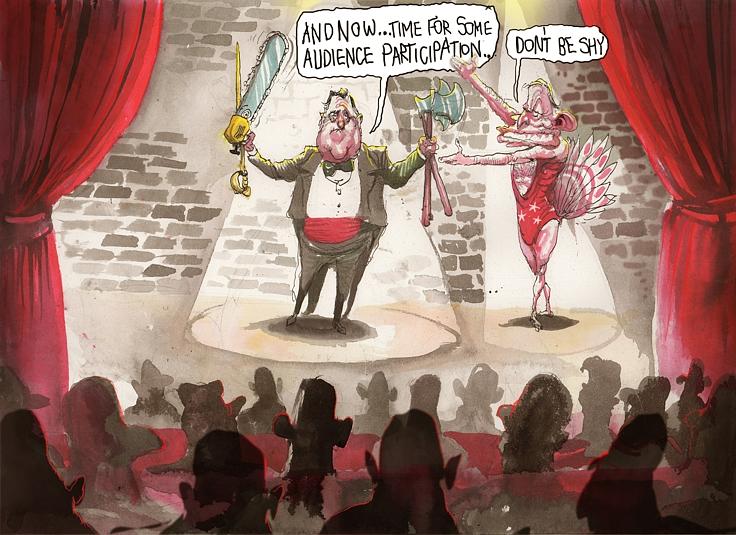
The Abbott Government has not only broken its election promises, it also has torn up a multibillion-dollar agreement with the state governments with Canberra proposing to cut the funding guarantee for hospitals from July 1. The blame game returns.
This is no tidy-up of the social democratic state--it is making Federal or commonwealth government smaller. It does this with around $80 billion of slashed funding for both health and education (Gonski). This way of cut back the power of the federal government and giving back to the states power that was deemed to have been taken from them forces the states to either cut services or increase taxes. This is small government, Abbott style.
 David Rowe
The Abbott Government is simply dumping the job of fixing the hospitals and education back in the laps of the states happening with no advance warning. The Abbott government is washing its hands of any major responsibility -- over the medium term -- for the public health system and for education which it argues, are state responsibilities and must be state funded.
The funding of these services is up to the states, and any extra taxes should be levied by them. They need the extra revenue to pay for the rising health costs, given that the Abbott Government has dumped investing in primary /preventative health primary care, which is a federal responsibility.
What Canberra has done, for instance, is to cease the funding guarantees made under the Gillard Government's National Health Reform Agreement 2011, (NHRA), and by revising Commonwealth Public Hospital funding arrangements from July 1 2017. From 2017-18, the Commonwealth will index its contribution to hospitals funding by a combination of the consumer price index and population growth-- but not for growth costs in the health system, which are greater than the rise in the consumer price index.
Financially starving the states means that the states are being put in a position to ask for the GST to be increased or broadened or both, since the states don’t have the practical capacity to expand their revenue to meet such a gap. Federalism can be seen a compromise between the extreme concentration of power and a loose confederation of independent states for governing a variety of people usually in a large expanse of territory. Australian federalism, since the mid -20th century, is premised on the Commonwealth having the taxing powers. Co-operative federalism assumes that the two levels of government are essentially partners.
Is it all cheap political theatre with the state Liberal governments in on the act? Paula Matthewson argues that:
It's not too long a bow to imagine Abbott holding a private meeting with the Liberal premiers - outside of COAG - to advise that they'd take a haircut in the Budget but would be the beneficiaries of federation and taxation reform. That is, play along and you will be rewarded.The other clue to this being the true state of play is the states protesting that they only want a fairer share of the existing GST pie. This is an unsustainable position if the pie remains static. For every state that gains more GST revenue there will be another that gets less, so the only way for all states to get more (in actual terms) is for the overall pie to grow. And to do that the GST must be increased or broadened.
It may be the case that the Abbott Government's shifting the burden back onto the states by financially starving them without warning is to prepare the ground for for broadening and extending the GST.
However, It also represents a remodeliing of Australian federalism from a co-operative one to a competitive one. The states are seen as sovereign in their own sphere and as competing against one another.
Dual federalism assumes that the two levels are functioning separately. In this kind of state-sovereignty federalism the national and state governments are equally sovereign, each supreme within its own sphere, and the line between them is determined by fixing upon those subjects that must remain within state jurisdiction. The coexistence of the states and their power is of itself a limitation upon the commonwealth's power.
The competition bit arises when the wealthy mining states refuse to share their wealth with the poorer states (eg., SA + Tasmania), so that the latter are forced to run down their health and education services. And that's their problem. There is to be no welfare for the mendicant states.
This is the Commission of Audit's view of Australian federalism.
Posted by Gary Sauer-Thompson at 9:33 AM | Comments (4) | TrackBack
May 13, 2014
deficit gloom and doom
It looks that the 2014 budget promises growth at the same time as cutbacks designed to deal with an immediate crisis that doesn't exist. Behind the rhetoric and spin is the neo-liberal politics of austerity with its push for user pays, smaller government that will reduce economic growth and cause economic stagnation in Canberra.
 Alan Moir
The public service job cuts will have negative effect on environmental protection and give Big Mining and fossil fuel industries greater scope for its environmental destruction. That is what smaller government and rolling back green tape means. A neo-liberal mode of governance means no green tape restricting an open for business Australia, irrespective of the environmental consequences.
The rhetoric of good economic management in this context means a neo-liberal mode of governance. So Australia sells assets and cuts welfare spending to rein in a debt burden that is already the second-smallest among developed nations whilst refusing to reduce the vast amounts of subsidies and tax credits given to corporations--eg., the diesel fuel subsidy for the mining industry. The cuts in welfare spending for everyday people and disadvantaged people is necessary because these kinds of support create dependency and promotes laziness.
In this context “reform” is a synonym for “cut”, and ideology trumps evidence. Austerity is the dominant political paradigm of our time. What's usually meant by austerity is ‘fiscal consolidation’, a term that basically means reducing the budget deficit in order to create the conditions for stable growth, so that growth over time reduces the net debt of the state. Fiscal consolidation is a perfectly sensible thing to do when you are growing and pay back some debt.
Austerity is when is when you try and do this in conditions where you don’t have economic growth (as in Europe) or entered a period of low economic growth as in Australia. The LNP's 'contribute and build' rhetoric refers to ‘expansionary fiscal consolidation’. This nonsense on stilts says that we are so worried about government debt that just waiting for the government to slash the welfare budget by 50% so that we can be confident that ten years time that there will be a smaller tax bill as a result of this. So we will go out and spend and invest big time and the big growth rates return.
The theory that sits behind this politics of austerity is that of Public Choice, and this attributes the rise in government debt to an inherent tendency of democracies to“live beyond their means." The trajectory of debt management by consolidation is in the direction of a neo-liberal state that is “leaner,” less interventionist, and, in particular, less receptive to popular demands for redistribution than was the case for social democratic states of the postwar period. So we have declining public investment, increasing privatization of government services and increased reliance on private-public partnerships.
Will this will restore economic growth and secure democratic legitimacy for the Abbott LNP Government?
Posted by Gary Sauer-Thompson at 9:10 AM | Comments (15) | TrackBack
May 2, 2014
a return to the past
So the Business Council types on the Commission of Audit want to return to a small federal government, the states being the primary deliverer of services like health and education and a competitive federalism. The big picture story is about government being smaller, getting out of the way of the market, reducing complexity, targeting welfare, and fixing a broken federation.
 David Rowe
In wanting to return to the past the Commission the commission wants to substantially dismantle Medicare, cut down on the age pension, leave superannuation tax concessions unscathed, reduce Medicare to something mainly for the poor, hit middle-income families and make the treatment of welfare recipients much harsher. The Commission of Audit’s full report would dismantle the social safety net and cause the pain to be felt disproportionately by the poor.
The return to this kind of small government wont happen because the radical proposals of audit reports are not put into practice by politicians hoping for re-election. However a genuine problem of a budget shortfall in the medium term is being spun as an immediate short term budgetary crisis entirely of the previous government’s making. This crisis will leave future generations of Australians saddled with excessive debt. So drastic action is needed now.
To assert that Labor's reckless spending is the culprit behind the deterioration by the government ignores that the main reason for the decline in government's finances has been on the revenue side of the ledger. Revenue is down from 26 per cent to 23 per cent of gross domestic product in the past decade, while spending has remained at a relatively stable 25 per cent.
Posted by Gary Sauer-Thompson at 1:08 PM | Comments (4) | TrackBack