January 08, 2005
Tsunami Relief: UN v US
There has been a bit of politics being played out between the UN and the US around the emergency relief for the countries devastated by the tsunami. President Bush initially said that the US was in charge:
"We've established a regional core group with India, Japan and Australia to help coordinate relief efforts."
As Simon Tisdall, writing in The Guardian, observes Bush made no mention of the central coordinating role of the United Nations, nor did he offer direct assistance to the several UN agencies that were already tackling the disaster. The impression given was the ambivalence of the US to the UN's leadership role. The US did a big emergency number with money ships, marines and helicopters.
After the Jakarta summit the "core group" was disbanded and the UN's overall control of reconstruction was acknowledged. The UN sees this as an opportunity to regain some credibility.
At issue are long-standing, fundamental tensions between the world's only superpower and the pre-eminent global political organisation. Tisdall says:
The Bush administration craves the legitimacy that only the UN can confer on its policies in places such as Iraq. On the other hand, it resents attempts by other countries, acting through the UN, to place restraints on its exercise of power.Since the cold war ended, the UN has become the principal battleground where states' practical and ideological differences over the application of international law, multilateralist versus unilateralist solutions, and the "Bush doctrine" of pre-emptive force are fought out.
However, the conflict is more than this.It is also about the kind of development of the Southeast Asian region that needs to take place to restore lost livelihoods. The UN is going to use the reconstruction to go beyond delivery aid to push for its Millennium Development Goals of reducing poverty, hunger, disease, illiteracy, environmental degradation and discrimination against women.
The US and Australia are not that happy about this socially driven agenda since this kind of reconstruction delinks aid from western business interests, American influence in the region, and Washington's demands for US-style democracy and a market economy to be imposed everywhere.
Australia has already opted out of the UN with its bilateral arrangment with Indonesia. No doubt the US will seek to head off a revitalised UN. The UN will be allowed some independence but only up to a point.
Posted by Gary Sauer-Thompson at 09:55 PM | Comments (0) | TrackBack
January 06, 2005
livelihoods gone
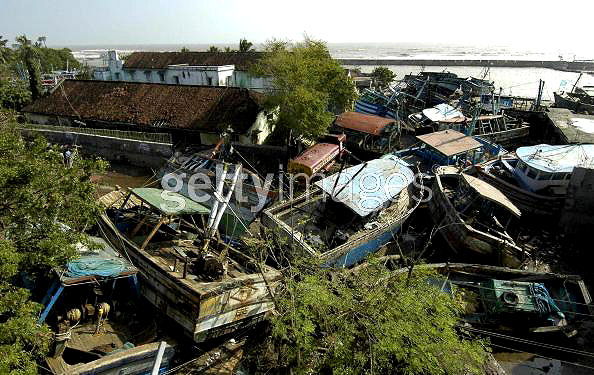
It is clear that Short-term relief is not going to be enough when livelihoods and fishermen's hamlets have gone:
So what next? Maybe we need a bit of debt relief?
An argument can be found here. A counter argument. Others say that trade is more important. However, both aid and trade are needed. Europe, for instance, could acknowledge that far-reaching debt relief and the opening of its markets, would start countries such as Sri Lanka on the slow ascent out of chronic poverty. The G7 should grant debt relief.
It is also clear that the region needs more than debt relief.
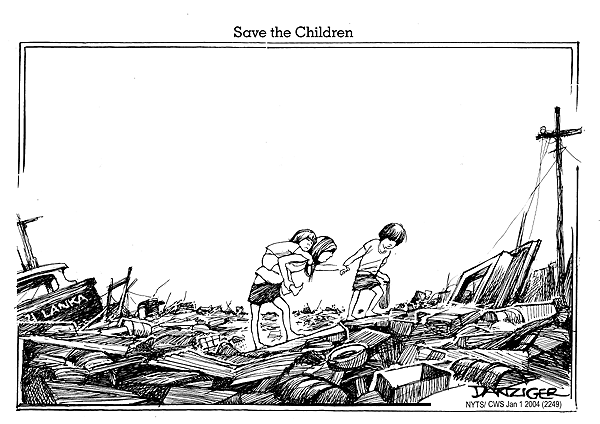
It needs long-term development assistance to help restore livelihoods and enable shattered communities to get back on their economic feet:
So the Australian Government's $1billion reconstruction and development package to Indonesia is to be welcomed.It will be administered by Indonesia and Australia, not the UN; and it places an emphasis on the reconstruction of the devastated region of Aceh and its future development. More detail on the package can be found at Geoffry MG's Beyond Wallacia.
I presume the focus of this package is on restoring livelihoods. Can we so presume, given the ongoing military operations still being conducted by the Indonesian military in Aceh?
However, we should retain a critical eye. Will the emergency relief, when channelled into this conflict zones, serve to feed armed conflict and undermine the ability of local economies to recover and develop?
What is clear is that Indonesia should lift its military state-of-emergency in the tsunami-devastated Aceh province and allow aid groups should not be pressured, and even forced, to turn over aid to the military for delivery.
It is clear is that there is national self-interest as well as the good neighbour humanitarianism at work in Australia's long-term development assistance to Indonesia. The development package gives Australia lots of benefits.
It enables greater cooperation with Jakarta in the war against terrorism; it helps to ensure that a viable Indonesian economy provides benefits for Australian trade and investment;it provides opportunities for Australian companies to be involved in rebuilding key insfrastructure in a devastated Aceh province; and it ensures that Australia becomes a key regional player playing a different role to the deputy sheriff of the US willing to launch pre-emptive strikes against Australia's neighbours.
Australia is doing good deeds in Indonesia. Read the Diplomad for an embassy perspective on the good on the ground work being done by the Australians and Americans, in contrast to the slow moving UN.
Posted by Gary Sauer-Thompson at 12:54 PM | Comments (0) | TrackBack