June 15, 2005
water reform
The rains have come but:

Asa Wahlquist, writing in The Australian, highlights a point that I've often made about the governance of water: that the state water utilites are a major problem. She says:
Spending on water infrastructure has plummeted in the past two decades as state governments have plundered the profits of water utilities and failed to reinvest in the sector.
She says that twenty years ago, Australia's infrastructure spending was about 4per cent of gross domestic product, against an OECD average closer to 3per cent. But the latest figures, from 2002, show Australia spent only about 0.5per cent of GDP on infrastructure, or one-seventh of the OECD average of 3.5 per cent.
She quotes Paul Perkins, the head of the Barton Group, who says that the finger can be pointed at the state Treasury's:
We so-called reformed our utilities, but the money went straight into Treasury and decisions on investment started to be made by Treasuries.
The state water utilites have become water corporations who are now more interested in making a profit, than ensuring a more sustainable use of water in the cities.
This represents a failure to apply the national competition policy to water in our urban areas.
Update: 20 June 2005
The winter rains have come in Adelaide and Canberra this last week, but not so Sydney. I was in Sydney from Thursday 16th to Sunday 19th and only a few drops of rain fell early on Sunday morning. The rest of the time was clear blue skies and losts of sparkling sunshine.
I caught a program on the NSW Statewide on Friday night before I went out to dinner
about water levels at Warragamba Dam and the low levels. The Sydney Water offical did not mention climate change once and exuded heaps of optimism about the future.
Crisis? What crisis? It was just a matter of waiting for the rains to come we were informed. The graphs of history showed they would come he said.
Update: 22 June 2005
They are a little more sensible in Melbourne. There they recognize the significance of climate change:
Global warming will stretch Melbourne's water resources to their limit, forcing the city to find new sources of supply, a report by the nation's top science agency has revealed... the CSIRO report, outlines a worst-case scenario for Melbourne, in which the city would lose 35 per cent of water flowing to dams by 2050. Under expected climate change, Melbourne will lose water due to less rainfall and higher temperatures says the report, commissioned by Melbourne Water. The scientists' "mid-range" scenarios project an 8 per cent loss of average flows by 2020, rising to a loss of 20 per cent by 2050.
That does even factor in the increased demand for water due to the increase of population. They are talking in terms of permanent water-saving rules to conserve water and recycling water as well as seeking new supplies.
Sydney by contrast is continuing to say that as recycling's not a key to Sydney's water shortage, ans desalinisation is the key, so all the storm water and treated sewerage can continue to flow into the sea.
Posted by Gary Sauer-Thompson at 02:17 PM | Comments (6) | TrackBack
June 11, 2005
politics of climate change
Gerard Henderson is a favourite of Oz bloggers---see DogsfightAtBankstown for the background on the one way adverserial relationship. And deservedly so because his commentary was pretty boring, repetitive and low grade.
Recently Henderson wrote:
I have long held the view that The Age is the most left-wing newspaper in Australia---in a sense, its culture is set by Michael Leunig .... In my view, turning The Age into "The Guardian on the Yarra" is bad for the political debate in Australia. It is also a counter-productive commercial decision---since contemporary Australia's capital cities are too small to sustain a left-wing broadsheet like The Guardian---or, indeed, a conservative broadsheet like The Telegraph in London.
Would it be bad for political debate in Australia? Let us take a look at the Guardian:

Bell's cartoon seems pretty accurate to me, given the way the Bush administration plays the politics of climate change by downplaying the link between greenhouse gas emissions and global warming to hide the effect of man-made emissions on the heating the planet.
The rightwing/conservative politics of climate change in Australia disguises the effects of greenhouse gas emissions on climate change by saying the lack of rain and warm temperatures is due to natural causes. The dry autumn and lack of water in south-eastern and western Australia is caused by the drought, and this will soon ease when the rains come. So there is nothing to worry about.
What we need is more hard critical commentary that questions the view that the states can go ahead building more coal-fired power stations to power their industrial machines; that there is no need to recycle storm and waste water; that there is no need to have solar power on household rooftops to run airconditioners and feed power back to the grid.. etc etc.
Is that not a useful role for a liberal newspaper such as The Age? It can also open its pages to critical conservative commentary to help foster the formation of public opinion through deliberation and dialogue. The Age can help foster this dialogue by requiring their columnists to avoid the tone of 'only we know all the political stuff.' As Tim Dunlop says:
I'd like to see some doubt creep into their pontificating, see them inject a bit of originality into their phrase turning, and for them to recognise that their priviledged position obliges them to challenge authority, whether it be political, economic or cultural.
That might help foster public dialogue once the Senate is captured by the conservatives.
Posted by Gary Sauer-Thompson at 11:28 AM | Comments (0) | TrackBack
June 06, 2005
looking the other way
I keep watching the Carr Government's shift away from ecological economics. It had good creditionals from increasing the size of NSW's national parks, a green Olympics in 2000 and Bob Carr's good policy talk on salinisation of the Murray-Darling Basin, the threat of global warming to snowfields, over-development of the coastline and destruction of old-growth forests before 1995.
A green Pemier leading a green government? Not likely.
Carr's recent actions indicate a green wash. He avoids investing in long-term water reuse and recycling schemes to ease the pressure on increasingly stressed rivers and dams; talks about building new coal fired power stations that will increase global warming; turns 15-year water access licences into perpetual water rights thereby handing over $6.8billion in water licences to irrigators and agribusinesses, whilst reducing the environmental flows back to rivers amount to 3 per cent of total flows, despite an undertaking by to return 10 per cent.
Has the Carr Government has been captured by the big energy and agricultural industries?
Sydney is running out of water, the reduced rainfall is looking to be the normal state of affairs, and the city has little groundwater and few other options for increasing its water supply.
Yet the Carr Government proposes to build more coal fired stations that use lots of water in the production of energy, which produce greenhouses that cause global warming, climate change and reduced rainfall over Sydney. It's a neat circle.
Posted by Gary Sauer-Thompson at 04:08 PM | Comments (0) | TrackBack
May 21, 2005
Governing Sydney town
I'm in Sydney for the weekend for some meetings and a new job. I've a few hours off this afternoon so checked out Glebe Books and Fish Records. I'm currently working from an internet cafe in Glebe.
These headlines hit me when I saw them over breakfast at the Novotel in Darling Harbour. The piece says:
Faced with surging demand for power-hungry air-conditioners, the NSW Government is preparing to approve the extension of a coal-fired electricity plant near Lithgow and has cleared the way for more coal power stations.
They are doing the same as Victoria: reassuringly talking about climate change and the need for environmental sustainability whilst doing the very opposite on the ground.
The skyscraper skyline of Sydney, as seen from my room in the Novotel, indicates a very wealthy global city booming from the financial flows of international finance capital. NSW is the premier state in Australia because of its financial power. This is the driver of the new capitalism that is rebuilding Sydney.
Though it will probably run out of water in the near future, there is no sense here that there are ecological limits to economic growth. What is Sydney going to do about its long-term water shortage? Wait until it runs out of water?
This coming up against the limits of growth is not due to the booming population--many people are leaving Sydney because of a lack of quality of life: it is too expensive to live there and the traffic flows are too clogged. You need to be a millionare to have a quality life in Sydney.
Sydney just refuses to recycle its storm and waste water--it still all flows into the sea. This refusal by Sydney Water suggests that the Carr ALP Government lacks the courage and political will to engage in infrastructure reform. You get the sense that things are drifting along in terms of governance, with the government reacting to each crisis in education, health, transport and water as it happens.
Update: 23 May 2005
This cartoon captures the contradiction of the Carr Government's governance of NSW:

Cathy Wilcox
Posted by Gary Sauer-Thompson at 04:40 PM | Comments (0) | TrackBack
May 14, 2005
a big dry
The south east and western parts of Australia are currently enjoying unseasonably warm weather with temperatures about 2C to 3C above the average. The autumn rains are late in this part of Australia, very late. There have been no rains as we begin to move into winter.
Australia is vulnerable to the increases in temperature and decreases in rainfall projected for the next 50 to 100 years, because it already has extensive arid and semi-arid areas, relatively high rainfall variability from year to year, and existing pressures on water supply in many areas.
This is not good news for those parts of the parched southeast of Australia with their low water supplies due to what many say is the ongoing drought.
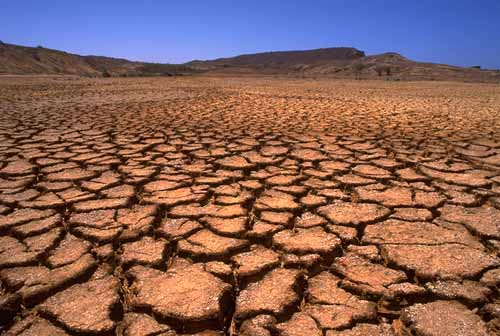
When I was having a drink in Manuka last Monday night after flying into Canberra I read an article in the Canberra Times about drought, lack of water and the town of Goulburn. Goulburn lies between Sydney and Canberra, and it is close to running out of water for its inhabitants. This situation of a big dry formed the core of my conversation with the waitresses, and again in the context of climate change with friends late Thursday afternoon, when we were waiting at the airport to fly back to Adelaide.
I remembered reading CSIRO modelling that says Australia's continental-average temperature has risen by about 0.7°C from 1910-1999, with most of this increase occurring after 1950. This increase will continue: by 2030, annual average temperatures wll be from 0.4 to 2.0°C higher over most of Australia; and by 2070, annual average temperatures will increase by 1.0 to 6.0°C over most of Australia with spatial variation.
The Canberra Times had a photo of a some water in a cracked and dried-out dam bed that once held a vast depth of water.This is the last of the drinking water, the shower water, the water to wash the dishes and laundry for the people of Goulburn.
The Australian has picked up the story. Amanda Hodge says:
With less than 2000 megalitres of water - less than eight months' supply - left in store, the town's situation is critical. And the drought has already played havoc with Goulburn's social fabric...This year, cherished public and private gardens are dead, the public swimming pool is about to close and footballers of all ages and codes are having to share the few rock-hard grounds still open.
Goulburn has few options to find more water. It can tap into a broken acquifer to would give it a few more months. It is unlikely to be able to build an emergency 8km pipeline to pump water back upstream from the Wollondilly River as Goulburn lies within Sydney's Warragamba Dam catchment area, and Sydney is also caught up in averting its looming water crisis.
So Goulburn will have truck water in for 22,000 people. That is expensive--too expensive for many. Presumably Goulburn is not recycling water and is not using treated effluent produced from wastewater plants. Time to become a little smarter.
Is it just the drought or natural variability?
The increase in termperature, lack of rain in winter, decreasing water and reluctance to shift to recycling is a familar story across parts of southern Australia. People continue to rely on the rains as the climate changes around them, even though Australia is heading into its third drought run, with 45 per cent of the nation drought-declared even before the large winter cereal crop is sown.
Climate change should be a dominant issue in planning Australia's medium and long-term future as Australia is 'vulnerable' since global warming will enhance the drying associated with El Niño events. Areas, such as WA's fast-growing Southwest Region, are places where significant impacts from global warming can be expected. The decrease in rainfall in WA's Southwest together with similar reductions on the southeast mainland, will lead to a further drying out across the country between now and 2070.
Posted by Gary Sauer-Thompson at 10:19 AM | Comments (8) | TrackBack
May 09, 2005
Victoria's green wash?
One consequence of the Howard Government gaining control of the Senate is the closing down of environmental politics and policy and a roll back of the environmental state that had been created by a reformist Senate over the last ten years.
So the environmental action shifts to the ALP controlled states which spin the green rhetoric but do little on the ground.
The spotlight is flickering on the Bracks Government in Victoria. It is crunch time. It is faced with a decision to keep the Hazelwood brown-cioal power station (Australia's dirtiest power station) operating until 2031.It is also decidng whether to underwrite cheap coal-fired power for a $1 billion-plus expansion of Alcoa's Portland aluminium smelter.
The Brack's Government has called for deep cuts to Greenhouse emissions, supports state-based emissions trading and voluntary sustainability, is implementing greenhouse abatement measures, and says that it is committed to increasing renewable energy targets.
Like NSW and SA there has been little action on the ground.
Crunch time.
Posted by Gary Sauer-Thompson at 04:20 PM | Comments (2) | TrackBack
May 06, 2005
only a god can save us now
Nice. The can do Carr Labor Government in the state of NSW reckons that it has all the hot issues nicely under control, except for water.

Their fingers are crossed because they are waiting for the rains to fall to solve Sydney's growing water shortage. Nothing that a bit of spin won't fix.
Posted by Gary Sauer-Thompson at 01:57 PM | Comments (6) | TrackBack
April 29, 2005
modernist water dreaming
For the return of more technocratic modernist dreams we only need to look at the way the states are dealing with water shortages arising from the declining rainfall in south-west Australia and the Perth region in the last decade or so.
Dams and increased storage capacity are back on the policy agenda. The Queensland Government flagged a new $149million dam, Wyaralong Dam, in the hinterland behind the rapidly growing Gold Coast, as part of its new $55billion infrastructure investment. Dams depend on rain in the hinterland or catchment.

Sydney, for instance, is faced with big water shortfalls and it keeps on talking about needing to build new dams to increase storage capacity. They are still in love with one big massive structure with a several billion dollar price tag. However, the decline in rainfall from a drying climate means that the rains aren't there to fill the dams already built. Though the water shortfalls will continue to increase, the NSW Carr Labor Government continues to resist recycling the storm and waste that gushes from the city drains into the sea.
Sydney's water strategy is one of finding more water to waste, rather than saving the water it already has. it highlight's the Carr Government's reluctance to reduce the megacity's ecological footprint and ensure environment protection, restoration and an improved quality of life.
Over in Western Australia they continue to talk about bringing water down to Perth from the Kimberleys. The Gallop Labor Government is seriously considering four options: various kinds of pipeline proposals including that Ernie Bridges; a canal; shipping water along the coast in tankers; and tugs towing water bags. The big projects for a big country means that there is very little mention of recycling storm and waste water, despite plans to build a desalinisation plant for Perth. At least Perth, unlike Sydney, recognizes that the big rains aren't going to return on a regular basis.
What seems to have been completely forgotten in all of this modernist infrastructure dreaming is the pricing water to reflect full cost recovery. Though that was an integral part of the COAG water reform process, it has been quietly sidelined. So the water reform process has stalled and old frayed dreams have become the new reality.
Update: April 30
An editorial in the Sydney Morning Herald talks straight.It says that we should not excuse the Carr Government's failure to deliver on water reform.
It has had a decade to confront neglect. Yet it still treats the city's water shortage as a short-term emergency, hoping temporary water restrictions will tide us over until a sustained downpour blesses the city's optimistically named "catchment" area. Crisis management is no substitute for a sustainable long term plan. This must begin with control of demand by firm regulation of use and pricing that properly reflects scarcity. These are not measures for the time being, but for the foreseeable future, to re-educate a community that for too long has been able to avoid the full seriousness of Sydney's water problems. But restrictions on private consumption have severe limits; what is needed is recycling.
It adds that the technology is there to re-use grey water, storm water and even sewage, to meet more of Sydney's water needs than will the proposed desalination plant.The desalination project perpetuates the flawed central thinking of last year's Metropolitan Water Strategy which, despite offering many welcome initiatives, put little emphasis on re-using water.
Posted by Gary Sauer-Thompson at 01:15 PM | Comments (0) | TrackBack
April 09, 2005
saying no no no to Kyoto
The Kyoto Protocol agreement to reduce greenhouse gas emissions is back in the news, as the US, Australia go their own way to develop an alternative to the Kyoto protocol.

The energy intensive industries in Australia are also resistant to change. They want to put off taking action for as long as possible. The impression you get fromeading htei comments in the media is that these are people who have a knee-jerk negative reaction to any kind of environmental regulation—---or, for that matter, any kind of government regulation. But they continue to hold out their hand for government subsidies for their old polluting industries.
These business interests determined that the international climate negotiations were a threat to their livelihoods and profits.
They persuaded the Australia Government not to sign the Kyoto Protocol. Australia, it was said, should not agree to anything that might harm its economy. Their goal is to put off that day of restrictions on carbon emissions for as long as it is politically possible to do so. Their blindness is not the scepticism about science. It is that they do not see that the drive for climate solutions is a business opportunity: producing and selling alternative fuels, becoming exporters of renewable energy, attracting high-tech businesses, or even selling carbon emission reduction credits.
However, Australia is vulnerable to the effect of climate change from an economic and environmental perspective, and so restrictions on carbon emissions in this country are inevitable. So are the requirements that the largest greenhouse gas emitters disclose their emissions. That is why the states are beginning to establish a bottoms-up emissions trading system with targets and caps. Hopefully climate change becomes one of the drivers of energy policy.
The states say that they are doing their bit to make climate change a driver of energy policy with their in-pinciple agreement about a state-based emissions trading scheme. But are not these same states also going ahead building new coal-fired power stations, which cause the greenhouse emissions in the first place? Does not Queensland desire to be Australia's electricity generation powerhouse through providing cheap electricity with ever more coal-fired power stations?
Posted by Gary Sauer-Thompson at 01:13 AM | Comments (0) | TrackBack
January 04, 2005
todays quote
From Paul Sheehan writing in the Sydney Morning Herald yesterday:
"It was an auspicious week to be reminded that Australia has never had so much material wealth yet so much environmental poverty.
For more than a hundred years, a slow-motion natural disaster has been unfolding in this country - you could call it a dry tsunami - mostly invisible, but deadening over the long term, as uncountable millions of tonnes of topsoil have blown away, never to be replaced, as a result of profound ignorance of the landscape. Hundreds of thousands of Australians have left the land, unable to make a living in an environment of wasting soils, dying rivers, changing climate, eroding coasts, disappearing species, plunging biodiversity, salinisation, desertification and factory farming."
The dry tsunami image is unfortunate. But he is right about Australia being in a long-term environmental decline that has not been arrested.
Posted by Gary Sauer-Thompson at 08:34 AM | Comments (0) | TrackBack
December 27, 2004
Gunns v Greens#3
An article in The Age by Steven Curry that responds to Greg Barnes defence of Gunns. Curry in support of my position, that the Gunns suit is a SLAPP designed to damage as many prominent foes as possible and to hurt the protest movement. It is a use of the civil courts to undermine basic democratic values.
In commenting on my criticism of Barnes Rick took issue with my argument about needing to shift from the logging of old growth forests to plantations to ensure a sustainable forestry. These comments are too important to be left in the comments section of that earlier post. I am posting it in full.
Rick says:
"In very approximate proportions, the nation’s wood comes about one third each from plantations, native forests and imports. The main point here is that as native forests close down as sources, the proportion of imports increases. This shift is taking place now, and if the plantations had the capacity to pick up where the native forests leave off, I wouldn’t be arguing with you now.
In terms of sawn wood, the plantations that are ready for harvest now were planted in the 60’s, 70’s and 80’s. There is some wood coming from younger plantations, but this would be from highly productive sites, and thinnings, much of the latter being undersize, marketed as posts or chipped for particleboard and paper.
There is a belief around that we have enough plantation resource to supply everything we need, and there is even a resource economist, whose name escapes me, who has written a paper to this effect. Apparently there is a conspiracy to withhold plantation resources so that we can knock over more native forest. She is, in the opinion of the industry, wrong. I haven’t read the paper, but the fundamental gap in her argument to me is that plantations are expensive to establish, and the longer the interval between establishment and harvest, the worse the economics look. Private and government organisations that established plantations that are approaching final harvest now have been paying interest on those investments for decades. If you do the analysis of the present value of a future sum of money, you’ll see that the long period between establishment and financial return makes sawlog plantations a risky investment. The ever-accumulating interest (govt departments pay interest too) is the main burden. So in this situation, to argue that any plantation owner would deliberately delay harvest for long periods of time is to argue that money is free. Another particularly important point is that plantations reach a harvestable size and then wood production slows down without further thinning. Modern pine mills are also not built to saw large logs, so the cost of milling “over mature” logs begins to rise. There are many details glossed over here, such as early revenue from thinnings and silvicultural strategies, but this will be too long as it is. Basically, a plantation management timetable is determined by silviculture (agronomy for trees) and economics. Conspiracy theories about this are like most conspiracy theories; a shred of evidence and a lot of imagination.
It is normal to say “they” should have planted more plantations in the 70’s and 80’s. Back in those days, social attitudes were different, support for plantations was much less and hindsight has always been excellent.
More plantations should be established now, I don’t think there is any disagreement between us on that. A few points:
1. New sawlog plantations will not come onto the market for many years, and we need to be discussing where our wood should come from in the interim decades. The current situation looks to me like we will import much/most of it from the rainforests of Asia because that’s the cheapest source.
2. Long rotation sawlog plantations don’t look very attractive compared to a pulpwood plantation harvested once at age 10. At present most of the private investment goes to pulpwood. Why? 10 years fits within a working life. Not many people early in their working life have the wealth to invest in longer rotation plantations. Consequently most of the sawlog investment comes from corporations, of which Gunns is one of the most prominent.
3. From the industry side, things look bleak. Our opponents may say “they have brought it on themselves”. But they must realise that an industry with an uncertain future doesn’t attract finance readily for 20-40 year investments. As evidence, Wesfarmers, who bought Bunnings and have sold the timber production side of the business as quickly as possible. Meantime, the timber and hardware sales side of Bunnings is an economic flagship. We are collectively busy buying wood, but we don’t understand what it takes to make it.
4. I have mentioned previously that there have been concerns expressed by Brown that too much prime farmland is being swallowed up by bluegums. The most vitriolic criticism of forestry is directed at woodchipping. The modern bluegum plantations are a deliberate strategy, initiated in the late 80’s with levies on native forest woodchip exports in WA, to establish a plantation resource to supplement, and then perhaps even replace, the native forest resource. This is an example of industry financing, under government pressure, the development of a plantation wood resource for a particular market. The result is further criticism and the principal proponent of this strategy has been vilified as the worst thing to happen to WA forestry by the greens and he has been reskilled. The worst fallout from this is the implication that forestry will be attacked no matter what it does. Not a healthy social environment for long-term investment.
5. We already have plantations, even pine, that are impossible or difficult to log because of public concern about the aesthetic impact. This is not public belligerence, but it demonstrates the somewhat irrational nature of the human animal. We all like a sense of continuity and dramatic changes to the landscape cause concern. Hence there is usually strong opposition to the establishment of plantations if they are large scale and impact on the visual character of a district. The next generation of people grow up used to the plantations and then oppose the harvesting phase. Normal behaviour; I’ve heard anecdotes along these lines from around the world.
6. The plantation industry is commonly criticised for using monocultures. This is a basic economic requirement for the production of wood and with the high cost of establishment of plantations on one side and the cheap resource in neighbouring Asian forests on the other, monocultures are here to stay. If you look at European forests, they are very largely monocultures and people there are very attached to their plantation forests as a place of recreation. (They also don’t seem to have much trouble, to my knowledge in Sweden, Finland, France, Germany and Austria, with harvesting those forests in the full view of the public.) I have noticed anecdotally that there is mounting opposition from green people to the bluegum plantations in WA due to this monoculture concern.
7. There is discussion about, and some trials, growing mixed species of native trees in plantations. These will be more expensive to manage, but we could pay more for our wood, especially when the Asian forests run out in the future. But if there are instances of people becoming attached to their neighbourhood pine plantations, there is a strong possibility that today’s mixed native species plantation will be tomorrow’s high conservation value forest. This happens virtually every time a regrowth native forest (argued by most people to be appropriate for timber harvesting) approaches final harvest. This point also demonstrates the irrationality of, or at least circular logic of, the belief that harvesting forests “destroys” the forest.
In general, you are arguing sensibly that there should be a move from native to plantation forests, and most people do the same. As individuals. But if you take the general form of public opinion, which is what influences political behaviour and policy, the situation is different. Public opinion sloshes around under the influence of many factors, but it is comparatively easy for a dissenting minority to stir up support AGAINST many issues. It is very difficult to harness such unified public support FOR a complex reasoned argument. When it comes to intergenerational resource production and management, we don’t seem to be coping very well.
The RFAs were an attempt to develop a negotiated long-term strategy, with all parties at the table. I am not aware of the details nationally, but my understanding is that the major green groups refused to participate in this process because by standing aside from the negotiating table, they were free to then attack the Agreements as soon as they emerged. It must have been difficult for the greens to sit at the table with the industry if government and industry have responsibility for supplying the nation with the wood it consumes. There will always be a gulf between those with ideals and those with responsibilities. Politically, this has been a most successful green strategy and it even calls into question, are they about responsible resource management, a genuine practical balance between our consumption of resources on one hand and the protection the environment on the other, or are they just out for political influence? When your genuinely held fundamental aim is to “save the world” (who can oppose such an ideal?), almost any means could be justified by the end.
In terms of responsible long-term resource management, the RFA process seems have been a disaster. Decisions were made without the benefit of a stronger conservation influence. The situation is now more chaotic than it was before. Why are we surprised that there is inadequate plantation resource being established?
I consider it reasonable to conclude that the core of the green movement is indirectly working for the removal of commercial forestry from this country. They don’t have that as a formal part of their platform, probably very few if any of them recognise what impact they are having. But the net real effect of their efforts is that commercial forestry in this country is too expensive and subject to too many wild swings in the public mood (measured over the length of a forest rotation). The industry here will diminish further and responsibility for our wood resource will move off shore, because there is a lot of cheap old growth forest over there, at the moment."
Posted by Gary Sauer-Thompson at 10:46 PM | Comments (0) | TrackBack
December 26, 2004
Santa's complaint
I've always seen the Bush Administration as engaged in the rollback of environmental legislation that was designed to protect public health and the environment.
Santa is not overly happy with the environmental state of affairs in the US:

Sounds like the US is not doing all that great a job in maintain healthy air quality by controlling air pollution these days.
It wouldn't have anything to do with the Bush Administration protecting the energy industry by allowing it to continue polluting without using state of the art mercury controls, would it? The Bush adminstration is weakening the clean air laws, and that means that millions more tons of soot, smog, and toxic pollution to be spewed into US air each year.
Presumably public health takes second place to profits in a Republican USA. A blind Republican eye is turned to airborne mercury pollution from smokestacks rains down on our rivers and lakes where it accumulates in the food chain, especially fish. Anyone who eats contaminated fish, particularly children, is at risk, since mercury exposure can cause irreversible damage to the brain, kidneys, and cardiovascular system. Exposure to mercury is also known to reduce fertility.
Posted by Gary Sauer-Thompson at 09:25 AM | Comments (0) | TrackBack
December 22, 2004
wishful thinking
Climate change is hurting Australia - increased droughts and bushfires, the destruction of our coral reefs. Over the next 50 years there will severe damage to Australia's ecosystems: to Kakadu National Park, extinctions in North Queensland's highland tropical forest and the probable destruction of the Great Barrier Reef.
Senator Campbell, the Environment Minister, would know all of this when he went to Buenos Aires last week. He would also know the implications it has for Australia's miracle economy. One would hope that he has been so briefed.
So what is Australia going to do post-Kyoto---after 2012?
So 
Moir
I'm not certain that Australia has been that courageous in breaking with the US, which increases emissions while pretending to do reduce greenhouse intensity. The US is not going to do very much to reduce to reduce domestic greenhouse emissions, even though it is world's largest producer of greenhouse gas emissions.
Australia and the US have previously firmly stood together on their objections to signing the Kyoto protocol on climate warming, which comes into force next year. What Senator Campbell says is that Australia does not agree with the US stance against future greenhouse gas targets, or its claim that economic growth and technology were the answer to reducing heat-trapping emissions.
But Australia is not going to met its Kyoto commitment by joining an international emissions trading markets, which start early 2005. Nor is going to put a price on greenhouse pollution through a revenue neutral carbon levy.
Nor is Australia going to pour billions of dollars into clean energy research to utilize the natural sunlight advantage we have? Australia is not going to support the development of a stronger renewable energy industry through a Mandatory Renewable Energy Target of 10% by 2010 and 20%.
So what happens when Australia can no longer rely on reductions in land use to buffer its growth in energy-related emissions.
Are not energy production and transport related emissions predicted to rise by over 30 percent by 2012, from 1990 levels? Does that not mean Australian industry will have to invest heavily in order to meet future emissions reduction targets?
There is very little action at this stage.
Update
Is it not strange the way that the gungho free marketeers, such as Alan Oxley writing in the Australian Financial Review, (20 12 2004, p. 47) oppose the use of markets to help reduce greenhouse emissions?
Oxley fogs the issue of governance of the global economy by following the US line that says that the science, which supports the contention that global warming is partly man made, is unravelling. So there is no greenhouse problem. It is about green activists creating state of fear. This is the denial argument.
The insurance companies are not fooled by this kind of faulty reasoning. They know about the rapidly rising payments resulting from more severe and frequent hurricanes, heat waves and flooding. They acknowledge that extreme weather patterns have always existed, but they maintain that their frequency and intensity has been increasing because of global warming.
Oxley backtracks. In the next paragraph to the one above he talks about Australia rightfully following the lead of the US in focusing on "practical policies to reduce emissions and avoid the economically damaging strategy of energy costs". So there is a greenhouse emission/global problem after all.
What is astonishing is that the Australian Financial Review continues to publishes this kind of twaddle. Presumably they hold that anything that hinders or reduces economic growth is bad. By economic growth on this issue they can only mean the profits of the energy intensive industries. That is what is being defended. Energy policy in Australia is currently run to protect the economic interests particular groups of energy industries.
Where then are Australia's practical programs to reduce emissions and avoid raising energy costs?
Is that not a question the AFR should be asking of the Howard government? Is that not a challenge of governance as much as tax cuts and welfare reform?
Posted by Gary Sauer-Thompson at 05:39 AM | Comments (6) | TrackBack
December 21, 2004
Gunns v Greens#2
I'm reposting this comment by Rick Giles from an earlier Gunns versus the Greens post. These comments are too valuable to languish in the comments section of an old post. They represent a different perspective to my one, and so present the other side of a public debate.
Rick's post is more than a much needed corrective, to my own views. They are also more informed about current forestry practices than my own views which are that logging of old growth forests should stop, there should be a transition to plantations, and that Tasmania should shift away from a reliance on wood chips to a knowledge economy. This, if you like, is the other side of the debate.
Rick Giles
'Is there a difference in principle between making defamatory accusations against a person in order to cause them financial harm, and running a public campaign to destroy an industry? I would say they are two similar shades of grey.
The forests debate is founded upon the truism that logging is bad, and as Gary says, the forests debate will be decided in the court of public opinion. But surely there are good grounds to say that the forests debate should also be conducted on technical grounds. Logging is undeniably an ugly (as in lacking aesthetic values) practice, but is it the most destructive form of land use? In some instances it is very bad, but if logging is conducted properly and followed by successful regeneration, it is much less destructive than farming, where ecosystems are eradicated permanently.
In my home state, there is strident opposition to logging, but not a word of opposition from anyone about broad-scale strip-mining of the same forest, which involves logging, clearing and burning of the residue vegetation, removal of 3-4 metres of bauxite ore, replacement of 0.5m of topsoil and revegetation. The soil profile is substantially and irreversably changed by mining due to the removal of most of the well-structured soil, leaving a shallow topsoil on top of a kaolin clay. The fact that logging is not opposed when it is followed immediately by mining, but is opposed if followed by conventional forest regeneration, suggests to me that much of the forests debate is about emotive responses stimulated by some politicians and a number of unelected activits for their own personal benefit.
Perhaps Gunns will be able to force their opponents to have their assertions about the impacts of logging tested in court, or perhaps they are as you say, just forcing defendants to expend their resources in legal defence. I'm sure there will be a number of lawyers who have strong opinions about forestry, something that they know almost nothing about, who will provide a defence pro bono.
If the purpose is to force the matter to a head, it could be seen as a test case for the question, is it legal to conduct forestry in Australia? If the decision is no, or if as you say the court of public opinion decides no and overrules the legal court in any case, where should Australia gets its wood? Wood and wood products are already our third largest import, and much of it comes from forests being cleared to palm oil plantations in Asia. Substitute materials such as plastics and steel are heavy net emitters of carbon dioxide (construction wood sequesters more CO2 than it emits).
It is understood that forestry is perceived to be the worst form of land use known to man, but good forest practice is not. Let's see this tested in a court, where simple slogans and hysterical claims (from either side) can be exposed to some rigorous analysis.
If people elect to continually slander others for personal gain (whether the gain is in the form of a sense of self-worth, prestige, power, or political influence), then they must appreciate that at some point the subjects of their attack may seek to defend themselves. The reason why some argue that Gunns should not be permitted to defend themselves is that forestry is believed to be morally indefensible, even by the public who use the fibre it produces. Furthermore, it is assumed that Gunns' opponents are morally pure and not tainted by vested interest. This is a charmingly naive assumption.'
Rick Giles
Rick's position is supported by this op-piece by Greg Barnes who contest my own view that Gunns are using SLAPPS to silence debate. He says:
"In other words, there is a balance that needs to be achieved in any democracy between the right to freedom of speech, and potential harm done to others as a result of the exercise of that right. In the Gunns case, it is important to protect the right of the company to go about its lawful business, just as it is important to allow individuals and groups to protest against the company's business activities."
Barnes adds that if companies have no rights to seek legal redress to protect their rights and interests against what they regard as unlawful actions then the result will be anarchy.
Posted by Gary Sauer-Thompson at 05:01 PM | Comments (8) | TrackBack
December 16, 2004
anti-democracy tendencies
Gunns' is suing environmental activists opposed to its ecologically destructive logging practices in Tasmania.
Gunns has served writs on 20 individuals and groups, including Senator Bob Brown, Tasmanian Greens leader Peg Putt, the Wilderness Society and Doctors for Forests, citing their "ongoing damaging campaigns and activities" against the company.
The company has no commitment to arguing its logging case in public. It prefers using SLAPPS as a means of transforming public debate into lawsuits. Though this legal instrument fails legally, it ties people up because of the substantial investment of money, time, and resources to defend themselves. The resulting effect is a "chill" on public participation in, and open debate on, important public issues.
There ought to be a law that protects people from SLAPPs and defends the right of political speech of citizens in a liberal democracy. Gunn's anti-democratic response may well reflect the state of politics in Tasmania. Richard Flanagan writes:
"In Shakespearean terms, Tasmania is the play within the play; it always has been. Tasmania is now a corporate state. It has a supine government and an opposition that is an opposition in name alone. Its Labor Premier, Paul Lennon, demonstrated during the recent federal election campaign that his loyalty to the logging industry outweighed his commitment to a national Labor victory."
In the corporate state of Tasmania you are slapped down and punished for speaking out about the destruction wrought by logging the old growth forests.
What Gunns, as the SLAPPer, is trying to do in Victoria is to sue persons and groups in the green movement because they have communicated their views to government officials and tried to influence government action to stop the logging the old growth forests.
The concern about these kind of lawsuits is the negative impact they have on citizen participation and deliberatiion in our liberal democracy.
That does not concern Tim Blair. Both he and Steve Edwards over at the Daily Slander support Gunns in the power struggle to make Australia a more sustainable place to live. So they reject the notion that a healthy liberal democracy is based on the free exchange of ideas, and that citizens should be able to freely organise to influence public policy.
Steve Edwards says the Gunn SLAPP a good idea, since:
"keeping the Greens tied up in court will reduce their campaign funds, and therefore their ability to win Senate seats, hold the balance of power, and do untold damage to the Australian economy."
This is one indication of growing conservative intolerance for allowing dissenting voices to speak, let alone be listened to.
My judgement is that Gunns will lose in the national court of public opinion.That is where the battle for the forests will be decided.
Posted by Gary Sauer-Thompson at 08:32 AM | Comments (11) | TrackBack
November 28, 2004
Greenhouse sceptics
 This is a good article on the Greenhouse sceptics by Melissa Fyfe in The Age. Our climate has changed. What has caused it?
The sceptic's position, as outlined by William Kininmonth, former head of the National Climate Centre, part of the Bureau of Meteorology, in his book Climate Change: A Natural Hazard, is that global warming is a natural process.
The implication is that a drier, hotter world represented in Jason South's photograph is not caused by humans burning fossil fuels.
Their politics is pretty clear and upfront. It is about the continuation of cheap energy for the energy intensive industry, and that industry avoiding any payment for the costs of the environmental consequences (increased carbon dioxide emissions) of using cheap energy produced by coal-fired power stations.
The Lavoisier Group says that the context of them asking their questions about science of climate change undertaken by the Intergovernmental Panel on Climate Change (IPCC) is:
"...one of concern for the future of Australia as a free prosperous and independent nation; a nation whose economy has developed over the last fifty years on the basis of cheap energy and an abundance of mineral and agricultural resources. More recently Australia's manufacturing industries have increasingly become globally competitive, but more often than not, that competitiveness has been based on the abundance of cheap energy which we have taken for granted. Our economy is now at risk from the imposition of a carbon tax (a tax on burning fossil fuels) which will turn our cheap energy into expensive energy, with serious consequences for every Australian."
These free marketeers have no concern for, and are in fact opposed to, shifting the policy compass to a sustainable economy.
They assume that business and economic economic progress is a snug fit. It is a category mistake to ask businesses to achieve broader social goals. Doing so risks undermining the very competitive free market economic system in which business activity leads to opportunity and prosperity.
From what I can gather Kininmonth's book is directed at the IPCC's Third Assessment Report.
It is one thing to raising justifiable concerns about the limitations of current global climate models and their ability to indicate future regional patterns of climate change. It is another thing to say that the limitations of the models imply that the observed global warming over the past century is entirely natural in origin. That is a big claim.
Bridging the justifiable concern about the global climate models and the claim that global warming is entirely natural is the politics. That bridge is signified by the use of 'nonsense', 'bizarre', 'beggaring belief' or 'alarmist' to describe those who say that the observed global warming of the last hundred years has natural and human causes. When you hear those words it is reasonable to think in terms of science aligned with the fossil fuel lobby.
Posted by Gary Sauer-Thompson at 07:49 AM | Comments (0) | TrackBack
November 15, 2004
approaching the tipping point
Well now.
People are beginning to think through the implications of climate change now that it is widely accepted that global warming has both natural and human causes.
Here is one kind of thinking through.
Hotter temperatures, less rain, and less water for the Murray-Darling Basin and cities, such as Perth, is another kind of thinking through.
The evidence is mounting that Australia is facing a drier, hotter, windier future. The latest modelling by the CSIRO shows that by 2030 Australia could warm by up to 2 degrees.
Update
I managed to catch a bit of Bob Carr on Lateline after coming back from having a drink in Manuka. Carr has become a national ALP spokesperson on Greenhouse and global warming. He is the one making the running on it-----far more so than the Federal Labor Party. It is the NSW Government that is playing host to the international climate change task force in an effort to find a new formula acceptable to the countries who've refused to sign the Kyoto Protocol.
This is part of what he said on Lateline:
"....a 40 per cent drop in rainfall in parts of Australia is going to create severe problems.It strikes at the very habitability of the Australian continen....A rise in the world's temperature of 0.7 degrees Celsius over the industrial era and scientists believe that there is another 0.6 per cent or 0.7 per cent already locked in, the effects of which we haven't yet seen....[That is] totally irreversible.Can't claw it back.And that brings us to a total of 1.3 or 1.4 degrees rise in average temperatures.
This is getting us close to that awful tipping point of 2 degrees where the polar ice caps just melt away, the oceans rise, the rain forests around the globe dry out, Bangladesh floods and a lot of other extreme things happen.Now, that would have us living at temperatures that recognisable human beings have never lived at.We've produced a situation where the planet has been cooked up, been heated up, and no other culture or civilisation, no recognisable humans have lived under such conditions."
Where is federal Labor on this? All you hear about is Australia should sign Kyoto. Australia should sign Kyoto. Where is the thinking about post-Kyoto?
Where are there attempts at informing Australian citizens about the significance of global warming for Australia? At the moment they seem to be more interested iin consulting with big business in the form of dining out with the big end of town.
Where is the advocacy about needing to change our sources of energy? Where is the public persuasion about Australia needing to shift from electricity generated by polluting, coal-fired power stations to clean, renewable energy like solar, wind, biomass and micro-hydro power?
If Carr is so hot on global warming and green energy then why is he planning to build more coal-fired power stations to meet the state's future energy needs?
Posted by Gary Sauer-Thompson at 02:31 PM | Comments (0) | TrackBack
October 20, 2004
a note on water
Despite making a shift to accessing water from a reverse osmosis desalinisation plant that need not be driven by coal-fired power, the NSW's State Government's Metropolitan Water Plan is shortsighted.

Moir
It is a forlorn hope because it rains more in Sydney than in the dams' water catchment.
The editorial in the Sydney Morning Herald asks the right question:
"The State Government's Metropolitan Water Plan - like the rain sweeping Sydney - is welcome. And like the rain, it's not enough. The plan's emphasis falls too heavily on accessing more water and not enough on better using the water we have. How can a government hope to persuade the people to value water when "the plan" is to go on dumping most waste water and stormwater in the sea?"
How can a state government that says it is committed to a sustainable city when it goes on dumping most waste water and stormwater in the sea?
The argument against recycling is an economic one. It is too expensive to send recycled water back into the supply system and so reduce Sydney's ecological footprint. Less than 2% of total water used in Sydney is recycled and 1999 effluent recycling targets have been abandoned.
Posted by Gary Sauer-Thompson at 08:19 AM | Comments (0) | TrackBack
October 19, 2004
urban water reform

It is well known that the effect of global warming means less rain for south eastern and western Australia--the seaboard arc running from Sydney around to Perth. Less rainfall means less water in the resevoirs of the cities. These are already low, periously low in Sydney. Sydney is running out of water. It increasingly requires more water that the rains will provide.
If that is the future, then the solution needs to be clever and innovative. More than likely this innovation will need to involve recycling our storm and waste water, instead of letting it flow out to sea as waste.
All this is well known in policy making circles, and it has been so for 10 years or more. The solutions are also well known.
Yet nothing happens apart from spin and tapping water further up the catchment or digging deeper to tap declining underground water. Meanwhile it rains less and wasteful urban water use continues. Sydney, like Adelaide, is living in cloud cuckoo land, hoping for the day when the rains will return and the reservoirs are full once more.
What stands in the way are the poorly governed public water utilties who block long-term change for short-term profit and the state governments who cream of the profits for the general treasury. The neo-liberal hand of Treasury means that no money is ploughed back into greening and modernizing the infrastructure to ensure the recycling of water. SA Water and the Rann Government in South Australia is a prime example, as is Sydney Water and the Carr Government in NSW. They resist reform.
These utilities (SA Water & Sydney Water) are corporations selling water to make a profit. Their business is not the conservation of water. If a utility is in business selling water to prop up a state government, then this makes it incapable of promoting and instituting measures like recycling, stormwater harvesting and demand management.
Ticky Fullerton explores the above issues on the ABC's Four Corners
Posted by Gary Sauer-Thompson at 10:17 AM | Comments (0) | TrackBack
October 06, 2004
The trees are the winners
Now a timber worker would understand the philosophy stated in this cartoon, and the way that it works against their short-term interests:

Pryor
The economy is in conflict with the environment. So any attempt to protect the environment undermines the economy is the timber worker's position. The Greens will close down the forest industry. Laatham is aiding and abetting that.
Hence yesterday's strident reaction to Latham's $800 million forest policy package:"we've been sold out to shore-up Labor's support in the mainland marginal electorates." It is outrage tempered with a hope that the LNP will come good and look after the industry. That is the job of governments.
Some of the writing in The Australian is so biased that it is a distortion of what is going on. Consider this piece by Denis Shanhahan:
"LABOR'S forest policy was unravelling and John Howard was thinking about just standing back and letting it form a tangled mess at Mark Latham's feet...After dangling expectations in front of Latham and the electorate, the Prime Minister considered sitting back and letting Labor implode ... Labor is living in fear and expectation that Howard would delay committing himself and would just slip through to the election without harming the Liberals' chances of picking up a Tasmanian seat."
The piece is all about the ALP's unravelling and imploding and Howard's Cheshire grin at the waves this is causing. Not a hint of acknowledgement that the ALP's forest package was good public policy; or that it was good public policy to protect the old growth forests in Tasmania.
The news reports are carrying stories that John Howard is expected to unveil his forest policy to protect core areas of high-conservation old-growth in Tasmania. Richard Herr, a University of Tasmanian political analyst, suggests that a middle-ground forest policy by Howard would allow the LNP to minimise defection of green-conscious Liberal voters (eg.,the doctors wives) while maximising support amongst the disenchanted timber workers in Tasmania.
Whichever the way this goes, the old growth native forests in Tasmania are going to be the winners. There is no turning the clock back now. Despite industry claims that the ALP policy would shut Tasmania down, logging old growth forests deserves a similar fate as damming the Gordon-below-Franklin River for hydro. Logging is ruled out by any cost benefit analysis that puts a realistic value on the environmental qualities of the region.
October 7
Howard has now come out as a friend of workers, loggers and the Tasmanian Government. Howard's forest plan is a minimal one: it would preserve an extra 170,000 hectares of Tasmanian old-growth forest; it would ensure no job losses for timber workers; it does not alter the Regional Forest Agreement signed in 1997;and promised to spend $50 million on initiatives including research into alternatives to clear-felling, saving the Tasmanian devil and improving forest workers' skills.
The irony is the television footage of timber workers cheering Mr Howard as their saviour. They see the Coalition's forest policy represented a much better deal than Labor's policy. It locks up around 140,000 hectares of the forests that can't be logged under existing forest management; are located on the steep-terrain North Styx which would always have been very difficult to log; or are lined streams and rivers, or forests at the top of mountains already excluded from logging.
So the Coalition appears to be protecting forest that, under the state-federal agreement, the forest industry was not going to touch anyway.
Will this strategy swing at least two Labor seats in the Tasmania (Bass and Braddon) to the Liberals? Many are saying that Howard has been shrewd in his forest gamble in wedging the ALP's traditional blue collar workers. Ah the judgement and timing they say. The forestry branch of the CFMEU has split off and has sided with the National Party (in Gippsland) in the name of resource security. The views of these timber workers are little different from that of the foresty industry, including Forestry Tasmania.
But will Howard's policy swing the Liberal seat of Adelaide to the ALP through the anti-John Howard sentiment in Adelaide's leafy,"small l" liberal eastern suburbs? Or has Howard done enough to win back the disaffected liberals?
Posted by Gary Sauer-Thompson at 09:15 AM | Comments (2) | TrackBack
October 05, 2004
Tasmanian forests
Well, well well. The ALP has done it.
It's forest policy is basically another review. Yet it is a review with a known outcome. The result is likely to be more old-growth native forest protected, around 240,00 hectares of old growth forest.
Latham has pledged to outlaw logging in virtually all of Tasmania's old-growth forests, and offered $800 million in compensation to help timber companies and their workers, families and communities cope with having a large slice of their resources locked away. The $800 million would be spent on "skills, retooling and upgrading". So workers who lose their jobs would be rehabilitated by being reskilled to go up the value-added chain".
And the ALP has flagged that it would be willing to use the commonwealth's legislative powers to override the ALP Tasmanian state government if necessary.
Good on them. Full marks. The ALP has managed to make health, education and the environment the key election issues and to make the Coalition react negatively.
I presume that playing this green hand means that in the last week of the election the opinion polls are still showing Labor behind in the crucial marginal seats. Otherwise why bother deepening the split within the ALP itself? However, Back Pages is still calling it as the ALP in front. So why the need to play the forest hand now? Why not continue to play the cat and mouse game?
Is it the emotive magic bullet to wound the opponent that John Wanna says is now required?

Leak
As Louise Dodson observes the concern for Tasmania's forests in this campaign is primary political: it is more about gaining tactical advantage and less about saving the old growth forests.
Is it merely a figleaf to secure the inner city marginal seats on the mainland? A a bid to win the light green vote while not losing support in the 5 seats it holds in Tasmania?
The ALP's move does reopen the 20-year regional forest agreement signed by the commonwealth and Tasmanian governments in 1997. That agreement guaranteed the timber industry a sustainable supply of 300,000 cubic metres of sawlogs every year for the next 20 years.
The ALP policy says that a new scientific panel to assess which parts of Tasmania's high conservation value old-growth forests should be protected from logging. The panel would examine areas including the Tarkine Wilderness in the state's north-west, the Styx Valley north of Hobart, the Great Western and Eastern Tires, the north-east highlands, the Tasman Peninsula and the Ben Lomond Extensions and would report by September 2005.
The panel would carry out its scientific assessment on the basis of eight different bio-regions in the state rather than treating the whole state as a single bio-region as occurred under the 1990s RFA scientific assessments.The bio-region approach would guarantee that more areas are scientifically assessed as warranting conservation.
There is no immediate protection for Tasmania's old-growth forests. There is only to be no extension to the logging area whilst the scientific assessment is under way. The loggers are not shut out. A review without a commitment to end logging gives too much room for the forestry industry to roll back a divided ALP.
Though the ALP policy does mention sustainable forestry, value-adding and downstream processing, there is little detail about what is involved in a transition to sustainable forestry? What makes the forestry industry sustainable?
The 400 (or is 320?) timber workers and their union do not want to know anything about sustainability. Nor are they willing to acknowledge that what is involved is stopping them cutting 90-metre tall native trees down and getting to them to cut down radiata pine trees in a plantation instead. Or better management of existing plantations.
Yet the forest industry threatens a capital strike, the Tasmanian federal ALP parliamentarians continue to do their kneejerk reflex and the Tasmanian Liberals re-discover state rights.
Posted by Gary Sauer-Thompson at 08:58 AM | Comments (3) | TrackBack
September 20, 2004
biff & forests
The second part of the federal election begins with Howard returning to the western suburbs of Sydney to reinforce his hold on the seats of that city with a bag of cash and some old fashioned political biff.

Rowe
Rowe does have the direction of the biff wrong though. It is far more likely that Howard and Latham's new Labour will compete in biffing the poor, the disabled, and single family mums. Both get their political rocks off in biffing those in poverty to make them shape up and become self-reliant. This is new (neo-liberal) Labor, is well described by Evan Jones over at Alert & Alarmed. New Labor is fully in tune with:
"...up to date, ‘get up and go’ age. Clean lines. Up tempo. Efficient; dynamic; etc. There is no room for stragglers."
Or malingerers. It is the aspirational, middle class suburbanites, who desire to go to elite private schools and make lots of money, who are in need all the breaks and incentives to ensure their self-reliance.
Outside of the global city the big issue of saving the old growth native forests in Tasmania is increasingly coming to the fore.
The Construction, Forestry, Mining and Energy Union (CFMEU) has become even more intransigent in its opposition to any moves to end clear-felling of old-growth forests in Tasmania. No suprise there. They cannot see the forest for the trees and have no idea of forests as ecosystems.
As Tim Bonyhady points out in The Age Tasmania. It is the state with the crudest RFA, the one most biased in favour of wood production. It is also the state where the flaws in the Regional Forest Agreement (RFA) are most evident. THE RFA in Tasmania has resulted in:
"...woodchipping on an unprecedented scale. Many of its most significant old forests including Australia's largest temperate rainforest in the Tarkine and Australia's tallest forest in the Styx, are being logged ... Tasmania's old forests are those worst served by the RFA process and most in need of protection."
The Tasmanian Labor Government has ignored the RFAs' environmental criteria, given precedence to wood production in large areas of old forest, ignored public opinion and made no attempt to facilitate the restructuring of the forest industry so that it becomes sustainable.
September 21
Back the land of the biff. This article by Louise Dodson takes a stab at showing why winning seats in Sydney is proving to be difficult for Latham.
With fat incomes, upwardly mobile attitudes and sky high mortgages in some of the most valuable real estate in the world Sydney is very different from the rest of Australia, especially Adelaide. The wealth and prosperity in seats such as Hughes, Lindsay, Macarthur and Parramatta were onece Labor strongholds a decade ago. They rebelled against Paul Keating and have remained with Howard since 1996.
Posted by Gary Sauer-Thompson at 10:04 AM | Comments (0) | TrackBack
September 17, 2004
Forests & cynicism?
It has taken a long time to surface but it has finally happened. The environment is back on the election agenda, and in a big way. This issue has bubbled away, but it has been both overshadowed by national security, health and family packages and ignored by the policy commentators. Now both the major parties are making a pitch for votes on saving the environment. Saving the Tasmanian forests not the Murray is the dividing issue.
The Coalition has upped the ante by flagging the possibility of stopping the logging in old-growth forests with a forest transition package worth "hundreds of millions of dollars" to compensate for lost jobs in the Tasmanian timber industry. The Tasmanian timber industry (Forest Industries Association of Tasmania) is claiming $9 billion in compensation. They are dreaming.
This shift is a realization that the proposal to end old-growth logging in Tasmania has strong support across the urban electorates in the capital cities. Those mentioned are Sydney's Wentworth, Adelaide and Kingston in South Australia, Brisbane, and Dobell in NSW. Presumably the aim is prevent some social Liberals (eg., Liberals for the environment ) from voting for the Greens or Labor on the environment.
The response to this flagging of the Tasmanian forest issue is cynical:

Leak
It is only a flagging by the Coalition at this stage. It may not happen, due to the sensitivity of logging in such marginal regional seats as Richmond (NSW) Eden-Monaro (NSW), Page (NSW) Corangamite (Victoria) and Gippsland in Victoria.
Yet flagging the issue is enough to box the ALP into a corner. As expected the state Labor government in Tasmania is opposed to any reform. It's emotive language about the green assault on timber workers, placing them on the scrap and the sacrifice of the interests of the state, means that the logging of old growth forests has become a national issue. This knee-jerk reaction ignores that Tasmania as a world-renowned tourist state is a better future than Tasmania as a plantation economy.
And it appears that federal Labor has been wrong footed. It has come out saying that this is little more than a spending spree, and that it will oppose any Coalition plan to spend hundreds of millions of the federal budget surplus to phase out old-growth logging in Tasmania's forests.
The ALP now appears to be pro-logging and anti-the environment. Its forest policy is currently being run out of Hobart. Turning its back on saving the forests is an odd situaton to be in for a party that professes to care for the environment.
Posted by Gary Sauer-Thompson at 09:30 AM | Comments (4) | TrackBack
September 14, 2004
water water water
I'll be on the road today showing some people from China Geographic around the river country of the Murray Mouth and Lower Lakes.
On the surface this looks to be okay--if it is tied to the National Water Initiative's objectives and timelines of reducing the over-allocation of water in the Murray-Darling Basin.
Then a project like the water proofing Adelaide, which will enable Adelaide to reduce its dependence on River Murray water, one can be funded. This reduction can be achieved by modernizing our water infrastructure to capture stormwater runoff from Adelaide's watershed in the western Mt Lofty Ranges; by recycling waste water in urban Adelaide and by increasing water efficiency in households and businesses.
This would be a significant step. Where is the ALP on this? What is it going to do? How is it going to achieve its goals of returning 1500 gigalitres to the River Murray? The ALP has gone very quite on the environment. Have you noticed? -- Since this is vital political issue in South Australia we can expect a counter ALP announcement in the next few days.

Wilcox
A discussion paper on the water proofing Adelaide project can be found here. The project has not progressed very far because the Rann Government has not put up the money. They talk the talk of Adelaide becoming a sustainable city, but they never put the money on the table.
It is the same with Adelaide as a solar city.
If the $2 billion is not linked into the objectives and timelines of the National Water Initiative, then the project's will be highjacked byboth the National Party and the recalictrant irrigators who see no reason why they should use technology to make their use of water more efficient.
Does this River Murray initiative mean that the marginal seat of Adelaide is looking a little bit safer for the Howard Government? Or will the state government counter it by banging away about the lost future competition policy payments?
Will more environmental policies be needed for those marginal inner urban seats. Or is a big ticket symbolic issue, such as saving Tasmania's old growth forests from destruction?
16 September
The ALP's River Murray rescue package has been announced It rightly concentrates on the core issue of restoring environmental flows, but makes no mention of the National Water Initiative, nor does it indicate how farmers will be compensated for reduced water allocations.
Though Howard appears to have outbidded Latham on the Murray the Howard package did not cut through in SA. It was blocked by Latham's proposal. Howard will have to do something more to cut through and stop the slow but steady drift to the ALP in Adelaide's marginal seats.
The Labor states have pulled out of the National Water Initiative because they have lost future competition payments. The Labor premiers have repudiated the $500million federal-state CoaG agreement and turned their backs on years of negotiations about the how risk from reduced water allocations is to be shared between federal and state governments and farmers.
How can they pull out of something they have already signed up to?
Posted by Gary Sauer-Thompson at 07:53 AM | Comments (2) | TrackBack
September 06, 2004
Tasmanian forests
What has continually suprised me is the failure of the two main parties to develop good policies to protect old growth forests in Tasmania. Both the ALP and the Coalition shy away from this, even though these policies would help their chances in the inner city electorates of our major cities. Both parties need to establish their environmental creditionals.
There were mutterings from both sides about conserving Tasmania's forests carried by the wind a few days ago; but these were little more than mutterings about possible future policies. They are only beginning to talk the talk.
The ALP does have a state of principles about what constitutes a sustainable environment. However, the ALP's environment policy has nothing to say about conserving old growth native forests.
They see it as falling under resources and jobs. These resource policies are driven by State ALP Governments, since the federal ALP does not have a greened up resources policy. Presumably the economy and wealth creation comes first, then the environment bit is tacked on by the neo-liberal technocrats to appease the left wing base of the party.
The Coalition has no specific election policies on conserving Tasmania's old growth forests. It's party platform does not mention old growth forests, preferring to talk about balancing our immediate economic needs with a need to conserve and nurture our environment and resources for future generations.
Balance means that a good economy is a prerequisite to have good environmental policies because you can't run a good environmenal policy if you don't have the money to pay for it.
So says Ian Campbell, the new Environment Minister in the Australian Financial Review (subscription, 2 09 04, p. 60). He says that environmental change will be driven by the market, not a comand and control approach. The minister adds that good economic outcomes willl lead to even better environmental outcomes.
That is not the case with Gunns in Tasmania. The good economic outcomes for Gunns and Tasmania are premised on bad environmental outcomes. And the Minister knows that.
Both major parties are unwilling to gain the electoral advantage over the other in the marginal inner city seats by saving Tasmanian forests. Strange isn't it?
Posted by Gary Sauer-Thompson at 02:16 PM | Comments (0) | TrackBack
August 24, 2004
goodbye water dreaming
I will be on the road for a few days looking at water and vineyard development in the Barossa and Clare Valley's in South Australia. Nobody has any time for the grand industrial dreams of turning the northern waters of Tropical Australia southward to the Murray River. They are seeking 21st solutions.
As Don Garden, an environmental historian at the University of Melbourne, writing in The Age says that industrial dream mindset viewed:
'...the landscape as a collection of "natural resources" that they believed it was their right or even duty to exploit.
Water was seen as being present in adequate quantities. It was simply in the wrong place and at the wrong time. This was a fault that human ingenuity and engineering could rectify. In due course we could make the arid wastelands productive. We could "make the deserts bloom"That approach was pursued from the middle of the 19th century and resulted in an enormous investment of capital and engineering skill that reached its high point in the Snowy Mountain scheme.'
In the Barossa and Clare Valley there is an awareness of the costs of that approach in terms of environmental exploitation and degradation. In South Australia:
".... there is scarcely a water system that has not been truncated and diverted...Vast areas of land have been cleared of their natural vegetation and are badly salinated. Native flora and fauna that once existed in millions are reduced to tiny remnants and, in many sad cases, are extinct or threatened. Most of our native woodlands and their inhabitants are gone...The legacy for our rivers is that many are dead or dying, including the once mighty Murray. They are increasingly salty...Aquatic life has been devastated, including iconic species such as the Murray cod. The river red gums that graced the river floodplains are dying of thirst because they are denied the periodic floods on which they depend for regeneration and reproduction.That other great source of water, groundwater, has been seriously over-exploited and is now starting to fail.
That is the legacy of industrial dreaming that was indifferent to ecology. That legacy is the situation within which wineries now have to work. It is realised that without a healthy environment there is no healthy economy and no healthy future for Australia.
Posted by Gary Sauer-Thompson at 08:52 AM | Comments (0) | TrackBack
August 19, 2004
a note on water
I'n the last few days I've been travelling around the Eastern Mt Lofty Ranges and mallee country around the River Murray looking at the devastation wrought by state encouraged agricultural development. The result is denuded landscapes, saline groundwater rising to the surface, rivers that no longer flow few birds and fish.
Devastated landscapes are a very sorry sight. It is going to be a long hard haul to repair this country and to change old agricultural practices that devastate the ecology of the country.
The cities are facing water shortages. As the Sydney Morning Herald says little is being doen to address this:
"At present, just 2.3 per cent of Sydney's water is recycled, though this will double to 4.6 per cent in the coming months as the Port Kembla steelworks switches to recycled water. Sydney Water's most recent long-term planning document, Waterplan21, released seven years ago, envisaged raising recycled water use to just 6 per cent by 2021 - a very low figure. At the very least, an updated mid-term strategy is needed.
Manufacturing and industrial ventures use 11 per cent of water, vastly outweighed by households at 70 per cent, so that raising the recycled level for households is essential. Yet Rouse Hill is the only residential development in Sydney which incorporates water recycling. It is being expanded by 10,000 homes, bringing the total receiving a dual supply of drinking and recycled water to 25,000 homes, which is insignificant compared with annual housing construction in Sydney."
There is a similar lack of action in Adelaide, even though it too faces severe energy and water problems.
Into the vacuum step the old fashioned engineering modernists with their big dams and piping schemes to transport water across the country. The standard argument in The Age is this:
"Australia has no shortage of water in even its direst, driest years. It simply falls in the wrong places.The quantity of the northern falls is so vast that diverting south as little as 3 per cent of it would demolish the common view that water shortage is inevitable in Australia and that sick, depleted rivers and rationing (as opposed to sensible conservation) are crosses we simply have to bear.
What kind of projects would be feasible?
The first is to build dams in the flood-prone Flinders River region of central Queensland to pipe water south and so permanently resuscitate the Murray-Darling Basin and Adelaide. This proposal has been costed at $2 billion - less than the Commonwealth contribution already committed for stop-gap measures to ameliorate the basin area's present problems.
The second is to increase Perth's seriously threatened supplies by relieving it of its responsibility to send water to Kalgoorlie. Instead, the huge mining areas east and north-east would be supplied by pipeline from the remote and water-abundant Fitzroy River country."
So we can keep going the way we have with landclearing, standard agricultural practices, removing biodiversity.
These big machine modernists have no ecological understanding at all. They do not understand the nature of the country they live, nor how the economy depends on ecoology. And that's the problem.
Posted by Gary Sauer-Thompson at 11:04 PM | Comments (0) | TrackBack
July 13, 2004
Kyoto: Australia's last stand
In yesterday's and today's Australian Financial Review (subscription required) there are articles on climate change, the European Union and the Kyoto Protocol. They are based on an interview by Geoff Kitney with Margot Wallstrom, the EU's environment commissioner.
Wallstrom says that once Russia ratifies the Kyoto Protocol--and they are preparing the instruments to ratify Kyoto--- the critical mass required for it to come into effect will be achieved. The likelihood is that the rest of the world will go ahead with implementing the treaty. That pretty much leaves the US and Australia standing alone as the main opponents of Kyoto. Wallstrom says:
"I expect they will still continue to hold out. There is a lot of prestige and there are a lot of vested interests involved....But I think in the end, so many countries willl adopt Kyoto the pressure will be too strong for the United States and Australia. The pressure will come from their business communities. Already we have many US companies coming to us because
we are going ahead with emissions trading early next year. They want to trade with us."
A thought. Is Australia standing with the US because of the alliance relationship? It is being a loyal ally by giving the US a fig leaf of international credibility. Surely not? Is it not more likely that the Howard Government has been completely captured by the energy-intensive industries?
Wallstrom then goes onto say:
"I think that despite the positions of the US and Australia, we do have a consensus that climate change is happening. We have a consensus that is real and also a consensus from the world's best scientists that it is man-made and that the influence of human activities means we have a reason to act."
How long will the last stand by the world's two major greenhouse-gas-producing developed nations continue?
At the moment the US and Australia are opposed to reducing emissions within an international legal framework, which establishes the rules by which all nations must play. Is this yet another expression of the Howard Government's contempt for the institutions of liberal internationalism?
Posted by Gary Sauer-Thompson at 08:02 PM | Comments (3) | TrackBack
June 28, 2004
CoAG & Water in 2004
At last Friday's CoAG meeting the Basin states and the Commonwealth signed up to two agreements: one to establish a national water initiative, the other to recover water for environmental flows for the Murray-Darling river system. These agreements have been heralded as a historic step towards a sustainable water future for the Murray-Darling Basin and Australia.
Are they? We have good reason to be sceptical.
Peter Cullen is a good guide on this complex issue of water reform. On the latter agreement, the Living Murray Agreement, Cullen says:
"The first of the agreements repeated all the great pledges they made last year to commit $500million and to return 500 gigalitres of water to the Murray River in its first stage of restoration. This was an agreement between the lower basin states NSW, Vic and South Australia and only concerned recovery of water to rehabilitate the Murray. There was not much new in this, and progress has been glacial."
Very true. Not much actually happened here. It was old news being recycled to make the states look good---to be seen doing something. Cullen says:
"What has been agreed is that all proposals (to clawback over-allocated water resources) will be judged by the Murray Darling Basin Ministerial Council and have to be agreed as eligible measures if they are to be funded from the $500million pool. The deal pledges to set targets for water recovery. Much of this was agreed last year, and not much water has been delivered to the Murray. Environmentalists and those living along the lower sections of the river are certainly impatient with the rate of progress. They need to keep expressing their concern to governments, otherwise political attention will move on to some other issue."
Nor was any extra money actually put on the table to recover water. Little by way ofactual proposals to recover the promised 500 gigalitres of environmental flows was put on the table. Apart from Victoria, the states are doing the barest minimium in the longest possible time. The lowest common denominator thinking still rules; even in SA, the state make the loudest noises about the pressing need to save the Murray.
It was better news on the other agreement, the National Water Initiative, signed by all states other than Western Australia and Tasmania. This agreement lays out the sorts of principles that need to guide water management in the 21st century, and repeats some of the ideas developed in the Murray arguments. Cullen says that this involves some complex matters, which he outlines as follows:
"It seeks to give farmers security for their water rights so they can invest in some certainty. It wants to provide legally secure water for the environment and lay out principles as to how it should be recovered, managed and reported.
It does agree that water can be recovered through a variety of means, including purchase on the market by a tender, infrastructure improvements or regulation, and agrees that whatever means are used they must be cost effective. It seeks to establish a nationally consistent water market so water can move to its best uses. It also met farmers' concerns about sharing risks of less water in the future due to improved knowledge and government policies.
This agreement also commits states to a transparent water planning framework and provides a commitment to return all over allocated river and groundwater systems to sustainable levels of extraction. It recognises the connection between groundwater and surface water in many systems. And it acknowledges indigenous interests in water and seeks to engage them in water planning.
The deal establishes a National Water Commission, funded solely by the Australian Government to review states' progress under COAG agreements and to provide advice to COAG on water issues. This is an important step to developing an overdue national water strategy. As a federal body, it will not be held hostage to the lowest common denominator thinking that drives most of the ministerial councils we have in Australia."
That is a significant step forward. However, the governments have only committed to the broad principles. Yet very little has been achieved in terms of of recovering water for the Murray. Not a drop of new water seems to have been delivered as yet, and it is not clear when any will be.
We are still talking about recovering the water. We are not actually delivering it. Nor are we providing the resources to do so.
Posted by Gary Sauer-Thompson at 03:01 PM | Comments (0) | TrackBack
June 15, 2004
something to chew over
This article by Tim Flannery makes some good points about the probable effects of climate change and global warming. Flannery says:
"The way we respond to climate change this decade will shape Australia into the foreseeable future....Declining rainfall has cost Perth two-thirds of its surface water supply, and in 1998 the rainfall deficit began to spread east, parching the western plains. Now Sydney's dams are at an all-time low."
Global warming also means less rain in the south-eastern Murray-Darling basin, less run-off and less flows in the River Murray.That is bad news news for the Murray's floodplains and wetlands. And not only in Australia.
Flannery then asks two good questions. The first is:
"So, what would Australia look like in a world that is two degrees warmer? Two degrees of additional warming is sufficient to kill about half the world's coral reefs....Extinctions of its unique fauna will start at one degree of warming, and after two degrees will accelerate rapidly....At two to three degrees of warming, Australia's alpine zone will become restricted to six peaks, and many of its species will become extinct."
The second question is:
"Why should we care about our biodiversity? First it's of great economic importance. Imagine tourism without the reef, rainforests and Kakadu. Imagine the world without the $30 billion yielded each year by coral reefs. Of course, biodiversity is much more important than that, for it feeds and clothes us, gives us clean air and water, and protects us from illness. Who knows, for example, where the next cancer cure is coming from?
I fear what future generations will say of us if we don't act, because two degrees of warming will gut our nation, destroying its greatest treasures and deeply compromising its capacity to support us."
Flannery then spells out what needs to be done.
June 17
There is a lot of nonsense about climate change in the media. Most of it is little more than the outpourings of the public relations arm of the fossil fuel industry. This public relations seeks to deny that climate change is man-made and that it is essentially [caused by] the burrning of fossil fuel. It seeks to undercut the forming consensus on the scientific issues by making the lack of scientific certainty a primary issue. Not even the Pentagon buys that kind of spin.
Posted by Gary Sauer-Thompson at 09:14 PM | Comments (18) | TrackBack
June 03, 2004
on how to mess things up
John Quiggin has an op-ed in the Australian Financial Review on water (subscription only) in the Murray-Darling Basin. He rightly identifies the core problem and solution : the over-allocation of water licences across the basin (but particularly in NSW) and the need to claw these back. John says:
"We have made commitments, which in total have exceeded the amount [of water] available.These commitments include water for existing irrigators, promise of access to new entrants, urban water supply for Adelaide and elsewhere and the preservation of sufficient flow to sustain the natural environment. As with all unbalanced budgets, the only resolution is for some users to take less. The problem is to determine who should go without and who, if anyone, should bear the cost of compensating the losers."
Spot on. The solution adopted by the state and federal governments is a market one. Convert water entitlements (licences) into property rights and establish a water market so that irrigators could trade water.
Alas, the state governments meerily continued on their incompetent and corrupt ways. They neglected to buy the water licences that they had issues but irrigators had not used (sleepers and dozers) before setting up the water market. The federal government was looking elsewhere.
John points out the problem:
"Thanks to the property-rights approach these "sleeper" rights have been converted into tradeable entitlements for which the holders, naturally enough, want comenpsation at full market value. As a result, the simplest and neatest solution to the problem of overallocation, that of buying out enough users to bring supply and demand into balance, is considerably more expensive than it mght have been. The conflict over who should bear the costs has therefore become sharper."
Rightly said.
It's a mess. The National Water Initiative talks in terms of "firm pathways and open processes for returning overallocated surface and groundwater systems to environmentally sustainable levels." But it says little about this is to be done.
Quiggin offers a way. He says:
"One way to resolve some of the conflicts ...might be to make payments to irrigators now in return for relinquishment of water rights in the future. This could be a step towards a fully-fledged futures market in water entitlements...As part of the reform proccess, existing licences with fixed terms of 10 and 15 years are to be converted to perpetual entitlements It would make sense to see if some licence holders were willing to forgo this conversions in return for an upfront payment."
It's a good idea. It would be a step to help bring supply and demand into balance.
However, it does not return water to the Murray-Darling rivers to ensure ecosystem health. That is not happening. It should be since the state of the River Murray's wetlands is very poor.
Posted by Gary Sauer-Thompson at 02:35 PM | Comments (5) | TrackBack
May 25, 2004
Water and urban life
I attended a public lecture on the significance of water for Adelaide's future as a city last night. It was given by Professor Peter Cullen in the Adelaide Town Hall as part of the thinkers in residence programme. An earlier talk by Cullen can be found here.
The public lecture was a stellar event. The town hall was packed. All the important movers and shakers in public policy were there. The nation is facing a water crisis where demand oustrips supply. But we gathered together in Adelaide to hear the assumptions underpining our taken-for-granted way of life being challenged. The basic assumption in Adelaide is that you can protect the river's health and continue to take the water that you need from the river whilst pointing the the finger of blame upstream. You still hear water dreaming about towing icebergs from Antarctica to solve Adelaide's water problems.
Cullen's talk was entitled 'Making Waves - water challenges for Adelaide in the 21st Century'. It outlined how South Australians need to create a sustainable environment in which our scarce water resources are respected and managed. He argued that Adelaide cannot rely on the River Murray as a lifeline anymore. It must start to think in an innovative way, rather than just assume that increased economic growth will continue to underpinned by the ecological health of the river country. All that needs to happen if for the eastern states to sort out their conflicts.
The city cannot assume this because Adelaide is going to face a water squeeze in the next 50 years. The water may not be there, and if it is, the water may well be too salty to be drinkable or usable. Adelaide, however, was not facing up this. Economics ruled, not ecology. The urban culture was very complacent about continuing to assume that the River Murray would continue to act as the city's ecological life support system. So world's best practice in water management is needed to deal with the water squeeze.
Adelaide has to work out how to live sustainably in a dry country by protecting the sources of water, manage the reduction in demand and find alternative sources of water. Doing this will mean that Adelaide will need to become innovative and clever.
So it is not just the wasteful upstream rice growers taking too much water as South Australians point out. South Australia needs to get its own house in order and claw back water from its own irrigators. It also has to start doing something about the wastage of River Murray water by Adelaide urban users who are currenly pouring 50% of that water on the water-guzzling European gardens. Why aren't they using recycled storm and water for their English gardens?
Posted by Gary Sauer-Thompson at 11:58 PM | Comments (6) | TrackBack
April 19, 2004
lobby groups
You see the defensive blocking tactics of the energy intensive industries to the need for them to undergo a green modernization in this story.
The industry says that "without investment, the Victorian economy will fail to grow at the rate the Government wants."
True. But this lobby group is not referring to investment in renewable energy as that brings jobs and investment in regional Australia. The industry is talking about a particular kind of investment----theirs.
Who are they? The article says they are:
"Victoria's heavy manufacturing industries: car and parts manufacturers, the aluminium sector, electricity generators, paper and plastics manufacturers, petroleum, chemicals and the cement industry. All are big power users and big emitters of carbon dioxide....[Victoria's] strength in manufacturing is based on cheap power from brown coal generators in the La Trobe Valley. The generators are also the worst polluters."
This manufacturing sector says that it creates 15 per cent of Victorian jobs and 60 per cent of exports. They are concerned that Victoria's power generation capacity will run short by 2010. And if brown coal is penalised for its greenhouse emissions in the form of costs imposed on industry for pollution, then there will be no incentive to invest in a new power station.
A coal-fired power station using dirty brown coal.
Sounds like blackmail to me. You can sense it in the text. The states cannot lead the way in green modernization now that the Howard Government is stuck. and won't move on green energy. The surface of the text says that green means less jobs, less investment and less growth. The blackmail is unspoken: We will go offshore if you go green. Its a threat.
That is the big end of town speaking to make sure the forthcoming Victorian budget is pro-business. Pressing the Brack's government to knuckle under and reign in a too active environmental minister.
That is one hand. The other hand is a plea for evermore protection and subsidy.
The intensive energy industries say no to Kyoto; no to a carbon trading system introduced by the states; no to an increase in the Mandatory Renewable Energy Target (MRET) by Canberra; no to green modernization and sustainability; no to a carbon constrained world.; no to taxes on their greenhouse emissions. They should not be held responsible for helping to create a warmer world.
Posted by Gary Sauer-Thompson at 05:00 PM | Comments (0) | TrackBack
April 09, 2004
it's an upside down world '
The problem faced by the national electricity market is that the generation of electricity from brown coal in a highly polluting process.
This method of generation produces a lot of CO2 gases which contribute to global warming.

Paul Harris, The Loy Yang power station in Traralgon, La Trobe Valley, Victoria.
The Federal Government's response to the sustainability issue? It refused to sign the Kyoto Protocol and is defending the coal and aluminium industry at all costs. The Australian renewable energy sector has no government funds for research and development, whilst millions is now going into carbon storage technology--geosequestration--- that will bury CO2 gases underground.
It's a subsidy for an unsustainable industry. Melissa Fyfe says that:
"The technology cannot be attached to existing power stations, such as those in the Latrobe Valley. It is also expensive. The Paris-based International Energy Agency (IEA) has estimated putting CO2 underground could cost between $US45 and $US50 ($A57-$A63) a tonne. This may make coal-based electricity more expensive to produce than wind-powered electricity, one of the more pricey renewable options."
So much for the Howard Government's commitment to market efficiency and competitive markets. It is really about market protection and corporate subsidies
Posted by Gary Sauer-Thompson at 05:19 PM | Comments (0) | TrackBack
April 06, 2004
Ironbar cracks again
 He is at it again. Having a go at placing barriers to hard won public policy shift to a sustainable Australia that would boost the river flow of the River Murray by just 3%.
Last time it was Canberra, national parks and bushfires. This time it is the Murray-Darling-Basin and water.
He, of course, is Wilson 'Ironbar' Tuckey. The deposed minister has led a bankbench revolt against the Howard Government's policies to restore health to the ailing River Murray.
The form the revolt has taken is the publication of the interim Federal Parliamentary committee report, Inquiry into Future Water Supplies for Australia’s Industries and Communities, being undertaken by the House of Representatives Standing Committee of Agriculture, Fisheries and Forestry. Since the committee is dominated by Coalition MPs' it's report represents a revolt within government ranks.
The report comes out against CoAG's decision to restore 500 gigalitres of water to the Murray by reducing the amount available for irrigators and to use the water to help restore six iconic Murray sites. It says that the money is better spent on conducting an audit of water resources and uses within the river system.
The justification? The ecological science upon which the CoAG decision was based has knowledge gaps. The committee appears to have relied on work such as this and this. This work lies behind the politics of saying that we should delay putting water back into the river to nurse it back to health because we do not know enough. Their argument is that the gaps mean inaction.
We do know that the redgums in the Chowilla floodplain in SA are dying:

Andrew Tatnell, dying River red gums in the ‘Garden of Eden’, Chowilla
They are dying from the twin effects of lack of flooding and rising groundwater salinity. They desperately need a drink.
We have met some of these anti-green politicians before and engaged with some of their arguments. Their rearguard action is being argued in SA by Patrick Secker in South Australia, whose electorate of Barker incorporates the lower Murray. He is going around the state saying that we haven't got enough evidence to make decisions about environmental flows and that we haven't really thought about what we are trying to achieve. He says nothing about the need to ensure the sustainable management of the resource base.
That photo of dying river gums in the Chowilla floodplain would indicate otherwise. As does the hypersaline conditions in the southern Coorong, which have resulted from a lack of river flow.

John Baker
In both cases it is the biological communities and the riverine habitat that suffer from lack of water. So more water is needed.
Update
The scientists who point this out as part of their research are accused of advocating the environmental cause by National Party Ministers. They are not dispassionate obervers. Do these these Minsiters have good reasons for saying that a positivist science is better than an ethically-informed and politically engaged science?
Posted by Gary Sauer-Thompson at 04:22 PM | Comments (0) | TrackBack
March 18, 2004
The campaign trail: looks like veneer to me
Whilst John Howard's re-election strategy is centred on 'the economy and national security', Mark Latham is currently walking a tightrop between economic growth jobs and environment in Tasmania. Latham's ALP is trying to neutralize national security as an issue with a quick stir of human concern about children in detention centres.
We have been experiencing 3 days of John Howard here in South Australia. The PM is basically trying to shore up the marginal Liberal seats in Adelaide (eg., Makin, Hindmarsh, Adelaide) with some smoke and mirrors. This involves federal funding for a high tech hub for manufacturing in Elizabeth; more funding to improve the economic and environmental future of the Murray River in South Australia; and funding stormwater retention and new production methods for viticulture in the Adelaide Plains).
There is also a strong attack on the Rann Government's proposed workplace laws; and the standard 'Labor does not understand how to manage the economy' script at a SA business lunchen.
Meanwhile, Latham is trying to keep Tasmania for the ALP whilst trying to win the inner urban seats of Melbourne and Sydney with some green veneer. So far he has endorsed clear felling of old growth native forests, job protection, no changes to the regional forestry agreement, and an unwillingness to retrain forestry workers.
That poses a problem. The ALP strategy is an old one: to influence preferences in key seats in Melbourne and Sydney is going to need more than reassuring the timber industry and unions in Tasmania. Still, Latham has another day to learn the green talk, send the right messages to get those crucial green preferences and put together a coherent, sustained case for reform.
I do not expect much to come out of this Tasmanian visit. It's about political expediency. Latham's writings are neo-liberal in tone (roll back the bureaucracy, open up the market, foster social entrepreneurship) etc etc; and they show little understanding of the way that the economy is dependent on ecology. Latham sees resources not ecology. So he will miss the way the Gunn's veneer mill uses a miniscule fraction of forest destroyed by the unprecedented levels of woodchip destruction of the wild forests.
Oh, I've also heard about little about liberal corporatism in Tasmania from the federal ALP. Then, they always were corporatist, were they not? Hence their historical resistance to the democratic project. Today they serious about political power and willing to sacrifice substantive social and environmental reform.
Update
So Bob Brown endorses Mark Latham even though Latham endorsed the Tasmanian government position on logging. Latham did not concede an inch on forest policy.

Bill Leak
Leak is a bit tough. After all, Bob Browm has raised the profile of the issue from a state to a national issue. Good for him.
So what does Brown's endorsement of Latham mean?
A deal: Green preferences to go to the ALP in the House of Representatives; ALP preferences to go to the Greens in the Senate. That means the Democrats have been cut out. That means more Green Senators in the Senate.
Here's a question. If the Greens hold the balance of power in the Senate (as I suspect they might do) then will they work with the government of the day? Or will they say no as they have been doing throughout this term of Parliament?
Posted by Gary Sauer-Thompson at 11:29 AM | Comments (6) | TrackBack
March 15, 2004
Tasmania: liberal corporatism
Writing in today's Sydney Morning Herald Richard Flanagan says that, just like the old days of hydro-industrialisation, the Tasmanian government, the unions, big business and an acquiescent local media are in agreement. They agree that the clear-felling of old-growth forests for woodchip is the path of development in the state of Tasmania in a global world.
Flanagan then makes an interesting observation. He says:
"Three years ago, a report based on consultations with the Tasmanian community and initially sponsored by the state government found that Tasmanians were overwhelmingly against further logging of the island's old-growth forests. But neither of the major parties reflect their beliefs."
The politicians (the Lib/Lab ones) have re-organized liberal democracy to marginalize any democratic opposition to their mode of governance. They have instituted corporatism as a political system.
Its form is not a fascist corporatism. It is a system of liberal corporatism, consisting of governance by Big Business, Big Labor and Big Government. In this system, the State functions to balance the interests of large economic power blocs while maintaining their common ascendancy or dominance in the face of potential democratic and green threats from below.
Corporatism is favoured when the goal is to ensure rapid economic development, guided and spurred by a government that is simultaneously dedicated to enforcing political and social stability within its borders. Democracy is sacrificed in the process.
I do not see Mark Latham challenging this corporatism when he visits Tasmania? I'd say he'd go along with this liberal corporatism. He will quietly forget to talk about his old theme of needing more democracy will he not?
Posted by Gary Sauer-Thompson at 05:29 PM | Comments (0) | TrackBack
March 12, 2004
Tasmania: senseless economics

In a global world Tasmania sells itself as "the natural state". The gap between the clean and green rhetoric and reality of the logging of old-growth forests continues has been mentioned in the ecological vandalism post. This highlighted the effects of the logging of Tasmania's old growth forests through the practice of clearfelling. Logging is at odds with the state’s wilderness destination marketing.
In this story in The Bulletin Bob Brown outlines the economics of woodchipping. He says that Tasmanians are the poorest Australians and that much of the profits made from woodchipping go elsewhere. Brown says the numbers are like this:
"Tasmania, after growing the trees for centuries, gets $10 per tonne royalty, Gunns gets about $100 and the Japanese papermakers get $1200 per tonne. Tasmania, , gets less than 1% of the end price and is losing the nation's grandest forests in the process. "The export industry should be getting the leftovers but at the moment it gets the core and it's Tasmania that gets the leftovers."
This is Third World economics. Not much future there for a Tasmania ruled by rednecks, with little conception of sustainability and who cannot see beyond the clearfelling of old growth forests.
Bob Brown has an alternative:
" Many more enduring jobs could be created by adding value to the timber before it is exported and by supporting more specialty timber products – such as furniture, boats and crafts – and small sawmills. [Forestry] would remain an important high-value-added industry without exports of woodchips."
That makes sense, doesn't it. It undercuts the redneck claim that the Australian Greens are about destroying jobs.
Update 1
This article by Melissa Fyfe and Andrew Darby in The Age undercuts the forestry=jobs argument run by the Tasmanian Labour Government. The article says:
"In terms of economic worth, the two industries [tourism and forestry] are neck and neck, both claiming turnovers of about $1.3 billion. However, in an economy that has been sluggish for some time, the argument in favour of Tasmania’s timber industry is often about jobs. But employment growth is coming from the tourism sector, not logging. Once the dominant local employer in many small Tasmanian towns, forestry now yields fewer than half the jobs provided by tourism."
The deepseated view in the state government, that real jobs come from heavy industry such as forestry--Tasmania’s "smoke stack" future option--is flawed. Jobs are being downsized in a forestry industry dominated by Gunns. Future job growth will come from the "attractive industries" such as tourism.
Posted by Gary Sauer-Thompson at 04:24 PM | Comments (4) | TrackBack
February 20, 2004
Overheating: That is the news
The main political news this week is not what is happened in the bubble of federal parliament. Nor is the crisis of masculinity, or why boys need good masculine role models, even if the work-life balance/conflict is one of the most pressing political questions for Australia.
It's the soaring temperatures and the two week plus heat wave in Southern Australia.
The place is warming up. The airconditioners are not coping. People are stressed from the heat. Cities like Adelaide just bake day after day. Its been blackouts in Perth.
State energy managers hustle to ensure an adequate power supply as Australians suffer from what is likely to be the hottest stretch of weather for quite some time.
And its been a similar story in California.
It brings the issue of global warming to the fore. It's getting hotter and its getting drier. This has not been factored into the forward planning of a national electricity market. And the public and private electricity infrastructure is decaying.
Despite the warning signs, the US, Canada and Australia are seeing an overall increase in their greenhouse gas emissions. Increasing temperatures. Now just think about the implications of climate change for Australia's Great Barrier Reef.
It means a bleaching of the coral caused by rising water temperatures. What will be left are bleached coral skeletons. That's a heavy knock for the Queensland tourism industry.
The inference? The coal-fired power stations are a big source of the greenhouse gas emissions that cause the heating of the climate and water and so are responsible for the destruction of the Great Barrier Reef.
Update
A report on the destruction of the Great Barrier Reef can be found here. Called 'Implications of Climate Change for Australia’s Great Barrier Reef', it is a comprehensive study on how Australia’s Great Barrier Reef may look in an overheating world. It explores possible future scenarios for the Reef.
The best case scenario for the Reef is recoverable loss if global temperature increases remain below 2 degrees. The worst case scenario is one of coral populations collapsing by 2100 with the re-establishment of coral reefs being highly unlikely over the following 200-500 years.
Posted by Gary Sauer-Thompson at 04:39 PM | Comments (2) | TrackBack
February 14, 2004
River Murray & the IPA
I notice that the Institute of Public Affairs (IPA) has published a booklet on the River Murray. I have yet to read this contribution to the public debate.
The summary of their Myth & the Murray booklet makes two points. It says that things are not that bad and it criticizes the environmental movement:
"We have all heard about the declining health of the Murray River, including poor water quality, dying red gums and threats to the continued survival of the Murray cod---this is the popular view in urban Australia. Along the river, communities believe that the end of commercial fishing, a substantial restocking effort, improvements in on-farm practices and the construction of salt-interception schemes have resulted in a healthier river. The available evidence supports the local view and suggests that, with the possible exception of native fish stocks, the river environment is healthy.
Many of the scientific reports that have led to the perception that the Murray River is in poor health make their comparisons with a natural river, which is one without dams and locks, one that gushes and then runs dry. Such comparisons are misplaced. If the ultimate objective of the conservation movement is a natural river, then we must reject the cultural heritage and economic wealth created by the engineering works, including the Snowy Mountains Scheme. In its natural state, the Murray River could not provide for Adelaide's water needs and it could not support the irrigation industries that have made the region the food bowl of Australia."
I have commented on the anti-environmental flow irrigators here; on the three pronged water reform here; and on the IPA here.
Two comments. The environmental movement, along with most government agencies and ecological scientists, has suported the idea of a healthy working river not a return to a natural--- ie., a pre-Snowy Mountains Hydro-electricity Scheme----River Murray. The IPA is fighting fictions on this in their attempt to roll back the public policy consensus that the River Murray needs 1500 gigalites of environmental flows to ensure its health as a working river.
In so fighting the fictional enemy, the IPA plays the 'enlightenment card' when they construct the ngo environmental movement as a religion in contrast to their market-driven and empirically based science. Jennifer Marohasy says:
"Indeed, environmentalism is emerging as a new religion, with Greenpeace, the World Wide Fund for Nature and the World Wildlife Fund representing the new church, complete with charity status and tax exemptions for their multimillion-dollar earnings."
This representation of green ngo's conveniently ignores the way these think tanks are involved in the public policy process through their reports and advocacy.
Posted by Gary Sauer-Thompson at 10:34 AM | Comments (0) | TrackBack
January 10, 2004
Native Forests: more debate
These comments by Frank Strie were made in the comment box of the previous post. They address the opinions of Greg Barnes at Crikey.com.au in an insightful way as Frank widens the debate from trees to ecosystem. They are too important to be left buried in the comments as they point towards the idea of ecological integrity.
I have edited the comments so they flow more easily. This is what Frank said:
"For Greg Barns it, (the issue) continues to be still all about trees and trees again.
No matter how often one points this out to him, (see under letters on Tasmanian Times). Barns ignores to see the forests, the creeks and ecosystems. He also ignores the serious debate about good water quality and quantity, clean air and the great loss of opportunities due to resource destruction. Barnes simply will not recognise that forests (not only trees) are the issue.
In reality, the logging debate is much wider than just a fight about big old growth and tall trees, just between the Wilderness Society and Forestry Tasmania and it's Industry lobby. Greg Barns appears simple-minded, as he can only see two opposing sides, just as he uses the example of two countries at war.
What about the local community what about the world community? All around Tasmania there are communities confronted with destruction of landscape, water resource, 1080 poison, chemical spray etc. etc. Just have a look at Discover Tasmania or Tarkine or Doctors for Forests.
Is the broader population not involved in the debate? Are they not participating on talkback radio and letters to the editor and other forms of debate? Is the public community just outside observers for G. Barns? Is every critical voice a typical greenie? If so what a narrow view!
For me and my associates in the 'for forests movement' (Doctors for Forests) the debate is not simply about economic versus environmental arguments; it is actually about social, ethical and intergenerational issues too.
Typical negotiated 'compromises' and handshakes behind closed doors are just old fashioned ways, in contrast we are working on real solution with the community. The problem is that in the meantime the destruction continues:...( here and here.)
The Forest Practices System is self-regulated in Tasmania. Just as in other industries around Australia, self-regulation does not work; and in the case of forests,after its gone it takes hundreds of years to get back to what it was, if ever again!
Back to positive contributions.One example of committed work can be found here and ProSilva, or the quality management in our forests. Nearly 10 years ago this paper was first written and presented, however it was ignored and by some just dismissed outright.
The destruction continued, the problem has become more than just a "challenge" of our time. Isn't it time to work out the positive changes, not just with the traditionally two opposing sides? Together with the local community and to make really sure it will work we should not forget to involve the world community."
For a positive Tasmania
Frank Strie, FWM
Schwabenforest Pty. Ltd.
Posted by Gary Sauer-Thompson at 09:37 AM | Comments (0) | TrackBack
January 09, 2004
Native Forests: The logging debate continues
Over at Crikey.com.au Greg Barnes has continued the recent round debate on logging Australia's old growth native forests. It is good to see Crikey offering its site for the debate, given the limited space devoted to the issue in the corporate media.
If you recall, the recent round of the debate was kicked off by Richard Flanagan writing on the rape of Tasmania in The Bulletin. Flanagan argued that woodchipping in the island-state has been likened to an ecological catastrophe. The article was mentioned at public opinion here. The argument was continued by Christopher Bantick in The Age mentioned here at public opinion.
Now Crikey has not been noted for its sympathy to environmental concerns. Wendy Wedge, one of Crikey's right wing columnists is hostile to the environmental movement. (More Wendy here.)To its credit Crikey was sympathetic to Flanagan's argument. Crikey said:
"Flanagan's story is the most comprehensive and compelling to be written on the Tasmanian forest industry in recent times, but gathering the information was not easy. The logging industry is surprisingly exempt from the Freedom of Information Act, making it difficult to find out things like how much the loggers actually pay for crown forest....The statistics Flanagan has on the clearfelling and logging of old growth forests, precious temperate rainforests, rare myrtle trees, leatherwoods and so on, are just devastating, enough to stun even the most hardened economic rationalist."
Crikey mentioned the lack of reporting of the forestry issue in Tasmania and the way the two major political parties are hopelessly compromised by their ties to the big forestry industry. Crikey also points out that the wealth creation from woodchipping is concentrated in Gunns Ltd and that the majority of Gunns shares are held by mainland institutions. So it is a national issue.
So what is Greg Barne's response to Flanagan and Bantich? Does he add anything to the debate? Alas, Barnes does not say very much. If we ignore his use of the war between the Israel government and the Palestinians to map the conflict between greenies and foresters in Tasmania, then Barnes is making two points. First, he is sick of the 'posturing', 'slogans' and 'emotion' in the debate:
"Geoff Law from the Wilderness Society, the Greens Bob Brown, Gunn’s CEO, John Gay and Forestry Tasmania’s Managing Director, Evan Rolley have all been running their campaigns for over a decade. There are no new voices on either side in Tasmania – people who can work with scientific and economic fact, not slogans and emotions, to create the conditions for an end to the conflict...Both the hard line greens and big business are now resorting to shallow marketing these days as a means of continuing the conflict...the Wilderness Society's marketing is no worse than the "infomercials'' run by Gunns...".
Fair enough. We do need more than political rhetoric.
This brings us to the second point that Barnes makes. Barnes says that we can move beyond the political rhetoric through compromise and consensus.
"It is time for the Wilderness Society and the Greens to accept some compromises on their ambit claims -- and it is time the Tasmanian government and timber companies to come to the negotiating table with goodwill. And it is time for the cultural crowd like Bantick and Flanagan to stop their public protesting through the media and become involved in helping the parties at the table to reach some consensus."
Fair enough. We should move away from the posturing to further political and commercial self-interest and acknowledge a complex ecological reality. The ecological reality of forests is more complex than political rhetoric has depicted.
So how do we figure out what compromise and consensus would mean in this situation? What would it look like if it went beyond the old Regional Forestry Agreements (RFA) that were struck in the name of achieving compromise and consensus. Do we need to move beyond the RFA's? Are the RFA's working? Should they be dropped? Should they be modified? If so in what way? Is the problem with the RFA's per se, or in its application by the Bacon Labor Government in Tasmania?
I do not know the answer to these questions. It would be helpful if they were addressed by people such as Greg Barnes. Unfortunately, Barnes does not address the RFA issue at all.
So all Barnes leaves us with is some political rhetoric---'posturing'--- from the political middle ground. Now it is fair enough for Barnes to speak as an Australian Democrats defending the middle ground of politics. Different voices help to keep the public debate going. And Barnes does have to offer something more than repeating the posturing he levels at his fellow debaters. He has to offer more, since his criticism is that it is the political posturing that is preventing the debate from moving forward. Political posturing achieves nothing in terms of public debate.
Barnes is judged wanting by his own argument.
Posted by Gary Sauer-Thompson at 07:01 AM | Comments (6) | TrackBack
January 02, 2004
a new tourist spot
I've been hunting for photographs of the ecological devastation of Tasmania's old growth native forests without much luck. Few photographs of the recently clear-felled Tasmanian forest coupe exist.

Andrew Dyson
Large-scale woodchipping continues in Tasmania. The old growth native forests are regarded by the forest industry as a natural resource. The industry's only conception of value-adding is composting a greenie.
The current battle ground is the clear-felling by the corporatised Forestry Tasmania of the mountain ash (Eucalyptus regnans) that grow in the Styx valley. Some of Australia's, and the world's, oldest hardwood trees, are being clearfelled for the sake of woodchips, sold chiefly to Japan. No other state in Australia clear-fells old-growth forests the way Tasmania does: wholesale destruction for the expansion of the plantation estate.
As Christopher Bantick observes:
"Currently, old-growth logging in Tasmania employs fewer than 350 people. It is difficult to imagine that these people could not be absorbed into the harvesting of soft wood and related milling activities. It has not even been tried....Forestry Tasmania points to the loss of jobs if logging old-growth forests were to cease immediately. The Bacon State Government, under mounting community pressure, has asked Forestry Tasmania to phase out old-growth harvesting by 2010, but without job losses. Should the present logging rate continue it is unlikely there will be many old-growth coupes left by then.
Christopher suggests that tourists to Tasmania should visit the Styx and photograph and distribute widely images of the continuing destruction of old-growth areas.
Good idea. The self-regulating Forest Industry is so negligent in its responsibilites to the environment that it has been exempted from all environmental, planning and land management legislation by the Tasmanian Government. Even stream side reserves are clearfelled and planted with plantations. The forest industry's understanding of world's best practice is to maximize the area to be clearfelled and the volume of woodchips.
is all about
Posted by Gary Sauer-Thompson at 11:47 AM | Comments (4) | TrackBack
December 16, 2003
caring for our forests
It is extremely hot in Adelaide today. Tis another one of those 40 degree plus days when the hot north wind blows down from the desert, turning the city streets into a furnace. Power bills will soar. More blackouts. No doubt ETSA will blame the weather for the power cuts.
It's another day in an Adelaide summer. That means the bush fire season is on us again.
Extremely hot & dry conditions means that it is a fire danger day. Red alert. Total fire bans across most of the state. Police patrols out looking for arsonists.

Remember the Canberra fires last year?
I remembered reading this a week or so ago by Alan Oxley, a director of ITS Global, a strategic consultant on international issues. Oxley is also acting as consultant for the Sustainable Timber Industry Coalition.
From what I remember the article was about the logging industry's case for greater access to our forests to prevent a repeat of last summer's tragic bushfire season. Commercial loggers are the good guys because they practice forest management, whereas environmentalists are the bad guys as they just lock up the forests and do not practice the active management of the noble loggers.
A moral is drawn from the Californian experience:
"California's timber industry has pointed out for years that unmanaged forests not only create fire hazards, but get sick and die. Insect infestation and dead wood are killing the Sierra Nevada range. California environmentalists want it preserved as a wilderness "biosphere" to protect the spotted owl. But foresters warn that if nothing is done to restore the health of the range, it is increasingly at risk of being destroyed by super wildfires.
The moral? Wilderness is no good. Plantations are good. Oxley's conclusion? "Our forests do need protecting. But not from the timber industry. They need to be protected from bad environment policy."
That's how the Timber Industry understands sustainability. Unmanaged forests are a firebomb waiting to explode. They need to be logged and burnt regularly to make them less fire-prone.
Unlock the forests is the subtext. Let foresters manage forests. As Gavan McFadzean, a Victorian campaigns manager for the Wilderness Society, says:
...."letting the loggers into Victoria's precious and protected old-growth and native forests to be managed by foresters is like giving Dracula a key to the blood bank."
So true. So very true.
Posted by Gary Sauer-Thompson at 01:36 PM | Comments (6) | TrackBack
December 11, 2003
ecological vandalism
From the 1950s-to the 1970s Tasmania was once ruled by a Hydro Commission that wanted to dam its wild rivers to generate electricity. Today Tasmania is ruled by the Forestry industry backed by Forestry Tasmania. As with the Styx Valley, over 90% of the Tarkine forest logged by Gunns Limited ends up as woodchips, and is exported to Japanese paper companies including Oji, Nippon and Mitsubishi.
The public in the Island state have shown consistent and overwhelming opposition to the clearfelling of native forests and to the desecration of giant trees such as El Grande and those in the Styx. Public opinion holds that Tasmania’s forest resource is being sold short, with far too much being exported unprocessed as either woodchips or whole logs.
Despite this clear felling of native rain forest is out of control. The pro-business Bacon Labour Government is complicit in the ecological destruction of native forest by the woodchipping industry.
Why ecological destruction? Two thirds of the area logged is clearfelled and burnt - usually for conversion to plantations---from napalming.
 This photo is of a regeneration burn following clearfell logging in north-western Tasmania’s Tarkine area. You can see the helicopter in the centre of the photo with the “heli-torch”, an incendiary device that drops thousands of ping-pong balls of napalm on the mangled remains of the forest. Approximately 15,000 ha of forest is treated this way in Tasmania every year.
The monoculture (radiata pine or Eucalptus nitens) is sustained by a heavy program of fertilisers and pesticides that contaminates the island's water resources, and kills possums, wallabies, kangaroos, wombats, bettongs and potaroos.
Writing in The Bulletin (subscription required) Richard Flanagan says that:
"The battle for the forests in Tasmania is as much about free speech and democracy---about a people's right to exercise some control over their destiny, about their desire to have a better, freer society---as it is about wild lands. The fate of the forests long ago ceased to be a green issue in Tasmania, and has come to be seen as an issue about Tasmania's future; an issue that has joined in opposition a myriad of ordinary Tasmanians of all political persuasions and backgrounds."
Why so? Because the woodschippers are not only destroying Tasmania's natural heritage.Their contempt for liberal democracy has seen them corrupt the political process, distort the process of state parliament, deform the polity, cowed the media and stunted Tasmanian society.
This is what happens in the Third World. The destruction in Tasmania is probably worse than what is happening in Third World.
Posted by Gary Sauer-Thompson at 02:33 PM | Comments (0) | TrackBack
November 18, 2003
More on River Murray
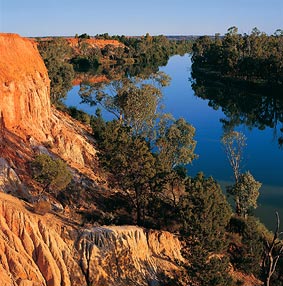 There is a comment in today's Australian that opens up what is normally remains hidden behind the bland press releases and the sound bites of ministers who have an eye on looking good before the court of public opinion.
The news item says that the South Australian Rann Government has ensured that irrigators will receive an extra 72 gigalitres from the Murray, due to better-than-average rainfall this year.
This has allowed South Australia, along with NSW, to ease restrictions by up to 10 per cent. So irrigators would be able to take up 95 per cent of their annual allocation of water. It had restricted them in June to 55 per cent of their allocation.
The comment that is of interest is the response to a question about where the the water for 500 gigalitres of environmental flows is going to come from. A spokesman for the South Australian Environment Minister John Hill said the source for the large water injection had not yet been decided. However, two possibilities were improvements in irrigation infrastructure, allowing the water savings to remain in the river, and going to the market and buying water. An then this:
'"That way only willing sellers would part with their water - leaving the high-value end of the market in South Australia largely immune," the spokesman said.'
The message? Though the Rann Government is concerned about the River Murray's health, it is the interests of irrigators dominate. We cannot upset the irrigators. That is the bottom line.
Why does this open up what is normally concealed? Consider these remarks by Warren Truss when calling on South Australia to increase its contribution to the river fund. SA, which is at the end of the river, and extracts only 6 per cent of total flows, has imposed a household levy of $30 to raise $79 million over four years as a contribution to river works.
'"I'm disappointed with South Australia's offer," Truss tells Inquirer [The Australian] "NSW and Victoria are putting in about double the amount of South Australia. South Australia's going to have to make a contribution, financially and in giving up water. We'll be looking for a proposal from South Australia for water savings. It can't just be a matter of demands on other states."
Now juxtapose the two comments.
For all its public rhetoric about saving the Murray, SA is concerned to protect its wineries. Water for development is its key concern: managing the river in a sustainable way so that we can continue making money out of it There is nothing said here about SA finding water for the River Murray, even though SA favours using most of the money on buying back users' water rights. In contrast Truss is wanting SA to give up some water for the River Murray.
No way says John Hill, the Environment Minister. He dismisses such comments as bizarre! Water savings must come from the eastern states. SA does not need to help to find environmental flows for the Coorong.
That is what sits hidden behind the press releases.
Posted by Gary Sauer-Thompson at 09:20 AM | Comments (1) | TrackBack
November 14, 2003
Returning water to the River Murray
 The Murray-Darling Ministerial Council meets today to consider ways to improve the health of the River Murray. It is expected to adopt a 5 year river plan to return water to the troubled river.
Judging from the media reports a targeted approach will be adopted.
The focus of the plan is on improving the 4 iconic sites of the Barmah, Koondrook-Perricoota & Gumnbower forests near Echuca, the Chowilla floodplain near Renmark, and the Coorong near the Murray Mouth.
The media reports say the plan:
"....chooses specific forests and wetlands to receive extra water rather than simply proposing extra flows for the whole river, in a change of thinking recommended by the Murray Darling Basin Commission...The plan will devote 500 gigalitres a year... to the four areas, averaged over five years. It is believed the plan revolves around water savings of up to 300 gigalitres a year from "engineering" water use - by covering irrigation channels to reduce evaporation and offering farmers incentives to change their irrigation patterns, among other approaches."
The short term plan is seen as a necessary first step to protecting these iconic sites. The plan will allocate 180 gigalitres to the Murray Mouth annually, and 160 gigalitres to the highly degraded Chowilla floodplain. Hence we may have a process of working on what these iconic sites need to ensure their ecological health. Though the small amount of water will not keep the Murray Mouth open, nor save the Chowilla-floodplain, water is set to be returned to the Murray River for the first time in more than 100 years.
The negative is also important. To flush out the now hypersaline Coorong estuary and keep the mouth open would require at least the full 500 gigalitres, leaving nothing for other sites. There is a long way to go, even though the return of water to the river is historically significant.
This environmental flows strategy is contested by irrigators. Writing in the Australian Financial Review (subscription required, 13, 11, 03 0.78) John Cox continues to beat the anti-reform drum of the "simplistic green lobbying which advocates that environmental outcomes in rivers like the Murray can be improved by increased river flows." Cox says:
"The present debate on the future of the River Murray has been conducted solely in terms of environmental outcomes and the fact that Australians give a 60 per cent weighting to economic outcomes in regional communities [15% each to social and health outcomes and 10% to the environment] along the River Muray does not seem to be relevant to the debate and to the decisions being made."
Cox argues that the environmental scientific approach is simplistic because its strategy of increased environmental flows ignores the economic and political effects of buyback. Cox says:
" ...a reduction in water for irrigation will result in a significiant loss in regional income and have serious financial, social and psychological effects on these [regional] communities."
Cox's intervention appears to be backed Lee Benson's Science Behind the Living Murray report (not online), which was done for Murray Irrigation Ltd in NSW.
The small amount of water to be allocated (ie the 500 gialitres) will not keep the Murray Mouth open, or save the Chowilla-floodplain and the ecology of the river between the iconic sites. Much more water is needed to save these. As The Age recognizes that "more water will eventually need to flow down the whole length of the Murray and not just at environmentally sensitive sites." A third of what needed has been allocated. The next step is for the Federal Government to make a long-term commitment to restoring flows to the whole river when it meets again with the states in April.
Update
As expected the Murray-Darling Basin Ministerial Council approved the Federal Government's 500-gigalitre "first step" flows to six iconic river assets, with the Hattah Lakes in Victoria's north-west being added to the list of sites to get the extra water.
As expected Federal Government ministers assured farmers that most of the 500 gigalitres (billion litres) promised for the Murray yesterday would most of the water will not be bought from farmers and that there will be no adverse social or economic impacts on river communities.
As expected the Miinsterial Council agreed to invest in water saving techniques and engineering works to save substantial amounts of water, rather than buy back water allocations on the market and so reduce the over allocation of water licences by the basin state governments.
Posted by Gary Sauer-Thompson at 01:15 PM | Comments (0) | TrackBack
November 05, 2003
free trade and water
There was a good comment in my earlier post on Australia's proposed Free Trade Agreement (FTA) with US from Roy Whyte at the Canadian Democratic Movement. Roy gives a Canadian perspective based on their experience of both FTA and NFTA with the US. I am posting his comments here in full.
Roy says:
"As the source of much of argument regarding the pending Australian-US trade agreement, let me say this - beware.
Having rules and groundwork for trade is great and is necessary but beware of the beast dressed as a benign object. Canada and Mexico were duped into believing many of the very same things your government is telling its people.
They will claim an increase in market access and with that will come jobs and an increased economic outlook.
Its all smoke and mirrors. America has no interest in free trade - we Canadians know that first hand. Canada has seen a net decrease of over 150,000 jobs since ratification. Our GDP growth in the 1990s was the worst since the Great Depression. Innovation and research has plummeted as our companies are no longer under Canadian control.
Another example - even though under our agreement NAFTA - that we are to have equal access without tariffs or duties that is not what is happening. Softwood lumber is a major export for many Canadian provinces and we have seen not once or twice but a DOZEN attempts by the US government to put duties and penalties on Canadian exports of softwood lumber as they claim we dump onto their markets. The WTO has decided against the US each and every time. This has NOT stopped them from doing it again. At this very moment 1000s of Canadians are out of work as a result of a 28% duty slammed onto our exports of softwood lumber. So much for free.
It does not stop there - wheat, tomatoes, potatoes and other goods have seen duties put on as a simple result of us having a competitive advantage over our American counterparts. Do not trust the snake oil being sold by Howard.
It gets even worse. With time and increased access to your markets you will see a sudden and dramatic increase in buyouts of your companies.
In Canada we are nearing 50% foreign ownership of our industries and corporations - with most being American owned. Of Canada's top 500 companies a full 35% are foreign owned.
In 1997 there were 41 large Canadian petroleum companies. Today there are six. Of the 35 that no longer exist, U.S. companies bought up 21.
In energy and in resources, Canada's ability to control its own supplies and prices has been drastically reduced. Canadian oil and natural gas prices are now set in the U.S. If the U.S. faces a severe shortage and their market dictates huge price increases, too bad, Canadians will face the same high prices. Canadian oil and gas can no longer be sold at lower prices in Canada than the prices we charge Americans.
With the ratification will come direct competition with US companies. This means there will be tremendous pressure on your government to steadily cut corporate tax rates and the rates for the rest of the wealthy - the trickle down theory - or the staying competitive line.
With those decreased tax rates will come massive social cuts in health care, social services, aboriginal monies, and a tax shift onto the lower classes. Once they begin to suffer, Howard and the like will claim privatization will be the answer to all your ills. Don’t believe it. Every single sector of the Canadian economy that was public and turned over to private industry has seen - increased costs, degradation of services, and even avoidable death through unclean water and food.
Contained within the trade deal are sovereignty killing clauses such as our infamous 'chapter 11'. What that does is gives investors and corporations the same and increasingly more rights than private citizens. For example, when Canada through our House of Commons banned a toxic chemical known as MMT because it was shown to cause nervous system disorders, the Ethyl Corporation of the US sued under 'chapter 11' claiming lost profits, and future lost earnings. Even though the chemical was banned under democratic procedure for the benefit of all Canadians it was overturned, and we had to pay compensation! And it goes on... the Sun Belt Water Company is suing for over 1 billion dollars because the Canadian provinces voted not to allow bulk water shipments. In essence, your government will become a powerless tool of the people while foreign companies control your national agenda all in the name of 'free trade'.
I could go on and on and on about all the ills hoisted upon us through our one-sided trade deal with the US but I think you are getting the picture..."
We can broaden these insights. Why not look the effect of the FTA on Australia's environment on the what if assumption that the FTA does go through. This is what our policy makers should be considering.
I reckon this account by Kenneth Davidson is about right. Davidson suggests that the negotiations should be shelved. He is working from a report published by the newly established, non-partisan, Melbourne-based think tank, OzProspect on the commissioned a report on the environmental consequences of an AUSFTA. An FTA with the US will affect Australia's environment through increased agricultural production for export. Davidsons says:
"The study concludes that if the US market for primary products is opened up for Australian farmers, the resultant expansion in agricultural production would increase Australian water use by up to 1.3 trillion litres a year - almost as much as the entire national domestic water use."
That's an increase of around 6 per cent of Australia's total water use. This is at a time when politicians are trying to clawback water from irrigators and return water to the rivers in the Murray-Darling Basin to improve their health. It is also at a time when governments are trying to repair the country from salinisation and landclearing. An FTA with the US will exacerbate environmental degradation in Australia.
So where is the report on the environmental impacts of most trade agreements by the Howard Government? Are they going to undertake such a review reviews that would include significant opportunities for public involvement?Should not an environmental impact statement (EIS) be mandatory to ensure that environmental considerations are taken into account in m negoitations?
Don't hold your breathe for an EIS.
Posted by Gary Sauer-Thompson at 11:21 AM | Comments (4) | TrackBack
September 30, 2003
something different required
I see that Bjorn Lomborg, the sceptical environmentalist, is in the country for a lecture tour of Australia as a guest of the Institute of Public Affairs. He delivers the H.V. McKay lecture in Melbourne tonight. He comes with a background of controversy.
Good luck to him on the tour. I hope the environmental debate in this country is stirred up and is lifted to a level above the polemics. It sure needs it. The conservatives offer us Allan Wood, who wears the mantel of science to dismiss green propaganda; whilst the Quadrant crowd wear the mask of scientific reason to dismiss environmentalism as a religion. Both run explicit anti-environmental agendas. They are engaged in politics not science, have an explicit disregard for ecology and a onesided understanding of the relationship between economics and ecology.
Now Tim Blair says that the Wood piece is a good read and recommends it. So what is Wood saying? Well, he usefully sets up the debate in Australia in neo-liberal terms. He says that:
"A central proposition of Lomborg's that environmental scientists have great difficulty with is that economic growth and rising incomes, once they reach a certain level, are associated with less, not more, environmental degradation -- at least in democratic market economies."
Wood then goes to quote Ian Castles to characterise the other side of the debate:
'"To deny that problems of the environment can be solved by greater wealth and private property rights is dogma, not science," Castles says. An important reason for the association between growth and an improved environment is that growth facilitates new technology which allows higher average incomes and improvements in the environment.'
The description of the issue is okay but judgement is whacky. It is dogma to think otherwise to neo-liberalism. Green dogma vs neo-liberal science. It's cartoon thinking.
Is it dogma to argue that increased economic growth and rising incomes are associated with more environmental degradation in Australia? Not at all. To see this we shift from abstract level to a specific and presssing issue. Only then can we begin to sort through the issues rather than engage in the usual polemics.
So let us take the recent debates about the national electricity market in the Australian Financial Review last week (subscription required, 24th & 25th September, p.63) On the one hand, we have Henry Ergas arguing that the regulated utilities need to be allowed a higher rate of return to finance the new investment that is needed to prevent the lights going out. Regulators, such as the ACCC, should not compromise the incentives for efficient investment.
On the other hand, we have Graeme Samuel from the ACCC that the rate of return is okay, electricity prices are now competitive with other OECD countries, market signals are working effectively to boost investment, and there is greater consumer participation in the energy market through the choice of retailer. The market wilh ensure that the lights will stay on.
I will put to one aside the faith in markets and the spin that the NEM is working competitively. Note the complete absence of any policy concern with the issues of sustainability. It is all all about the market. Yet sustainability sits there under 'new investment needed' It appears in the foreground when we ask: 'new investment in what to ensure the lights stay on?' Up pops investment in coal-fired power stations to generate the extra electricity needed to keep the lights on. Coal fired power stations means increased greenhouse gases. And Australia has a public commitment to reduce its production of greenhouse gases not increase them.
Should we not then make the shift to investment in renewable energy? Should not that be a concern of the national regulator?
So what do the neo-liberals then say? That renewable energy is not cost effective and that it is limiting carbon emissions is not cost-effective. The policy end of sustainbility is effectively excluded by market criteria. So what stands as the policy end is economic growth. That is pushing a political agenda.
As I said above, the debate needs to go up a notch. Maybe Bjorn Lomborg will help the neo-liberal market boys find the courage to throw away their tattered catechism? The line that is learned by rote from the catechism is that those concerned about environmental health have got it wrong because things are pretty okay and they are getting better all the time.
The philosophical assumption of the catechism is the ecology of the continent is only to be considered when it provides benefit or opportunities for economic utility. Somehow I doubt whether Bjorn Lomborg will question that assumption.
Posted by Gary Sauer-Thompson at 12:21 PM | Comments (0) | TrackBack
Water politics
This article is about right. The problem with the overuse and over-allocation of water does lie primarily with the farm (especially in the Murray-Darling Basin) and not the cities.
Yet the cities need to address the way they use water. They waste it on the garden and washing down the car in the driveway. However, we do need to shift from a policy of water restrictions in Sydney, Melbourne and Adelaide to recycling water. That means redesigning our cities to be more sustainable.
I see little impetus for that shift.
Posted by Gary Sauer-Thompson at 11:44 AM | Comments (1) | TrackBack
September 26, 2003
Water politics
As we have previously seen the claims from the hardline irrigators in the Victoria and NSW to environmentalists has been negative. They claim that the River Murray is good shape, that there is no need to cut allocations to irrigators and that ecological science has not shown the ecological outcomes of environmental flows. This has been their standard response to the Living Murray Project's claim that a minimium of 1500 gigalitres of environmental flows is necessary to restore whole of river benefits. That claim has been supported by ecologocal scientists as Alan over at Southerly Bluster highlights. The background to this political conflict is here
The public policy response has been to use the $500 million from CoAG to improve the health of 4 iconic sites. These are the Coroong/Murray Mouth esturay and Chowilla floodplain (scroll down) near Remark in SA; and the Barmah-Millewa Forest floodplain (near Eucha and Deniliguin) and the Gunbower-Koondrook wetlands/forest near Barham in Victoria/NSW. These iconic sites have the highest environmental priority on the River.
Apparently the rehabilitation plans and go ahead will be given at the CoAG meeting in November. That means the policymakers are thinking in terms of lower environmental flows than 1500 gigalitres; or more accurately have adopted an implementation strategy that allows time for the irrigation industry to adjust. Such a strategy would begin by securing water relatively slowly. Consequently, the environmental benfits are slow in coming and some irreversible ecology losses will occur.
There is the question of where the water is going to come from. The irrigators around Shepparton are saying that they are confident that no water is going to be taken from irrigators and urban consumers for environmental flows. And Murray Irrigation Ltd in southern NSW is helping to lead the irrigator's counterattack by denying that the overallocation of water is a central consideration.
Why are they confident? They have been assured they say. By whom? That woudl be the Minister? Would that be Warren Truss? The National Party have control of water reform in the Murray-Darling Basin. They have got property rights and water trading for irrigators. The next step is to ensure that there will be no major upheavals within the agricultural community from addressing the problem of environmental flows. When they hear this talk about water reform for environmental flows and about plunging agriculture profits, decline in jobs, communities reeling. Why 1500 gigalitres would put half of them out of business. So there is going to be lots of community consultation.
So reform can only move slowly. Very slowly. And that means? If there are to be no cutbacks in irrigator allocations in the short-term, then that leaves us with a series of engineering works and operational changes to improve environmental flows. That means? Dredging the Murray Mouth and pumping water for 30% of the Chowilla floodplain. And the other 70%? Why that would count as an irreversible loss. Tough. But it gives time to the industry to adjust doesn't it.
Posted by Gary Sauer-Thompson at 11:35 AM | Comments (0) | TrackBack
September 10, 2003
Water politics
According to a story in the Australian Financial Review (subscription required, 08 09 03, p. 6) farmers around Mildura are firming in their opposition to water reform in the Murray-Darling Basin. Theirs is a similar position to that defended by George Warne from Murray Irrigation in Southern NSW in recent months. For an indication of the latter's position see and here.
The argument of the Mildura irrigators is that the River Murray is not dying from overuse. The River Murray is not on life-support. It is in good shape. It is teeming with life. The irrigation infrastructure has ensured that water stayed in the river during the drought.
So there is no need for environmental flows because the river is not being degraded and it is not getting worse. If the River Murray is not getting worse, then there is no need to cut back on allocations to irrigators for environmental flows.
The evidence? Its not science. The River Murray looks okay from where I live and work in Mildura. That is considered enough to refute ecological science.
It's hardly a knockdown argument. It flies in the face of the Federal Governments' own National Action Plan for Salinity and Water Quality.
The second strand of their argument is that the assumptions of the Murray-Darling Basin Commission's Living Murray's Project are flawed. This is advanced by Sussan (that's two 'ss') Levy to contest the broadsheet view that the River Murray is dying. She says that the proper way to view the River Murray is from the perspective of the agricultural production in the Murray-Darling Basin.
The continued viability of agriculture is the primary public policy concern, not environmental flows. Hence the resource needs to be carefully managed and better understood so as to get things under control. That will take care of the River
Why is this the proper way to view the River Murray? Because the River Murray is a resource and not an ecosystem. And that difference is the core bone of contention. When you put that together withe the dismissal of science in favour of personal observation you get the rejection of an ethically informed ecological science.
Posted by Gary Sauer-Thompson at 03:51 PM | Comments (0) | TrackBack
September 01, 2003
Water wars: its written in the wetlands
The pro-irrigator groups in the Murray-Darling Basin continue to speak up against water reform in the basin. The way they do so indicates that they are anti-environment. This confirms my earlier suspicions that they have decided to oppose government attempts to return water to the River Murray for environmental flows. What we have here is a recycling of the old 'zap the cap'---of the 1990s National Party of Australia.
The latest shot in the water wars is this text by John Cox in The Australian.Cox, a citrus irrigator from the Riverland in South Australia, is responding to the water reforms announced by CoAG last Friday. He confronts the green groups by ignoring CoAG's creation of a national property rights regime and concentrating on CoAG's modest proposals to buy back irrigation water to improve the ecological health of the River Murray.
Cox is concerned because the need for greater environmental flows in the Murray-Darling river system does not sit well with irrigators, whose water allocations and annual income have been cut substantially this year due to drought.
That is true. We did have a drought. And more water for environmental flows for the River Murray does mean less water for irrigators due to the over-allocation of water entitlement by state governments. Hence clawback. Some form of government buy back of irrigator's water entitlements is needed in terms of equity. However, Cox does not question this buyback on compensation or equity grounds. Rather, he argues a case that buyback is not needed at all. It is a say no to environmental flows.
To his credit Cox puts the question openly:
"The Council of Australian Governments agreed to a $500 million fund to help buy back irrigation water from agriculture to increase environmental flows. Not surprisingly, the Wentworth Group, the Australian Conservation Foundation and the Living Murray initiative of the Murray Darling Basin Commission have supported the initiative. The Murray River is in decline, they say, because too much water is being taken out for irrigation.
But is this really true? And is even more money needed to "save" the Murray River...? As a South Australian citrus grower who depends on irrigation water from the Murray, I don't think so."
Okay. The position is clear. The River Murray does not need environmental flows. So why not? What is the argument?
Sadly, it is not much of one. Cox makes the usual gesture to the case made by the Institute of Public Affairs that there is no scientific evidence for declining river health and that the evidence points to decreasing salinity etc. So the River Murray does not need saving. I have dealt with that here.
Cox then refers to the work of John Pigram from The Centre for Ecological Economics and Water Policy Research. According to Cox, Pigram argues that the:
..."link between ecological processes and designated flow regimes is not clear and that there is therefore no guarantee that greater environmental flows will improve environmental outcomes...But there has been no quantitative scientific analysis on the magnitude of environmental flows needed, on ways to minimise these flows and on achieving more cost-effective environmental outcomes by other means than river flows."
Fair enough. The links are not clear and there are no guarantees. Hence the use of the precautionary principle.
However, it doesn't take a lot of science to establish that the red gums on Chowilla wetlands are dying from lack of water and are in need of a good drink. The last flood was a decade ago. Those redgums in the River Murray's floodplain need a flood. Such a flood will have to be created by topping up the winter flows.
Cox would know about Chowilla since the floodplain is in the Riverland. He evades this issue. He says that the information on the Murray-Darling Basin Commission's website is flawed:
"...there is no quantitative economic analysis of the justification for the capping of diversions or for an increase in environmental flows. The economic studies on capping that have been carried out are purely qualitative and quite puerile. There is also no report on how these increased environmental flows will improve environmental outcomes."
This is the old IPA script of 'the greens have no science'. It's a furphy. You do not need to do an economic analysis for Chowilla, a Ramsar wetland of International Importance. Since the construction of Lock 6 in 1930, groundwater under the Chowilla floodplain has risen to within 2-4 metres of the soil surface.
There have been practical experiments done at Chowilla floodplain, which show that giving the wetlands a drink is vital to the ecological health of the floodplain.
The second way Cox evades the issue is to say that environmental flows are wasted water since they amount to stored water evaoporating in Lake Alexandrina. He asks:
" So should environmental flows be increased to satisfy evaporation requirements, given that most of these shallow water storage structures have been man-made? Lake Alexandrina has been changed from a tidal lagoon into a freshwater lake by the barrage at Goolwa."
Lake Alexandrina has become a water storege are for the sake of local irrigators it should be added. That is why the Lake is not managed as it if were a Ramsar wetland by being seasonally raised and lowered.
Cox then makes his position clear. In contrast to the lack of science by the greens we have:
"...the economic costs from reducing water allocations by 35 per cent – as in South Australia – has a direct economic effect on irrigators. After all, they have to modify their irrigation systems and do not have enough water to grow crops properly. In the case of orange orchards, for example, there is not sufficient water allocated to grow the large fruit that is needed for our most profitable export market in the US."
Cox's position is that irrigators cannot have water taken from them because Australia's balance of payments will suffer from reduced agricultural exports. It is the IPA script that there is little evidence to justify a need for drastically curtailing productive agricultural uses of the river to bolster environmental flows. What needs to be protected is the prosperity of farming communities in the Basin.
It's not a plausible argument. Water trading enables irrigators to acquire more water by buying it from low value adding dairy farmers. That is the whole point of CoAG creating a market ---it encourages efficiency in the use of scarce water resources. And water resources are scarce. And the market would work in favour of horticulture since it is a high value added industry.
Posted by Gary Sauer-Thompson at 11:05 AM | Comments (4) | TrackBack
August 28, 2003
Water: three legged reform

Whilst the Institute of Public Affairs (IPA) continues to rail away (also here and here) in public about green groups pushing governments to their democratic limits, the Council of Australian Governments (CoAG) is addressing the need for water reform.
The CoAG meeting tomorrow may be a crucial one in terms of the reform process in water politics. Expectations have been raised that the states and the commonwealth will agree on a national policy that will allow water "rights" (entitlements) to be held without owning land.
This will allow water trading of these entitlements, ensure greater efficiency in the use of water and provide financial security to water users.
We should not get too carried away. That is only one leg of water reform. The are two other legs.
One of them is protecting river health. The issue is simple. There is not enough water to go keep going the way we have done on the past. There is not enough water in the Murray-Darling Basin system for all the entitlements of water that have been allocated by state governments. The over-allocated rivers and groundwater systems need to be bought back into balance by recovering water for the environment. There needs to be a shift in emphasis to ensure that the envvironmental needs of our river syems have the first call of the water required to keep them healthy. There needs to be a reduction of around 25% in water use.
The third leg of water reform is engaging local communities to determine catchment mangement priorities and strategies through a devolution of decision making. People who are required to give up water should be told what environmental assets are being protected and the volumes of environmental water is needed to protect them. We need to ensure a fair transition to sustainablity so that no group (eg., farmers) in the Murray-Darling Basin bears an unreasonable burden. That means, for instance, that there needs to be less dependence in the River Murray for urban water use and a shift to greater recycling of storm and waste water.
It is more than likely that CoAG will only address the first leg of the reform stool.
Posted by Gary Sauer-Thompson at 03:20 PM | Comments (0) | TrackBack
August 27, 2003
Water reform: its only a tiny step
This article on water reform by Tim Colebatch gets it about right. He describes the new policy framework which has achieved a consensus as the way to go and what needs to be put into place:
"The new framework, which builds on work by the NFF, the ACF and the Wentworth Group of scientists, would give a clear legal basis to farmers' water rights, so they can be mortgaged as collateral for loans. It would replace their historic entitlements to a certain volume of water with a more realistic entitlement to a share of the water available.It would set up a water market for the entire Murray-Darling Basin, in which water rights could be traded across states and catchments, regulated by the Murray-Darling Basin Commission. And it would establish environmental trusts as players in that market, bidding for water rights so as to increase the environmental flow."
But as always in this we have reform on the cheap. We have a $500 million commitment to the Murray when $1.5 billion is required, and the Commonwealth is only putting in 25% of that $500 million.
What does that mean? It indicates that the emphasis is long on market reform and short on the environmental side. The Commonwealth wants a deal on the market framework at CoAG with the states without a matching long-term plan to fund the buyback of environmental flows. The buy back of water allocations is not going to be properly funded.
Of course Allan Woods will have none of that. In writing a blurb about this forthcoming policy forum on water pricing by the Melbourne Institute for Applied Economic and Social Research this neo-liberal says that the real problem is the environmental lobby:
"The danger is that politicians will too readily pander to the demands of an unsophisticated environmental lobby, just as they did with the earlier equally unsophisticated irrigationist and protectionist lobbies."
Hardly. According to the neoliberal view of Australian history the old style irrigationist and protectionist lobbies were anti the self-organizing market. They were into command and control regulation. So too the environmental lobby.
Wood is wrong. In contrast to the old style irrigationist and protectionist lobbies the environmental lobby gives qualified support to the creation of a water market; provided there is a commitment to restoring 1500 gigalitres of environmental flows to ensure the ecological health of the River Murray. It is that commitment that is in doubt.
What Wood is saying is lets get the free market working and to hell with the ecological health of the River Murray.
Posted by Gary Sauer-Thompson at 09:11 AM | Comments (2) | TrackBack
August 24, 2003
think tanks & water politics
As usual P.P. McGuiness can be relied on to miss the main point in the debate about think tanks. He sees the criticism of right wing think tanks as an attempt to "demonise those who espouse free market ideas or innovative ideas in social policy." He adds:
"Think tanks are once again in the gun, because apparently there is a sinister network of right-wing think tanks which accept money from commercial enterprises to advance the ideas put forward by the late Friedrich Hayek, and so to serve the interests of business and the rich."
Then we have screeds on what a wonderful fellow F. A. Hayek was.
It's hardly a case of the demonizing of sinister networks in order to block innovative ideas. It is more a case of bad ideas and politics in relation to the dying wetlands of the River Murray.
In an earlier post on water politics I asked:
"So on whose behalf is the IPA [Institute of Public Affairs] firing the salvoes in the water wars with the gloom and doom environmentalists? The think tank is getting money for the environmental project but they are turning out such poor work that their ideas won't spread much. The faith in think tanks by those funding this IPA project is misplaced. They may get the headlines but that old developmentalism is well and truely dead, even when it wears the new market clothes."
On behalf of the farmers, is the answer judging by this address by Dr Mike Nahan, Executive Director, of the IPA In the light of the Howard Government putting up money ($125) for environmental flows for the River Murray, we have these polemics by Nahan about undemocratic green groups who have influence over the liberal state. These radical groups are:
"...seeking to exploit environmental concerns as a means of revolutionising society and controlling commerce...[they are] fundamentally at odds with the broader interests of society...They have now shifted their focus from forestry to farming, and are busily spinning their destructive web...we have allowed the spin merchants to present themselves as experts, summarising the 'received' research on biotechnology, diagnosing the state of the Murray River and lecturing farmers on improving farm management. We have allowed the spin to masquerade as science."
The green groups are a minority group. Their interests are sectional ones and stand for the inevitable destructiveness of commerce and modernity and the end justifying their means. They are ensconced in positions of influence in the bureaucracy, research institutes, advisory bodies, and regulatory agencies and have sway over the mainstream parties. The liberal state has become an environmental state.
So who speaks for the public interest these days? It is the farmers! As Nahan says: "One thing is clear: the farming community must confront the Green movement."
The farmers must fight the green campaign to save the mighty Murray because this at the expense of the farmers.
Why the need for confrontation, given this process? Nahan says that is because:
"The Greens are developing a 'victim versus villain' scenario, where they play the role of saviour. In the latest version of this drama, farmers are the villains and the victim is Mother Nature. The Greens have convinced large sections of the public that you---the farmers---are the villains raping mother-earth."
This is polemics, crude polemics at that. It has very little to do with public policy. It is the politics of a farmer fightback against the the liberal state's policy of restoring the environmental flows for the River Murray.
What is this fightback? It is farmers defending their property rights against the liberal environmental state and reclaiming science to confront spin.
Which farmers have to fight back? It cannot be all farmers, since compensation for reduced allocations is a part of the recovery of environmental flows for the River Murray. It is those farmers who are opposed to the recovery of environmental flows for the River Murray.
It is a sectional interest group pretending that they speak on behalf of the economy, agriculture and farmers. So the IPA does the job for them.
Posted by Gary Sauer-Thompson at 12:59 PM | Comments (0) | TrackBack
August 19, 2003
Coral reefs under threat

The BBC has a story on the slow bleaching of coral reefs around the planet. (Link courtesy of kenrufo This is Not a Blog). The background to the mass bleaching can be found here.This si the Townsville Declaration. It says that:
"Marine protected areas are currently the best management tool for preserving coral reefs, especially for extractive activities such as fishing. To be effective, 30 - 50% of the available reef area should be no-take (no fishing) for long-term protection of coral reefs and their services."
Coral bleaching is now recognised as probably the primary threat to coral reefs anywhere. That includes the Great Barrier Reef in Australia, as the 7.30 Report indicates. The Reef has long suffered from the negative impact of agricultural activity along the coast.
Posted by Gary Sauer-Thompson at 02:32 PM | Comments (0) | TrackBack
August 17, 2003
The green touch when the lights go out
I have just come across Drew Hutton's Greenblog. Drew rightly fingers the Beattie Government for its decision prior to the 2001 election to build the Paradise Dam on the Burnett River as pork-barreling. That dam is going ahead even though environmntal flow targets will not be met. Developmentalism rules. This time it is propping up a failing sugar industry.
As Jack Robertson notes:
"The truth is that neither mainstream party in Australia is truly serious about Green issues...Conservatives and neo-conservatives increasingly dismiss them outright, while Progressives usually still pay patronising lip service only, seeing such matters as just another opportunity to rope in a few extra bleeding heart votes by cynical, opportunistic default....I realise that the gap between the expressed ideals and the dirty daily realities of traditional political groupings has been rendered too wide by the entrenched habits of pragmatism. There is always a 'reason', an 'excuse' for the jettisoning of principle by our two mainstream political groupings, and the net result is two mainstream political groupings that operate according to no over-arching principle at all."
Jack argues that the Left and Right that so animates the OZ bloggosphere is a dead division as ther is only the fight for raw power with a little half-hearted window-dressing to disguise that fight.
What does Drew Hutton offer? He has given a recent speech to the trade union movement. In it he connects the Greens to the social democratic a political tradition in a critical way. Drew says:
"...many Greens would argue that traditional social democracy has difficulty incorporating environmental arguments into its perspective, is not oriented towards the rights of future generations and is often too concerned with saving capitalism from itself rather than transforming it."
Drew says that the Australian Greens work within the social democratic tradition because:
"..green politics asserts that the market, of itself, is inherently destructive and cannot deliver social justice or environmental outcomes and therefore, it is only through government regulation and intervention in economic planning that the public interest, rather than merely private profit, can be served."
He argues that a renovated social democratic strategy is still there pushing industry in the direction of innovation and sustainability will not come from the ALP.
To see this you have to look at the support the ALP has given to the establishment of a national electricty market with little to no commitment to sustainability. They bought the vision that the deregulation of the power industry would enable the discipline of free markets to generate just the right amount of electricity at the right price. Yet what we have experienced in South Australia are rolling blackouts and US owned NRG ripping money out of the state from a shortage of supply during demand peaks during the summer.
As Southerly Buster notes the recent blackouts across North America highlight the flaws of the deregulated market. Robert Kuttner says thare are three main flaws:
First, there is a fairly fixed demand for electricity and generating capacity is tight, so companies that produce it enjoy a good deal of power to manipulate prices.
Second, the idea of creating large national markets to buy and sell electricity makes little sense as it consumes power to transmit power across vast distances.
Third, under deregulation the state utilities no longer have an economic incentive to invest in keeping up transmission lines. Antiquated power lines are operating too close to their capacity. The more power that is shipped long distances in the new deregulated markets, the more power those lines must carry.
What we have in both North America and Australia is a is an ancient electric grid that's obsolete if not obscene.
"It is a massively fragile ... device that dangerously and inefficiently carts around electricity from expensive, polluting and extremely unsafe central generating plants to buildings that waste massive amounts of energy and generate none."
As Harvey Wasserman argues the whole electricity system demands a green deconstruction:
"Solar technologies are ready to make energy self-sufficiency a tangible reality. Photovoltaic cells on rooftops and embedded in windows can produce grid-free electricity, with battery or fuel-cell backups. Geothermal power can heat and cool with nothing but the power of the earth's crust. Methane digestion can turn waste into usable gas. Basement generators can use biomass fuels like ethanol and soy diesel for off-grid self-sufficiency."
It's a more decentralised approach. The aim of the green technologies is not to:
"... provide 100% of a building's energy, but can gradually make them increasingly self-sufficient. Meanwhile more efficient heating, lighting and cooling systems can reduce demand. Windows that actually open and close can balance usage, building by building."
Instead of this green public sense, we have the celebration of the swashbuckling, risk taking entrepreneur. This is oen who is willing to hazard everything, takes immeasurable risk and calls foreth an endless stream of invention and enterprise. This is the ethical subject of capitalism par exellence, and it takes us beyond the thrifty, utilitarian world of rational calculators.
Posted by Gary Sauer-Thompson at 11:34 AM | Comments (0) | TrackBack
August 13, 2003
Water politics and faith

Despite the recent rains the Murray's mouth remains closed. The river is not a river. It is a series of irrigator pools. And while the dredging of the mouth continues, little action is being take on keeping 20% of the flow in the Murray-Darling in the river. It's a tough one.
Let us pick up on a previous debate with John Quiggin. Water politics is not about whether pre-modern or modern societies are more sustainable. It is about the way we in modern Australia have given priority to wealth creation at the expense of protecting the environment.
The use of science and technology to reshape nature to make our deserts bloom has given rise to the current situation where there is not enough water to satisfy both the needs of farmers and to ensure the ecological health of the environment. It is not just a question of shortage of water--the starting point for neo-classical economics---as there has also been a huge mismanagment of our natural resources. So why the mismangement?
Some say it was due to ignorance and that we know better now. But that is contestable. The policy makers had enough knowledge about the environmental impacts of the Snowy Mountain Hydro-electric Scheme, but they thought that science could fix the problems. They had a big faith in science and the technical fix to solving problems. This faith in Enlightenment progress covered over a flawed Baconian Enlightenment. The old utilitarian conception of developmentalism had no understanding of the ecological limits of the Basin. Nor is nature akin to a piece of plastic that can be moulded by the human will in any way that is desired. Nature, or the ecology of the Basin, has its own dynamic and tendencies, as we are now discovering with dryland salinity.
Peter Cullen, the public face of the Wentworth Group, talks about getting the policy framework right. If we do---he means creating an open market where landownership and water allocation are separate issues---then agricultural production in the Murray-Darling Basin could double on half the water used now. It's an entoxicating vision. As a knowledge broker he has the ear of governments. They accept his way forward. He is very persuasive.
Those old agrarian socialists, The National Party of Australia, has embraced the free market. Buy water, sell it, do want you want with it. You can make money from it. The new message is: the days of command and control, of governments telling farmers what they can and cannot do, have are gone. That's history. Let the marketplace decide how our rivers run. When you hear them speak in Canberra you can be forgiven for thinking that they have got religion.
Farmers are worried. They hear this message about the free market sorting out what farmers can and cannot do through the price mechanism. The farmers think about it and ask: what if all the water from a particular region is traded away? Do the people in the region then pack up and go and live in Sydney? Aah, say the free marketeers. Our farmers are now more efficient in the use of water. That is good for the economy. And good for the environment. But how that will be so is rarely made clear. No worries. What you need is faith. Faith in market forces to sort things out for us.
There is so much faith amongst the economic enlighteners. But it is not a case of keeping the government out of the way to let the spontaneous market work its wonders. The old command and control bit refers to the government impeding the production of wealth and causign impoverishment. That overlooks the little problem of how the state intevenes to achieve environmental flows that is so crucial to the health of our rivers. The National Farmers Federation (NFF) and the Australian Conservation Foundation (ACF) have come up with some principles for a strategic policy framework. And the Wentworth Group has just released a Blueprint for Water Reform. The iron cage of liberty beckons.
If water reform in the Murray-Darling Basin continues in terms of ever more plans that may be implemented at a CoaG meeting, then the level of public debate is low. Two examples will suffice. There is an article in The Advertiser about water politics called Water Raids Across Border. Written by Catherine Hockley, it refers to the effect of water trading on South Australia. Hockley reports:
"Irrigator Tony Sawers, who also owns a Flinders Ranges station, has bought six farms near Jervois with water allocations totalling up to 3000 megalitres. He is already destocking the land of dairy cattle in the hope of temporarily transferring water this season to irrigate more high-value crops on hisproperties in the drought-stricken Goulburn system, in northern Victoria."
Fair enough. South Australian winemakers have been buying interstate water for their vineyards. This is a shift from low value users (dairy farmers) to high value ones. It is what the market does best. So why should the unmetered Lower Murray dairy farmers on the reclaimed swamps between Mannum and Wellington be exempt from this water trading?
Hockley takes a different stance. She says:
"It means that a vital water flow for the struggling upper South Australian reaches of the River Murray will not enter the state."
Now she cannot be referring to environmental flows as there are none. Nor can she mean that the irrigators in the Riverland will go without water as they have their own allocations, and the sale water had been already allocated. It is not free. This can only mean that Hockley thinks that allocated water flowing down the river to the Lower Murray Swamps is akin to an "environmental flow" until it reaches the lower Murray Swamps.
I presume what Hockley means is that it is better to have more, rather than less, water flowing down the river into South Australia. Yes, but that it is parochial whingeing. Why don't South Australian's start addressing ways to increase environmental flows for the River Murray through recoverying water from within their boundaries? Why don't they start getting serious.
The Lower Murray Dairy farmers are very vulnerable in the marketplace. They do need to clean up their act: they are very inefficient in their use of water; do not prevent pollution from the farms flowing back into the river; and their farms are need for rehabilitation. They are in the process of being rationalised as farmers sell off water allocations and properties. So they are vulnerable to being bought out by the more entrepreneurial interstate irrigators.
If South Australians do not like this, then an opportunity exists for the SA government to buy out the water allocations of Lower Murray dairy farmers for environmental flows. Then we can have water trading within environmental limits. But don't hold your breath for the Rann Government to intervene in such a way. They continually evade any action within their territory.
Going beyond media events and grandstanding means taking on SA Water to prevent them from buying up the farms in the lower Murray swamps and then onselling the water for profit. The Rann Government should direct SA Water to put that water in a water trust to help restore environmental flows for the Murray. They will avoid it making any moves under the cover of saying that environmental flows are a national problem in need of a national solution.
Another illustration of the low quality of public debate is the intervention by the Institute of Public Affairs (IPA) with the claim by Dr. Jennifer Marohasy of their Environmental Unit that the Murray River is doing just fine. Who are they trying to kid, when even the Howard Government understands that salinity is a bread and butter issue.
Marohasy's argument is that salinity levels at Morgan are decreasing. That's true---it is diue to the success of Salinity and Drainage Strategy. What Marohasy fails to address is the threat of dryland salinity that is rendering widening areas of land unusable, the lack of river flow, the near extinction of various aquatic species from pollution, erosion and reduced water flows. Nothing is said about our highly subsidised and unsustainable farming practices. These are subsidised by cash for droughts, floods and poor markets. Unsustainable because of the acceptance of high levels of degradation to our groundwater, rivers, wetlands, esturaries and coastal waters.
So on whose behalf is the IPA firing the salvoes in the water wars with the gloom and doom environmentalists? The think tank is getting money for the environmental project but they are turning out such poor work that their ideas won't spread much. The faith in think tanks by those funding this IPA project is misplaced. They may get the headlines but that old developmentalism is well and truely dead, even when it wears the new market clothes.
Posted by Gary Sauer-Thompson at 05:25 PM | Comments (4) | TrackBack
August 06, 2003
things are warming up
If this report is right, then it is not good news. (Link courtesy of kenrufo over at This is Not a Blog). Alaska and the Arctic are warming up fast.
This is the website where the Arctic Climate Impact Assessment can be found. It is an:
"... international project of the Arctic Council and the International Arctic Science Committee (IASC), to evaluate and synthesize knowledge on climate variability, climate change, and increased ultraviolet radiation and their consequences."
I'm trying to find similar work on Antarctica. I remember seeing images of ice sheets cracking and falling into the sea just recently. I presume it was a part of the West Antarctic Ice Sheets that was disintegrating. Or was this on the eastern side?
I have come across this old report and a more recent one.
Posted by Gary Sauer-Thompson at 12:16 PM | Comments (0) | TrackBack
July 29, 2003
on the nose

This is one of the reasons why I dislike the America represented by George Bush. And Bush says that opening up wilderness areas to loggers is a fire-prevention plan. It's a knock down argument.
He's an oil man without the green wash. His agenda is to roll back green legislation that protects the environment. It's about chain saws in national parks.
Posted by Gary Sauer-Thompson at 09:23 PM | Comments (0) | TrackBack
July 17, 2003
"Fixing" the Murray
I see that John Quiggin has a post on River Murray. His argument is about the cost to fix the Murray. Many of the current proposals, he says, are outlandish in terms of the amounts involved. So he has a quick look. It is good to see economists getting involved in the issue.
John says:
"I thought of the following as a back-of-the-envelope exercise in cost estimation. Suppose the government bought back 1500GL of water at $40/ML/year, this would be an annual payment of $60 million, which could be financed from a capital sum of $1 billion at 6 per cent interest. I'd guess that increasing natural flows would solve about half the problem, which would imply a total cost of the order of $2 billion. This is incredibly crude, but I'd think the order of magnitude $1 billion - $10 billion is about right, and that we are likely to end up spending something around the low end of this range."
I have some queries.
First, this seems to imply that governments enter the water market each year and buy the 1500 gigalitres required for enviromental flows. Why that option? Why not reduce the cap by 10-12%. Why not buy back water licences permanently? Why not take farm land out of production--pay the farmers to leave?
Secondly, we have $1 billion for environmental flows and $1billion for the other half of the problem. What is the other half of the problem? Land restoration? Reducing water consumption? Shifting to sustainable agriculture?
Thirdly, how do we go from $2 billion to $10 billion? Is this an insurance for the rapid rise in the cost of water due to increasing shortage?
Fourthly, I appreciate its back of envelope calculations but John does talk in terms of "fixing" the Murray. It is not clear what 'fixing' means in this context. It is often suggested that the "fixing" problem is about the demand of the domestic consumers, who are unwilling to pay a higher price for their vegetables.
This was implied by Ticky Fullerton in her 4 Corners Sold Down the River. Sure those living in the cities need to change their habits in the use of water, and we need to redesign our cities to make them more sustainable. But the centre of the "fixing" problem is the unsustainable agricultural practices of farming systems (eg., the wine industry) that are now geared to exporting their products to overseas markets.
The queries are offered in the spirit of dialogue and debate.
Posted by Gary Sauer-Thompson at 01:58 PM | Comments (1) | TrackBack
July 15, 2003
how things turn around
I see that Gareth Parker supports those, such as science blogger Aaron Oakley, who characterise the environmental movement as fanatical and as having abandoned science and reason. Gareth's position is that green policies encourage reactionary and backward looking governments to adopt anti-development policies.
This anti-green position that denies its opponents any form of rationality has great insight. Its has depth. It opens up new ways of looking at national politics. It helps us to understand what eludes us in terms of public policy.
Why, it was only the other day when I was in Canberra that I heard John Howard the Prime Minister talking about green policies on water and salinity. The big plan was announced with much fanfare, and water reform has now become a central part of the Howard Government's third term agenda.
And it was only last night on national television that I saw John Anderson, the Deputy Prime Minister, saying that the Murray-Darling Basin needed environmental protection and water reform.
As I understand it, John Anderson has been placed in charge of water reform. And big things are expected of him. I hear around the traps----the corridor gossip you know--- that John will deliver before he retires to the farm. It's an obligation thing he has with the nation.
I have to admit that I never had considered the Howard Government to be reactionary, backward looking, fanatical and abandoning science and reason.
But there you go. Its a new perspective on conservative politics.
No doubt we can expect dire consequences from the imposition of the forthcoming anti-development policies on irrigators. Make no mistake folks. Its dire. It will leave the country sterile and bankrupt, with no future for us. If the Howard Government continues on its current path of ill-considered and irrational decisions, then Australia will be exporting people soon. Our destiny, it seems, is to become a banana republic.
Posted by Gary Sauer-Thompson at 12:18 PM | Comments (3) | TrackBack
July 07, 2003
Green Debate
You rarely see a debate about the causes of unsustainability in the mass media in Australia. What you do see is neo-liberals repeating their lines of the Washington consensus that sustainability can be achieved through a competitive and efficient market shifting water usage from low value to high value irrigators. Or you hear neo-liberals denying the need of environmental flows for the River Murray.
So this article in The Australian by William Lines comes out of the blue. It is an extract from People and Place (no link to full article). Lines' case his simple. The Australian Greens have sold out their greennness. They are more red than green.
"The Australian Greens no longer speak for conservation in Australia. Why? Because of their increasingly left-wing pose and their rejection of population growth as a cause of environmental decline. In 1995, the party called for stabilising Australia's population and reducing immigration. By 2002, the Greens had not only abandoned this guiding principle but had reversed it. Today, they openly encourage immigration."
According to Lines, the Greens have embraced a Left agenda, as they have replaced their traditional concerns with population and environmental degradation with a social justice platform. They have done so to increase their electoral vote to win more seats. This means that instead of being "neither Left nor Right but in Front", the Greens are now solidly aligned on the Left.
'Replaced' is too strong. Supplemented their environmental concerns would be more accurate, since Bob Brown continues to talk about stopping landclearing in Queensland and protecting old growth native forests in Tasmania. But it is accurate account of the transformation of the Australian Greens.
Lines' chief concern is with population numbers because he sees this as the chief cause of environmental degradation. He accurately describes this degradation:
"In recent years, a succession of government and non-government reports has highlighted the growing human impact on nature in Australia. We now know more than ever about the deteriorating conditions across the continent such as declining biodiversity, fading vegetation cover, failing rivers, advancing salinity, collapsing marine ecosystems, and the subversive spread of exotic species."
True. But it is not obvious that has been caused by population growth--too many people on the land. The carrying capacity of the land has been exceeded in the Murray-Darling Basin. However, this has been caused by developmentalism in the form of irrigated agriculture. That mode of agricultural production is not only unsustainable in terms of current water use & landclearing; it is also the way agricultural producion system uses water. That use is unsustainable because its leakiness (ie., water flowing down to the water table) causes the saline groundwater to rise. So we have salinised grapes. That is not good news for the Australian wine industry.
What we have is dryland salinity and a wine industry that is unsustainable with its current practices of going for volume and exports through irrigation. Eventually the grapes become too salty for high quality wine. As the wine tasters taste the salt in the wine so Australian wines will start being rejected by upmarket overseas distributors.
Posted by Gary Sauer-Thompson at 10:47 AM | Comments (4) | TrackBack
July 05, 2003
more good news
I meant to mention this yesterday. It says that the Bracks Labor Government in Victoria has announced that:
"All new Victorian homes will have to have solar hot water or rainwater tanks under building regulation changes to be announced today."
The report says that the "changes are part of the State Government's mandatory five-star energy standards to come into full force in July 2005."
And the old homes? Should not they be encouraged to convert?
It should be South Australia leading the way on shifting the policy compass to sustainability, not dragging its heels.
Libertarians will dislike the mandatory bit. They will see the heavy hand of the environmental state crushing human freedom to do as we please. But the mandatory bit is required for the sake of the common good.
Posted by Gary Sauer-Thompson at 05:21 PM | Comments (0) | TrackBack
blocking 'development-at-all-costs'
This is very good news. Ningaloo Reef on the seaward side of North West Cape in Western Australia has been protected from 1980's developmentalism. This development Coral Coast Resort--- by Coral Coast Marina Development Pty Ltd was in the form of marinas, hotels, private villas and shops being built near the reef at Mauds Landing. The development has been rejected by the Gallop Labor Government due to Ningaloo Reef being an environmental icon of international significance.
The pro-development lobby would reject the decision as another example of disintentives to investment and weath creation. They see it as anti-development rather than sustainable development.
Posted by Gary Sauer-Thompson at 04:45 PM | Comments (2) | TrackBack
July 04, 2003
a catechism of doom?
The debate over environmental flows for the River Murray has been picked up by Alan Moran of the Institute of Public Affairs. Moran has written an article in The Australian Financial Review (no link, Wednesday, 2 July, 2003, p. 55) entitled 'Go with the flow on river management.'
The article is one strand in a political campaign to convert irrigator entitlements to access to River Murray water into property rights to ensure ongoing wealth creation and prosperity. The article is pretty bad when you look at the arguments. I am suprised the AFR has printed something close to junk journalism from a high profile public policy institute.
Moran's argument is that there is little evidence to justify a need for drastically curtailing productive agricultural uses of the river to bolster environmental flows. What needs to be protected is the prosperity of farming communities in the Basin.
He starts by addressing the Wentworth Group's recent text Blueprint for a Living Continent' as part of the campaign to save the Murray. Moran says the Blueprint text:
'....proclaimed our land management was causing our rivers to die and our topsoil to blow away, threatening our future capacity to farm. [The Wentworth Group] is the spearhead of a high-powered campaign calling for action to "save the Murray". The crux of the campaign is a catechism of doom about salinity in the Murray (sic) Basin.'
This is a catechism of doom, says Moran, because the evidence does not support the Wentworth Groups' thesis that bad land management practices have negative environmental consequences. Moran argues this case by trying to show that the green arguments about river flow, salinity and habitat do not stand up to scrutiny.
1. on the issue of natural flow Moran acknowledges that the River Murray is a working river system that has been radically changed since European settlement. But:
'...it remains swimmable and fishable.... it is even flowing now, in the middle of a "one in a hundred-year" drought.'
The River Murray is not flowing. There is river flow over the Blanchetown lock, but there has been no river flow over the Goolwa Barrages for some time. That is why the Murray Mouth is closed and the Murray-Darling Basin Commission is dredging the tidal inlet . The Murray is a series of irrigator pools not a flowing river.
2. On the issue of salinity Moran argues that the threat of salinity is being overplayed. He says that:
"..careful management and impressive engineering levels have restrained the river's salinity. Upstream of Morgan in South Australia, salinity levels have been reduced over the past 29 years and are now at the levels observed in 1938. Hence, for 1500 kilometres the river's agriculture has not adversely affected salinity, which is evident for the last 200 kms in South Australia."
True, the 10 year Salinity and Drainage Strategy did reduce irrigator induced salinity and remedied water logged land.
However, Moran ignores dryland salinity in which leaky modern agriculture and grazing agricultural systems has been causing groundwater tables to rise in many areas. As the water rises, it brings with it natural salt stored in the soil. The 1999 Salinity Audit indicated that the salt mobilisation process across all the major river valleys in the Murray-Darling Basin is on a very large scale. This Salinity Audit predicts that during the coming 100 years the annual movement of salt in the landscape will increase two to three times. The salt load exported to, and through the Basin's rivers will double. Consequently, average river salinities will rise significantly, exceeding the critical thresholds for domestic and irrigation water supplies. Salinity is already impacting on the wine industry in South Australia, throwing its future into doubt.
3. on the issue of the ecological habitat of the river Moran says that:
"...there is no data to support claims that river usage is threatening to eradicate native animals and plants. In fact, the Murray-Darling Basin Commission has only recently embarked on a systematic appraisal of the environmental health of the system."
The black and white photo of dead river gums that accompanied the article suggests otherwise. Moran should visit the Chowilla floodplain in the Riverland for a holiday. The agricultural use of the River Murray has meant that this floodplain has not received a decent flood for around a decade. Consequently, all the redgums are dying. This report indicates that there is compelling need for further action.
Contrary to what Moran claims, the status of native fish in the Murray-Darling Basin (MDB) is alarming. Native fish are estimated to be at 10 per cent of their pre-European settlement levels and are still on the decline. Native species have also become extinct in some areas of the Basin whilst in others it is recommended that aquatic ecological communities in the Lower Murray be listed as endangered. Even the Murray cod, that iconic fish, has been declared a threatened species.
Moran's argument, that the green case on river flows, salinity and habitats does not stand up to scrutiny, fails badly. Since all that information is publicly available Moran presents a shoddy case built on distortions and misinformation. Why? Because he is primarily concerned to defend the policy to "turn southern Australia into the supermarket of Asia." He sees the environmental flows program as undermining the "affluence of the region's towns" and "undermine incentives to invest in increased productivity."
It is either wealth creation or environmental protection for Moran. He has no conception of ecological sustainable development or sustainable farming. The environmental groups must be rolled back to make way for property rights. Further reductions in water entitlements to irrigators will be a disaster is the gloom catechism that Moran is defending. The Living Murray Initiative is seen as the greatest threat rural communities currently face.
For instance, The National Party of Victoria says that there is:
"...a lot of emotional talk about the Murray mouth closing. We are in a drought and inflows are at their lowest level ever. In a totally natural state, the river would have stopped flowing a long time ago and sea water could have backed up to Renmark as it used to."
The National Party of Victoria says that the tidal wave of emotional sentiment is driven by metropolitan environmentalists whose solution of putting more environmental water back into the river is idealistic and simplistic. The River Murray is a working river and you cannot turn it back to what it once was. Whole communites, such as Mildura, are founded on irrigation.
THe National Party of NSW concurs. The 1500 gigalitres of environmental flows for the River Murray that was recently proposed by the Federal Labor Party is illogical.
Posted by Gary Sauer-Thompson at 11:09 AM | Comments (0) | TrackBack
June 17, 2003
The ALP & policy formation
in his recent leadership campaign against the challege launched by the socially conservative Kim Beazley, the embattled Simon Crean argued that he stands for policy not poll-driven marketing.
What policies asks Ken Parish? Well, Crean kept on mentioning the River Murray amongst others (eg., Medicare) when he appeared on television.
Ken Parish claims that the policy of returning 1500 gigalitres to a dying River Murray is half-baked without giving any reasons. (Ken's weblog seems to going downmarket and reinventing itself in a more tabloid style.) Contrary to Ken's judgement this commitment to returning to 1500 is good policy. It is fully within the perameters of the Living Murray project of the Murray-Darling Basin Commission and clearly distinquishes the ALP from a Coalition Government straitjacketed by the irrigators and the National Party. Crean is to be applauded fro breaking new policy ground. Ross Gitten's piece, which was all about the ALP adopting courageous policies, does not even mention the River Murray. Typical economist blindspot.
However, this environmental policy is little more than a skeleton of a policy. A commitment. Nothing more. As Tim Colebatch accurately observes:
"Crean's commitment to return 1500 gigalitres of water a year to the Murray-Darling system.... is only a first step. Where would the water come from? If it comes from irrigators, who would pay the bill to compensate them and restructure irrigation areas so that uneconomic uses give way to sustainable farming? The bill will be huge; Labor cannot dodge that issue."
The ALP is dodging the issue. The water will have to come from irrigators in the Goulbourn and Murrumbidge valleys of the Murray-Darling Basin and compensation (around $1.5billion) will need to be paid. There is a credibility problem because the ALP is in favour of big tax cuts-----reducing bracket creep. It says that money for this policy initiative will be funded by reallocating priorities, not by increasing tax (eg., an environmental levy) How so? What is going to be cut? These would be significant cuts. There are no details.
How is the ALP going to ensure a sustainable agriculture? That is the long-term solution, and it will require more than letting the market rule through water trading. How will a federal Labor Government bring the Labor States into line to ensure their reasonable use of water (s.100 of the Constitution) within their territory?
It is a bit thin. A small target that ducks and weaves in the prevailing wind. Small policies that bear no relationship to an overall vision of a better kind of Australia. This an ALP that wants to get its hands on the levers of power without offending anyone. As Gitten's says:
"Labor is selling two propositions: the Liberals aren't putting enough money into government services and they're making you pay too much tax. So it wants to portray itself as the party of bigger government and the party of lower taxation. Which makes it the Magic Pudding Party."
Gittens is spot on. As John Quiggin observes "a serious policy program could make a big impact."
Posted by Gary Sauer-Thompson at 02:37 PM | Comments (4) | TrackBack
June 15, 2003
A long time coming
The environmental as a political issue keeps bubbling along. It is hotting up in South Australia with the recently annnounced water restrictions for the city, and the cuts to irrigator's allocations due to low River Murray flows.
Of course, restrictions is not the full story in water politics. SA Water is out in the Clare Valley and the Barossa trying to sell more water through pushing increased irrigated agriculture. Whilst SA Water is in charge of the minor water restrictions in the city, it is actively promoting water development under the guise of piping water to country towns in the Clare Valley.
The pipeline will go ahead under the guise of that old chestnut "drought proofing" the region. Mark Brindal, the Minister of Water Resources in the former Olsen Liberal Government, is not happy about this. He has stated that he supported the supply scheme when he was water resources minister. But he has said that he had not been told by SA Water that unused water allocations would be taken up by the scheme. He said that he believed the extra water would be bought on the open market to supply the scheme. His judgement is that:
"This is a sacrifice of the environment for profits. SA Water [is engaged in]clever sophistry [when it argues that] the water was part of its unused allocation. It still means that more water is being taken out of the river. I support the scheme but not at the expense of the river."
SA Water's John Ringham continues to defend the scheme by saying that it would also supply filtered water to townships without a regular supply.That township water is the cover for pushing future water development from SA Water's unused water allocation, which is allowed to remain in the river as environmental flows at present.So The SA government is taking environmental flows from the River Murray to increase irrigated agriculture at a time when it is pushing for increased environmental flows for the River Murray on the national stage.
This indicates that SA may have water restrictions due to drought and low rainfall, but there is no policy move to sustainability. Sustainability is a no no for the Rann Government. It relies on the profits made by SA Water through selling water to bloster its bottom line, produce a surplus and so keep the international credit ratings agencies onside. It is all about economics not sustainability.
Sustainability as a policy goal will be a long time coming in SA even though the iconic redgums are on death row from the lack of flood plain water (eg. Chowilla) due to irrigators taking nearly all the water. Though we know the history of water dreaming state governments still do not act to shift the policy compass to sustainability.
Maybe they are taking their advice from Alan Moran from the Institute of Public Affairs who thinks that all this sustainability stuff is way overrated.
Posted by Gary Sauer-Thompson at 11:51 AM | Comments (1) | TrackBack
June 13, 2003
question mark over wine industry
This is a publicity blurb. But we can read between the lines if we adopt the perspective of the cultural critic over at junk for code speaking as a wine consumer looking for wine with a clean and green image.
The key point is the threat of salinity to viticulture. The new technology will:
"...enable more effective irrigation management and will assist in halting the billion dollar losses in land and crops resulting from salinity across Australia...The rapid growth in Australia's wine industry, which is based on dramatic export growth in recent years, has seen a significant expansion in the irrigated vineyard area of Southern Australia. The long-term viability of many of these regions is threatened by rising water tables and salinity....The ability to effectively manage irrigation and salinity will ensure long-term economic and environmental sustainable in the wine industry and enable further expansion, in line with export growth."
So they can keep pouring River Murray water into closed valley systems to irrigate new vineyards and monitor the rising salinity levels. Managing the salinity levels through technology provides a way to avoid changing their current irrigation practices and move away from shifting to becoming high quality dry grain viticulturalists as a long term strategy.
Technology will save the day. It shows that the wine industry is environmentally friendly. The development-orientated politicians who are interest in small government and cost cutting can relax. The promise is a big one. With
"...the salinity probe it will be possible to implement a national monitoring system. The benefits to commercial irrigators will be improvements in crop management and risk management. The network will provide government authorities the ability to monitor water tables and salinity in hand with water infrastructure. This will enable an integrated management system at a substantially reduced cost than current alternatives and, in some instances, reduce the need for the major capital expenditure on remediation schemes."
A broader perspective to the technological one can be found here. It is one more concerned with long-term strategic issues of generating wealth whilst protecting and improving the environment.
The on-the-ground reality is that the poor handling of environmental issues by the wine industry will become the most serious potential impediment to its exports in the next decade. The scenario is this: Australian wines are rejected by overseas buyers (eg., Sainsburys and Tescos) because of their unsustainable practices that harm the catchment and the product. That scenario means that the clean and green image has gone.
The scenario means that the Australian wine industry can only survive if it can justify its clean and green image. If it does not, then it risks losing its export market share on environmental grounds.
Update
These remarks by Philip White, the noted Adelaide-based wine critic, on the future of the wine industry reinforce, and supplement, the above arguments: He says:
"Winemakers tend to blame the cotton and rice growers for salinity, particularly in the Murray, but their record here is really bad. The aquifers of McLaren Vale, Polish Valley, Padthaway, Langhorne Creek, to an increasing degree, the Barossa Valley and even Coonawarra is [sic] not healthy, they are all very badly damaged by winemaking."
And:
"In the last 30 years we had a really good opportunity to be the world's best dry grain viticulturists, instead of that we chose to be the world's best irrigators, and we have ridiculous figures where you know, it's up to a 1000 tonnes of water to make one tonne of cheap cask wine which is sold for less than the price of bottled water. That is not sustainable and if I was a shareholder from whichever country, I'd be very, very concerned about the future of that business."
There is a question mark over the industry.
Posted by Gary Sauer-Thompson at 02:10 PM | Comments (1) | TrackBack
May 20, 2003
....and SA is doing what?
Peter Garrett from the ACF has an article in The Advertiser on the River Murray (no link). He says that Federal Budget was a real blow to all South Australians who care about the River Murray and the quality of their drinking water.
He adds that there was no money in the Costello Budget to save the Murray. The Federal Govt is sitting on the sidelines as our great river system turns into a trickle, and SA becomes an environmental basket case. Garrett concludes with the following sentence:
"As the Murray dies and salinity continues to ambush our land, the evidence suggests South Australians are being deprived of their bread, butter and water."
The text is all very emotive and it plays well in Adelaide. It is read there in terms of bad Howard Government and the good Rann Government, which is saying that saving the Murray is now the moral equivalent of war. The ACF is trailing its politics---that it is only the ALP that can, and will deliver, on environmental outcomes.
The article is not a good piece of writing. Garrett's defence of the Labor Party conveniently overlooks that the SA government is doing nothing to return water to the River Murray within its own territory. The Rann Labor Government allows SA Water to conveniently on-sell water savings to the Barossa and to sell unallocated water to the Clare Valley for further vineyard development.
It is still the old story of water for development not water for the River Murray that is happening on the ground within SA. Just like the old days SA is continuing to build new pipelines to divert water from the River Murray for agricultural purposes. What has changed, as a result of neo-liberal policies to create a water market, is that a corporatised SA Water is selling the ecological health of environment short to make a profit.
Making a profit is perfectly rational for a self-interested maximising corporation not acting in the public interest. SA Water cannot be entrusted with restoring environmental flows to the River Murray since it is primarily concerned with hiking the rate of return on public assets .Since the control of River Murray water in SA is dominated by SA Water the way is opened up for the whole shift to the sustainable use of water resources to break down.
The common public interest in SA's water infrastructure lies with the SA Parliament. And the state politicians actually foster water development. This is not the action of a state that really wants to save the River Murray; or rather it is a state that wants someone else to make the necessary sacrifices to save the Murray whilst it maximises River Murray water for irrigated development.
Posted by Gary Sauer-Thompson at 05:31 PM | Comments (4)
May 07, 2003
Easing back into things
I did not see any television whilst on holiday in Mallacoota Inlet. Nor did I listen to the radio. I did glance at The Australian and The Age now and again. I noticed that Meg Lees had formed a new party; that the neo-liberals had launched their attack on public health dimension of the welfare state to create a two tier health system. Whilst the Labor leadership squabbles over strong and popular leadership, the Liberals position themselves within the Labor Party's 'natural' territory.
I also couldn't help noticing that Angela Shanahan was accusing second wave feminists of being all career and no motherhood yet again.
And John Howard had been feted in Washington; the West was still going on about terrorism; the Palestinians were under US pressure and fish feel pain when hooked.
Tis easing back into things ever so gently.
And I noted that John Howard was even talking up water policy (salinity, water rights and tree clearing) as being an important part of his third term policy agenda. Under clear treeing is the regulatory environmental state. How far will the Howard government embrace tough constraints on liberty? The key focus of this water policy is on a nationally acceptable water right system to facilitate free trade in water and to ensure compensation for adjustment for farmers. Under such a regulatory trading regime water will gravitate to most high value users who can then achieve significant productive benefit with less amount of water.
So we have a heavy sell for the market as a neo-liberal instrument for sustainability----production in the Murray Darling basin will double and the amount of water used will halve.
But will this instrument achieve long-term sustainability and enhance the health of our rivers? Or will it be used to increase the irrigated land under cultivation? Is sustainability the new wrapping for yet more water development?
I find it odd that people talk about (water) rights for something that has been little more than access entitlements. Yet a national system of water rights remains the core of water reform and water reform along with health is high on Howard's third term agenda.
Posted by Gary Sauer-Thompson at 10:20 AM | Comments (1)
April 23, 2003
River Murray fiction continues
In this story the fiction that the River Murray is still a river is continued. Terry Plane and Andrew McGarry write:
'A HUGE deposit of sand dumped by a king tide on the western reach of the Murray mouth threatens to close the river this week, in spite of six months of dredging aimed at keeping it open.
South Australian Environment Minister John Hill described the condition of the river mouth as "desperate", and said it looked as though dredging would not keep the mouth open.
"I had a report last week that things were looking good," Mr Hill said.
"Then a king tide pulled a whole lot of sand in and now we're facing blockage again. Things are pretty desperate."'
The impression given is that the river threatens to stop flowing due to the king tide dumping heaps of sand. Well, the river stopped flowing 18 months ago. All that is happening is that the current dredging in the Mouth Mouth inlet is to keep sea water flowing up to the Goolwa barrages and into the Coorong. There is no river to keep flowing since the River Murray has been reduced to a series of irrigation pools. And there is little likelihood of river flows before 2004.
The calls for a decision to be made on increased environmental flows at the Murray-Darling Basin Ministerial Council in October are for flows to return the Murray to being a river. But extra flows means a high cultural change in the river country to treating the river as a river and not as an irrigation channel. That involves clawback of water from irrigators an NSW and Victoria. That involves people changing the way they have previously used water. That then means changes to the way they have traditionally earned a living from using water from the River.
Posted by Gary Sauer-Thompson at 11:18 AM | Comments (1)
March 23, 2003
Constraining Bush, Greening Carr
At last someone is succeeding in constraining the Republican Administration in Washington. These republicans really are bad news for the environment.
Oh, and the greens in NSW didn't do as well as expected did they? They were gunning for more than 2 upper seats. They were after that elusive lower house seat. It looks as the Greens have replaced the Democrats as the third force. The Democrats were not that green in NSW.
Will the Greens now green the Carr Government and get them to move beyond their greenwash to acting resolutely in clawing back water in the NSW section of the Murray-Darling Basin to help save the River Murray?
Posted by Gary Sauer-Thompson at 09:46 PM | Comments (2)
March 07, 2003
Miranda Devine on Green Politics in NSW
It is difficult to follow the NSW election at a distance. You miss the detail and the local politics. There are compensations the heavy spin in which policies just form a back drop comes through loud and clear. What we have is selling the leader as a personality package whilst the Ho hum election battle involves big conflicts over meat pies and sausage rolls. The policies are merely a back drop for the circulation of media images. As Tim Mc Donald says Promises, promises: Show me the policies!
So all the policy conflicts and battle of ideas shift to the Greens. They are the ones causing policy waves around drugs and education. If it ws not clear before it is now: the Greens have replaced the Australian Democrats as the third force in Australian electoral politics. Antony Green observes:
"While replacing the Australian Democrats as the third force, the Greens are very different political beasts. The Democrats occupied that small part of the political spectrum between Labor and the Coalition, while the Greens are unambiguously to the left of Labor. As a result of this firmer ideological position, the Greens have begun to receive the sort of policy scrutiny that has never been applied to the more pragmatic Democrats."
What sort of scrutiny is that? The well-known Miranda Devine has taken upon herself to put the Greens under the microscope. Her big claim is red inside the green watermelon: that the environment movement has been taken over by people with a class warfare agenda. The good coverage of the NSW election by the SMH, and the excellent work by the ABC's Mattew Liddy in his Election Pole Vault weblog, does not scutinize the commentary within the battle of ideas. So there is no scrutiny of Miranda Devine's scrutiny of the greens. Being at a critical distance from the din of the battle allows us to do this. So lets have a closer look at Miranda.
She basically makes the argument in terms of the timber industry whose utilitarian environmentalism pretty much amounts to the wise use of natural resources. Miranda says that the green movement's dishonesty is nowwhere more apparent
"....than in the destruction of the NSW timber industry, which once led the world with its skill and innovation. Right now, after what should have been the best logging season in 50 years, timber mills on the North Coast are running out of logs, 1400 jobs are at risk and the certainty the industry was promised by the Government and conservation groups three years ago has turned out to be a mirage."
Why is this? What is wrong with conserving old growth forests? Miranda's argument is a bit unclear at this point. But the Carr Government's attempt to establish its green creditionals, and so wrap up green preferences, is involved. Miranda see this as:
"...a pre-election "gift" to the Greens of 15 new national parks comes despite the fact that 1.6 million hectares incinerated in NSW and the ACT (including much of the Kosciuszko National Park) this bushfire season show the National Parks and Wildlife Service to be incapable of managing the flora and fauna already in its care. Of course, such election-eve announcements are not really about saving the environment. They are about feeding the green monster. "
Presumably Carr is also feeding the growth monster, eg., big business, developers and casino operators, would by okay. Miranda's feeding the green monster argument is not that persuasive since the Carr regime has to feed both "monsters" to retain its hands on the levers of power. Regaining power is what it is all about.
Of course Miranda would reject 'feeding the growth monster', but she presents no arguments for that claim. She has to since the whole idea of the free and competitive market as a force of creative destruction means that industries come and go. It is time for the present practices of forest industry to go. In a global economy more money can be made elsewhere. As things currently stands this suggests that Miranda is calling for protection for an outmoded, inefficient industry. Spinning for Pauline Hanson now?
However, Miranda has been well schooled in the ways of rhetoric and she knows that she needs something more substantial for the SMH readership, than spinning to protect the forestry industry. If things are left with this emotional appeal to jobs Miranda would quickly be out of a job. So she has another line of argument:
"And the terrible irony is that destroying the timber industry may ultimately do trees more harm than good. A school of progressive, rational environmental thought around the world now holds that timber is the ultimate sustainable industry, a solar-generated renewable resource that we should be using more of, not less."
This is the wise use of the utilitarian conservatism being wheeled out. It talks the language of sustainability not just protecting jobs. But it is hard to make sense of. Miranda is saying that we should use more of these natural resources not less. Why so? She turns to an expert, (Patrick Moore, website www.greenspirit.com) who says that:
"...trees are the answer to environmental problems from soil erosion to salinity, water pollution and greenhouse gas emissions. [We should be] growing more trees and then using more wood, both as a substitute for non-renewable fossil fuels and materials such as steel, concrete and plastic, and as paper products for printing, packaging and sanitation".
What does this mean in practice? Well wilderness is rejected as is specially cultuivated plantations. What is advocated is that our native forests should be logged through the selective culling practised on the North Coast, because this thins the eucalypt canopy thereby allowing young trees to grow and old trees to flourish.
Miranda does a quick flick of the switch at this point. Its the key move. She says the greens are opposed to a sustainable forest industry:
"....as is clear from the NSW Greens' policies on [drugs, taxation and education] the environmental movement has been hijacked by people with agendas that have less to do with the environment than with class warfare. Trees are just a convenient cloak under which they can hide an old-fashioned long-discredited ideology, and they will quite happily sacrifice those trees on the altar of their principles, as the bushfire devastation shows."
And away she goes on bushfires just like Wilson Tuckey. Miranda has to move in this direction if she is to establish her 'green monster' case. She does this by trying to show that the greens are irrational. Pretty nifty use of rhetoric eh? This is the key line:
"People who base their opinion on science and reason and who are politically centrist need to take the [green] movement back from the extremists who have hijacked it, often to further agendas that have nothing to do with ecology."
We need to do this because of the the absurdity of the current situation in which 'timber towns disappear and the precious bush skills of timber workers are squandered' all 'for the illusion that we are saving the environment.'
Are the greens irrational in not supporting a sustainable forest industry? Far from it. Its a furphy. Have a look here under policies, caring for the earth then environment (section 1.3. 2 Forests and Wood Production) and the greening of industry. Miranda has not even bothered to read the website. So there is no engagement with any of the ideas contained in these policies.
Great journalism huh?
The failure to engge with green policies leaves Miranda Devine exposed as spinning for the state government to protect the forest industry. Miranda is no economic rationalist. Maybe she could do a bit of work for Pauline Hanson's election campaign. It sure needs a helping hand.
Posted by Gary Sauer-Thompson at 11:39 AM | Comments (4) | TrackBack
February 26, 2003
Great Barrier Reef
This report does not seem to have been picked up by the print media, or if it was it was not included in the online articles. It says that soil erosion and runoff of fertilisers and chemicals from coastal agriculture pose a significant threat to the Great Barrier Reef (GBR), particularly the inner reefs.
"Water quality in rivers entering the Great Barrier Reef (GBR) lagoon has declined because of diffuse pollutants, especially sediments, nutrients and chemicals from cropping and grazing lands in relatively small areas of the adjacent catchments. This diffuse pollution threatens inshore reefs and associated ecosystems."
The pastoralists and sugar farmers have great difficulty in acknowledging the consequences of their bad farming practices despite the science that is available. According to the greens (WWF what is needed to tackle the pollution are:
--An immediate and permanent moratorium of land clearing in the Great Barrier Reef catchment;
Urgent legislative protection for coastal freshwater wetlands;
All agricultural activities to be regulated under the Queensland Environment Protection Act 1994;
Fertilizer and pesticide use to be licensed;
Legislative discharge limits for acid sulphate soil to be set;
A major Great Barrier Reef catchment riparian revegetation and wetland restoration program that is properly funded.
In contras the economists at the Productivity Commission recommend voluntary changes to current land use practices. They really do have problems building market externalities such as the ongoing destruction of the Great Barrier Reef into agricultural production.
Posted by Gary Sauer-Thompson at 09:40 PM | Comments (1) | TrackBack
February 25, 2003
River Murray Forum
Blogging has been light today because I have been at a River Murray Forum in Old Parliament House in Adelaide. All the movers and shakers were there plus the usual clique of characters that turn up to such shows or events. I was there as an observer (in the gallery) but observers were given an opportunity to ask some questions.
The Forum was organized by the SA Government to achieve a consensus position by SA politicians on the River, which the Rann Government would take to the next CoAG meeting in October. It planned to bang the table with the communique to get some action on the 1500 gigalitres of environmental flows that the river requires for moderate health. It wanted urgent action to restore the health of the Murray, including an immediate additional flow of 500 gigalitres.
The Forum laboured passionately and mightly throughout the day. It argued about a national crisis caused by the River Murray no longer being a functioning river due to the over-allocation of water for consumptive use in the Basin. It was agreed that the restoration of any additional flow will require a substantial transfer of rights from consumptive users to the environmental uses; and that this would require a robust water entitlement and allocation system upon which a fexible water market could be built. Fervent speeches were made about co-operation, bipartisanship and resolute leadership.
What was produced was a damp communique that said very little apart from the usual motherhood statements. Though the SA Government wanted urgent action nothing was said about what SA would do as a basin partner to clawback water: all attempts to get some tough action into the document was resisted in the name of achieving consensus between the different political parties. All that the SA politicians could come up with was that SA 'would contribute to environmental flows, develop a water entitlement system for the basin and conserve water. ' Great leadership huh?
So the message that SA was sending to the basin states was that it was not willing to show leadership in terms of resolute action, that it expected the other states to make the first moves and that it is reform shy.
Great passion on the floor. Spin at the end. Consensus politics produced a document that was greeted with an embarrased silence when it was read out. 'All that work for this?', was the public feeling After a long 20-30 secs there was a few polite claps. Then a few minor adjustments, and off the pollies went for a group photo on the steps of Parliament House.
Nothing much happened. It was a talk fest. So there was little media coverage.
Posted by Gary Sauer-Thompson at 05:58 PM | Comments (1)