August 17, 2005
back to the past
I'm not sure about this cartoon. What does it mean? It puzzles me. The meaning is not obvious.
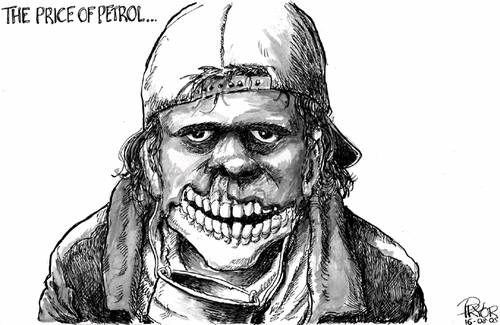
I'm not sure what it signifies. It is a powerful image though, is it not?
Does it mean that our oil-based civilization will collapse and we return to barbarism because the high cost of petrol will stifle the economy? We go back to the dark ages?
Petrol is rising because demand is fast increasing (India and China) and exceeds the supply. That is what the economists tell us. So we cannot afford to rely on petrol any more.
Honestly, I'm not confident of that interpretation. I do not think that it gets it. I do sense that it is a critique. Anyone got any clues?
I think it means the price of petrol is the genocide of our Indigenous people. We keep it cheap for us and dangerous for them. We are all responsible for this.
Posted by: Anne Magarey on August 21, 2005 01:37 PMAnne,
That is a much better interpretation of the Geoff Pryor cartoon than mine.Maybe it is occassioned by this story.
I can add to your interpretation if I may. The price of petrol includes petrol sniffing amongst indigenous people. It is not being addressed very well.
Consider this story from The Australian:
As community elder Sarah Goodwin was giving evidence, sitting on a chair in the sand, her son, Steven Uluru, wandered up with a can of petrol pressed against his face. He sat quietly at the edge of the gathering, put the can under his shirt and lowered his nose to the petrol.A few moments passed, and Northern Territory Coroner Greg Cavanagh became visibly upset. "The pathos is just ..." he said, then stopped and stood up. "I'm going to go for a walk."
Five minutes later, Mr Cavanagh returned and promptly adjourned the inquiry until today. Of all the evidence presented to the inquiry, this was the most blunt.
Ms Goodwin wiped a tear from her eye, saying her son had been sniffing a "long, long time".
"We can't stop nothing," she said. "When they sniff, they don't listen to mother, father, family."
Four years after The Australian first reported on petrol sniffing at Mutitjulu as part of a series of articles that prompted Prime Minister John Howard to spend $1million on the problem, the picture on the ground remains just as bleak.
Of a population of less than 400, up to 40 people sniff petrol at Mutitjulu, a run-down community about 20km from Uluru and the luxury resort town of Yulara.
It is a highly visible problem, with community members too scared to intervene and some locals even exchanging sex for petrol.
It is probably associated with mental health. Posted by: Gary Sauer-Thompson on August 21, 2005 07:11 PM