September 19, 2005
September 18, 2005
September 13, 2005
the play of perspectives
One aspect of politics as performance as a disclosure of self and a common public world is that it recognizes the plurality of opinion in the political world. This plurality is based on the play of perspectives that the difference of position creates.
This plurality is understood by Arendt's politics as performance in terms of a rejection of the Platonic privileging of (absolute)truth and identifies opinion as the stuff of political life.
September 10, 2005
New Orleans as a state of emergency
New Orleans is dead as a city as contaminated water, toxic chemicals, fire, stench, decomposing bodies, and drenched darkness spread through the city.
A quote from an article in Bad Subjects:
'Floating corpses, dehydrated babies, fires, National Guard soldiers with shoot-to-kill orders. This is a state of emergency.'
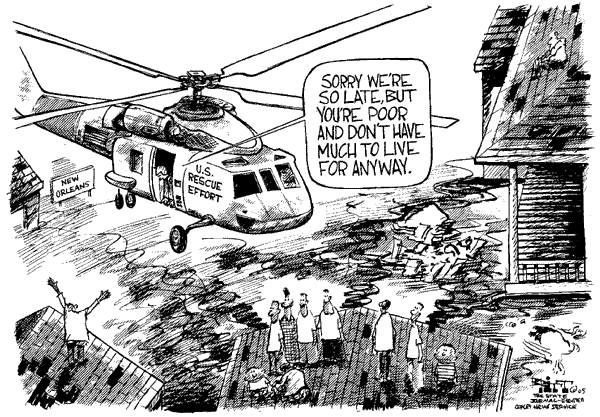
Chris Brett
The quote is from an article entitled 'The Floating Corpse of New Orleans' and it is by Tomasz Kitlinski, Joe Lockard and Stephane Symons. They go to say that:
It is this the state of exception that, according to Giorgio Agamben, characterizes our current political order.The state of exception has become the rule not only in far-off lands and isolated prisons, but even in the center of the American heartland. New Orleans has become a locale where law and human rights are not applicable anymore: the outside has penetrated to the heart of the inside. The Superdome and the Convention Center, with their anarchic interiors, absence of assistance, predatory gang violence, overflowing toilets, and piles of dead bodies, exemplified the materialization of a state of exception.
The people in New Orleans have been reduced to bare life. The people sitting lost in the streets of New Orleans are homines sacri, those who can be left to die or killed with impunity; they have been stripped of any content or quality, their lives have been reduced to mere biological instance.
September 09, 2005
Reading Arendt
I am noting this article on Hannah Arendt entitled Between Modern and Postmodern:A Reading of Arendt's Political Theory in the 1990's by Jiang Yi-huah. Jiang says:
In the 1990's, Arendt continues to be interpreted as a modernist, or a theorist sympathetic with the basic tenets of modernism although critical of certain phenomena of modernity. Following Habermas' reading of Arendt, Seyla Benhabib tells us that Arendt is a "reluctant modernist." Arendt's presentation of the modern age, in terms of the decline of the public sphere and the rising of a social sphere of economic activity and bureaucratic domination, is one of the most severe criticisms that modernity have received from an antimodernist. But Benhabib thinks the story of modernity presented in The Human Condition should be balanced by Arendt's early works, such as Rahel Varnhagen and The Origins of Totalitarianism.
September 07, 2005
Interpreting Arendt
On one interpretation of Hannah Arendt her representation of modernity is characterised by the decline of the public sphere and the rise of a social sphere of economic activity and bureaucratic domination. She is seen as a critic of modernity working from the perspective of being an antimodernist, whose argument is it that an authentic politics (as freedom of action, public deliberation and disclosure) has been decisively lost in the modern era.
I find this interpretation questionable. Why cannot her conception of politics as performance and rhetoric be used today?
In On Revolution, Arendt refers back to the founding revolutionary moments of the American Republic in order to assert her version of a 'positive', participatory politics peopled by skilful, civic-minded political orators.
Ned Curthoys says that Arendt argues that:
It would be a mistake to think of America's political liberalism in negative terms, as freedom of movement or freedom from unjustified restraint in the pursuit of property. In the parlance of Arendt's phenomenological essentialism, such negative freedoms are the result of processes of liberation and emancipation from oppression; they are not the 'actual content of freedom' The positive content of freedom is never simply civil rights or the amelioration of social and economic grievances, but 'participation in public affairs and admission to the public realm'. Political freedom as participation does not so much consolidate as transform the animus of a collective cause. Arendt is enamoured by the American Revolution's transfiguration of its initial civic grievance, the argument for 'no taxation without representation' into a revolutionary possibility, the foundation of a new republican body politic and a declaration of inalienable human rights.
These political leaders, who founded the American republic disclosed the active political virtues---'personal integrity', an enlarged capacity for 'judgment', and 'physical courage'. So Arendt is able to step from classical Greece into modernity: she is not an antimodernist Grecophile theorist of the polis and its lost glory.
September 06, 2005
Arendt: rhetoric and performance
Ned Curthoys in 'The Politics of Holocaust Representation' in Arena Journal locates Hannah Arendt's conception of politics as performance in the classical rhetorical tradition. He says:
The active political language Arendt seeks is, surprisingly enough, rhetorically adept, emanating from a culture whose elites were educated and trained in the persuasive arts, and where a certain degree of formal variety and esprit in speech delivery was demanded. Reversing our usual conceptions of rhetoric as manipulative and/or cliched language, Arendt follows Cicero in valorizing rhetoric as the basis for an acculturated political and legal praxis, a civil science and republican virtue. Rhetoric, in this non-utilitarian sense of the word, provides the necessary social skills for a heady interactive public space such as the democratic assembly, the agora or marketplace. Rhetorical training for participation in these spaces inculcates the art of vigorous argument, sociable persuasion, exercises in perspective, and a delight in controversy between equals, imbuing public spiritedness and a desire for civic participation.
Ned goes on to say that in the culture of the ancient Athenian polis and the Roman republic of the first century AD, the 'who' which energetically disclosed itself was often the political orator whose formal excellence enhanced institutional genealogies of communication skills and continually renewed recognized forms of deliberation and argument. He adds:
Within an Arendtian politics, the rhetor's power of public address, stylistic felicity, personal distinction, and inventive reasoning augmented the body politic, volatile and renewing political and legal thought through the luminosity of public performances. The firmly delimited political sphere of antiquity was, then, a forum for greatness in word and (or as) deed, possessing a 'power' that continually enriched the public realm with new 'appearances' and natal human 'artifacts'. The specific meaning of each deed in a truly public-political realm, argues Arendt, can lie only in the 'performance itself and neither in its motivation or achievement'
The identity of the self is an achievement of the actor in the public world creating a particular style of action.
September 05, 2005
politics as performance
Hannah Arendt is commonly seen as a political philosopher of nostalgia an antimodernist admirer of the Greek polis. She has been charged with an elitist nostalgia for the politics of ancient Greece, engendering a fatal split between the 'political' and the 'social' in her thinking.
Arendt does return to the ancient Greek polis and a public assembly where propertied equals debate issues of moment. Arendt's celebration of heroic, agonistic political action as a form of theatre does capture something that helps us to understand contemporary politics
Arendt's conception of politics as performance places the emphasis on political theatre and the consumate political actor. It is to be contrasted with the instrumental conception of politics as administration and the ethical critieria of everyday life (eg., compassion, honesty, generosity, and sensitivity to suffering.)
The public self for Arendt is constituted exclusively through words and deeds, engaged with others in a novel enterprise whose greatness and distinction are manifest, but whose meaning and destiny is impossible to fix in advance due to lack of control over events or fortuna. The political actor does not have control over what he/she initiates.
Arendt's "space of appearance" marks a site where there is a consciousness between participants of their rights of expression and the acknowledgment that the site of this engagement, the public space, produces an expectation of performance. The space of appearance can be interpreted as a theater, with politicians taking the role of actors and the political moment--a meeting of the Federal parliament in Canberra--as the venue, or political "stage." We citizens and journalists adopt the position of spectator who watch and judge the display and spectacle for its political import
September 04, 2005
aftermath
I'm sick with the flu at the moment and so I'm unable to read Arendt on politics as performance in my attempt to overcome the narrow definitions and understandings of political philosophy.
I will try and do some reading on the plane to Canberra. In the meantime we have two cartoons that view the US from the outside.Tis the best that I can do in my current state.
This cartoon about the rhetoric and reality of empire, is from the social democratic left in Australia:
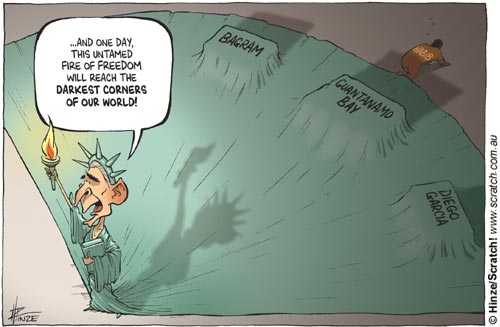
Heinrich Heinz, Outposts of tyranny
This cartoon, which exposes the dark side of America's racial divide, is from Jordan:
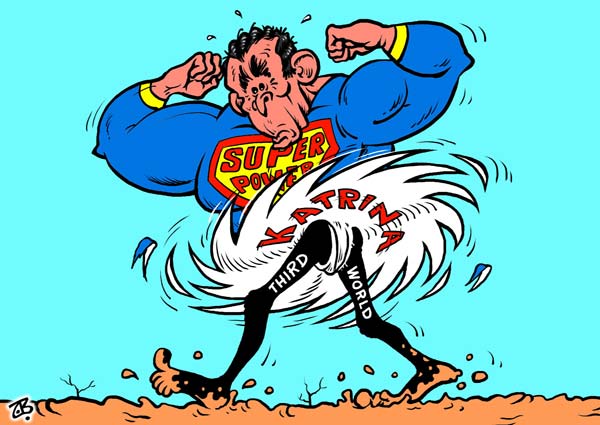
The media images of a flooded New Orleans discloses the third world conditions that the poor in New Orleans live in. They were left to fend for themselves as the Republican Bush administration did little to try to save its most vulnerable citizens.
Update:5 September
The commentaries around President Bush's first visit to New Orleans resonant with politics as public performance and theatre. You could that President Bush's performance in New Orleans was pretty poor compared to the heroic one after 9/11. It lacked compassiom and sensitivity to suffering even though the breakdown of society resulted in people driven becoming "barbarians" who had come to live in the "conditions of savages" in the Superdrome and the convention centre.
President Bush's 9/11 perfomance had the mark of greatness. It was fiercely agonal and full of passion. He became the war President protecting the homeland in the war on terror.
September 03, 2005
death of liberalism?
Can we talk about the death of liberalism in Australia?
Some conservatives do when they state that tolerance was brought about liberalism's terminal crisis of confidence. Then they talk about market liberalism in the next breath as they laud the virtues of the free market. So they don't mean liberalism per se; they mean either social and political liberalism.
Other conservatives argue that authentic liberal values have been corupted and all but destroyed by the left. The Left have purported to be liberal themselves, when in fact they have replaced the liberal values by illiberalism--a totalitarian mindset.
We can, however, talk about the rule of law being under seige by the national security state's politics of fear that manifests in a defensive reaction to the threatening terrorist object, person, or movement. Fear tacitly underpins on the "protective-obedience axiom" developed in the mainstream of political theories of Machiavelli, Hobbes and Schmitt.
September 02, 2005
political kitsch?
I'm sick with the flu so this is a post of quotations by necessity.
Remember all the Howard government talk about, if you don't like 'Australian values', then Muslims can 'get out' of Australia? That talk was associated with stripping Australians of their citizenship and rewriting the Citizenship Act.
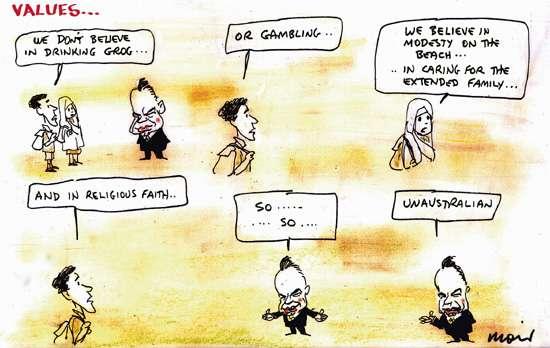
In New Matilda magazine Guy Rundle writes:
It would be futile to point out the manner in which the current shameless spruiking of fear and panic is against the spirit of anything that could remotely be called 'liberalism'. It's probably also of little use to talk about the way in which it plays into a sort of cowardice---a willingness to throw liberal principles overboard at the sound of a bomb 20 000 kilometres away.
Well that throwing away liberal values is what I've pointed out in Multiculturalism under threat post. I thought it a significant point myself. Oh well.
Rundle calls this kind of talk political kitsch, and he does have a point:
Politics is unthinkable without kitsch, and maybe, as Milan Kundera observes, kitsch is the aesthetic ideal of all politicians and all political parties and movements. Kitsch does suggest vulgarity and a desire to please, and the current tabloid "nationalistic" rhetoric and cheap populism is political kitsch. This kind of kitsch is everywhere and it relies on codes and clichés that convert complex and troubled emotions into a pre-digested and trouble-free form—---the form that can be most easily pretended. Political kitsch is pretense.
Rundle then goes onto to ask:
The most important question is, does it mean anything? It would be easy to say, 'no,' and try to ignore the plaster-ducks-flying-up-the-wall talk of Australianness, but it is probably unwise. Political kitsch and opportunism has a way of hardening into something else if it is not contested.
Which is? For Rundle it is racism:
So what is the purpose, or at least the result, of this urging on of a grab-bag of universal social values and particular modern ones as 'Australian'? It is racism pure and simple. It is an attempt to paint the global Islamic community as some sort of de-socialised rabble, who are so barbaric that they have to be told to teach their children the virtues of care and honesty.
I think that kind of response to a conservatism's policy of assimilation that says multiculturalism creates ghettos and allows terrorism to flourish,is too easy as it is too quick and habitual.
It plays off high culture critics to the politicians appeal to the worst instincts in the contemporary public----ie., the economically battered and debilitated mass--- who will gladly hand over the liberal freedoms they have to the strong leader who will ensure law and order. Kitsch is the aesthetics of totalitarianism.
Political kitsch does away with having to think about what is happening to Australian liberalism or Australian conservatism. Could not the constant use of racism by the left as a knock down argument against a totalitarian conservatism be seen as a form of political kitsch?