November 26, 2008
regulating capitalism
In this review of John Braithwaite's Regulatory Capitalism: How it Works, Ideas for Making it Work Better at the Australian Review of Public Affairs Jenny Stewart says that:
when everything is booming, how we love it! Easy credit fuels massive consumption. We buy bigger houses and more and more stuff to put in them. Clive Hamilton keeps telling us we should stop, but we take no notice .... But then, like recovering junkies, we have to weather the bad times, when the credit dries up, and businesses stop investing, and the grim spectre of recession. So, what should be done? There is general agreement that once the dust has settled, markets that have been more or less unregulated will have to be reined in. But this is easier said than done. Whatever governments do, they create opportunities for some of the cleverest boys and girls in the world to outwit them. Like generals, governments always seem to fighting the last war or, sometimes, the wrong war. There is moral hazard at every turn, because the knowledge that they will be saved leads the entrepreneurs of risk into even more daredevil schemes.
Stewart says that Braithwaite argues that there is a kind of symbiosis between the capitalist system and the states that attempt to regulate it. While capitalist expansion creates new challenges, so does the regulatory apparatus grow in power and flexibility to meet those challenges. ‘De-regulation’, accordingly is a myth.
Stewart argues that we need a theory that would give some guidance for establishing a new order that combines improved national-level regulation, with some kind of new (or re-newed) form of international regulation. Such a theory of regulation would reconcile the political and the economic.
November 25, 2008
For the Common Good
A review by Scott London of an old book that meant a lot to me----Herman Daly and John Cobb Jr's For the Common Good: Redirecting the Economy Toward Community, the Environment, and a Sustainable Future (Boston: Beacon Press, 1989). London says that according to Daly and Cobb:
contemporary economic theory holds to a crude, mechanistic worldview of homo economicus as an autonomous individual driven solely by self-interest and of society as an aggregate of such individuals. This view tends to equate gains in society as a whole with the increases in goods and services acquired by its individual members, but it says nothing about the changes in the quality of the relationships that constitute that society. They therefore propose a "paradigm shift" from economics conceived as "crematistics" (maximization of short-term monetary gain) to the sort of economics Aristotle called "oikonomia" (management of a household aimed at increasing its use value over the long run for the community). In "economics for community," their term for the latter alternative, there is no aim for unlimited accumulation or "growthmania." Instead, "true wealth is limited by the satisfaction of the concrete need." Such a conversion entails a departure from radical individualism to the notion of a "person-in-community," as well as a fundamental shift away "from cosmopolitanism to communities of communities."
This kind of paradigm shift has not happened in Australia. The mode of economic governance is still a neo-liberal one despite the recent resurgence of sustainability talk around the Murray-Darling Basin.
November 17, 2008
the internet, agora, Obama
Geordie Williamson in his All Together Now in the Weekend Australian Review argues that the use of the internet in the US presidential campaign has reinvigorated the ethos of the town square. He says:
Never before has a technology proved itself capable of replacing the town halls and city squares that, since the early democratic experiments in the Greek city states of antiquity, have provided the civic space where information is transmitted and ideas are debated, from politics to economics, science to philosophy, by flesh and blood individuals. Developments such as these have inspired pundits from Bill Gates to Wired's founder Louis Rossetto to hail the rise of a digital agora (the ancient Greek term for a place of civic congregation) and to prophesy its revolutionary implications for politics and pretty much everything else.
However, he says that what he saw where crowds of real people, gathered together in often very large numbers, despite delays and physical inconvenience:
to hear a man speak using rhetorical models outlined by Aristotle 24 centuries ago.During the past months, and at no time more than on election night, these crowds have assembled in stubborn resistance to the phenomenon that, we are told, has relegated real-world political rallies to window-dressing for the network news....., the city-sized crowds he [Obama] has attracted, are also a mass indication that the internet, far from supplanting the old-fashioned public realm, has reinvigorated it.
He adds that throughout Australia and across the world, in both qualitative and quantitative terms, public lectures and debates, symposiums and supper-clubs, readings and festivals have exploded in popularity and vigour. They represent an unscripted, unplugged antidote to the theatre that passes for political and cultural discourse in the televisual and online universe.
Let's grant this. What is its significance? To answer, Williamson turns to Seigel's Against the Machine where he argues that the internet produces loneliness which has become a defining condition of our recent history. Williamson turns to Mark Poster's Information Please, where it is argued that the internet radically destabilises identity, is a "a poor substitute for face-to-face contact", and is a space where rational argument rarely prevails and achieving consensus is widely seen as impossible. Williamson then asks:
Could it be that one of the Obama campaign's achievements has actually lain in realising the internet's limitations before the rest of us? That, while the campaign has harnessed those aspects of the technology that would aid it -- fundraising and logistics, say -- Obama has really been running against the loneliness it engenders, the angry echo chambers it endlessly replicates, the human communities that it collapses and degrades?
Williamson argues in the affirmative as the real action is in the world. So on election day he closed his laptopand headed to a public place to stand amongfriends and like-minded others.
November 11, 2008
our obligations to other animals
Though few people deny the sentience of non-human animals and generally hold that animal cruelty with no purpose is wrong, most believe that any human interest or desire, except the pure desire to cause pain, is enough to override this.
Christine Korsgaard delivered the 2008 Dewey Lecture in Law and Philosophy entitled "Interacting with Animals: A Kantian Account". Korsgaard is unhappy with utilitarian approaches to animal welfare and sought to provide a Kantian account of our obligations to other animals.
November 9, 2008
Obama's burden
Barack Obama will have to repair the damage which his predecessor has perpetrated around the globe and within the US itself. It is a big ask. Expectations are high, too high. Close Guantanamo. Deconstruct the whole "war on terror". Get the US out of Iraq. Do something about Afghanistan. Oh, there's Israel and Palestine to sort out. Obama has been constructed as a modern Atlas, preparing to take the burdens of difficult global problems on his shoulders.
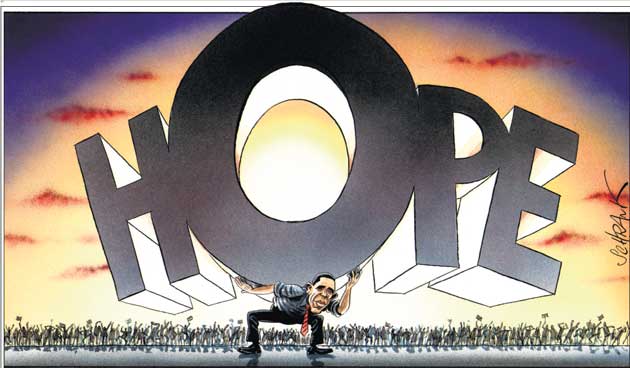 Independent
It ain't going to happen. It cannot. Obama inherits a disastrous legacy of wars, financial crisis and poisoned alliances, an America still divided despite the signal achievement of his victory as a black man, and surrounded by an unstable and uncertain world.
November 8, 2008
reception of French 'theory'
The reception of "French Theory" in Australia and the United States happened around the beginning of the 1980s, when the works of Foucault, Deleuze, Lyotard, and Derrida were being put to work on campuses and in some alternative communities, often as the theoretical foundation for a new type of politics.
According to Ethan Kleinberg's review in Notre Dame Philosophical Reviews François Cusset in French Theory: How Foucault, Derrida, Deleuze, & Co. Transformed the Intellectual Life of the United States, concentrates on exploring how the reception of French Theory in fields such as Cultural Studies, Ethnic Studies, Post-colonial Studies, and literary criticism in general.
According to Cusset, it was in these "niche markets" of academic culture that the "most sophisticated tools of textual analysis and the new university came to be applied to subjects as wide ranging as gangsta rap, "Harlequin" romance readers, Star Trek fans, and even the supposed 'philosophical' subtext of the Seinfeld series." Here, the counter-cultural inflection bestowed upon French Theory made it appear the appropriate tool for criticism of popular culture and allowed for the work of some of the most abstruse thinkers to seem like an appropriate tool for almost any text. On Cusset's reading, despite the attraction to the critical dimensions of post-structuralist philosophy, especially for critically examining sites of knowledge, the American academics that applied this thought in teaching and research actually remained within the American utilitarian tradition.
Cusset articulates the ways that strategies of encapsulation created an "uprooting and reassembling" that allowed the American proponents of French Theory to legitimate or authorize their work by recourse to quotations while at the same time altering that work to fit their own (practical) intellectual or political agenda. This rhizomatic proliferation of French Theory soon led to the sort of mutations that ultimately made the American variant unrecognizable in France.
So whilst while in France Foucault, Derrida, Deleuze, and company remained a disparate group of thinkers, in America they were all incorporated under the "brand name" French Theory and applied in accordance with market forces. In other words, French Theory did not exist in France and its popularity in America was the result of a new market that desired its product.
Kleinberg says that this argument requires that one accept Bill Reading's argument in The University in Ruins (1997) that liberal arts education -- and the university in general -- has undergone a profound change in its mission and identity as it has been transformed from a site designed to foster a unified national culture into a corporate-style service industry selling a vacuous and indefinable notion of "excellence."
Kleinberg says that:
Using Reading, Cusset asserts that the shift to university-as-service-industry led to a need for increased specialization to provide specific sites of interests that would attract the student/customer and that the brand French Theory came to serve this purpose. For Cusset, this reveals both the popularity and most troubling aspects of French Theory in America where a subject like Madonna becomes the object of "serious" academic discourse, employing French Theory to do so, for the utilitarian purpose of attracting students/customers to the major or selling books.
What is missing from Cusset's account is a sustained engagement with the ways that American theorists such as Paul de Man, J. Hillis Miller, and others actually appropriated, incorporated and applied the theories of these French intellectuals in their work. There is little or no discussion of the role of historians or philosophers in this reception (the Society for Phenomenology and Existential Philosophy, for instance, is entirely absent) and there is virtually no textual analysis. Even the chapter on "Academic Stars" (Judith Butler, Gayatri Spivak, Stanley Fish, Edward Said, Richard Rorty, and Frederic Jameson) spends no more than five pages on any one thinker.
November 5, 2008
Obama's 'Yes we can' victory speech
Remarks of President-Elect Barack Obama—as prepared for delivery on Election Night Tuesday, November 4th, 2008, Chicago, Illinois
If there is anyone out there who still doubts that America is a place where all things are possible; who still wonders if the dream of our founders is alive in our time; who still questions the power of our democracy, tonight is your answer.
It’s the answer told by lines that stretched around schools and churches in numbers this nation has never seen; by people who waited three hours and four hours, many for the very first time in their lives, because they believed that this time must be different; that their voice could be that difference.
It’s the answer spoken by young and old, rich and poor, Democrat and Republican, black, white, Latino, Asian, Native American, gay, straight, disabled and not disabled – Americans who sent a message to the world that we have never been a collection of Red States and Blue States: we are, and always will be, the United States of America.
It’s the answer that led those who have been told for so long by so many to be cynical, and fearful, and doubtful of what we can achieve to put their hands on the arc of history and bend it once more toward the hope of a better day.
It’s been a long time coming, but tonight, because of what we did on this day, in this election, at this defining moment, change has come to America.
I just received a very gracious call from Senator McCain. He fought long and hard in this campaign, and he’s fought even longer and harder for the country he loves. He has endured sacrifices for America that most of us cannot begin to imagine, and we are better off for the service rendered by this brave and selfless leader. I congratulate him and Governor Palin for all they have achieved, and I look forward to working with them to renew this nation’s promise in the months ahead.
I want to thank my partner in this journey, a man who campaigned from his heart and spoke for the men and women he grew up with on the streets of Scranton and rode with on that train home to Delaware, the Vice President-elect of the United States, Joe Biden.
I would not be standing here tonight without the unyielding support of my best friend for the last sixteen years, the rock of our family and the love of my life, our nation’s next First Lady, Michelle Obama. Sasha and Malia, I love you both so much, and you have earned the new puppy that’s coming with us to the White House. And while she’s no longer with us, I know my grandmother is watching, along with the family that made me who I am. I miss them tonight, and know that my debt to them is beyond measure.
To my campaign manager David Plouffe, my chief strategist David Axelrod, and the best campaign team ever assembled in the history of politics – you made this happen, and I am forever grateful for what you’ve sacrificed to get it done.
But above all, I will never forget who this victory truly belongs to – it belongs to you.
I was never the likeliest candidate for this office. We didn’t start with much money or many endorsements. Our campaign was not hatched in the halls of Washington – it began in the backyards of Des Moines and the living rooms of Concord and the front porches of Charleston.
It was built by working men and women who dug into what little savings they had to give five dollars and ten dollars and twenty dollars to this cause. It grew strength from the young people who rejected the myth of their generation’s apathy; who left their homes and their families for jobs that offered little pay and less sleep; from the not-so-young people who braved the bitter cold and scorching heat to knock on the doors of perfect strangers; from the millions of Americans who volunteered, and organized, and proved that more than two centuries later, a government of the people, by the people and for the people has not perished from this Earth. This is your victory.
I know you didn’t do this just to win an election and I know you didn’t do it for me. You did it because you understand the enormity of the task that lies ahead. For even as we celebrate tonight, we know the challenges that tomorrow will bring are the greatest of our lifetime – two wars, a planet in peril, the worst financial crisis in a century. Even as we stand here tonight, we know there are brave Americans waking up in the deserts of Iraq and the mountains of Afghanistan to risk their lives for us. There are mothers and fathers who will lie awake after their children fall asleep and wonder how they’ll make the mortgage, or pay their doctor’s bills, or save enough for college. There is new energy to harness and new jobs to be created; new schools to build and threats to meet and alliances to repair.
The road ahead will be long. Our climb will be steep. We may not get there in one year or even one term, but America – I have never been more hopeful than I am tonight that we will get there. I promise you – we as a people will get there.
There will be setbacks and false starts. There are many who won’t agree with every decision or policy I make as President, and we know that government can’t solve every problem. But I will always be honest with you about the challenges we face. I will listen to you, especially when we disagree. And above all, I will ask you join in the work of remaking this nation the only way it’s been done in America for two-hundred and twenty-one years – block by block, brick by brick, calloused hand by calloused hand.
What began twenty-one months ago in the depths of winter must not end on this autumn night. This victory alone is not the change we seek – it is only the chance for us to make that change. And that cannot happen if we go back to the way things were. It cannot happen without you.
So let us summon a new spirit of patriotism; of service and responsibility where each of us resolves to pitch in and work harder and look after not only ourselves, but each other. Let us remember that if this financial crisis taught us anything, it’s that we cannot have a thriving Wall Street while Main Street suffers – in this country, we rise or fall as one nation; as one people.
Let us resist the temptation to fall back on the same partisanship and pettiness and immaturity that has poisoned our politics for so long. Let us remember that it was a man from this state who first carried the banner of the Republican Party to the White House – a party founded on the values of self-reliance, individual liberty, and national unity. Those are values we all share, and while the Democratic Party has won a great victory tonight, we do so with a measure of humility and determination to heal the divides that have held back our progress. As Lincoln said to a nation far more divided than ours, “We are not enemies, but friends…though passion may have strained it must not break our bonds of affection.” And to those Americans whose support I have yet to earn – I may not have won your vote, but I hear your voices, I need your help, and I will be your President too.
And to all those watching tonight from beyond our shores, from parliaments and palaces to those who are huddled around radios in the forgotten corners of our world – our stories are singular, but our destiny is shared, and a new dawn of American leadership is at hand. To those who would tear this world down – we will defeat you. To those who seek peace and security – we support you. And to all those who have wondered if America’s beacon still burns as bright – tonight we proved once more that the true strength of our nation comes not from our the might of our arms or the scale of our wealth, but from the enduring power of our ideals: democracy, liberty, opportunity, and unyielding hope.
For that is the true genius of America – that America can change. Our union can be perfected. And what we have already achieved gives us hope for what we can and must achieve tomorrow.
This election had many firsts and many stories that will be told for generations. But one that’s on my mind tonight is about a woman who cast her ballot in Atlanta. She’s a lot like the millions of others who stood in line to make their voice heard in this election except for one thing – Ann Nixon Cooper is 106 years old.
She was born just a generation past slavery; a time when there were no cars on the road or planes in the sky; when someone like her couldn’t vote for two reasons – because she was a woman and because of the color of her skin.
And tonight, I think about all that she’s seen throughout her century in America – the heartache and the hope; the struggle and the progress; the times we were told that we can’t, and the people who pressed on with that American creed: Yes we can.
At a time when women’s voices were silenced and their hopes dismissed, she lived to see them stand up and speak out and reach for the ballot. Yes we can.
When there was despair in the dust bowl and depression across the land, she saw a nation conquer fear itself with a New Deal, new jobs and a new sense of common purpose. Yes we can.
When the bombs fell on our harbor and tyranny threatened the world, she was there to witness a generation rise to greatness and a democracy was saved. Yes we can.
She was there for the buses in Montgomery, the hoses in Birmingham, a bridge in Selma, and a preacher from Atlanta who told a people that “We Shall Overcome.” Yes we can.
A man touched down on the moon, a wall came down in Berlin, a world was connected by our own science and imagination. And this year, in this election, she touched her finger to a screen, and cast her vote, because after 106 years in America, through the best of times and the darkest of hours, she knows how America can change. Yes we can.
America, we have come so far. We have seen so much. But there is so much more to do. So tonight, let us ask ourselves – if our children should live to see the next century; if my daughters should be so lucky to live as long as Ann Nixon Cooper, what change will they see? What progress will we have made?
This is our chance to answer that call. This is our moment. This is our time – to put our people back to work and open doors of opportunity for our kids; to restore prosperity and promote the cause of peace; to reclaim the American Dream and reaffirm that fundamental truth – that out of many, we are one; that while we breathe, we hope, and where we are met with cynicism, and doubt, and those who tell us that we can’t, we will respond with that timeless creed that sums up the spirit of a people:
Yes We Can. Thank you, God bless you, and may God Bless the United States of America.