August 24, 2005
Martha Nussbaum's lecture
I've just come back home from attending a public lecture by Martha Nussbaum on 'Disability and Issues About the Social Contract Tradition'. There is some material on this issue here. Going to the lecture was like returning to the world of a conservative academic philosophy after doing a stint in the legislature as a political advisor. I say conservative because many there would approve of cheap.
In the lecture Nussbaum argued against the social contract tradition in favour of the Aristotelian account of human life in the form of a capabilities approach. In Nussbaum's view, the core role of governments as well as development actors is to endow citizens with the required conditions for actualizing centrally human functionings, in other words, to provide them with the necessary capacities and opportunities to live flourishing lives. It is the central human functional capabilities that indicate what it is for us to live a good life.
As she puts it:
The basic intuition from which the capability approach begins, in the political arena, is that human abilities exert a moral claim that they should be developed. Human beings are creatures such that, provided with the right educational and material support, they can become fully capable of these human functions. That is, they are creatures with certain lower-level capabilities (which I call "basic capabilities") to perform the functions in question. When these capabilities are deprived of the nourishment that would transform them into the high-level capabilities that figure on my list, they are fruitless, cut off, in some way but a shadow of themselves.
Nussbaum's approach to social justice, with its emphasis on capabilities---the potential to function-- and functionings---the realization of capabilities-- talks in terms of real people, real life, not thin abstractions; talks in terms what is a full human life; real people, real life rather than not thin abstractions; rejects the classic dichotomy between emotions and reason; and holds that a just society aims at well-being.
I was suprised by Nussbaum's embrace or adoption of a Rawlsian political liberalism, given her explict rejection of both the social contract tradition and Rawls' strong version of it; on the grounds that the inner logic of the social contract is unable to incorporate physical and mental disability of citizens.
I guess it was a way for her to lighten the metaphysical burden of her Aristotlean conception of the good life in a liberal polity based on the fact of "reasonable pluralism". She accepted liberal pluralism and the idea of an overlapping consensus---or agreement on justice as fairness between citizens who hold different religious and philosophical views (or conceptions of the good).
Nussbaum reworked Political Liberalism's idea of public reason--the common reason of all citizens--in the light of her capablities approach.
June 29, 2005
Peter Saunders on Weber and ethics
There is a bit of a debate about higher education happening in the Australian blogoshpere. See here and here for the contributions from Catallaxy; see here for Troppo Armadillo and for public opinion.
What I want to raise here is the comments by Peter Saunders made on this post. Saunders says that Max Weber said it all a century ago in his essay on 'Science as a vocation':
"Science today is a 'vocation' organized in special disciplines in the service of self-clarification and knowledge of interrelated facts. It is not the gift of grace of seers and prophets dispensing sacred values and revelations, nor does it partake of the contemplation of sages and philosophers about the meaning of the universe.And if Tolstoi's question recurs to you: as science does not, who is to answer the question 'What shall we do, and, how shall we arrange our lives?'--- Then one can say that only a prophet or a savior can give the answers. If there is no such man, or if his message is no longer believed in, then you will certainly not compel him to appear on this earth by having thousands of professors, as privileged hirelings of the state, attempt as petty prophets in their lecture-rooms to take over his role."
Ethics is radically separated science as are values from facts. The consequence is that an ethics concerned about the good life is reduced to the voice of the prophet or a savior, when it is actually a part of our comportment in everyday life.
Now Saunders recognizes this.
He says that the Weber is concerned about the dangers in the growth of instrumental rationality, and he warns against the 'cult of the expert' in the modern world and argues in favour of a radical separation of facts and values, science and politics. He says:
"Sometimes his [Weber's] concern [have] been interpreted as wanting to preserve science from value judgements, but he is much more concerned to preserve ethical debate from contamination by spurious claims to expertise. Weber wants us to recognise that we have to make our own ethical choices from among the 'warring gods' of ultimate values, and that nobody can resolve these ethical dilemmas for us. He thinks there is a real danger of academic experts trying to subvert or pre-empt this moral world by telling us what to think."
The implication of Weber's positivism is that a moral vacuum arising from an emotivist conception of ethics (it's merely personal preferences) which allows academics posing as experts to decide the ethical choices.
We can refuse the emotivism that is accepted by Saunders.
May 31, 2005
welcoming the other
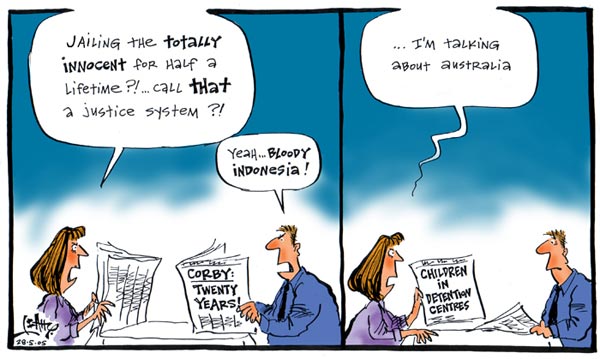
In the light of mandatory detention and the way that Australia locks up, asylum seekers and refugees as the bearers of human rights, the insight of Emmanual Levinas makes sense: the core of the ethical relation is constituted by the welcoming of the other.
I knew that Levinas breaks with Heidegger's phenomenology by understanding the ethical relation to the Other, the face-to-face, as exceeding the language of ontology. Ethics transgresses the liberal centering on the self-relation and its various forms, and centres on the relation with the other.
This is a return to the lived experience of a primordial "face-to-face" or person-to-person encounter, whilst the primacy of the ethical relation provides a more adequate description of human relations in a community.
The penny drops.
March 15, 2005
ethics and politics
I was ploughing through an academic article on the political/legal philosophy of Jacques Derrida and Giorgoi Agamben and their relationship to Nietzsche on the plane to Canberra on Sunday night. The article by Adam Thurschwell is entitled ('Spectres of Nietzsche: Potential Futures for the Concept of the Political in Agamben and Derrida'. I was reading it because of this post, on Agamben's The State of Exception.
I cannot recall where I found Thurschwell article online. In The German Law Journal perhaps?
There was a passage in Thurschwell's article that I found both interesting and puzzling. It talked about the absolute break between the ethical and the political in, I presume, late modernity. I say absolute because the sense of the passage, and others similar to it, was of an unbridgeable gap between the ethical relationship and any given form of politics. Thurschwell says that this absolute break, gap or gulf is accepted as a given by both Derrida and Agamben and is the reason why they have embraced the vocabularly of messianism.
Why so I thought? Is the absolute gulf because of positivism? Or nihilism? It didn't make sense because positivism makes the gulf between scientific fact and emotivist ethics, and so both ethics and poltics are expressions of personal emotions. Nihilism says that our highest values have beeen devalued.
Hence my puzzlement about the assumption of an unbridgeable gap between ethical relationships or ethos and any given form of politics.
Then I recalled Robert Menzies collection of Wartime speeches, The Forgotten People, with its appeal to people in small business or who come into politics as individuals, bearing particular character qualities. This linked ethics and politics.
These people were of good character, they saw themselves as virtuous, and it was because they saw themselves as virtuous, as having particular character qualities that they believed that they were the backbone of the nation, and hence fit to govern and hold political power.
There is no great divide between ethics and politics in this continuous political tradition. It's appeal is to individualism, the virtues, and to the home as the place of the individual with their private aspirations and the ground ground of virtue ethics.The virtues draw deeply on Protestantism (Puritan ethic) and these are coupled to a self-realization ethic that every individual should have the opportunity to develop their personality and capacities to the fullest extent.
August 04, 2004
marriage is for some
Parliament is a strange place. It is currently ruled by a discourse of free market ideas about wealth creation being the end of public policy co-mingling with social conservatism.
Today the social conservatives--the religious right--were having their shindig in the Great Hall. They--anti gay groups and evangelical Christians-- were in Parliament to talk about traditional marriage between men and women. They--the Australian Christian Lobby were there for a forum on marriage.
So how does their brand of social conservatism fit with the free market economics that drives public policy?
The Coalition is going to reintroduce proposed changes to the Marriage Act to confirm that marriage was a union between a man and a woman, to the exclusion of all others. Here is the argument advanced by the Prime Minister:
"I support marriage because I believe it provides stability in relationships, because it is a public expression of commitment, but it is also the environment in which children are best raised and nurtured and brought to full adulthood and enjoyment of life's opportunities. Now, many marriages fail. We all know that. That doesn't of itself and should never of itself damn the institution or suggest that other relationships can have the same status as marriage."
So why the emphasis on heterosexuality? Here is the PM again:
"We all know from life's experience that longstanding institutions provide encouragement, they provide hope, they provide emotional support, and they also provide a practical way of helping people through life. I have often said that a stable, functioning, united home and marriage is not only the best emotional environment in which to raise children, but it is also the best and most efficient social welfare system that mankind has ever devised....There are many in the community who have no religious beliefs who believe very strongly in the core institution of marriage. There are many in the community who believe in its bedrock value. There are many in that category in the community who have the view that I hold, that all other things being equal, it is far better that children be raised in a married home with the benefit of both their mother and their father."
It is the last sentence that is problematic. That all other things being equal, it is far better that children be raised in a married home with the benefit of both their mother and their father. Why is that so?
No justification is given for why same sex couples are worse parents than heterosexual couples. The implication is that children will suffer by being parented by same sex couple families.
April 12, 2004
the politics of abortion
This story is of ethical interest.
A pregnant woman walked into the emergency department of Melbourne's Royal Women's Hospital one day in late January, 2000. Leaning heavily on her husband, the 40-year-old was hysterical after learning that her unborn child suffered from the non-fatal abnormality, dwarfism. She begged staff on the ward to help her. She wanted her 32-week-old foetus aborted. She was adamant. If the hospital refused to help, she said she would kill herself. Or travel to Asia, where she believed she would find someone willing to perform the operation.
After the woman was examined and counselled over the next few days, staff, including a psychiatrist, a geneticist and an obstetrician, were convinced that if the pregnancy was not terminated, even at this late stage, the woman would commit suicide. A "foetal reduction" was carried out and the baby, a girl, was stillborn. Although the woman did not see the child, she named her Jessica.
Later-term abortion is performed in major obstetrics hospitals around the country in cases where serious foetal abnormality is present. In Jessica's case, the abnormality was not fatal; instead, the doctors' reasons for terminating were based on their overriding concern that the woman's life was at risk. The doctors raised the option of the woman continuing with the pregnancy and giving the child up for adoption. The couple rejected this. The woman had a history of mental illness and had attempted suicide several times in the past.
Though abortion is illegal in Victoria, 1969 Victorian Supreme Court ruling that permits abortion when there is a serious danger to the pregnant woman's physical and mental health. Yet the law is grey. The Victorian Crimes Act prevents a woman who is over 28 weeks pregnant – the point in gestation where the foetus is deemed "viable" – of "unlawfully" destroying a child that is capable of being born alive. It carries a maximum penalty of 15 years in prison.
There was an internal hospital inquiry into the case. It found there was some uncertainty in the diagnosis and that the woman's case notes were incomplete. The inquiry noted there was less clinical support for late termination of pregnancy, where there is some doubt about the diagnosis or where the foetal abnormality is less severe. The inquiry concluded the doctors acted in good faith, given the circumstances, and cleared them of any wrongdoing.
A a staff member referred the case to the hospital's adverse events committee. There were deep ethical concerns among some staff at the hospital and hospital management took the unusual step of going public. It suspended the three doctors involved and referred the case to the state coroner. The hospital said at the time it was unclear from the medical records whether a lethal injection had been administered to the baby before the birth was induced.
Two years ago, the state coroner's office ruled it did not have the jurisdiction to investigate the termination because the baby had been born dead, though the acting Victorian government solicitor provided advice to the coroner that his office did have jurisdiction over the case. However, the state coroner, Graeme Johnstone, agreed to release the woman's private medical records to Victorian National Party senator Julian McGauran, an anti-abortion politician, then sealed the file prohibiting anyone else from access.
Using information in the records, McGauran lodged a complaint with the Medical Practitioners Board of Victoria, accusing the doctors involved of malpractice. McGauran says the doctors broke the law by agreeing to terminate such an advanced pregnancy.
Victoria's Health Services Commissioner Beth Wilson is appalled by the coroner's actions, saying the files should never have been released. The Medical Practitioners Board of Victoria was deeply divided over whether to launch an inquiry. It determined it didn't have a legal basis to refuse. The board was forced to seek a search warrant after the Royal Women's Hospital refused to hand over the files, citing patient confidentiality. The hospital opposed the order and it is on that issue that the court will rule at the end of April.
In response to claims that his complaint Medical Practitioners Board of Victoria was politically motivated McGauran says that:
"I am trying to draw a legal distinction between early- and late-term abortion. I know I don't have the public's support on early termination but I don't believe the community wants abortions at 32 weeks and no institution should allow distressed patients on the edge of suicide to dictate medical practice or ethics."
According to University of Melbourne medical law specialist Professor Leone Skene, it is clear that it is sometimes lawful to terminate a pregnancy even when it is also clear the baby could have been born alive. She adds that the law has never been tested. We do need clarification on when late-term abortion can be performed. We don't know what circumstances constitute 'unlawful'.
March 28, 2004
Moral duties to other states
If states have moral duties to other states then what would these be?
Well, Australia has a moral duty not to invade Indonesia save under great provocation. Australia also has a duty to help Indonesia if and when a great disaster befell it---eg., a famine, flood, earthquake or volcanic eruption.
These moral duties are recognized. Australia intervened to prevent the terror killing people in East Timor under the flag of the UN when the Timorese voted for self-independence from Indonesia.
Hence Australia accepted that there are principles governing a state's conduct to those living beyond its borders.
December 09, 2003
a story with a moral
Time for a little philosophical story.
Once upon time, way back in the 1980s the once proud social democratic Australian Labor Party ( ALP) embraced and fostered the deregulation of the market so as to modernize Australia.Tthe symblic act was to float the Australia country. It was to save the country it was said. It saved the country, it is said today. As the 1980's rolled on, many of the ALP's lefty members fought rear guard actions against their Party's policies of on-privatisation, free trade, competition policy and deregulation of the financial sector.
Many in the ALP accepted that retrenchments and unemployment from "structural adjustment" was an inevitable consequence of economic growth and a changing product cycle. You can hear the 'econ' speak in the voices of these modernizing social democrats when they say this.
They justify it by saying that these experiences of retrenched workers are nothing new. They have been going on since the 1930s, retrenched workers have always found difficulty finding alternative employment, and those who secure new employment experience earnings loss and occupational downgrading.
Moreover, obtaining casual jobs----which is what many retrenched workers have been able to do---is a step up the rung of the ladder to full employment. And there may be an increase in job satisfaction, such as swapping the full time dirty job in the old factory for the casual job of lawn mowing. And many women are happy to work 20 hours a week. They do not want to work 40-50 hours.
Hmm.
Can this process---the Third Way--- be seen as a capitulation to the market? Many have thought so. Betrayal of the old social democratic values they cried.
The spin doctors of the modernizers, who marketed the political product offered to sceptical citizens at elections, tried to convince us otherwise. The modernizing social democrats still stood for social democracy, not just economic growth and markets of their Liberal opponents. They said they wanted to revive political engagement by creating a new vision for a better future with a new welfare strategy that would provide protection and security from social and economic risk and to promote citizenship.
A new welfare stategy? What was that? It was difficult to make out with all the noise being made by politics as marketing, media strategy and image management not substantive policy and public debate. The lack of policy was callled 'presenting a small target' by the spin-doctors.
There was lots of noise.
The conservatives in the liberal university stood for defence of tradition in the face of this onslaught of economic reform that made universities commercial institutions. They favoured the grand imagery. They depicted the economic rationalist reformers as the barbarians entering the gates of the citadels of civilization. Faced with being crushed by the onward march of a modernist economic reason they called for shutting the doors of the citadels (the universities) and hiding behind an Aristotlean ethics until economic rationalism consumed itself in a fury of self-destruction.
Meanwhile, the postmodern left in the academy were loudly calling for difference, diversity and pluralism, whilst pretending that they were way beyond social liberalism. Value pluralism was seen as a trump card as the unified nation state brokedown in the conditions of global capitalism. Foucault was deployed to say that the secular state no longer exercised sovereign power. Power was everywhere; it enmeshed in the micro networks of civil society.
Meanwhile, what was going on, as seen from the perspective of the unemployed in the Job Network was that the redistributive measures were connected to the ethic of paid work and individual responsibility. What was lacking in the economic talk was an ethic of care. That could be seen in the demonisation of the asylum seekers; the negative representation of people on benefits; the indifference to people with mental health problems or to the plight of street kids; the harshness shown toward disable people on benefits; miserable increases for pensioners benefits in the face of the GST, withdrawal of public health services and the increases in the price of energy due to privatisation.
Could there not be a political ethics of care in the face of this lack of mutual respect and equal worth? That was the question citizens were asking themselves. Could not this ethics of care underpin the new welfare state? Why cannot 'care' be a central political category? Could not social care be a part of the normative framework of obligation and responsibilities, instead of the conservative's mutual obligation and charity?
November 12, 2003
resisting the Stoics on anger
I have a deep resistance to the Stoic extirpation of the passions in public life. I think that anger is perfectly justified, but that it should be moderated. Let me give an example from this post.
In South Australia, when the Olsen Liberal Government fought a state election, it stated very clearly that it had no intention of privatising the publicly owned electricity utility. It was duly re-elected (the Australia Labor Party was still on the nose). Then it set about privatising the publicly owned electricity infrastructure. After a lot of political fighting it suceeded in passing the necessary legislation through the Upper House (the Legislative Council) when the Labor members split, fractured and crossed the floor.
The consequences of that privatisation, and the embrace of the national electricity market, is that consumers are worse off. Our power bills are 25% higher than they were, and they likely to remain so. This is the new order of things. Its all a bit like the saga in California.
As a citizen I'm justifiably angry. The Liberal Government lied to get re-elected and it spun lies about how entering the national electricity market would result in reduced prices consumers. It said that we would be better off, even though it knew that prices for electricity would increase dramatically.
If you like, I"m very angry about being on the receiving end of Plato's noble lie. It is a similar situation with many Americans over the deceitful neo-con justifications for going to war with Iraq.
To his credit Seneca engages with this position that anger is an important part of self-respecting public response to political deceit, cunning and nastiness. His text On Anger affirms the common ground, before it moves on to argue that anger is a bad motivational force compared to virtue and duty.
This is then coupled to the argument from excess. If we rely on anger as a motivational force then it can exceed the boundaries set by reason: soldiers wiping out a whole village in Vietnam. In such situations we are out of control because of the anger, and are unable to stop. Anger is double edged and is capable of turning back on us.
True. These are good points. Anger can be and is linked to excess and being out of control However, the example of citizens being angry about deceitful politicians, (including Prime Ministers and Presidents) indicates that a deliberate wrong has been done and that this is important to me. The judgement is that there ought to be some punishment for the wrong-doing politician. These, I would hold, are good judgements as they offend values of the Australian polity that are deemed to be important: honesty and trust. The judgement is that politics need not be conducted in this deceitful way.
This throws the ball back into the Stoic court.
November 09, 2003
Restraining anger?
One of the more powerful Stoic arguments against the passions (anger) in public life is that anger is not as easily controlled or moderated as is commonly made out. Anger involves the rejection of limit and restraint; it becomes wild and out of control. It is harmful to oneself and to others and it often leads to hate and to cruelty, violence and murder.
That argument has to be conceded, given the Palestinian/Israeli conflict. There anger leads to brutality and vengeance for its own sake.
But that does not mean that we should extirpate anger, does it?
Yet the connection between anger and hate is a close one. It is not easy to disentangle it.
But we should get angry when bad things take place as when our loved ones are killed by a terrorist bomb as in Bali. Anger is part of what it is to be human.
November 08, 2003
a question
I get pretty angry about the way our cities have been organized and designed for cars and not for people. We have a few parks as public spaces where one forgets the city whilst being in the city. And we have the contrast between a safe and homely house and the intrusion of a weird and alien presence when the city was turned into a metropolis.
This transformation had serious psychological consequences described by, among others, Baudelaire and Zola. The individual felt estranged in the metropolitan mass, estranged in all possible connotations of the word. The uncanny manifested itself in phenomena like agoraphobia and claustrophobia and the historical avant-garde movements tried to transfer the modern feeling of the uncanny to their public using techniques of defamiliarisation.
What also angers me is the way the core of my self in the metropolis is invaded by and controlled by the way the city is organized for the economy by town planners, by the incesant advertising everywhere and by the nose that invades my whole being.
The happenings in the urban world lacerate my self and distort my desire to live a passionate urban human life.
Hence I am subject to, and violated by, fortune----the efects of the polluted city on my body ----and this undermines my self-sufficiency and my desire for freedom from external control.
Should not a therapeutic philosophy build a wall around the self and protect it from the assaults of fortune? This appears to be the goal of Stoic philosophy.
Or should I give up seeking self-sufficiency and let go my desire for freedom from external control.
October 27, 2003
Stoic governance of anger
I mentioned in an earlier post on anger in public life that Seneca argued against the usefulness of anger to a position in which reason is the opposite of the passions. He holds that community and individual well-being means that we cannot allow reason to mingle with, and be contaminated by, the destructive passions.
This is the standard Stoic view of the extirpation of the passions (eg., fear love, grief, anger, envy, jealously etc). Stoic therapy of self-confrontation and self-scrutiny aims to ensure that the passions are eliminated from human life.
How do we make sense of this elimination? Stoics such as Seneca, start from what we can call the commonsense position. And that is?
Well the passions are seen to be a form of false judgement. They are violent upheavals in our subjectivity to be contrasted with the calmness of reason. What we noticed about the Bali bombings is that the grief was a form of emotional upheaval involving grieving for loved ones who had been killed by the bomb.
Judgement implies that the passions have a cognitive element as they involve ways of interpreting the world: eg., citizens being angry with John Howard's actions on refugees; or Australian journalists beign angry the Green Senators disrupting the US Presidency when Bush addressed the Australian Parliament; ior the Australian people with the Islamic bombers in Bali. Hence these judgements can be evaluated in terms of them being true or false.
That pretty much accords with our commonsense position today.
Evaluative here means good/bad, worthwhile/worthless, helpful/noxious etc. It presupposes a complex web of connections between self and community and a sense of fortune, or of things being outside our control. We fear being blown by a terrorist bomb, and we grieve or mourn when we hear that a friend or lover has had the misfortune to be in the wrong place at the wrong time eg. Bali.
So why hold that passions should be extirpated rather than moderated? Why is a flourishing life one lived free from anger (and fear, jealously, passionate love, intense joy etc)?
From what I can make out it is necessary because the judgments are false. Why so? There are several arguments. Externals, such as grief over the death of loved one,do not have great value given the fillness of time. I will let that argument go.
Secondly, the passions are held to be not that important in motivating ethical action. Insead of anger toward the Bali bombers we could act out of duty to defend the nation from attack. Thus in On Anger Seneca says:
'"What then?" you ask; "will the good man not be angry if his father is murdered, his mother outraged before his eyes?" No, he will not be angry, but he will avenge them, will protect them. Why, moreover, are you afraid that filial affection, even without anger, may not prove a sufficiently strong incentive for him? Or you might as well say: "What then? if a good man should see his father or his son under the knife, will he not weep, will he not faint?" ... The good man will perform his duties undisturbed and unafraid; and he will in such a way do all that is worthy of a good man as to do nothing that is unworthy of a man. My father is being murdered-I will defend him; he is slain-I will avenge him, not because I grieve, but because it is my duty.'
I've got problems with this argument. Anger and grief seems to be a more morally valuable response to terrorist murder than duty since it indicates the cares and commitments to loved ones and friends. The care and the commitment to others is what was so remarkable about the aftermath of the Bali bombings; it indicates the importance of family life and personal relationships to our conception of a good human life well lived. it is the police tracking down the terrorists who are doing their duty for the nation state.
The third argument is one that holds the passions are bad. They rae experienced as a form of emotional upheaval that cause disorder, agony and torment. Consider the way Seneca sets this image of the passions as a torrent that overwhelms us and leads to ruin:
"But you have only to behold the aspect of those possessed by anger to know that they are insane. For as the marks of a madman are unmistakable-a bold and threatening mien, a gloomy brow, a fierce expression, a hurried step, restless hands, an altered color, a quick and more violent breathing-so likewise are the marks of the angry man; his eyes blaze and sparkle, his whole face is crimson with the blood that surges from the lowest depths of the heart, his lips quiver, his teeth are clenched his hair bristles and stands on end, his breathing is forced and harsh, his joints crack from writhing, he groans and bellows, bursts out into speech with scarcely intelligible words, strikes his hands together continually, and stamps the ground with his feet; his whole body is excited and "performs great angry threats"; it is an ugly and horrible picture of distorted and swollen frenzy-you cannot tell whether this vice is more execrable or more hideous."
The passions are pathological by their very nature. They leave us weak and diseased and in need of therapy. It is over the top but can be redescribed in terms of psychoanalysis and the unconscious. Suddenly we have an argument that bites.
to be continued.
October 22, 2003
Seneca on anger
Can philosophy help human beings in overcoming the conflicts that cause us to suffer so much pain? Anger is one such emotion in public and private lives, where it largely takes the form of the desire to repay past suffering caused by others. The task for a therapeutic philosophy would be to help us deal with anger.
What advice do Stoics like Seneca offer us? How can a Stoic therapeutic philosophy help us?
Sencea regarded anger as a form of madness. He describes this emotion as follows. He says that it is:
"...wholly violent and has its being in an onrush of resentment, raging with a most inhuman lust for weapons, blood, and punishment, giving no thought to itself if only it can hurt another, hurling itself upon the very point of the dagger, and eager for revenge though it may drag down the avenger along with it....it is equally devoid of self-control, forgetful of decency, unmindful of ties, persistent and diligent in whatever it begins, closed to reason and counsel, excited by trifling causes, unfit to discern the right and true-the very counterpart of a ruin that is shattered in pieces where it overwhelms."
So what can be done about this form of madness? Can we control it through it reason and so limit its destructiveness? Aristotle thought so since he held that a life of virtue was one built on moderating the passions. That is pretty much my own view, even though I adopt a more psychoanalytic approach of anger and revenge having their roots in the unconscious.
Seneca argues against this approach. Anger is more properly viewed as an enemy of a life based on reason. He says that:
".. ..The enemy, I repeat, must be stopped at the very frontier; for if he has passed it, and advanced within the city-gates, he will not respect any bounds set by his captives."
Here we have a familar picture: reason is the opposite of the passions. We cannot, says Sencea, allow reason to mingle with, and be contaminated by, the passions. Hence he argues against the usefulness of anger.
Seneca says that "there is nothing useful in anger, nor does it kindle the mind to warlike deeds; for virtue, being self-sufficient, never needs the help of vice.
Secondly, reason will never call to its help blind and violent impulses over which it will itself have no control, which it can never crush save by setting against them equally powerful and similar impulses, as fear against anger, anger against sloth, greed against fear.
Seneca, then deals with an objection that states that against the enemy anger is necessary. Anger, in other words is necessary for politics and warfare. Seneca responds:
"...what use is anger when the same end may be accomplished by reason? Anger is not expedient even in battle or in war; for it is prone to rashness, and while it seeks to bring about danger, does not guard against it."
And so it goes on. There is no need for something as base and destructive as anger. Reason rules and the passions are extirpated.
October 20, 2003
anger
I've little time this week to write as I am painting the holiday shack at Victor Harbor. I'm pretty tired in the evening.
But I have noticed a lot of anger in public life in Australia amongst the political elite. It mostly takes the form of revenge and payback for past wrongs, defeats and humilitations.
You hear about the anger in Tasmania where those in the forestry industry are consumed by anger towards the greens.
These examples of anger in public life reminded me of Seneca. He wrote about it.
This is his essay On Anger.
Why Seneca? Two reasons. First, I just happening to be glancing through Alain de Botton's The Consolations of Philosophy between the breaks in painting.
Secondly, I'm full of anger in my personal life. It is eating away at me, turning me into a different kind of person.
And De Botton? It is easygoing, well written, easily understood, peppered with illustrations and pleasant to read. From what I can make out consolation is about soothing our spiritual aches. It is a kind of like those self-help books about achieving happiness that are touted on daytime TV.
He's a doctor of the soul who deals with life's emotional problem. Hence his text is working within the tradition of philosophy as a way of life.
Can he help us to deal with anger in our personal and public lives?
August 30, 2003
a trail of blood
I have been following at a distance Tony Blair's difficulties about the reasons Britain went to war with Iraq. And I have been squizzing his statements to the Hutton Inquiry into the death of Dr. Kelly. I noted that John Scarlett, the chairman of the joint intelligence committee, read a scrip prepared for him by Downing Street, and accepted the blame, and all the responsibility, for a faulty government intelligence report.
What secrets lurk in Whitehall? Can they be contained? Can they be dug out?
My concern is not those events in this post. It is more to do with the traces of empire in the complex historical experience we are now living; traces of old and new political structures that shape our conduct.
This is a long bow for some as the very language of empire will cause a recoil.
Let's take the surface bit. Blair protested his innocence at the Hutton inquiry. He said that he is a man of utmost honesty, that the BBC broadcast crucially challenged his integrity and so threatened his continuation as prime minister. Blair plays the conviction politician full of sincerity well. He is forever going on about moral renewal, moral order and moral responsibilities. He assumes that good will flow from his good intentions. His carefully crafted public image is that he does not have dirty hands as he is above the bloody business of politics. He justifies his actions with good intentions. Intentions count more than outcomes.
Unfortunately, Blair comes talking about his good intentions and leaves a trail of blood behind him.
He seems to love a good war involving dropping bombs on people. He talks about peace and goes to war. He talks about us and them. Calling the French veto on Iraq at the UN 'capricious' undermines his sincerity in upholding the international legal system.
The dirt that sticks to Blair is the way that the world of dirty politics of tabloid bruisers, political bullies and spin from the media machine continually mocks his good intentions. He tries to convince us that good consequences flow from good intentions. But we see the dirty hands.
Behind the carefully rehearsed performances is the reality of power. Blair like John Howard in Australia, stood shoulder to shoulder with the Americans as junior partners assisting an imperial power in one of its wars. Both Britain and Australia had few geo-political interests in Iraq, and neither were seriously threatened by Iraq. For both of these conviction politicians American power is sacrosant. For them present-day American imperial power is a modernizing force of good in the world, as it is enlightened and altruistic.
What is left unsaid is the dark side. I have in mind the ruthless militancy of the American democracy, the demonology of the American nation state; the vast publicity machine that convinced around 50% of Americans that Saddam Hussein was directly involved in September 11; the severe onstraints on the discussion of the role of Israel in the Middle East; and the role of the media outlets of the Christian Coaltion and Israel lobby in fostering a hatred of Arabs and Muslims and equating them with evil.
Yet underneath the special alliance sits a conception of Britain as a global power with responsibilities East of Suez:---Britain's intervention in the Gulf has been continuous since 1991. You can sense the old imperial structure at work--- order and security with Britain playing e same role that Australia did for Britain: being the loyal provider of auxiliary cohorts of soldiers.
Empire! How that word resonates in post-colonial Australia. Let me give two examples.
The first one is the way that Britain and Australia are part of the same story of Empire. The great UK imperial structure may have been dismantled after 1945, along with the other empires that ruled Asia, but the effects of the imperial divide between colonizer and colonised can still be felt. Multicultural liberal Australia stands in opposition to the racist colonialism of the recent past, with its unspoken racist hierarchy. High culture in the UK (Mathew Arnold's sweetness and light) functioned to cover up and disguise the inhumane events in the Australian colonies. Reading for the unstated colonial assumptions is one way to read the Western cultural canon of Mathew Arnold, S. T. Coleridge and John Stuart Mill that spoke in terms of a civilising mission.
Today, there is a colonial reassessment going on about the destructiveness wrought by colonialism in Australia in terms of suffering and dispossession. This discourse says that the past is over and the time has come for the Aboriginal Australia to own up to its self-inflicted wounds. Those liberals who support the claim for a treaty are befuddled romantics. And aboriginal Australia cannot keep on blaming white colonial Australia for everything bad. The rhetoric of blame and guilt has to go.
But empire is not something in the past. Today we have the US empire. The US has mn moved from hegemony in the Middle East to empire. And we live the effect of this empire engaged in a civilising mission. Resistance to the US empire in the Arab/Muslim world is said to bred a barbarious and xenophobic anti-westernism--called Islamofascism that is out to destroy Anglo-American civilization. This mental grid covers over and obscures the diversity of the Arab diasporia in South-East Asia with its very different histories and cultures. The cultural grid that is locking into place constructs Arabs as deceptive, cunning and untrustworthy.
Australia has signed up as loyal allies who will provide troops to support an imperial war against any part of the Arab/Muslim world that defies the US and Israel. Iran is one with its nuclear weapons program. Both America and Israel will go to war to prevent Iran from acquiring nuclear weapons. Though we are part of the empire, our cities are far from being protected from destruction by "barbarian" counterattacks. Within the empire we stand vulnerable.
Those are the two traces of empire. They mark overlapping territories and intertwined histories. Whether we like it or not, our fortunes as Australians are now tied to a neocon imperial America that is supported by a wounded nationalism. And the rebellion in Iraq to the US occupation of that country threatens to become a nasty circle of terrorism and war.
June 22, 2003
after economic rationalism
This review of John Kekes, The Art of Life, (Cornell University Press, 2002) is via Lawrence Blum. This book is a step away from philosophy as abstract theorizing in academia towards the particular and concrete.
The Kekes book is a development of the idea of philosophy as a way of life. That idea of philosophy is one of a life of examination---both of one's own life and an examination of the culture in which one lives. The point of this self-reflection and the art of living well is to achieve a good life that enables human and non-human flourishing.
The Kekes book takes this further. In the first part of the book Kekes gives five types of concrete good lives of personal excellence: those of self-direction, decency, moral authority, depth and honour. Part two examines in four chapters the general conditions for practising the art of life and develops some of the ideas which emerged from the examination in part one. Part three, the final chapter, draws together the threads of the various arguments to provide 'one possible and reasonable approach to living a good life?.
Judging from the review, the limitation of this book is the absence of "the political" as well as "politics". If we talk about about living a good life and accept that there is a deep conflict about what constitutes the good life (eg., wealth creation versus sustainablity) then we step into the political. Often we get roadblocks to the need to turn to the political. We stay with economics in the public sphere and sideline living the good life to the private sphere.
The conception of philosophy as living well at philosophy.com is a more Aristotlean one, in which there is structuring a good life around a dominant end, with living well being that end. Living well involves, living with a specific tradition, shaping a certain character based on moral virtues, freedom as self-realization, and a sustainable mode of life. Living well, is bound up with being within a political community and using political power to establish the conditions for living well.
This gives us a different kind of rationality to the instrumental reason of the market place. phronesis and it involves an engagement with the rationality of ends. Recall the dead end John Quiggin had ended up with his account of rationality. In his first entry on rationality he avoided giving any content to rationality. Subsequently, he gave two accounts of economic rationality. The first referred to a form of critical and sceptical economic thinking:
"...'economically rational'[ was] used to describe the arguments of the group in the Labor Party, including Whitlam himself, who sought reductions in protective tariffs and agricultural price support schemes. By implication, opposing claims were regarded economically irrational. A little later, the term 'economic rationalists' was used to describe the supporters of free trade within the Labor government. [It meant] policy formulation on the basis of reasoned analysis, as opposed to tradition, emotion and self-interest."
John then gave some content to economic rationality by spelling out what is meant by the popular conception of economic rationalism. (This is what is usually called neo-liberalism). John's account of this form of economic rationalism in Australia states that it stood for:
"... a dogmatic, indeed, quasi-religious, faith in market forces and the private sector. More and more, economic analysis was based on deductions from supposedly self-evident truths, which were effectively immune from any form of empirical testing. Many of the beliefs that are now central to 'economic rationalism' would have been regarded as irrational prejudices by the first generation of economic rationalists.
By the 1980s, economic rationalists had largely adopted the microeconomic views of the Chicago school, rejecting ideas of market failure in favour of the belief that the simple neoclassical model of perfect competition was a good description of the economy, or would be in the absence of undesirable government intervention."
Christopher Shiels highlights the trick played by the economic rationalists in the public sphere. He says:
"A crucial role in our local history has been played by the rhetorical trick that John Q highlights, i.e. 'if you aren?t an economic rationalist, you must be an economic irrationalist'. Ok, it?s now a tired retort; relying on the truism that there are many ways of rationalising, but no camp will wish to hold to irrationalism. Yet, it has also been a neat sound bite for the policy advocates. In the age of marketing, most would trade on a catch like that, if it fell their way."
Shiels notes that 'economic rationalism's final resting home is as a dinky die swearword in public policy. True. It is no longer used by politicians. In the late 1990s they moved onto neo-conservatism. This leaves us with John's first account---- critical and sceptical economic thinking based on neo-classical economics as the rationality of the public sphere. It also leaves us with utilitarian egoism firmly in place.
What is of interest here is Quiggin's assumption that economics is rationality per se, and that anything else is not rational it is tradition, emotion and self-interest. It also leaves us with scientific knowledge as the only form of knowledge.
This is a standard ploy in an economics that has been seduced by the modernist dream of finding a set of "universal" principles that would unify the diverse practices of social inquiry. This universal colonizes rationality for itself and so scientific knowledge becomes the only form of knowledge. What it rejected as waste product----tradition and emotion---is considered by definition to be the opposite of rationality. And no attempt is made to engage with a rationality that is structured around emotion and tradition, eg. phronesis or a practical knowing.
No attempt is made to consider the "empirical-analytical" rationality of the social sciences and the "historico-hermeneutic" rationality of philosophy into a dialogue over rationality. This leaves the critics of economics in public policy embattled and besieged by a host of technical economic thinkers in a technocracy. We are thrown into, and confronted by a world in which there is a hegemony of technology based on science; a false idolatry of the professional expert; 'a scientific mystification of the modern society of specialization, and the domination of nature and a too easy acceptance that science is a substitute for lost cultural orientations of religion.
What is lost by a high modernist social science is the connection of the ethical and the political by the Romans and the Greeks.
In Rome, phronesis as practical judgement and knowledge developed into the vir bonus ideal of public life. Calvin McGee says that this ideal held that:
"...all Roman citizens should strive to be "good men" able to "speak well" when they were called upon to give advice in the public interest. In Greece, the impulse of practical philosophy developed into the vision of the phronimos, a person imbued with practical wisdom who is able to bridge the life of the mind and the life of the polis."
This is a different and alternative tradition to Quiggin's utilitarian one. What I am suggesting is we appropriate the 'truth' of what this through acknowledging that ourselves have been shaped by this effective history. So it isnot a nostalgic return to Greek/Roman r is advocating, but rather an appropriation of Aristotle's own insights to our concrete situation. . . . We come to understand what Aristotle is saying and at the same time come to a deeper understanding of our own situation
February 04, 2003
In the politicians we trust?
The politicians are asking us to trust them at a time when we are about to go to war with Iraq. Yet we know from bitter experience that one of the first casualities of war is truth. Our governments will lie, dissemble and spin in order to persuade us that going to war with Iraq is a good thing. And they will do this by fair means and foul. Thats what war does---standard operating procedure.
Do we trust the politicians? Not really. Politics has been marked by a loss of trust the commentators say. Mistrust is the norm. We expect the politicians to be untrustworthy. Lets face it, they have blood on their hands, they have an intimate relationship with rat cunning, treachery is a dear friend and they live in world woven by webs of deceit. Mistrust and betrayal is the norm in political life.
Is that not the moral of the Tampa incident and the children overboard affair in the last federal election? That governments don't come clean about their dirty hands.
The politicians, being good professionals who realize they need to have a few spin doctors (journalists) to advise them, tackle the mistrust by endeavouring to reduce the level of suspicion. They work away at the edges, smoothing the sharp distinction between trust and distrust, so they sort of blend through painting their grey on grey.
Does it work?--is the image of the Australian Prime Minister as honest John a successful one in reducing the mistrust? Who knows for sure. He looked good on gun control but he is offside with public opinion on the war with the Iraq issue. Many citizens reckon that Howard committed to the war with Bush many months ago and is unwilling to come clean. So he is playing us for mugs and is seen to be untrustwothy on the war issue.
Journalists and publicists are probably even more mistrusted and despised than politicians are. Very few of us place trust in the stories we read in the media these days. The everyday practices of the media probably heightens the distrust, and creates an overall public mood of suspicion.
Yet trust is there in the background holding things together at a deep level. Consider the war with Iraq again.
The Australian Government has gone along with the fiction that if Iraq presents such a threat to the security of a superpower that the latter requires a defensive shield from incoming ballistic missiles. Little evidence has been presented. Or alternatively, if Iraq is not disarmed then its weapons of mass destruction (biological and nuclear weapons) might fall into the hands of terrorists and Australia's national security is threatened. Again little evidence has been presented.
What is said over and over again is that there will be no stability and no security for the US , Britain or Australia---nay the international community--- until Iraq is disarmed of its weapons of mass destruction, totally and permanently.
The argument? It goes like this. The war politician points to Iraq's history of training and supporting terrorist groups and its use of weapons of mass destruction (biological weapons) against Iran and its own Kurdish people. Then a nightmare scenario is outlined: the ultimate nightmare for us all must be that weapons of mass destruction fall into the hands of terrorist organizations. Why is that so? Because these are rogues states, part of the axis of evil. So we cannot stand idly by and allow the possession of such weapons of mass destruction by rogue states because it is more than more likely that these rogue states will help the terrorists to acquire and ultimately use the weapons of mass destruction.
The argument has a certain logic that a lot of people find convincing. But many citizens in the US, Britain and Australia are not convinced. But it doesn't matter because there is an emotional undertow that glues it together and gives it weight. It is fear and trust. Fear of the terror. Trust in politicians to provide the national security to ease the fear. Democracy is ultimately founded on trust; and though we know that there is no one to protect us from the politician/guardians, at some point we accept that trust is required to ensure the liberal polity keeps working. We know at some point that we have bit the bullet and stare the terror down.
We trust the politicians even though they have let us down so many times in the past, and they have breached our trust by breaking so many promises. Oh we remember the clever distinction between core and non-core promises. And we remember the hands in the till, the shady deal, the kickbacks, the conflicts of interest and the hand out for the cash. And we remember that many of them get away with it with a bit of help from their powerful friends with bending the rules and regulations of accountability whilst they talk about governing the country in the public interest.
Yet we continue to trust. We will go to war with Iraq soon, even though the politicians are dealing from a crooked deck. The majority of Australian citizens will place our trust in our liberal political institutions provided they get a mandate from the United Nations. The United Nations is the litmus test---for all its many flaws. The majority of Australian citizens will put their trust in the United Nations to make the right call (judgement) about going to war with Iraq.
Are we wrong to do that? To rely on trust rather than the simple power politics and muscle of a great power to get the problem presented by the current Iraqi regime sorted. Well, the hawks certainly think so. The trust stuff is for girls, the chicken hearted and the sissies. They are all for handing the job of getting things sorted over to the military and their smart technology.
But the gungho hawks trust the military to sort out the Iraqi's fast and with a minimum of fuss and resistance. This allows them to present their distorted version of why we want to bomb a people back to the stone age--its good versus evil folks.
A liberal polity works on trust. Even in the gun culture of the US that works on fear and violence. The politicians know this: they paint a picture of pure terror and then promise to protect us and our democratic rights from anthrax. Terror can only be averted through trust is the message they want to convey to us. Then they say that we citizens have a duty to be alert---not alarmed--- and to be active by keeping an eye out for terrorists and the various acts treason. The politicians say they have good grounds to believe that we are in danger. And we have to trust them on that one. It is our duty to do so.
Of course the Americans take it much further. They know that they have God on the side and in God they trust. He guides them in their manifest destiny. They trust that world history is moving towards that destiny.
That is a big trust in dark times. It deals with absolutes in a world of terror. So it requires lots of bulletins and briefings from the White House and mind-numbing slogans and half truths about evil and absolute freedom delivered in a folksy style for the cameras in highly staged settings. The big metaphysical trust is counter the destruction of everyday trust by a terror unleashed on the world.
The terror unleashed recalls the historical memory of the terror of the French Revolution. Today's is a different kind of terror to that earlier modern one ---it is international rather than national, and it uses weapons of mass destruction rather than the guillotine. Both forms of terror strike at the very heart of the social order, work to split it violently asunder and so create a crisis of trust in the political institutions.
Then as of now we citizens ask: can we trust our politicians? How can we call them to account? How do we recreate a culture of public service and ensure that the professional politicians are free to serve the public weal of citizens?
We can suggest one answer: only when the politicians and the senior public servants freely serve we citizens can we begin to replace our mistrust with trust.