August 01, 2005
A quote:
"The thesis, inspired by Jurgen Habermas, that the 'state' has increasingly colonised 'the lifeworld' is misleading, not least because the very nature and meaning of state and lifeworld were transformed in the process. State institutions certainly extend the scope of their operations and the depth of their penetration in the lives of their citizen subjects. But they do so by a complex set of strategies, utilizing and encouraging the new positive knowledges of economy, sociality and moral order, and harnesing already existing micro-fields of power in order to link their governmental objectives with activiities and events far distant in space and time."
It is from Nicolas Rose, Powers of Freedom: Reframing Political Thought, (p.18)
June 21, 2005
about Foucault's understanding of power
In reading the Introduction to Alain Badiou's Infinite Thought: Truth and the return of philosophy, by Oliver Feltham and Justin Clemens we find this statement:
"When poststructuralists do engage with problem of agency they again meet with difficulties,and again precisely because they merge their theory of the subject with their general ontology. In his middle period Foucault argued that networks of disciplinary power not only reach into the most intimate spaces of the subject, but actually produce what we call subjects. However, Foucault also said that power produces resistance. His problem then became that of accounting for the source of such resistance. If the subject--right down to its most intimate desires, actions and thoughts--is constituted by power, then how can it be the source of independent resistance? For such a point of agency to exist, Foucault needs some space which has not been completely constituted by power, or a complex doctrine on the relationship between resistance and independence. However, he has neither."
One claim here is puzzling. It is that if Foucault claims that power completely produces the subject so as to act in concert with relations of force, then it is not possible for him to also claim that this totalizing power produces resistance on the part of these same subjects.
Is that so?
Why cannot relations of force/power produce (shape) the free subject and resistance by that subject? If you take the power relations of our political institutions, then these shape you so that you become a different kind of person who can also resist the particular use of power in that institution. Power and resistance are fused together. Resistance is not a different sort of thing to power.
May 09, 2005
Foucault, power, sovereignty#2
An interesting paper by Mitchell Dean, which links and connects Foucault, Schmitt and Agamben. Dean makes some good points. He says that:
"For Foucault, politics can only be approached as the articulation or displacement of the poles of a series of oppositions: the right of death and the power of life, sovereignty and bio-politics, the 'city-citizen' and 'shepherd-flock' games, individualizing and totalizing character of modern powers, techniques of government and techniques of self, reason of state and liberalism, etc. But the point at which they link, overlap, interact, of enter a zone of indistinction is difficult to discern. Foucault proposes their relations are demonic, but cannot tell us why or how. "
I've always puzzled how Foucault's toolbox could be used to make sense of the detention camps for refugees and illegal immigrants situated on the edge of the political life of liberal democracies. I've wanted use Foucault's toolbox to move beyond the discourse of natural right deployed by many left liberal critics of the detention camps who appeal to international agreements and seek the universalization of certain rights without exception.
But I haven't made much progress and I'd begin to suspect that I'd reached the limits of Foucault's account of power re the duality of sovereignty and bio-politics. Maybe governmentality----the techniques of of government and the reasons of state would do. But it didn't give that much depth as illegal immigrants are both outside and inside the normative rule of law.
Sovereignty is important here. As Schmitt points out, sovereignty is precisely the power to determine the exception to the rule. Thus it is the act of sovereignty that captures the Guantánamo detainees, such as David Hicks, and then pushes them beyond the reach and protection of the US and Australian sovereign state. The Australian state is also dismantling the rights and laws of the legal system so as to make exceptions of 'asylum seekers' in order to legally intern them in places offshore (the 'Pacific Solution') and exempt them from the laws of the land.
So there things stood with a question mark over Foucault's toolbox.
Dean makes a second point. He adds that there is a:
"...possibility that Foucault has underestimated the extent to which sovereign forms of power were constituted in relation to notions of life, and a failure to distinguish different concepts of life."
The detention camp, which suggests that the state of exception is invoked with respect to refugees and illegal immigrants, has pretty much become stablized within the moral and political life of the liberal polity.
May 05, 2005
Foucault, power, sovereignty
As I understand Foucault's historical studies, Foucault focused on the forms of power, such as those of discipline, bio-power, and governmentality, which are other to sovereignty. Te whole thrust of bio-power (or the power over life), for instance, is that it opens up a post-sovereigntist and non-juridical conception of power.
This opening up is what I find to be innovative in Foucault's writings on power, as it brings the power relationships of biomedicne and biotechnology into the foreground. It is but a small step to extend this diverse cconception of forms of power to a politics of death--say detention camps for refugees and illegal immigrants and the destruction of a whole people. Detention camps are making a big return.
In his essay 'Governmentality' (The Foucault Effect: Studies in Governmentality, ed. G. Burchell, C. Gordon and P. Miller, Harvester Wheatsheaf, London, pp.87-104) Foucault juxtaposes the 'self-referring circularity' of sovereignty, as found in Hobbes and Pufendorf, to the productive arts of government from the 'reason of state' thinkers and the German cameralists who succeed in giving content to the achievement of public order and security. Foucault shifts away from the blood and sword sovereignity to statecraft, on the grounds that this understanding of government contributes to modern rationalities of governance.
However, Carl Schmitt reminds us that we cannot write sovereignty out of the picture. The sovereign decides not only what the ends of government are, but how to understand such ends and the practical content when applied to life. We cannot avoid sovereignty when we are thinking about the rationalites of the state.
So we need to think bio-politics, governance and sovereignity.
January 28, 2005
moral politics and regulation
In this post on the religious right over at public opinion it was argued by some that the family and censorship politics fundamentalist religions (eg. the Family First party) is imported and not a homegrown product.
I'm not convinced by this argument as I reckon that the politics of the moral majority in Australia is a renewal of the traditional polics of moral regulation.
What I have in mind here is the moral politics of the sexual purity, hygiene, temperance and censorship movements in civil society in the early part of the 20th century. This form of moral regulation was increasingly marginalised during the second part of the 20th century, but it rebirthed or renewed in the 1990s. What was was seen as traditional conservative attempts to reinstate the old version of respectability (eg., The Festival of Light, Fred Nile) slowly moved to centre stage in response to the radical politics of neo-liberalism in the form of family values.
This rebirth/renewal is less a return to traditional politics of moral regulation than a new configuration.
January 23, 2005
Foucault, social medicine, governmentality.
This is a lecture on social medicine given by Foucault in Brazil in 1974. I'm having a look at it because it refers to the crisis in medicine with a reference to Ivan Illich (ed.). Medical Nemesis: the Expropriation of Health. The lecture is now 30 years old and it is part of Foucault's key argument that modern medicine is social medicine, and therefore a social practice that has been developing in capitalist society since the end of the 18th century and the beginning of the 19th century.
Does it have any insights for us with respect to social medicine? We are currently caught up in a debate about federalism, the governance of health (hospitals) and they way that political power can be, and is, used to direct our conduct. How then does Foucault's lecture help is out?
In this lecture Foucault provides a social history of medicine and he goes back to the English Beveridge Plan of the 1940s to explore the way in which the state took charge of the health of a population for the benefit of individuals.
Foucault says that the Beveridge Plan is significant as it meant that:
"...the concept of a healthy individual in the service of the State was replaced by that of the State in the service of the healthy individual. It is not only a question of a reversal of rights, but also of what might be called a morality of the body ... It was no longer a question of an obligation to practise cleanliness and hygiene in order to enjoy good health, but of the right to be sick as one wishes and as is necessary."
Health began to enter the calculations of the macro-economy. The Beveridge Plan gave rise to a new series of rights, a new morality, a new economics, a new politics of the body. Since then the body of the individual has become one of the chief objectives of State intervention, one of the major objects of which the State must take charge.
Foucault then connects this governmentality (concerned with economics and power) with the technological advance of biological medicine through the discovery of antibiotics. This enabled the medical institution to effectively fight infectious diseases in the human boddy for the first time.
Thus we have a new form of social medicine. What then is the crisis of social medicine that Foucault alludes to? Foucault addresses this in terms of several characteristics of modern scientific medicine.
The first characteristic is that scientific medicine kills. Not because of ignorance, errors of diagnosis, but because of the very effects of medication as a therapeutic intervention. The bugs and germs have adapted to our anti-biotics. So the positive effects of an enlightened scientific medicne are now accompanied by negative and harmfu effects.
Medicine has historically functioned on the basis of its own failures and the risks that it has taken. Medical risk becomes greater when medicine shifts to modifying genetic cell structure as every aspect of life now becomes subject to medical intervention.
The second characteristic of modern scientific medicine is undefined 'medicalization" whereby medicine functions outside its traditional field as defined the patient's needs, pain, symptons and malaise. Medicine has shifted from being clinical to being social as it has gone beyond being concerned with diseases to being involved in screening populations, sexuality, health promotion and delinquency.
The third characteristic of modern scientific medicine is its political economy. Medicine and health are now presented as an economic problem. This is more where is the money going to come from, as it involves the health of the body as a consumer object, produced by drug companies and doctors and consumed by patients. Health as a product is marked by inequality, profit making, doctors becoming functionaries of drug companies, self-regulating subjects etc.
How does this medical sociology address the current crisis in medicine? Foucault says that a historical account of the rise, or takeoff, of social medicine indicates that the talk about 'the crisis in medicine'is a false one.
January 18, 2005
democracy as governmentality
One interpretation of Foucault's governmentality is the following one advanced by Ali Rizvi over at Foucauldian Reflections.
Working off Foucault's essay 'The Subject and Power',(an afterward to Michel Foucault: Beyond Structuralism and Hermeneutics), Ali says:
"This power of the capitalist state is based on the emergence of a new type of power: bio power and disciplinary power. A new type of state has emerged in the west because the "western state has integrated in a new political shape, an old power technique which originated in Christian institutions. We can call this power technique the pastoral power" [p.213] Bio and disciplinary power is a modern reinterpretation of Christian pastoral power (ibid. p. 214). This reinterpretation has been made possible due to 'profound transformation' in the basic mode of power. Power does not any longer work primarily as negativity, as a deduction. It takes the form of positivity..."
Ali says that modern reinterpretation of Christian pastoral power is salvation oriented but its conception of salvation aims at ensuring salvation in this world (eg., welfarism). This secularized pastoral techniques are incorporated into the mechanisms of the modern capitalist state, and so the state "stretches its reach to the soul and body of individuals on the one hand and to the social body at large on the other hand."
Ali says that:
"By 'bio-power' Foucault wanted to emphasis the form of power which does not only cater for the needs of the individuals but also looks after 'population' as a whole. On the other hand 'discipline' is what is concerned with individual in his specificity and concreteness. What links these two forms of power is the phenomenon of body. While the 'bio power' is 'focused' on the 'species body' the disciplines are 'centered on body as machine.'"
Ali does not mention citizenship in his account. Yet it should be since the capitalist state is a liberal democratic one and the individual is a citizen. If we make this shift then it can be argued that democracy is a disciplining force. The argument is that political institutions construct the identities of subjects as citizens, who then willingly support and participate in democratic processes.
Hence democracy is a form of governmentality that constitutes subjects as democratic citizens to make them amenable to government control within a liberal constitutional order.
Why so?
Because democracy is based on a set of power relations and so we are tangled up in power and knowledge relations that both constrain and enable the possibilities of citizenship.
One can illustrate this in terms of deliberative democracy. In this understanding of democracy reasoned discourse or debate is based on a particular kind of conversation or communication: dispassionate, reasoned and logical. The problem with this is that white middle class male citizens are better than others at articulating their arguments in rational and reasonable terms. Those who cannot do this are excluded. The liberal justification for this austere style is that rhetoric needs to be purged from deliberation to keep the door closed to demagogues, manipulators, deceivers and flatters.
Hence we have the process of constraining the possibilities of citizenship.
The reaction from the right wing of the blogosphere to this liberal demand about deliberation has been an oppositional one. The resistance is described by August Pollack:
"....What matters- the only thing that matters- is that they said something they think was really clever on the comments section of some person they've likely never met.....The right-wing blogosphere has removed itself from any realm of rational discourse and instead established only one principle: win the argument. It doesn't even matter to them what the fucking argument is. If some liberal said something, they're either a hypocrite, a liar, or a traitor. Don't worry, you'll make some shit up to validate that a little later...History will never look back on this time and discuss how changes were made through the art of rational bipartisan discussion."
We have an assertive type of conservative discourse that affirms its difference to the elitist liberal ethos of disspasionate and disembodied writing through confrontation. The alternative form of communication is rhetoric involving jokes, anger, laughter, ridicule flattery and hyperbole.
Though the world of journalism and politics in Australia has yet to be transformed by blogging rhetoric is the favoured discourse of the conservative journalists in the Murdoch press.
This shows that we are both subjected to power and subjects in our own right. So we can about strategies for governing through citizenship.
December 30, 2004
Foucault, medicine, and the gaze
The area of health and medicine is a huge public policy issue. It is always in the news in terms of system failure: hospital waiting lists, lack of public funds, rising costs, cancelled emergency surgery.The focus is usually on the public hospital and the overlapping jurisdictions between states and commonwealth.
Behind this sits a many stranded medical discourse on sickness and medicine which is rarely discussed or mentioned. This discourse involves medical governance, medical science, disease and sickness, technological interventions, political power and medical knowledge, methods of research, biological reductionism etc.
Foucualt is seen to have a lot to say on this in terms of the concept ofdiscourse, the critique of the medicalization thesis, the analysis of the body and the self, bio-power and a governmentality analysis of health policy, health promotion, and the consumption of health. A lot of this discussion in academe takes place within medical sociology.
My initial attraction to Foucault's exploration of the sickness/healing discourse is the way he turns a sceptical or critical eye on the modernist metanarratives of medicine in modernity: doctors as the scientific experts winning the war against disease. The medicos act as bearers of the scientific enlightenment that had awakened modern liberal society from, and thrown off, the yoke of the dark medieval superstitions that kept us in a state of ignorance.
Foucault called this the medical gaze. The gaze of the physicans in modernity could penetrate illusions of sickness and the appearances othe symptons to see through to the underlying reality of disease. The physician had the power of science to see the hidden truth.
In the process the scientific medicos who governed our bodies had developed their own myths. A central one is the all wise and the all knowing doctor who uses science to guard our health, and to keep the "quacks" (the allied health professionals) from becoming a part of public medicine.
December 20, 2004
Foucauldian critique of romantic democrats
This article on citizenship by Melanie White and Alan Hunt, which is hosted here,can be read as a criticism of Webdiary's internet activism and deliberative democracy pathway suggested in a previous posts.This pathway calls for more active citizenship and more public involvement.
This is a response to a public life in Australia that gives up on the project of freedom as self-government, abandons the aim of calling economic power to democratic account, that fails to form in citizens the qualities of character that equip them for political deliberation and self-rule.
This proposal is seen as romantic nostalgic for the participatory involvement of what is taken to be a small community's face-to face interaction. It's target is civic republicanism, which has re-emerged as an alternative to liberalism. Republicanism stresses the positive values of political participation and the limits of negative freedom of a rights based political culture.
A lot of the article is an explicition of Foucualt based on interpreting Foucault's idea of governance of the self (associated with the ethics of care for self) by linking it to citizenship, thereby going beyond Foucualt's more individualist understanding of care for self. I am sympathetic to this reworking of Foucualt.
The key idea is that relations of government produce particular kinds of citizens. An indication of this can be found here in this post by Mark Bahnisch at Troppo Armadillo. Mark mentions the work of Barry Hindess on governmentality, which suggests that the liberal university of yesteryear helped to produce:
"...reflective citizens through a humanistic education. This is not an innocent programme, and in the past it's been closely linked to broader ideas of governing the state. In neo-liberal governmentality, Hindess suggests, a different elite is interested in producing a different sort of citizen----self-disciplining, responsible and self-interested."
What White and Hunt do is highlight Foucault's understanding of governance as subjects governing themselves through the production of truth: as establishing a domain where the practices of true and false can be ordered and made pertinent. This is what Webdiary has done with respect to the Howard Government.
Many pages latter, after describing two forms of care for self, as public virtues associated with the 19th century understanding of character and the personality one (self-realization and expressive individualism) of the 20th century, White and Hunt connect changes in forms of citizenship to these two forms of care for self. The former is state-centred and public to one involving multiple point of contacts and participation across a variety of sites and institutions.
Let us accept this genealogy and move onto the critique of the contemporary romantic nostalgic around citizenship associated with civic republicanism. This romanticism is linked Rousseau and it understands citizenship to be a revolutionary project. Their argument that citizenship has no necessary content as it is associated with repression as well as egalitarianism.
That is insisted upon not argued. Is not citizenship in a liberal policy such as Australia connected to the broadening of democracy and the sovereignty of the people?
December 15, 2004
deliberative democracy, Foucault, mutual obligation
The emergence of deliberative democracy in Australia will come out of the political spheres that consist of political association and interaction separated from and in opposition to the liberal state now controlled by the conservatives. The insight here is the importance of the conversations taking place in civil society in the meeting places such as coffee shops, the debates in the broadsheet newspapers, the deliberation in the blogosphere, and the dialogue in political associations.
An example is the current dialogue about mutual obligation and indigenous people which is being conducted by Meg Lees; by public opinion here and here); by Kick and Scream (here and here and here) and Troppo Armadillo (here and here). A key text in this dialogue in the bloggosphere is this one by Pat Dodson and Noel Pearson.
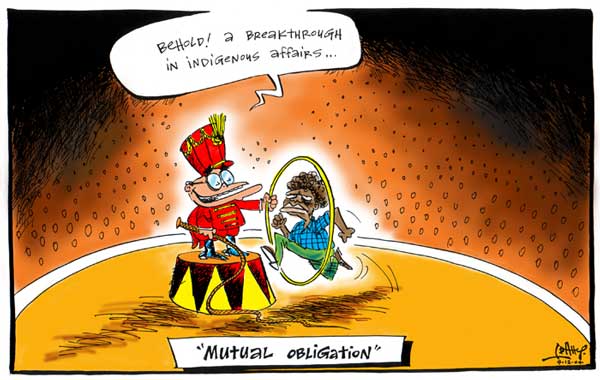
The process of deliberation and opinion formation about what should be done about the third world conditions of indigenous people, and their current welfare dependency, will proceed differently in the diverse public spheres of civil society, due to the political and economic structures. So it is useful to ask the Foucauldian question, 'how is power exercised in liberal society?'
It is an appropriate question because in this debate we are concerned with power, how power works, and to separate out power to improve the health of the children from force exercise against the community's will. A key issue that has arisen in the public debate is this: 'what is the nature relationship between the imposition of mutual obligation by the state and the liberty of the indigenous people to shape their own way of lif?.
At this stage of debate this relationship is currently seen terms of an either or dualism of (negative) freedom and (government) constraint. I suggest that Foucault offers a way to transgress this dualism, in the light of this post on governmentality and the duality of (free) subject and power (as domination).
So what is Foucault saying? How can he help us?
The above mentioned post was part of a series of posts on governmentality that were based on this text. The post said that:
"Governmentality refers to a continuum from techniques of government to technologies of self-regulation. This enables a more complex account of the way neo-liberalism works as a mode of governance, with its strategies of making individuals and families responsible for social risks such as retirement, illness, unemployment, and poverty.This shaping of responsibility as care of self leads to a moral subject who is able to rationally assess the costs and benefts of a particular course action in relation to others."
Mutual obligation is an example of what Foucault means by governmentality. It is a mode of governance of a population that works by shaping the conduct free subjects so that they become responsible parents and members of the community.
As Dodson and Pearson argue, the aim of this mode of governance:
"The aim must be to normalise obligations between Aboriginal parents and their children, between family members, and between individuals and their communities....The obligation to attend to children's hygiene is primarily an obligation owed by parents and adults to their children. It is not an obligation that, in the normal course, is owed to government..."
So the government should be shaping the parents conduct so they become the kind of subject, who as parents, fulfil their familial responsibility to attend to the hygiene of their children to prevent them from getting sick: the blindness caused by trachoma, the kidney failure caused by scabies and the deafness caused by unresolved ear infections.
Ali Rizvi has some useful insights here about how Foucault understands the workings of power. He quotes a passage from Foucault's, 'The Ethic of Care for the Self as a Practice of Freedom”, where Foucault says:
"Relations of power are not something bad in themselves, from which one must free one’s self. I don’t believe there can be a society without relations of power, if you understand them as means by which individuals try to conduct, to determine the behaviour of others. The problem is not of trying to dissolve them in the utopia of a perfectly transparent communication, but to give one’s self the rules of law, the techniques of management, and also the ethics, ethos, the practice of self, which would allow these games of power to be played with a minimum of domination” Michel Foucault (1987) “The Ethic of Care for the Self as a Practice of Freedom” trans. J. D. Gauthier Philosophy and Social Criticism special issue “The Final Foucault” 12 Summer, p. 129).
And in this latter post Ali usefully comments:
" ...practices of subjection are not all pervasive in the sense that there is always room for the constitution of subject as autonomous subject amidst the practices of subjection.This is possible because Foucault does not oppose power to freedom. Power is one kind of relation while freedom is another kind of relation. According to Foucault power “is the mode of action on the action of others” in the sense that its purpose is “to structure the field of possible actions of others”. Hence viewed, power relations must form an integral part of any society and thus “there can be no society without power relations”. Moreover power and freedom far from being contrary concepts are prerequisites for each other. At least Foucault makes it explicit that power can only be exercised “over free subjects and only insofar as they are free”. If power is the structuring of other’s action it can only be possible if there is space (freedom) for such a structuring."
This point is significant.The indigenous people in Mulan in Westeren Australia may be living in third world conditions but they are free subjects in a liberal society. So the techniques and instrumentalities of mutual obligation are concerned to shape the conduct of free indigenous subjects. There actions are to be structured to ensure they take responsibility for their children's health. And the indigenous community has agreed to have their conduct so shaped by the mechanisms of mutual obligation.
The questions are: is there space (freedom) for a structuring of the other’s action in those indigenous communities currently living on the edge of modernity?
Can aboriginal people be shaped to become free liberal subjects?
Are they, as liberal subjects able to, to use the instruments of mutual obligation to impower themselves, become more responsible parents and govern their community so that better health outcomes for their children can be achieved?
November 20, 2004
capitalist rationality
I have just come across an academic paper on Foucault and capitalist rationality by Ali Rizvi over at Foucauldian Reflections.
Capitalist rationality? That pulled me up short. I had understood political rationality in terms of neo-liberalism as a mode of governance, and then understood that mode of governance as a form of knowledge-power. I had interpreted some kinds of economics as neo-liberal (ie., the free market stuff+ minimal government + individual contracts) and read that as a form of political discourse.
Capitalist rationality? That would mean the rationality of self-reproducing economic system or order. That rationality is embodied with concepts and a shaping of economic conduct through economic and power relationships that work to maximize accummulation.
Ali says that the problem of governance in Foucualt's texts is the problem of governance for accummulation, and an assemblage of instrumentalities and mechanisms are in place to ensure docility and utility of human and the accummulation of capital. He then introduces the polity to show that liberal government and capitalist system are two sides of the same mode of governance.
Yes and no. Yes if we are talking about a neo-liberal mode of governance that governs a population through market mechanisms and instrumentalities. No if we are talking about liberal political institutions, as these have their dynamic and political logic, even if these institutions pass legislation dealing with the reform of industrial relations (eg., deregulation) and it becomes part of the rule of law.
Consider Parliament.
It is the democratic institution within our constitutional structure (in contrast to the bureaucracy and the legal system), which grounds its claims in the doctrine of parliamentary sovereignty, which is turn is a fundamental principle of constitutional law. Parliament operates in terms of political inconsistencies and constitutional ambiguities.
In his Conversations with the Constitution Greg Craven says that we are deal with a liberal political entity:
"...that mediates high constitutional functions through grubby politics, is the focus of absorbed but disgusted public attention, exists to bring down governments while shoring them up, and is simultaneously committed to democracy, practical outcomes, its British heritage and its own local style. Like anything interesting it seethes with contradictions as rotten meat crawls with maggots."
I would add that Parliament is simultaneously committed to democracy whilst it acts to white ant democracy.
Now Ali is not dealing with governance not sovereignty. However, the logic and dynamic of the polity is different to that of the capitalist market as businessmen quickly discover when they come to Canberra to lobby. Presumably we are taalking more about governance as administration of the market and not the polity per se.
November 10, 2004
Governmentality#5
In this post I want to return to considering Thomas Lemke's paper, 'Foucault, Governmentality and Critique', which I had previously considered here and here.
In those two posts I had briefly shown how Foucault makes a critical contribution to our understanding of neo-liberalism by moving beyond the standard knowledge and power dualism of political philosophy and the duality of state and economy. In this post I want to cosider how Foucault makes a critical contribution to our understanding of neo-liberalism by moving beyond the duality of (free?) subject and power (as domination?) This is the dualism of freedom and constraint so common in a liberalism premised on negative liberty.
Governmentality refers to a continuum from techniques of government to technologies of self-regulation. This enables a more complex account of the way neo-liberalism works as a mode of governance, with its strategies of making individuals and families responsible for social risks such as retirement, illness, unemployment, and poverty.This shaping of responsibility as care of self leads to a moral subject who is able to rationally assess the costs and benefts of a particular course action in relation to others.
A particular example that Lemke metions (pp. 12-13) the self-esteem movement as a way of governing ourselves. Another example would be citizenship where ordinary people have a productive involvement in public affairs.
However in place of the republican government of the people and by the people, political governance is government for the people with the primary responsibility being to provide services. From a nation of free citizens, we have become a nation of individualists and consumers for whom liberty means the right to be left alone and the right to choose among brands of toothpaste. The examples of citizens engaged in serious public work is declining.
November 05, 2004
governmentality#4
In this post I want to return to considering Thomas Lemke's paper, 'Foucault, Governmentality and Critique', which I had previously considered here.
In that post I had briefly shown how Foucault make a critical contribution to our understanding of neo-liberalism by moving beyond the standard knowledge and power dualism of political philosophy.
In this post I want to consider how Foucault moves beyond the duality of state and economy. This duality is taken for granted in that a neo-liberal discourse is concerned to rollback the (bad) state to make room for the (good) deregulated economy. As public policy neo-liberalism is an end of politics discourse that is deeply political since it escalates the rights of the private sector (meaning corporate, not petty bourgeois, capital) over public regulation and public sector or community provision. Economics is a political economy:---what we know from Marx is that the economic relations of exploitaton in the sphere of production are power relations between capital and labour.
The paradox of using the power of the state to roll back the state to make room for a deregulated market is well known.
So how does Foucualt transgress the state economy dualism? Lemke suggests that he extends Marx's political economy by combining a microphysics of power with a macropolitical question of the state. How? By looking at power relations concentrated in the form of the state in terms of the practice of government. The state itself is a tactic of government that makes possible what is within the competence of the state and what is not.
Instead of neo-liberalism being a retreat from government to the deregulated market, it is a transformation of politics involving the restructuring of power relations in society. What is happening under a conservative governance is not a shift to a smaller state. Libertarianism has been sidelined by a big government conservatism.,which increasingly governs through the non-government organizations (ngos) in civil society.
An example of the transformation in governance is the way the churches and welfare organizations have become involved in governing the unemployed through a welfare to work policy. The am is to get more the unemployed, disabled and single mothers off welfare and into work.
So the stark duality between state and economy is no longer a foundation of political philosophy. It is an element or effect of a neo-liberal discourse.
October 30, 2004
governing citizens
This is a very useful summer course at York University, Canadia, on Foucault, governance and citizenship that is run under the auspices of the Canadian Reseach Chair in Citizenship Studies. It ties in with the posts on governmentality.
The course blurb says that in dealing with the issue of governing citizens breaks with traditional approaches. Rather than:
".... considering citizenship as an enclosed political identity (liberal, communitarian, republican, radical), we examined it as an assemblage of strategies and technologies that aim to produce governable subjects. It is through these assemblages that citizenship becomes a 'problem' insofar as its project of producing governable subjects encounter resistances, difficulties, detours and reversals to which it responds with various different rationalities. We examined this subject by drawing upon the literature on 'governmentality' as we also investigated the limits and flaws of this literature."
The first reading is an account of Foucault's unpublished governmentality lectures by Colin Gordon.
October 29, 2004
Governmentality#3
How does Foucault's governmentality approach make a critical contribution to our understanding of neo-liberalism by moving beyond the standard dualisms of political philosophy, such as knowledge and power, state and economy and subject and power (as domination)?
Lemke says that the dualism of knowledge and power is undermined by the concept of political rationality. This concentrates on the rationalities underlying the historical practices of neo-liberalism that produces new forms of knowledge, new concepts that contribute to new government domains of regulation and intervention.
Lemke mentions sustainable development as an example. This reinvents nature external to the economy as an ecosystem and brings the stand alone economy within the environment. The economy is now seen as dependant on the ecosystem, eg. if there is no water in the dams or the rivers, then there is no economy or cities. Hence we have limits to growth and the efficient management of natural resources.
The second way that the dualism of knowledge and power is undermined by the concept of political rationality is the focus on the strategic character of government. Instead of the old idea of a (pure) plan that is then applied to (an impure) reality we have rationalities as part of reality.
The various resistances to the Living Murray Initiative that plans to return environmental flows to the River Murray by the irrigator groups are not just a block to the implementation of the plan. They are already a part of the plan, as they actively contributed to the fissures, contradictions and incohereneces inside the Living Murray Initiative.
October 28, 2004
governmentality#2
I previously mentioned this paper by Thomas Lemke entitled 'Foucault Governmentality and Critique' in my earlier post on Foucault & governmentality.
What does Lemke say? He starts by asking two good questions:
"(1) why does the problem of government assume a central place in Foucault's work? and (2) how could this concept serve to analyse and criticize contemporary neo-liberal practice?"
I am more interested in the 2nd question than the first given this.
On the first question, Lemk says that governmentality is the missing (unpublished) link between the genealogy of political rationality and the genealogy of the subject. What the unpublished lectures explore is the way that the history of the modern state and individual co-determine each others emergence.
Governmentality as a mode of governance has the following characteristics:
1. Foucault's earlier rejection of the juridical model of power (law, contract, consensus in favour of the war (and conquest) give way to a view of consensus and coercion as instruments, mechanisms, means of government;
2. governmentality is what links the individual's self-control is linked to political form and economic regulation and exploitation;
3. it distinguishes between power as strategic games and domination to consider ways the modes of power regulate or shape our conduct to empower subjects.
That is a quick sketch. It is enough to enable us to as the question we are interested in: 'How goes this way of looking at power help us to understand neo-liberalism?'
Lemke usefully constrasts it with other approaches such as:
*one that treats neo-liberalism as wrong knowledge ie., as an ideology;
*one that treats neo-liberalism as the extension of the economy into politics as the truiumph of capitalism over the state. So they set out to civilize a barbaric global capitalism. Mark Latham's ALP adopts this approach, which it calls the Third Way;
*one that concentrates on the negative consequences of neo-liberalism on individuals in the nation-state.
Lemke says the limits of these 3 approaches is that they continue to rely on the very concepts they intend to criticize. They presuppose the dualism of knowledge and power, state and economy and subject and power as domination. The critical contribution lies in it moving beyond these dualisms in political philosophy.
October 25, 2004
Foucault & governmentality
Thomas Lemke's book, A Critique of Political Reason: Foucault's Analysis of Modern Governmentality look to be a very interesting text indeed. Governmentality is the link between Foucault's exploration of the political rationalites and genealogies of the state and the techniques of domination on the one hand, and his exploration of ethics, the genealogies of the subject and the technologies of subjectivity on the other. Governmentality links the formation of the state and the formation of the subject.
I have tried looking for Foucault's lecture courses on governmentality on the internet off and on, but I've come up with nothing much. As I understand it Foucault gave two courses of lectures around 1978 and 1979. at the College of France. The 1978 lecture course is a genealogy of governmentality from the classical Greeks and Romans through the Christian idea of pastoral guidance to the idea of state reason and the police in the 18th century. The 1979 lecture course explored the social market (German Ordo)liberal and the neo-liberal (Chicago School) forms of governmentality. It is a pity that these lecture courses are not online, as the 1979 lecture series ---summarized by Lemke here ---looks to be interesting. These lecture series (audio only?) should be online.
In the meantime the Foucauldian Reflections weblog run by Ali Rivzi fills the online gap. The weblog is very good and thoroughly recommended. Ali is also in the process of developing a resource site that provides a wealth of articles by and about Foucault. So things are beginning to shift in terms of online resources.
My understanding of governmentality is gained from reading some of the above lectures several years ago.I'm interested in governmentality as it connects academic theory with public policy and political power in a fruitful way. I've found the governmentality approach to be particularly useful for understanding how neo-liberalism works to govern (shape the conduct of) populations through the deregulated market that take the whole of society as their domain, governing the environment through community, and the practices of social medicine as a system of power and economics. Governmentality gives us is the idea of neo-liberalism as a political project that creates a political economic reality that it says exists.
I have not read Lemke's book. So I am working from his summary of this text. Lemke starts off by saying that the body/power Foucault of Discipline and Punish tended to identify power with discipline. The relations of power are understood in terms of war, struggle and conflict not law, legitimation, will and consensus. Foucault reversed the juridical model of power centred around sovereignty and during the 1980s he took a lot of flak from Anglo-American liberal critics (Habermas, Taylor, Walzer) for this reductionism. They highlighted the gaps, contradictions and aporias in Foucult's work on power and drew attention to the tension between his empirical insights into the modern mechanisms of power and normative problems associated with saying that domination and discipline was bad. Hence an effective critique of the use of power was undermined.
In the second part of his book entitled 'Governmentality' Lemke shows:
"....how Foucault significantly changes his conception of power: the importance of discipline is relativated with respect to macropolitical phenomenons (bio-politics); the war-model, that he prefered and opposed to the juridical model, is questioned and finally critized for being reductive."
So Foucualt takes the criticisms on board and then revises his understanding of how power in a liberal society actually works. What replaces the earlier disciplinary model of power is governmentality. Governmentality is an important category shift.
What then is governmentality?
Lemke says that:
'This is the point where the notion of government appears. Foucault uses this term to solve both problems that are insufficiently treated in the "microphysics of power:" government takes up the question of the government of the self (the problem of the subject) and articulates at the same time the problem of the government of the others (the problem of politics and the state).Foucault "discovers" a new dimension of power: government does not operate as "right" or as "war"; it works foremost as a "conduct of conducts."'
By conduct of conducts in a liberal society Foucault the practices (conduct) of a population and our subjectivity. An example is how neo-liberalism weans us off our social democratic reliance on state provision of services, and shapes the unemployed through welfare to work programs to become more self-reponsible and entrepreneurial.
Lemke rightly says that this perspective of politics as governmentality is especially useful to analysing the ongoing transformations of the welfare state that are linked to the appearence of new "neoliberal" forms of subjectivity associated with the welfare-to work-policies that target the unemployed, the disabled and single mothers.
In the third part of his hbook, which is entitled 'Politics and Ethics', Lemke says that:
"I try to show that Foucault's interest in subjectivity and ethics in his later work does not signify that he breaks with his analytics of power. On the very contrary: government is the notion that links the ways subjects conduct themselves ("ethics") with forms of power and domination."
Governmentality is concerned to ensure the right conduct of a population in a deregulated market and to shape new forms of (entrepreneurial) subjectivity. In governmentality the ethics and the politics are deeply intertwined.
I appreciate that this is a very condensed summary of some complex material, but I think that it is enough to highlight the importance and the significance of governmentality for a history of the present.
A paper by Lemke for those interested. It provides more background on governmentality and highlights the way that the contact point of the state governing others is also the contact point for our self-regulation.
May 17, 2004
Empire: Foucault, disciplinary society & biopower
Hardt and Negri say that they have two main reasons for turning to Foucault to develop Hegel's concept of the police or public authority in the Philosophy of Right. As we have seen in a previous post public authority (police) is located within civil society and it mediates (regulates) the differing interests of producers and consumers, is concerned with education and poverty.
What Hardt and Negri are doing is rumaging through Foucault's conceptual tool box to deepen our understanding of the mode of governance exercised by public authority in civil society. The aim is to use the tools developed by Hegel and Foucault to help us understand the governance of the modern liberal capitalist society in modernity, and then apply them to the way internatonal relations are currently governed.
We have to get the tools from somewhere. So let us see what they reckon will be useful from Foucualt's toolbag.
Hardt and Negri say that the first reason for making the turn to Foucault's tool box is to pick up Foucault's concept of a disciplinary society. Hardt and Negri describe this as follows:
"Disciplinary society is that society in which social command is constructed through a diffuse network of dispositifs or apparatuses that produce and regulate customs, habits, and productive practices. Putting this society to work and ensuring obedience to its rule and its mechanisms of inclusion and/or exclusion are accomplished through disciplinary institutions (the prison, the factory, the asylum, the hospital, the university, the school, and so forth) that structure the social terrain and present logics adequate to the "reason" of discipline. Disciplinary power rules in effect by structuring the parameters and limits of thought and practice, sanctioning and prescribing normal and/or deviant behaviors."
The second reason for turning to Foucault to develop Hegel's cconcept of the police is Foucault's concept of biopower. Hardt and Negri say:
'Biopower is a form of power that regulates social life from its interior, following it, interpreting it, absorbing it, and rearticulating it. Power can achieve an effective command over the entire life of the population only when it becomes an integral, vital function that every individual embraces and reactivates of his or her own accord. As Foucault says, "Life has now become . . . an object of power."'
Does biopower achieve an effective command over the entire life of the whole population?
Biopower is described by James Marshall as a:
"...form of power that is exercised on the body and it carries a specifically anatomical and biological aspect. It is exercised over members of a population so that their sexuality and individuality are constituted in certain ways that are connected with issues of national policy, including the machinery of production. In this way populations can be adjusted in accordance with economic processes."
"So that populations can be adjusted in accordance with economic processes?" What could that mean in a liberal society of free individuals?
An illustration would be the attempts by the neo-liberal state to do shape the conduct of populations so they act are more in accord with the processes of free market and are weaned of the welfare state. James Marshall says that Foucault meant it in the sense of a diciplinary society: as
"... technologies of domination [that] act essentially on the body, and classify and objectify individuals. They were developed in disciplinary blocks such as the prison, the hospital, and the school. In so far as these objective classifications are adopted and accepted by individuals so their selves are also constituted."
James Marshall says that the other technology of biopower is the technologies of the self :
"...in technologies of the self there is the belief, now common in western culture, that it is possible to reveal the truth about one's self. By telling the truth about one's sexuality, where the "deepest" truth is embedded in the discourse and discursive practices of sexuality, individuals become objects of knowledge both to themselves and to others. But telling the truth is both therapeutic and also controlling. Eventually, according to Foucault, we learn how to do these things to ourselves."
Foucault argued that the conjoint effects of these two technologies of domination and self give rise to a mode of governance, or governmentality as the art of government exercise by public authority.
Governmentality refers to the way a public authority in civil society exercises the art of shaping, creating and directing the "diffuse network of dispositifs or apparatuses that produce and regulate customs, habits, and productive practices" for the public good or interest. James Marshall says that governmentality:
"...is a form of activity which attempts or aims at the conduct of persons; it is the attempt to shape, to guide, or to affect not only the conduct of people but, also, the attempt to constitute people in such ways that they can be governed. In Foucault's work this activity of governance could cover the relations of self to self, self to others, relations between institutions and social communities, and the exercise of political sovereignty."
Foucault broadens public authority beyond civil society to include the state as the political sovereignty in a nation state.
It is not clear whether Hardt and Negri follow him in this. I suspect that they do, since they want to use these concepts to map the mode of governance exercised by empire. However, we need to bear in mind that no nation-state rules the globe. So political sovereignty exercised by empire is going to be along the lines of governmentality.