February 26, 2005
Globalization and Australia's future: a big worry
The debate over the effects of free trade and international capital flows is a polarized one. Boosters of globalization assert that it is a win-win proposition for the rich and the poor, developed and developing countries alike. Hence all countries should gain from opening their economies. The critics see global corporations lining its pockets at the expense of everyone else and they emphsize the injustices associated with "sweatshop labor". They are anti-globalization. That is level at which the debate has been, and is being, conducted.
This article by Geoffrey Garrett in Foreign Affairs indicates that debate overlooks those in the middle. Garrett says:
"...while globalization has benefited many, it has squeezed the middle class, both within societies and in the international system. In today's global markets, there are only two ways to get ahead. People and countries must be competitive in either the knowledge economy, which rewards skills and institutions that promote cutting-edge technological innovation, or the low-wage economy, which uses widely available technology to do routine tasks at the lowest possible cost. Those who cannot compete in either include not only the erstwhile industrial middle class in wealthy nations, but also most countries in the middle of the worldwide distribution of income, notably in Latin America and eastern and central Europe.
This has certainly been the case in Australia: the middle class has been squeezed, the old industrial working class was thrown onto the scapheap, the regions are left to wither on the vine, and the worrking class kids with low skill levels end up in casual jobs on supermarket counters.
What about Australia as a midle ranking power? Are we like some of those countries Latin America and eastern and central Europe? We are certainly not like Japan and Germany.
Garrett then adds:
"The question is, how can they be helped? Displaced American manufacturing workers would probably rather get jobs at Microsoft or Genentech than at McDonald's or Wal-Mart. But for most of them this just is not a realistic option. On the global stage, countries such as Mexico and Poland would similarly like to compete with Japan and Germany in the U.S. market for high-value-added goods and services. But their work forces are not skilled enough and their economic institutions not sufficiently supportive of investment or innovation to take advantage of the knowledge workers they do have."
The question is: is Australia's future one in which its work force is not skilled enough, and its economic institutions are not sufficiently supportive of investment or innovation to take advantage of the knowledge workers it does have? Is Australia like Mexico and Poland?
What is in doubt is Australia's ability to develop new technologies and industries faster than anyone else. For the last five decades, Australia's scientific innovation and technological entrepreneurship have been poor and, unlike the US, they have not ensured the country's economic prosperity. Australia started late and it is being outpaced by Asia.
Adam Segal, in an article entitled Is America Losing Its Edge? in Foreign Affairs says:
"...the most serious challenge is coming from Asia. Through competitive tax policies, increased investment in research and development (R&D), and preferential policies for science and technology (S&T) personnel, Asian governments are improving the quality of their science and ensuring the exploitation of future innovations. The percentage of patents issued to and science journal articles published by scientists in China, Singapore, South Korea, and Taiwan is rising. Indian companies are quickly becoming the second-largest producers of application services in the world, developing, supplying, and managing database and other types of software for clients around the world. South Korea has rapidly eaten away at the U.S. advantage in the manufacture of computer chips and telecommunications software. And even China has made impressive gains in advanced technologies such as lasers, biotechnology, and advanced materials used in semiconductors, aerospace, and many other types of manufacturing."
Segal for the last 30 years, U.S. companies have led in the invention of new products while Asian firms have played a secondary role, lowering the costs to manufacture U.S. inventions. But Asian firms have begun to challenge that division of labor and are no longer content simply to follow. Australia, in contrast, has been content to import the technology not manufacture it.
The result has been a shift in the locus of innovation from individual corporate labs to networks of technology firms, capital markets, and research universities.
Segal's acount of what is happening is worrying for Australia. He says that:
"Cheaper communications technologies have also allowed U.S. companies to operate more globally, dividing production into discrete functions, contracting out to producers in different countries, and transferring technological know-how to foreign partners. Contrary to conventional wisdom, not just labor-intensive manufacturing is being moved offshore; Microsoft, Intel, Bell Labs, Motorola, and other firms increasingly perform advanced research abroad.The attraction of emerging technology clusters in places such as Shanghai, China, Bangalore, India, and Hsinchu, Taiwan, was at first based on their cheap labor supply. But as local technology companies have developed, new research institutes have been founded, and scientists and engineers from such countries have returned home after training and working in the United States, these hubs have started supporting innovation of their own."
Australia is bypassed. We have so few developing emerging technology clusters here and unklike Asia, the state is not spending 3 percent of GDP on R&D. Australia is drifting back to being a quarry providing the raw materials to fuel the industrial machinery in Asia.
Why? Because, though geography does not matter in a globalised world as technology firms can now locate anywhere, these firm need to be be competitive. As Segal says to remain competitive, technology companies need knowledge-and information-rich regions as suchb firms are likely to be drawn to technology hubs that provide the concentration of ideas, talent, and capital needed for future innovation.
Australia does not provide those kind of hubs, and the emergence of new technology clusters here are way behind thoes in Asia. We do have the leverage of those regions that can successfully assemble the components of innovation for global capital. Does that mean we have to go low tech by driving down our work conditions and pay scales?
Segal says that US firms have the capacity to develop and absorb new technologies as they emerge elsewhere, the ability to make good use of diverse ideas and systems, and the capability to adopt and integrat new technologies more rapidly than their competitors.The US has dynamic innovation systems.
But not Australia. Ours are very rudimentary. So the low tech road may well be forced on us.
January 25, 2005
Rewriting Marx
Is the spell of modernity breaking?
A quote from Terry Eagleton's After Theory about the juggernaut of modernity:
"There is far too much change around, not too little. Whole ways of life are wiped out almost overnight. Men and women must scramble frantically to acquire new skills or be thrown on the scrapheap. Technology becomes monstrous in its infancy and monstrously swollen corporations threaten to implode. All that is solid - banks, pension schemes, anti-arms treaties, obese newspaper magnates - melts into air. Human identities are shucked off, tried on for size, tilted at a roguish angle and flamboyantly paraded along the catwalks of social life. In the midst of this perpetual agitation, one sound middle-aged reason for being a socialist is to take a breather."(p.8)
This is a rewrite of Marx's all that's sold melts into air passage in the Communist Manifesto, that classic nineteenth century account of the impact of global capitalism on nations and populations.
As contemporary western subjects we experience the globalising world through a modern consciousness. No matter what our history or tradition ours is a modern gaze.
What I find interesting about Eagleton's 'After Theory' is this reviewer's reconstruction of Eagleton's response to this juggernaut and the end of culture theory as a criticsm of modernity in 'After Theory.' William Deresiewicz says:
"Eagleton articulates a set of ideas about the nature of human happiness and of the collective life necessary to achieve it that is often persuasive and beautiful. From Aristotle he takes the notion that happiness is not, as capitalist ideology insists, a matter of achieving wealth or success or indeed any goal but of fulfilling one's nature as a human being, the flourishing of one's innate capacities for excellence and virtue.But if the good life means becoming more fully human by developing the virtues, it takes both strenuous practice (one becomes brave or compassionate by being brave or compassionate) and the social conditions that make such practice possible.
Ethics, in other words, is a subset of politics. "If you want to be good, you need a good society," Eagleton writes; "nobody can thrive when they are starving, miserable or oppressed." A true ethics is thus a materialist one, a morality not of feeling but of acting: feeding the hungry, comforting the sick."
Eagleton is rediscovering the classical philosophical roots of Marx. About time.
Is this not a rebirth of an alternative discourse to that of the modernist, scientific Marxism that Eagleton so eagerly embraced and wielded in the 1970s? Can I presume that Eagleton has dumped the science?
January 04, 2005
Tsunami & global security: on gaps and connections
An interview with Thomas P. M Barnett, whose ideas were outlined here
In his book 'The Pentagon's New Map' Barnett's Gap group of countries were understood as the least connected to the global economy (they export one or two raw materials but very little manufactured goods).This group included much of the Caribbean Rim, the Andes portion of South America, virtually all of Africa, the Balkans, Central Asia and the Caucasus, the Middle East, and much of Southeast Asia.
Southeast Asia includes the area hit by the tsunamiin the Indian Ocean. So the Barnett strategy would be to deepen their fragile connections to the global economy ---"to shrink that Gap over time by helping those regions integrate themselves with the global economy in a fair and just manner." Global stability (i.e. U.S. national security) requires a shrinking of the Gap by the Core.
The tsunami disaster provides and opportunity to shrink the gap of those disconnected economically and technologically from the global economy. This is what Barnett says on his weblog:
"There is connectivity to be won in Asia in 2005. There is a future worth creating there, a Core worth expanding, a Gap worth shrinking."
Barnett asks:
"How about an unprecedented "core regional group" made up of the United States, India, Japan, and Australia. Ever heard of that quartet before? Toss in China and you've got a mighty hand ready to sow connectivity where disconnectedness was generated almost instantly by one massive vertical shock followed the world's biggest horizontal wave."
China? That is asking a lot for regional governance when China is still as a big threat and not a regional partner. To his credit Barnett identifies this problem and criticizes the security people in the US Department of Defense.
But Barnett misses something else that goes to the heart of his gap/core thesis and the security aspect of globalization. This is civil war in Aceh? Will connectivity do away with that? He presumes so. Others do not.
Have a look at this article coutresy of
This corporate kind of globalization disconnects Aceh from the global economy. It does because of the connections between U.S. corporate interests and the Indonesian military repression in Aceh. Allan Nairn says that Exxon Mobil's
"....natural gas facility dominates the Acehnese economy, by way of extraction. They also have Indonesian troops garrisoned on their property. The Exxon Mobil company pays protection money to the Indonesian military and the military buries bodies of its victims on Exxon Mobil lands. The revenues from Exxon Mobil are a mainstay of the Jakarta central government. Not much of it finds its way back to Aceh."
And there are two other problems. Allan Nairn says thateven now, after the tsunami disater and international aid is flowing in, the Indonesian military is continuing to attack villages, more than a dozen villages in East Aceh and North Aceh away from the coast.
And the military is also impeding the flow of aid. They’ve commandeered a hanger at the Banda Aceh airport and:
"...the distribution of supplies is being done in some towns and villages only to people who hold the 'red and white,' which is a special ID card issued to Acehnese by the Indonesian police. You have to go to a police station to get one of these ID cards, and it is only issued to people who the police certify as not being opponents of the army, not being critics of the government. Of course many people are afraid to go and apply for such a card."
You can have the tendencies of connectivity and disconnectivity operating at the same time.
Does not Aceh question Barnett's assumption that globalization is beneficial to the Gap? Does it not raise the issue of whether more globalization is good or bad?
December 31, 2004
Globalization
The new face of China
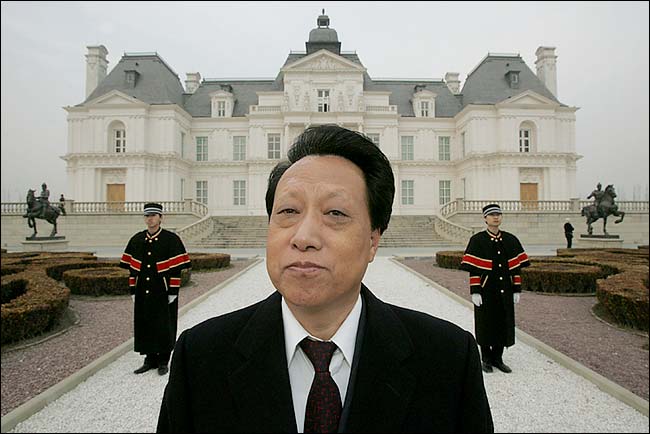
This is no ordinary imitation. It is the oriental twin of Chateau Maisons-Laffitte, the French architect Francois Mansart's 1650 landmark on the Seine.
November 28, 2004
Islam and the West
 This interview with Gilles Kepel about adn around his book The War for Muslim Minds: Islam and the West is very good.
What caught my eye was the section on Islam in Europe’s heart. This means the “war for Muslim minds” as being fought in Europe as much as in Iraq or Palestine – and the communities of believers on the periphery of cities like London and Paris as the main battlefield in this war for the next decade.
To make his point Kepel refers to an incident in August 2004 where an “Islamist army” in Iraq bought two kidnapped French journalists, Christian Chesnot and Georges Malbrunot, from the group of thugs responsible for their seizure. The Islamists announced they would behead the journalists unless France rescinded its secular ban on the wearing of the hijab (and other religious apparel) in French schools. The Islamists was convinced that this would mobilise the Muslim masses in France in their favour, and were supported in this expectation by various French Islamists on Arabic–speaking satellite TV.
Kipel says:
"Much to their dismay, French people of Muslim descent – regardless of the degree of their devotion – adamantly denied the kidnappers the right to speak in their name, and affirmed a primary solidarity with the journalists, not to whoever claimed to speak in the name of Islam."
Those Muslims who came out onto the streets of France to say “not in my name” were also making a crucial decision about their identities as individuals living in Europe within the context of the national debate over the wearing of the hijab. Kipel describes the significance of this not in my name stance:
"They were saying that their Muslim descent must not be hijacked to jeopardise what to them was most important in this whole episode, which was their being French and European...The larger point is that personal identity is not a given, but something in the continual process of being built. In the case of the hijab, the state affirmed the right of young women of Muslim origin in France not to be under pressure in state schools or projects from thugs who – in the name of Islamism or salafism – compelled them to wear the veil or be abused as “prostitutes” or even physically attacked."
I find this significant because the conservative discourse in Australia is to dump Muslims into the Islamist camp to creat the other as barbaric civilization which hates the Westfor what it is.
This blocks the very different voices of Muslim Australians living in our capital cities and their experiences of liberal democracy. It is amongst Australian Muslims that we would expect to find support for the idea of an Islamic understanding of a constitutional democracy. This would be one in which legitimation resides in a citizenry of individuals enjoying equal human and representational rights, governed by a parliament which legislates through consensual and majority decisions and operating within the rule of law and the Constitution.
I would presume that this would mark a innovative interpretation of Islamic political thought. An example courtesy of Stray Reflections
September 18, 2004
Nation states & Sovereignty
From a Gauche. An interesting link: 'The Perverse Preserverance of Sovereignty' by Anthony Burke from the University of Adelaide in Borderlands. I see that the University without Condition is reading the text.
Anthony says that:
"It's a familiar story: the withering away of the state under globalisation, or if not so much the state, the withering away of a certain idea and formation of sovereignty. A sovereignty that no longer possesses the fullness and power of its Westphalian ideal: a bounded territorial realm in which national authority is absolute, which provides a representative and political principle through which states and their people can manage and control the forces that affect their lives. With the increasing globalisation of capital and trade, the growth of supranational regimes of economic governance such as the WTO, the interventionist zeal of the World Bank and the IMF, and the might and influence of the transnational corporation, sovereignty appears to be a thing of the past - the nostalgic ghost of a world transformed."
The nation state in modernity is being eclipsed.It is most keenly felt in the loss of economic autonomy experienced under globalisation.
July 07, 2004
more of the same
A quote from this review by George Scialabba of Emmanuel Todd's, After the Empire: The Breakdown of the American Order, in Dissent (Sping 2004). It reinforces the folly judgement of the previous post.
Scialabba says:
"The end of the cold war presented the United States with a fateful choice. We could relinquish the artificial financial advantages that kept money flowing into Wall Street even as foreign demand stagnated, American industry declined, and the American trade deficit grew. This would have meant military retrenchment and a period of economic austerity, but it would have restored our competitiveness, allowing for reindustrialization on a solid basis and with a more evenly distributed prosperity. However, we didn't. Instead, after declining through most of the decade, military budgets began increasing in the late nineties. Was this a deliberate decision by America's rulers to go for empire rather than rejoin an international community of equals?"
The US blew it according to Emmanuel Todd. He says that the American ruling class is even more rudderless and clueless than its European counterparts. He argues that choosing to remain a leading nation rather than become an empire would have been by far the better long-term strategy for the United States.
July 05, 2004
Empire: the multitude
After looking back over the international Marxist tradition of liberation Hardt and Negri ask:
"But how can this potential for liberation be realized today? Does that same uncontainable desire for freedom that broke and buried the nation-state and that determined the transition toward Empire still live beneath the ashes of the present, the ashes of the fire that consumed the internationalist proletarian subject that was centered on the industrial working class? What has come to stand in the place of that subject? In what sense can we say that the ontological rooting of a new multitude has come to be a positive or alternative actor in the articulation of globalization?"
These questions need to be asked because the new subject of revolt is not the international industrial working class. It is the multitude of anti-globalisation protesters, who are made up of politically diverse groups – anti-capitalists, protectionists, anarchists, environmentalists, alternative life-stylers, travellers, animal welfare activists, anti-fascists (fascists) and so on. They are generally clear about what they’re against – globalisation, capitalism, neo-liberalism-that make up the Washington consensus--than what they are for. And they understand that the corporate form of globalization stands for “There is no alternative to this”. It basically says that you cannot follow distinctive national policies, labour standards or welfare rights, because there are people in Jakarta or China who would have your job.
On the other hand, this anti-globalization multitude has a good grasp of our mutual interconnectedness and vulnerability. In the 21st century we no longer inhabit a world of discrete national communities. Instead, we live in a world where the trajectories of different countries are deeply enmeshed with each other. As David Held puts it:
"In our world, it is not only the violent exception that links people together across borders; the very nature of everyday living – of work and money and beliefs, as well as of trade, communications and finance, not to speak of the earth’s environment, connects us all in multiple ways with increasing intensity."
The multitude's critical concern with corporate globalization of the Washington consensus now needs to be overlaid with the Washington security agenda. We are caught up in, and shaped by, both. So we can usefully bring Hardt & Negri into play with this material.
Now Hardt & Negri recognize that the very subject of labor and revolt has changed profoundly. They say that the composition of the proletariat has transformed and thus our understanding of it must change too. So how do they do this?
Hardt & Negri say that in modernity the old:
"....industrial working class was often accorded the leading role over other figures of labor (such as peasant labor and reproductive labor) in both economic analyses and political movements. Today that working class has all but disappeared from view. It has not ceased to exist, but it has been displaced from its privileged position in the capitalist economy and its hegemonic position in the class composition of the proletariat. .... It means, rather, that we are faced once again with the analytical task of understanding the new composition of the proletariat as a class... Our point here is that all of these diverse forms of labor are in some way subject to capitalist discipline and capitalist relations of production. This fact of being within capital and sustaining capital is what defines the proletariat as a class."
They do so struggle and revolt that reveal trace of the multitude's refusal of exploitation and that signal a new kind of proletarian solidarity and militancy.They menton them:
"Consider the most radical and powerful struggles of the final years of the twentieth century: the Tiananmen Square events in 1989, the Intifada against Israeli state authority, the May 1992 revolt in Los Angeles, the uprising in Chiapas that began in 1994, and the series of strikes that paralyzed France in December 1995, and those that crippled South Korea in 1996. Each of these struggles was specific and based on immediate regional concerns in such a way that they could in no respect be linked together as a globally expanding chain of revolt."
They say that we ought to be able to recognize that although all of these struggles focused on their own local and immediate circumstances, they all nonetheless posed problems of supranational relevance, problems that are proper to the new figure of imperial capitalist regulation:
"We ought to be able to recognize that this is not the appearance of a new cycle of internationalist struggles, but rather the emergence of a new quality of social movements. We ought to be able to recognize, in other words, the fundamentally new characteristics these struggles all present, despite their radical diversity. First, each struggle, though firmly rooted in local conditions, leaps immediately to the global level and attacks the imperial constitution in its generality. Second, all the struggles destroy the traditional distinction between economic and political struggles. The struggles are at once economic, political, and cultural-and hence they are biopolitical struggles, struggles over the form of life. They are constituent struggles, creating new public spaces and new forms of community."
Okay. Let us grant them the argument. That these diverse struggles are struggles over forms of life. They are struggles to bring about the good life.
June 21, 2004
Empire & regional integration
In this article John Quiggin questions the regional integration thesis of the Australia Free Trade Agreement with the US. He says that:
"In general, an integration agreement involves the adoption of common, or at least compatible, economic policies on a wide range of issues, including intellectual property, public ownership of infrastructure, and competition policy. Ultimately, integration is likely to extend the provision and financing of health care and education.However, 'integration' is a misleading term in the context of a bilateral agreement between Australia and the United States. Given the relative size of the two countries, and the fact that the United States has adopted a general strategy of seeking bilateral agreements on trade and other issues on a 'pattern bargaining' model, it is clear that any agreement will involve Australia adopting American institutions and not vice versa.
This does not represent a difficulty for advocates of an FTA such as Austa. Austa publications indicate a strongly-held belief that the economic and social institutions of the United States are superior to those of Australia, and that we will therefore benefit from an agreement which binds us to replace our existing institutions with those of the United States."
Thus we have an account of how empire works. It works to the disadvantageof Australia. Thus John Quiggin can say issues "relating to economic integration should be dealt with in a multilateral context and in a manner that does not prejudice the democratic rights of Australians to control their own social and economic institutions."
June 06, 2004
Empire: room to move?
There was an article in last Friday's edition of the Australian Financial Review (subscription required) that touches upon our theme of empire. Written by Stephen Bell, it addresses the role played by the Reserve Bank in Australia. Bell says:
'For years now globalists and neoliberals have been putting out the message that "globalization" and the need for "national competitiveness" meant governments have little policy discretion. Budgetary policy, taxation, welfare and even microeconomic policy are said to be constrained by a "golden straitjacket." Governments are supposed to win over fickle, footloose investors and defer to herd-like financial markets that can punish nations overnight for straying from the path of economic virtue.'
This powerful message has come from Canberra neo-liberals and various international commentators who make their living from spinning popular economics.
Bell says that we have been conned. He says that the wide varietion in tax, welfare and microeconomic policy regimes around the world is strong evidence that governments still have a good deal of policy discretion --if they choose to use it. Many states don't so choose.
Bell says that the Australian Reserve Bank has carved out a distinctive policy approach that challenges the neoliberal thesis about policy convergence. The policy path meant that the Reserve Bank has had to fight to become independent of government control during the 1980s; to pursue its multiple goal statutory charter of low inflation and full employment in the 1990s in the face of the neoliberal preference for low inflation-only objectives; and to avoid the hawkish crunching inflation through a harsh recession favoured by the othodox international monetary authorities.
Hence there is room to move.
But let us not get too carried away with thsi independence. The Reserve Bank still used unemployment and labor insecurity as disciplinary instruments to crack then contain inflation.
May 15, 2004
Empire: Ch1.#11- Universal Values
In finishing the third and last section of Chapter one Hardt and Negri say that they find themselves confronted with a classic problematic of political philosophy: the decline and fall of Empire. They spell this out along the following lines:
"Empire is emerging today as the center that supports the globalization of productive networks and casts its widely inclusive net to try to envelop all power relations within its world order----and yet at the same time it deploys a powerful police function against the new barbarians and the rebellious slaves who threaten its order. The power of Empire appears to be subordinated to the fluctuations of local power dynamics and to the shifting, partial juridical orderings that attempt, but never fully succeed, to lead back to a state of normalcy in the name of the "exceptionality" of the administrative procedures."
I guess you can see this in Iraq. The local crisis in Iraq affects many areas of life – security, economy, domestic politics and inter-ethnic and inter-religious relations in Europe and the Middle East. It is a global crisis in the form of a clash of civilizations; but a clash of civilizations in which there is an enormous clash within the Muslim world between those who want to reform, and secularise, and those whose power is threatened, or who want to take power in the name of fundamentalism. It is global in the sense that likely to have serious consequences for everyone on earth.
Hardt and Negri's way of thinking is classical in that it reaches back to the Roman Empire:
"These characteristics, however, were precisely those that defined ancient Rome in its decadence and that tormented so many of its Enlightenment admirers.... Should we conceive this as an Empire of decadence, then, in the terms Montesquieu and Gibbon described? Or is it more properly understood in classical terms as an Empire of corruption? Here we should understand corruption first of all not only in moral terms but also in juridical and political terms, because according to Montesquieu and Gibbon, when the different forms of government are not firmly established in the republic, the cycle of corruption is ineluctably set in motion and the community is torn apart... Second, we should understand corruption also in metaphysical terms: where the entity and essence, effectiveness and value, do not find common satisfaction, there develops not generation but corruption...These are some of the fundamental axes of Empire that we will return to later at length."
My my. This frames the issue from the perspective of classical republican philosophy. Aristotelian political philosophy adopted the "standpoint of the citizen-ruler and it sought to provide the moral perspectives and the linguistic resources that could generate prudential insight and sharpen skills required for political deliberation .... Aristotelian political philosophy defined its own function in practical political terms. Its task was not to provide a body of truths that would perhaps render the prudential insight and deliberative skills of the citizen-ruler superfluous, but rather to offer resources for sharpening that insight and making those skills more effective. "
Presumably the gesture to republicianism as a rejection of classical liberalism that defined itself with the imperatives of the rhetoric of pure theory, adopted the rhetorical posture of an absolutely detached spectator regarding a field of audience-independent "political" facts, and deduced deduced from indubitable first principles universal truths about the essence of human political association.
May 13, 2004
Empire: Ch.1#10
I've been busy down in the cellar churning out political material whilst everyone has been sleeping soundly.
sigh.
What I keep noticing is the unphilosophical nature of politics and the exclusion from politics of philosophical questions concerning politics. There is the substantive exclusion from political debate and decision-making the key issues concerning our ways of life. As Alasdair MacIintyre comments this is the case even though "the activities of government are such that they are not in their effects neutral between ways of life, but undermine some and promote others. "
Oh well, let us come back to the Hardt and Negri text. Here is someone else looking at the text.
In the Universal Values section we find Hardt and Negri exploring the connection between the police actions and universal values. They ask:
"Should we assume that since this new right of intervention functions primarily toward the goal of resolving urgent human problems, its legitimacy is therefore founded on universal values? Should we read this movement as a process that, on the basis of the fluctuating elements of the historical framework, sets in motion a constitutive machine driven by universal forces of justice and peace? Are we thus in a situation very close to the traditional definition of Empire, the one promulgated in the ancient Roman-Christian imaginary?"
They add that imperialism is no longer possible today since no nation state, not even the United States, is capable of acting as a sovereign power to rule over the global order.
We could say yes to these questions and quickly move on. However, Hardt nad Negri say:
"It would be going too far to respond affirmatively to these questions at this early stage in our investigation. The definition of the developing imperial power as a science of the police that is founded on a practice of just war to address continually arising emergencies is probably correct but still completely insufficient. As we have seen, the phenomenological determinations of the new global order exist in a profoundly fluctuating situation that could also be characterized correctly in terms of crisis and war. How can we reconcile the legitimation of this order through prevention and policing with the fact that crisis and war themselves demonstrate the very questionable genesis and legitimacy of this concept of justice? As we have already noted, these techniques and others like them indicate that what we are witnessing is a process of the material constitution of the new planetary order, the consolidation of its administrative machine, and the production of new hierarchies of command over global space."
That is a good signpost. A new juridical apparatus is in formation with the new global order. That is why we need to keep an open mind here and adopt the stance of exploring what is going on. As Hardt and Negri say we are are participants in this development and so our citizenship, just like our ethical responsibility, is situated within these newly global order.
In this article in Global Agenda (courtesy of H.U.H.) we find that Hardt and Negri reject the view that we should think of the new global order in terms of the hegemony of the US. They say:
"It is becoming increasingly clear that a unilateral or “monarchical” arrangement of the global order – centred on the military, political and economic dictation of the United States – is undesirable and unsustainable. "
May 09, 2004
Empire: Ch1#8
Hardt and Negri finish the The Model of Imperial Authority section of Chapter One to considering the global order in relation to the idea of a global police force.
As we have seen this section was preceded by considering the function of exception as understood by Carl Schmitt as imperial right. In some ways
this is a useful move to make. A large part of Australia's foreign interventions have been to restore order in East Timor and the Solomon Islands. The situation in both countries bordered on crisis. Australia effectively acted to the crisis of failed states by intervening with a policing operation that acted to disarm the destablizers.
Can we say the same about the US in Iraq? Was that an exceptional situation? Or is Schmitt's idea of the exception being lost in this reworking?
Hardt and Negri say:
"In order to take control of and dominate such a completely fluid situation, it is necessary to grant the intervening authority (1) the capacity to define, every time in an exceptional way, the demands of intervention; and (2) the capacity to set in motion the forces and instruments that in various ways can be applied to the diversity and the plurality of the arrangements in crisis. Here, therefore, is born, in the name of the exceptionality of the intervention, a form of right that is really a right of the police. The formation of a new right is inscribed in the deployment of prevention, repression, and rhetorical force aimed at the reconstruction of social equilibrium: all this is proper to the activity of the police. We can thus recognize the initial and implicit source of imperial right in terms of police action and the capacity of the police to create and maintain order. The legitimacy of the imperial ordering supports the exercise of police power, while at the same time the activity of global police force demonstrates the real effectiveness of the imperial ordering. The juridical power to rule over the exception and the capacity to deploy police force are thus two initial coordinates that define the imperial model of authority."
In his Political Theology Schmitt says "Sovereign is he who decides the exception.' The phrase refers back to the classical Roman institution of dictatorship as a way to deal with an emergency that severely threatened the Roman republic. It was a mechanism that preserved a constitutional order in a time of dire crisis (ie., a temporary exceptional moment). The Roman dictator was appointed in a time of dire emergency (a foreign invasion or rebellion). He was given unlimited powers and could act unrestrained by norm or law. These powers were limited as the dictator could not go beyond the specific task or suspend the regular order.
With Hardt and Negri the exceptional moment becomes the exceptionality of the intervention. The exceptionality of the intervention makes sense of the way the US intervened in Iraq: eg., the unilateralism, the sidelining of the United Nations, and the pre-emptive strike.
Is this a case of the legitimacy of the imperial ordering supporting the exercise of police power, while at the same time the activity of global police force demonstrates the real effectiveness of the imperial ordering?
It seemed to me that legitimacy was not granted. The legitamcy of the US action was called into question not matter how brutal Saddam Hussein's regime.
May 07, 2004
Empire: Ch.1#7
Hardt and Negri link the the new supranational juridical order to Carl Schmitt's idea of the exception. They say that this order involves:
"....hegemony over juridical practices, such as procedure, prevention, and address. Normativity, sanction, and repression follow from these and are formed within the procedural developments. The reason for the relative (but effective) coincidence of the new functioning of domestic law and supranational law derives first of all from the fact that they operate on the same terrain, namely, the terrain of crisis. As Carl Schmitt has taught us, however, crisis on the terrain of the application of law should focus our attention on the "exception" operative in the moment of its production....supranational law [is] defined by...exceptionality. "
For Schmitt the exceptional situation is is that which calls for the emergence of an all-powerful sovereign who must rescue a constitutional order from a particular political crisis. Schmitt had in mind the besieged Weimer Republic in the 1920s; it was threatened by right wing and Communist rebellion and shaken up by an overwhelming economic crisis. The all powerful sovereign is the temporary dictator who is given emergency powers.
So what happens when Hardt and Negri take this idea of the exception and apply it to the international area?
Could Iraq under Saddam Hussein be seen as a particular political crisis that justifies the emergence of an all powerful sovereign, namely the US? What is installedin Iraq is a temporary dictatorship, with sovereignty due to be handed back to the Iraqi's on June 30th. Can theUS be seen as a dictator of the world order who has emeregency powers to deal with an exceptional situation?
May 06, 2004
Empire: Ch1.#6
Hardt and Negri say that there has been a paradigm shift in the way we understand empire. They say this shift:
"....is defined, at least initially, by the recognition that only an established power, overdetermined with respect to and relatively autonomous from the sovereign nation-states, is capable of functioning as the center of the new world order, exercising over it an effective regulation and, when necessary, coercion.It follows that, as Kelsen wanted, but only as a paradoxical effect of his utopia, a sort of juridical positivism also dominates the formation of a new juridical ordering. The capacity to form a system is, in effect, presupposed by the real process of its formation. Moreover, the process of formation, and the subjects that act in it, are attracted in advance toward the positively defined vortex of the center, and this attraction becomes irresistible, not only in the name of the capacity of the center to exercise force, but also in the name of the formal power, which resides in the center, to frame and systematize the totality. "
They add that the ancient notions of Empire help us articulate better the nature of this world order in formation. As Thucydides, Livy, and Tacitus all teach us (along with Machiavelli commenting on their work), Empire is formed not on the basis of force itself but on the basis of the capacity to present force as being in the service of right and peace.
They go on to say that the ancient model gives us a first approximation, but we need to go well beyond it to articulate the terms of the global model of authority operating today. They add:
"Juridical positivism and natural right theories, contractualism and institutional realism, formalism and systematism can each describe some aspect of it. Juridical positivism can emphasize the necessity for a strong power to exist at the center of the normative process; natural right theories can highlight the values of peace and equilibrium that the imperial process offers; contractualism can foreground the formation of consensus; realism can bring to light the formative processes of the institutions adequate to the new dimensions of consensus and authority; and formalism can give logical support to what systematism justifies and organizes functionally, emphasizing the totalizing character of the process."
It's an assemblage of different bits and pieces.
May 02, 2004
Empire: A genealogy of right
The category of right is what Hardt and Negri are talking about in Empire. Their approach to this juridical concept for international relations or world order sits quite comfortably with in the tradition of Hegel's Philosophy of Right.
Here is Hegel on international law in para 330 of the Philosophy of Right:
"International law springs from the relations between autonomous states. It is for this reason that what is absolute in it retains the form of an ought-to-be, since its actuality depends on different wills each of which is sovereign."
Then we have the addition where Hegel spells out, and develops, the cryptic remark. He says that:
"States are not private persons but completely autonomous totalities in themselves, and so the relation between them differs from a moral relation and a relation involving private rights. Attempts have often been made to regard the state as a person with the rights of persons and as a moral entity. But the position with private persons is that they are under the jurisdiction of a court which gives effect to what is right in principle. Now a relation between states ought also to be right in principle, but in mundane affairs a principle ought also to have power. Now since there is no power in existence which decides in face of the state what is right in principle and actualises this decision, it follows that so far as international relations are concerned we can never get beyond an 'ought'. The relation between states is a relation between autonomous entities which make mutual stipulations but which at the same time are superior to these stipulations. "
So we live in the world of ought because in the 1930s there is no international power that decides what is right for nation-states and is able to actualize this decision. The situation is the same in 2004, despite the existence of various international bodies. We live in ought.
Does this apply to the IMF or the WTO?
If we come back to Hardt and Negri, they say that the point of departure for their study of Empire is a:
"...new notion of right, or rather, a new inscription of authority and a new design of the production of norms and legal instruments of coercion that guarantee contracts and resolve conflicts."
Good. They are going to develop some new categories to deal with a new situation. How will they do this? They go on to say that they:
"...accord special attention to the juridical figures of the constitution of Empire....because they provide a good index of the processes of imperial constitution. New juridical figures reveal a first view of the tendency toward the centralized and unitary regulation of both the world market and global power relations, with all the difficulties presented by such a project."
They make a Hegelian-Marxist move by connecting the juridical catgories to the process of global power and order, They say that:
"Juridical transformations effectively point toward changes in the material constitution of world power and order. The transition we are witnessing today from traditional international law, which was defined by contracts and treaties, to the definition and constitution of a new sovereign, supranational world power (and thus to an imperial notion of right), however incomplete, gives us a framework in which to read the totalizing social processes of Empire. In effect, the juridical transformation functions as a symptom of the modifications of the material biopolitical constitution of our societies. These changes regard not only international law and international relations but also the internal power relations of each country."
They then give this approach to the juridical concept of Empire a twist by looking at the genealogy of the concept to give us some preliminary terms for our investigation.
This genealogy gives us a:
"...juridical concept involves two fundamental tendencies: first, the notion of a right that is affirmed in the construction of a new order that envelops the entire space of what it considers civilization, a boundless, universal space; and second, a notion of right that encompasses all time within its ethical foundation. Empire exhausts historical time, suspends history, and summons the past and future within its own ethical order. "
They then trace these two tendencies and argue that in early modernity both separated and develop independently. There emerged in modern European political thought a conception of international right; the developed utopias of "perpetual peace." Their account states:
"In the ...case [ie., the conception of international right] the order that the Roman Empire had promised was sought, long after its fall, through a treaty mechanism that would construct an international order among sovereign states by operating analogously to the contractual mechanisms that guaranteed order within the nation-state and its civil society. Thinkers from Grotius to Puffendorf theorized this process in formal terms."
And in the second case, the idea of perpetual peace:
"...continually reappeared throughout modern Europe, from Bernadin de Saint Pierre to Immanuel Kant. This idea was presented as an ideal of reason, a "light" that had to criticize and also unite right and ethicality, a presupposed transcendental of the juridical system and ideal schema of reason and ethics."
They conclude their genealogy of the juridical concept of world order with the following:
"The fundamental alternative between these two notions ran throughout all of European modernity, including the two great ideologies that defined its mature phase: the liberal ideology that rests on the peaceful concert of juridical forces and its supersession in the market; and the socialist ideology that focuses on international unity through the organization of struggles and the supersession of right."
The socialist one barely exists anymore. Marxism has been consigned to the historical trash can. So what we have left is the idea of perpetual peace produced by the global market. That was the tacit assumption of the 1980s and 1990s.
Hardt and Negri conclude their genealogy by saying that the two different developments of the notion of right, which persisted side by side through modernity, are tending towards being united and presented as a single category. Their argument is that in postmodernity the notion of right should be understood again in terms of the concept of Empire.
April 27, 2004
Empire: Ch.1#3
Hardt and Negri say that the emerging new world order is not appreciated by contemporary theoriests. They spell this out along the following lines.
"Many contemporary theorists are reluctant to recognize the globalization of capitalist production and its world market as a fundamentally new situation and a significant historical shift. The theorists associated with the world-systems perspective, for example, argue that from its inception, capitalism has always functioned as a world economy, and therefore those who clamor about the novelty of its globalization today have only misunderstood its history...proper attention to the....universalizing dimensions of capitalist development should not blind us to the rupture or shift in contemporary capitalist production and global relations of power. We believe that this shift makes perfectly clear and possible today the capitalist project to bring together economic power and political power, to realize, in other words, a properly capitalist order. In constitutional terms, the processes of globalization are no longer merely a fact but also a source of juridical definitions that tends to project a single supranational figure of political power."
They go on to say that:
"... other theorists are reluctant to recognize a major shift in global power relations because they see that the dominant capitalist nationstates have continued to exercise imperialist domination over the other nations and regions of the globe. From this perspective, the contemporary tendencies toward Empire would represent not a fundamentally new phenomenon but simply a perfecting of imperialism...Without underestimating these real and important lines of continuity, however, we think it is important to note that what used to be conflict or competition among several imperialist powers has in important respects been replaced by the idea of a single power that overdetermines them all, structures them in a unitary way, and treats them under one common notion of right that is decidedly postcolonial and postimperialist. This is really the point of departure for our study of Empire: a new notion of right, or rather, a new inscription of authority and a new design of the production of norms and legal instruments of coercion that guarantee contracts and resolve conflicts."
So we should not think of the US as a super colonial power. We are in a post-colonial post-imperial period.
April 26, 2004
Empire: theory + world power
We ended the last post with a question: What then, is the juridical concept of Empire? In the text under consideration Hardt and Negri say that:
"The theoretical responses to this constitutionalization of a supranational world power, however, have been entirely inadequate. Instead of recognizing what was really new about these supranational processes, the vast majority of juridical theorists merely tried to resurrect anachronistic models to apply to the new problems. To a large extent, in fact, the models that had presided over the birth of the nation-state were simply dusted off and reproposed as interpretive schema for reading the construction of a supranational power. The "domestic analogy" thus became the fundamental methodological tool in the analysis of international and supranational forms of order."
They go on to say:
"Two lines of thought have been particularly active during this transition, and as a kind of shorthand we can conceive of them as resurrections of the Hobbesian and the Lockean ideologies that in another era dominated the European conceptions of the sovereign state. "
The reference is back to the social contract tradition in which there is a transfer of power from the individual nation-states to the supranational entity. So what is the diference between the two currents within the social contract tradition? Hardt and Negri deal with the Hobbesian traditionfirst. They say:
"The Hobbesian variant focuses primarily on the transfer of the title of sovereignty and conceives the constitution of the supranational sovereign entity as a contractual agreement grounded on the convergence of preexisting state subjects. A new transcendent power, "tertium super partes," primarily concentrated in the hands of the military (the one that rules over life and death, the Hobbesian "God on earth"), is, according to this school, the only means capable of constituting a secure international system and thus of overcoming the anarchy that sovereign states necessarily produce"
And the Lockean? Presumably it would be more constitutionally orientated. Hardt and Negri say:
"By contrast, according to the Lockean variant, the same process is projected in more decentralized, pluralistic terms. In this framework, just when the transfer toward a supranational center is accomplished, networks of local and constitutionally effective counterpowers rise up to contest and/or support the new figure of power. Rather than global security, then, what is proposed here is a global constitutionalism, or really this amounts to a project of overcoming state imperatives by constituting a global civil society."
Hardt and Negri say that these theories of the supra-national were formulated (during the cold war, when the United Nations only limped forward in the best of times). Their judgement is that these theories cannot account for the real novelty of the historical processes we are witnessing today.They do not recognize the accelerated rhythm, the violence, and the necessity with which the new imperial paradigm operates.
April 25, 2004
Empire: Chapter 1
Back to Empire.
When we move to the first chapter of the text we find Hardt and Negri clearing the ground very quickly. They say:
"The problematic of Empire is determined in the first place by one simple fact: that there is world order. This order is expressed as a juridical formation. Our initial task, then, is to grasp the constitution of the order being formed today."
That is pretty clear. So how do we do that? By clearing away two conceptions of the constitution of world order.
"We should rule out from the outset, however, two common conceptions of this order that reside on opposing limits of the spectrum: first, the notion that the present order somehow rises up spontaneously out of the interactions of radically heterogeneous global forces, as if this order were a harmonious concert orchestrated by the natural and neutral hidden hand of the world market; and second, the idea that order is dictated by a single power and a single center of rationality transcendent to global forces, guiding the various phases of historical development according to its conscious and all-seeing plan, something like a conspiracy theory of globalization."
That clears away both the neo-classical conception of the world market and the US as a hegemonic power.
That makes a space for us to investigating the constitution of Empire in juridical terms. This is looked at in terms of the:
"... process of the long transition from the sovereign right of nation-states (and the international right that followed from it) to the first postmodern global figures of imperial right. As a first approximation one can think of this as the genealogy of juridical forms that led to, and now leads beyond, the supranational role of the United Nations and its various affiliated institutions.....The U.N. functions as a hinge in the genealogy from international to global juridical structures. On the one hand, the entire U.N. conceptual structure is predicated on the recognition and legitimation of the sovereignty of individual states, and it is thus planted squarely within the old framework of international right defined by pacts and treaties. On the other hand, however, this process of legitimation is effective only insofar as it transfers sovereign right to a real supranational center."
Then there is a suprise. They propose to look more closely at this transition in juridical terms, by reading the work of Hans Kelsen, the old legal positivist whom Carl Schmitt confronted in terms of legal postivism (juridicial formalism) as a governing technology in modernity. For Schmitt the consequences of Kelsen's legal positivism is that law becomes a mere operation of a state bureaucracy.
Hardt and Negri interpret Kelsen along neo-Kantian lines:
'Kelsen proposed that the international juridical system be conceived as the supreme source of every national juridical formation and constitution. Kelsen arrived at this proposal through his analyses of the formal dynamics of the particular orderings of states. The limits of the nation-state, he claimed, posed an insurmountable obstacle to the realization of the idea of right. For Kelsen, the partial ordering of the domestic law of nation-states led back necessarily to the universality and objectivity of the international ordering. The latter is not only logical but also ethical, for it would put an end to conflicts between states of unequal power and affirm instead an equality that is the principle of real international community. Behind the formal sequence that Kelsen described, then, there was a real and substantial drive of Enlightenment modernization. Kelsen sought, in Kantian fashion, a notion of right that could become an "organization of humanity and [would] therefore be one with the supreme ethical idea."<4> He wanted to get beyond the logic of power in international relations so that "the particular states could be regarded juridically as entities of equal rank" and thus a "world and universal state" could be formed, organized as a "universal community superior to the particular states, enveloping them all within itself."'
Consequently, Kelsen conceptualized the United Nations as the organization of a rational idea. It gave legs to an idea of the spirit; it proposed a real base of effectiveness for a transcendental schema of the validity of right situated above the nation-state. The validity and efficacy of right could now be united in the supreme juridical source, and under these conditions Kelsen's notion of a fundamental norm could finally be realized.
Kelsen is quickly shunted to one side due to the divorce between his formal construction and validity of the system and the material structure that organizes it. Kelsen's remains a fantastic utopia. They locate themselves in:
"... the gap between the formal conception that grounds the validity of the juridical process in a supranational source and the material realization of this conception. The life of the United Nations, from its foundation to the end of the cold war, has been a long history of ideas, compromises, and limited experiences oriented more or less toward the construction of such a supranational ordering. The aporias of this process are obvious, and there is no need for us to describe them in detail here. In the ambiguous experiences of the United Nations, the juridical concept of Empire began to take shape."
What then, is the juridical concept of Empire?
April 23, 2004
Negri
This post gives us some insight into Negri's Empire. Shavro over at The Pinocchio Theory says Negri's thinking is grounded in the changes that the world has gone through in the last thirty years or so: changes from industrial capitalism to a "knowledge economy," and from the Cold War to a global marketplace, in which corporations have become more powerful than nation-states. In this new economy, traditional distinctions of place and time, between physical and intellectual labor, and indeed between labor and leisure, have pretty much disappeared. Shavro goes on to say that:
"Basically, Negri argues that capitalist "production" is no longer a specific category or specific portion of society. It is no longer the "base," in comparison to which everything else would be a mere "superstructure." Rather, capitalist production is everything and everywhere -- and quite directly so. It's brain power as well as machinery, leisure time as well as work time, recreation as well as reproduction, inner thoughts as well as outer actions."
He adds that this is the situation foreseen by Adorno and his colleagues in the Frankfurt School. They presaged a state of society in which all independence would be exterminated, and everything would be subjected to the "laws" of capitalism, commodification, and instrumental reason.
Hardt and Negri conclude the Preface of Empire by saying that they "hope to have contributed in this book is a general theoretical framework and a toolbox of concepts for theorizing and acting in and against Empire."
April 22, 2004
Revisioning Australia
In his what is wrong with left and what can we do about it post Peter Levine says that the US Democrats (social democrats in Australia eg., the ALP), which are:
"... today’s “progressives” are actually conservatives, staving off radical change and defending old institutions as preferable to the market alternatives promoted by Republicans. Bill Clinton is a progressive hero not because of what he built, but because of the proposals he vetoed.Today’s progressives are not only conservative about New Deal institutions. They are eager to conserve natural ecosystems and minority cultures (especially poor, indigenous ones). They are more fiscally conservative than Republicans. They are also more resistant to scientific innovation: witness their response to genetically engineered crops. They have adopted traditional conservative priorities by objecting to federal power in the areas of law enforcement (the USA Patriot Act) and education (No Child Left Behind). And they are the biggest defenders of institutions, such as public broadcasting and the National Endowment for the Humanities, that promote the high culture of the past."
This is largely true. You only have to compare Keating's ALP to the free market vision of John Hewson's Fightback Liberals in the early 1990s. The latter aimed at the destruction of social democracy. Keating defended social democracy whilst embracing the free market vision of an open, competitive economy.
Yet the Hawke/Keating ALP were also the economic revolutionaries as they opened the Australian economy up to the global market, and kicked away a lot of the props of old protectionist Australia int he name of competition policy.
Peter says that the:
"The problem with this kind of conservative “progressivism” is not that it is wrong. Rather, it is politically and rhetorically weak, because it lacks a broad, coherent, forward-looking agenda. School systems, unions, and welfare programs are unworthy of more than half-hearted endorsement, yet no political movement can win by half-heartedly defending the recent past....What the Left needs are new models, new institutional arrangements. The best of these, alas, are still in a nascent, experimental, R&D stage. If that is our problem, then we will get nowhere by playing politics Texas-style. At best, we are now at the beginning of a long, slow process of developing a workable alternative to laissez-faire economics."
In responding to this post Mark Schmitt at The Decembrist, Peter says that social democrats "don't yet have enough compelling ideas or concrete experiments waiting to be expanded. While we develop such experiments, we need to preserve the capacity of government to become a force for ambitious reform."
Did the Australian social democratic lack a vision of what Australia could become? No. They went beyond defending the past. The Keating ALP had a vision of what Australia could be in a global economy governed by economic flows. It was developed during the early 1990s and was used to fight the 1993 election.
It was what was often referred to as the big picture. This basically married a free market economy to social democracy. Don Watson in Recollections of a Bleeding Heart describes it as a story of progress of an independent Australia
"...towards a modern, competitive, skilled high waged economy replete with jobs that were not a dead-end;...democracy of the broadest kind, the maximisation of rights and liberties, the extension of both individual opportunity and social justice; a post-imperial multicultural Australia [that gave its people] the opportunity to choose those institutions and symbols which reflect their sentiments and reality and not those ogf a bygone era."
By 1993 the Keating ALP stood for tradition of the fair go, republicanism progress to a competitive economy, being a part of Asia and become part of a free trade system in the Asia Pacific Rim.
April 21, 2004
Empire: Preface#3
In the Preface to Empire Hardt and Negri give a working definition of what they mean by the term. They say:
"We should emphasize that we use "Empire" here not as a metaphor, which would require demonstration of the resemblances between today's world order and the Empires of Rome, China, the Americas, and so forth, but rather as a concept, which calls primarily for a theoretical approach."
That effectively does away with a literary approach in favour of a categorical approach of Hegel--what the academic literature calls the non-metaphysical interpretation. So what does the category Empire refer to? Hardt and Negri say:
"The concept of Empire is characterized fundamentally by a lack of boundaries: Empire's rule has no limits. First and foremost, then, the concept of Empire posits a regime that effectively encompasses the spatial totality, or really that rules over the entire "civilized" world. No territorial boundaries limit its reign. Second, the concept of Empire presents itself not as a historical regime originating in conquest, but rather as an order that effectively suspends history and thereby fixes the existing state of affairs for eternity. From the perspective of Empire, this is the way things will always be and the way they were always meant to be. In other words, Empire presents its rule not as a transitory moment in the movement of history, but as a regime with no temporal boundaries and in this sense outside of history or at the end of history. Third, the rule of Empire operates on all registers of the social order extending down to the depths of the social world. Empire not only manages a territory and a population but also creates the very world it inhabits. It not only regulates human interactions but also seeks directly to rule over human nature. The object of its rule is social life in its entirety, and thus Empire presents the paradigmatic form of biopower. Finally, although the practice of Empire is continually bathed in blood, the concept of Empire is always dedicated to peace-a perpetual and universal peace outside of history."
This is a very fluid category; one that is hard to pin down. But it sounds like that Empire refers to the global market. Political authority or sovereignty resides within the political market .
If so, then this is a rupture from Aristotle, who held that politics should command the market in order to achieve the good life. It is a radical disrupture.
April 19, 2004
Empire:Preface#2
In my previous post on Michael Hardt and Antonio Negri's Empire I had casually linked to a post on Peter Levine's blog, which said the democratic left lacked a vision of a better life. Peter is talking specificially about the US, but his remarks also apply to Australia. He says:
"In my view, Democrats and progressives face much deeper problems than Fox News and Karl Rove—problems that also frustrate the Left in Europe; problems that have produced a long, slow decline over two generations. Their crisis is intellectual, not just tactical. It was painfully evident in the primary campaign, when we heard no serious proposals for such change from anyone on the Democratic side.... This void suggests to me that the Left is weak today because of a lack of tough and creative thinking, not because good "progressive" ideas are being suppressed by the mass media."
I said that it was this concern that motivated me to begin to read Michael Hardt and Antonio Negri's Empire, since all we had on the table was a Mark Latham's version of the Third Way. Two American response to Peter's revitalizing the left post can be found Hre and here. They are primarily concerned with revitalising the left in party political terms of the US Democrats. That way of revitalising the left is outside my ambit in Australia. Even though I'm a philosopher working within political life I am not a part, or member, of the ALP, the bearer of the social democrat tradition in Australia.
My concern with revitalising the left is more theoretical; but one based on the actual experience of politics.
That then is the context of my reading Empire:--do Hardt and Negri's develop anything that would help to develop a positive vision for the democratic left, currently endeavourign to conserve our civic culture from the series of attacks by the conservatives?
After saying that the new global form of sovereignty is what they call Empire Hardt and Negri distinquish empire from imperialism. They say:
"By "Empire,"... we understand something altogether different from "imperialism." The boundaries defined by the modern system of nation-states were fundamental to European colonialism and economic expansion: the territorial boundaries of the nation delimited the center of power from which rule was exerted over external foreign territories through a system of channels and barriers that alternately facilitated and obstructed the flows of production and circulation. Imperialism was really an extension of the sovereignty of the European nation-states beyond their own boundaries. Eventually nearly all the world's territories could be parceled out and the entire world map could be coded in European colors: red for British territory, blue for French, green for Portuguese, and so forth. Wherever modern sovereignty took root, it constructed a Leviathan that overarched its social domain and imposed hierarchical territorial boundaries, both to police the purity of its own identity and to exclude all that was other.The passage to Empire emerges from the twilight of modern sovereignty. In contrast to imperialism, Empire establishes no territorial center of power and does not rely on fixed boundaries or barriers. It is a decentered and deterritorializing apparatus of rule that progressively incorporates the entire global realm within its open, expanding frontiers. Empire manages hybrid identities, flexible hierarchies, and plural exchanges through modulating networks of command. The distinct national colors of the imperialist map of the world have merged and blended in the imperial global rainbow."
Hardt and Negri then go on to give a Marxist account of the transformation of the modern imperialist geography of the globe. They say that the realization of the world market signal a passage within the capitalist mode of production. Capital seems to be faced with a world defined by new and complex regimes of differentiation and homogenization, deterritorialization and reterritorialization.
Fair enough. We have through that radical transformation in Australia during the last two decades. Hardt and Negri add:
"The construction of the paths and limits of these new global flows has been accompanied by a transformation of the dominant productive processes themselves, with the result that the role of industrial factory labor has been reduced and priority given instead to communicative, cooperative, and affective labor. In the postmodernization of the global economy, the creation of wealth tends ever more toward what we will call biopolitical production, the production of social life itself, in which the economic, the political, and the cultural increasingly overlap and invest one another."
That is an accurate description of the new mode of life in postmodernity arising from the transformation of Australia undertaken by the Hawke/Keating ALP during the 1980s and 1990s; a transformation that was often experienced as hell. That is the actual experience of politics of many citizens in Australia.
So how do we understand it?
April 18, 2004
Hardt & Negri's Empire: Preface
This looks to be the full text of Michael Hardt and Antonio Negri's Empire. I have not read the book, but I have noticed that this upbeat lefty text has been widely reviewed. I presume that it can be read in contrast to the views of the conservative and neo-liberal right—eg., Fukuyama, Nye, Huntington, Luttwak, Friedman, Brzezinski—who have spelt out what I see as the field of US hegemony in geo-politics, economics and mass culture.
So I will work my way through the text here. My reason for this is that since the 1980s there has been a notable gap between ordinary people trying to live in the way they want with the nation state and the systems of political and economic power that defeat them. What is going on here apart from defending the institutions of the welfare state from the revolutionary neo-liberals attempts to privatise them health, education, water, electricity, public broadcasting? My concern here is: "does the democratic left have a positive vision of a nation state and the good society in a global world? Or is it just a defensive stance? Is the Third Way of a Latham-led ALP all there is on the table? Is the Third Way it?
The Preface of Empire opens with the following remarks:
"Empire is materializing before our very eyes. Over the past several decades, as colonial regimes were overthrown and then precipitously after the Soviet barriers to the capitalist world market finally collapsed, we have witnessed an irresistible and irreversible globalization of economic and cultural exchanges. Along with the global market and global circuits of production has emerged a global order, a new logic and structure of rule-in short, a new form of sovereignty. Empire is the political subject that effectively regulates these global exchanges, the sovereign power that governs the world.Many argue that the globalization of capitalist production and exchange means that economic relations have become more autonomous from political controls, and consequently that political sovereignty has declined. Some celebrate this new era as the liberation of the capitalist economy from the restrictions and distortions that political forces have imposed on it; others lament it as the closing of the institutional channels through which workers and citizens can influence or contest the cold logic of capitalist profit. It is certainly true that, in step with the processes of globalization, the sovereignty of nation- states, while still effective, has progressively declined. The primary factors of production and exchange-money, technology, people, and goods-move with increasing ease across national boundaries; hence the nation-state has less and less power to regulate these flows and impose its authority over the economy. Even the most dominant nation-states should no longer be thought of as supreme and sovereign authorities, either outside or even within their own borders. The decline in sovereignty of nationstates, however, does not mean that sovereignty as such has declined."
Okay. I can go along with that. In a globalized world empire is the name for the political subject that effectively regulates these global exchanges and capital flows. Empire is the name of the sovereign power that governs the world.
And the primacy of the nation state has declined. You only have to think of the jobs moving offshore to realize that. The nation-state---Australia or the US---does not possess the power to prevent these economic flows.
But that does not mean that sovereigny has declined. I'm open to suggestion on what this could mean.
Sovereignty is generally seen as the supreme authority within a territory, and the terrority can be the globe or any part of it. So we can have historical manifestations of sovereignty. The nation state would be one such manifestation. It's power is now being circumscribed by the global market.
Hardt and Negri say that their " basic hypothesis is that sovereignty has taken a new form, composed of a series of national and supranational organisms united under a single logic of rule. This new global form of sovereignty is what we call Empire."
Okay, I'm open to considering a new form of sovereignty in a global world. One that looks to be along economic lines. What we have is a re-thinking of sovereignty.
About time too. Sovereignty had ben too closely tied to the nation-state for too long.
March 07, 2004
Globalism and globalization
I'm due to catch a plane in an hour or so. So I'll make a note here and try to come back to it sometime tomorrow. The text I want to introduce is by Stephen Granville from the Lowy Institute for International Policy. It is called 'Globalism: an unfinished business' and it was published in the Review section of the Australian Financial Review (subscription required, 5 March 04, p. 9).
Granville's article (see link on right side of webpage ) responds to the John Ralston Saul article, 'The end of globalism'.
What we can infer from the Saul article is the imbalance between global market forces and the capacity of national governments to control them. Granville targets what he claims is Saul's nostalgia for the nation-state.
A lot of the article is devoted to an argument that states Saul is confuses globalism (a neo-liberal ideology) with globalization (the process of integration): he makes a category mistake that is very common in the debates over and around globalization.
I will try to find the time to explore the Granville article in more depth tomorrow.
Update
I'm too busy to probe the Granville article. It has been long hours of work in Canberra. I've been contracted to do a job in the theatre of democratic political life. It's a 7am to 11pm day with little time for play.
Some days latter
I've finally found a spare moment.
Granville basically clears away the exaggerated conceptions of globalization (ie., different forms of globalism) of th starry eyed globalisers to uncover the core of the globalization process. The core is described thus: technology links nations; the efficiency gains from technology; poverty comes from disconnection from the global economy; individual national culture is the outcome of people's choices.
That core indicates that we should reject the option of turning away from globalization and concentrated on analysing the deficiencies of globalization and making a concerted effort to address them. He then gives some indication of what this would mean: more international rules to regulate the global economy; addressing the democratic deficit in global institutions; and recognizing the imperfection of the free market and restraining it's international flows.
All of that is perfectly acceptable.
Granville then argues that Saul confuses a process --globalization as increasing international integration--with an ideology. That is claimed rather than argued for. Granville quickly moves on to target Saul's focus on the rebalanciing of the binding rules for both the public good and self interest with the nation-state.
Why? It should be done from with the global world and no the narrow confines of nation state.
Why the preference for cosmopolitianism?
We Australians should step forward eagerly to embrace the global world, turn benefits to our advantage and get into the global rule making business. That implies working within citizenship of a nation state is turning ones back on the global world. It's an either or that Granville presents.
What hogwash. There is a lot of middle ground inside the duality. Granville's text is an illustration of what Don Watson has been saying about the decay of public language.
March 06, 2004
Globalization#6: the nation-state reappears
I'm back home for a day or so. I'm exhausted. I fell asleep as I started on a yesterday's post.
In his 'The end of globalism' John Ralston Saul writes:
"Ideology, like theatre, is dependent on the willing suspension of disbelief. At the core of every ideology lies the worship of a bright new future, with only failure in the immediate past. But once the suspension goes, willingness converts into suspicion - the suspicion of the betrayed. Our brilliant leaders abruptly appear naive, even ridiculous.And so, in the late 1990s, our disbelief came back, and with it our memory. The years between 1945 and 1973 no longer seemed such a failure. In fact, it had been one of the most successful eras in history for both social reform and economic growth. It was something to build on, to reform; not something to dismiss."
What was remembered was the nation-state. It was still a central international reality, as both international immigration and 9/11 illustrated. People started talking in terms of the national security state standing strong against illegal immigrants and international terrorists. The borders were no longer open.
Suddenly, it was no longer a Malaysia or a Brazil defending the nation state against international flows of people and capital. The old world of the conflict of national self-interest in an anarchic world returned, as the US attacked Iraq in trhe name of preventive war.
What also returned was the old language of nationalism, empire and imperium. The 21st century starts with the borderless world of globalization giving way to American empire.
Saul says that:
"What this [the return of the nation-state] might mean remains painfully unclear. Here we are, rushing around one of those sharp corners with no idea of where we are going. Perhaps back to the worst of old-style negative nationalism. Or perhaps on towards a more complex and interesting form of positive nationalism, based on the public good....The world turns, shifts, takes a new tack, or retries an old one. Civilisation rushes around one of those blind corners filled with uncertainties.Then, abruptly, the opportunities present themselves to those who move with skill and commitment."
No doubt Saul will be interpreted to be anti-globalization and pronouncing globalization dead. This would be a mistake as the article is about globalism--an ideology---not the process of globalization, which refers to increasing international integration.
previous
February 29, 2004
Globalization#5: the turn away
More from John Ralston Saul:
"Observant national leaders couldn't help but notice that the theories of Globalisation were failing them. The most public of these failures was the breakdown of international lending and debt mechanisms. For a short period it looked as if the IMF's punishing approach might actually work. For a dozen years most Latin American governments tried to follow instructions laid down by the IMF, Western governments and the private banks. They endured crucifixion economics, and in many cases this eventually produced apparently solid growth, even if the parallel result was a greater rich/poor gap. But in each case the recovery was followed, a few years later, by even greater collapse. It turned out that such prolonged austerity had weakened, not strengthened, the social-economic fabric. So after all of the liberalisations, privatisations and inflation-stabilisation programs, growth in Latin America in the late 1990s was a little over half what it had been before the reforms."
He goes on to say:
"In other words, Latin America no longer believes in Globalisation. Neither does Africa. Nor does a good part of Asia. Globalisation is no longer global. Indeed, most Western finance ministers have been quietly working for some time on partial reregulation of the markets. Why quietly? To avoid the ferocity of the true believers.In 1998 the governor of the Reserve Bank of Australia, Ian Macfarlane, began calling for reregulation. "More people are asking whether the international financial system as it has operated for most of the nineties is basically unstable. By now, I think the majority of observers have come to the conclusion that it is, and that some changes have to be made."
In the same year a combination of street demonstrators and distrustful ministers of finance from around the developed world killed the Multilateral Agreement on Investment negotiations, which had been aimed at a further Globalisation of finance and investment. They rejected the idea of yet more business-oriented binding treaties, with no binding political or social counterweights."
That is what needs to be emphasised. What is rejected is a particular model of globalization. The corporate one. It was rejected because it was indifferent to the old fashioned politics and social life of nation-states.
February 27, 2004
Gloablization#4
More from John Ralston Saul. He says that there were three particularly obvious signs that corporate globalisation would not deliver on its promises.
"First, the leadership of a movement devoted to "real competition" was made up largely of tenured professors, consultants, and technocrats - private-sector bureaucrats - managing large joint-stock companies. Most of the changes they sought were aimed at reducing competition.Second, the idea of transnationals as new virtual nation states missed the obvious. Natural resources are fixed in place, inside nation states. And consumers live on real land in real places. These are called countries. The managers and professors who waxed enthusiastic about the new virtual corporate nations were themselves resident citizens and consumers in old-fashioned nation states. It would be only a matter of time before elected leaders noticed that their governments were far stronger than the large corporations."
The Iraq war soon reinforced the idea that we citizens continue to live in nation states and nation states were not about to be consigned to the dustbin of history by the global market.
It is the third sign that interests me in the light of the Asian financial crisis in te late 1990s. Saul says:
"Finally, the new approach to debt - public versus private, First World versus Third World - revealed a fatal confusion. Those who preached Globalisation couldn't tell the difference between ethics and morality. Ethics is the measurement of the public good. Morality is the weapon of religious and social righteousness. Political and economic ideologies often decline into religious-style morality towards the end. But Globalisation had shoved ethics to the side from the beginning and insisted upon a curious sort of moral righteousness that included maximum trade, unrestrained self-interest and governments alone respecting their debts. These notions were curiously paired with something often called family values, as well as an Old Testament view of good and evil.It somehow followed that if countries were in financial trouble, they were moral transgressors. They had to discipline themselves. Wear hair shirts. Embrace denial and fasting.This was the crucifixion theory of economics: you had to be killed economically and socially in order to be reborn clean and healthy."
I read that and I think of Indonesia. They were treated roughly by the IMF. It was standover tactics.
February 24, 2004
Globalization#3: Form and content
More from John Ralston Saul on the neo-liberal turn to free markets in the 1970s. The following passage captures the rhetoric of the neo-liberal globalization at the time. He says:
"As for the new force or ideology that came forward to fill the vacuum [of the 1970s] it involved an all-inclusive strategy called Globalisation - an approach that contained the answer to every one of our problems. It was delightfully seductive. It contained simple, sweeping solutions and... it lodged ultimate responsibility in invisible untouchable hands. Thus Globalisation required no one to take responsibility for anything.This transcendent vision quickly filled the vacuum...[it held that]....great global, indeed inevitable, forces were at work. There was therefore little that [one] could do. Nation states were powerless.This was the beginning of the mania for public declarations of impotence by democratically elected leaders. Globalisation became their excuse for not dealing with difficult issues, for not using their levers of power and larger budgets to effect. They made the force of inevitability credible."
Behind the rhetoric of inevitability---there is no other way---stood a particular philosophy about method. Saul says:
"Globalisation had brilliant proponents .....And their basic theory was - is - that modern methodology is universal. What's more, these methods are preferable to the untidy business of democratic argument and personal will, whether that is a matter of personal opinion or personal choice. In other words, they were engaged in the classic struggle to promote method over opinion; that is, form over content."
Saul does not say what the partuicular form was. I've previously identified it as free market economics---in a mathematical axiomatic style. Platonism if you like.
Christopher Sheil takes a broader approach. He says that form over content means that:
"...government has abdicated from an interest in content in favour of governing according to formula. Instead of governing according to content, government has been reduced to method. What this means is that, instead of a democracy, we have a technocracy; instead of a government that really knows what things it's doing, we have one that only knows how to do things."
He gives national competition policy as an example. It is with this policy that Australian citizens are finding that governments are not at all engaged in the content that concerns them. Governments at the federal and state levels are primarily concerned with the form.
The effects of National Competition Policy are still with us today. Saul briefly refers to it in the followign passage:
"The sin of public debt was then broadened by attributing it to public utilities. Running well or not, they had to be privatised and deregulated into a global marketplace to cleanse them of public sector inefficiencies. This led in turn to the large utility-style private businesses, such as airlines, being freed of regulatory restraints to satisfy a moral version of individualism that promised, for example, the right to travel, cheaper fares, greater choice, more destinations."
In Australia the public utilities were primarily water, electricity and forestry. If they were not privatised, they became corporations whose primary goal was to make a profit and return a dividend to the government. No thought was given to ecological sustainability.
February 22, 2004
Globalization#2
I was loaned a copy of Don Watson's big tome Recollections of a Bleeding Heart when I was in Canberra last week.
I want to read it with a question in mind. Why did the Australian Labor Party embrace the neo-liberal doctrine of globalization in such a black and white way that it attacked the electorate for its parochialism and reform fatigue, adopted such a skewed vision of history, and saw austere microeconomic reform as the main political game. How come the Canberra policy makers become so blinkered that they did not even realize that they were blinkered or tunnel visioned?
John Ralston Saul says that it arose from a geopolitical vacuum:
"Globalisation materialised in the 1970s from the sort of geopolitical vacuum or fog that appears whenever a civilisation begins to change direction, to grope its way around a corner from one era to another.In geopolitics, a vacuum is not an option. It is the period between options; an opportunity, providing you can recognise it for what it is; a brief interregnum during which individuals can maximise their influence on the direction of their civilisation."
So what caused that vacuum or void? Saul gives an interesting answer:
"Perhaps a quarter century of social reform had left the liberal elites exhausted. The need to manage a multitude of enormous new social programs that had been put in place in a democratic manner - an ad hoc manner - made it difficult for political leaders to concentrate on the main line; that is, to concentrate on a broad sense of the public good. Instead, governments were caught up in the endless and directionless details of management. Or perhaps the cause of the vacuum was the resulting reliance of those political elites on technocrats, who understood little of the debate - in fact, distrusted it - and so drew the leaders into isolation. Most Western leaders seemed confused about what to do next. They had come to the end of a chapter of social progress."
That seem right. I distinctly remember many social democrat politicians at he time saying that they had no arguments to defend social democracy from the big Hayek roll back against socialism. Their cupboard was bare. They had nothing in their tool kit. Hence they could not resist neo-liberalism and the turn to the free market.
Watson was a bleeding heart historian working for a neo-liberal politician in the last few years of the ALP's decade long rule. So I want to see if he has an answer for why the neo-liberal conception of globalization swept all before it.
Maybe I won't find what I'm looking for. As a speech writer for the Paul Keating, then the Prime Minister, Don Watson may have become a courtier in Keating's court until it all came crashing down in 1996.
February 21, 2004
the decay of globalisation
I was reading Friday's Australian Financial Review today, whilst the rain fell softly breaking the long heatwave that has baked Adelaide for over two weeks. I came across this article on globalization by John Rolston Saul.
My take on this article was different to that of Chris over at Backpages. My attention was caught by this passage:
"Grand economic theories rarely last more than a few decades. Some, if they are particularly in tune with technological or political events, may make it to half a century.....Our own Globalisation, with its technocratic and technological determinism and market idolatry, had 30 years. And now it, too, is dead."
That judgement sure resonates in Australia. The state's head was cut off and the market was put on a pedestal. Saul continues to build his case:
"... the signs of decline are clear, and since 1995 those signs have multiplied, building on one another, turning a confused situation into a collapse. We have scarcely noticed this collapse, however, because Globalisation has been asserted by its believers to be inevitable... a holy trinity of burgeoning markets, unsleeping technology and borderless managers. Opposition or criticism has been treated as little more than romantic paganism."
Romantic paganism? In Australia the critics were deemed to express irrationality and embrace an evil nationalism. Instrumental reason was identified withreason.
What then did globalization stand for? Saul continues:
"That the power of the nation state was on its way out, to be replaced by that of global markets. That in the future, economics, not politics or arms, would determine the course of human events. That freed markets would quickly establish natural international balances, impervious to the old boom-and-bust cycles. That the growth in international trade, as a result of lowering barriers, would unleash an economic-social tide that would raise all ships, whether of our Western poor or of the developing world in general. That prosperous markets would turn dictatorships into democracies. That all of this would discourage irresponsible nationalism, racism and political violence. That global economics would produce stability through the creation of ever larger corporations impervious to bankruptcy. That these transnational corporations would provide a new kind of international leadership, free of local political prejudices.That the rise of global marketplace leadership and the decline of national politics, with its tendency to deform healthy economic processes, would force the emergence of debt-free governments. By then wedding our governments to a permanent state of deficit-free public accounting, our societies would be stabilised."
This has been hurled at us citizens for thirty years as thunderbolts from on high by the economic and political elite. We were the sludge. They were the movers and the shakers. We had to be blasted out of our habits, traditions adn old ways of doing things.
Behind the new stood something old. Saul describes it thus:
"In summary, global economic forces, if left unfettered by wilful man, would protect us against the errors of local self-pride, while allowing individual self-interest to lead each individual to a better life. Together these forces and self-interest would produce prosperity and general happiness. In a society where Christian dogma had been so dominant until so recently, how could people of goodwill not be attracted by this good news - by these promises of personal redemption? And if you add to all of this a multitude of new, technocratic market methods - well, then, the cycles of history would be broken, setting us on a permanent, inevitable course."
Yep, it was the return of the old nineteenth century laissez-faire economics wearing the positivist mask of social science. l
One of the consequences of the new economic/business language was the decay of public language that Don Watson describes.
November 28, 2003
anti-globalization
The previous post about local urban communities emphasised the local response to the deterritorializing forces of gloablization. These local communities are defending the importance of their place as a way of dealing with the impact that economic globalization is having on their daily lives. The 'place' of local communities is the 'location' in the global economy for global capital.
What then is the global context of this resistance? it is not just free trade. There is a global context for local communities since these communities are not isolated islands. They are linked to other groups and form part of a virtual movement in a network society.
Roughly speaking we can say that those who oppose, or resist the negative effects of corporate form of globalization that is fostered by the World Trade Organization, the International Monetary Fund and the World Bank on their local communities are usually characterised as the 'anti-globalization movement'. This movement is usually seen as defensive: as defending local communities, the heritage of particular places and national traditions against the global market. This makes this resistance susceptible to attack as 'protectionist' and 'globaphobic.'
In Australia this movement has reservations about the benefits of free trade. It is sceptical of the economist's arguments that mutual gains are to be realized through comparative advantage; highlights the social losses from increased unemployment and the loss of hard won work conditions; and points to the undermining of protectonist environmental regulations and the social democratic welfare state safety net.
The movement defends civil society against the global market, and it has developed a global presence and linkage. It has used the Internet to create a new electronically connected civil society, a virtual community and a public space. The diverse and headless global movement---what Bataille would call acephalous--- has a political impact because of the impact of negative public opinion on the ongoing market reform process.
Three events have fostered this. The environmental strand of ant-globalization movement was shocked by the way the rulings of the WTO in the 1990s opened the doorway to overturning protective domestic environmental legislation because it represented a barrier to free trade. This lead mainstream environmental groups to adopt a negative stance towards corporate globalization.
The second event was the way NiKe and Reebook produced their athletic gear in sweatshop conditions in Asia. This highlighted the consequences of footlose corporate capital shifting its production facilities to low-wage developing countries.
The third event was the Asian financial crisis in which the IMF ws seen to protect investors in the North America over the liveihoods of citizens in Sotuth Eastern Asian countries. The IMF, World Bank and the WTO were seen to have less regard for the well-being of people in the developing world than for international financial stability.
Whilst the antiglobalization movement drifts away from its environmentalism towards the social justice concerns of the growing North South economic inequality, it also puts pressure on the social democratic state within Australia to preserve the social safety net and enhance environmental protection. that socail safety net is important given the persistance of unemployment and the incapacity of the state to do somethign about it.
That then is the global context of local communities such as Fitzroy Melbourne, as described in Milkbar.com.au
November 25, 2003
Globalization & local communities
In my search for material on the negative impact that globalization is having on local/regional communities in Australia I came across Craig Bellamy's milkbar.com.au
Let us say that by globalization we understand the process in which national economies throughout the world are becoming globally interdependent. This push to interdependency, currently through Free Trade Agreements, is introducing a new form of relationship between economy, state, and society has been called the information economy or the networked society. This period of transformation that we are living through is a period of dramatic social change that is as great a transformation as the earlier period of industrialization.
So how does it affect local communites that we live in? We know the impact it has on regional Australia and the political expression of this negativity with Pauline Hanson, One Nation populism and the constraints on social democracy. What has been the impact of local communities in our cities? that is where most of us live. Can we distinquish between the steady gentrification of the inner city suburbs and the effects of globalization?
Milkbar.com.au explores the impact of globalization of the inner Melbourne suburb of Fitzroy. Craig says:
"If there is such as thing as globalisation then it has developed as the direct result of strategic choices by governments and corporations in the past thirty years. In Australia, our engagement with the dominant form of globalisation was exacerbated by the Hawke/Keating Labor governments (1984-1996) who deregulated large portions of the economy, floated our currency and embraced the all-trade-is-good mantra of global economic policy."
The mantra from the reformers in both the Labor and Liberal Government's in the 1980s and 1990's was that globalization was irreversible and that it was good for all Australians. Those who disagreed with globalization being a positive force wanted to economicially and socially isolate Australia from international trade and the international community. They offered a bleak future. Economic liberalism offered the only true path to the future.
So how does a local community fit into this big picture? Since the 1980s inner city Australian communities have experienced rapid gentrification, closing factories, rising rents and property values, and the appropriation of the working class culture that originally defined the suburbs. This is forcing out many of the long-term residents in favour of an eclectic mix of wealth distribution, lifestyles, and cultures. Fitzroy Melbourne is a good example of this change. Craig says:
"The suburb of Fitzroy may not be one of the most significant nodes in the globalised world but in a similar way to other inner city districts of Melbourne and elsewhere it does have significant symbolic engagements with the world...."
Fitzroy fits into the globalized world in terms of post industrialism. Craig says:
"Post-Industrialism has emerged in the past three decades and is understood as a decline of labour-intensive manufacturing operations that has altered the workforce demography and re-shaped communities, families and individuals everywhere. Popularly it is branded the ‘information economy’ or even the ‘new economy’ and is typified by a prevailing service sector and an expansion of industries that employ most citizens in knowledge production and consumption."
This is what happened to Fitzroy. It de-industrialized. Craig say:
"Fitzroy suggests a post-industrial landscape partly because (quite visibly) nearly all the manufacturing industries in the district have disappeared. The local labour intensive textile industries have been replaced by a strip of factory outlets that sell clothes manufactured in China and Indonesia. The warehouses where confectionary and garments used to be made are now the apartments of the new middle classes. For many of Fitzroy’s newest residents, Fitzroy is arguably a brand name with a purchasable lifestyle; for many of its older residents, it has developed into an expensive and less interesting place to live."
It was not just those in the country regions who were left behind by progress measured in terms of the embrace of globalization. Those in the inner suburbs found themselves being displaced. Graig says:
The inner cities are for better or worse the post-industrial frontiers of our country; a country that is fragmenting along lines of income distribution, employment, and lifestyle. Australia, like most Western countries, has moved from protecting the national industries of the ‘old economy’ to the ‘competitive’ economies of the post-industrial world."
The old categories of globaphiles and globaphones used by the Howard Government is too crude: it misses the transformations that have taken place in the inner city localities and suburbs. It is what is missed by the categories of the economic enlightenment that is crucial.