January 22, 2011
neo-liberal 'logics of control'
We live in a culture that is now saturated with images of crime, fears of crime, surveillance of our bodies, private policing and the techniques of repression. Behind these images a neo-liberal mode of governance operates in the economy and society. Though a neo-liberal shaping of public policy is most obvious in the economy-- market competition, privatisation, austerity politics, decentred regulation etc --- it also shapes the welfare and penal systems of late capitalist society. Crime is a central concern of a neo-liberal mode of governance. Criminology is booming.
In his Government and Control essay in The British Journal of Criminology (Vol 40, Issue 2, 2000) Nikolas Rose says that the logics of control under neo-liberal mode of governance is concerned with both the shift from reformation to incapacitation and punishment of criminals in the prison regime and the ethical reconstruction of the excluded individual in the welfare regime.
The latter is seen in workfare programmes that seek to micro-manage the behaviour of welfare recipients in order to remoralize them. They stress the need to reform habits as a condition of receipt of benefits, and ultimately, to seek to get get all those physically able to work off benefits entirely. The aim is responsibilization: to reconstruct self-reliance in those who are excluded. This implies that the problems of the excluded person are reformulated as moral or ethical problems; as problems in the ways in which excluded individuals understand and conduct themselves and their existence.
The language of empowerment codes the exclusion as a lack of self-esteem, self-worth and the skills of self-management to steer oneself as an active individual in the world of choice. Subjects are to do the work on themselves, not in the name of conformity, but to make them free. Doing the work means moral reformation through ethical reconstruction of the will and self control, of the habits of independence, life-planning and self improvement so that the individual adheres to the core values of honesty, self-reliance and concern for others and can be reinserted into family, work, and consumption.
Those who cannot be so reconstructed to become responsible, to govern themselves ethically, will be imprisoned. For them--the predator, the pedophile, the psychopath---harsh measures are entirely appropriate as they present a threat to the public.
Whilst welfare budges are cut the penal budgets expand, and the zones or spaces of exclusion---petty theft, drinking alcohol in public, loitering, drugs, etc--- are being effectively criminalized and being managed with an overlay of increased punitiveness.
October 12, 2010
Foucault on Governmentality and Liberalism
Mike Gane's Foucault on Governmentality and Liberalism in Theory Culture and Society December 2008 is a review of Foucault's lectures of 1977-78 and 1978-9 at the Collège de France. Gane says that:
The underlying challenge of the 1978–79 lectures is the question: is it not the case that neo-liberalism reverses classical liberalism? Something has changed, for it seems that now ‘one governs for the market, not because of the market’ (2008: 121). Modern liberalism no longer privileges ‘exchange’, today it privileges ‘competition’ (2008: 118). It asks: how can government be modelled on the market? So there is a paradox: if neo-liberalism continues the emphasis of classical liberalism in insisting on the non-intervention of the state, and that the state must not correct the destructive effects of the market, how is it that ‘neo-liberal neo-governmental intervention is no less dense’ (2008: 145)? The great mutation is that modern liberalism shifts the object of strategy from the individual (homo economicus) as producer or consumer, to the individual as the site of ‘enterprise’ (2008: 145). It is important to grasp, Foucault insists, that neo-liberalism is not laissez-faire liberalism, it also has a remarkable social programme that is based on taking the market as the formative ‘truth’ and ‘power of society’.
Gane continues his summary:
This programme, if examined carefully, is also seen to require a mutation in the function of law and juridical institutions (new functions, new terrains). So the paradox is explained: far from bringing less government, neo-liberalism will bring a different type of government and inserted at a different site: a new site of truth, a new application of power, and a new set of demands on conduct.
The focus of the lectures is on liberalism as a particular type of ‘governmental reason’ but there are national versions of neo-liberalism: German, French, American.
Gane says that what Focuault picks out from the latter is:
the new conception of human capital, and a critique of earlier liberalism in terms of time. Work is economic conduct; the individual becomes the ‘entrepreneur of himself’. This introduces the conception of the individual’s culture as a form of capital, and the individual’s body as involving genetic capital, the object of a new biopolitics. So the American version of neo-liberalism entails the extension and unlimited generalization of ‘enterprise’ through the culture, providing the basic intelligibility of a new form of governmentalization.
Gane does not say what the a new (neo-liberal) form of governmentalization is; one that has consolidated over the last 30 years. It is one based on faith in the market; the market does not fail; an alignment of state apparatuses with the market as a self-regulating mechanism; the market mechanism, in ensuring prosperity for the greatest number; does away with the need for state intervention to ensure of more equitable distribution of resources and opportunities; and new biopoliitcal techniques of control
October 15, 2008
returning to social democracy?
Bryan Gould in The Guardian makes the following comment on the way the financial crisis seen the unwilling slaughter of sacred cows of economics. Gone is the view that:
that governments have very limited capacity to manage the economy. Any pretension to extend that power will not only be self-defeating but also – because of the distorting effect on the proper and unfettered operation of the free market – positively damaging. Governments, according to this view, should limit themselves to those aims – such as the defence of the realm and maintaining the value of the currency – that are their proper concern.
What has returned is the view that:
government is a major player in the economy, both as an actor in its own right and as a coordinator of other actors and a maker of policy. It should accept, and perhaps seek and welcome, a responsibility for the performance of the economy – a performance to be measured not just according to monetary criteria but according to real phenomena such as output, employment and investment. The economy will perform better if the power of government is harnessed to the needs and interests of industry, and if government undertakes those functions – such as the provision of major infrastructure – that cannot easily be carried out by private industry.
There is near-universal acceptance that deregulated financial markets have got the world into this mess and only governments, acting co-operatively to "pump-prime" the economy and — in some cases — effectively nationalise the banks can get us out of the mess.
What we have here is neo-liberalism and social democracy. From the perspective of governmentality both forms of the relationship between state and economy are sets of liberal political techniques which are saturated with forms of reasoning and knowledge that aim to shape the conduct of a population. Both are forms of political rationality of government.
January 11, 2008
decay of the liberal state
In an interview at Eurozine entitled Denationalized states and global assemblage Saskia Sassen picks up on the decay of the liberal state theme mentioned in this earlier post. She says:
What is happening today is on the one hand a decay (objectively speaking) of liberalism even as an ideology – being replaced with neoliberalism, attacks on the welfare state, etc – and, on the other hand, a decay of the structural conditions within which Keynesian liberalism could function.
She says that this is evident in the US and in other liberal democratic regimes that are neo-liberalizing their social policies, hollowing out their legislatures/parliaments, and augmenting as well as privatizing or protecting the power of their executive or prime ministerial branch of government.
That is to say, we will see these trends where we see the conditions I identify for the US, even though they will assume their own specific forms and contents. I would say that Blair's reign in the UK especially since the war on Iraq has clearly moved in this direction. Instead of being guided (and disciplined!) by the Cabinet, which is parliament based, Blair set up a parallel "cabinet" at Downing Street from which he got much of his advice and confirmations of the correctness of his decisions. This had the effect of hollowing out the real Cabinet.
A similar process in the centralization of executive power happened under John Howard's regime in Australia. Big governance decisions were made without cabinet on ocassions-- eg. around the water issue in the Murray-Darling Basin.
The inference is traditional liberalism is in crisis, or at least being attacked by the governments themselves as well as by powerful economic actors and certain traditional society sectors, such as fundamentalist evangelical groups in the US. Why should it last forever?
Perhaps the real question is whether the state in countries such as the US is liberal, or ever was liberal. It may have implemented liberal policies, and the legislature at various times did embed liberal norms in the state apparatus. But these did not always last. Today we are witnessing yet another set of breakdowns.
Sassen says that today's "social question" – the groups that are marginal or excluded in today's economic circuits and the political subjectivities that this gives birth to illuminates like few others the decaying capacity of the liberal state to handle the social question – given the type of liberalism that has evolved over the last twenty to thirty years and the context within which today's liberal state operates.
July 17, 2007
governing Australia the Howard way
Paul Kelly's Cunningham Lecture delivered in 2005 was concerned with how Australian Governance is being re-shaped and re-thought by John Howard. Kelly's argument is that from a historical looking back perspective:
Howard will be important for three ideas that, ultimately, underwrite his conception of Prime Ministerial Government – an expansion in executive power authorised and sustained by invoking the popular will; the re-shaping of our governance culture to incorporate the priority he attaches to economic liberalism and national security; and the upholding of parliamentary supremacy and popular sovereignty against the limitations involved in the emerging demand for a Bill of Rights.
Kelly understands Howard as a change-agent despite Howard understanding himself as a ‘Burkean’ conservative; albeit one who follows Burke's maxim that ‘a state without the means of some change is without the means of its conservation’. This is change justified in the name of the national interest that is then equated with the will of the people.
So how does Kelly consider the contradiction between Burkean conservatism and economic liberalism designed to role back the welfare state? What is the balance or relationship between the two conservatism and economic liberalism?
June 22, 2007
governing indigenous people
A century ago, humanitarian arguments created remote reserves as a sanctuary for Aboriginal people not significantly affected by colonisation. But for successive modern governments, their remoteness has made it impossible to create an economy that allows people to work and participate in a functional society. The project of sustaining Aboriginal people in their own country in remote Australia, which is an experiment that really began with the Whitlam government and which has continued into the Howard era.
This has shifted under the Howard Government. Tony Abbott put a label on a shift in policy and thinking about Aboriginal issues. He called it, for want of a better term, "the new paternalism". Historian Dr Tim Rowse describes this policy thus:
The essence of it is to regard Aboriginal self-determination as a project that has failed because indigenous elites have proved to be not up to the job. It argues that the discourse of indigenous rights, which is what has empowered indigenous elites, has not provided a fix for the poverty and problems afflicting remote Aboriginal communities. That those far-flung communities are hugely expensive to service and maintain. That the social pathology within some communities has become poisonous. That they carry the remnants of a culture which is self-destructive and badly adapted to modern times — I think that is the view that the Government has acquired. It follows from that, then, that Aboriginal people's voices are not very important in the making of policy.
Rowse says that Mal Brough, the current Minister of Indigenous Affairs, is:
encouraged by a kind of command view of social policy, built on his own military experience, which says that if people are behaving in a problematic way, you create a more rigorous framework of rules and enforce that. That will guide you to better behaviour. I think that is his model, and no doubt it works in a military setting.
Will their plan work in indigenous communities?
Noel Pearson says that while Howard's plan is a necessary development, there are risks associated with the bold line of attack announced by Brough and Howard. He says that his assessment is:
* The focus on grog and policing is correct, but as well as policing there must be a strategy for building indigenous social and cultural ownership.
* Making welfare payments conditional is correct, but the Howard-Brough plan needs to be amended so responsible behaviour is encouraged. Responsible people shouldn’t just be lumped in with irresponsible people.
* The land-related measures are clumsy and ideological, but they are not an attempt at a land grab, and the problems with the land measures are nowhere near as high a priority as action for the welfare of children.
* There is a huge implementation challenge. Based on the performance of the federal and provincial bureaucracies up to now, I am not confident they are up to it. The Council of Australian Governments trials in the past five years have not delivered meaningful results.
Does this kind of intervention spell the end of decades of optimism about the capacity of local communities to run their own affairs? There is definitely a reversal of the tide of autonomy and decentralisation in northern Australia.
The intervention is not premised on a careful mix of customary indigenous arrangements norms with Canberra 's governance, whilst the possibilities of a collaborative approach with the Northern Territory Government and Indigenous community leaders is pownplayed.
June 18, 2007
Little Children Are Sacred: note on public policy
Brian Head, Professor of Governance at Griffith University, gave a seminar to The Centre for Research in Public Sector Management (CRPSM) at the University of Canberra, as part of its Seminar series. The abstract for Head's seminar, which was held early in 2007, says:
Public policy in OECD countries is increasingly supposed to be based on ‘evidence’ about the effectiveness of program design and implementation.The main catch-cries seem to be:
• what works?;
• are we getting the desired outcomes?’; and
• ‘what is affordable and effective or offers best value?’
This potentially provides a wider role for excellent social science research, both inside and outside government agencies, in filling gaps, analysing options and providing inputs to the forward agenda. Some reasons are given for why this enhanced role is distinctly limited.
This is certainly the rhetoric of how policy works within a neo-liberal mode of governance. Is there a gap between rhetoric and reality? Say in public policy around Indigenous issues?
Head's abstract goes on to say that some examples are provided, illustrating different contexts and outcomes for the impact of ‘evidence’ on policy settings. It is clear that some issues are ‘data-proof’ owing to established commitments and mandates.
Sadly, much of what happens in Indigenous Australia is quietly forgotten despite the exposure of the terrible conditions of violence, drunkenness, sexual abuse, educational failures, unemployment in indigenous communities. and loss of cultural meaning as spelled out in the Little Children Are Sacred report of the Northern Territory Board of Inquiry into the Protection of Aboriginal Children from Sex Abuse. Aborigines are 3% of the population, most living far from the leafy affluent spaces of white/Asian Australian suburbia. For the latter, anything happening north and west of Broken Hill is another country, and nothing that happens there to people white or black is of much concern, to politicians.
Head suggests that there are three lenses through which important stakeholders and decision-makers consider the challenges of policy change and maintenance. These correspond to three types of knowledge, with their own operating assumptions:
• Political knowledge
• Scientific expert knowledge
• Practical knowledge of managers/professionals
The question of what is relevant and ‘what works’ will look different through each of these lenses. Putting them together is a difficult but necessary part of the policy process. Collaborative approaches may attempt to do this.
This is right. As the Northern Territory Board of Inquiry into the Protection of Aboriginal Children from Sex Abuse says we know that terrible conditions exists in Indigenous communities:
...and we know the problems, we know how to fix many of them and the likely monetary cost.(And we pause here to interpose the question: What is the likely future cost of NOT now attempting to deal with the issues?). We have an enormous amount of knowledge in this country (at various times we have been described as the clever country and the lucky country -by our own people, of course) and in the Territory. The money is available. The Australian Government budget surplus last year was billions and billions of dollars. What has been acking is the political will. We have to stop marching on the spot and work with some real commitment to success to save Australia from an impending disaster.
It's politics that rules.
April 16, 2007
Foucault, unreason, governmentality
I've always wondered how modernist cultural conservatives would engage with Foucault's texts rather dismiss them. In Australia we usually we get something along the lines of a defence of the [positivist] Enlightenment by attacking the moral relativism and nihilism of "po mo", with little recognition of a history of the Enlightenment in the plural---as a series of multiple, conflicted enlightenments. Little more than that is offered. I would presume that, as empiricists who start from facts, the cultural conservatives would have an animus against rationalism, discourses and knowledge power. They hold that theories are build up from, and checked by facts. You do not start with a discourse. But this epistemology is rarely argued for. So, more often than not we have the cultural conservative dismissal of poststructuralism as a nasty foreign body that will infect the common sense of empiricism.
Well, here is an engagement, of sorts. A review by Andrew Scull of Foucault's History of Madness in The Times Online. This early text, which had been published in an abridged form as Madness and Civilisation in 1965 examines the ideas, practices, institutions, art and literature relating to madness in Western history. Foucault argues that in the modern period unreason is pushed further beneath the surface of society, and is understandable only through certain artists; madness on the other hand, becomes mental illness, and is treated and controlled by medical and psychiatric practices.Various cultural, intellectual and economic structures determine how madness is known and experienced within a given society. In this way, society constructs its experience of madness.
Thus madness in the Renaissance was an experience that was integrated into the rest of the world, whereas by the nineteenth century it had become known as a moral and mental disease. In a sense, they are two very different types of madness. Ultimately, Foucault sees madness as being located in a certain cultural "space" within society; the shape of this space, and its effects on the madman, depend on society itself. The' history of madness is the counterpart of the history of reason'. Hence the linkage between the self-affirmation of early modern philosophical reason and the social repression of unreason as identified in the form of disordered conduct.
Sculls' review is entitled The fictions of Foucault's scholarship. Scull says that the early abridged text:
.
.. could be read in a few hours, and if extraordinarily large claims rested on a shaky empirical foundation, this was perhaps not immediately evident. The pleasures of a radical reinterpretation of the place of "psychiatry in the modern world (and, by implication, of the whole Enlightenment project to glorify reason) could be absorbed in very little time...Here... is a world turned upside down. Foucault rejects psychiatry’s vaunted connections with progress; he rejects the received wisdom about madness and the modern world. Generation after generation had sung paeans to the twin movement that took mad people from our midst and consigned them to the new world of the asylum, capturing madness itself for the science of medical men; Foucault advanced the reverse interpretation. The “liberation” of the insane from the shackles of superstition and neglect was, he proclaimed, something quite other – “a gigantic moral imprisonment”. The phrase still echoes. If the highly sceptical, not to say hostile, stance it encapsulates came to dominate four decades of revisionist historiography of psychiatry...
Well, Foucault was analysing the cultural, intellectual and economic structures that dictate how madness is constructed. He is concerned with changing patterns or structures of knowledge, sets of relations, and broad themes. His central argument is that modern medicine and psychiatry fail to listen to the voice of the mad, or to unreason. According to Foucault, neither medicine nor psychoanalysis offers a chance of understanding unreason.
Scull is reviewing the new Routledge translation of Foucault's History of Madness. In Scull's terms Foucault was questioning psychiatry's legitimacy, which he reads in terms of Foucault's "anti-Enlightenment project." His objection is that:
Foucault’s isolation from the world of facts and scholarship is evident throughout History of Madness. It is as though nearly a century of scholarly work had produced nothing of interest or value for Foucault’s project. What interested him, or shielded him, was selectively mined nineteenth-century sources of dubious provenance. Inevitably, this means that elaborate intellectual constructions are built on the shakiest of empirical foundations, and, not surprisingly, many turn out to be wrong.
He says that Foucault argues that the Age of Reason was the age of a Great Confinement:
Foucault tells us that “a social sensibility, common to European culture . . . suddenly began to manifest itself in the second half of the seventeenth century; it was this sensibility that suddenly isolated the category destined to populate the places of confinement . . . the signs of [confinement] are to be found massively across Europe throughout the seventeenth century”. “Confinement”, moreover, “had the same meaning throughout Europe, in these early years at least.” ....But the notion of a Europe-wide Great Confinement in these years is purely mythical. Such massive incarceration simply never occurred in England in the seventeenth and eighteenth centuries, whether one focuses one’s attention on the mad, who were still mostly left at large, or on the broader category of the poor, the idle and the morally disreputable.
Scull is concerned with historical facts, Foucault with a historical sensibility or discourse without the category of power. More accurately, as Michael Gordon points out in his review, Foucault's account of the Great Internment' under the ancient regime, administered by the King's lieutenant de police, can be interpreted in the light of Foucault's later analysis of 'police' as a governmental rationality for the regulation of conduct.
Update: 18 April
Over at Catallaxy Rafe Champion has a short piece that says the triumph of pomo was an effect (not a cause) of an earlier triumph of politicisation and trivialisation of the social sciences and humanities:
And so POMO infected an organism that was already debilitated by other factors. The process of debilitation occurred in the period between 1965 and 1973, massively stimulated by events of 1968. Certainly by 1973 the lunatics were pretty well in charge of the asylum in soft faculties like Sociology. The timetable of publication of works by the major pomos indicates that they could not be indicted for events pre 1973.
Champion gives a list, which he says indicates the dates of publication of English translations of the early works of the authors (not a complete list) that lead to pomo as sympton of intellectual decline in the 1980s:
Foucault: Madness and Civilisation 1965, The Archeology of Knowledge 1972, The Birth of the Clinic 1973, The Order of Things 1973.
Derrida: “Speech and Phenomena” and Other Essays, 1973, Of Grammatology, 1976, Writing and Difference 1978, Spurs: Nietzsche’s Styles, 1979.
Lacan: The Language of the Self: The Function of Language in Psychoanalysis, 1977.
Gadamer: Hegel’s Dialectic: Five Hermeneutical Studies, 1976, Philosophical Hermeneutics, 1976.
de Man: Allegories of Reading 1979, Blindness and Insight, 1983.
Lyotard: The Postmodern Condition 1979.
Its an odd list---eg.,Gadamer: Hegel’s Dialectic: Five Hermeneutical Studies, 1976, Philosophical Hermeneutics, 1976--but it includes Foucault's Madness and Civilisation
April 15, 2007
from liberal to neo-liberal political rationality
Mark Beeson and Ann Firth in Neoliberalism as a Political Rationality: Australian Public Policy Since the 1980s give a useful overview of the way that liberalism historically governed the national economy and its modification by neo-liberalism from a governmentality perspective. They say:
In early nineteenth century liberalism the economy as an object of government is conceived of as a self-regulating and relatively self-contained national system.... The notion of a self-regulating system separates economic activity from the sphere of governmental activity. The economy, thus conceived, is driven by the self-interest of individuals and exhibits a natural tendency to growth.
I've always understood this in terms of the economy as a clockwork mechanism. All traditional schools of economics are based on the concepts of classical physics of the universe as a perfectly predictable clockwork mechanism. We still hear orthodox economists describing the "economy as a machine", talking about "fine-tuning" the "economic engine, " or the "economy losing steam" or that the government needs to repair a failed "market mechanism."
Beeson and Firth's argument is that the emergence of a neoliberal political rationality involves a transformation in the image of the economy as an object of government from one seen as essentially national and self-contained to one that is seemingly transnationalised and locked in relentless international competition. Successful competition
is now perceived to depend upon the promotion of economic efficiency, not only in the production of goods and services, but in all areas of national life. They say that economic security:
requires the prioritising of competition and economic
efficiency in areas as diverse as welfare, health or education, because policymakers have come to feel that they may impact upon the overall economic performance of nation as a whole. Thus, the priority accorded to economic efficiency in order to create or maintain international competitiveness initiates a new relationship between economy, state and society in which their distinctive identities as separate spheres of national life are increasingly blurred.
S we have a shift in a liberal rationality of government, which conceive of the economy as a self-regulating system with a natural tendency to growth, economic activity provides the resources for education, health services and welfare, to a neoliberal political rationality in which society and the state must be transformed to make them contribute to the drive for economic efficiency. in drive for economic efficiency.
April 14, 2007
liberalism as a political rationality
The ideas of neo-liberalism have had a profound influence on Australian public policy since the 1980s. In Neoliberalism as a Political Rationality: Australian Public Policy Since the 1980s Mark Beeson and Ann Firth say that neo-liberalism may best be thought of as representing a distinctive ‘political rationality' and that the emergence of a neo-liberal political rationality in Australia is a manifestation of new ways of thinking about national economies and their possible management.
They say that political rationalities are particular and historically specific instances of what Michel Foucault calls ‘governmentality’. Foucault used the term ‘governmentality’ to refer to a particular way of thinking about government which emerged in Western Europe in the eighteenth century and which has its object the economic security and prosperity of the state itself.
They add:
....government is a complex activity, which cannot be viewed simply as the implementation of any particular political or economic theory. The incorporation of economic doctrines or political philosophies into governmental practice is always partial and necessitates connection with administrative techniques and forms of
calculation which modify, if not transform, the theories and their objectives. Rather than the realisations of political or economic philosophies, political rationalities are more accurately viewed as amalgams of political expediency, policies, ‘commonsense’, responses to public opinion, economic doctrines and notions of human rights
liberalism as a political rationality makes individual freedom an artifact of particular strategies and modes of regulation, rather than the absence of government intervention. So analyses, which conceive of liberalism as a political rationality, focus upon the ways in which a variety of governing authorities, both state and non-state, seek to promote a form of life characterised by personal autonomy and rational choice.
The emphasis is upon the ways in which liberalism proposes to govern through the self-regulation of individuals who are at once the object and partner of those technologies of government through which political reason becomes practical.
April 11, 2007
neo-liberalism + families
My interpretation of neo-liberal's political rationality is that it is opposed to the trend towards higher government spending and increasing dependency on government benefits and services, and that we would choose to (prefer) to live in an affluent country where most people manage their own affairs without having to rely heavily on government to provide them with what they need. Social democratic policies are deemed to be backward-looking.
This implies that instead of depending on the welfare state the family is an autonomous social unity or group responsible for its own maintenance and care. Consequently, the neo-liberal mode of governance creates a moral imperative upon the families of the sick to adopt a caring role, while conversely, allowing for increasing regulation of the family by professional carers through the creation of formal mechanisms for carer involvement in provision of health services and the codification of carers' rights and responsibilities.
One side of the mode of governance is individualistic, and based upon policies of personal responsibility, self-advancement and entrepreneurship; the other side is imbued with the language of community and social capital. The existence of individualism and community within the same policy agenda may appear contradictory yet they coexist.
November 15, 2006
neo-liberal governance
Zhizomes has a special issue on neo-liberal governmentality that may have some insights into the previous Third Way post.
In the editorial Hai Ren says that this material is intended to contribute to the scholarly debate over neo-liberalism under contemporary conditions of globalization, and:
It asks: How are liberal and neo-liberal logics of governance developed on the basis of governmental discourses that address the lived experiences of ordinary people, industrial masses, subalterns, minorities, and other marginalized populations? How are neo-liberal subjects constructed in multiple ways? And what are some of the conditions under which neo-liberal capitalism becomes a dominant trend in this new century?
The editorial say it will address these questions by organizing the articles according to three themes: liberal logic and governmental discourses, construction of neo-liberal subjects, and conditions of neo-liberal capitalism.
Hai Ren states that:
Historically, neo-liberalism reflects the changing relationship between institutions of power (especially the state and the market) and the governance of political subjects (people and multitude). Contemporary neo-liberal capitalism operates not merely through neo-liberal modes of governance but also through other modes, including police (coercive) and liberal modes.... The development of neo-liberal capitalism has been based on certain historical and structural conditions such as the end of the Cold War, the reflexive mode of accumulation, and the domination of the United States as the only super power in the world. Next, both liberal and neo-liberal modes of governmentality are based on the development of governmental discourses on the lived experiences of ordinary people, industrial masses, subalterns, minorities, and other marginalized populations. That is, liberal and neo-liberal modes of governance operate alongside coercive or police modes of governance. Finally, neo-liberal subjects are more than just economic subjects since the economic order tends to operate in connection with many others: for example, through uses of multimedia and digital technologies, lifetime education, active participation in consumption, and engagement in conducting life as an enterprise.
September 8, 2006
tolerance & governmentality
In this chapter from Regulating Aversion: Tolerance in the Age of Identity and Empire Wendy Brown takes a Foucauldian approach to tolerance. She says that:
The central question of this study is not "What is tolerance?" or even "What has become of the idea of tolerance?" but, What kind of political discourse, with what social and political effects, is contemporary tolerance talk in the United States? What readings of the discourses of liberalism, colonialism, and imperialism circulating through Western democracies can analytical scrutiny of this talk provide?
Tolerance as a political discourse and practice of governmentality, that is historically and geographically variable in purpose, content, agents, and objects., would consider a consortium of para-legal and para-statist practices in modern constitutional liberalism---practices that are associated with the liberal state and liberal legalism but are not precisely codified by it.
She adds:
tolerance is exemplary of Foucault’s account of governmentality as that which organizes "the conduct of conduct" at a variety of sites and through rationalities not limited to those formally countenanced as political. Absent the precise dictates, articulations, and prohibitions associated with the force of law, tolerance nevertheless produces and positions subjects, orchestrates meanings and practices of identity, marks bodies, and conditions political subjectivities. This production, positioning, orchestration, and conditioning is achieved not through a rule or a concentration of power, but rather through the dissemination of tolerance discourse across state institutions; civic venues such as schools, churches, and neighborhood associations; ad hoc social groups and political events; and international institutions or forums.
June 20, 2006
liberal governmentality
One of the important shifts in our recent understanding of power is Foucault's category of governmentality.This designates a specific modern form of power targeted at 'population', which came to predominate over other types of power in Western Europe between the sixteenth and nineteenth centuries; one that offers a different understanding of power to that of coercion, authority and manipulation.
Foucault explored the way that government, by the end of the eighteenth century, was seen as having not a single but multiple ends, such as the increase of wealth and population. Through new forms of knowledge such as political economy, population itself was rendered visible both as an object and as an end of government. How to manage a population and to maintain its wealth and security becomes an essential part of the art of government and its rationality.
Governmentality is based on the idea that power circulates rather than being imposed from above. The workings of power involves the 'practices of the self' and 'practices of government,' and it weaves them together without a reduction of one to the other. Governmentality encompassed the 'conduct of conduct',and the art and rationality of forms of governance. Power is analysed in its effects rather than its sources and at the margins rather than at the centre.The focus is on techniques of rule, the strategies and practices by which governance was enacted.
Liberal governmentality is a mode of rule whose lynchpin was the liberal subject itself, a self which was at once self-watching and watchful of power. Tthe idea of freedom is integral to the liberal mode of rule; it represented not simply an end of government, an absence of restraint, but also, paradoxically, a technique of rule and thus a form of restraint. In liberal governmentality, Foucault observed, freedom is the condition of security.
So liberalism refers to more than a political party, ideology, or political philosophy. It designates a form of governance that proclaimed its transparency, cultivated the reflexive and vigilant citizen, and sought to govern at a distance from its object. Consequently, liberalism is better understood as a set of practices than of principles.
February 9, 2006
another kind of governance
Governance--- Hamas style in Palestine
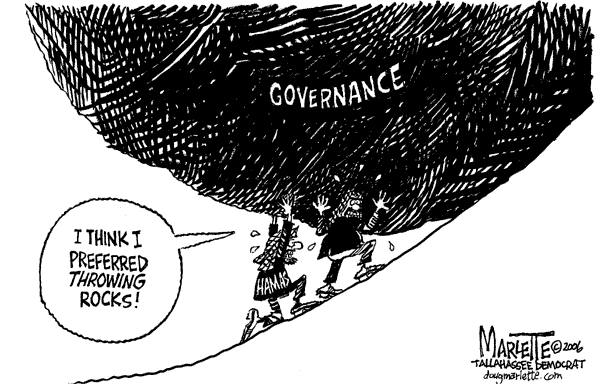
It's sure tough without a state.
You can thank the Israeli's for that.
May 29, 2005
neo-liberalism+welfare to work reform
I read Peter Saunders new book Australia's Welfare Habit and how to kick it whilst travelling to and from Canberra in the last couple of weeks. The book is usefully summarized in this article at the Brisbane Institute's online magazine. It indicates the way the social welfare state that we have grown up is now giving way to the enabling state.
Saunders is a market liberal and the primary reason behind his push for the reform of the welfare state is a small government philosophy. This classic liberalism limits the reach of central government so as to expand individual choice, freedom and opportunity. This presupposes that individuals should be able to take care of themselves; and, given this self-reliance, the proportion of the population needing federal welfare and health assistance should fall. If individuals and families assume more responsibility for their own welfare and employment, then the nanny state can be wound back, if not abolished.
Peter Saunders states that there are two reasons for reducing welfare dependency rates and return more people to economic self-reliance. The first is that:
"...income support is now costing taxpayers $80 billion per year. This expense is a key factor keeping taxes high, even on workers with modest incomes, with the result that work incentives and rewards for effort get eroded. Indeed, we are chasing our tails, for as we increase taxation to meet the growing cost of income support payments, so it becomes less attractive to work, and more people seek welfare as an alternative."
The second reason is that:
"... long periods on welfare corrode people's work skills, destroy their habit of self-reliance and undermine their wellbeing. Children raised in welfare-dependent families perform worse than they should in school, are more likely to end up in trouble with the law, and have a higher probability of winding up on benefits themselves. In short, having one in six of our working-age adults depending on benefits as their main or sole source of income is bad for those who have to support them and is bad for the recipients themselves."
What we have is an argument for a neo-liberal mode of governance. According to this political rationality the state is responsible for law and order; the market is responsible for promoting self-reliance and enterprise; the conduct and subjectivity of individuals needs to be shaped so they become more self-reliant.
Saunders spells out the three ways this neo-liberal political rationlaity will achieve its new market order.
"First, we need labour market reform to create more jobs for people now on welfare...This is why proposed changes to the award system and the unfair dismissal laws are so important, for these reforms will have their biggest impact on the supply of lower-paid jobs...Given the choice between a low-paid job and no job at all, there should be no question which is preferable."Mark Banisch has comments on this reform over at Larvatus Prodeo.
The second way is welfare reform
"..so that long-term income support recipients who are capable of working are encouraged or required to get off benefits and into employment. This is where recent government proposals to reform Disability Support Pension (DSP) and Parenting Payments are so crucial, for these are two of the main benefit categories which have been expanding rapidly in recent times."
However, welfare reform is not enough.The third leg in the reform triangle is:
"...tax reform, for in addition to ensuring jobs are available, and that people on welfare will apply for them, we also have to ensure that when people do work they are properly rewarded. This is not the case at the moment, particularly at the bottom end of income distribution, for workers are penalized heavily when they increase their incomes through a combination of high taxation and withdrawal of means tested benefits."
Saunders says that the Howard Government Labour is committed to market reform to generate more jobs; is interested in welfare reform to get more people into work; and is largely indifferent to tax reform to make it worthwhile working.
Many in Australia interpret this neo-liberal mode of governance as a return to 19th century laissez-faire liberalism as it represents a loosening or freeing of an existing set of market relations from the social shackles of the welfare state. However, the neo-liberal mode of governance goes further than this, as it more of all aspects of social conduct being reconceptualized along economic lines----as calculative actions governed by instrumental reason of self-reliant and enterprising subjects, which are undertaken through the execise of choice to achieve wealth maximisation.
The key figure here, and one which differentiates the new economic subject from the old one, is 'enterprising' or 'entreprenurial. 'We are entrepreneurs of ourselves as our conduct is now being shaped so that we are disciplined into the business of caring for ourselves. We are now increasingly obliged to make adequate provision for the preservation, reproduction and reconstruction of our own human capital.