August 1, 2007
Leo Strauss revisited
Contrary to some left wing interpretations that link Leo Strauss to the neo-consevatives reshaping of American foreign policy, Strauss is no imperialist and no reactionary, even if he was an elitist. Strauss was a lover of philosophy, excellence, and moderation, and an enemy of nihilism and relativism; the philosopher who in some sense made the serious study of political philosophy possible again.
Strauss disclosed the irreconcilability of philosophy and politics, he meditated even more deeply on the tension between reason and revelation, between Athens and Jerusalem. As he never tired of saying, “The core, the nerve of Western intellectual history, Western spiritual history, one could almost say, is the conflict between the biblical and the philosophical notions of the good life... this unresolved conflict is the secret of the vitality of Western civilization.”
May 25, 2006
Leo Strauss on tyranny
In an esay on tyranny in What is Political Philosophy and Other Studies Leo Strauss makes a distinction between present day and classical tyranny. He says:
The difference between [the two] has its root in the diffrence between the modern notion of philosophy or science and the classical notion of philosophy or science .Present day tyranny, in contradistinctin to classicla tyranny is based on the unlimited progress in the "conquest of nature" which is made possible by modern sceince, as well as the popualization or diffusion of philosophic or scientific knowledge. Both possiblities...were known to the classics....But the classics rejected them as "unnatural" , ie., as destructive of humanity. They did not dream of present day tyranny because they regarded its basic presupposition as so preposterous that they turned their imagination in entirely different directions. (p.96)
Today we live in a world that regards unlimited technological progress and universal enlightenment as essential for becoming human.
May 11, 2006
re-reading Leo Strauss
Some passages from an excerpt from Steven B. Smith's Reading Leo Strauss Politics, Philosophy, Judais that highlight what Strauss is trying to do.
The first passage states Strauss's view of modernity:
Strauss offered a deliberately provocative account of what might be called the “modernity problem” that had been widely debated in prewar European circles, but which was still relatively unknown to Americans of that era. Prior to Strauss, the most important current of twentieth-century American political thought was John Dewey's "progressivism." Against the view that the advance of science, especially the modern social sciences, was bringing about the progressive triumph of freedom and democracy, Strauss rang an alarm bell. Strauss argued by contrast that the dynamics of modern philosophy and Vertfrei, or value-free social science, were moving not toward freedom and well-being but to a condition he diagnosed as nihilism. In Strauss's counternarrative of decline, the foundations of constitutional government as understood by the American framers were gradually being sapped and eroded by the emergence of German-style historicism according to which all standards of justice and right are relative to their time and place.
So how does Strauss approach this problematic?
Smith's understanding on this is clear.: Strauss presented a distinctive way of asking questions or posing problems. Smith says that:
There is rather a set of common problems or questions that characterize Strauss's work: for example, the difference between ancients and moderns, the quarrel between philosophy and poetry, and of course the tension between reason and revelation. None of these problems can be said to have a priority over the others nor do they cohere in anything as crude as a system. Whatever may be alleged, there is hardly a single thread that runs throughout these different interests. Strauss did not bequeath a system, doctrine, or an "ism," despite what may be attributed to him. Rather, he presented a distinctive way of asking questions or posing problems that may have been loosely related but that scarcely derived from a single Archimedean point of view. It is questions that motivate all of Strauss’s writings---questions like "Is reason or revelation the ultimate guide to life?" "Has the quarrel between the ancients and the moderns been decided in favor of modernity?" and "Are the philosophers or the poets better educators of civic life?"
Smith then goes on to say that the great theme of Strauss's life work--what he himself referred to as "the theme of my investigations"---is the theologico-political problem, a term he drew from his early studies of Spinoza. What does this mean? Smith says:
At the center of the theologico-political problem is a choice or conflict between two comprehensive and apparently irreconcilable alternatives: revelation and reason, or as he refers to them metaphorically, Jerusalem and Athens. The difference between Jerusalem and Athens is not simply a philosophical or theological problem; it is at heart a political one. It is a matter of authority and who holds ultimate authority. Does final authority rest with the claims of revelation and all that it implies or with one's autonomous human reason as the most fundamental guide to life?
The Enlightenment's answer, of course, is autonomous human reason. By re-thinking the question the end of modernity Strauss can be seen to be questioning one of the key assumptions of modernity.
April 12, 2006
critique of liberalism: Schmitt & Strauss
I've just noticed that my edition of Carl Schmitt's The Concept of the Political (The University of Chicago Press) contains Leo Strauss's 1932 review of that text entitled 'Notes of Carl Schmitt:The Concept of the Political'
In this review Strauss showed that the underlying basis of Schmitt's affirmation of the political was a profound dissatisfaction with liberalism----that is, with liberal universalism and its aspirations for boundless security and a life that seeks fulfillment in the "interesting and entertaining." Liberalism, according to Schmitt, was above all a rejection of the political, had become submerged in concepts such as "economics" and "culture". In essence, the political had
disappeared as a theme of social science.
As we know Schmitt held that the characteristic distinction of the political is held to be the division into "friends" and "enemies." Such a life--lacking the passion and commitment that would lead one to die for a cause--seemed to Schmitt a rejection of all that was high and vital in human beings. So, Schmitt preached commitment and enmity; in Strauss's words: "He who affirms the political as such respects all who want to fight." The affirmation of the political is Schmitt's negation of liberalism.
Strauss says that Schmitt undertakes the criticism of liberalism in a liberal world, his critique of liberalism occurs in the horizon of liberalism and the critique introduced by Schmitt against liberalism can therefore be completed only if one succeeds in gaining a horizon beyond liberalism.
So Strauss was no more attracted to a debased liberalism than was Schmitt, but he sought not to negate it but to ascend from it. Like Schmitt, he asked, "What is the right way of life?" Yet unlike Schmitt, Strauss was unwilling to rest satisfied simply with any form of political commitment. When he raised the Socratic question, he did so in a Socratic manner--with a view to discovering the true answer.
According to Strauss, this ordering of the human things in terms of the right way to live is equivalent to the the question regarding the best way of life. For Strauss, there are only two alternatives that represent the best way of life. These are the life dedicated to perfecting one’s reason, i.e. the philosophic life, and the life dedicated to biblical faith. These two fundamental alternatives can be reduced to "reason", represented by Athens and to "faith", represented by Jerusalem. Strauss sometimes used the expression "the theologico-political problem” to indicate the problem regarding who or what should rule a community. The ultimate theologico-political problem, for Strauss, is whether biblical faith (Jerusalem) or reason (Athens) should be the highest authority for human beings.
November 7, 2005
Leo Strauss on Hobbes, fear, political power
Fear is fundamental to understanding the workings of political power as Carmen Lawerence and Thomas Hobbes well understand.
I finished that previous post by saying that 'maybe I should re-read Leo Strauss on Thomas Hobbes?' What I had in mind was getting a grasp of political modernity so that I could evaluate these lectures on fear and public policy. So I opened up the section of Strauss's Natural Right and History dealing with Hobbes [Modern Natural Rigjht], skipped all the stuff on Hobbes' mechanistic cosmology, mathematics and nature and turned to the bits of fear, death, self-preservation and the state. Strauss says:
The state has the function, not of producing or promoting a virtuous life [as held by classical political philosophy], but of safeguarding the natural right of each [individual to self-preservation]. And the power of the state finds its absolute limit in that natural right and in no other moral fact. If we may call liberalism that political doctrine which regards as the fundamental political fact the rights, as distinquished from the dutiues, of man and which identifies the function of the state with the protection or the safeguarding of those rights, then we may say that the founder of liberalism was Hobbes.
That brings one up short doesn't it? It does me, as I've been reading Hobbes as a conservative --ie., as an anti-liberal.
July 26, 2005
Natural right & historicism
Leo Strauss's response to the crisis of modernity, the view that 20th century relativism, scientism, historicism, and nihilism have been responsible for the deterioration of modern liberal society, and philosophy, is natural right. Natural right blocks the historicist move that leads to relativism and nihilism as it provides a firm foundation in reality for the distinction between right and wrong.
Strauss's project was to recover nature as the foundation for all our morality and so block postmodern nihilism and the historicism of the post-Hegelians historicists, who deny that reason can discover unchanging principles of right and wrong. The big struggle between natural right and historicism is at the core of modernity, and you can interpret Strauss's texts to argue that this conflict lay at the heart of the founding of the American republic. That event was founded on natural rights, and the Founders believed in their revealed religion as grounding natural law.
Natural Right and History explores this terrain by re-reading the classic texts in political philosophy to show that the reasons which have led to a rejection of natural right are not good ones. Strauss is engaged in revitalizing the potential of political philosophy, which had been buried by positivism in the social sciences and historicism in philosophy.
In this text Leo Strauss deploys his ancient-verses-modern dichotomy to highlight the distinction between classical and modern natural right. We usually understand the ancient modern difference in terms of the classical view that "human beings are by nature a social being" or political animal, and the moderns who held that the individual is prior to society. Strauss maintains that the classical understanding of political things is decisively superior to the modern one.
Classical natural right claims the good life for man to be "the life that is in accordance with the natural order of man's being, the life that flows from a well-ordered or healthy soul . . . The perfection of man's nature." However, beginning with Hobbes, modern natural right finds the possibility of man's perfection wholly impractical, instead championing the instinct of self-preservation and the rights of the individual.
Instead of reading Strauss's duality as ancients good, moderns bad,we can explore their presupposition to gain an understanding of modernity. The ancients in one way or another conceived of nature as a restraining order within which human beings lived out lives of lesser or greater virtue; the moderns saw nature as an alien other to be overcome through human activity. The distinction between the ancients and the moderns lies in determining which is the central grounding principle for moral and political life--nature's order, or humanity's will.
What Strauss makes apparent is the necessity of the opposition between the ancients and the moderns, between natural law and natural right, between natural order and human freedom. So at the root of modernity is the view that there is nothing independent of humanity which is superior in dignity to human artifice; the design of politics is rooted in human freedom and not divine or natural necessity.
Locke, for instance, was interpreted by Strauss as rejection of virtue as a concern of government. Locke, according to Strauss, turned to acquisitiveness as a substitute for virtue. Does that mean that constitutionalism needs a stronger foundation than the Lockean doctrine of natural rights based on self-interest?
Hence the importance of Strauss's interpretation of the American constitution. On this interpretation, The Declaration of Indepedence marked an understanding, on the part of the American Founders, that connected them to the classics, to the classical understanding of natural right and to the biblical tradition. That means a doctrine of natural rights under natural law.
June 14, 2005
Leo Strauss in Australia
The Australian 'Leo Strauss' is the one associated with the activities of his American disciples, many of whom are deeply involved with Republican and neoconservative politics. Hence we have the efforts to trace the Straussian influence in the corridors of power in the current Bush administration.
Such a reading is based on this kind of material. The duality interpretation appears to be the one adopted. On the one hand, Strauss created the hard core of the "esoterics," like the late Allan Bloom, Paul Wolfowitz, Werner Dannhauser, Thomas Pangle, and many others, who share Leo Strauss's secret Nietzschean doctrines, and secretly view themselves as Nietzschean "supermen," or "philosophers."
On the other hand, around this inner group, is the softer outer layer of the "exoterics," like William Bennett, Harry Jaffa, etc who are loyal to Strauss and his sect, but at the same time innocent of Strauss's actual views and committed to versions of traditional morality, patriotism and religion.
Most Australian academics have not read Strauss, nor are they ever likely to, as they have lost connection with the philosophical tradition that Strauss was at home in. Most of the lefty (ALP) academics work in the post-positivist social sciences (economics, sociology and history)and have little understanding of the political philosophical tradition. So they rely on secondary texts with their dubious interpretations, and have no way of evaluating the competing interpretations of Strauss's texts.
Tis guilt by association.
A quote from this review of Anne Norton, Leo Strauss and the Politics of American Empire, gives the flavour. The review argues that the US Straussians aim to create an American empire and to carry out a project of universal dominion. Norton notes that he [Leo Strauss] travelled in the orbit of Martin:
"Heidegger and Carl Schmitt, the twin philosophers of the Third Reich, and that their suspicions---about liberal democracy, the Enlightenment and rootless cosmopolitanism---run throughout his work. Thus it is hard to see the Straussians as anything less than emblematic figures of the American right, which shares far more affinities with the spirit of the European counter-revolution than we might think."
Maybe; in the sense that both were opposed to the modern Lockean doctrine of natural right that is based on possessive self-ownership.
However, unlike the European conservative counter revolution (Heidegger) Strauss grounded his philosophy on classical natural right that rests upon a (Aristotlean) teleological view of nature, i.e., one that states the nature of things is found in their perfections.
A critical review of Norton's text. What we get in Australia is a dismissal of Heidegger and Schmitt because of their politics. It is assumed that their philosophy is so deeply contaminated by their politics that it is fascist and to be attacked.
What we have in Australia is liberalism defending itself from criticisms by gatekeeping that keeps the borders closed and allows no foreign bodies in. Strauss is rejected because he is a conservative critical of liberalism. There is no need to examine the arguments that highlight the flaws of liberalism because it is conservatism that is the problem, not liberalism. So Strauss is rejected because of his politics.
April 8, 2005
Leo Strauss & political philosophy #3
Strauss says that his return to antiquity is necessitated by the crisis of our time, the crisis of the West. Strauss, like Nietzsche and Heidegger, sees a crisis of nihilism at the heart of modernity. This crisis opens up the possibilty of a return to a principle forgotten or lost sight of within modernity.
Like Nietzsche and Heidegger, Strauss holds that the recovery of this lost principle involves a return to the ancients who are now able to speak to us free from the distorting effects of modern assumptions.For Strauss, the problem of modernity is not represented by phrases "the death of God" (Nietzsche) or "the forgetting of Being" (Heidegger).It is represented by relativism, by which Strauss means that for the moderns no particular way of life has inherent worth.
Relativism means the rejection of natural right. The principle to be recovered is natural right.
In contrast to Heidegger, Strauss does not turn to the pre-Socratics. He returns to Plato and Aristotle--those thinkers who Nietzsche and Heidegger argue are the architects of Western metaphysics and thus fully implicated in the presuppositions of a nihilistic modernity.
March 31, 2005
Leo Strauss & political philosophy #2
I mentioned in this post that in his essay, 'What is Political Philosophy', Leo Strauss' response to the hegemony of positivism and historicism in the mid 20th century was to return to the classical political philosophy, and then to defend it against the political philosophy of modernity.
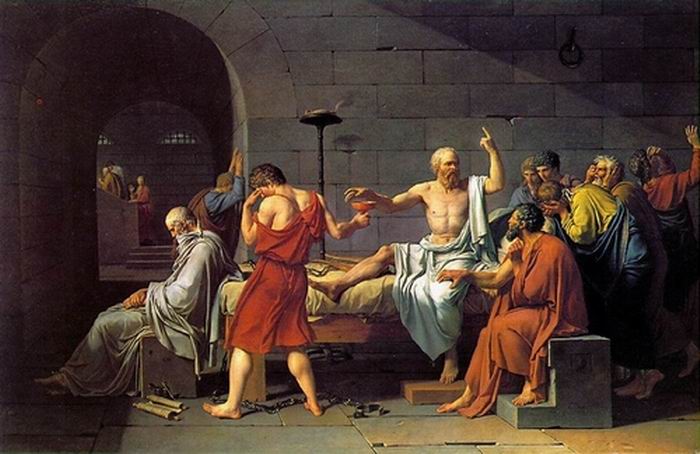
Jacques-Louis David, Death of Socrates, 1787
Strauss takes the classical philosophers seriously. He challenges modern historicism by arguing that we try to understand the classical philosophers as they understood themselves. And that is my problem with Strauss. I cannot see how we can do that. I can only approach the classics from where I am now. There are no skyhooks to lift me out of the present back into the past.I simply cannot dump all my modernist assumptions and think how Aristotle thought.
That is a different argument to the conventional conservative view that leftists today are obliged to denounce Great Books curricula, because wy know, consciously or unconsciously, that classical thought is very much alive and is a real threat to them. Not so. People should read classical political philosophy and engage with it.
I can however accept that the Straussians hold that premodern philosophy is better than modern philosophy and that they are pre-modern and anti-modern in the name of reason, of philosophy: an understanding of reason and philosophy that is different from the Enlightenment's.
Strauss argues that contemporary liberalism is the logical outcome of the philosophical principles of modernity, taken to their extremes. Liberalism, as practiced in the advanced nations of the West in the 20th century, contains within it an intrinsic tendency towards relativism, which leads to nihilism.
I accept that the implication of the argument we should free ourselves from the narrowness of the modern perspective and step back from the distortions and corruptions of modernity.But that does not necessarily mean a return to the ancient point of view towards political affairs. We can go post modern as well as premodern, and go post modern through re-reading the classics.
I can also accept that philosophy calls into question the conventional morality upon which civil order in society depends; it also reveals ugly truths that weaken men’s attachment to their societies. Ideally, it then offers an alternative based on reason, but understanding the reasoning is difficult and many people who read it will only understand the "calling into question" part and not the latter part that reconstructs ethics.
Leo Strauss,therefore, revives the quarrel between the ancients and the moderns when he calls for a return to and a renewal of ancient political philosophy, and in particular that of Plato. Though Strauss argues that he has recovered the original Plato lost sight of by the tradition of Neo-Platonic and Christian interpretation Strauss has not recovered the original Plato, but gives a particular reading of Plato.
March 20, 2005
Leo Strauss & political philosophy
I picked up a copy of Leo-Strauss' 'What is Political Philosophy?' the other day. It is a collection of essays, lectures and book reviews written in the mid-20th century. This text has surfaced before in this weblog.
In the lead essay, Strauss says:
"Today, political philosophy is in a state of decay and putrefaction, if it has not vanished altogether. Not only is there complete disagreement regarding its subject matter, its methods and its function; its very possibility in any form has become questionable ... We hardly exaggerate when we say that that today political philosophy does not exist any more, except as a matter for burial, i.e., for historical research, or else as a theme of weak and unconvincing protestation."
As a political philosopher in the US Strauss was writing within the hegemony of positivism in academia. He sees political philosophy as being squeezed by two enemies: positivism and historicism.
Strauss acknowledges rightfully understands positivism as maintaining that modern science is the highest form of knowledge; that the social sciences should model themselves on the natural sciences; there is a fundamental difference between fact and value; that value means personal preference; and that science is value-free. That kinda kills off political philosophy as politics departments embrace a positivist political science with enthusiasm.
Strauss also argues that political philosophy is squeezed by historicism. He characterizes this as abandoning the distinction between facts and values because every understanding is evaluative; denies the authoritative character of modern science refuses to regard the historical process as fundamentally progressive; denies the relevance of the evolutionary theiss and rejects the question of the good society.
Strauss decides to fight these two powerful modern currents by returning to the classical political philosophy of Plato and Aristotle; who use the language of citizens and statemen, is concerned with the best regime, virtue and the formation of character. Hence this philosophy is directly related to political life.
This classical tradition was then rejected in modernity in three waves: Machiavelli/Hobbes, Rousseau and German Idealistic philosophy and Nietzsche.
February 8, 2005
Shadia Drury, Leo Strauss, populism
After dealing with Allan Bloom in the 'American Applications of Straussian Philosophy,' chapter of her book, Leo Strauss and the American Right Shadia Drury turns to Willmore Kendall. He provides the pragmatic, practical and poltical application of Straussian ideas. Drury says:
"The third reaction acknowledges the truth of Bloom's vision, but refuses to despair. Instead, it takes a pragmatic approach and sets out to make the most of a bad situation. Willmoore Kendall is the best example of this approach, although it can be argued that Joseph Cropsey, Martin Diamond, and Thomas Pangle provide variations on this theme. This pragmatic approach lays the foundations of neoconservatism discussed in the next chapter."
This response combines the position of Jaffa and Bloom. Drury explains this in the following way:
"It accepts Jaffa's claim that America's foundations have an ancient lineage and are therefore not altogether modern, as well as Bloom's assertion that America's troubles have their source in her liberal modernity. But in this view, what is critical is the recognition that America's troubles are not totally incurable. They can best be addressed by curbing the excesses of her modernity. The key to nursing America back to health is to undermine her liberal modernity and bring to the fore vestiges of ancient wisdom that are deeply hidden and long forgotten."
This looks to be more promising as populism is deemed to be the cure for America's liberal malaise. This is certainly the main response in Australia to the problems of neo-liberalism.
The argument is that:
"..the populist project is not a betrayal of America's roots or her heritage, and that antiliberal, anti-individualist, and antisecularist ideas have always been a part of America's heritage, even if they have never been part of her official documents. The conservative spirit may not have inspired many American leaders, and as a result, it has been politically overshadowed by the more flamboyant spirit of liberalism."
So what is the Kendall's Straussian strategy?
Drury argues that Kendall launches an assault on liberalism by employing the:
"...classic friend-enemy dichotomy. The enemies are "barbarians" or Communists who threaten America from without, and "heretics" or Communist sympathizers and liberals who undermine America from within. The internal enemy is by far the most dangerous. Kendall is convinced that the liberal enemy may have won many battles, but it has not won the war."
The key is to turn the people against liberalism and foster a new populism in the service of conservative principles. The elite must turn the people against liberal institutions. The idea is to drive a wedge between liberalism and democracy, and to use the popular will to defeat liberalism.
Is this not what has happened in Australia under John Howard? Or in America under George Bush? Do we not have the populist attack on the (left)liberal elite in the name of the sentiments of the people? Do we not have the religious right attacking liberal permissiveness for moral decay of civil society in the name of family of values? Do we not have the cultivation of conservative populism as a working class movement---Thomas Frank's blacklash populism?
February 7, 2005
Shadia Drury's Straussian puzzles#2: Allan Bloom
As I've mentioned before the Australian reception of Shadia Drury's Leo Straus and the American Right basically accepts her critique of Strauss's conservative politics, the noble lie and the Washington neocons.A good example is Mark Bahnisch's post at Troppo Armadillo late last year. What continues to be sidestepped is any account of the Straussian philosophical critique of modernity. There is no probing of the Drury's understanding of the philosophical underpinnings of the Nietzsche, Heidegger, Strauss coupling
We can see this evasion by picking up on where we left off yesterday. After dealing with Jaffa in the 'American Applications of Straussian Philosophy,' chapter of her book, Leo Strauss and the American Right Shadia Drury turns to Allen Bloom's very popular The Closing of the American Mind as the exponent of the reaction of despair.
This view accepts that America is the embodiment of modernity and that this spells the death knell of classical wisdom. On this view, the principles on which America is founded are hopelessly modern and tragically flawed.Hence the reaction is understandably filled with despair and foreboding.
Let's accept that America is a liberal society grounded on Enlightenment values and so the embodiement of liberal modernity.
Drury says:
"Bloom portrays America as a polity grounded in the ill-conceived ideas of modernity, ideas that are engulfing the globe and shattering the glorious heritage of Western civilization.According to Bloom, America's Founding Fathers were the heirs of early modern philosophers such as Hobbes and Locke. These moderns were not privy to the sublime insights of the classics or their recent heirs--Rousseau and Nietzsche. Instead, they looked at man in his brutishness: untamed, uncultivated, and self-centered. And, incredible as it may seem, the early moderns set out to create a society made up of these selfish creatures. The result was a society of individuals whose natural tendencies for self-seeking and self-satisfaction were not suppressed by culture, but simply rechanneled into commerce. In this way, man's natural egoism assumed a form that was not altogether destructive of social life. The result was a bourgeois society that is paradigmatic of American life."
Bloom portrays American society as a collection of solitary individuals with nothing to live or die for. American society is a vehicle for individual self-preservation, self-aggrandizement, and the pursuit of wealth. America is little more than a collection of isolated, alienated, and disoriented individuals lost in a morass of cultural relativism and meaninglessness.
What has disappeared is the unified culture provided by myths and religion. So America is little more than an animal farm. So we have a critique of America society coupled to a critique of liberalism.
What does Drury make of this? She says that:
"One of the pervasive problems with Bloom's critique of American liberalism is that it confuses liberal reality with liberal ideals. In criticizing American liberal society, Bloom is under the mistaken impression that he is also criticizing liberal theories, ideas, and ideals. This confusion has its source in the assumption that American liberal society is the actualization of liberal ideals, or the logical and inescapable consequence of these ideas."Drury defends American liberalism. She argues that liberalism is not itself nihilistic or relativistic in order to show the futility of the Straussian critique of American liberalism. It cannot provide America with a meaningful critique of her liberal tradition.
Bloom gives a onesided reading of US society. Is not the US after 9/11 a most religious nation in which religion is intermingled with nationalism, patriotism and the sacrifice of an eternal war against terror. I interpret this as a onsided response to cultural relativism and meaninglessness of liberalism; a response that arises from within American traditions. So what we have with Bloom is a critique of liberalism in terms of it giving rise to the kind of society that Bloom describes. So the flaw with Bloom's account is that America is not wholly modern. It is deeply conservative and deeply pre-modern.
It is Drury's claim that Straussian school cannot provide America with a meaningful critique of her liberal tradition that is debatable. The Straussian position is basically a Heideggerian one: modernity's nihilism & technological mastery is a lethal combination and it gives rise to the dark night of modernity. This account of modernity is never confronted, for she guns for the anti-democratic response of the Platonic philosopher kings. So how much purchase has the Heideggerian account of modernity? Should it be taken seriously?
Though Drury rejects the conservative response to nihilism of Nietzsche, Heidegger & Strauss she does not say how liberalism can deal with the process nihilism that hollows out liberal vlaues.
February 5, 2005
Straussian puzzles: Shadia Drury
I'm puzzled by a remark that Shadia Drury makes in this chapter of her book, Leo Strauss and the American Right. Drury says that the first reaction to Strauss:
"... is a denial that America is modern; a denial that is predicated on a reinterpretation of the American founding as an ancient polity rooted in the great tradition in general, and the classical ideas of the Greeks and the Romans in particular. Harry V. Jaffa is the leading representative of this view."
This view, that Jaffa says that America is founded as an ancient polity rooted in the classical ideas of the Greeks and the Romans, does not square with what Drury says when she briefly outlines Jaffa's views. She says:
"For all his talk about the classics, Jaffa is first and foremost a Lockean. Like Locke, he believes that consent is the foundation of government; but like Locke, he insists on a natural law and a natural right that antedate all government, including government by consent. In other words, Jaffa follows Locke in championing limited constitutional government."
Is not Locke modern? Is he not a liberal?
My understanding is that Locke works off Hobbes and that Hobbes represents a fundamental rupture with the classical political tradition. Locke is, in fundamental way, a Hobbesian, though Locke did Locke assimilate, reject, and move beyond the Hobbesian political philosophy to launch liberalism. For Jaffa the principles of the Constitution are the principles of the Declaration of Independence. For Jaffa it is the Declaration alone that embodies moral realism and moral rationalism
Drury goes on to say that:
"Jaffa castigates his fellow conservatives for being historicists and relativists without principles. He denounces their unprincipled attachment to the past....He criticizes conservatives such as Russell Kirk, Irving Kristol, Jeanne Kirkpatrick, Martin Diamond, Walter Berns, and Willmoore Kendall for rejecting natural right in favor of rights rooted in history and tradition."
I understood that Locke held that political right derived from the equal natural rights of individual human beings, under the laws of nature and of nature's God.
So what makes Jaffa deny that America is modern?
It cannot be his distinctively Straussian approach to political philosophy that quite taks premodern philosophers seriously, and tries to understand them as they understood themselves. This is, by itself, only a challenge to modern historicism (i.e. historical relativism), which holds that the thoughts of premodern philosophers are outmoded, irrelevant and were mental prisoners of their epoch.
Nor can it be the Straussian claim that premodern philosophy is better than modern philosophy. This does turn the whole "progressive" view of history topsy-turvy, and provide a very distinctive point of view, and line of criticism, about modernity. However, the Straussians are pre-modern and anti-modern, in the name of reason, of philosophy, since there understanding of reason and philosophy different from the Enlightenment's.
But this has nothing to do with America being modern. So what makes Jaffa deny that America is modern?
Is it the turn to natural right in response to world dominated by the modern doctrines of historicism, relativism, nihilism, and positivism that constitute the the crisis of the West?
Or is it because Jaffa says that the proper response to these doctrines must come from the renewal and reaffirmation of the principles of the American Founding, embodied above all in the Declaration of Independence? For it is there that the United States asserted its claim to the individual rights of freedom and independence on the basis of certain "self-evident" truths about the human person and that "all men are created equal". Hence Jaffa makes a distinction between the principles of the Constitution from the compromises of that Constitution.
This is a fundemantal difference between the US and Australian consttutions There is no statement of principles upon which the Australian constitution is based. The political philosophy underpinning the Australian consitution have to be dug out by the High Court through a process of interpretation. It is this way of reading the Constitution that the legal postivists oppose.
This is my puzzle with Drury. Why does Jaffa's affirmation of the constitutional standing of the doctrine of natural rights,as enunciated in the Declaration of Independence, and expounded by Lincoln, constitute a denial that the US is modern?
The puzzle deepens because Drury's criticism of Jaffa's insistence that America is heir to classical ideals is that:
"It seems to me that there is a profound and fundamental difference between the American and classical traditions that Jaffa overlooks, largely because of his Straussian education...Another reason that the American Founders are not heirs to the classics has to do with the question of equality. The classical thinkers were not egalitarians. They did not believe that human beings were born equal.They thought that people had radically different potentialities and this meant that they were not entitled to the same privileges and the same consideration, or even formal equality before the law. Jaffa is quite mistaken in thinking that there is a line that extends directly from Aristotle to Locke."
But Jaffa, whatever his political philosophy, states that the proper understanding of America comes from the Declaration of Independence. He affirms the principles of natural right of all men being created equal and defends this against those conservatives who start from the constitution as a written text.
I reckon Drury is misreading Jaffa. The issue seems to be the emphasize Jaffa places on America's continuity with the classical and Christian sources of Western civilization. What this puts on the table is the questions of Strauss's reading of Locke, how do we assess modernity; and do we to interpret the American regime. With respect to the latter we would ask: 'how Lockean is the US:? Is this a cause for celebration or concern?
Update
There is a post over at John Rowe's blog on Harry V.Jaffa, which argues thatAmerica is founded on its ideal of natural (organic) law, that "all men are created equal". John highlights the conflict between these ideals and compromises of the Constitution.
February 3, 2005
Straussian interpretations: American
This chapter from Shadia B. Drury's Leo Strauss and the American Right is a good, easy read. It is entitled 'American Applications of Straussian Philosophy', and it makes a lot of sense of the different positions, currents, tensions and criticism amongst the American Straussians about the nature of America. I found it very useful as I was having trouble mapping the diverse applications of Strauss in the US.
Shadia identifies and outlines three different American reactions to Strauss's political thought reactions to Strauss with the words denial, despair, and pragmatism.
"The first reaction is a denial that America is modern; a denial that is predicated on a reinterpretation of the American founding as an ancient polity rooted in the great tradition in general, and the classical ideas of the Greeks and the Romans in particular. Harry V. Jaffa is the leading representative of this view. The second reaction begins with an awareness that America is the embodiment of modernity and that her triumph is the death knell of classical wisdom. On this view, the principles on which America is founded are hopelessly modern and tragically flawed. This reaction is understandably filled with despair and foreboding. The gloom of Allan Bloom's The Closing of the American Mind is particularly representative of this view. The third reaction acknowledges the truth of Bloom's vision, but refuses to despair. Instead, it takes a pragmatic approach and sets out to make the most of a bad situation. Willmoore Kendall is the best example of this approach, although it can be argued that Joseph Cropsey, Martin Diamond, and Thomas Pangle provide variations on this theme."
She adds that although these reactions are distinct, they are not mutually exclusive, and may overlap.
In the light of this diversity of Straussian interpretation I reckon we should stopping talking in terms of a monolithic Straussian position vis-a-vis liberal modernity. Jaffa, for instance, interprets the American constitution in terms of a more conventional understanding of classical philosophy and so breaks with the esoteric writings thesis in which the great philosophers of modernity wrote in a sort of code so as to disguise their real meaning.
January 26, 2005
Leo Strauss in Australia
Leo Strauss does not have a big profile in Australia. He makes an appearance in this Shadia B. Drury text and this text by Norman Madarasz over at the Evatt Foundation. Madarasz links to this text in Le Monde and this Canadian Text published at CounterPunch.
It is a critical reception of Strauss by those social democrats opposed to the Washington neo-cons and their Project for a New American Century. What this political reception of a conservative Strauss misses is the political philosophy; Strauss' philosophical critique of modernity, the concern with nihilism, his conception of a sense of crisis and the relevance of this critique to liberal Australia.
Gone missing from this reception are Strauss's critiques of historicism, relativism, scientism, and nihilism even though many of the modernist social democrats are critical of this kind of thinking.(They call it po mo). This failure to engage is not suprising since Australian culture is notable for the lack of a philosophical engagement with important public issues of social and political in any prominent or sustained way. The political reception of Strauss involves his rejection.
What the rejection does not come to grips with is this scenario. Hegel was the great mediator of the classical world and modernity. The failure of the Hegelian attempt at mediation demonstrates the inability of both Enlightenment reason and revealed religion to submit to any higher authority and establishes the autonomy of their respective epistemological and moral claims. Reason and revelation, in other words, could not be assimilated to each other, so the Enlightenment's claim to have philosophically refuted the 'truth' of revealed religion was, consequently, false. The implication is that Enlightenment is dogmatically grounded on a faith in instrumental reason.
The significance of Strauss is that saw, understood and tenaciously held on to this insight. By elaborating it into a cogent critique of modernity's historicism and relativism Strauss, became a formidable philosophical critics of modernity. Behind Strauss's arguments about the intellectual bankruptcy of contemporary philosophy, his radical doubt about modern rationalism, and his recognition of modernity's spiritual and moral crisis,is a formidable edifice of conservative thought which is still very much alive. It has yet to be appropriated by Australian consevatives.
However, things are changing for the better in the Australian reception of Strauss. Martin Sharpe, a lecturer at the Melbourne School of Continental Philosophy's Summer School gave a paper on Strauss and Washington politics to the Melbourne School's forum. In the talk Martin says:
"...in a Straussian view...'economic rationalism' is exactly the type of 'nihilistic' or 'vulgar way of organising our shared political life that is a symptom of our sorry state. There is nothing 'classical', in a Straussian view, about 'classical economics'. It is all modern. Plato didn't think we were 'rational choosers', motivated by 'utility', which ultimately boils down to what we think we can get pleasure out of. And there's something to this. None of us would want to hear from our partner that we are 'an efficient utility maximising agent. Equally, as a Straussian might rejoin, you just won't find Aristotle saying that what politics should really be about is maximising G.D.P. Tony Blair's idea of 'responsible financial management' would probably turn his stomach. And again, lots of us might agree with him. A 'decreasing trade gap' and an 'improved international credit rating' are hardly the most inspiring public ideals, whatever Mr Costello might say about 'good sets of figures'".
Martin recognizes that Strauss is a critical of the way of life of liberal modernity, and he finds this Straussian line of thinking (returning to the Greeks to critique modernity) eminently sane and even deeply humane. What then?
Martin's interest in the talk is the connection between the noble lie (Tony Blair's 'weapons of mass deception') around the justification for invading Iraq and Strauss’ defence of the political ideas of classical Athens. The real concern lies with the link between Strauss'understanding of classical political philosophy and the neo-con style of policy-making that sees U.S. marines occupying Iraq.
The bridge is constructed from three of Strauss's ideas:
*an irresolvable conflict between the public life of a city or nation, and the pursuits of philosophers and scientists;
*philosophy and science are the highest ways of life. Strauss interprets Plato as advising us that the best achievable political system will be one not led directly by philosophers, but by 'gentlemen' of noble background and education (noble statesmen) who have philosophers helping them to form policy;
*The world is divided into different types of people. A the top are philosophersas they can 'stand the most reality'. One step lower are the 'gentlemen as they are the least swayable by private interests, because they are guided by the pursuit of public honour and religion. The third type is all the rest of us---'the many'- who need a religion to keep our distasteful passions in check.
These ideas provide a bridge to the Washington neo-con world and its effect of undermining modern liberal democracy.
The philosophical critique of Australian modernity has been forgotten.
Martin has also helped to organize The Melbourne School of Continental Philosophy Summer School course on Leo Strauss. This explores Strauss'ideas in more detailand gives us a more sophiticated reading of Strauss. The Summer Course covers Stauss' views that Nazism was an outgrowth of modern ideas and an unpolitical faith in technology; his return to the classical Greeks, his reading of political philosophers,and his response to the crisis of modernity.
Alas none of the lectures are online.
June 30, 2004
Empire: bringing philosophy in
As I read and slowly work my way through Hardt and Negri's Empire I keep thinking of the way that philosophy is devalued in favour of literary criticism. It is not the negative narratives of the tragic philosophers that are rejected. It is philosophy. I keep on thinking that political philosophy, as a way of thinking and living is in need of legitimation.
If philosophy reflects on a form of life grown old, and does so as a mode of historical knowing, then what is it concerned with?
So let me introduce an interesting figure into the discussion--Leo Strauss who has crept into the discussion in the comment box.
This is Strauss opening a lecture course at the University of Chicago on Plato in the mid-1960s:
"What is political philosophy? A very simple reflection suffices to explain what political philosophy means. All political action is concerned with either preservation or change. When it is concerned with change it is concerned with change for the better. When it is concerned with preservation, it is concerned with avoiding something worse. Therefore all political action presupposes opinions of better or worse. But you cannot have an opinion of better or worse without having an opinion of good and bad. When you see that you follow an opinion, you are by this very fact driven to try to find knowledge, to replace opinion by knowledge.Therefore all politicial action points by itself toward knowledge of the good. Now the complete political good we call the good society and therefore all political action points to the question of the good society."
This is a classical conception of political philosophy but it has some bite today. Consider the way that Strauss used it to question the fashionable liberal opinions in the US in the 1960s:
"Today there are quite a few people who a e doubtful whether one can speak of the good society because that would imply that there is a common good; and for some reason they think there couldn't be a common good. But quite a few of these people speak, for example, of the great society, which is another form of the good society---only one doesn't know why great society is preferrable to good society. At least it has never been explained to us. Others speak of the open society, which is also a form of the good society-----and again we are not told why the open society is a better term than the good society. Be this as it may, one can reject only verbally the quest for a good society. And this is the concern of political philosophy."
It is old fashioned bit it returns us to the Anglo-American political tradition by reminding us of the classical roots of that tradition; a tradition that says a political regime is grounded in moral and political principles.
That tradition can then be adapted and applied to the dramatically new circumstances of globalization and empire. That is what Leo Strauss opens up.
Of course, Strauss did not think that philosophy was a mode of historical knowing. He remained faithful to the classical conception of philosophy as a quest for the eternal order. This conception presupposed an eternal and unchanging order within which history takes place, and which is not affected in any way by history. Hence he stands in opposition to the historical turn taken Hegel, Marx and Nietzsche.