January 7, 2011
capitalism as religion
In Capitalism as Religion: Walter Benjamin and Max Weber in Historical Materialism 17(2009) Michael Lowy analyzes Walter Benjamin's response Max Weber’s famous treatment of Protestantism and capitalism. Benjamin’s fragment sought to demonstrate that capitalism was strengthened by religious culture at key points in its development, and that it was itself a religious phenomenon.
The first is that capitalism is a peculiarly cultic phenomenon, one in which ‘nothing has meaning that is not immediately related to the cult’. The cultic activities – ‘capital investment, speculation, financial operations, stock-exchange manipulations, the selling and buying of commodities’ – are the only ones invested with meaning, as all else is rendered valueless.
The second religious aspect of capitalism is its conception of time. Capital’s time is homogenous, rationalized. It marches steadily forward without interruption, without pause.
The final religious aspect of capitalism is its production of despair. Capital recognizes nothing beyond itself. It forecloses on all futures except its own. This destruction of futurity can be seen as the essence of despair, since any hope is contingent upon the possibility of a future.
August 6, 2010
Christian fundamentalism: an anti-modernist backlash
Fundamentalism, at least in its U.S/Australian Christian form is related to the outdated values and repressive code of small-town Australia; it has an inclination toward the lowbrow and the vulgar; is s marked by authoritarianism; is characterized by a lack of historical consciousness and the inability to engage in critical thinking; is identified by literalism, primitivism, legalism, and tribalism; and is linked to reactionary populism and the "paranoid style."
Is this a liberal stereotype of fundamentalism as a "cultural system"? One plausible argument is that religious fundamentalism can be seen as a counter-movement, or backlash, to the onwards march of secularisation, a process which ultimately leads to the political and public marginalisation of religion in liberal democratic societies. Karen Armstrong writes in the Harvard International Review:
Religious fundamentalism represents a widespread rebellion against the hegemony of secularist modernity. Wherever a modern, Western-style society has been established, a religious counterculture has developed alongside it in conscious rebellion. Despite the arguments of politicians and intellectuals, people all over the world have demonstrated that they want to see more religion in public life. The various fundamentalist ideologies show a worrying disenchantment with modernity and globalization. Indeed, every single fundamentalist movement that I have studied in Judaism, Christianity, and Islam is rooted in a profound fear of annihilation. All are convinced that the modern, liberal, secular establishment wants to wipe out religion. Each fundamentalist group has sprung up independently; each even differs significantly from other fundamentalists within their own faith tradition. But at the root of all these movements is the same visceral dread that is rapidly being transformed in some quarters into ungovernable rage. This should not surprise us; culture is always contested, and the proud secularism of Western modernity was almost bound to inspire a strong religious reaction.
Jeff Haynes argues that secularisation, implying a significant diminishing of religious concerns in everyday life, has been one of the main social and political trends in Western Europe since the Enlightenment (1720-80). It was long believed that as a society modernises it inevitably secularises - that is, in becoming more complex, a division of labour emerges whereby institutions become more highly specialised and, as a consequence, are increasingly in need of their own technicians. To many, secularisation was one of the most fundamental structural and ideological changes in the process of political development, a global trend, a universal facet of modernisation. Everywhere, as societies modernised there would be a demystification of religion positing a gradual, yet persistent, erosion of religious influence. The end result of secularisation is a secular society, that is, where the pursuit of politics and public policy takes place irrespective of what religious actors do or say. Secularisation has gone hand in hand with separation of power between church and state.
Opponents of the secularisation thesis argue that the current era is characterised, not by the decline of religion, but by the widespread resurgence of religious ideas and social movements, which is one of the most unexpected events at the end of the twentieth century. The social upheaval and economic dislocation associated with modernisation leads to both secularisation and a renewal of traditional religions as a response to a general ‘atmosphere of crisis’.
Religious fundamentalism is nearly always premised on a rejection of the values associated with liberal democracy. Christian fundamentalism appears to be an anti-modernist backlash against science, industrialization, and liberal Western values: religious fundamentalists, feeling their way of life under threat, aim to reform society in accordance with religious tenets. The fundamentalists’ fear is that modern society wants to purge itself of religion. The terror and alienation of fundamentalist Protestantism is shown in its apocalyptic vision, which sees the world as so wicked and perverted that God has to smash it in a final, fearful cataclysm.
Christians are ‘fundamentalist’ in the sense of wishing to get back to the fundamentals of the faith as they see them. The ‘born again’ worldview is embedded in certain dogmatic fundamentals of Christianity, with emphasis placed on the authority of the Bible in all matters of faith and practice; on personal conversion as a distinct experience of faith in Christ as Lord and Saviour (being ‘born again’ in the sense of having received a new spiritual life); and, evangelically, in helping others have a similar conversion experience.
The features of the Christian fundamentalist movement in Australia are:
(1) a desire to return to the fundamentals of a religious tradition and strip away unnecessary accretions
(2) an aggressive rejection of western secular modernity;
(3) an oppositional minority group-identity maintained in an exclusivist and militant manner;
(4) attempts to reclaim the public sphere as a space of religious and moral purity;
(5) a patriarchial and hierarchical ordering of relations between the sexes’.
Karen Armstrong says that fundamentalism becomes more extreme when attacked because the assault convinces fundamentalists that the establishment really does want to eliminate them. She says that:
fundamentalism is inextricably tied to the modern world, and, rather than being merely a temporary aberration, it is here to stay. Fundamentalist movements may hearken back to a Golden Age, but they are essentially modern and could have taken root in no time other than the present. Christian fundamentalists may claim to be reading the Bible in a traditional way, but their literalist approach is essentially the product of the scientific age. In the premodern world, Jews, Christians, and Muslims all relished highly allegorical readings of Scripture, which, as the Word of God, was infinite and capable of multiple interpretations. Until the invention of printing made it possible for every Christian to have his or her own Bible and until universal literacy made it possible for them to read it, nobody could subject the Bible to the close and detailed reading employed by fundamentalists today.
Though a part of the modern world they reject the modern ethos. Armstrong adds that the ideologies of Christian fundamentalists reveal fears and anxieties that no society can safely ignore.
May 2, 2008
Reverend Wright
There has been a lot of media talk (largely condemnation) in the US about Reverend Wright, a pastor in the United Church of Christ, with Barack Obama repudiating Wright's recent address at the National Press Club under political pressure. Obama is outraged by Wright's comments.
So what did Wright say about the black church and liberation theology? Here is the section of the Jeremiah Wright Jr. address on reconciliation:
Reconciliation, the years have taught me, is where the hardest work is found for those of us in the Christian faith, however, because it means some critical thinking and some re-examination of faulty assumptions when using the paradigm of Dr. William Augustus Jones. Dr. Jones, in his book, God in the ghetto, argues quite accurately that one's theology, how I see God, determines one's anthropology, how I see humans, and one's anthropology then determines one's sociology, how I order my society.
Now, the implications from the outside are obvious. If I see God as male, if I see God as white male, if I see God as superior, as God over us and not Immanuel, which means "God with us," if I see God as mean, vengeful, authoritarian, sexist, or misogynist, then I see humans through that lens. My theological lens shapes my anthropological lens. And as a result, white males are superior; all others are inferior.And I order my society where I can worship God on Sunday morning wearing a black clergy robe and kill others on Sunday evening wearing a white Klan robe. I can have laws which favor whites over blacks in America or South Africa. I can construct a theology of apartheid in the Africana church (ph) and a theology of white supremacy in the North American or Germanic church.
The implications from the outset are obvious, but then the complicated work is left to be done, as you dig deeper into the constructs, which tradition, habit, and hermeneutics put on your plate. To say "I am a Christian" is not enough. Why? Because the Christianity of the slaveholder is not the Christianity of the slave. The God to whom the slaveholders pray as they ride on the decks of the slave ship is not the God to whom the enslaved are praying as they ride beneath the decks on that slave ship. How we are seeing God, our theology, is not the same. And what we both mean when we say "I am a Christian" is not the same thing. The prophetic theology of the black church has always seen and still sees all of God's children as sisters and brothers, equals who need reconciliation, who need to be reconciled as equals in order for us to walk together into the future which God has prepared for us.
Reconciliation does not mean that blacks become whites or whites become blacks and Hispanics become Asian or that Asians become Europeans.Reconciliation means we embrace our individual rich histories, all of them. We retain who we are as persons of different cultures, while acknowledging that those of other cultures are not superior or inferior to us. They are just different from us.We root out any teaching of superiority, inferiority, hatred, or prejudice. And we recognize for the first time in modern history in the West that the other who stands before us with a different color of skin, a different texture of hair, different music, different preaching styles, and different dance moves, that other is one of God's children just as we are, no better, no worse, prone to error and in need of forgiveness, just as we are. Only then will liberation, transformation, and reconciliation become realities and cease being ever elusive ideals.That doesn't sound too radical does it. The task of reconciliation hinges on our ability to see each other as equals while we recognize our differences.
October 31, 2006
blurring church and state
The sharp edges that separate church and state in liberal democratic Australia are further undermined with a proposal by the Howard federal government to fund chaplains in private and state schools. It is more than likely the money will flow through to the private schools are they will be more united about the variety of chaplain they want.
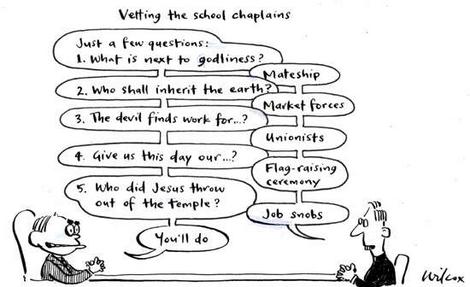
Cathy Wilcox
Presumably state schools are deemed to be value free zones--sites of nihilism--- by conservatives and only religion is about values. Secular humanism has nothing to do with values apparently. What has happened to John Stuart Mill? So are we going to have a return to the 1950s - conservative Catholic priests or fundamentalist Anglican chaplains telling students that women should be modest, they should wear scarves in church, they should not be seen in revealing clothes and they should not provoke men because men were wild animals who strayed easily. Rememberall that stuff about "men will be men" and the role of men was to seduce, the role of women to resist?
Is that what is meant by values---a preoccupation with sexual morality that is not too far removed from the "uncovered meat" sentiment of the widely criticized Sheikh Taj al-Din al-Hilali? It's another plank in the values debate isn't it. The beginnings of state-sanctioned religious intolerance?
Andrew Lynch, in an op-ed in The Age says that:
If the separation of church and state means anything, it is that the Government should not use public money to decide which religious opinions are to be promoted at the expense of others....Talk of insulating religion from the power of the state is not merely a resort to a vague ideal. It has clear constitutional text behind it. The inclusion by the constitution's framers of that text should prompt us to think critically about any proposals that look sure to entangle the Government in issues of faith.
Under the Commonwealth constitution, the Federal Parliament is prohibited from passing a law that confers on any religion the status of a national established church. It also cannot prohibit the free exercise of religion or impose any requirement for religious observance on the community. Additionally, the constitution states that "no religious test shall be required as a qualification for any office or public trust under the Commonwealth".