December 29, 2005
technology parks
When I drive past Flinders University from Adelaide to Victor Harbor I pass by a group of buildings called a technology park; this is a place where academic science and industry meet and collborate to form the drivers of the newly forming knowledge economy. Does anything happen there I wonder? I doubted it.
Technology park was modelled on Silicon Valley. It tries to emulate it so as to transform South Australia from a rustbelt to a knowledge economy state. That transformation through incubation was designed to solve the crisis that had occured when the set of ideas associated with industrialization ran up against a social reality that it could not explain --the failure of industralization and manufacturing to provide fo rthe state's economic growth during the late 1970s and early 1980s. Technology Park stood for the way that South Australia was going to become high tech--remember all that talk about the clever cocuntry?
Well nothing much has happened because SA is still low tech with little IT or biotechnology industries. Similarly for Australia in general, despite all the talk about bio-tech start ups spinning off from publicly finded research in public universities.
So what went wrong? A clue is provided by this interesting review by Jane Marceau of Margaret Pugh O'Mara's Cities of Knowledge: Cold War Science and the Search for the Next Silicon Valley. In this kind of economic policy about the knowledge economy:
"...it is held that science will kick start new industries and refashion older ones. On this account economies based on steel and 'rust belt' industry will be replaced by IT and biotechnology as the 'clean' and 'knowledge-based' engines that will drive both economies and societies."
Hence all the attempts to set up baby Silicon valleys in the different states around Australia. Marceau says that Cities of Knowledge gets below the spin currently spread by Australia's politicians and universities that they are pioneers in university-industry engagement. What then is disclosed.
Marceau says that O'Mara's text:
"...shows that higher education institutions and their science alone will not automatically produce the wealth, the spatial patterns, and the industrial technologies associated with the Silicon Valley holy grail. Universities and cities might build technology parks and link laboratories to companies and scientists to market forces, but success is not guaranteed. That alone is a useful lesson for us. But the book does more---it links iconic local geographical, research, and industrial development patterns firmly to the defence policies of Washington's Cold War. It also shows how local differences in the relative power of the players and the socio-economic circumstances of city locations have shaped how cities of knowledge do or don’t develop."
February 27, 2005
Australia's economic elites #1
In the light of the previous post about the difficulties Australia will have in making the transition to a high tech nation in postmodernity, we can ask: how good are our economic elites in addressing this problem. I ask this question because the Reserve Bank of Australia (RBA) has recently stepped beyond its controlling inflation brief to address the need for reform.
It is an interesting transgresson as monetary policy authorities have inflation control as their number one priority. What was noticeable was the limited nature of the proposed reforms: improved infrastructure, workforce training as getting more people into the workforce through welfare and tax reform. Nothing about inventing and exploiting new technologies, needing to pour resources into R&D, fostering innovation and entrepreneurship, or using using tax, education, and fiscal policies to create clusters of domestic start-ups.
Why the impoverished view of the big picture? Why is the RBA simply recycling the neo-liberal business establishment's case? That poverty of public policy puzzled me. Evan Jones over at Alert and Alarmed has a suggestion:
"Fortunately Macfarlane [the chairman of the RBA] is not a Greenspan. He is more the technocrat promoted beyond his station than an ideologue or capital markets functionary...For all Macfarlane's positive qualities, Macfarlane remains a technocrat. He is narrowly trained and narrowly informed. He embodies the fetishism of Anglo-American governments and bureaucracies for macroeconomic solutions to economic and industrial problems...Macfarlane presides over the economic pot on the stove and all he does is turn the heat up or down. He has to ensure that it's cooking and not boiling over, but that's it. He isn't responsible for what went into the pot, and he doesn't know the recipes...Let Ian Macfarlane keep the pot simmering...The secrets of economic and industrial dynamism do not lie with any pronouncements that emanate from the Reserve Bank."
A top economic policy bureaucrat does not understand the big picture. That does not bode well for Australia's future. Why the failure?
In an earlier post on this topic Evan Jones says:
"Australia has a set of economic elites that are dumb. Smart dumb, but still dumb. Worse, they are incapable of learning new tricks....The RBA technocrats have a brief for the macroeconomic sphere. This involves juggling a handful of timeworn macroeconomic indicators ---inflation, changes in gross domestic product ('growth'), saving, investment, the balance on current account, etc. There are variations on the margin in posited relationships (and noting of aggregates in key sectors, for example, dwelling investment), but the mentality is set on railway tracks heading into the distance. There is minimal to no lateral thinking."
That is about right. Why this mentality? Because it is assumed markets will do the right thing? But they are not with respect to energy.
January 6, 2004
Mars: raw images
Sending humans to Mars is still a dream.
At the moment Robots go to Mars so that we can learn as much as we can about the Red Planet. So orbiters look at the planet from on high and landers sit in one spot and investigate a landing site. But rovers can be commanded to look around, move to an interesting location and examine the soil and rocks in fine detail.
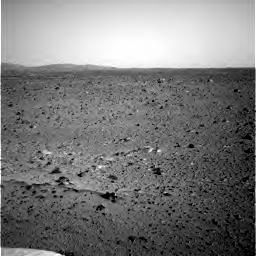
A raw image from the Mars Exploration Rover Mission:
The gallery is here. Some panoramic images are here.
When the above photo is connected to the first color panorama we have a stony plain with a range of hills in the distance. An old river bed?

The Mars exploration mission is really is about technology isn't it? The rovers become the feet, hands and eyes of explorers on Earth; a reinvented prothesis: a technology in place of our body.
There is so much faith, promise and utopian longing built into this technology. It really is about mastery human beings going to Mars.
And exploration, judging from our own earthbound history, is about colonization. Colonizing space is the dream.
Perchance I am just reading some remarks on technology made by Derrida at the Sydney Seminars when he visited Australia in 1999.