March 27, 2007
war conditions#2
Another indication of war conditions:
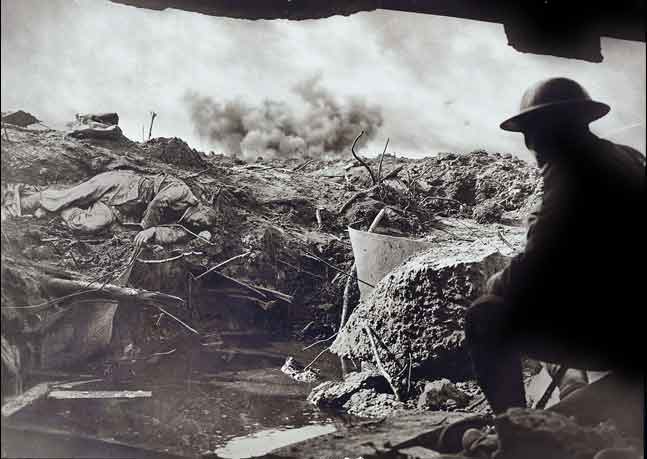
Frank Hurley, Looking out from the entrance of a captured Pill-Box on to the shell ravaged battlefield, 1917/18
March 25, 2007
war conditions
A picture of life under war conditions:
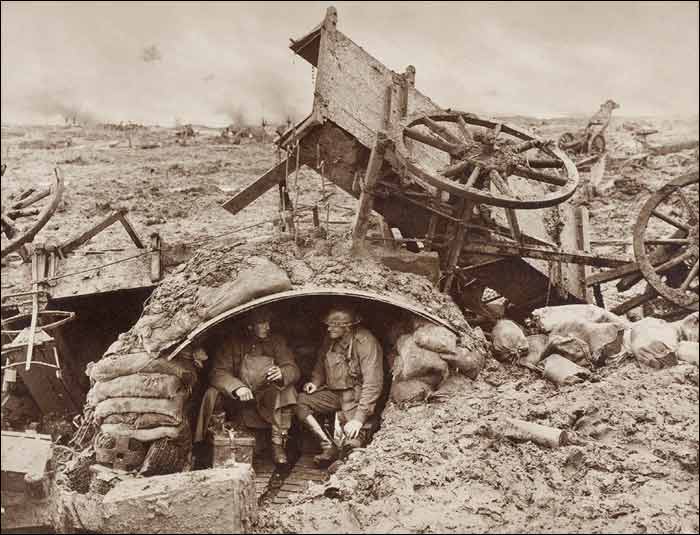
Frank Hurley, Westhoek Ridge (Flanders, Belgium) , 1917
The ground during winter became a series of horrendous mud pools, often knee deep, full of deep slime, due to the incessant rain
March 10, 2007
Walzer + war
In his Just and Unjust Wars (1977), Michael Walzer argues that we must make two separate evaluations of the morality of war: the justice of the cause or purpose for which war is fought and the morality or justice of the methods of warfare. Just cause is usually understood in terms of a self-defense against physical aggression is putatively the only sufficient reason for just cause. The consensus is that an initiation of physical force is wrong and may justly be resisted. Just methods is conventionally understood in terms of the rule that military responses must be proportional to the military provocation, and the rule that civilians must never be intentionally attacked. The inference is that even a just war must be waged justly.
Thus Israel is entitled to defend itself, but is not entitled to do so disproportionately or to wage war on civilians. Israel was judged to Israel to have engaged in unjust, because disproportionate, military activity in Lebanon for the kidnapping of three of its soldiers, the scale of death and destruction. The damage Israel inflicted on so much of Lebanon’s infrastructure through the use of air and sea-power in response to these kidnappings, especially on the civilian population of Lebanon, was deemed to be out of all proportion to these kidnappings.
Was the second Lebanese war a just war?
November 25, 2004
Israel: three options
I came across a reference to this article by Tony Judt in the New York Review of Books whilst reading Herzl's Nightmare by Peter Rogers, the former Australian Ambassador to Israel.
In the article Judt says that, as a result of its occupation of the lands conquered in 1967, Israel today faces three unattractive choices:
"It can dismantle the Jewish settlements in the territories, return to the 1967 state borders within which Jews constitute a clear majority, and thus remain both a Jewish state and a democracy, albeit one with a constitutionally anomalous community of second-class Arab citizens."
Or alternatively, Israel can:
"...continue to occupy "Samaria," "Judea," and Gaza, whose Arab population—added to that of present-day Israel—will become the demographic majority within five to eight years: in which case Israel will be either a Jewish state (with an ever-larger majority of unenfranchised non-Jews) or it will be a democracy. But logically it cannot be both."
And lastly, Israel
"Israel can keep control of the Occupied Territories but get rid of the overwhelming majority of the Arab population: either by forcible expulsion or else by starving them of land and livelihood, leaving them no option but to go into exile. In this way Israel could indeed remain both Jewish and at least formally democratic: but at the cost of becoming the first modern democracy to conduct full-scale ethnic cleansing as a state project, something which would condemn Israel forever to the status of an outlaw state, an international pariah."
Judt says that the situation of Israel is not desperate, but it may be close to hopeless.
Judt adds that suicide bombers will never bring down the Israeli state, and the Palestinians have no other weapons. There are indeed Arab radicals who will not rest until every Jew is pushed into the Mediterranean, but they represent no strategic threat to Israel, and the Israeli military knows it. What sensible Israelis fear much more than Hamas or the al-Aqsa Brigade is the steady emergence of an Arab majority in "Greater Israel," and above all the erosion of the political culture and civic morale of their society.
That puts the cards squarely on the table, does it not? It indicates that the Palestinian/Israeli crisis in the Middle East won't go away. It also suggests that the two-state solution—( the core of the Oslo process and the present "road map")—is probably already doomed. Israel is acting to ensure that the whole package called the Palestinian state is off the agenda. Sharon's plan is to bury the Palestinian national cause by conferring legitimacy on Israel's settlements in the West Bank.
So is the integrated, binational state of Jews and Arabs, Israelis and Palestinians ie., a pluralist states that is multiethnic and multicultural. For though Israel, is a democratic state, it uses ethnoreligious criteria with which to denominate and rank its citizens. It is a Jewish state that is walking down the pathway to becoming an intolerant, faith-driven ethno-state, and away from the pathway of a Jewish state becoming a binational state.
November 24, 2004
cycles of violence
A quote about the cycle of violence in the Middle East around the Israeli/Palestinian conflict:
"Occupation, violence and terror have produced a paralysing mindset. Israel argues that as long as there is violence there will be occupation. Palestinians counter that as long as there is occupation there will be violence. This refrain reverberates more loudly than ever. Even during the 1990s, when peace plans lay on the table, there was little respite from violence. Israelis and Palestinians killed the other and they killed their own." Peter Rogers, Herzl's Nightmare, p.75.
Violence has become an end in itself.
October 25, 2004
Sydney Peace Prize Lecture: 2003#4
In the light of this one sided account I want to return to pick up the thread in this post and continue with Hanan Ashrwai's 2003 Sydney Peace Lecture. The lecture was entitled, 'Peace in the Middle East: A Global Challenge and a Human Imperative'.
In it Hanan makes two remarks that are often overlooked in debates in Australia about the Israeli Palestinian conflict. The first point is the importance of self-determinaton:
"Self determination to the Palestinian people is not an abstraction, but the actual realization and enactment of their identity on their own land, and a motivating force for independence and statehood. It is the final negation of the myth of a “land without a people for a people without a land” that has long framed the rationalization for the most extreme forms of Zionism that sought to deny the very existence and humanity of the Palestinians."
That kind of insight is rarely heard in Australia now that the key discourse is terrorism. Barry Cohen in the above linked article makes no reference to it in his article, which is structured around reason versus prejudice.
The second point that Hanan talks about is what the Palestinans and Israeli's have in common:
"Neither side can lay claim to a monopoly of pain and suffering, in the same way as it cannot claim exclusivity of narrative and legitimacy. Clearly, peace cannot be made incumbent upon converting all Palestinians to Zionism or transforming all Israelis to espouse Palestinian nationalism."
She then goes on to observe:
"It should also become apparent that, ironically, in this context the Palestinians and Israelis have reached the stage of dependent legitimacies rather than a competition over a singular and mutually exclusive legitimacy. Since the essential requirement for peace lies in sharing the land of historical Palestine, it follows that there has to be a shared legitimacy based on parity and mutuality. Neither side can (or should be allowed to) destroy the other physically, morally, or legally."
And she highlights another commonality:
"......there can be no exclusivity of claims—whether to the land or to security or to the discourse and public presentation of the issues. Shared boundaries exist both as territorial and as moral/human concepts of proximity and interaction. Security, therefore, is a factor of mutuality and interdependence...."So what Hanan is doing is using the idea of peace in a world of violence to open up some middle ground. It is a thinking otherwise or differently that involves a critique of fundamentalism, power politics and coercion.
October 13, 2004
time for change
This article in Maarive International, entitled, 'No More Free Lunches', by Jonathan Ariel adds to, and reinforces, some of the points of the previous posts on Hanan Ashrawi's 1993 Sydney Peace Lecture. Ariel argues that both Israel and the Palestinians have come to a cross roads where they can no longer evade confronting their situation of destructive violence.
The first part of the article deals with Israel. It says:
"Israel has every right to occupy the land, but not to be an occupier of an alien population that does not want it. Israel decided to keep the Palestinians there, it must now pay for this historic mistake, since eventually every free lunch runs out, and the time to pay arrives. The price is going to be steep, the acceptance of the fact that for the foreseeable future, Israel will have to relinquish its dream of maintaining its sovereignty over all of western “Eretz Yisrael” or Palestine. It has the right to do so, but not the ability, given demographic realities. Numbers do matter. ..... Five and a half million Jews occupying 3.5 million Arabs is just not on, this may be neither fair nor right, but that’s the way it is. Israel created a situation in which it became an occupier of those Arabs, it is going to have to do what is necessary to change that."
Jonathan Ariel says that Israel has to deal with that reality. The options of driving the Arabs out or keeping them indefinitely under occupation as stateless people are neither morally nor practically viable in today’s world. The longer Israel tries to procrastinate, the less of the West Bank it will end up with.
Ariel goes on to spell out the implications of the demographic argument. He ays
"By the end of the decade it is estimated there will be six million Jews and five million Arabs, at which point all the Palestinians have to do is renounce the two state solution and demand Israeli citizenship. They will get it, since Israel would have no other alternative, after having occupied them for two generations it could not keep them as stateless residents, devoid of civil and political rights. That would make Israel an apartheid state, something it today most certainly is not."
Ariel then says that the Palestinians have also run out of room to maneuver:
"In their case the price is to come to terms with the fact that they will have to relinquish their dreams of a greater Palestine, and that the refugees are never going to return, because after over fifty years Israel no longer is their home.Just as Israel risks losing everything by refusing to come to terms with reality, so do the Palestinians. In their case this means one simple thing, the uprooting of the entire Palestinian nation. If after Israel has withdrawn from all of Gaza and most of Judea and Samaria, the Palestinians do not establish a stable state, willing and capable of living side by side with Israel, preferring instead to continue a war of terror, Israel will have no choice but to evict all the residents of Gaza and the West Bank."
Ariel says that the options are closing down for the Palestinians:
"Unfortunately there is no other option. Reoccupying the Palestinians is not a viable option, been there, done that, it didn’t work. Withdraw, well if the Palestinians continue down the path of terror after Israel has already withdrawn, than clearly that would not have been the solution either. Since living under a constant threat of terrorism is a non-starter, that leaves only one option, chuck them out. It’s not a pretty option.... But, under this worst possible scenario it would be the only possible one, since every other option would have already been a proven failure."
So the Palestinians have to do something more than give tacit support to Arafat's terror. By going along they become the object of military attack by the Israeli's.
So neither side can continue doing what they are doing.
October 11, 2004
Peace in the Middle East
There was an article in the weekend edition of the Australian Financial Review (subscription required) that has some bearing on the issue of peace in the Middle East. The article is by Peter Rogers, a former Australian Ambassador to Israel, and author of Herzl's Nightmare: One Land Two People.
In Australia we are constantly pressured to declare our allegiance to one side or the other in the Palestinian Israeli conflict. To criticize Israel runs the gauntlet of the charge of anti-Semitism. To criticize the Palestinians risks the accusation of pro-Israeli bias. Those of us who speak about the conflict can only hope we draw fire from both sides.
Rogers opens up this partisan debate. He points out that there are good reasons for taking aim at both Israeli and Palestinian, since each has acted towards the other with extraordinary blindness and inhumanity on the land both call home. At their heart lies a contradiction between freedom fighter and terrorist. On the Palestinians he says that:
"There is little doubt that Arafat is both [freedom fighter and terrorist]. In his quest for Palestinian statehood, he has employed, directly, and indirectly, indiscriminate violence---often against Israeli citizens. And he has, again, without a doubt, been a better terrorist than freedom fighter. Arafat may have delivered rebellion; freedom he has not. Arafat renounced terrorism but never discredited it. The conflict has defined Arafat. Tragically he cannot move on. "
The Palestinian leadership has become dysfunctional and lives in its own fantasy world.
Rogers says that the other side to Palestinian terrorism is Israeli colonialization of the Palestinian territorities of the West Bank and the Gaza Strip.
"There is no better example of Israeli myopia than its settlement of the West Bank and the Gaza Strip. This movement was launched soon after Israel's stunning victory over the Arab world in the 1967 Six-Day War. It was given enormous fillip by then agricultural minister Sharon, who in 1977 unveiled his 'vision of Israel at century's end', calling for 2 million settlers in the occupied territories by 2000. Fortunately, it did not come to that. But the extraordinary thing is that during the 1990s, when a peace deal seemed in prospect, Israeli's could not resist the urge to occupy land that logically should have been earmarked for the Palestinian state. In the past decade, the number of Israeli settlers in the West Bank have actually doubled, to about 230,000."
This account shifts beyond Arafat and Sharon to argue that Israeli's and Palestinians have grown so used to conflict they have appear to have lost the will and the courage to end it.
So where to now?
Rogers says that both sides know what needs to be done:
'Both have to renounce their dreams---the Jewish one of a homeland in all of Biblical Israeli; the Palestinian dream of their state supplanting the Jewish one. Arafat and the Palestinian leadership have to to say to the Israelis clearly, unequivocally: "We accept that you have a deep attachment to this land. We accept the Jewish state as a natural legitimate part of the region. We will deal harshly with those if us who attack you."And the Israelis have to say to the Palestinians:"You paid a great price for you self-determination.We dispossesed you from a land that you also hold dear. We cannot undo that wrong. But we can, and will, help you to to achieve your own statehood."'
Such a scenario does appear unreal. Neither side can move forward as both are locked up inside their own myths, sense of victimhood and absolutist conception of good and evil.
The decades of violence have rendered Israeli's and Palestinians incapable of peace. Both sides are incapable of looking one another in the eye and acknowledging that history has dealt both a raw deal. Both claim the high moral ground and neither deserve it.
Rogers concludes by saying that:
"For peace to have a chance Israeli's and Palestinians must acknowledge the horror if what they are doing to the other and to themselves. They are not ready for that mental shift. And no outsider can impose it."
How long before the constantly refreshed layers of hurt, anger, bitterness and hostility overwhelm any prospect of a rational solution?
Can a viable Palestinian mini-state really be concocted from the bits of the West Bank that Israel might relinquish, connected to Gaza by a tenuous land bridge across Israel? So the question we face is whether it’s too late for Palestine.
October 6, 2004
Sydney Peace Prize Lecture: 2003#3
This post returns to Hanan Ashrawi's 2003 Sydney Peace Prize Lecture entitled Peace in the Middle East.
I want to locate the lecture within the context of the Ashwrai affair in my first post on this lecture. I do so to highlight what is said in the lecture and the arguments to justify the attempts to prevent granting Hanan Ashwrai the 2003 Sydney Peace Prize.
Here is a sample of agument of the attack on Ashwrai. It is by Barry Ruben, who says:
"By giving Hanan Ashrawi a peace prize someone has made a bad mistake. The problem is not that she's a radical or relatively hardline. It is simply that she has done virtually nothing to promote Israeli-Palestinian peace.But from this mistake we can learn a great deal about the problems of the Middle East conflict and why it is so often remarkably misperceived by outsiders. The simple truth is this: Ashrawi is a woman and a Christian. She speaks English well and knows how to talk to Westerners. She does not shout (though her tone is usually icily sarcastic) or voice slogans.
The assumption is, then, that she must be a moderate. ... Like everything else about Ashrawi and this applies to other Palestinian leaders as well it is all a matter of appearance and never of substance. And that has been a major reason why there is no peace.
She does not analyse issues or make any contribution to understanding them but simply repeats the line of a leadership that is dictatorial and extremist.
She formally condemns terrorism but then explains it away so that the listener concludes that it is all Israel's fault."
Ruben says that Hanan Ashwrai is not in favour of peace since she has staunchly defended the Palestinian's "right" to "resist" Israeli "occupation", which includes the use of violence. So her emphasis is on image-building rather than peace-making.
That lipservice to peace is not what is happening in the lecture. If you recall she had argued that the Palestinian struggle for national self-determination was "just", meaning it was justifiable, defensible or, perhaps, morally necessary, given the alternatives of colonial oppression by Israel.
But more than that is happening in the lecture.
The conflict between Palesinians and Israeli's is placed in an international context. Hanan's key claim is that in the aftermath of September 11 the logic of peace that had been formulated:
"....as the substance of Palestinian-Israeli encounters and dialogues, even long before negotiations, is currently being drowned by the din of war drums and the frenzied mutual infliction of pain over the last three years. Such tragic and unprecedented pervasive violence is not only eradicating previous achievements and agreements, but is also destroying the prospects of any future reconciliation."
Hanan Ashrawi's perspective is that the fallacies and assumptions of those who bang the wr drums must be confronted. What then is a fallacy? She says:
"The notion that a whole nation can be brought to its knees by the use of unbridled violence, or that the will of a people can be defeated by military means must be discarded once and for all. Armies may be able to defeat other armies, but the limits of power are most apparent when used against civilians and non-combatants. Along with that, the fallacy that there is or can be a military solution to the conflict must be completely and irrevocably discarded."
A military solution cannot resolve a political problem. That would apply to both Palestinian and Israeli attempts to use violence against civilians and non-combatants.
She argues that the situation in the Middle East is one that reinforces the irrational and immoral killing of civilians and the victimisation of the innocent. She says:
"The drive for revenge, like the escalation of military brutality, has generated the most tragic and futile momentum for escalation and self-destruction. On both sides, the “no holds barred” mindset has taken over as a mindless, visceral, repetitive response with horrific ramifications."
That is is what the Middle East appears to be from Australia: a prevailing dynamic of death and destruction.
An assumption Hanan highlights here, and questions, says that greater pain and punishment would lead to success or surrender of one side to the other.
October 4, 2004
Sydney Peace Prize Lecture: 2003#2--Just war
I want to return to Hanan Ashrawi's 2003 Sydney Peace Prize Lecture entitled entitled Peace in the Middle East. The title appears to be as much an utopian desire as Kant's perpetual peace.
So how does Hanan deal with this? Remember that she said that the prospect of peace was the most effective means of dislodging the rising power of extremism, fundamentalism and militarism in the region. She adds:
"The legacy of colonialism clearly has served the interests of those in power, predominantly client regimes, who sought to maintain control, thereby leading to the collusion of internal and external forces in the exclusion of the people as a whole. A just and comprehensive solution to the Palestinian-Israeli (and hence Arab-Israeli) conflict would unleash all those forces so far held in abeyance, but forming the indispensable energy for sustainable progress, development, democratization, and regional integration."
A just and comprehensive solution to the Palestinian-Israeli conflict? Is that possible in a region marked by realpolitik and national self-interest? What Hanaan appears to be doing to carving out a space for a moral regime even in the midst of hell. She says that the energy (desire?) energy for sustainable progress, development, democratization, and regional integration threatens:
"... short-term stability based on restrictive and constrictive norms and patterns, [but] constitutes the sole mechanism for any stability that can lay claim to permanence on the basis of contemporary and future-oriented political, social, cultural, and economic systems of cooperation and interdependence."
Is this tacitly implying some notion of just war? It would appear to be so. Recall that she had previously said:
"....the just solution of the Palestinian-Israeli conflict, can be addressed in its proper context as the longest standing case of military occupation and as the most persistent unresolved case of denial, dispossession and exile in contemporary history. As such, it is also an anachronism in that it has all the components of a colonial condition in a post neo-colonial world, plus the requirements of national self-determination as a basis of nascent statehood in a world moving towards regional and global redefinitions."
A colonial condition is unjust whilst national self-determination is good. The lecture is based on the distinction between struggles against tyranny or oppression involving struggles for self-determination. She tacitly appeals to the basic norm governing humanitarian intervention: such intervention is justified to prevent or halt massive violations of personal security rights or the destruction of a national group.
Does the idea of a just war have any relevance? Or is it limited to colonial struggles?
One example of a just war is the first major intervention of the post-cold war period was designed to oust Iraqi forces from Kuwait, which had been invaded in August 1990. In this case the diplomatic options had to be backed by a credible threat of force against a fixed deadline. Secondly, the UN war sought only to restore things to the state they were in before the act of aggression. The war against Iraq had a limited aim of expelling Iraqi forces from Kuwait.
In contrast we can we argue, (and the UN did), that the military intervention to address Saddam Hussein's bad behaviour, was not warranted since the conditions for a just-war intervention in Iraq did not exist. Inspections yes, war no. Regime change is not a justification for war and the containment of Saddam was a better course of action than war.So America, Britain and Australia's war is unjust because there were alternatives to war that could have achieved disarmament at lower cost.
Hanan is quite right to tactily appeal to just war to support her case.