May 16, 2007
utopian puzzles: America + Australia
If Australia as the new world was “empty� (the “black man� was invisible in Britain’s eyes, part of the continent’s flora and fauna), it was quite literally a tabula rasa, a blank tablet upon which new men might inscribe a new history. As John Locke argued in in his Second Treatise of Civil Government, those discontented with the constraints of the social contract could seek refuge in the loci vacui, the empty places of the world, and start society over again.
If America was utopia, then Australia was dystopia--a prison.
However, America had slavery. So how could it understand itself to be pure and innocent? How come it understands itself in terms of an inner good being defended from an outer evil; or New World innocence being protected from Old World corruption. Is America as Eden the expression of what is known as American exceptionalism?
And yet there were utopian yearnings in Australia, such as the utopian-socialist one like William Lane’s The Workingman’s Paradise (1892), Barnard and Eldershaw’s socialistic and feminist Tomorrow and Tomorrow and Tomorrow (1947), and that great utopian experiment, the design and eventual construction of the federal capital at Canberra, whose design by Walter Burly Griffin involved a visionary scheme for a “cosmic city�, based on
the area’s natural topography, but also on Pythagorean geometry and esoteric symbolism.
Australian culture has been founded on the economy of pastoralism. Australia as a culture yearns naively for innocence but is “riven� by the ineffectiveness of its attempts to forget or dismiss the violence that founded it, or the the landgrabbing and quick settlement that marked the 19th century colonial economy.
May 18, 2005
Little Australia: a parody of history
This is critical of Australia's foreign minister. I'll never forget him encouraging Indonesia to bomb the Kimberleys during the federal election to justify his neo-con foreign policy.

Geoff Pryor
What we have is Alexander Downer's Earl Page speech given at The University of New England, Armidale. He says:
"In a time when bipartisanship was imperative in Australia in the national interest, Curtin had chosen from 1935 on to placate the international socialists, pacifists and anti-conscriptionists within his own party.... Curtin's leadership of his party in the crises that preceded it was characteristic of the Lefts approach to international politics. Labor's policy in response to the Italian invasion was that it would not support sanctions and "the control of Abyssinia by any country is not worth the loss of a single Australian life".Defending that policy, he began the long Labor tradition of wringing his hands over a Little Australia incapable of playing anything more than a minor role internationally: "Australia is but a minor power; it is a small nation, remote from the great centres of international civilization....we must have regard to our position, to our circumstances, to the place we hold in the geography of the world and to what we are capable of doing towards the maintenance of the peace of the worl....Australia should not resort to warlike acts against any other nation."
That Little Australia account (a small country in a world of giants) is a rewriting of Australian history. It ignores the way that the conservatives (eg.,Robert Menzies) were subservient to the imperial power of the UK and went along with the UK's foreign policy. It was Curtin who said no to Churchill around 1942.
It also ignores that, from H.V. Evatt and Arthur Calwell through to Bob Hawke and Keating, Labor leaders have sought to reconcile Australian dependence on its closest allies (first the UK then the US) with a measure of independence and international co-operation. It was a balancing act not a policy of appeasment.
Alexander Downer appears to think that Australia can, and should, walk the international stage as if it were a considerable power not a middling one. That can hardly be called a realpolitik view of international relations. It expresses a desire, a dream, a vision, an imagining, not realpolitik.
April 26, 2005
Kim Beazley on Anzacs & strategic policy
Yesterday was Anzac Day in Australia:
 I read some of the commentary in the corporate media written about the Anzacs, Gallipoli 1915 and the Anzac Legend over the weekend.
I was doing a bit of research--as much as I could do using dial-up internet-- for my posts on Public Opinion and Junk for Code.
Most of the commentary, including that on the weblogs, was about the new generation of cosmsopolitan Australians discovering their history, expressing their feelings of national pride and reinventing Anzac Day as a national day. The Anzac legend, with its values of heroism, courage and sacrifice, lives on is the theme of the commentary.
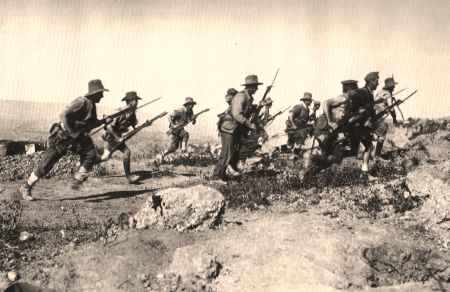 It is acknowledged that the Diggers were reluctant heroes and that the military campaign was poorly planned by the British.
The emphasis of yesterday's rhetoric was on mateship, sacrifice and national pride. Around 50,00 young Australian men died at Gallipoli. Slaughtered by all accounts.
No matter. Anzac Cove has now become a sacred site because the blood sacrifice changed the way we Australians saw the world and understood ourselves.
So why was Australia on the beaches of Gallipoli in 1915? Why celebrate a failed invasion of a distant country in which Australia had no strategic interest?

Horace Moore-Jones, The Coast North of Anzac Cove, 1915.
We should press this line of questioning, even though it makes us feel uncomfortable, because it leads to strategic policy considerations.
What was Australia doing there for heavens sake? It was on the other side of the world:
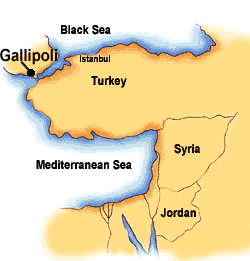 By all accounts Australia had no strategic reason to be there in the Middle East.
Who were we defending Australia from?
The Turks?
But they were defending their homeland were they not?
It was Australia who was invading their homeland. It was Australia making war on Turkey, a country with which we had no quarrel and no history of conflict. Why the invasion?
Did not the Turks defend their homeland from invasion with courage, tenacity and honour?
Did they not hold out against the Australian invaders and eventually repel them?
What was a Labor Government (that of Andrew Fisher) doing sending Australian volunteer troops to fight in the terrible terrain on the edge of the Midlde East?

Horace Moore-Jones, The Terrible Country Towards Suvla, 1915
Doing our duty for the British Empire is the common and conventional answer to this line of questioning. Australia simply provided the canon fodder so that the British Empire could defend its imperial interests.
Not so says Kim Beazley, leader of the ALP. In a recent address to the Lowy Institute he defended Australia's involvement on good strategic grounds. This is a historical revisionism. How plausible is it?
Before he makes his case Beazley outlines 4 strategic premises that he says guides his thinking about Australia's national security.
"The first is that I do not take Australia's security for granted. Nothing in our nature as a country - our values, our people or our institutions - guarantees that the world will do us any favours. Our future security depends on the nature of the global and regional international systems, the scale of our national resources and the skill and effectiveness of our policies.Second, Australia's future security is in the hands of no one but we Australians ourselves. Our circumstances are unique, and so are our responsibilities. Some find it easy to fall back on the idea that we can sub- contract our security to others. We cannot. It is our responsibility alone.
Third, to fulfil that responsibility Australian governments must provide realistic assessments of our national situation; active, imaginative and effective policymaking; a tough sense of priorities; a long-term view; and a true appreciation of our assets and liabilities.
And fourth, the mark of good Australian policy is not how it deals with artificial choices between regional and global engagement, but how effectively it marshals all the policy options available to meet Australia's unique interests."
These premises of strategic policyre national security are acceptable to me.
So how does Beazley deploy them in relation to Gallipoli? He does by criticizing the conventional position. Beazley says that like all legends the ANZAC story takes on an air of inevitability:
"It is impossible to imagine a world in which Australians did not go ashore that morning at Gallipoli. But there was nothing inevitable about it. They were there because of policy decisions - strategic decisions - taken by Australian political leaders."
Fair enough.
"The Gallipoli legend of today minimises these decisions. It suggests that Australians found themselves on the Turkish shore that day because their political leaders were too unimaginative, too supine, too emotionally tied to Britain to see that this was someone else's war, in which Australia had no part."
Beazley says that this is a travesty of the truth. A truer account of the strategic dimensions of the Gallipoli story deserves to be better known. He then outlines his case:
"Australians as a people thought carefully about their security in the decades before 1914. As the strategic challenge from Germany grew from the 1880's, they recognised that Britain would be less and less able to continue guaranteeing Australia's security. And they realised that as Britain started looking for allies in Europe and Asia, its interests would sometimes diverge from Australia's. We started to see ourselves, not as a mere strategic appendage of empire, but as an active partner in imperial security. As such we had our own unique interests and perspectives, and our own responsibilities."
John Quiggin takes exception to this paragraph.
I will grant that a developing independence in strategic thinking about national security can be granted. So our strategic policy was increasingly built on own unique interests perspectives and responsibilities. But I have more questions?
Does Australia's national interest coincide with imperial interest of the British Empire in 1915? Did we really act as active partners in imperial security then?
However, Beazley is quite sure about this. So how does he argue his case? He says:
"We cannot understand the decisions of 1914, and we cannot understand Gallipoli, if we do not understand that Australia had compelling, direct and distinctively Australian strategic reasons to play its part in helping to ensure that British power was not eclipsed. We needed Britain to defend us from what we saw - rather presciently as it turned out - as direct threats closer to home."
We needed Britain to defend us direct threats closer to home. Australia's compelling, direct and distinctively strategic reasons were the direct threats to our homeland.
What were these threats? None come to my mind. Australia was not threatened by China or Japan. Or did Andrew Fisher peer into the glass darkly? All that Beazley says is that Australia has global interests in 1914. So what were these global interests that ensured Australia had to invade Turkey in 1915?
Beazley does not say. We have silence other than vague estures to the future-Japan in the 1930s? This historical revisionism amounts to going along with 'great and powerful friends' to ensure their support. It is the security insurance doctrine of foreign policy.
February 3, 2004
starting over again
After my little break I started scanning the web for material to start over again. I found this passage most interesting:
"It is a commonplace that, for the most part, Australia inhabited the European Romantic imagination as the dystopia to North America's utopia. But while America had Southey, Coleridge and Blake to laud it as the next pantisocratic Jerusalem, Australia's spiritual patrons were more concerned with it's promise as a penal abyss into which a whole substrate of society might be cast and forgotten. Both were conceived in terms of "use," but the nature of this use differed radically in intention, even if it was similar in its outcomes."
That is about right from living in Australia. Pretty graphic that utopia dystopia duality. America is the sun. Australia is the land of refuse. The arse end of the world. I have been reading Bataille of late and it rubs off.
The above quote comes from p.4 of this text,which I've just stumbled across. The text makes other interesting remarks. On p. 3 it says that the history of the Western encounter with the Australian continent is one that is:
"...consistently found it to be aberrant, repellent, dystopic; the underside of the world, the Antipodes. That is to say, traumatic....In The Fatal Shore, Robert Hughes argues that, at the time of first settlement, Australia (and the Pacific basin, an "oceanic hell") functioned as a type of "geographical unconscious." The name of this dark continent at the time of "discovery" was Terra Australis Incognita: the name of the land-without-a-name."
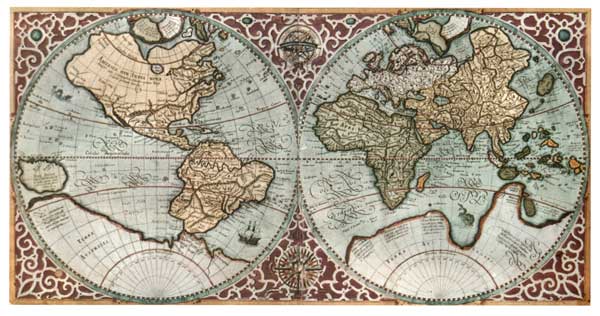
Mappamondo di Mercatore, 1587 (Londra, British Museum)
The land-without-a-name is the great unknown southern land.
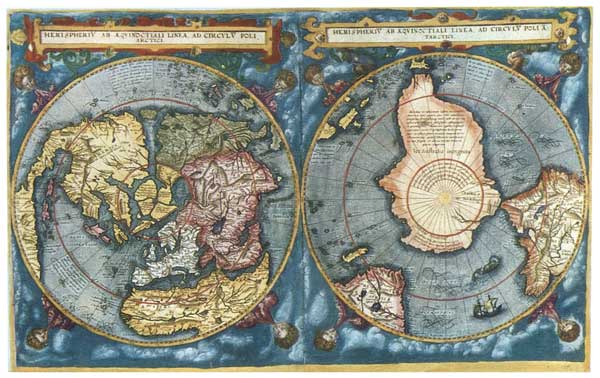
Mappamondo di Gerard De Jode, 1593
the Great Southen land as Terra Australis Incognitais clearer here:
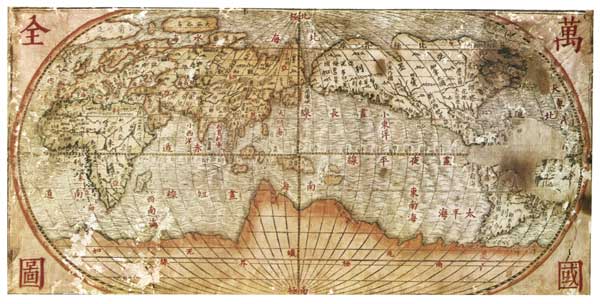
Mappamondo di padre Matteo Ricci, inizio '600 (Milano, Biblioteca Ambrosiana)
For the Dutch explorers who came down from Batavia and mapped the west coast of the Australian continent the land was an unliveable waste land. It was not a place of wealth or fortune.
The standard histories of this Eurocentric vision of the Australian continent say that it was put to rest by the voyages of James Cook. Once discovered the continent was then seen as empty.
The dark continent is spelt out in terms of Freud's unconscious. Thus Australia existed in the European imagination initially as the negative desire of an emergent scientific positivism. This "imagined country," as Hughes says, lurked beneath the rational conscious of the Enlightenment like something "infernal, its landscape that of Hell itself". Hughes says:
"Within its inscrutable otherness, every fantasy could be contained; it was the geographical unconscious. So there was a deep, ironic resonance in the way the British, having brought the Pacific at last to the realm of European consciousness, having explored and mapped it, promptly demonized Australia once more by chaining their criminals on its innocent dry coast. It was to become the continent of sin."
This Hell hole had other negative characteristics:
"Australia, it should be remembered, was first and foremost the destination of those who were considered to have insulted the law of property, it was dispossessed of those who failed to recognise (or even comprehend) the law of property, while it itself was consistently hostile to the very purpose of property– just as it has always been hostile to an aesthetics of the "proper." In this way Australia was also viewed (and often continues to be viewed) as dys-functional: the missionary work of pastoral industry, for example, being constantly undermined by the irrationality and godlessness of the place, manifested in floods, bushfires, droughts, and a native population seemingly immune to the inducements of salvation through toil. These demographic and environmental "disasters" give the appearance of a nihilistic force bent on sabotaging the efficient, serial production of pastoral industry"
Another characteristic of hell was that it was a British penal colony organized on rational lines:
"But as Hughes' comments imply, this Hell was already an operation of the rationalist spirit; it was what Foucault might have called a Hell of "discipline and punishment," a "corrective" Hell in the allegorical form of both Garten der Lüste and paysage moralisé. And in fact, in 1788, the colony of "New South Wales" was inaugurated as the largest scale prison facility in human history, and it at once become the epitome of the Sisyphean contract between labour and redemption enshrined in the Protestant work ethic of those who had instituted it.The flagrant nihilism of the penal colony extended also, to varying degrees of absurdity, to the project of continental exploration commencing in the 1820s, which most famously exhausted itself traversing one desert after another in search of a mythical ("redemptive") inland sea. In every endeavour, Australia seemed to resist assimilation to the European "idea," although this in itself seems to have been determined a priori, programmed by the "idea" that condemned it as dystopic in the first place."
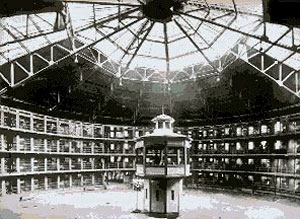
Australia is definitely an other to Europe and America. It is dystopia. It is it any wonder that many Australians feel alienated from the Europen Enlightenment. The light cast by the Enlightenment that light up the darkness doesn't look all that good from inside a penal colony. It looks more like Bentham's Panopticon:
A more popular conception of Australia as a dystopia is Australia as a cultural desert; one populated by well-fed barbarians, the decendents of convict victims of social justice, basking in a radicalized tradition, and living in cultural darkness. Culture was what took happened overseas in Europe, or rather Britain. What happened in Australia was derivative and second rate. It had a dead centre which was the desert.
Europe was mind (culture) Australia was body (primitive).
An elightened liberal society along social democratic lines was forged in the 20th century but Australia as dystopia lingered on and formed a space from within which one could be critical.
August 18, 2003
reason and emotion in history
There is a review of John Gascoigne's The Enlightenment and the Origins of European Australia (Cambridge University Press, 2002) by Gregory Melleuish in the CIS's publication Policy Magazine (Summer 2003). This is a history text that demonstrates that the moderate Enlightenment of lowland Scotland and England, and its values of reason and progress, were a significant factor in the formative period of Australian history.
What struck me about this text and the review was the downplaying of, and the negative attitude towards, Romanticism. Melleuish says that:
"This Enlightenment moulded the way the early European settlers in Australia saw themselves and their world. Gascoigne argues, correctly I think, that they had a minimal sense of their environment in Australia as being imbued with any sense of the sacred. For them it was a ‘terra nullius’ waiting to be made through their efforts. Hence Gascoigne identifies ‘improvement’ as one of the key words in their vocabulary: the new Australian world was there to be understood and improved. It was to be classified, analysed and then made bountiful."
Hence we have an instrumental reason of science, law and economics that shapes nature for human benefit in the public sphere. Nothing is said here the way this Enlightenment tradition evolved whereby achieving progress through the use instrumental reason was conceptualized within utilitarianism as a public philosophy. Progress is the key category here, since it unites the different tensions and contradictions of modernity under the banner of development, which is seen as harmonious and continuous and as bringing betterment to everyone.
What is then rejected is the view that modernity is characteristed by deep contradictions, divisions and fragmentation; the collapse of an integrated experience of life; and the irreversible emergence of autonomy as a central value. It was this that fueled the criticism of modernity both those who celebrated being modern.
So what of the reaction to the Enlightenment in this historical account?
According to Melleuish, Gascoigne says that that the Enlightenment is only one part of the cultural inheritance of Australia. Nineteenth century Catholicism, for example, took an entirely different view of the Enlightenment. And there was Romanticism, the reaction against the rationality of the Enlightenment that emphasised feeling. Melleuish says that Gascoigne rightly argues that Romanticism had a hard time in Australia because of the lack of both a sacred landscape and an organic past with which the present could be contrasted.
This is misleading. Romanticism may have had a hard time becoming domesticated in Australia. But it was a reaction to a particular conception of science; an technologically powerful applied positivist science that stood apart from, and above nature, manipulating it to maximise utility. It was also a reaction to industralization as well as a defence of cultural nationalism against the cosmopolitan values of the Enlightenment. (read British Empire).
On the philosophical interpretation we have a crisis of reason. The Enlightenment reason into technology project is put into question. This is not just because of the social role of science, the confidence in the technological fix or the institutional structure of science. It is also because the particular conception of instrumental rationality presupposes mind/body, reason/feeling, fact/value, human/nonhuman dualities.
The ecological impulse runs strong in Romanticism, and it resurfaces in, and is reworked by, todays environmental movement, which, in Australia, started from ethical concerns to protect wilderness in Tasmania. It challenges the Enlightenment's assumptions that moral standing is strictly a human quality; that issues of right action are exclusively questions of human relations; and that it is right on utilitarian grounds to exploit wilderness (Australia's rivers and old growth native forest in Tasmania) for human use. This exploitation for wood chip is deemed to be wrong.
So romanticism in this sense is now an integral part of an Australian national culture. Melleuish acknowledges this domestication in the following way:
"There is a division between rationality and feeling within Australian culture: on the one side there is science, law and economics and on the other the arts, moral self-righteousness and emotion. This division that has become greater in recent years as areas that previously favoured rationality, such as history, have increasingly succumbed to basing their approach on feelings of moral outrage."
That division between rationality and emotion is the inheritance of the different currents of the Enlightenment and Romanticism in modernity. Now Melleuish's statement, that rationality is being displaced by "feelings of moral outrage" implies that ethics is feeling. Those who act to put a moratorium on any logging and clearing of native vegetation in areas of high conservation value have no reason.
In that phrase of moral outrage you can sense the contempt and condescension to Romanticism; to the hermeneutical ways of writing Australian history; and to non-scientific forms of rationality. Criticism of Whig narrative of the progress of modernity is dismissed as moral outrage that is grounded on nothing more than feeling.
The inference is that such criticism is dismissed as irrational. By default, what is rational is the instrumental reason of science, law and economics that shapes nature for human benefit in the public sphere. And so we have the standard duality that structures public debates in Australia. We have closure; a defensive closure around a frontier that rejects what it finds threatening. In philosophy, for instance, we do not get an engagement between 'argument' and 'text ' (or 'writing'); and so we have a grotesque simplification of the differences between and within each side.
Melleuish does not consider whether the diverse oppositions to the technocratic Enlightenment tradition geared into big industry are also forms of rationality rather than simple feelings of moral outrage. If these oppositions are a form of rationality, then what kind of rationality are they.
This is important, even if we are dealing with a book review. First, environmental issues are here to stay, given the degradation of our landscapes. Secondly, the claim that no such environmental crisis exists in Australia------its all green delusions derived from a gloom and doom scenario --- cannot be taken seriously, given the current politics of water. Thirdly, the different strands of ecological thinking have become the main opposition to business-as-usual, despite all the attempts to close environmentalism out. Fourthly it is a political opposition that now has its roots in the reworking of social democracy.
This is more lines and tracks in this alternative space (field) than Melleuish's simple "feelings of moral outrage." To think with Melleuish here is to continue with banal and cliched defence of what is deemed to be normal, and so presupposes what is being placed into question or is being disrupted. The normal ignores that the critical responses are diverse ways of thinking differently that respond to problems arising from the way we have approached the world. Thus the normal functions to block environmentalism in the name of gloom and doom, and it rejects the various currents of postmodernism because of its relativism, lack of objectivity, lack of realism (there is nothing outside the text) and irrationality.
Yet no attempt is made to engage with those romantic currents within postmodernism, such as that pushes reason, utility, law and language to the limit through pain filled with jouissance. No attempt is made to understand the texts of a Georges Bataille or to argue with Derrida. Instead we have a war; a polemically driven war between two philosophical fronts (analytic and continental philosophy) in which strategic means are adopted to defeat the enemy. Such a war is based on the rejection of the philosophy of the other side.
That exchange bnetween different ways of doing and writing philosophy as 'hostilities between two different warring sides' is not very helpful at all.
An example of this thinking differently is to displace feelings of moral outrage for 'ecological rationality'; an ecological rationality that responds to the pressing need to make our cities more sustainable. Thus Adelaide, because of its current dependence on a dying River Murray, could use its current situation as a downstream state to become a Green city. It could live up its spin as a place where innovation is a way of life to become a sustainable city: to become an ecological innovator through devising fresh initiatives for sustainable solutions and fostering green industries.
These are quite different tracks and trails in the field to the one marked by 'feelings of moral outrage.'
June 5, 2003
writing history
Due to some of the previous postings I've done on the writing of Australian history (eg., here) I keep getting the odd email criticising my interpretative approach to contemporary disputes in history.
The criticisms mostly come from those who adhere to an empiricist model of history and they think that interpretation of texts opens the door to "anything goes". Because of my focus on primary historical sources as texts and not as facts I am a seen to be light on the truth. Somehow an interpretative approach is acceptable in responding to films but not to historical events.
According to the advocates of the empiricial method, history should be a mirror of past reality and the various distortions (eg., personal bias, prejudice and faulty use of sources) should be removed so that we can possess objective knowledge. On this conception of writing history texts for the present, history can, and should, correspond to the reality of the past. So the emphasis is on getting the story straight. Radicals never get the story straight because they let their political enthusiasms (passions) get in the way. Method and evidence are to the fore because they are the royal road to Truth.
In this post I will make a couple of quick remarks about an interpretative approach by highlighting what is repressed by the empirical method.
First, it sees the connection between writing history and literature. It places the emphasis on the composition, creation and construction of writing different situated histories. These histories are a form of knowledge based around narratives, they presuppose a philosophy of history, politics, judgements about right and wrong etc and this literary narrative creates meanings about the past for us now.
Secondly, a Hegelian point. The empirical method represses the historical conceptual apparatus that works up, or orders , the atomic facts into a complex structure of a narrative. Without this conceptual apparatus we would have a jumble of unrelated facts and not historical knowledge. Call this this historicism.
In bringing the repressed to the foreground we have a different way of writing history--- a discourse that gives the past various meanings through the creation of written texts. As a discourse (a lot of interelated texts) history is different from the past. If you like, the past is what has gone and history is what historians have made aand are making of it. History texts are their reading of the past. As historicans they read it differently to geographers, ecologists or economists: ie they select different things to write about, approach the writing differently and work with a dissimilar conceptual apparatuses.
The above are simple points. They are what historians know. But they want to hammer it back into the empirical way of doing history. Somehow the latter is seen as the only legitimate way in Australia.
May 23, 2003
The return of assimilation
This text recalls an old idea once the core of conventional thinking. The text says:
"AUSTRALIANS used to talk about "smoothing the pillow of the dying Aboriginal race". The racism of that idea has been thrown on history's scrap heap, but the underlying pessimism of that attitude has survived in a strange way. Most people who accepted indigenous Australians as equals in principle still didn't expect any solution to our endemic problems. Least of all did they expect a solution worked out by indigenous people."
The old idea isassimilation. It has its roots in the dispossesion of Aborigines from their lands and the nineteenth century idea of the Aborigines eventually dying out. However, assimilation has not died, nor has it been thrown on history's scrap heap. Assimilation never went away. It went backstage. It has new life with talk of genocide, multiculturalism and the national security state; a new lease of life in an Australian conservatism that is structured around Anglo nationalism.
Assimilation (sometimes the word integration was used) was a way of governing aborigines after 1945 and it represented a break with the older policy of protection on reserves in which the disappearance of the Aboriginal people was a stated aim of public policy. Assimilation replaced the older biological notions of race and biological determinism (character traits based on blood) that had become discredited. Assimilation meant absorption--- the absorption of indigenous peoples into mainstream society: the future for Aborigines lay in them becoming a part of a homogeneous Australian society, not being placed outside it in reserves.
What did assimilation as a process of being absorbed into Australian society mean? As a mode of governance it meant that Aborigines were to live like white Australians. They were to become a part of a single Australian community with the same rights and responsibilities, observing the same customs, and influenced by the same beliefs, hopes and loyalties.
Assimilation meant the denial of cultural difference. The affirmation of cultural diference gives us multiculturalism.
It does not take much to rejig assimilation to make it a political response to non-European migration. The non-white migrants were welcome here provided they lived like white Australians, observing their customs and habits, having the same loyalities etc. The social cohesion of the liberal state was premised on everybody being Anglo-Australians----the cultural patterns of the migrants had to be destroyed and replaced by the cultural patterns of the Australian way of life.
What is problematic about assimilation is the cultural assumption that the European (ie British) way of life was superior to all others--Aboriginal way of life, Chinese, Vietnamese and Iranian way of life. The future of the non-white peoples lay in discarding their remnants of their "archaic" way of life. That is why all were expected to become British; expected because it was a better way of life. What is best for immigrants and those granted asylum is that they abandon their distinctive cultural beliefs and practices and adopt those of the Anglo-Australian majority.
Lefty liberals who live within the Enlightenment tradition continually dismiss Australian conservatives as yesterdays men. It is said that they are uncomfortable with with, and disdain, the major change in social values and cultural beliefs over the last 40 years. They belong to the baggage of history.
This is a misreading. It dismisses rather than tries to understand. It is too caught up in the genocide episode surrounding the Bringing Them Home report of the 1990s, and the various denials about genocide happening in Australia.
Assimilation is alive and well in Australian conservatism. It is a core strand of this political tradition. This strand says that we Australians live in a threatening world. We are anxious, if not terrified, because the terrorists could strike at any time. Australia is a target. We need to feel as one. One-ness is necessary for the national security state. There is no room for the political affirmation of cultural difference. What is required is an unsullied Union Jack flying proudly over the Australian continent.
What assimilation means is that the conservative conception of a sense of belonging to the nation-state was historically premised on an Australian ntionalism is an ethnic white nationalism, and not on a civic one based on citizenship. Today it premised on an Anglo-nationalism. A nationalism that affirms its superiority to the barbarism of the Nazi's, the Balkans, Cambodia and Islam.
April 14, 2003
going post-national
In her Relativities column in the Weekend Financial Review (subscription required), p. 28, called, 'Identity shifts marks new work view', Deidre Macken, adopts a cosmopolitan perspective that dislocates her social being from national identity and interests. She adopts the global city perspective of the world market to argue that the market forces of globalization have:
"...allowed regions and cities to establish their own relationships with the world, so that being a Sydneysider is something different to being an Australian."
Clearly Sydney as a global city has become disconnected from the rest of the country in a way that a provincal city such as Adelaide is not. But what does disconnected mean? Macken explains this in the following way:
"Demographically my home town is very different to my country. Its younger, more multicultural, better paid, better educated, more travelled and more disrespectful of traditions such as the monarch and flag."
Wll, some parts of Sydeny. There are other parts that are less educated, poorer, less well paid, less travelled and more moncultural than parts of Adelaide. But Sydney is a global city and Adelaide is a provincal one.
What are the implications of Sydney as a global city disconnecting from the country? According to Macken the charms of patriotism and nationalism have little appeal to her. They are something to be embarrased about. For a global being such as herself they are relics of history to be discarded. Macken says:
"I feel part Sydneysider and part Australian but less likely than ever to be stirred by the sight of an Australian flag on foreign soil. "
I interpret this as being against nationalism (whether civic or ethnic) and in favour of individuals who are 'citizens' of the world. Thats what being a Sydneysider in Macken's sense implies. She is announcing the end of the nation-state in favour of the global marketplace. Unlike her fellow citizens who reside in the rest of the country, Macken is post national and proudly so. According to Macken, those of us who live in the country and are bounded by the horizons of the country are stirred by the sight of the old national tradition of the Australian flag evoking patriotic emotions.
Being a Sydneysider, a global being, is living against historical tradition, the authority of long-standing national practices that have outlived their time, such as the monarchy. So we have tradition within closed boundaries versus the openendedness of cosmopolitanism or universalism. A national culture is a tradition in the sense that involves, change, diversity, conflict and not simply something fixed or static that is based on a core national character.
Macken's cosmopolitanism ignores the conflict within the country; ie, whether tradition in the form of local communities is opposed to the nationalism of the centre (Canberra), which is unresponsive to local traditions and practices that underpin Australian federalism. This opens up possibilities for a cultural pluralism within a sovereign state.
Secondly, the embrace of cosmpolitianism and dismissing tradition acts to displace the sense of the nation as a form of cultural belonging; as a way of belonging to a political community with its shared beliefs, common language and mutual commitment. Instead of belonging to a sovereign nation-state we have a free floating nomadic existence. My identity as an Australian forms my fundamental perspective on the world, provides me with a set of memories and aspirations, gives me a past and a future, and gives me a place in the world that I recognize as home.
Thirdly, being a global trotting Sydneysider on this account means asserting the global market over the nation-state with the identity of the Sydneysider one of being a producer or consumer in the global markeplace. This is a global identity that disconnects from being a citizen concerned with public issues and the public good within the boundaries of the self-determining, nation state. The state's legimacy depends upon its claim to represent a community defined by its culture.
So why disconnect? From what I can make out Macken's global perspective implies that the nation-state as a particular sort of political entity is more homogenous as a cultural group whereas Sydney is more multicultural. This implies that the nation contains minority migrant groups in such a way that it does not allow for the proper existence of cultural diversity of poly-ethnicity or culturally defined communities.
Is this so?
It seems to be an idealised account of Sydeny. It conveniently overlooks that a lot of what passes for multiculturalism in Sydeny is migrant sitting around in a ghetto and saying I'm not an Aussie; I see no reason why should I contribute, or fully participate in this society; and I am not part of the country. It is not my homeland.
What Macken's global perspective does not acknowledge is that cultural diversity is a problem for the nation-state. The state as a particular sort of political entity needs to address the homogeneity of the nation so that the dominant culture of the nation becomes more multicultural. Rather than the nation "containing" minority groups--as if one was the host and the other the guest---it should redefine the nation so that the nation involves cultural diversity.
Being a member of the nation involves both being Australian or Greek. My sense of self or identity as an Australian involves both and without either I will experience a sense of loss; a deep sense of dislocation and alienation. There is both a sense of belonging to this country and a valuing of the Greek cultural heritage of the migrant community. The problem is where a liberal state do this? Though it is meant to be neutal between different cultures or ways of life, the liberal state actually functions to protect and perpetuate one culture--the Anglo-Australian one.
April 9, 2003
Nationalism
Gerard Henderson's recent piece on patriotism in the Sydney Morning Herarld is called Rallying around the flag is no jingoism.. In it he recycles George Orwell, who, in his Notes on Nationalism, praised patriotism and rejected nationalism. The former was good the latter was bad. Henderson says that Orwell
"...defined patriotism as involving "devotion to a particular place and a particular way of life, which one believes to be the best in the world but has no wish to force upon other people". In this sense, the concept was essentially defensive. Not so, however, nationalism which, Orwell maintained, was "inseparable from the desire for power". The abiding purpose of every nationalist was to achieve more power for a nation."
Henderson uses this distinction to say that:
"Australia is a patriotic nation. Always has been. But it is not nationalistic - in that Australians have never attempted to impose power as a nation. Australia is essentially a pragmatic and empirical society....Patriotism looks like being around for quite some time. Moreover, most scoundrels find nationalism much more attractive."
I have dealt with patriotism here.
I take exception to this understanding of nationalism because Australia is a deeply nationalist nation, even though it does not want to incorporate Papua New Guinea into a little empire. Why so? Because the Orwell understanding of nationalism is an odd one.
One conception of nationalism is the romantic one based on language, culture and tradition. It has its roots in Herder and it gives us a cultural nationalism concerned with developing an Australian culture in opposition to an English colonial culture and an American mass culture. Another conception of nationalism is a civic or liberal one in which individuals give themselves a state and the state is what binds together the nation. On this acount a nation is viewed as a purely legal and political entity and the emphasis is placed on the sovereignty of the people.
What Henderson is not doing is questioning Orwell's identifying nationalism with Nazi Germany, the Soviet Union) or a movement (political Catholicism, Zionism, anti-Semitism, Trotskyism and Pacifism). What Henderson seems to assume is the equation of nationalism with ethnic nationalism which is concerned with ensuring that each nation (a people bound by ethnic ties) should have its own sovereign state. So they promote the nation-state model, whiich means that all ethnic groups should have their own state. This then gives rise to incessant conflicts and wars betwen nations.
Henderson is quite right to reject this for Australia, which by and large has become a multicultural society. That leaves us with the civic conception based on Ausatralia as a liberal nation-state and which has been underwritten its self-determination and autonomy or independence.
But Australian history shows that the Australian people has been composed of a dominant Anglo-Australian class who controlled the state and who shaped a certain (ie., English) culture, language, history and set of traditions. These shaped the hand of the state which acted to minmize the existence of minority and immigrant groups so as to create the conditions for assimialtion. The aim of assimilation as a mode of governing a population was to make the Australian people linguistically and culturally homogenous so as to ensure national cohesion.
This is what Henderson ignores.