July 26, 2003
After an Exhibition: a note on Australian landscape
Regionalism in art---such as representations of the South Australian landscape have a hard time being accepted in the art world. This painting of Waldegrave Beach (near Elliston on the Eyre Peninsula) by Siv Grava--
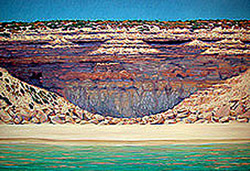
Siv Grava, Waldegrave Beach, Images Gallery, 2003, Oil on canvas
This regional art is confronted by being rejected as unfashionable in the metropolis. The art institution still thinks in terms of avoiding the literal image, defying figurative conventions, the avant garde and being self-referential about art. They are still bound up in the prejudices of the New York avant garde of the 1950s, which held that regionalism was trashed by the march of art history. For modernists regionalism meant backward-looking conservatism whilst being avant grade meant being authentic.
Being modern for photgraphers in America and Europe meant this kind of abstraction:

It did not mean this:

That is Australiania or kitsch.
In a globalised world regionalism is returning. What causes its rejection this time is that it is about the specifics of place: eg., Maslin's Beach by Siv Grava
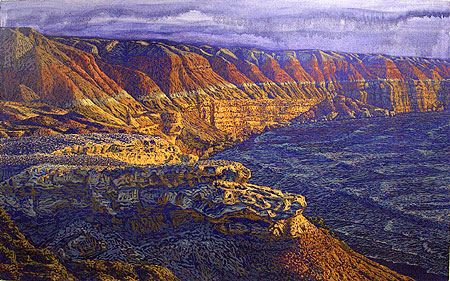
Siv Grava, Maslin's Beach, Images Gallery 2003, Oil on canvas
The opening of Siv's exhibition at Images Gallery was last night. I slipped in quickly whilst passing by.
So anyone producing works to represent the specifics of their place risks being ensnarred in Australianness, Australiania, and postcard views. Those words mean one thing to the art institution:---kitsch. Today, kitsch means artworks that appeal to popular or lowbrow taste, artworks that are often of poor quality, and cliched artworks. Kitsch causes that aesthetic 'yuk' feeling in the art institution.
And the reason for the immediate recoil, if not repugnance, by the art institution to the specifics of regionalism. Art transcends the particularities of place. It does so by either meditating on the [spirit] of the Great Southern Land, or alternatively by becoming a colouristic exercise of aesthetic appeal.
An acceptable strategy to avoid Australiania is to deconstruct kitsch sunset photgraphs of Uluru for tourists. Such a strategy is deployed by David Hume:
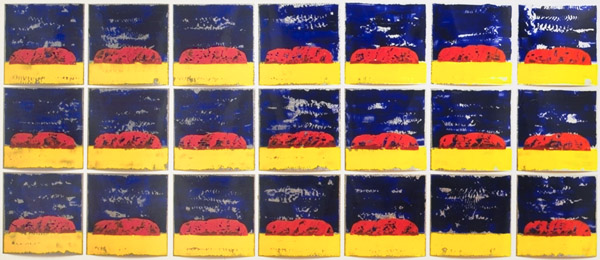
David Hume, Postcards From The Rock, Acrylic on galvanised steel, Beneath the Beyond 2 exhibition, 2000.
This strategy is seen as okay by the art institution because it is art being self-referential. Being self-referential means that the artwork is not a cliche, and it prevents the artwork from become part of the flotsam of mass culture. To be a good modernist you must fear and hate kitsch. For modernists art stands opposed to kitsch.
What happened with modernism was a forgetfulness about place. Place was erased. "Erasure" denote the art institution's tendency to displace, deny, or unrecognizably alter its past; its history of being in a specific place. The traces of the past continued to remain even after the landscapes and buildings had been demolished. What occured was a burial, rather than a disappearance of regional representations of the past and place.
We are now begining to recover the old images of our region:

The Hans Heyson representations of the Flinders Ranges, which were once high art, are in danger of becoming kitsch.
Posted by Gary Sauer-Thompson at July 26, 2003 03:47 PM | TrackBackcould be a good idea to credit images ie artist name, work title and date, medium...
Posted by: on May 28, 2004 11:11 AMUnknown,
you are quite right. It was not good.
I've got better as I got the hang of using images on a weblog.
I've tried to rectify the error as much as I can. Though sometimes you do not get the title, date or medium online.
I'm having trouble findinf the Paul Strand image online.
Posted by: Gary Sauer-Thompson on May 28, 2004 02:17 PMit is a very well set out site!!!!!!!!!!BUT i thing is you are missing the year that the paintings were made???????it would be good if you added them into your site because it helps for assignments!!!!!!!!THANKYOU FOR A WONDERFUL SITE!!!!!!!!!!!!!!!!!!!!!!
Posted by: hiiiii on October 15, 2004 05:20 PM