July 28, 2003
Sontag: Regarding the Pain of Others#10
The tenth part of Rick's project on Susan Sontag's Regarding the Pain of Others is concerned with the themes of beauty and shock. My comments on the ninth part of the project can be found here.
In this section Sontag says:
"It is one of the classic functions of photographs to improve the normal appearance of things…Beautyfying is one classic operation of the camera, and it tends to bleach out a moral response to what is shown."
Here is an example of the classical beautifying process of photography. It is portrait of a Tambul warrior from New Guinea. It was taken by Irving Penn.
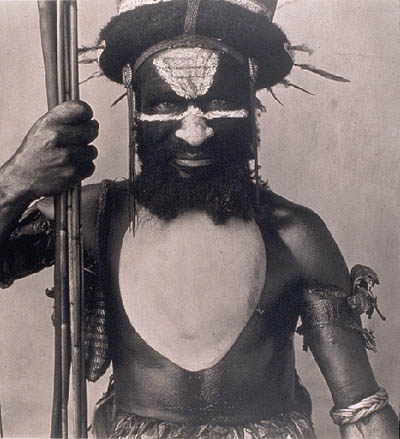
Has the moral response been bleached out? Yes. Beauty is a historically product. The beauty in this photo is the beauty of fashion under the sign of art and Vogue. So we get an overlap between art and fashion in the form of style. Style is expressed though elegant lines and an elevated and aristocratic tone. Penn was a master of creating style as a spell of untarnished beauty.
When you put Vogue fashion and ethics together you come up with charity, the dictates of constant change in fashion or modesty. Still there is little point in banning beauty.
So let us accept Sontag's point about the beautifying process of photography. Sontag then turns to the opposite of the beautiful, the ugly. She says that:
"Uglifying, showing something at its worst, is a more modern function: didactic, it invites an active response. For photographs to accuse, and possibly to alter conduct, they must shock.” (Sontag, p. 81)
This bookwas once seen as ugly and shocking, then this. As Adorno puts it in Aesthetic Theory, "Ugliness is a historical and mediated category and when conservatives condemn such works as ugly they also mean decadent or corrupting. They tend to equate ugly with suffering.
And today? What photos do we find shocking today? This photo is considered shocking in the West. It is of Uday Hussein's body and it was publicly released to change conduct and opinion in Iraq:
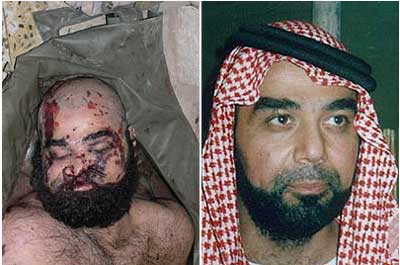
Some do not find the photo shocking. Terry Teachout over at Arts Journal says the photos:
"...were broadcast on TV and scattered throughout cyberspace last week, usually labeled "warning—graphic photos," or words to that effect. And they were graphic, I guess…but I can’t say they shocked me. I’ve seen a lot worse (I used to work for the New York Daily News, after all). More to the point, the photos released by the Defense Department were tame compared to what you can see any day of the week by renting any reasonably violent Hollywood film released in the last 30 years or so, going all the way back to 1969 and Sam Peckinpah’s The Wild Bunch."
Others do find them shocking. Update. For the Arab world see here
And even some in the West. Why?
Because the public release of a photo of individual dead body breaks with an unwritten military convention not to publish photos of individual dead bodies. The US government explicitly broke that convention by releasing the photographs to prove to Iraqi's that Hussein's sons are dead.
As Photdude points out, this tradition of not publishing photos of individual dead bodies is codified in the First Geneva Convention.
Article 15 says: “At all times, and particularly after an engagement, Parties to the conflict shall, without delay, take all possible measures to search for and collect the wounded and sick, to protect them against pillage and ill-treatment, to ensure their adequate care, and to search for the dead and prevent their being despoiled.”
Article 17 states: “They shall further ensure that the dead are honourably interred, if possible according to the rites of the religion to which they belonged, that their graves are respected, grouped if possible according to the nationality of the deceased, properly maintained and marked so that they may always be found.”
Photodude says that though the Third Geneva Convention is specifically about prisoners of war, it does say they must be protected “against insults and public curiosity.” He adds that having your death-deformed face broadcast all over the world might just qualify as “public curiosity.”
In a latter post Photodude comes back to working out why he is shocked. He is shocked because basic human respect and international law has been broken.
So let us accept Sontag's point, that if photographs are to alter our conduct they must shock. Ths leaves us with tension of beauty bleaching out morality and the ugly shocking us. Sontag's duality is problematic.
Then Sontag adds something extra---some difference. She says:
“Harrowing photographs do not inevitably lose their power to shock. But they are not much help if the task is to understand. Narratives can make us understand. Photographs do something else: they haunt us.”
(Sontag, p. 89)
Below is a portrait of some plain country folk by Mike Disfarmer who worked as a photographer in Heber Springs Arkansas. The portraits that were taken from 1939 to 1946.
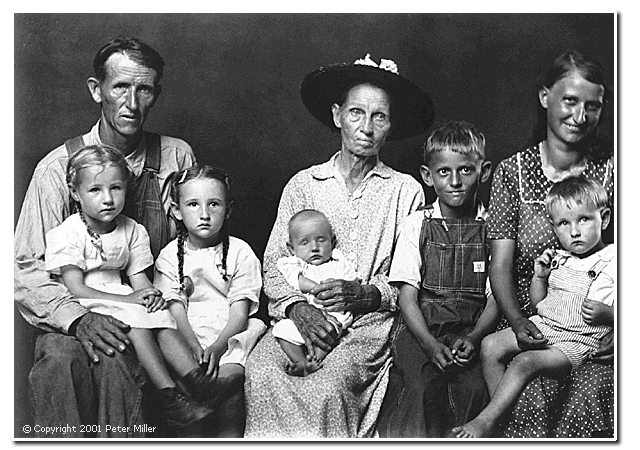
This photo is neither uglifying nor beautifying. It is haunting in its starkness and simplicity. Why haunting. Because the hard physical toil and suffering of rural Depression life is encoded in their bodies; as is their pride, stoicism and simplicity. Grief is expressed in these bodies--the photo expresses both grief and a sense of being alive.
The photos are also haunting because we understand that many of the portraits of country boys in uniform, with their mates and girlfriends just prior to them, will be going off to fight in WW11.The young men would be dead in a few years. The photo is a special event.
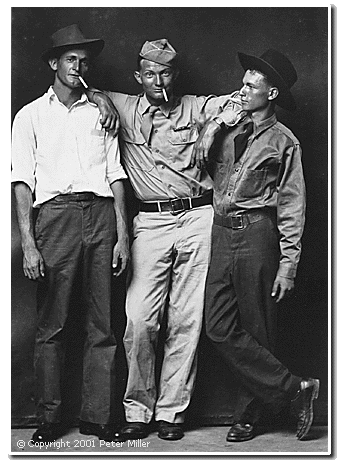
The young men would die in war. That is why these photos haunt us. They radiate a darkness that keeps beauty in check. The haunt us because they remind us of the affinity of art with death.