September 02, 2003
Japanese modernism?
Courtesy of wood s lot
Yasuo Kuniyoshi:
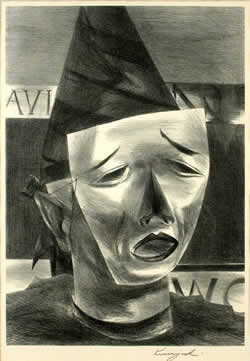
A Japanese modernist?
By that I mean a modernism that was genuinely Asian: both a culture that was truly modern by virtue of its being universal, and a culture that would overcome the West by subsuming it under a larger synthesis of Western and Asian values.
Japan in the early 20th century was situated uncomfortably on the cusp between Western modernity and its Asian identity. Modern Japan was nation-build state and it represented itself as a nation-state with fixed national borders and deep nationalism. Yet it became an empire, an empire that confronted, and became a part of western modernity which had universal terms.
We in Australia regard Japan as being an Eastern country with Western characteristics. Our pespective is a Western universalism that is tacitly opposed to Japanese exceptionalism. However, Asian countries such as Indonesia view Japan as being Western but with a vague memory of something Eastern.
Somewhere in the 19th century the arts from the East and the West got interwoven. In the late nineteenth century and in the early decades of the twentieth century, Japan firmly embraced the modernist art styles from the West. But at the end of the twentieth century it appears that Japan has, once again, turned to Asia.
Today, Japan is a economic superpower within Asia. It appears to the odd man out in Asia, even to the point of being regarded as 'the Other'. From the perspective of Australia Japan is considered the trend-setter of a radical high tech modernity. It also leads the West in areas such as fashion, architecture, technology, design, computer graphics, popular visual culture, photography, and the new media.
Japan is postmodernity from the perspective of someone living in Adelaide with their back to the southern ocean; shaking of the deep nostalgia for double fronted bluestone cottages of nineteenth architecture; trapped by the twentieth centurys obssession with the car as the core of modernity, and unable to am apparently attempting to escape from history in which all tradition and time are equated with the logics of North Atlantic modernity. If you like, Japan makes history while Adelaide is but a footnote in the endless elaboration of North Atlantic modernity.
I get gloomy at this point.
Americanization is coming through the front door of a radical neoliberalism that pushes tradition and authority aside, and leaving it as a pile of rubble on the margins of the freewheeling market. We are left with have the fragments to pick over as the wind blows hot and dry from the north, the sun bakes the earth, and our skin shrivels from the heat.
I'm not so sure I would define Kuniyoshi's modernism as genuinely Asian. He left Japan as a young man, studied, created, taught and spent most of his life in the US. This is not to say that he was not influenced by Asian aesthetics, and he certainly is a modernist, but probably more an American one than Japanese. Isamu Noguchi who actually went back to Japan and spent time working there probably made more effort in pursuing and working with Asian aesthetic ideas, although I think he saw himself as trying to bridge the two cultures because of his mixed heritage, American mother and Japanese father. He was disappointed not to get a bigger part of the commission at the Hiroshima memorial.
In terms of driving the Asian cultural issues, its not too much of a surpise that Japan's influence is the strongest, considering the size of the economy but I do think that Korea and China are both going to be important centers of cultural and political activity in the years to come.
Posted by: Harry Phillips on September 7, 2003 04:32 AMPeople of the world get to pick whatever culture seems most attractive to them in the 21st Century.
You got a problem with that?
Posted by: M. Simon on September 7, 2003 11:16 PMHarry,
I thought Kuniyoshi was more an American modernist than an Japanese one when his work online.
I will check out Isamu Noguchi in terms of exploring Asian aesthetics.
Thanks for the info. Much appreciated.
Posted by: Gary Sauer-Thompson on September 8, 2003 10:06 AM