September 10, 2003
Sontag: Regarding the Pain of Others#17
Rick's seventeenth post on Susan Sontag's Regarding the Pain of the Others is concerned with historical amnesia My comments on Rick's sixteenth post can be found here.
Sontag is looking back on the archive of images of human cruelty. Reflecting on these she says:
"Someone who is perennially surprised that depravity exists, who continues to feel disillusioned (even incredulous) when confronted with evidence of what humans are capable of inflicting in the way of gruesome, hands-on cruelties upon other humans, has not reached moral or psychological adulthood. No one after a certain age has the right to this kind of innocence, of superficiality, to this degree of ignorance, or amnesia."
There is no amnesia at one level. We know about depravity:
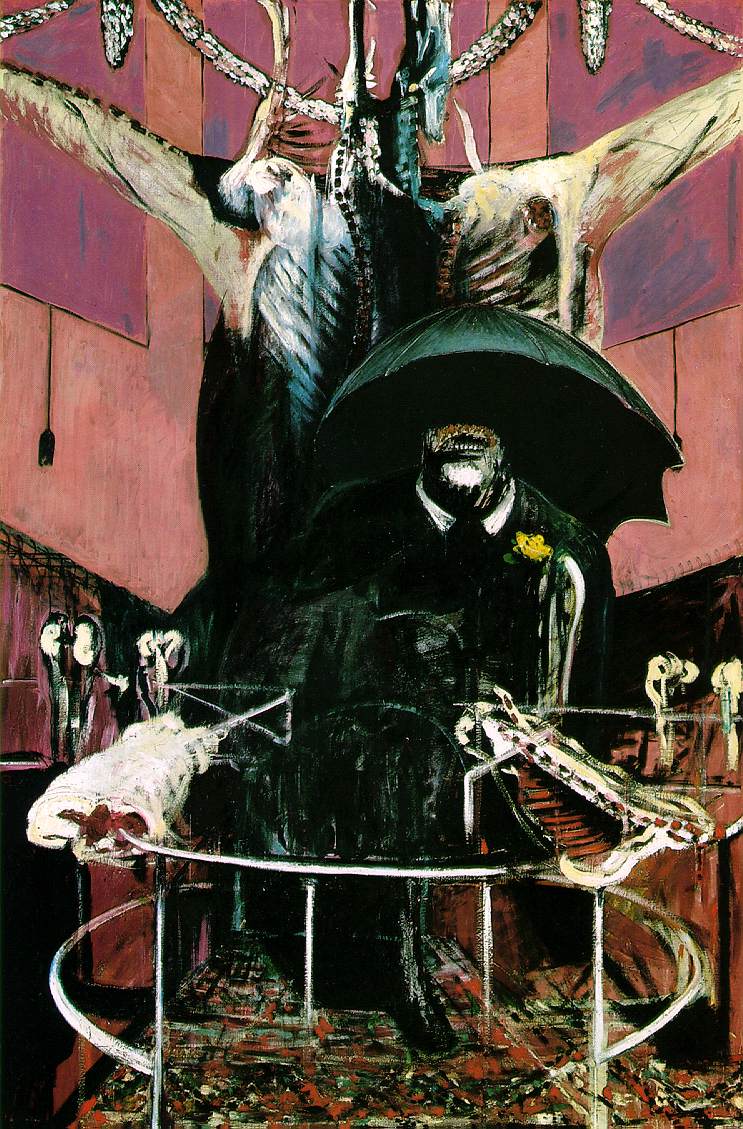
F. Bacon, Painting, 1946
Sontag then goes to make a point that sums the journey we have been on:
"There now exists a vast repository of images that make it harder to maintain this kind of defectiveness. Let the atrocious images haunt us. Even if they are only tokens, and cannot possibly encompass most of the reality to which they refer; they still perform a vital function. The images say: This is what human beings are capable of doing; may volunteer to do, enthusiastically, self-righteously. Don't forget." (Sontag, pp. 114-115)
We do forget. Australians, for instance, did forget what happened to the Aborigines during the early part of the 20th century. The forgetting is associated with the attack on the black armband view of Australian history . . .by which is meant an excessive emphasis in recent historical writing on past wrongs. This mournful view of Australian history needed to be displaced by a view of Australian history as overwhelmingly a more positive and patriotic history.
Thus the discourse of Australian conservatism. The historical forgetting is a consequence of the conservative political campaign to discredit Aboriginal land claimants, deny that the stolen generations were taken from their families, and insist that the European occupation of Australia was remarkably peaceful. The forgetting of the suffering of the indigenous others is part and parcel of the attempt to rewrite Australian history in the service of a partisan political cause.
So we are left with pile of fragments as suggested by Rick Visser Melian debate (fragment):
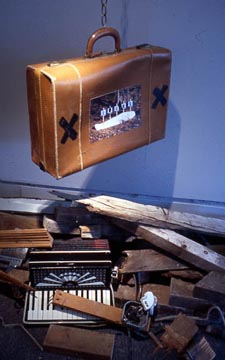
We have blank petrified signs that have undergone a draining of meaning. We have dead letters, lifeless scripts, and empty signs in a world of naturalizing mythology.
We grub amongst these ruins of meaning for fragments that say something to us.
We hunger for a sign that we can interpret in some way to break open a frozen mythic world that we live within.
Is there a fragment that can be retrieved and then reconfigured?
So what do we do in the face of this forgetting? How we stop the forgetting once we have remembered the horrors that still shape us.
Sontag is clear. As Rick reminds us in the comments to this post Sontag says:
"There now exists a vast repository of images that make it harder to maintain this kind of defectiveness. Let the atrocious images haunt us."
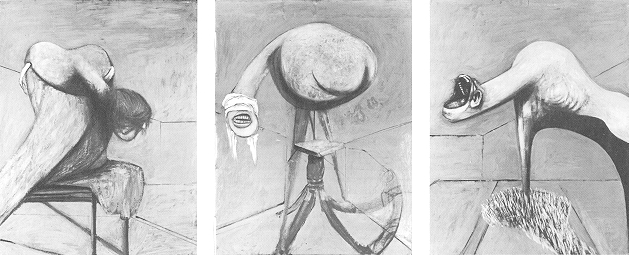
F.Bacon Three Studies for Figures at the base of a Crucifixion (1944)
There is an archive of images that can and do haunt us.
The images do haunt us that is for sure:

F. Bacon, Head Surrounded by Sides of Beef, 1954
But what do we do with the haunting inside us as we live in a world of naturalizing mythology?
Are we not fractured? Is not our ego dismantled?
We do need to break up that frozen mythic world that insists that the European occupation of Australia was remarkably peaceful. How do we do so? Sontag gives us little help. All she says is that the images say to say this is what human beings are capable of doing.
Posted by Gary Sauer-Thompson at September 10, 2003 04:54 PM | TrackBackSontag says: "Let the atrocious images haunt us. Even if they are only tokens, and cannot possibly encompass most of the reality to which they refer; they still perform a vital function. The images say: This is what human beings are capable of doing – may volunteer to do, enthusiastically, self-righteously. Don’t forget." (Sontag, pp. 114 – 115)
LET THE ATROCIOUS IMAGE HAUNT US (ME).
This may be the pith of her exploration -- and mine -- in regarding the pain of others.
Rick Visser
Posted by: Rick Visser on September 10, 2003 11:21 PMRick,
thanks for that. I was beginning to wander off the trail into the desert.