September 22, 2003
Sontag: Regarding the Pain of Others#19
Rick's nineteenth post on Susan Sontag's book, Regarding the Pain of Others, can be found here. We are coming to the end of Rick's wonderful and innovative project that started here.
The text is from Sontag and it says :
"Among single antiwar images, the huge photograph that Jeff Wall made in 1992 titled, "Dead Troops Talk (A Vision After an Ambush of a Red Army Patrol near Moqor, Afghanistan, Winter 1986)" seems to me exemplary in its thoughtfulness and power. The antithesis of a document, the picture, a Cibachrome transparency seven and a half feet high and more than thirteen feet wide and mounted on a light box, shows figures posed in a landscape, a blasted hillside, that was constructed in the artist's studio." Sontag, p. 123
The image is this:
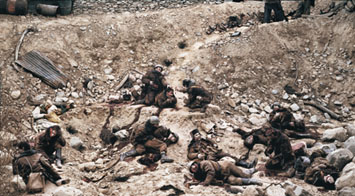
Jeff Wall, Dead Troops Talk.
Sontag uses it to close her book and argument---though I'm still not sure what her argument actually is.
We have come full circle to an earlier post: the documentary work of Mathew Brady in the American Civil War.
Of course, I do not accept the position that the work of Mathew Brady was a document. Brady constructed his images and organized the bodies. This time around we have the construction of the image upfront as we have proper studio and gallery-based based work that plays with artistic language. We do not have the black and white documentary realist style of Brady that spoke "the Truth" about the horrors of American Civil War. The art blurb describes the way the work is produced:
"Wall creates his works using actors and actresses on location, as in a movie production, and uses a computer to construct elaborate scenes. Just as painters of past ages composed and depicted historic scenes, landscapes and fashions, Wall portrays our present age fully applying his knowledge of art history and photography."
With Jeff Wall's work we are firmly within the acommodating space of the art institution. He has studied art history and has a good working knowledge of that history:
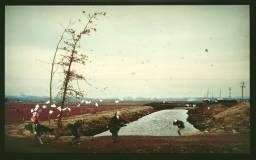
Jeff Wall A Sudden Gust of Wind (after Hokusai) 1993
Wall uses an 8x10 view camera, has a myriad of assistants, takes multiple photographs of the same subject under a variety of lighting conditions, and then assembles the resultant photograph digitally from many negatives. He often lights different areas of the photographs separately, and uses many large studio strobe-units. Consequently, it often takes weeks for him to take the photograph, not counting the digital work. The art space in which we now stand is also the vanishing point of documentary practice of photojournalism.
Another art blurb describes the media Jeff Wall uses:
'Wall's enormous photos (some over 16 feet) aren't really photos at all. They are large transparencies displayed on fluorescent light-boxes - much like how X-rays are viewed by physicians.[Wall] continually posed himself the question of how an artist could create an intense impression in the fashion of Goya or Manet, by depicting the current age. He also asked himself what kind of work would be significant for our modern society. One answer to these questions was his idea of using fluorescent light boxes with photographs, thus hitting on a new form of expression. As he put it, "It is not photography, cinema, painting, or propaganda -- though it has strong associations with them all."'
What is produced is something that has been staged for us. It is a tableau created by “a painter of modern life.”

Jeff Wall The Flooded Grave 1998-2000
And the content? What is being said with all this sophisticated technological apparatus.
And yet what is missing from the thoughtfulness and power of this artwork is the raw violence and menace of a Bataille who deals with the repulsive.
Sontag does make contact with this. She says about the Red Army soldiers in Afghanistan who went through hell:
"We - everyone who has never experienced anything like what they went through - don't understand. We don't get it. We truly can't imagine what it was like. We can't imagine how dreadful, how terrifying war is; and how normal it becomes. Can't understand, can't imagine. That's what every soldier and every journalist and aid worker and independent observer who has put in time under fire, and had the luck to elude the death that struck down others nearby stubbornly feels. And they are right."
Is not war and dead bodies repulsive? Is it not difficult to make sense of the killing of human lives. Do not the justifications and rationalisations of imperial nation-states ring hollow, as with Iraq? Is there not something that is left that is senseless and it cannot be jsutified. It just is. It is so repulsive about death and perversion that it resists the attempts of theory to incorporate it.
Is not the repulsive and horror the end point of the human? Is there not dissolution there? What happens then? People start eating one another to survive? Solders go on a beserk rampage killing civilians?
I raise this Bataillian voice because my sense is that art --including sophisticated photography such as Jeff Wall ---cannot, is not capable, of expressing the horrors of human life any more. There is a sense that we are standing at the end of art history. What is decisive in our historical experience is no longer being expressed by art. That belongs to the past. Art today no longer has this character.
Yeah I know. I'm recycling Hegel's classic thesis of the withering away of art--- art has entered the phrase of its demise. But it makes sense and it is difficult to shake off easily. Some aesthetic forms have died. And so have some contents. The progressive narrative of style is dead. So aesthetics makes graveside speeches as the art that became philosophically conscious transforms itself into theory. Much art today gives us immediate enjoyment and it does little more than aim to be aesthetically pleasing. And a lot of art that was made in the twentieth century confirmed Hegel's additional point that art was made in order to know what art philosophically is.
Posted by Gary Sauer-Thompson at September 22, 2003 05:35 PM | TrackBack