November 16, 2003
inside and outside architecture
I tried to write a post yesterday about place & modernity in response to David Tiley's comments on this post I could not.
I wanted to explore the idea of an Australian architecture; one that was critical of the traditional appropriation and reproduction of an architectural language that’s coming from a different climate. 19th century English (Victorian) architecture does not work well in our cities, let alone in our coastal scapes. I was interested in a regional beach architecture that was part of the earth, the buildings would come out of the particular site, the materials would be local the skin of the building would be an ecotone. Something that flew in the face of modernism, the Bauhaus, Harry Seidler and the high rise housing block.
I got bogged down in how current discussions about place pit modernity against the tradition of a small seaside/country town (eg., Victor Harbor) as a local place filled with its own unique character. Modernity stood for mass consumption, the dominance of exchange-value over use-value, and standardized forms with difference reduced to surface decoration. In terms of beach architecture modernity is giving us arrogant souless containers that betray the spirit of the modernist avant garde.
I just came up with an environmentally sensitive architecture that is sensitive to the particularities of place:
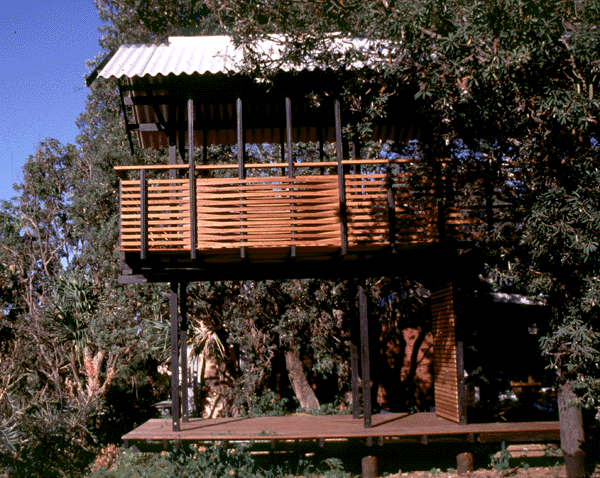
Brit Andresen, Mooloomba House
Brit says that one’s home should be the place where you can most fully be yourself. That is should be a space in postmodernity where you can shed all the obligations of being in the social world, and come home to things that are yielding in some way.
Today, I decided on a different tack. I had another look at Gabriel Poole's lightweight architecture in a beachplace here. We can shift from the beach as place or the architecture as poetic dwelling that opens up a world to the built form as space. A space that is a radical rupture from the dark Victorian houses that are miserable spaces. They're either cold or dank in winter or hot saunas in summer. Our beach shack in Victor Harbor is an improvement: it is your typical brick and tile house that is out of character with the beachscape.
That perspective on Poole's beach architecture is thinking about architecture in terms of its environment.
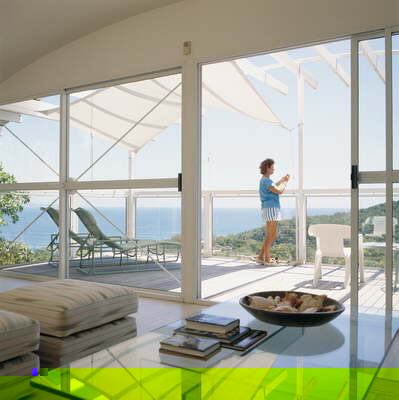
G. Poole, Noble House
Can we not think differently to this kind of poetic dwelling? Could we not think of this beach architecture as an architectural space, and this space as chora or receptacle? Is it not this built form a space of bodily dwelling? A container that shapes our subjectivity and affirms our identity?
We look at these simple built forms nod, make a comment or two about the lightness of the architecture and then move on.
But could we not use these simple architectural forms to think architecturally differently: to break with architecture as technological innovation, or the latest(Tuscany) fashion fad, or the They desperately hold on to the English model of housing for example, and this heavy handed tradition of Federation, or neo-Federation housing moving long the coast, even though it is inappropriate environmentally, climatically and culturally.
Why not think of producing built form differently?
To think differently so as to keep architecture open to its outside. What does that mean. I had a look at an article by post. noted above he says:
"Place for many cultures is about time and history, and maybe cultural forms. Or it can be about family. For us, in a space which is truncated in all these ways (leave your past, leave your family, go to this homogenised southern world) it is about landscape.I reckon two amazing things happened with this. On the one hand this is a landscape which is unique and distinctive, requiring its visitors to develop new ways of being to live in it. And on the other it has been inhabited for a very long time by a culture still in connection to it.
Hence, I reckon our great cultural project is about landscape. How do we live here? How do we share it with the original inhabitants? how does our current appreciation of the place (partly through satellites) combine with perceptual systems learnt from "our" indigenous heritage to explode the western experience of the world..."
How would we introduce the outside that is aboriginality into architecture? Do we have a glimmer of what that would like?
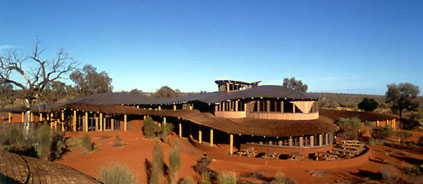
Uluru-Kata Tjuta Cultural Centre
Is that a first step?
Posted by Gary Sauer-Thompson at November 16, 2003 01:01 PM | TrackBack
I think you are asking great questions.
I have a friend who owns shops in Port Elliott, which is a highly distinctive stone village that almost feels like Cornwall (for me). My sister has a unitlike sort of thing at Middleton Beach which was put up by her builder husband in that utter sort of matchbox meccano studwall sort of way. Standardised parts, volumes held apart, no engineering logic to the structure cos all those problems have been solved by stiffness. Until recently, we had a pole house in Wye River, built by a surfing builder for himself as a response to the ocean, the forest, and his own hobbitlike desire for decorated fretwork. The underlying logic was that everything was second hand, and nothing was too big to bring down the mountain roads in a Kombi.
Each of these has a complex and inappropriate internal logic that has nothing to do with landscape, real inhabited space and a movement forward in our collective response to our changing world. (and why should they? they are all cheap, made by people stretching their resources and the design problem - once you realise it - cries out for an architect.. Glenn Murchett etc..)
and you are absolutely right: it could be "a space of bodily dwelling? A container that shapes our subjectivity and affirms our identity? " And that engages with Aboriginality. There's been a few attempts by architects working to Black communities, in Gariwerd, for instance. And Central Australian housing projects wrestle hopelessly with the demands of Aboriginal shelter in the modern context. And the most famous Murchett project is in Arnhem land, for Aboriginal owners.
Federation Square is a fantastic aberration in all this. I love it, but it was conceived a response to the notion of federation, which became about fusing and sedimentation and therefore about the layers under and round the place - and then (I guess because of the British involvement), the form and materials came from the Kimberley. Melbourne, of course, is nothing like this.. and the bluestone obsession we have is worn out and colonial anyway - so it as asking for a rethink.
So this all doesnt take us far. It is getting to ask questions about us in our environment - but that's not quite landscape.
Something to do with being body and experience in a place. Maybe this is the way to formulate the question: if you were building a house at a site in Victor Harbour, what would the brief to the architect be? It might set the terms of reference.
- D
Yes David,
The places you mention --Port Elliot and Middleton along the South Coast of the Fleurieu Peninsula---do have their own local character.So does Goolwa, the river port.
The emphasis by the heritage groups is to protect this historical character and to prevent a Southern Queensland style development from taking over.
It's a big either or that squeeezes the middle ground. The middle ground is the low expense junk of the kit home, or the expensive Tuscany look that could be anywhere. The latter is all the rage in the booming marina development of Hindmarsh Island---booming booming now that the Hindmarsh Bridge has been buiilt.
So there is little concern about developing a regional architecture that expresses the dynamics of this particular place. Hence my turn to Gabriel Poole for some insights.
Posted by: Gary Sauer-Thompson on November 18, 2003 10:43 AMIndeedy. One of the obvious points, of course, is that Gabriel Poole and a few others like Murchett are addressing the problem in very sophisticated ways. And the particular tone of that coast is absolutely NOT either the Gold Coast or Tuscany. In a weird way, its more like something painted by a Flemish Master.
To continue the pleasure of our personal tone - these examples all relate to me in strange historical ways. I had a holiday on Hindmarsh Island when I was a child, where we stayed in an old tram under a vast sky beside bleak waters, and I remember it as hugely melancholy. (partly because this was yet another attempt by my parents to work out their hopeless marriage.)
I remember Goolwa as redolent with despair. I still think its the creepiest town in Australia. When I say this - even when I am driving through it - the other people involved either go "what on earth are you talking about?", or "I know exactly what you mean."
I also found the Tricon Centre via Things. There's a connection there too - I was born in Portsmouth and my family had been there, around the Royal Navy, for generations. I've never seen the Tricon Centre, but the photo you have posted suggests it is actually a response to some spirit of place. It is a brutalised military and industrial town, composed so much of people who ended up there after service in the Navy, or pinned there as their base.
It seems to have gone back, not to the romantic "Master and Commander" grey stone of the Southsea Front and the Hard nearby, but to the inner sense of defence and violence. There's a starkness about it, a sense of texture that is confronting - you can feel it but you don't want to touch it. An intimation of mass and scale, of the individual as small part - exactly what the military does to people.
But of course, clearly, the people in the town didnt want to engage with their built world to express this sense of the place. And why should they? They only ever did it before because it was a necessity. And its clearly not necessary to build the tricon centre like that.
So who gets to decide? and how does that fit with art in its broadest sense as expressing an individual sensibility. Murchett can, Utzon could, the Fed Sq mob probably didnt, and I do know the building process was maddening for both the architects and the end users.
Just to continue this personal rant, I can remember being taken around Fed square as a construction site when i was writing a report on the film industry and the place. We walked into a ground floor studio space to find a huge pillar in the middle - which wasn't even on the plans circulated to the group who would use it. But it obviously held up the building..
Now they want to tear down the Tricon centre, and for me thats emblematic of the collapse of the whole imperial thing, on which Portsmouth as the headquarters of the Royal Navy had been run since the time of Henry the Eighth.
David,
good comments on the Tricon centre and its connection to imperial Britain.I hadn't thought of empire.
Goolwa has changed. It is still a small town near the mouth of the Murray River. But it has become more toursity. It is defining its character as a place for recreational boating. It has an environmentally orientated council that is concerned to protecthe native habitat from development and farmers.
The seachange boom is taking place on Hindmarsh Island rather than along the River. The development is selling a pacakge: you can have your 4 wheel drive parked out the front, your two story Tuscany getaway and your sleeklined white cruiser parked out the marina in the back. Its all glamour, fun and lifestyle.
So I'm not sure what you mean by it being the "creepiest town in Australia." I have always found the bleak spaces around Lake Alexandrina creepy.
You are right. The tone of the coast of the Fleurieu Peninsula is not Gold or Sunshine Coast,Tuscany or California. I'm thinking of setting up a virtual regional gallery attached to junk for code to show the various hsitorical and contemporary representations of the coast
Posted by: Gary Sauer-Thompson on November 20, 2003 07:02 AM