February 02, 2004
Bataille & Cinema
There is a post on the eye in the Dali and Brunel film Un Chien Andalou (1928)over at philosophical conversations. After writing it I went back to what Bataille had written about the film in his text, 'Eye' (reprinted in Visions of Excess)
In the footnotes Bataille writes:
"This film can be distinguished from banal avant-garde productions, with which one might be tempted to confuse it, in that the screenplay predominates. Several very explicit facts appear in successive order, without logical connection it is true, but penetrating so far into horror that spectators are caught up as directly as they are in adventure films. Caught up and even precisely caught by the throat, and without artifice; do these spectators know, in fact, where they-the authors of this film, or people like them-will stop? If Bunuel himself, after the filming of the split-open eye, remained sick for a week . . . how then can one not see to what extent horror becomes fascinating, and how it alone is brutal enough to break everything that stifles?" (Visions p.19)
Bataille judges Un Chien Andalou to be a powerful film because the bodily sensations it evokes in its creator and its spectators breaks what stifles the audience and makes us complacent. The sliced-open eyeball and the fragmentary, illogical cuts of Un Chien Andalou disrupt this complacency by causing felt bodily sensations of fear and disgust in us. The opening scenes of Un Chien Andalou makes us cringe, look away, perhaps even vomit.
The violent disturbance to the ordinary, habitual way of sight. Does that then lead to the pure visionary wonder of childhood-----the romantic's innocent eye---of a Paul Klee?
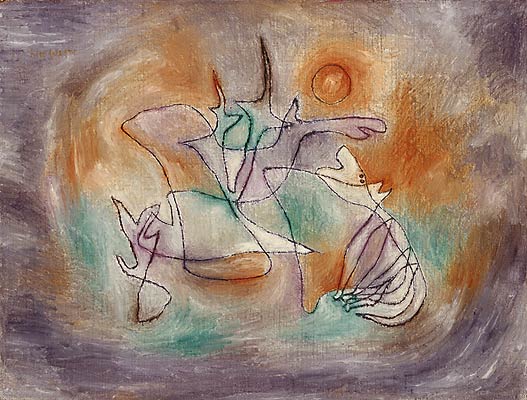
Pau Klee, Howling Dog, 1928
With Bataille we have left the world of the disembodied mind of modern philosophy, and are now in the world of bodily sensations that leads to loss of self.
Can we make use of Bataille idea's to understand cinema?
Some suggestions can be found here and here.
Posted by Gary Sauer-Thompson at February 2, 2004 08:19 PM | TrackBackThat was a bovine eye wasn't it? I must say I find that anything to do with invading or lacerating eyes evokes a visceral response in me...
What about the response John Waters was trying to evoke when he had Divine eat dog faeces? Now that made me feel sick!
I have heard it said that any work of art that can produce that kind of gut reaction in a viewer (either positive or negative) is a "good" work of art (I feel uncomfortable with value judgements and labels like good and bad), whether one finds it aesthetically pleasing or not.
Actually, it was equine. Although I believe Bunuel wanted to use the eye of a human corpse, but was disallowed.
Posted by: Jeremiah on February 3, 2004 01:18 AMThe eye scene inthe film does refer back to Descartes and Kepler personally slicing through the eye of a cow in the name of science.
They were concerned to figure out how the recorded reversed and inverted images on the retina of the eye could be seen by us in their upright and correct order.
This gave rise the active aspect of vision--the probing, penetrating and searching---of the one sovereign eye. This made the beholder the privileged centre of perspectival vision.
Hence we have the reduction of vision to the disembodied gaze---often the male gaze of the female form in painting, photography and cinema.
On the other point, Bataille connects the surrealist tactics of shock to taboos and their transgressions and sovereignty. So it is not shock for shock sake.