April 24, 2004
Critical regionalism in Architecture

Marco Frascari, Drawing table
One of the innovations at the 2004 Adelaide Festival of Arts was the inclusion of Architecture Symposium.
I did not attend. The symposium appeared to be appeared about themes of concern to junk for code; namely regionalism and architecture. The symposium asks the question: How could regional identity be explored in architecture, as it is in food and gastonomy?
Or as it is in regionalism in painting for that matter?
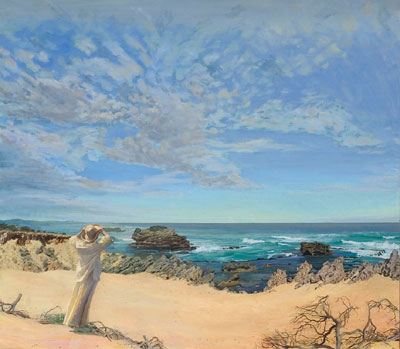
Brian Dunlop, Penelope at the Crags, 2003
There is little regional architecture around Adelaide. Take the southern coast of the Fleurieu Peninsula where the seachange phenomenon is giving rising to a massive boom in new holiday and retirement homes. The homes are project homes that has little connection to the climate or the seaside tradition. It is a housing type that makes no attempt to engage with people, environment or place.
Yet we do have a tradition of a critical regionalism in Australian Architecture. The more the effects of globalization impact on us, and on architecture and town construction, the clearer the critical regionalism becomes as an alternative strategy. This emphasizes and respects the specific quality of a region and its cultural identity.
One way of doing this is to take the pathway to sustainable cities. Billions are spent adding to the network of freeways, tunnels and toll roads to subsidize the developers without a hint of concern about the sustainability of what is being built in suburbia; or the consequences of a car-dependent city. What has been created by the market are classic urban-sprawl, car-based cities in Australia.
In Adelaide the development boom is taking place on the coastal strip of the southern Fleurieu Peninsula, about an hours drive from the city. The transport corridor is car-based---motorways and passing lanes without even a hint for a new southern light rail network. So Adelaide becomes even a more car-based city. Sustainability means dealing with our car dependent cities.
Posted by Gary Sauer-Thompson at April 24, 2004 06:12 PM | TrackBack