November 17, 2004
the picturesque
The explorer's eye was not an innocent eye: it was culturally informed and his vision of the new space of Australia informed by a constructed vision.
An example of the constructed vision was the picturesque. It sees the landscape as a frame for aesthetic appreciation.
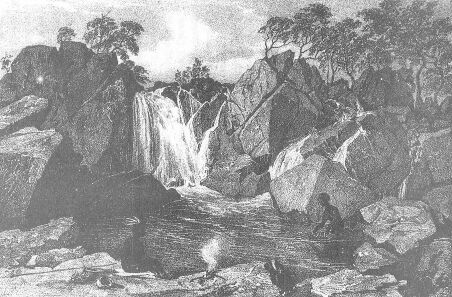
This illustration in Mitchell's explorer journal is constructed within the conventions of the picturesque.
Sir Thomas Mitchell, PLATE 37: Cobaw Waterfall with Natives Fishing, Three Expeditions into the Interior of Eastern Australia, Vol 2
In the picturesque views are seen as being artistic but containing elements of wildness or irregularity, with the picturesque being distinguished from the sublime and beautiful. In colonial Australia the picturesque (often park-like scenery) included the suggestion that the land was adapted to European inhabitation and agriculture--for the sheep runs of the pastoralists.
Aesthetics is aligned with economics.