December 04, 2004
Eureka
Australians yesterday commemorated the 150th anniversary of the Eureka Stockade.
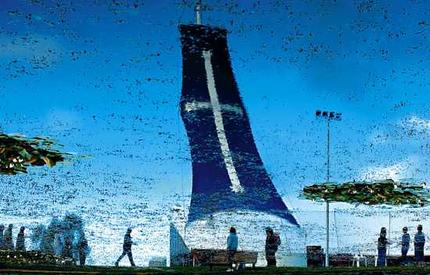
The Southern Cross flies over yesterday's dawn service in Ballarat, Victoria.
According to legend the Southern Cross flag was hand-stitched by women on the goldfields from their petticoats and was raised above the stockade in defiance of the British.
The violence at Eureka goldfield in Victoria, near the city of Ballarat, was the country's first and only armed uprising against colonial tyranny. In 1854 a group of 120 angry miners made a stand against crippling taxes enforced by an over-zealous police force. They built a ramshackle blockade, raised the Southern Cross and confronted red-coated government troops. When the soldiers stormed the camp two days later, they easily overwhelmed the poorly armed rebels. 30 diggers and five police were killed.
Courts in Victoria refused to convict 13 men charged with high treason. Mining licence fees were scrapped, miners were given the vote and the colony soon acquired a democratically elected parliament.
This is a controversial commemoration because the flag has anti-establishment, republican connotations. The Southern Cross did not fly over federal Parliament in Canberra this week, but it could be found in the building. It had a token presence in the foyer of two of the building's four entrances--the Senate and the House. However, the flag was hoisted above every state parliament as part of the celebrations.
The Eureka flag is a political sign. Why not adopt the Eureka flag as our national flag?
The events of Eureka should be restored to its previous position as a central legend of Australian nationalism, the birthplace of Australian democracy, and a reminder of the link between our democratic traditions and Australia becoming a republic.