January 10, 2005
public spaces as mixers of public experience
First this description of the former central market of Les Halles, known as the belly of Paris, by Nicola Ouroussoff in the New York Times:
"The market of Les Halles, housed in Victor Baltard's stunning glass-and-steel pavilions, was one of the great monuments of 19th-century Paris.Packed with humanity, it embodied the modern vision of the city as the great mixer of human experience, a place whose creative energy was derived from its pitch of social friction.
To Parisians, the demolition of the pavilions in the early 1970's was an architectural atrocity, comparable to the mid-1960's demolition of McKim, Mead & White's Beaux Arts-style Pennsylvania Station. The creation of the Forum des Halles on the same spot - a soulless warren of underground shops that has been a favorite haunt of drug dealers - exemplifies the worst of late-20th-century Modernity, with its tabula rasa approach to history and its penchant for sterile inhuman spaces."
There were so many public spaces as mixers of public experience that were destroyed in that way.
Les Halles is undergoing a major renovation.

Rem Koolhaas's proposal for Les Halles,
Its eye catching and poppy work from the OMA. Is it a rennovation of the modern vision of the city as the great mixer of human experience?
That modern vision was right. We do need urban places whose creative energy are derived from its pitch of social friction. Modernism failed to deliver on that promise:
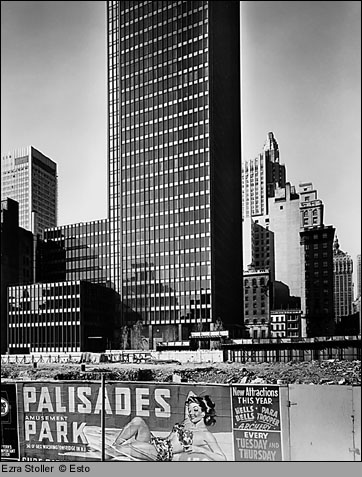
Ezra Stoller Seagram Building, New York NY, Photographed 1958, Mies van der Rohe, Architect
More of Stoller's photographic images of modernism here if you are not convinced. These suggest that modernism became more concerned with the idealization of architectural form, and forgot about creating a city that would enable a great mixing of different human experiences.
Koolhaas is aware of the double condition of runaway development and disciplinary paralysis in our cities.
Posted by Gary Sauer-Thompson at January 10, 2005 08:19 PM | TrackBack