August 04, 2005
spam
 Spam is often defined as any email we don't want and didn't ask for--junk email. But it borders onto intrusive advertising.
The economics of email spam are seductive. It is relatively easy and incredibly cheap for anyone to send out millions of messages to anyone with an email account. Unlike any other form of marketing in history, most of the delivery costs are borne by the recipients: by the Internet-service providers (ISPs) and corporations that maintain our mail servers and then by us.
That is why the flood of junk email offers for low mortgage rates, printer toner cartridges, penile implants, money-laundering deals with wives of deposed African dictators, and much, much more is swelling by 20% each month, according to some ISPs. In the United States and Europe, spam accounts for between 40% and 70% of all email traffic, depending on whom you ask.
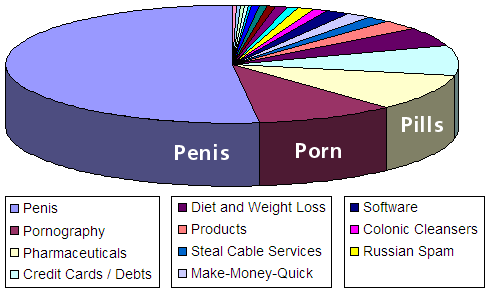
In their attempt to keep spam out of their systems, ISPs and big corporations are also blocking about 15% of all legitimate marketing messages. They use software that filters out messages whose content raises red flags. But spammers can, and do, fool the filters.

Many of the products advertised in spam are fraudulent in nature, such as quack medications and get-rich-quick schemes. Spam is frequently used to advertise scams, such as diploma mills, advance fee fraud, pyramid schemes, stock pump-and-dump schemes, and password phishing and pornography.
I'm just not okay with me having to to pay for the ads of spammers whose work is based on the theft of legitimate email adresses. I see spammers as criminals as they often falsely claim that the message was solicited, or hide their identity, or make unsubstantiated or false claims, and at a minimum commit trespass to chattels.
I cannot see the system changing.