August 29, 2005
Deleuze, Bacon, abstraction
I have just come across some interesting comments by K-Punk on Gilles Deleuze and Francis Bacon, whilst commenting on a philosopher's forum Centre for Research in Modern European Philosophy at Middlesex University earlier this year.
In the Bacon text--Francis Bacon: The Logic of Sensation--Deleuze attempts to construct a logic of sensations from the artist's work. While the idea of figuration in painting has largely been representational Deleuze sees Bacon, (and Cezanne before him) collapsing the Figure into the world of forces, placing it in a new relation to force. Deluze's idea of 'color-force' is an attempt to understand how color can be expressive of force rather than representative.
K-Punk says that in The Logic of Sensation, Deleuze's encounter with Bacon, Bacon is seen to be an artist of abstraction. Bacon isolates figures from their everyday background:
"...before subjecting them to processes of deformation, dissipation, shadowing and smudging so that they end up as abstract streaks. Bacon's abstraction is a kind of middle way between pure abstraction, which buries the creative spark in geometric formalism, and abstract expressionism, which surrenders form to chaos."
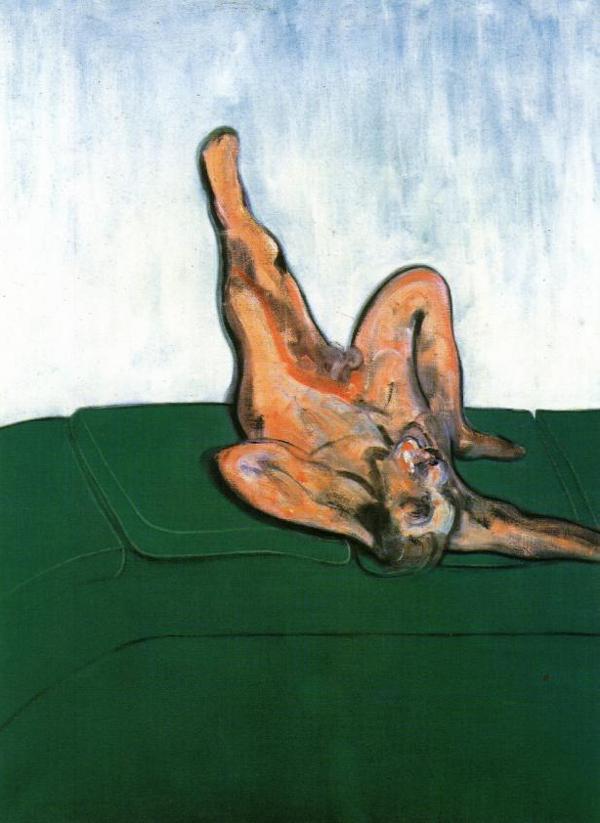
Francis Bacon, Reclining Figure, 1959
On could argue that the increasing prominence of a cosmopolitanized, professionalized abstract art in the 1960s was the art of an emerging class, a new cultural bourgeoisie in industrial Fordist capitalism. It was opposed by the cultural conservatives (the art historian Kenneth Clarke) who deployed a 'humanistic' vocabulary of aesthetic grandeur and figuration.
K-punk usefully describes this process of abstraction by linking it back to Wilhelm Worringer in 'Abstraction and Empathy' and 'Form in Gothic':
The earliest art, Worringer maintained, was an attempt to subdue the forces of chaotic Nature with rectilinear forms. As humanity becomes more settled, it develops an 'organic' representational art which centres on the human figure. The Gothic line interrupts this representational repose with an unsettling new form of abstraction, which is neither purely mechanical as in primitive abstraction nor organic as in Greek and Roman representationalism: this barbaric line is uncanny, zigzagging; a 'vitalized geometry'. For Deleuze, is in this line, and in the germinal pulse that animates it, that we are to locate those figures that arouse horror in us through their occupation of an interzone between life and death, animate and inanimate. Nonorganic Life is the throbbing energy formation Deleuze follows through nomad art, Gothic cathedrals, German expressionist cinema and Bacon.
This strikes me as being on the money, even though I'm not yet sure how it connects with Deluze's argument that sensation as the primary modality of art.
Posted by Gary Sauer-Thompson at August 29, 2005 07:45 PM | TrackBack