« April 2004 | Main | June 2004 »
May 31, 2004
Iraq: exit strategy
The US neo-con language of democratization and development situates America as the humanitarian liberators of the Arabs from the authoritarian oppression of Saddam Hussein and other dictators in the Middle East. Iraq would be the beacon light of democracy and reason, which would spread across the Arab world.
This is part of the neo-con's broader regional strategy to ensure regime change in Syria and Iran. Currently the US is endeavouring to squeeze Syria economically and isolate it politically in order to force Syria to changes its ways: to force Syrian troops out of Lebanon, abandon the pursuit of weapons of mass destruction, stop supporting terrorism and stop supporting the Palestinians. Syria is defined as the problem in the region and regime change means overthrowing the government of President Bashar Al Assad. Syria is held to be a "terrorist state" run by an "irrational" and fascist regime.
It is probably about time that the broad regional strategy of the US in the Midlde East is questioned.
At the moment the democratic liberal language of the US is being deployed as part of a broader, concerted strategy to turn Iraq into a dependent and docile American client. At the moment the paternalistic role is being played by the provisional Coalition Provisional Authority (CPA), in which the US props up and trusts the exiles, but exercises control over Iraq through the instruments of budgets and security.
This can be seen as a continuation of the history of the colonial administrators of the inter-war French and British Mandates exerting a tremendous amount of power over Iraqi institutions and agencies.

It is said that this kind of neo-colonial occupation will change on June 30th, with the handover of sovereignty. I cannot see how the on-the-ground situation after-June 30 is likely to be better than the situation on the ground pre-June 30--– do you?
It does look as if the exit strategy is a continuation of the modern form of colonialism? This kind of exit strategy would mean that the Iraqis are given sovereignty over their oil resources as long as that sovereignty does not interfere in the American strategic access to those resources. The limitation of Iraqi sovereignty----quasi-colonial regime with little domestic legitimacy---- would mean that any Iraqi leader who cooperates will again be viewed as a servant of American strategic interests. This kind of political authority does not look a promising way to deal with the ethic regions of a quasi-independent-Kurdish state, a Sunni Triangle dominated by ex-Baathist generals and a Shi’ite south coming under Iranian influence and control.
So the liberalism promised to Iraqi's by the US has an alternative face of neo-colonialism, political instability, social and cultural dislocations and economic hardship. The situation is bad. The modern face of western colonialism will lead to the further radicalization of Iraqi society. This Iraqi insurgency will increasingly acquire an explicitly Islamist character, not to an increasing secular society. It is already accelerating recruitment to the ranks of Osama bin Laden's terrorist network.
'Tis time for Australia to face the political realities. That means dumping the neo-con illusions wrapped around Centcom's Operation Iraqi Freedom that have been accepted by the Howard Government. A searching account of the connection between political realities and failure for the US is given by Billmon over at Whiskey Bar. I've relied on some of that excellent material and links for this post.
Posted by Gary Sauer-Thompson at 9:52 AM | Comments (16) | TrackBack
May 30, 2004
Labor Dreaming
The tide keeps flowing out on the Howard Government. Some are carried away:

Rowe
True, it now looks possible that the Howard Government can be defeated. The budget bounce was not achieved as was expected. (A delayed bounce?) We even have a pollster showing the results for a 2%, 4% and 6% swing to the ALP. It's 1996 in reverse says Hillary Bray. Why, you can even hear the death rattle says Crikey. Laura Tingle in the Australian Financial Review says that the "government doesn't just fear it is going to lose the election, it knows it."
I do not buy this story. It's mostly Labor spin, wishfulfillment and lazy journalism. What we have is a contest. My guess, that it would still be very tight in the marginal seats, is confirmed by private Liberal and Labour polling. The marginals are all that matters. We have little information about what is happening there. The marginals are quite different in character.
For instance, in Adelaide the conservative lower to middleclass electorate of Makin with its northern biblebelt is very very different to the innercity seat of Adelaide, where many gay couples live. Hence they require different policies on different issues, which is why Trish Worth has broken with Howard's conservate understanding of marriage and his attempts to ban same-sex marriages. Since Trish Worth could well lose her seat she had to protest.
In the political chessgame being played, the recent move is the postponement of the pencilled-in election date of August 7th (pushed to October?). With the bad image of Iraq now really hurting the Howard Government's soft underbelly, it will be forced to spend some of the $2.4 billion left in its war chest to gain some traction. It has to paint itself green to look more progressive and to tactically counter "Latham's" energy and environment speech late last week to secure the much-needed Green preferences and establish a left wedge.
So we can expect more leaks on the money Howard will spend on the environment to stop the drift. Howard has singled out the environment as a maintstream issue in Australian politics. He knows that he needs to sort out the vexed issues of environmental flows; water rights; compensation for reduction in the clawback of the overallocation of water (especially in NSW); and finding a truckload of money to pay for it all. And he confronts a constituency of famers (e.g., Murray Irrigation Ltd) who refuse to take responsibility for any risk for any reductions in water allocations in the future.
And the ALP? What I saw last week in the House of Representatives was a tightening up on the front bench. A visible shrinking. They are instinctively doing their small target routine once again. Latham's speech did not talk about the money ($1.5-2 billion) for the 1500 gigalitres needed to restore the Murray-Darling Basin to reasonable ecological health. The ALP right still reckon that green policies represent a disaster for the economy, mean lost jobs and send a bad message to business. It has yet to adopt a policy of stopping the logging of old growth native forests and compensating/retraining those put out of work. The ALP plan to phase out the clear felling of old-growth forests by 2010 won't please Bob Brown. The forests will have gone by 2010.
From what I saw last week nothing much is happening in Canberra. Where were the searching questions on Mitsubishi? On renewable energy? The ALP reckon that with the Howard Government in freefall they can win the election, if they just hang on, stay together and talk in unison from the same script.
Bollocks. Maybe Howard never had a plan B for the post-budget politics in his draw. But there are many tactical moves in the political chess game still to play.
Posted by Gary Sauer-Thompson at 10:13 AM | Comments (4) | TrackBack
May 29, 2004
Rann Government Budget
The SA state budget was handed down on Thursday night by the neo-liberal Treasurer Kevin Foley. There is a resounding silence amongst Adelaide bloggers. Adelaide Pundit is on holiday. So is Jocknessmonster. And Scott Wickstein shows little interest. It appears that Dogfightatbankstown is in hibernation. It looks like it is up to me to carry the can.
Foley's budget was fairly predictable affair, given the track record of this government.
A budget surplus and tight money management to win the favour of the money markets and gain the much-sought AAA credit rating. There was a bit of spending on health and money to protect for children at risk, so as to remind the electorate that the Rann Government was a Labor Government
Not too much spending mind you. That would upset the market. Just enough to cover its tracks. So the social compassion did not extend to education, which was downplayed yet again. As was affordable public housing.
The environment was forgotten, in spite of the talk from thinkers in residence about the SA economy needing to make the shift to sustainability. In spite of the Rann Government's commitment to sustainability in its strategic plan the environment was not considered to be a Labor priority in Foley's Budget speech.
These guys are really mean. In spite of the proceeds from the GST rolling in, and the Government flush with stamp duty from the housing boom, they continue to increase government charges. They should be reducing these state taxes now that the GST is flowing SA's way. The only one that could be justified was increasing the cost of water.
All Kevin Foley could talk about in the post budget sell was the return of that AAA credit rating by posting higher and higher surpluses, reducing the State's long-term debt, and ever more disciplined, good financial management and fiscal rectitude. Does that mean tax cuts next year when an election is due? Does it mean further reductions for business?
It sure does not mean sustainability. I notice that SA Water remains a taxiing mechanism for the Government and Treasurer Kevin Foley. The Government requires SA Water to pay more and more money in the form of higher dividends into Treasury coffers. So would appear that the move to lift water charges as a way of conserving water supplies is merely an effective rise in the water tax for consumers in the Adelaide area. The increased water tax is sold as conserving water.
It is a sell job because nothing from the tax is being put back into the environment: eg., to acquire water to increase environmental flows for the River Murray. Nope, SA water is out there in the regions selling more and more River Murray water to increase its profits to help pay the dividend to the Treasury coffers. The political decision to continue this business-as-usual shows the lack of commitment to a sustainable SA. It's mostly talk to manage the image in the media.
The image management is also undercut by the $11.4m for the venture capital fund to facilitate emerging industries such as biotechnology and renewable energy. It's a joke in terms of stimulating a new high tech economy.
Posted by Gary Sauer-Thompson at 1:35 PM | Comments (0) | TrackBack
May 28, 2004
Iraq: media and democracy
Apart from the conflict between the Defence and the State Department I don't really know the ins and outs of Washington and I have no idea of the current state of infighting. I have no idea who is to trying to pin the blame on whom, or what caused the downfall of Ahmad Chalabi, not so long ago the administration’s hero-darling-in-exile.
Nor do I have much idea of the role played by Israel and Iran in Iraq. I have only a vague sense of the effects of Iraq on domestic American politics and know next to nothing about the effects on the inter-ethnic and inter-religious relations in across the wide arc of nation-states in the Arab world:----Israel, Turkey, Iran, Afghanistan and Pakistan
My concerns are more humble. As we all know The Australian was, and is pro the war with Iraq. It's editorials and copy made the case for overthrowing Saddam Hussein, often in the face of strong anti-war feelings in their countries. It's editorials lent credibility and moral support to the White House's claims that the U.S.-led war had international backing and to John Howard's support for, and involvement in, the imperial presidency's war.
The Australian was not a watchdog for democracy. It was one of the Dogs of War, as it played the role of “threat inflator” big time; a role that had its roots in the cold war era.
Now that the case for war has unravelled, the imperial Presidency has badly mismanaged the occupation and there is civil war in Iraq, will The Australian acknowledge its role in deception? That it had spun madly to persuade Australians citizens that Iraq had weapons of mass destruction, or that Iraq had extensive links to Al Qaeda. Will it acknowledge that it spun the false claim that Iraq posed a substantive threat to Australia as the pretext needed to invade, conquer and occupy Iraq? The crude security arguments were used to justify the need for pre-emption and national missile defences.
Sorry, the national missile defence scheme was to protect us from a drought- ravaged North Korea raining nuclear missles down on our cities, wasn't it.
Will The Australian acknowledge that this, and the attacks on the critics as appeasers, was an example of bad journalism. That its editors and journalists routinely skewed information in an on-going and effort to swing Australian public opinion in favour of the war and the Bush Administration? That it advocated Australia blindly trail along with the US repulsing any critical thoughts about being a deputy sheriff in the Asia Pacific region as unAmerican.
As the fires of war burn in Iraq The Australian'sstance becomes a touch critical. The reality is that in the overall war on radical Islamic terrorism Iraq represents failure with a capital F. The reality is that the US is bogged down with insurgencies that its forces can barely contain, let alone permanently defeat. I know that The Australian will not acknowledge that it got it badly wrong on Iraq.
Posted by Gary Sauer-Thompson at 8:42 AM | Comments (2) | TrackBack
May 27, 2004
Iraq: fogging the distinctions
Despite a big speech recently the imperial presidency is not travelling well:

Tandberg
It is becoming harder and harder for Bush to make the case that the war in Iraq has made America safer.
It is easy to understand why the imperial presidency is not travellling well after the Abu Ghraib photos. Even Newsweek has become critical of the few bad apples rhetoric from the White House. It recognized that fear and humiliation were used to break prisoners' resistance to interrogation, that the army privates had been taught the techniques of torture, and that Defense Secretary Rumsfeld and Attorney General John Ashcroft had signed off on a secret system of detention and interrogation that opened the door to such methods.
The rhetoric of the imperial presidency does not match the reality. For instance, the rhetoric of handing over sovereignty to Iraq does not mean that Iraq becomes a democracy, or that it have free elections, or that the new Irag government tells the Americans to go. Sovereignty does not mean the Iraqi people are free as a nation to decide their own fate. No way.
It means something different. It means a client regime. And Australia will go along talking the fog to blur the distinction between occupation and sovereignty. It accepts the scenario of the client regime that acts in US interests to help the US exert its hegemony over the Persian Gulf region through military control. That hegemony needs to defend the dependency of the industrialised world on Gulf oil.
There will be lots of fog on this, just like there has been on the use of terror in the Abu Ghraib prison. Australia knew. It kept quiet and denied all responsibility. We knew nothing and had no involvement. The reality was otherwise. Is the public emotion one of shame at Australia's complicity and denial?
So Iraq is starting to hurt John Howard and his government's standing in the electorate is begining to slide. This slide is more noticeable with Bush and Blair. Their publics are souring on the war and its prosecution. The defence of it begins to look like a circling of the wagons.
Update
I missed listening to the House of Representatives yesterday as I was on the road. Looking at the newspapers this morning I detect the signs of desperation in the ranks of the Government about those photos. Howard thundered away about there being
"...absolutely no suggestion whatsoever that Australian soldiers or other military personnel serving in or around Iraq have been involved in any way in the abuse of Iraqi prisoners which we have seen portrayed in the media. Defence has publicly stated that no Australian Defence Force member witnessed any mistreatment of detainees".
Nobody is saying that. The complicity is not about involvement in, or witnessing the torture. It is about the Government being told about it, staying silent, and going along with the practice.
Posted by Gary Sauer-Thompson at 10:01 AM | Comments (2) | TrackBack
May 26, 2004
Gangland: It's also the police
It is a bit like another month another killing in Melbourne. It's ever more images of more funerals with guys in dark glasses hanging around looking tough. Adelaide may have its Snowtown murders, but Melbourne is gangland. It is impossible not to notice the images of guys in suits with dark glasses staring stoney faced at the observing television cameras. The images say gangland.
The shootings are sold as gangland killing--- the gangland drug lords taking one another out ---in the media headlines. Is it a payback war between rival crime families, which has been in full swing in the streets of Melbourne. Or is just rival gangs fighting for dominance of the drug market?
The media bylines often refer to police corruption. The police are in bed with the crooks caught up in a turf war over drugs, and they have become part of an underworld tussle for power and ascendancy. The police are running drugs. And the state government is not all that interested in catching their cops.
Surely public confidence in the police and Victoria's justice system has been seriously shaken as the result of the corruption of the disbanded drug squad? So why not an independent inquiry?
Well, in Victoria the police investigate themselves and the endemic corruption in the police force with limited resources. The police investigating their own is the way the Bracks government likes it. It's government policy.
Why so? Well, The Victorians assume they have the best and cleanest police force seems to be the justification. They deny the links between "rotten cops and organised crime" The media is attacked for suggesting otherwise. The myths live on.
Yet the image created from watching media reports is that the Victorian police force is not a bunch of cleanskins:
"Melbourne's intertwined worlds of gangland drug lords and corrupt police are spiralling out of control. Police investigating their own kind have been threatened with engraved bullets and had their families followed and intimidated. One investigator, Simon Illingworth, resorted to ABC television to tell his story of bashing, threats and intimidation by his fellow police officers."
In Melbourne, it would appear that there is an entrenched system of corruption that ruthlessly protects itself. As Tony Fitzgerald, author of the Fitzgerald Report into Queensland police corruption in the 1980s, said: "The unwritten police code is an integral element of police culture . . . (it) requires that police not enforce the law against other police, nor co-operate in any attempt to do so, and perhaps even to obstruct any attempt." Entrenched or endemic corruption is often associated with legal and political corruption and/or protection.
Mark Le Grande says it is better time to establish an independent inquiry in the form of standing royal commission rather than a bureaucratic body (crime or corruption commissions) that is a downstream agencies. The latter is controlled by a government minister and "staffed by public servants who are subservient to ministers and whose careers do not prosper if they make robust decisions or take robust action to overcome bureaucratic or political intransigence."
Posted by Gary Sauer-Thompson at 8:14 PM | Comments (2) | TrackBack
May 25, 2004
Water and urban life
I attended a public lecture on the significance of water for Adelaide's future as a city last night. It was given by Professor Peter Cullen in the Adelaide Town Hall as part of the thinkers in residence programme. An earlier talk by Cullen can be found here.
The public lecture was a stellar event. The town hall was packed. All the important movers and shakers in public policy were there. The nation is facing a water crisis where demand oustrips supply. But we gathered together in Adelaide to hear the assumptions underpining our taken-for-granted way of life being challenged. The basic assumption in Adelaide is that you can protect the river's health and continue to take the water that you need from the river whilst pointing the the finger of blame upstream. You still hear water dreaming about towing icebergs from Antarctica to solve Adelaide's water problems.
Cullen's talk was entitled 'Making Waves - water challenges for Adelaide in the 21st Century'. It outlined how South Australians need to create a sustainable environment in which our scarce water resources are respected and managed. He argued that Adelaide cannot rely on the River Murray as a lifeline anymore. It must start to think in an innovative way, rather than just assume that increased economic growth will continue to underpinned by the ecological health of the river country. All that needs to happen if for the eastern states to sort out their conflicts.
The city cannot assume this because Adelaide is going to face a water squeeze in the next 50 years. The water may not be there, and if it is, the water may well be too salty to be drinkable or usable. Adelaide, however, was not facing up this. Economics ruled, not ecology. The urban culture was very complacent about continuing to assume that the River Murray would continue to act as the city's ecological life support system. So world's best practice in water management is needed to deal with the water squeeze.
Adelaide has to work out how to live sustainably in a dry country by protecting the sources of water, manage the reduction in demand and find alternative sources of water. Doing this will mean that Adelaide will need to become innovative and clever.
So it is not just the wasteful upstream rice growers taking too much water as South Australians point out. South Australia needs to get its own house in order and claw back water from its own irrigators. It also has to start doing something about the wastage of River Murray water by Adelaide urban users who are currenly pouring 50% of that water on the water-guzzling European gardens. Why aren't they using recycled storm and water for their English gardens?
Posted by Gary Sauer-Thompson at 11:58 PM | Comments (6) | TrackBack
May 24, 2004
Israel: a few thoughts
Ariel Sharon's original disengagement plan included the evacuation of the "Philadelphi Axis", the narrow buffer zone on the southern edge of Gaza, which cuts Gaza off from Egypt. (the link is a map). It involved evacuating all the settlements in the Gaza Strip along with their 7,500 inhabitants.
This disengagement plan meant that Sharon did not consider that the occupation of this territory was necessary for the security of the Israeli nation state. What is the strategic value of preserving 21 tiny Gaza enclaves with 7500 settlers ringed by 1.3 million Palestinians and prone to attack.?Presumably, the reasoning is that the Gaza Strip is a military and demographic burden, and the quicker Israel gets out of it, the better. That means the end of occupation of the Gaza strip.
Instead we have the Gaza paradox: the Israeli army moves in so it can pull out. This appears to be Sharon's way of doing things.
The common interpretation of what is going on in Israel appears to be that "the right won the elections and the Likud referendum, but the left is winning in public opinion”; that Israel will eventually leave the territories and that a Palestinian state is already a foregone conclusion.
Three thoughts.
Why return to the Philadelphi Axis? Why widen this buffer zone? The official purpose for destroying parts of Rafah is to destroy the tunnels under the Philadelphi Axis. The rational is that house demolitions in Rafah are necessary to prevent increasingly sophisticated weapons from being smuggled in under the border from Egypt.
Yet the tunnels have been there for years and, no doubt, new ones will be rebuilt. The episode indicates that the regular Israeli army is faced with opposition from guerilla fighters supported by a desperate population. That implies the military option is not the only way of dealing with the situation or working to isolate Yasser Arafat and his organization to highlight the way they have acted with such callous disregard for the interests of the Palestinian people.
From the perspective of the Palestinians, the building of the security wall by Israel can be seen as a form of concentration and encirclement. It is an ironic policy, given the experience of Israel Jews in the European ghettos. Moreover, the ongoing investment in the settlements signifies an occupation regime based on a continual movement to the other side of the line of the State of Israel. The massive investments in the territories create a new demographic reality that strengthens the occupation regime.
If Sharon is serious about his proposal to undertake a wide withdrawal from Gaza, then the military wasteland way of doing it will help to ensure the final erosion of the PA's "authority" in Gaza. This would result in the emergence there of an Islamist-led administration If so, then would not Sharon be justified in being able to hit it hard as part of the war on terror?
Update
It is disappointing that Australia/Israeli & Jewish Affairs Council (AIJAC) is not more critical of Sharon and the Likud Right. Within Australia the Council appears to be so obssessed with the leftish critics of Israel that it cannot acknowledge the realities of occupation regime, or the 37 years of full occupation. Only Palestinians should acknolwedge realities. Nor does the AIJAC question the way that Israel's national security state continually undermines Israel's democratic ethos.
The latest example of this is the arrest of the British journalist Peter Hounam, holding him in a "dungeon with excrement on the walls" , limited to "two hours of sleep", and questioned for more than four hours by Israeli security, without being charged. Hounam said he was detained on suspicion of espionage and threatened with deportation.
May 31
Mordecai Vanunu, who took the wraps off Israel's secret nuclear arsenal, has spoken out publicly about his abduction and 11 years in solitary confinement. What real damage to state security does he represent now? Yet restrictions are imposed on Vanunu in the form of a ban against "maintaining connections or exchanging information in any way with foreign citizens". Security overides democratic freedom.
Posted by Gary Sauer-Thompson at 11:56 PM | Comments (35) | TrackBack
May 23, 2004
so much wasted blood
An Arab representation of the Palestinian/Israeli conflict, the latest episode of which has been called Operation Rainbow by the Israeli military. Even some in the Israeli Government are saying the military operation targets civilians and homes.
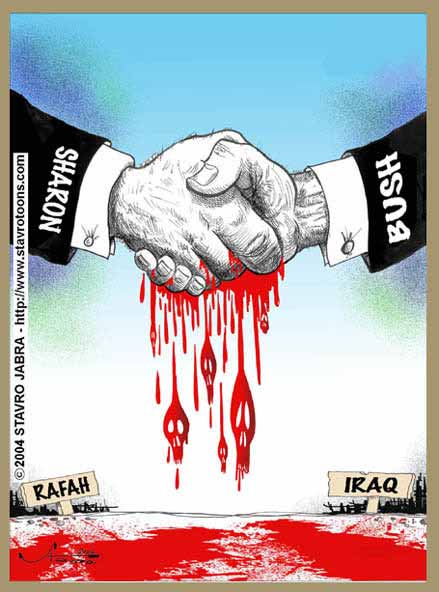
The deal struck between Bush and Sharon was for a unilateral withdrawal from the whole Gaza Strip and the evacuation of the settlements there.
An account by someone who was in Rafah. And another. Some photos.
Some Israeli's are saying that the nature of the war has changed:
"There are increasing indications that the war and its strategic conduct have been changed, despite the fact that the usual clichés about the war on terrorism and about the need to accept compromises and withdrawals are still being heard throughout. While we cannot deny that a justified war against terrorism is still going on, the main focus of the war is now upon the Palestinian population, which causes the destruction of the little infrastructure that still exists, and the prevention of the availability of basic necessities for the population to exist upon. As such, the war has ceased to be a legitimate one."
Ariel Sharon is backtracking on his deal with Bush to please the Israeli right. Sharon is in trouble. He may have a government, but he doesn't have a party.
Posted by Gary Sauer-Thompson at 10:20 PM | Comments (12) | TrackBack
May 22, 2004
Mitsubishi: writing is on the wall
Mitsubishi Motors states that it will use a $5.7 billion package to expand its Asian operations rebuild its market in the US and repair its brand in the Japanese market. It plans to slash its global workforce by 30%, reduce production capacity by 17% and trim debt by 40%. This is a company in big trouble. As part of the restructuring the Lonsdale engine plant in Adelaide is to close.
Yesterday's editorial in The Australian on the winddown of Mitsubishi's manufacturing plants in Adelaide was pretty harsh. It said:
"The Howard Government must hang tough and promise no more public money for Mitsubishi. As reported in The Australian yesterday, the Government is considering more assistance if the crippled car company decides to shut its Adelaide plants...Mitsubishi has received about $300 million in loans and grants from the state and federal governments in recent years. To empty another bucket of public money over its 3,500 workers would be an act of highway robbery against every other Australian taxpayer. And it would not even secure the workers their jobs."
Now there is little point in the state or federal government propping up a run-down Londsdale engine plant that has declining orders. It may well be the case that Mitsubishi has no long-term future as a manufacturer in Australia, even though a further $600million will be invested in Tonsley Park assembly plant for the launch of the new model Magna next year. Mitsubishi may well pull out by 2011 at the end of what was considered the viable lifespan for the new Magna.
But should not something be down about the workers of the Lonsdale engine plant to prevent them from being thrown onto the industrial scrapheap? The Australian did not think so. It says that:
"If Mitsubishi does decide to close the Adelaide plants, it will not be the fault of the workers. They will be the victims of the company's global bad business plan...Certainly the loss of the Mitsubishi plants would be a cruel blow to the workers, plus people in companies that supply components. Estimates of the flow-on effect put total job losses at anything from 8,000 to 20,000. But whatever the number, it would not be the end for South Australia. A survey of the state's exporters this week found that about two-thirds expect orders and staff numbers to increase in the coming year."
That is true. But would the displaced workers be able to pick up those jobs without extensive retraining? The Australian is not interested. The editorial ends by saying:
"Nor does it matter if Australia loses the weakest of its four car manufacturers. In the globalised car industry, using taxpayers' dollars to keep a dying company alive will never succeed. The Howard Government should let nature take its course and leave Mitsubishi to live, or die, as its own strength dictates."
The workers have to make their own way in the marketplace. Too bad if they cannot pay their mortgages or do not have the appropriate skills to find a new job. That is their problem.
The Howard Government thought otherwise. It announced a federal government injection of $50million to help the sacked workers and create new industry jobs in South Australia. The $50 million is for structural adjustment and job creation in South Australia.Of the $50million, $10million is set aside for job training, while the rest is to help attract new manufacturing investment to Adelaide's southern suburbs.
Nick Minchin said it was a good news day. What needs to be said is that keeping the Lonsdale assembly plant open is a stay of execution. Exports have been part of the rationale for keeping the plant alive, but export line has been canned. And the company still has to make a decision on the regional R&D project in Adelaide. Since Mitsubishi's next Magna now relies heavily on a diminishing band of Australian buyers prepared to buy a tainted product, I cannot see Mitsubishi Australia making a buck from here. The writing is on the wall.
South Australia needs a new industry policy. One that will lead to a growing and diverse manufacturing sector based around research and development. Why not start with renewable energies?
Posted by Gary Sauer-Thompson at 10:56 AM | Comments (7) | TrackBack
May 21, 2004
a political celebration
1200 of the faithful came to celebrate John Howard's 30 years in political life. Does Howard dream of emulating Robert Menzies, his political hero?
While others simply puked those at the party did a lot of genial backslapping about Howard who was sold to us as a good, strong man who got results for Australia. The more thoughtful of the backslappers are waiting for the budget bounce: for the Coalition's primary vote to recover within a few weeks of the giveaway budget. One presumes that they reckon political attitudes will shift when the first of the $4 billion family payments start to arrive in voters' bank accounts.
The anniversary dinner was a fundraiser for the Liberal Party's NSW branch, a bonding of the Liberal family and a simulated spectacle with talkback jock Alan Jones acting as MC.

Bill Leak
It was more than a celebration. It was also a campaign launch on the theme of Protecting, Securing, Building Australia's Future (from the Other.)
The media continued to speculate about leadership tensions and ignored the Liberal fables of unity and history. They reminded us of Enoch Powell's quip that "All political careers end in failure."
It started out well for them. It was a new conservative dawn in 1996 when Howard swept Paul Keating's tired ALP aside in a landslide. Since then we citizens have been offered private affluence and public squalor. Many silently accepted the deal---wealth creation, free markets and a close alliance with the US --- so that we can be relaxed and comfortable.
But things on the national security front have turned after the initial successes of Tampa and the Iraq war. In terms of foreign policy John Howard, like Tony Blair, is being portrayed as an American stooge. The bottom line is 'with the Americans either right or wrong' as Iraq sinks into unmitigated disaster. Blair walks into a political wasteland. Howard is still travelling okay.
However, Howard is becoming to be seen as a politician who uses spin, disinformation, constructive ambiguity, and news management to cover his deceptions. The late reasons given for going to war with Iraq basically said that Howard and Bush works for democracy, freedom and peace. But recent events there show they work for war. The conflict with Muqtada al-Sadr is making the US-led Coalition look like an oppressive occupier in Iraq. Howard appears to be in denial about the political consequences spreading around the world from a war gone horribly wrong.
Remind me. Which group is the US fighting to liberate? Surely not the Sunnis after Fallujah. Not the Shiites given US encroachments on Shiite holy sites. Not the Marsh Arabs. Of course the US military continues to maintain that the resistance is almost entirely manned and organized by outside fighters. Nobody outside the US military believe this. The evidence indicates homegrown anti-occupation revolts. So which group is the US fighting for to bring them democracy? The neo-con dream of democracy in the Middle East looks more like turning into a brutal occupation.
Posted by Gary Sauer-Thompson at 4:46 PM | Comments (3) | TrackBack
May 20, 2004
Free trade: PBS undermined
The Free Trade Agreement with the United States is back on the agenda. Well, it had never gone away, just slipped into the background. With the FTA having been signed in Washington with all that fanfare, it needs to be ratified by the US Congress and the Australian Senate. The House of Representatives Joint Parliamentary Committee on Treaties is due to report on June 23, whilst the Senate Select Committee is due to issue an interim report on June 21.
In Australia the free traders have trimmed their sails somewhat. They have become more far more realistic. An editorial in today's Australian Financial Review (subscription required, p. 70) says that:
"The pact is far from being a perfect deal. But in the real world the least-worst outcome is often the best available. On balance, the AUSFTA, as it is known, will provide better access for Australian exporters of goods and serivces boost two-way investment and raise Australia's profile in the world's largest economy. This is not to be sneezed at. "
The AFR's argument is that with multilateralism trade deals stuck, Australia should pursue any meaningful offer. That is what the Howard Government is doing. Resisting the FTA is political opportunism. THE AFR is silent about the Howard Government buying off the sugar farmers.
And Australian consumers? Will they benefit from the greater access to Australian markets for US firms? Or is it an deal for US industry?
This warning, which says that the free trade agreement with the United States would lead to Australians paying 30 per cent more for prescription drugs, keeps on surfacing. This time round the warning is sounded in the US. Kevin Outterson, a law professor at the University of West Virginia and an expert on international drug pricing, says Americans currently pay about one-third to 50 per cent more for leading prescription drugs than Australians.
Prof Outterson says that for a 30 day supply of the cholesterol-reducing drug Lipitor (30mg), Australians pay about $US42.92. Americans, for the same quantity, are charged about $US94.57. For 30 200mg capsules of the pain reliever Celebrex, Australians pay $US24.97, while in the US it costs $US76.09.
Prof Outterson then said that:
"Australia has lower prices and a more functional and complete system than anyone else and that's exactly why the drug companies want to shut it down, because it is such an outstanding model. The FTA is designed to gum up the works on a very efficient, thoughtful system, that many of us wish we could import into the US."
This scenario of higher prices for Australian medicines keeps on being denied by the Howard Government. It says that the FTA will not have the effect of increasing drug prices and it will not contribute to the long-term financial sustainability pressures on the Pharmaceutical Benefits Scheme.
Kenneth Davidson asks the right question:
"Who to believe? Have the US drug companies who have driven this aspect of the free trade agreement been wasting their time, or does the Howard Government have an agenda that is aimed at looking after the interests of US drug companies rather than the interests of Australian citizens?"
The issues is whether the intellectual property rights of the US drug companies are given priority over the protection of public health. Will the PBS be undermined?
The ALP says that this is a key issue; a deal breaking issue. Stephen Conroy, the Shadow Minister for Trade, says that the ALP's position is that it will vote the FTA down if it undermines the PBS.
Australian academics confirm the warning of Prof Outterson. They say that the full effect of the FTA on the pharmaceutical market is unlikely to be felt for about five years. The effect? They say:
"We estimate, very conservatively, that Australia’s PBS will have to pay at least one third more for its drugs with the FTA than without it. If the likely FTA effects are applied to 2003 figures, the extra cost to of the PBS to the government last year would have been around $1.5 billion for the same drugs at the same levels of use and with no increase in the health benefit to Australian patients. Similar pressures would be felt by other buyers of prescription pharmaceuticals, particularly hospitals."
Seems pretty clear doesn't it. Australian consumers will pay more for new drugs under the PBS in order to enable the US drug companies to make more profits.
Posted by Gary Sauer-Thompson at 11:49 PM | Comments (1) | TrackBack
May 19, 2004
Gaza: blood flows like in Lebanon
This news about Israel bulldozing 100 houses, with roads, sewers, water mains and farmland being destroyed in Rafah, stands in marked contrast to the Sharon plan to withdraw from the Gaza strip.
Gaza is being painted with the red colors of Lebanon. The terrorist attacks--ie., those targeting civilians-- are by both sides.
And the Israeli high court has rejected a petition from residents and endorsed the policy of bulldozing Palestinian homes without warning and without giving residents a chance to remove belongings.
In the light of this the question should be posed. What reason does Israel have to be in the Gaza strip?
As this op-ed in Maariv International makes clear:
"The IDF is there in order to protect the Jewish settlements within the strip, which occupy approximately one-third of the strip’s area but house a population equal to 0.5% of its Arab population, and the routes to those settlements. In other words, the Gaza Strip is not a security zone for the defense of Israel."
Are these settlements buffering vulnerable frontiers?
Is not the destruction in Rafah the action of an occupying power? The land on which the homes to be destroyed are occupied by Israel in violation of dozens U.N. Security Council resolutions demanding the Jewish state to withdraw and turn these lands back to the Palestinians.
Israel's action is justified by a brand of Judaism that places land before humanity and life. It is an action defended by the governing Likud Party now beholden to a Messianic sect of the settler movement that is opposed to the formation of a Palestinian state.
I raise the question because there is a gap between Israeli politics and the national security state. The politics: an estimated 100,000-150,000 recently rallied in Tel Aviv in favor of quitting the Gaza Strip. The national security state sends a full IDF armored division supplemented by artillery battalions into the Gaza strip and lays seige to Palestinian population of 75,000 to 80,000.
The implication? There is no real, coherent disengagement plan. Sharon is dissembling yet again.
Sharon is a long time advocate of extending Jewish settlements into the ocupied territories and he has a harsh interpretation of Israeli security requirements. On one account Israeli withdrawal from Gaza is interpreted as part of Sharon's lifelong campaign to further Israeli expansion on the West Bank and to manipulate negotiations so that any eventual Palestinian state is confined to a series of non-contiguous enclaves.
Sharon's polices have the effect of increasing the hostility of the Muslim countries, but those of European nation states and most international public opinion. As this op-ed piece in Haaretz says:
"For amid the death and destruction, not even the tip of the tail of the withdrawal from Gaza can be spotted. The prime minister promises to bring a revised plan to the cabinet in two weeks or so. There, too, the chances are slim....what is happening in Gaza is a quintessential case of the systematic breakdown of decision-making in a seemingly sophisticated organization.... Gaza has been marked for evacuation. Aren't the general staff and the minister of defense - setting aside the prime minister for a moment - capable of internalizing the fact that all of the hundreds of attempts to wipe out the infrastructure of terror have been hurled back in the face of their hopeless pretension? And what will happen after the IDF, in keeping with its promise, leaves Rafah in the near future? "
Israeli military might is not going to solve this conflict. Sharon has ensured that the right of Palestinan return had been revoked; the status of the West Bank's largest settlements secured; the construction of the wall continues the expropriation of Palestinian land; whilst the Israeli military maintains total control of the Gaza w strip's air, land and sea access, its water, imports and electricity.
This destroys the physical possibility of a Palestinian state. What then are the options for the Palestinians?
Posted by Gary Sauer-Thompson at 9:11 AM | Comments (25) | TrackBack
May 18, 2004
post-budget blues
I haven't really been following the screeds of commentary on the Costello budget. However, it does appear that this account still holds.

Alan Moir
Australians say thankyou for the tax cuts and the family payments. They will help us out for the past price increases and forwhen interest rate rises start to bite on the mortgage repayments. Then they act as citizens and ask: where is the money for the much needed improvement in health and education services?
Their judgement is: the money is in the kitty. It is time to spend. So why was it not spent on where it was needed most, and for the good of the nation?
The ALP people are starting to rub their hands. Their step is lighter. Their hearts are singing, and they are smiling as autumn slides into winter. They have a bounce in their comportment. They smile and say quietly amongst themselves, "it's looking good for August 7."
The euphoria should be tempered. The policy debate is not being engaged in any serious way. It is all short-term thinking about how to present the best possible package to win over the electorate. The focus of the party strategists is on short-term outcomes not serious reform that addresses long-term policy issues: environment; infrastructure renewal; a better tax system and aged care.
An opportunity squandered, you could say. What was delivered was a strategy based on an an easy ticket to power with a few weeks of campaigning centred on a quick budget bounce in the key marginal seats in outer Brisbane and western Sydney.
Posted by Gary Sauer-Thompson at 9:49 AM | Comments (9) | TrackBack
May 17, 2004
Nick Berg video: text
The spotlight turns on Donald Rumsfeld in the Abu Ghuraib prison scandal. The work of Seymour Hersh highlights that the American-run soften-up chambers at Abu Ghraib, was part of a "black ops" program personally approved by Defense Secretary Donald Rumsfeld, and implemented by undersecretary for intelligence Stephen A. Cambone.
To balance this have posted the text accompanying the video of the decapitation of Nick Berg (courtesy of EASTWESTNORTHSOUTH) below. Like the video I doubt that we will see this text in the corporate media. They are viewing the video on a news channel in Baghdad. The execution is repudiated by professional liberal Iraqi's.
The media in Australia have been acting as gatekeepers who fail to understand that in the Middle East political violence also incorporates media coverage. The two dance together. I hope the spotlight will turn on this failure.
They are two sides of the occupation of Iraq; an occupation that needs to be placed within history of the US; just like the decapitation needs to be placed within the murderous history of Saddam Hussein's regime.
As far as I can gather the Islamic text is from the original web site. The translation is pretty rough.
The text reads:
'A statement to the nation
The praise of Allah for all Muslims with his support and the humiliating of those who attempt to defeat Islam and who attack it and who entice the unbelievers with their cunning.
The one that appreciated the days countries with its justice and the prayer and the greeting on from above the Islam lighthouse by its sword as for after :
The Islamic nation
You rejoice at the first signs of the dawn that have started that have granted the wind of triumph. Allah was benevolent to us in Al Fallujah, granting us victory
On one of the days of Allah and that was known to Allah alone
The Islamic nation
Does any excuse for waiting remain? How the free Muslim sleeps, with his eyelids closed.
And he sees that Islam is slaughtered and can be seen bleeding its dignity
And the shameful pictures and the news of the evil humiliation of the Islam people men and women in Ghareb 's father prison then where the jealousy and where the zeal and where the anger about the Allah's religion and where the jealousy for the Muslims sanctities and where the revenge for the honors of Muslims and Muslims is in the crosses prisons .
As for you are the Islam clerics then to Allah we complain about you, you see that Allah have founded the argument on you by the Islam young man who humiliated the strongest force in the date then broke its nose and destroyed its pride
We came to you that you learn from them the reliance meanings and derive from their doing the lessons of sacrifice and redemption to when you remain as the women you master only the slapping language and know only the way of wail and weeping
Then this appeals the world freemen and this it begs Kofi Annan and a third begs Amr Moussa and fourth he demands peaceful demonstrations and as if they did not hear to his saying ( ( O you the prophet incited the believers to the fight ) )
You were fed up with the fight of the conferences and the oratorical battles ohm came to you that you take the jihad way and carry the sword that sent by it the prophets master
And we beg from you that you do not be involved as usual in the denial of what will do it satisfaction of the Americans
He has ordered the prophet - peace be upon him - and he is master the merciful are with the slitting of the necks of some prisoners and their slow killing
And for us it is an example and a good example
As for you, the Roman dog Bush, I hope you are displeased and we wait for you with God's Help tough days and you and your soldiers today who tred Iraq's land will regret it.
And she dared in it to the Muslims fever
And another message to traitor Pervez Musharraf then we say to him that we in wait for your meeting with your soldiers
We demand of the American and will take revenge for the blood of our brothers in and Iraq and elsewhere
And as for you and the Americans soldiers wife then we say that we offered to the American administration this prisoner in exchange for some of the prisoners in Abu Ghareb prison but they refused
Then we say but if the dignity of Muslims and Muslims in Abu Ghareb prison and others is worth theur blood and souls
we tell you to know that the coffins will arrive to you one coffin after another, as your people are slaughtered in this way.........
Then you kill the polytheists where you find them and you take them and count them and place them where they can be seen.
Allah is the greatest and the honour to Allah and to its messenger and to the militants
And our last claim is that the praise of Allah is the Lord of the Worlds
Abu Mus'ab Alzrqawy
Prince of Al Tawhid group and jihad
Iraq
22 Rabi I 1425
*******************
11/5/2004
And you see the slaughter, your fighting brothers suspend the head of this unbeliever on one of Baghdad bridges so that they teach a lesson to others from the infidels and serves as a witness to the honour of the Muslims.'
End of text.
It is hard for me to place this text in a context. There are similarities with the execution of Wall Street Journal reporter Daniel Pearl, in early 2002 by a group of Pakistani jihadi terrorists. Is this psychological warfare?
When you put the two events (the Abu Ghuraib prison scandal and the decapitation of Nick Berg) together the logic of the situation points to the occupation of Iraq being a strategic blunder. So is the ongoing emphasis on military tactics (eg., getting Muqtada al-Sadr even at the cost of causing damage to the sanctity of the shrine cities) and the emphasis on military tactics to the exclusion of political ones.
Posted by Gary Sauer-Thompson at 7:56 PM | Comments (18) | TrackBack
May 16, 2004
Iraq: going according to plan?
Given this report in the Washington Post, you would have to ask: did the American military know what they were doing when they decided to go after the radical Shi'ite cleric Muqtada al-Sadr?
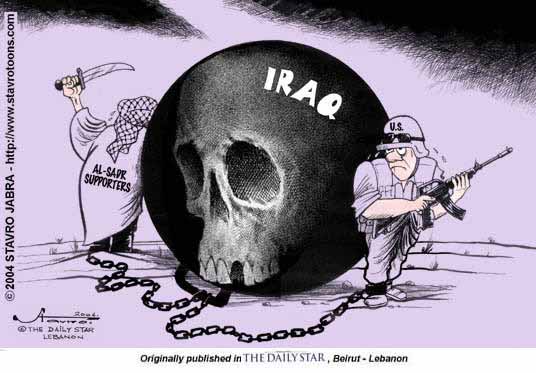
Stavro
Earlier this year U.S. officials closed his newspaper, al-Hawza and announced a warrant for Sadr's arrest in connection with the killing of Abdel-Majid Khoei, a moderate cleric and potential rival who had returned from exile in Britain.
The report says that U.S. and British troops are now battling al-Sadr's militia forces in four southern cities, including new fighting in Amarah near the Iranian border whilst there are firefights between U.S. forces and insurgents in the east Baghdad slum. In the process Muqtada al-Sadr has become a symbol of Islamic resistance to the US occupation.
This report in the New York Times says that fighting is taking place inside Karbala and in nearby Najaf, where American tank troops fought Sadr's militia on Friday. The political consequences are high because of the presence of the shrines held sacred by Shiites. Presumably the American military is willing to take the risk, as they are starting to occupy the mosques. Juan Cole reports that US helicopter gunships blasted areas inside the graveyard in Narjf that is considered sacred ground by pious Shiites.
Do they understand the politics of their military action? They are being seen to abuse both the holy Shi'ite ground and Iraqi prisoners. Would not that make their Shiite allies recoil? And they would not have many Sunni allies left after the Falluja event. Who does that leave? The Kurds? How does this effect the Iranians?
In this political context the video of Nick Berg's decapitation can be seen as a graphic press release carefully designed for a global audience. It is a political weapon designed to turn the US people away from supporting the war. The radical Islamists are using the global media to get their message across, to spread fear and recruit members and to gain leverage. It would appear that the global media in this case are the blogs.
Posted by Gary Sauer-Thompson at 5:37 PM | Comments (0) | TrackBack
May 15, 2004
The Beheading: tit for tat?
The video of the beheading of Nick Berg (reputedly by the Jordanian militant Abu Musab al-Zarqawi, who has links to Al Qaeda) was taken down from the Muntada al-Ansar al-Islami website before I could find and download it.
If you want to see the video check here or, better still, here.
There are some graphic stills from the video on the net:

More stills here.
I have not seen these powerful still images online in the major media. Does a double standard operate here?
It is not a war any more in Iraq. It is an occupation, complete with uprisings, torture and savage reprisals. Paul McGeough talks in terms of cycles of violence:
"This week's grotesque beheading of a Jewish-American in Iraq came after the appalling scandal of the abuse of Iraqi prisoners by their US captors, which followed the debacle of the American attack on Falluja, which was retribution for the butchery of four American security contractors in the same city, which Arab observers claim bore the hallmarks of a revenge attack for an unspecified American act at some point in the past 13 months."
In the Senate, Robert Hill, the Australian Defence Minister, who understands that the moral footing of the occupation is slipping, continues to talk about the transfer of sovereignty to Iraq on June 30th. This implies that the Americans will leave Iraq by June 30. Does this mean that their troops go with the hand over of sovereignty?
The stark reality is that the US occupation will continue, and so will the cycles of uprisings, torture and reprisals.

There does seem to line being run softly softly by politicians in Australia.This says that the decapitation of Nick Berg was cruel and inhumane, and that this barbarism puts the American torture of prisoners in Abu Ghraib in some sort of context. The perspective is that the Americans are better than the Arabs. The former are better deal with the crimes committed by their bad guys whilst the crimes committed by the bad Arabs go unpunished by Arab states.
Thus Alexander Downer, the Australian Foreign Minister, says in relation to the torture in Abu Ghraib prison to induce prisoners to speak:
"...Well, they're crimes. There's no question about that. However you define the crimes they're crimes and I expect people who commit crime to be prosecuted. That, at least, is cold comfort but it's comfort that where people like Americans and Brits are concerned they do prosecute these crimes, they're not just left undealt with. Under Saddam Hussein's regime much more evil crimes than this occurred and of course no one did anything about it."
Might not these crimes imply that the incarceration of terrorist suspects at Guantanamo is insufficiently transparent?
What Downer is endeavouring to do is to prop up the loosening moral footings of the occupation. In doing so he has places two things to one side. First, he is silent about the way his noble West helped create Saddam the monster. Second, Downer ignores that the Abu Ghraib prison photos show intention – a plan – to ensure Arab subjugation to get them to talk; a plan that probably goes to the top. Downer seems to accept the bad apple theory: the military personnel had bad (wild, untamed, animal) natures that got out of control.
Is there a moral equivalence being suggested here in Downer's better (US is civilized) and worse (Arabs are barbarians) duality? The softly softly implication that is being suggested is the implication that, if the barbarians are willing to do those evil things to the American civilians, then the US is partially, if not wholly, vindicated in the abuse it has perpetrated. It's a moral equivalence interpretation of tit for tat.
Is this moral equivalence to shore up the slipping in moral footings of the occupation? Is there a moral equivalence here? Or is it illusory? I think it is illusory: how can there be moral equivalence between us (civilized) and them (barbarians).
So Downer's black and white attempt to shore up the moral footings looks very shaky given the indications that Washington probably knew about the system of interrogation involving sexual humiliation, physical force and torture. The line between civilization and barbarism is much thinner than Downer implies.
On another note, there are comment on the beheading as human sacrifice and the sacred here and here
Update
The Weekly Standard's moral clarity article talks in terms of forces opposing a free society in Iraq. The word 'free' needs to be questioned after the images from the Abu Ghraib prison and the indications that this was standard operating procedure.
I have been reading some Iraqi blogs this evening to see their reaction to the execution of Nick Berg by the Ansar al-Islam group. Many are shocked and in recoil. The beheading was condemned by many Muslim leaders as contrary to Islamic law. This is not acknowledged by the Howard Government or the Bush administration in their condemnation of the lack of outrage shown by Muslim world to the Nick Berg beheading.
Some good comments on this can be found at Mykeru.com
Posted by Gary Sauer-Thompson at 5:53 AM | Comments (73) | TrackBack
May 14, 2004
spinning out of control
The US strategy for freedom and democracy from Saddam's killing fields, and then across the greater Middle East, is looking a tad tacky:

This expresses the view that the Bush administration's key strategic concern is to promote genuine democracy and independence in Iraq is hollow. The US Army acknowledges that the majority of the prisoners in the prison were innocent civilians.
Here is Riverbend's response to the images of torture in the Abu Ghraib prison. A response from Mai Ghoussoub, a European Arab, can be found here.
Here is the International Red Cross Report. Here is the neo-conservative spin. This is a response to Donald Rumsfeld's testimony to the US Congress
The US military is becoming divided over the strategy pursued in Iraq. The current one is winning the battles and losing a war. If the US envisaged its presence in Iraq as a grand nation-building exercise, then its mode of occupation has caused many Iraqis are coming together with the nationalist goal of expelling the US from Iraq.
With extremist Islamists (Al Qaeda?) in Iraq ritually beheading Nick Berg, an American civilian, it does look as if the Iraq war is spinning out of control. The still photos from the video are here.
Juan Cole reports that the beheading was condemned in the Arab world here. (see Jordan Times) Juan also provides a link to other condemnations.
As Billmon observes Iraq is becoming "a war without limits - and without mercy given or shown." It has become a nasty, cruel and vicious war. Even Andrew Sullivan is going wobbly.
Posted by Gary Sauer-Thompson at 2:16 PM | Comments (0) | TrackBack
May 13, 2004
spinning on spin
I've mentioned the spin adopted by the Howard Government senators that endeavours to disconnect Australia from the torture of prisoners at Abu Ghraib prison in Iraq.
Here is how it is being done in the US. The line is that Donald Rumsfeld was deeply committed to the Geneva Conventions protecting the rights of prisoners, that everyone knew it, and that any deviation had to come from "the command level."
In both countries the administration/government is determined to avoid taking any concrete steps that might convince the world it is serious about dealing with the underlying systemic roots of the scandal. So both Canberra and the White House continue to keep repeating how shocked, horrified and disgusted, etc etc. everyone is. They would never condone the torture.
That then is the Karl Rove strategy to deal with the problem—a political and public-relations disaster for the imperial presidency. Up to this point the general strategy to deal with the problem had been keep the issue quiet for the first months of this year and to restrict knowledge of what had happened to a small group.
The official chain of command flows from General Sanchez, in Iraq, to General John Abizaid, who is in charge of the Central Command, in Tampa, Florida, and on to Rumsfeld and President Bush. It was that chain of command which would have decided that the Army prisons to be first and foremost geared to interrogations, and the gathering of information needed for the war effort. Hence military-intelligence operatives were placed in control of the prison system, instead of the usual procedure of military-police units being in control.
It is to the credit of Robert Hill, the Defence Minister, that he refused to follow the Howard/Downer line, which qualifies their condemnation of the torture of prisoners by the US in the Abu Ghraib prison in Iraq. Howard's version of line says the torture commited by Saddam Hussein was far worse, so we need to keep a sense of perspective. Downer's version is that there are a lot of barbaric people in Iraq. In Downer's moral universe that makes the American's civilized. So what is civilized about sexual brutality and torture that is designed to humiliate another culture?
Hill, in contrast, rejected out of hand the argument that some torture was justified by the need to "soften up" prisoners for interrogation.
Posted by Gary Sauer-Thompson at 12:32 AM | Comments (12) | TrackBack
May 12, 2004
the feel-good Budget
I watched Costello deliver his Budget. Strong economy, strong families and reform was the theme of the rather flat speech. Then I caught the quick wrap on the 7.30 Report, where Kerry asks the tough questions and nails the evasive answers about the spending spree.
He didn't ask very many about the little money being spent on the nation's collapsing social, environmental and economic infrastructure?
What I saw confirmed the pre-budget Government "leaks": it was all about families and tax cuts for those with lots of money. Singles on below average income have to rely on a strong economy, good economic policy and sound economic management. There was nothing much on education; suprisingly little on health apart from a boost to aged care; nothing on the environment.
Inequality is built into the Costello budget, since those on low to middle incomes--Labor's traditional constituency--- were forgotten. See John Quiggin for more on the good, the bad and the ugly.
Cleverly crafted was my immediate response. A classic pre-election budget that makes it very difficult for Labor. It helps people to juggle family and work responsibilities and it will play well with the middle income voters in the marginal seats, such as those in inner Adelaide. Hence all the smiles on the Minister's faces. They will have a bounce in their step tomorrow as they seized back the political agenda---pinched it from the ALP. And they still have $2.4billion left in the war chest to tie up the loose ends. They've achieved their central goal: making life difficult for the Latham-led ALP.
Who cares if the cupboard is bare? Who cares if the billions pumped into the economy will fuel interest rates. The budget does not do too much economic damage so the financial markets will be relaxed and comfortable about the "growth dividend" to the middle class. Remember public debt is very low and the economic downturn is still around the corner. And who is thinking about the increasing current account deficits, rising debt and unemployment?
There are some real uglies. No money for the Murray-Darling Basin: nothing for buying back the over-allocated entitlements; no commitment to returning 100 gigalitres a year to the River Murray for a decade; no mechanisms put in place to recover the water to help restore health to the river.
I'm working my way through Budget Paper No 1. But I will run out of time.
Posted by Gary Sauer-Thompson at 1:08 AM | Comments (2) | TrackBack
May 11, 2004
contrasts
Link this photo of an Iraqi detainee about to be attacked by US military dogs in Abu Ghraib prison in Iraq:

with this commentary by Newt Gingrich.
Isn't this what Prime Minister Howard has been saying?
In the Senate today the Robert Hill said the Howard Government knew about what was going on around January and February 2004, due to the report of the International Committee of the Red Cross. That claim is at odds with this claim by Robert Hill, the Defence Minister, that he only became aware of what was going on through the public domain in the last few days.
All that talk by Hill about the "transfer of sovereignty" in Junesounds more and more akin to a publicity stunt.
After listening to question time in the Senate today the Howard Government's way of trying to killing the story became clear. It is to say that the abuse of prisoners was the isolated work of a few bad apples, and that appropriate action is being taken by the US and UK Governments. In other words the system is working. No problems here, as it was called abuse not torture.
It was all said with a straight face and deep sorrow, disgust and regret about the photos of the isolated bad ones, even as media reports circulated about how widespread the torture was.
And, it was added during the urgency motion, Australia is not an occupying power. So it all had to do with the UK and the US. Hence Australia has no legal or moral responsibility. It has no involvement in the torture. So said Senator David Johnston. He is washing his hands of Australia signing a document for the transfer of prisoners of war; one that contained a commitment to the protocols of the Geneva Convention.
So what was the action by the Howard Government in response to the knowledge of what was going in the prison system? At that point we got diversion, diversion, diversion. Then we heard a story about all the good things happening in Iraq and the anti-Americanism of the critics told by Senator Sandy MacDonald. Nothing was said about the Red Cross estimating that 90% of all prisoners held by the US were innocent.
Nothing was said about the Fallujah and Najaf sieges in Iraq by Senator Lightfoot when he defended the Government. He seemed to think that military occupation by a foreign power is freedom for the Iraqi's. He showed no awareness of the uprising by forces of the radical Shiite Muslim cleric Moqtada Sadr.
This is a government in denial.
Posted by Gary Sauer-Thompson at 5:07 PM | Comments (9) | TrackBack
May 10, 2004
politics as showbiz
It often feels like this for an ordinary punter around budget time:

David Rowe
We've had the "leaks"--- the spin--- that gains the free advertising for the government from a compliant media. The copy is everywhere. And we know the little budget secret: tax cuts that will soon be clawed back. And we wait for the big suprise is what will enable the Howard Government to repel the ALP challenge and keep them in power for another three years.
Update
I do not normally agree with one Padraic P. McGuinness. But I concur with his comments on the budget ritual. He says:
"Tonight we see conducted one of the most boring and pointless rituals of the year - the presentation of the annual budget of the Federal Government. There is good reason to present budgets, but they have become surrounded with a degree of artificial excitement and hypocritical behaviour perhaps exceeded only by Christmas Day and Mother's Day combined. All that remains is for some empty-headed radio jock wishing listeners a Happy Budget Day."
Well said. Padraic P. McGuinness then goes to highlight the ritual of the budget lockup:
"The government of the day (as well as Treasury) has always liked the drama of budget presentation, and the power its secrecy and final unveiling gives it over the media. The "lock-up" - where a huge number of the media are confined incommunicado while they digest and prepare for publication the contents of the budget - has become loved by the press, where attendance is treated as a special prestige. Paul Keating, as Treasurer, introduced a special briefing inside the lock-up, thus corrupting the primary purpose of reporting and analysing the budget rather than the Treasurer's spin."
Yep. It's been nearly all spin and little analysis up to now.
Posted by Gary Sauer-Thompson at 4:15 PM | Comments (0) | TrackBack
May 9, 2004
the pictures from Abu Ghraib
The pictures from the Abu Ghraib prison in Iraq have effectively challenged the imperial presidency's narrative of liberating, civilising mission of the US. The US Congress knows that the 'democracy flowering in Iraq' narrative has been effectively undermined.
So do the Arab commentators in the Middle East:

Nasser Al-Ja'afari, Alquds, 5/2/04. Quiet: Iraqis are being trained in US-UK "Democracy" in Abu Ghraib Prison
The pictures show American soldiers willingly engaged in torture, whilst the report of abuse made by Maj Gen. Antonio Taguba shows that the torture is systemic.
A key point from this is that the problem exposed at Abu Ghraib is illustrative of a standard operating procedure of the military body, from the Secretary of Defense (Rumsfeld) to the lowly foot soldier. Abu Ghraib is not an exception. Throughout the prison system for the war on terror (eg., Iraq, Afghanistan, Guantanamo. etc) prisoners have been “softened up” for interrogation so they would talk, with clear directives all the way up the chain of command.
What we are now seeing is the imperial Bush administration, and its loyal allies here in Australia, trying to disguise what’s really going on. The script is that they never knew what was going on; the incidents of torture are an aberration;and the demeaning behavior of the few rogue agents will be duly punished. The crimes at Abu Ghraib were a big mistake; an oversight that can be fixed by slapping a few rogue low-level (churchgoing) soldiers on the wrist.
Who taught these grinning low-level soldiers the refined techniques of torture to soften up" the detainees so as to prepare them for the interrogation. it would appear to be contracted interrogators from the Rumsfeld testimony at the Senate hearings.
I didn't see the hearings. So I'm reading the transcript.
So who trained the privates in the softening up techniques? And who was in charge of the trainers? Was it the civilian interrogators who were responsible to military intelligence. The latter hired the civlian interrorgators and had the responsibility for supervising them.
It was the public relations spin we heard most of last week. What we did not hear much about was the racism about getting rid of the snakes", and "draining the swamps" in the "uncivilised parts of the world".
Bush said that what happened in the Abu Ghraib prison did not represent the compassionate, freedom-loving America he knew. We should remember that torture is also an integral part of the operating procedure of both the CIA and the US prison system. Tough-on-crime Texas is as good a place to start as any.
So there is good reason for many in the Middle East to understand the symbol of America not to be the Statue of Liberty. It's the prisoner standing on a box wearing a dark cape and a dark hood on his head, wires attached to his body, afraid that he's going to be electrocuted. That image has become an iconic portrait of imperial US power.
Posted by Gary Sauer-Thompson at 1:29 PM | Comments (20) | TrackBack
May 8, 2004
Budget choices

I know that it is not that black and white. But see this article by Michelle Grattan from The Age. Over the last 20 years public opinion has has shifted away from preferring personal tax cuts to preferring federal government budget surpluses to be used to ensure better public services.
We also need money put into long term building up of the nation's infrastructure (rail, road, telecommunications, electricity) and into a decade of environmental repair (land degradation and environmental flows). There appears to be little money for the latter in the budget leaks.
And the knowledge economy? That has taken a bit of a back seat of late as well.There was a big splash with the $5.3 billion five-year program designed to lift research and development performance and tighten the links between Australia's innovation system and commercialization. There is more smoke and mirrors (rebadging) in this version of Backing Australia's Ability, than moving Australia to a credible R&D performance.
The package does not address the declining investment in public research and development; nor the very low R&D rate of private industry. So it does not arrest the stagnating or decline in investment in innovation.
So Australia slips further behind in creating a knowledge economy. Meanwhile the Howard looks as if it doing something, when nothing new is the case. Hence the size of the electorial bribes.
Posted by Gary Sauer-Thompson at 5:24 PM | Comments (0) | TrackBack
May 7, 2004
tired but....
I've just arrived back in Adelaide. I saw more of the photos of Iraqi prisoners being abused by American soldiers in the Abu Ghraib prison this morning.
The imperial presidency has said that the US went into Iraq with the express purpose of establishing democracy and rights, and with a promise to improve the lives of the Iraqi people. That late justification for the US invasion and occupation has been undermined by the photos. US credibility is now on the line.

Bill Leak
Winning hearts and minds in Iraq, and the Arab world generally, are now illusions.
The Taguba report on the alleged abuse of prisoners by members of the 800th Military Police Brigade at the Abu Ghraib Prison in Baghdad can be found here. It shows that the abuse was systematic. This kind of abuse started in Afghanistan. What is unusual is that it was photographed.
om_blog looks at the issue.
Do I sense just a bit of back tracking by Australia's very own neo-con? Some sense that the situation has gone beyond one of damage control? That the image of a wired-up, hooded Iraqi prisoner may signify the nature of the US occupation in Iraq? It cannot be publicly admitted of course, since the line must be held. But doubts have crept in: this might be part of a deliberate policy to soften up, or break down, Iraqi prisoners for interrogation.
Images matter in the clash of civilizations. This image suggests that the soldiers felt entitled to mistreat prisoners of war. They felt that their actions were in accord with what military intelligence wanted done. This cannot be flicked away easily by saying that Saddam was worse. That is not the issue anymore.
Australia should get out. There is no need for Australia to become tied to an image of a wired-up, hooded Iraqi prisoner, which signifies the US occupation in Iraq. Australia should condemn the US for engaging in such standard operating procedure.
Posted by Gary Sauer-Thompson at 8:09 PM | Comments (3) | TrackBack
May 6, 2004
today's puzzle
Let us accept the claim by David Bernstein that abusing the Star of David is deeply offensive.

Spooner
The Spooner piece refers to a political artwork that was shown in Melbourne. David Bernstein from The Age reports the decision was made to remove the offensive anti-Israel art display in Flinders Street after controversy. I don't know the exhibition, the artspace or this work referred to. All I know that it was in Melbourne, that it sparked controversy about the nature of art, and that it was dismantled.
Bernstein says that the removal decision rekindled the freedom of speech and art debate that erupted over Andres Serrano's equally offensive Piss Christ a few years ago. He says that there was never any doubt that the exhibit - "which superimposed a series of outrageously distorted "facts" about Israel's mistreatment of the Palestinians on a huge Star of David - was going to enrage the local Jewish community."
Bernstein then critically deals with the "facts" listed in the art work.
When I read his reasoning I thought this indicates why it is so difficult to have a debate on the Israeli /Palestine issue; one that sorts through issues rather than than engaging in personal attacks.
Since I'm going to be on the road today I will leave it up to you gentle readers to spot the problems in the way that Bernstein deals with the "facts".
Update
The artwork in question:

It is titled 'fifty six', it was by Utako Shindo and Azlan McLennan, and it was exhibited at 24/seven. The artists statement can be found here. Links courtesy of om_blog.
We have this description of 'fifty six' by some journalists at The Age:
'The work features a large Star of David painted on a wall. Red text, on the window in front, reads: "Since the creation of Israel in 1948. 200,000 Palestinians have been killed. 5,000,000 refugees have been created. 21,000 square kilometres of land has been annexed. 385 towns and villages have been destroyed. 300 billion military dollars have been spent. 100+ WMD's have been manufactured. 65 UN resolutions have been ignored.'
The Flinders Street project, titled 24seven, involves exhibition of artworks from February to November. Artists can use the space for one calendar month. Works are visible all day, every day from February to November.
Posted by Gary Sauer-Thompson at 7:11 AM | Comments (59) | TrackBack
May 5, 2004
it's the media's fault
The racism marks the attitudes of the western occupiers has effects:

Alan Moir
A round-up of the media can be found here.
If you read Abu Aardvark then you know that the imperial presidency reckons its the Arab media that's at fault, not the US policies in the Middle East. Abu says:
"...according to the Bush administration - the Arab media is a hostile cesspool of hatred and propaganda, one of the main problems facing the United States in the region, the primary reason for anti-Americanism, and an irresponsible source of incitement."
In contrast, the imperial presidency finds Murdoch's Fox News Channel 's coverage "fair and balanced."
As the New York Times says, with "each setback and blunder in Iraq, the administration has ... cheerfully [denied] that anything happened and sticking to its original plans while international support for the occupation has steadily fallen to its current minimal level."
Posted by Gary Sauer-Thompson at 7:42 PM | Comments (0) | TrackBack
May 4, 2004
Mitsubishi: bad signs

In yesterday's Australian Financial Review (subscription required) Brendon Pearson reports on the Mitsubishi crisis. He says that the only remaining hope for the Mitsubishi Motor Corporation (MMC) is the rescue package being put together from the Mitsubishi group. The promised bailout will probably be too small, the company has no surplus assets to sell off, and the DaimlerChrysler stake will be diluted.
That does no augur well for a medium to long-term turnaround for the car maker saddled with high debt, low sales and losses. A cash crunch means cuts to its global operations. Even with the extra money a turnaround will take a long time. What is likely to happen is financial support for MMC is provided until another strategic buyer could be found.
A Chinese buyer?
All this is in such marked contrast to Nissan, Nissan Motor which was near-bankruptcy, revived and is now making record profits. MMC, by contrast, had slumped further over the past two years. It appears that the management lacks a sense of crisis. It has failed to improve its management despite a near decade of continual trouble. The corporation's tendency of covering up problems apparently has not changed.It's corporate culture is overly bureaucratic with a stiff organizational atmosphere, outmoded business practices and a lack of concern for consumers. It's management structure needs reform.
The crisis-hit Mitsubishi is not a big player in Australia since it's volumes of sales keep declining. It appears to be a similar story in Canada. Something on the Chrysler side of the operation. It's not doing that well either.
Nihon Keizai Shimbum, Japan's leading newspaper reported that Yoichiro Okazaki, the new CEO of MMC Yoichiro Okazaki is thinking of scrapping Daimler's original restructuring plan. Okazaki is proposing to a turnaround: to continue with the Japanese production of Pajero SUV since it represents Mitsubishi Motors "identity"; put on hold its original plan to shut down its Australian operations, and instead of withdrawing from the North American markets, "rebuild" it to make it as important as its Japanese market.
Where's the money coming from to do that? Would not that require a change in the corporate culture?
Here is a Mitsubishi sucks website
Posted by Gary Sauer-Thompson at 3:11 PM | Comments (3) | TrackBack
May 3, 2004
the tide keeps flowing out
This report by Glenn Milne is interesting in the light of the Howard Government's strategy to spend big time to retain its marginal seats.
Milne has been on the road with the Mark Latham caravan attending oldstyle public meetings for three days. What has he learned? He says that:
"The most striking thing about these meetings was the dis-connect between what the media and politicians see as the national political agenda and the concerns expressed in these windy public halls."
At the time the media ws concerned with the war in Iraq, national security and media political links. Milne says that is not what the people attending the meetings wanted to talk about. They wanted to talk about domestic issues:
... 'and they included the corrosive insecurity of modern life and its effect on the coming generation, the poor health of indigenous Australians, deceit and honesty in government, the GST, increases in fire levies, mental health services, wages safety nets, water storage, Telstra, public education, nursing homes, regional roads and the need for services rather than tax cuts.
These are the preoccupations of ordinary folk. And it was clear from these meetings they did not think Howard was talking much about them. Latham, by contrast, is getting marks for simply being there to hear what one man called these people's "cries for help".'
This indicates that there is a quiet process of de-linking happening between the conservative Howard Government and the battlers.
I cannot see the Costello budget addressing these issues directly, since it will be more focused on tax cuts than providing for well-funded health and education services. The Howard Government is committed to undercutting the legs of social democracy by creating a private health and educational system. The favour the solution supported by business and free-marketeers: creating a market to get private businesses to a provide health and education services and allow them to make a good profit. Yet the public don't want privatised health care.
Milne says those three days on the road gave him a chance to sniff the breeze. He says that "it didn't smell good for the Government."
Another dot in the political landscape. We can start linking up the dots. The political tide is flowing away from the Howard's shoreline.
Posted by Gary Sauer-Thompson at 9:45 AM | Comments (0) | TrackBack
May 2, 2004
Israel: national identity
Israeli Prime Minister Ariel Sharon’s “Disengagement Plan” represents a shift in the Israeli-Palestinian political balance. In that plan Israel will affect a complete withdrawal from the Gaza Strip and from several outlying posts in the West Bank, but will retain “eternal” control over East Jerusalem and four principal West Bank settlements. The right of return for Palestinian refugees whose ancestral lands lie inside Israel’s borders is perpetually refused.
The plan was endorsed by the Bush White House, and it has now to be voted on by the 200,000 registered members of Sharon's Likud Party. It appears that the settlers will defeat the plan. They--(the settler public?)---appear to be unwilling to accept the removal of Jewish settlements from the Gaza Strip and the end of the settlement project in Gaza in return for a great deal of the Land of Israel in the West Bank. They--the settler movement--- want the Israeli bloc of settlements in the Gaza Strip to continue.
Whatever happens around the disengagement plan--and it looks as if it will be rejected by Likud---Israeli political-military hegemony in the Middle East will continue. It is the only established nuclear power in the Middle East. It does not have weapon-inspections despite the current pressure being placed on Iran to agree to weapon-inspections. The old double standard in the Middle East continues.
So what happens to the Gaza strip, if and when Sharon pulls out in the name of security for the Israeli people? Presumably, Gaza will become an autonomous Palestinian island with no state authority. Those living there will struggle to find enough bread to eat. How will Gaza maintain itself? Foreign aid? Gaza will become hell.
And Israel after disengagement? What will happen to its national unity? This interesting article that links up to this earlier post gives an indication.
The article contrasts two Jewish figures. Mordecai Vanunu who told the "Sunday Times" what every average citizen knew: that Israel had built the Dimona atomic reactor. The other figure is Yigal Amir, the assassin of Prime Minister Rabin.
One is reviled, the other is punished but not reviled. In Israel Vanunu has been described as a traitor, a spy and an apostate, though did he did not sell his story and he was not spying for another country. The article says Yigal Amir was punished in order to preserve unity but Israelis are not repulsed or revolted by him because he threatened Israeli democracy and not the Jewish identity of the state. He affirmed the Jewish identity of the Israeli state in response to those who threatened it, such as Prime Minister Rabin.
Mordecai Vanunu is repulsed or revolted because he threatened the Jewish identity of the Israeli state. He changed his religion.
This implies that the Israeli state is both Jewish and democratic. The state of Israel depends on a Jewish nation with religion binding the people and giving them their identity. The Israeli left can then be attacked by the Likud right for being cut off from the Jewish nation. This Jewish identity does not bode well for the Palestinian/Israeli citizens living in the Israeli state.
The settler movement/Likud, which sees disengagement from the occupation of Gaza as the destruction of a part of Israel, continues to define its conception of Jewish identity as a national identity. Should that not be questioned and rejected? The right wing supporters of the settler movement in Australia are opposed to "Sharon’s plan to pull out of territory and remove settlements [since it is] a disastrous major turnaround which would virtually destroy all hope of a peaceful resolution." Are the rightwing Israeli-Australians also opposed to the two state solution? Do they also reject helping those Palestinians working for a two state solution?
Posted by Gary Sauer-Thompson at 1:18 PM | Comments (7) | TrackBack
May 1, 2004
dead meat
This guy is dead meat, politically speaking:

Tandberg
He is Professor David Flint, the Chair of the Australian Broadcasting Authority,--the regulator of the communications market. He has been writing fan mail to Alan Jones, a shockjock over at 2GB, (Sydney Radio) on the ABA's letterhead. Just a little example of the way Flint acts without integrity and impartiality when the ABA was investigating the issue cash-for-comment. There are other examples.
Alan Jones' breakfast radio programme at 2GB wields a lot of power because of its daily audience size, Jones' easy access to senior conservative politicians and his ability to set the political agenda in Sydney. So federal conservative politicians--eg., the PM--- bypass the Canberra Press Gallery filter and appear on the Jones breakfast programme. Jones is seen to be the King of Sydney broadcast radio. Good to have on your side.
Howard, Flint, Jones and Laws. A tight media/political circle. One with lots of reverberation. This is what Bob Carr, the Premier of NSW, had to say to the ABC about Flint, as reported by Crikey.com
“I think he's too partisan, I think he's involved in arguments about national affairs from a partisan viewpoint. I don't think anyone would seriously argue anymore that he would carry public confidence. If John Howard is a conservative, has respect for our institutions, and that by definition is what conservatives believe in – a respect for our institutions – he should say to Professor Flint, you've been too partisan, you've embarrassed the Government as it happens, but I've got to have an ABA that can command respect.”
A regulator (the ABA) that commands respect is one that it is distanced from government, consists of persons whose duty is to further the public good not foster partisan interest. It is also one that needs powers. As Richard Ackland observes, the rorts in the cash-for-comments indicate the need to strengthen the power of the regulator. Ackland says:
"...the ABA recommended that the Broadcasting Services Act be amended to give it power to remedy this form of fudging. It called for proper sanctions so it could properly respond to serious breaches of the code, it asked to be able to enforce advertising-free periods, it wanted the power to ban presenters from broadcasting, it sought to be able to require on-air corrections, or the findings of the ABA to be broadcast, the power to impose civil penalties, and injunctive relief where there have been breaches of the act."
The partisan Flint, of course, dismisses the claims about his conflict of interest as mere lefty elite chatter in the twilight of the (social democratic) idols. However, it is just a matter of time before the compromised Professor Flint goes. Twilight is falling around this particular conservative elite.
Will Flint fall on his sword? Will he cut his wrists and let the blood drip on the sandstone during a glorious sunset? Will he ritually disembowl himself?
Posted by Gary Sauer-Thompson at 2:14 PM | Comments (0) | TrackBack