« July 2004 | Main | September 2004 »
August 31, 2004
Election: Gunning Costello
Since we live in a new apartment in the city of Adelaide we are very sensitive about happens to interest rates. We keep a close on them since slight rises have a big impact on the budget. We are fearful they will rise and rise and we will have no spare cash to meant the increased payments.
What I've noticed is that the theme of fear is everywhere these days. It is not just the fear created by the national security state continually raising the possibility of terrorists associated with Al Qaeda blowing up a bit of Australia.
It is also a fear created by interest rates going through the roof with an ALP government. The alarm is raised by the conservative side of politics as part of their attempt to paint the ALP as bad economic managers.

Wilcox
The message is that you can only trust the Coalition if you feel want to feel secure. The fear of interest rates rising strikes a chord in the marginal seat of Adelaide, given the boom in apartment living in the inner city. You only need some of these to panic and the ALP has no hope of winning the seat of Adelaide.
Are we spooked? I thought that the economy was running better than it had in 30 years. You know there is low unemployment, good economic growth, company profits are surging and there is high productivity. Has not the economy had been a star turn, and in good shape? So why would interest rates go through the roof?
Do not the economists say that whoever wins government in October will have little impact on the long term trajectory of interest rates? Doesn't the Reserve Bank now control interest rates?
Does not the Government's spendthrift ways contribute to the pressure on interest rates? Does not the ALP outrank the Coalition in growth-spurring structural reform over the past two decades? Does not Australia have the highest interest rates of all the major developed economies?
Don't we have a trade deficit blowout. Why isn't the ALP talking about that deficit? Why is there no criticism of Costello's bad economic management? Are we not living beyond our means etc etc?
Why is the ALP so defensive around the economy? Where is its courage?
August 2nd
There is plenty of room for the ALP to attack Costello on economic management around Australia having higher interest rates than the other major developed economies. As Kenneth Davidson in The Age points out:
"Australians must pay more for their money than the people of most other countries because the Australian dollar is rightly seen as carrying a bigger exchange risk than most other countries, not only because of the huge current account deficit and foreign debt, but because the dollar is rightly seen as a commodity currency dependent on the fluctuating world demand for agricultural produce and raw materials, rather than the sophisticated products and processes associated with the knowledge-intensive post-industrial era."
The Howard government not only runs massive trade deficits. It also does little to transform the Australian economy into a knowledge-intensive one.
But we have silence from the ALP. Does that signify that the light on the hill is barely flickering these days?
Posted by Gary Sauer-Thompson at 11:56 PM | Comments (0) | TrackBack
August 30, 2004
Election day 2: figures
It is the second day of the election campaign. Parliament House feels ghost-like. Only the Senate is sitting. No one really wants to be here much. The Liberals look quite jaunty and confident in the corridors. Their polling is looking good in the marginals? Do they see more hope, prosperity and stabilityin the figures?

The policy differences can be found here.
I read Malcolm Mackerras opinion piece in the Australian Financial Review on the plane to Canberra this morning. He is briming with confidence in his own predictions. He is predicting that the Coaliton will control the parliament as a whole (with 38 Coalition Senators, eight Green Senators and 4 Democrats).
Figures are reality to Malcolm. They are what really exists. Not hopes, fears, resentments, unease and pride--all that heart stuff that lies underneath the public issues.
Posted by Gary Sauer-Thompson at 8:40 PM | Comments (0) | TrackBack
August 29, 2004
US: Presidential campaign
I've been watching the US presidential race at a distance. The Republican National Convention is due to roll in New York this week.
From what I can see the dirty tricks of the Atwater/Rove mud treatment have been successfully deployed by the shadowy Bush hitmen against a lacklustre and lame John Kerry. Just as the dirt was deployed against Michael Dukakis (the Willie Horton rape case) and then John McCain, so we have the Swift Boat snipers acting on behalf of the Rambo White House to gun down Kerry's heroism and show him to be unfit for command.
Maureen Dowd in the New York Times describes the big lie tactic of the bottom-feeders well:
"Just as the Bush campaign dragged out fringe veteran surrogates in South Carolina to slime the former P.O.W.[john McCain] for being antiveteran, now the stomach-turning Swift boat attackers are sliming a war hero as a war criminal....the Bush crew is shamelessly doing to Mr. Kerry what it once did to Mr. McCain: suggesting that the decorated Vietnam vet has snakes in his head and a temperament problem. "
As Paul Krugman acidly observes in the New Tork Times:
"One of the wonders of recent American politics has been the ability of Mr. Bush and his supporters to wrap their partisanship in the flag. Through innuendo and direct attacks by surrogates, men who assiduously avoided service in Vietnam, like Dick Cheney (five deferments), John Ashcroft (seven deferments) and George Bush (a comfy spot in the National Guard, and a mysterious gap in his records), have questioned the patriotism of men who risked their lives and suffered for their country: John McCain, Max Cleland and now John Kerry."
This image by Stanley Martucci & Cheryl Greisbach captures the implications well:
 The American political system allows the Rambo cowboy crowd to get away with their lies and smears. The US, it appears, thinks that lies in politics are okay and the norm in a liberal democracy.
Truth in politics is of little concern in this liberal democracy. The norm is cooked intelligence, profiteering and politicization of homeland security.
What is needed is the US liberal democratic poiltical system condemning, then regulating and punishing the abuse of free speech by the Bush campaign thugs. What is not needed is moves to restrict the use of political free speech.
If we come back to the presidential election it would appear that Though it the race is neck and neck (Kerry by a head?) Kerry's major problem is that he's not yet securing the votes of people who are unhappy with Bush's policies or the direction of the country.
Just like the ALP in Australia.
Posted by Gary Sauer-Thompson at 12:00 PM | Comments (0) | TrackBack
August 28, 2004
Iraq: Najaf saved
Bell has got it very wrong about Najaf. It was Grand Ayatollah Ali al-Sistani who saved the day.

The US military and the client Allawi government failed to defeat the defiant Moqtada al-Sadr, whilst Moqtada al-Sadr escaped from the trap set for him. In the meantime the has wrought a lot of damage. The standard procedure of the Iraq police in Najaf to news management is intimidation of independent journalists.
Christopher Allbritton's descriptions of his experiences at the Inman Ali Shrine in the old city of Najaf during the siege can be found here.
Posted by Gary Sauer-Thompson at 6:06 PM | Comments (1) | TrackBack
August 27, 2004
Israel: Sharon's game plan
This is a good account of Ariel Sharon's strategy vis-a-vis the Palestinians. One of the best I've read.

Leunig
Sharon strategy has always been a Greater Israel. At this stage he is willing to concede the Gaza strip so as to expand the illegal settlements in the West Bank. And the US openly supports the strategy. That means Australia supports a Greater Israel.
And within Israel? Inside the Jewish state, or the Jewish national homeland, there is different treatments of different peoples. One nation cultural politics rules inside the Jewish state.
29 August
There are voices within Israel that critique this kind of Zionism. An example can be found in the Olga Document, which states that its critique of Zionism is based as on Zionism's:
"....refusal to acknowledge the indigenous people of this country and on denial of their rights, on dispossession of their lands, and on adoption of separation as a fundamental principle and way of life. Adding insult to injury, Israel persists in its refusal to bear any responsibility for its deeds, from the expulsion of the majority of Palestinians from their homeland more than half a century ago, to the present erection of ghetto walls around the remaining Palestinians in the towns and villages of the West Bank. Thus, wherever Jew and Arab stand together or face each other, a boundary is drawn between them, to separate and distinguish between the blessed and the cursed."
The critique is based on a liberalism that is opposed to all laws, regulations and practices that discriminate between Jewish and Arab citizens of Israel, and demands the dissolution of all institutions, organizations and authorities based on such laws, regulations and practices.
Posted by Gary Sauer-Thompson at 1:36 PM | Comments (4) | TrackBack
August 26, 2004
Health: ALP collapses?
The Howard Government's approach to health is not quite as bad as this:

Moir
Extending the increase in the bulkbilling rates to the suburbs in the major cities was not bribery. It was good policy, given the low rates of bulkbilling there. That move had placed out of bounds in the MedicarePlus negotations between Tony Abbott and the 4 cross bench senators earlier this year. The extension was needed. It is to be applauded.
What was missing from MedicarePlus was a shift to funding quality health care based on 15 minute appointments, rather than a 6 minute tick and flick bulkbilled health care.
Abbott's recent extensions to the private health insurance rebate (from 30 per cent to 35 per cent for those aged 65 to 69 and 40 per cent for people over 70) Abbott has managed to box the ALP into accepting the private health insurance rebate. The ALP now lacks the courage of its convictions to stand firm on its previous policy of abolishing the rebate to defend a universal Medicare.
All that the ALP currently says is that it will not let the recent Band-Aid changes through the Senate. My bet is the ALP will blow all hot and passionate before the Senate cameras about the rebate whilst quietly letting Abbott's changes through.
Does not that low target strategy tacitly endorse a two-tier system that entrenches distinctions between those with private insurance and those without? Does that not mean the ALP is supporting the present size of the private sector with huge outlays of taxpayer money? Where is the equity there?
So it goes along with the myth fostered by the Howard Government that the 30 per cent rebate on private health insurance offered to the middle class to encourage them take out private health insurance are in fact designed to strengthen Medicare. The reality is that the rebate is funded by
Is the ALP planning to allow people to flow back to Medicare as the cost of private insurance increases faster than inflation when it regains the Treasury benches?
What the politics of health means at the moment is that Howard is able to fight on the ALP's own ground. The ALP's historic advantage of being trusted by Australians to ensure better health outcomes for them has been squared.
Posted by Gary Sauer-Thompson at 9:57 AM | Comments (0) | TrackBack
August 25, 2004
yeah
I've just got back to Adelaide. I've been watching the news here and there as much as it is possible in the country towns. There is no internet connection in the hotels or motels, the television is lousy, and the mobile coverage is marked by blackspots.
No one loves Telstra in the regions that's for sure.
Most of the news I saw has been about the hullaballoo around the Olympic women's eights rowing final. The focus has been on the crew members becoming embroiled in a tense public feud over Sally Robbins' dramatic collapse 350 metres from the finish line.
This caught my eye as I quickly scanned the quality press online before dinner:

Bruce Petty
The guy can be a national embarrassment. His understanding of Australia's foreign policy is to give carte blanche to whatever the US does. He assumes that the alliance with the U. S. is beyond criticism, and he is willing to encourage an increasingly irresponsible American foreign policy. As a result he is willing to insult other countries such as Spain and the Philippines for not going all the way with the USA.
Australia suffers as a result of Downer's stridency. What more needs to be said?
26 August
To be fair Downer is caught in a bit of a vice. He is trying to balance Australia's growing economic dependency on China with Australia's growing security dependency on the US. The US and China are at odds with one another and there is growing tension between them on economic and security matters. So Australia walks a tightrope.
Posted by Gary Sauer-Thompson at 8:22 PM | Comments (0) | TrackBack
August 24, 2004
goodbye water dreaming
I will be on the road for a few days looking at water and vineyard development in the Barossa and Clare Valley's in South Australia. Nobody has any time for the grand industrial dreams of turning the northern waters of Tropical Australia southward to the Murray River. They are seeking 21st solutions.
As Don Garden, an environmental historian at the University of Melbourne, writing in The Age says that industrial dream mindset viewed:
'...the landscape as a collection of "natural resources" that they believed it was their right or even duty to exploit.
Water was seen as being present in adequate quantities. It was simply in the wrong place and at the wrong time. This was a fault that human ingenuity and engineering could rectify. In due course we could make the arid wastelands productive. We could "make the deserts bloom"That approach was pursued from the middle of the 19th century and resulted in an enormous investment of capital and engineering skill that reached its high point in the Snowy Mountain scheme.'
In the Barossa and Clare Valley there is an awareness of the costs of that approach in terms of environmental exploitation and degradation. In South Australia:
".... there is scarcely a water system that has not been truncated and diverted...Vast areas of land have been cleared of their natural vegetation and are badly salinated. Native flora and fauna that once existed in millions are reduced to tiny remnants and, in many sad cases, are extinct or threatened. Most of our native woodlands and their inhabitants are gone...The legacy for our rivers is that many are dead or dying, including the once mighty Murray. They are increasingly salty...Aquatic life has been devastated, including iconic species such as the Murray cod. The river red gums that graced the river floodplains are dying of thirst because they are denied the periodic floods on which they depend for regeneration and reproduction.That other great source of water, groundwater, has been seriously over-exploited and is now starting to fail.
That is the legacy of industrial dreaming that was indifferent to ecology. That legacy is the situation within which wineries now have to work. It is realised that without a healthy environment there is no healthy economy and no healthy future for Australia.
Posted by Gary Sauer-Thompson at 8:52 AM | Comments (0) | TrackBack
August 23, 2004
Election Campaign#3
Does Rowe have the state of play wrong?

Rowe
Latham is not really battered and bruised. It would appear from recent polls that the trend of John Howard's clawback of the ALP's two party preferred vote lead has run out of puff. What is even worse is that the catchup trend of the past month or so may be falling away, with the gap between the two major parties now beginning to widen. That would be bad news for Howard.
What now for Howard? One strategy is more money to be spent on shoring up the Coalition's electoral base?
The latest on this front is increasing the subsidies to private health insurance for the aged users of the health system. The recent health moves have effectively boxed the Latham-led ALP into a corner. The party of publicly-funded universal health care now confirms that it would keep the 30 per cent private health insurance rebate if it won government.
Have you noticed how the ALP keeps on moving to the right whilst its rhetoric remains the same?
Posted by Gary Sauer-Thompson at 12:57 PM | Comments (0) | TrackBack
August 22, 2004
Iraq: Najaf
The news from Najaf is confusing. I have have very little sense of the state of play.
We had reports earlier in the week that Muqtada Sadr's Mahdi Army fighters had been defeated, and that they had handed over the keys of the Imam Ali shrine in Najaf to a representative of Grand Ayatollah Ali Sistani. No agreement has been reached between Sadr and the Shiite religious hierarchy on the precise terms for ceding control of the shrine.
Then we had reports of heavy fighting, which keeps on continuing. On this account Sadr's Shia militia is holding its own. Others say the US and multinational force (MNF-1) is winning this round.

From what I can gather the U.S. is trying to force Muqtada al-Sadr and his Mahdi militia out of the shrine of Ali, to disband the “al Mehdi” militia and restore the city to occupation control. So, if the US military backs down now the credibility of the new client Allawi regime will be tattered. It looks as if the siege will continue.
What we can figure out is that the resistance to the US occupation is now being led by fundamentalist Shiites who want to impose an Iraqi state run by Islamist on a population, which does not want to become a clone of Iran. The siege of Najaf does highlight how the MNF-1 uses excessive force to deal with acts of resistance to the occupation. The aim is to overpower the Shiite Islamists and maintain enough security to manage Iraq's future.
There is little awareness in Australia that the US has been bombing the sacred cemetery and parts of the Najaf, reducing some parts of the city to rubble; or that the Howard Government supports a desecration of a sacred Muslim cemetery. Bombing the city of Najaf is hardly winning the "battle for the hearts and minds" of the Iraqis.
Yet the official government line is that Iraq is improving, that Iraqis support the occupiers, that they support their new Allawi government, that the "war on terror" is being won, and that Australians are now much safer.
Does the siege of Najaf suggest that the Allawi client regime and the Americans control little of the countryside of Iraq, and only parts of Baghdad? We know that the highways are littered with burnt-out police vehicles and American trucks and that tn the summer heat Baghdad has the smell of death.
So I guess the chaos means that our fuel prices will continue to increase.
Posted by Gary Sauer-Thompson at 10:05 AM | Comments (0) | TrackBack
August 21, 2004
bored
I found the news and politics boring today. I scanned it all online this afternoon but nothing caught my attention. I couldn't be bothered that Ross Cameron, the bible-bashing, morals-crusading federal Liberal MP for Parramatta is a fornicator and an adulterer. The guy lacks a lot of understanding of how society works.
I had that jaded, cynical mood of the Canberra Press Gallery after several days on the campaign trail. You know, the sense of having seen it all the spin about nothing much in particular before, but you cannot remember when or where.
So a joke from the London Times:

Finn Andersson, Microsoft Technician
Microsoft needs to be broken up in the name of competition since it acts like a monopolist. I find the Windows world to be very frustrating.
And this is what I would like to see happen to spammers:

Stephanie Bennett, Spammers Prison
Spammers are an argument against the free market so loved by Ross Cameron who says good economic governance is about light regulation and trust.
The spammer subcontractors use the same spamming lists to pound us all day and night via public infrastructure. We know that there is always more spam coming down the line, yet our ISPs make spam and virus filters optional and costly extras. Why is it not included in the monthly fee and made it mandatory. Everyone would benefit apart from the spammers.
Posted by Gary Sauer-Thompson at 10:45 PM | Comments (0) | TrackBack
August 20, 2004
Media: its failure
There is a good article by Max Suich,The Independent Monthly, on the Australian media in The Age. he argues that there is a large
"....problem in the Australian media and, in particular, in the serious press. Political news reporting has become little more than the official account of the interminable singles tennis match between John Howard and Mark Latham. This dull fare is sexed up with opinion articles from the tribe of staff commentators, opinion-page columnists, talk jockeys and current affairs interviewers and analysts."
A lot of reporting is a recycling of media releases. Media releases are designed so that journalists dump them in. Hence the idea of the drip feed. There is very little thinking going on. Many journalists have no understanding of the issues they are reporting on, nor are they encouraged to do so.
Suich then goes on to connect this to parliamentary politics. he says:
"Where newspaper specialist reporters find out something, beyond the official line, they often place it in their personal columns or commentaries. Here it often fails to meet the arbitrary rules for setting the news agenda of TV news, radio and rival papers, and so, despite its importance or interest, is ignored. The result is that the simplicities of the parties' sloganeering dominates the news agenda.
As the politicians move into a formal election campaign, it will be the objective of both the Howard Government and Latham Opposition to maintain this straitjacket on the media. The whole of their strategy is concentrated on achieving that end."
Most of the news reporting is boring. That is why people turn to commentary and the conflict about the meanings and interepretations of the news.
Posted by Gary Sauer-Thompson at 8:13 AM | Comments (0) | TrackBack
August 19, 2004
a note on water
I'n the last few days I've been travelling around the Eastern Mt Lofty Ranges and mallee country around the River Murray looking at the devastation wrought by state encouraged agricultural development. The result is denuded landscapes, saline groundwater rising to the surface, rivers that no longer flow few birds and fish.
Devastated landscapes are a very sorry sight. It is going to be a long hard haul to repair this country and to change old agricultural practices that devastate the ecology of the country.
The cities are facing water shortages. As the Sydney Morning Herald says little is being doen to address this:
"At present, just 2.3 per cent of Sydney's water is recycled, though this will double to 4.6 per cent in the coming months as the Port Kembla steelworks switches to recycled water. Sydney Water's most recent long-term planning document, Waterplan21, released seven years ago, envisaged raising recycled water use to just 6 per cent by 2021 - a very low figure. At the very least, an updated mid-term strategy is needed.
Manufacturing and industrial ventures use 11 per cent of water, vastly outweighed by households at 70 per cent, so that raising the recycled level for households is essential. Yet Rouse Hill is the only residential development in Sydney which incorporates water recycling. It is being expanded by 10,000 homes, bringing the total receiving a dual supply of drinking and recycled water to 25,000 homes, which is insignificant compared with annual housing construction in Sydney."
There is a similar lack of action in Adelaide, even though it too faces severe energy and water problems.
Into the vacuum step the old fashioned engineering modernists with their big dams and piping schemes to transport water across the country. The standard argument in The Age is this:
"Australia has no shortage of water in even its direst, driest years. It simply falls in the wrong places.The quantity of the northern falls is so vast that diverting south as little as 3 per cent of it would demolish the common view that water shortage is inevitable in Australia and that sick, depleted rivers and rationing (as opposed to sensible conservation) are crosses we simply have to bear.
What kind of projects would be feasible?
The first is to build dams in the flood-prone Flinders River region of central Queensland to pipe water south and so permanently resuscitate the Murray-Darling Basin and Adelaide. This proposal has been costed at $2 billion - less than the Commonwealth contribution already committed for stop-gap measures to ameliorate the basin area's present problems.
The second is to increase Perth's seriously threatened supplies by relieving it of its responsibility to send water to Kalgoorlie. Instead, the huge mining areas east and north-east would be supplied by pipeline from the remote and water-abundant Fitzroy River country."
So we can keep going the way we have with landclearing, standard agricultural practices, removing biodiversity.
These big machine modernists have no ecological understanding at all. They do not understand the nature of the country they live, nor how the economy depends on ecoology. And that's the problem.
Posted by Gary Sauer-Thompson at 11:04 PM | Comments (0) | TrackBack
August 18, 2004
back in town
I've just got back to confront hundreds of spam mail. I quickly glanced at this commentary about the battle for Najaf in Iraq. Gary Leupp says:
"The Mahdi Army cannot, in my view, really liberate anyone with its fundamentalist religious agenda, and this, perhaps, many of its adherents will come to understand. But for the time being, it presents the imperialists with their thorniest challenge. The warriors of this jihad know that their countrymen will desert, or defect to themselves, rather than serve the infidels in Najaf. The original sin of the occupation is that it is, after all, an occupation. Worse, one based on lies. Justified after the fact, after the bogus rationales were all discredited, by the boast, "We overthrew a dictator," the occupation now faces the jihadis' charge that it is worse even than Saddam."
So what happened at Najaf? Juan Cole's judgement about the battle of Najaf is that the:
"The Marines in Najaf were acting like just another militia, engaging in a local turf war with Muqtada and his men, and giving no thought to the consequences of behaving barbarically in the holy city of Najaf."

Cole's comments are based on this report. That says:
"Marine officers said they turned a firefight with al-Sadr's forces on Aug. 5 into a eight-day pitched battle -- without the approval of the Pentagon or senior Iraqi officials. It was fought out in bloody skirmishes in an ancient cemetery that brought them within rifle shot of the Imam Ali Mosque, Shiite Islam's holiest shrine....As a reconstruction of the battle in Najaf shows, the sequence of events was strikingly reminiscent of the battle of Fallujah in April. In both cases, newly arrived Marine units immediately confronted guerrillas in firefights that quickly escalated. And in both cases, the U.S. military failed to achieve its strategic goals, pulling back after the political costs of the confrontation rose."
The pathway to democracy taken by gungho US Marines is what Australia is tacitly supporting with its all the way with the USA: strike quick before the inevitable political storm breaks.
An analysis by Helena Cobban can be found here
Posted by Gary Sauer-Thompson at 11:12 PM | Comments (0) | TrackBack
August 17, 2004
on the road
I will be on the road for a few days in South Australia looking at the lack of biodiversity in the Mallee and proposed salt interception schemes in the Riverland. I will also look at a dead Marne River in the Eastern Mt Lofty Ranges. This death event has been caused by wineries in the Eden Valley capturing nearly 70% of the run-off from the winter rains. They say they are drought proofing.Too bad about the Marne River.
Since few really care about such things, here are some loose comments on more sexy topics.
This cartoon just about sums up the recent antics of Alexander Downer, Australia's foreign minister.

Moir.
Then have a read of this and this. These refer to the challenge to Howard's accountability and credibility by Mike Scrafton, a former adviser to a defence minister, Peter Reith. They are concerned with what Scrafton told the Prime Minister about the children overboard incident prior to the previous federal election.
Scrafton's account will place the PM on the defensive. Another arrow fired at Howard's case for war with Iraq (built on the claim that Iraq undoubtedly had WMDs that posed a substantial threat to Australia) this account of what Hans Blix informed Howard.
Then read Michelle Grattan. No doubt the Liberal staffers will walk the corridors in Canberra to spread the innuendo and dirt amongst the Canberra Press Gallery. That is part of the standard smear campaign rolled out against dissenters and whistleblowers.
August 18
I'm catching up what has been happening in the commentary around Mike Scrafton's intervention. Pual Kelly says:
"Scrafton has been a career public servant and is a credible witness. He told this paper that "nobody at my level forgets saying to the Prime Minister the intelligence he has been relying on for a month is wrong". His explanation for not revealing his version to the earlier Bryant inquiry makes sense -- serving career bureaucrats don't undermine prime ministers. That is not their job."
Another former senior public servant has gone public to support Scrafton's claims that the PM was told there was no evidence to support the children overboard claim at least three days before the election in 2001.
More from Michelle Grattan here. A full account can be found over at Backpages. Things are unravelling for Howard at long last on Tampa. From the grabs I saw on commercial television today the PM is not sounding very persuasive. He looks as if he has a credibility problem.
It looks as if the ALP has regained the political initiative.
Posted by Gary Sauer-Thompson at 7:53 AM | Comments (0) | TrackBack
August 16, 2004
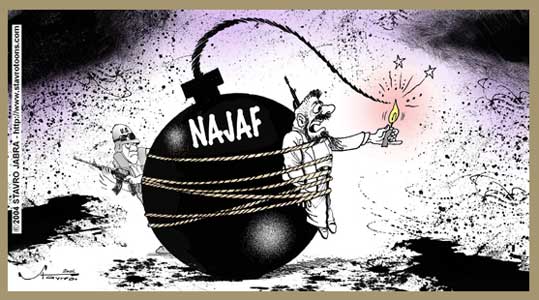
It is not how I see it but:
Stavro
I read the situation as one in which the Americans hamfisted assault on the holy city of Najaf has turned Iraq's against them.
Posted by Gary Sauer-Thompson at 11:50 PM | Comments (0) | TrackBack
August 15, 2004
A green senate?
It looks like the Olympics have won out over the federal election:

Rowe
I'm not suprised. Howard still needs to keep the momentum going in the crucial marginals in Queensland, Adelaide and Western Australia. However Chris Sheil agrees with Alan Ramsay's judgement that "the Government's hard-won political momentum has gone." Has it been lost over the doubts about the undermining of the Pharmaceutical Benefits Scheme in the American free trade agreement?
Has Howard's momentum gone? The lost ground on health can be, and is being countered. Doctors in outer metropolitan and regional areas will be given extra bulk-billing rebates by the federal government to help make working in those areas more attractive. That is an important policy shift against the ALP. They are effectively countered on their own terrain.
Some are annoyed by all the speculation about the election date. Yet the way things are currently organized in federal parliament setting the election date is a part of the campaign tactics to gain advantage over the enemy.
It continues to look like the Democrat vote has collapsed whilst the Australian Greens are riding high enough to gain the seats they need in the Senate to be publicly funded as a political party. They need 5 seats. If the Greens gain those 5 Senate seats then this will make it hard for the whoever (Coalition or the ALP) gains control of the House of Representatives.
The Senate is the key, but few are thinking about the implications of that. Who is polling the Senate? My judgement is that the LIB LAB Coalition we saw around both the FTA and the same sex Marriage Bill last week is an indication of what is to come.
Now wouldn't it be nice if the Greens knocked off the ALP in a few inner city seats in Melbourne (eg., the seat of Melbourne) or Sydney?
August 18
From what I can gather the inner seats of Sydney that are under threat from the Greens are Grayndler held by Anthony Albanese and the seat of Sydney. I saw a media grab of Peter Garrett being used by ALP strategists to roll back the Green threat and shore up the ALP's left flank.
Posted by Gary Sauer-Thompson at 6:19 PM | Comments (4) | TrackBack
August 14, 2004
campaign nonsense
In the previous post I mentioned that in this election campaign we are now witnessing outrageous misrepresentations that get up people's noses. Here is an example. It is the silly shrills of Alexander Downer.
This is the transcript of the interview with Alan Jones at Radio 2GB:
JONES: "Does anyone know how much nuclear capacity they've [North Korea] got?
DOWNER: Well, we know a bit about it but we don't know the full story, no.
JONES: They are developing long range missiles, they've said that, haven't they?
DOWNER: Exactly. They have developed long range missiles. They probably haven't developed many of them but they have developed long range missiles and we believe they have developed a long range missile that could go all the way from North Korea to the United States …
JONES: Yes. Land on continental America.
DOWNER: … or for that matter …
JONES: Here?
DOWNER: … here.
JONES: Australia.
DOWNER: They could fire a missile from North Korea to Sydney.
JONES: Yes, that's right. I read where North Korea makes between US one million and two billion a year smuggling missiles, weapons of mass destruction, technology and drugs, and indeed, is their main source of money.......
DOWNER: ..... If North Korea develops a substantial nuclear stockpile, the Japanese in particular are likely over time to respond to this with the building of their own nuclear weapons system and that would, of course, cause enormous alarm in China and it would lead to a dramatic deterioration in the security environment in North Asia.
JONES: And here we are, a tiny little country, most of our population centred around a few cities and ill-equipped to survive any nuclear exchange.
DOWNER: We have no capacity to do that."
This is such complete nonsense. North Korea is developing two new classes of long-range missiles, whose furthest reach is judged to be about 4000 kilometres, with limited accuracy. Sydney is around 10,000 kilometres from North Korea. So we have a macabre joke.
The interview about the communists in north Asia highlights the conservative's scaremongering tactics in international affairs; as part of a strategy to create a climate of fear that is designed to rework their 1960s scenario of Australia being under threat Alan Jones, the conservative shockjock, is a willing participant in whipping up public fear by the national security state. Jones is their lapdog publicist.
The strategy can be seen in the interview. Look at how Downer hooks Islamic terrorism onto the old communist threat to create the big bogey Other that is disconnected from Australia's actions in the Middle East.
Posted by Gary Sauer-Thompson at 11:24 AM | Comments (1) | TrackBack
August 13, 2004
contrasts
I returned from Canberra last night glad to be away from living in the shadowland of federal Parliament where nothing of substance was happening in the debates on the issue of free trade. It was all a game of charade and it is continuing through today. The fortnight's sitting was like being in Plato's cave where all one can see are the flickering shadows. Parliament is a cave where the reality is the news headlines.
I awoke this morning in Adelaide to lots of news feeds and commentary about the Olympics and the conflict in Iraq:

Leunig
It would appear that the American marines have surrounded Najaf and cut off all the roads leading into the shrine of Imam Ali whilst US planes and artillery have been bombarding positions in the Valley of Peace cemetery. It would appear that the US are determined to strangle Muqtada Sadr's Mahdi Army, and force it out of Najaf in an attempt to eliminate its homegrown challenge to the caretaker Allawi Iraqi Government.
The Allawi Government is becoming increasingly dictatorial. It has reintroduced the death penalty, closed down the al-Jazeerah satellite news service, authorized an American invasion of the shrine of Ali, and is marginalizing its potential rivals via the courts. The US, Britain and Australia have put Allawi in power, continue to support him, and are turning a blind eye to this unelected government torturing its own people.
Would not the US attack in the cemetry and around the shrine of Imam Ali create even more political disturbance in the region? All this is cannot be going to go down well with Iran. As Juan Cole says:
"The US military actions in the holy city of Najaf are deeply offensive to Muslims throughout the world. Although many might also criticize Sadr and his militia for using the holy sites as cover, the strongest condemnation inevitably is reserved for the foreign troops, seen as imperialists."
Najaf is a holy city that is sacred to Muslims and to Shiites in particular. So what are the Americans doing? Trying to pick a fight with Iran?
None of this is a concern in Australia. The discussion over foreign policy is reduced to these shadows. What we now have are the outrageous misrepresentations of an election campaign that get up people's noses.
14 August
Nicolas Rothwell has a featured article in The Australian on the tensions between Iran and Iraq. He says that:
"Though Iraqi politicians from Saddam's era onwards have always suspected Iran of territorial ambitions, the situation is more complex. Iran, as the central nation of Shia Islam, believes it has a duty of care towards the holy sites of Karbala and Najaf, but it may not wish for a separate Arab Shia state to be formed. Any break-up of Iraq into ethnic states would destabilise the region further and threaten vital oil exports that form the lifeblood of the Iranian economy....The theocratic regime in Tehran, ideologically hostile to the US and Israel, looks out on a disquieting regional landscape, with its potent foe, the "Great Satan", camped on its border and a westernising, secular client state in place in Baghdad."
Rothwell concludes by saying that Iran's chief aim is to raise the costs of the US occupation and perhaps even to persuade the Americans into withdrawal. This can be done most effectively, and most deniably, by discreet activities, sufficiently tactful to avoid provoking US response.
Posted by Gary Sauer-Thompson at 10:23 AM | Comments (0) | TrackBack
August 12, 2004
Liberalism & national security
I see that Margo Kingston has posted a speech she delivered to the Sydney Institute online at Webdiary. In this speech she links back to Robert Menzies Forgotten People to the present rule by the Howard Government.
I too have been reading that text ( here and here. I concur with Margo's judgement in Not Happy, John that:
"...that far from being the torch bearer of Menzian Liberalism, John Howard has destroyed it from within, and in so doing has plunged our democracy into a crisis which only the people of Australia, working together, can now salvage."
This undermining of liberalism is particularly evident in the post September 11 national security legislation, especially the body of legislation associated with the Anti-Terrorism Bill (No 2) 2004. The duty of governments to protect the rights and safety of people within their territory is at the cost of fundamental human rights and civil liberties.
Menzies says that
"There are fascist tendencies in all countries - a sort of latent tyranny. And they exist, be it remembered, in radical as well as in conservative quarters. Suppression of attack, which is based upon suppression of really free thought, is the instinctive weapon of the vested interest... Fascism and the Nazi movement are both based on social philosophy which elevates the all-powerful State and makes the rights of the individual, not matters of inherent dignity but matters merely of concession by the State. Each says to the ordinary citizen, "Your rights are not those you were born with, but those which of our kindness we allow you." It is good to be reminded by Mill that this tendency is not confined to any one country. As the organization of society becomes more complex we must be increasingly vigilant for the freedom of our minds and spirits."
Menzies then defends freedom, even though he acknowledges the limits on all these matters in time of war when the "supremacy of the national security is clear and undoubted."
Posted by Gary Sauer-Thompson at 8:36 AM | Comments (0) | TrackBack
August 11, 2004
FTA: Gittens on the money
The debate on the Free Trade Agreement with the US continues in the Senate. This article by Ross Gittens in the Sydney Morning Herald highlights an important issue that has not been discussed much.
Whilst Australian business sees the FTA as opening up access to the US market for them to make lots of money, and the ALP State premiers see it as ensuring lots of new American investment in their state, a real issue is intellectual property rights (IP), such as patents, copyright and trademarks). It is the issue the Americans are most concerned about.
This is the longest section of the FTA agreement and the most damaging for Australia. It is not about struggling novelists, filmakers and musicans. Since the US owns most of the worlds IP, so it gains most from extending its IP protection whenever it can in areas such as business software, films, music, software, books, drugs and agricultural chemicals. Gittens says the US is:
"...trying to get other countries to "harmonise" their IP laws with US laws, to act as policemen in prosecuting citizens who pirate American IP, and to enhance the ability of US companies to protect their rights in other countries' courts.This is all very well for the Americans, but it offers little benefit to us, just costs. Why? Because we are, and always will be, a heavy net importer of IP."
This is a big imbalance. And the FTA agreement gives US companies plenty of scope to use our courts to remove restrictions on their trade through the dispute resolution process.
That means a lessening of the capacity of the Australian Parliament to deal with these IP issues by regulating in the national interest. The Parliament has very little say in all of the hidden details as the power resides with executive. The current debate on the implementing bill is the only say the Parliament has, and that basically is no say.
The ALP is talking about addressing the issues of concern (their 42 points) in the future knowing full well that the actions of the Australian Government are constrained once the FTA is locked into place. As Gittens says we are selling off a slice of our national sovereignty. The support of this by the ALP indicates the political expediency by the ALP.
How is this going to be done? Peter Dahros & co say by shifting away from understanding intellectual property rights (IPRs)asinstrumental tools that governments use to regulate free markets, because without that regulation markets would not allocate an optimal level of resources to invention and creation to understanding intellectual property rights as natural rights or primary human rights. They say that:
"Essentially the US is creating a new paradigm in which the granting of monopoly rights is no longer seen as something that is special or exceptional, but rather something that is a permanent feature of the regulation of global knowledge markets. In this new paradigm, it will be US multinationals that will be the private regulators of global knowledge markets."
The effect of the IPR chapter in the FTA text is to reduce the capacity of the Australian government to define standards of intellectual property regulation that suit Australia's industrial and public policy needs.
So Australia sells off a slice of our national sovereignty.
Posted by Gary Sauer-Thompson at 9:35 AM | Comments (0) | TrackBack
August 10, 2004
Maybe
What the cartoon does do is capture the way the ALP has been forced back onto the ropes despite its clever tactical moves. The ALP must be hoping that the desire for change within the electorate keeps them off the ropes and does not allow the Coalition's support to consolidate. The Coalition's weakest areas remain Queensland and South Australia. And the ALP is saying it believes the election will be won or lost in the formal five-week campaign, once Howard names the date.

Pryor
The cartoon does get the situation wrong. Not just because it ignores the role of the media in the election campaign--eg., the strong anti-ALP bias of The Australian. What it ignores is that the contest is too close for Latham to be trussed up and roasted. What the cartoon does capture is the way the honeymoon of Latham has gone and Lathma's aura has been relentlessly worn way.
The image is how the Howard Government would like to frame the situation a the moment. But we need not accept the framing.
Do the differences matter? Is it not Tweeddledom and Tweedledee doing their dance?
John Howard will accept Labor's minor amendments to the US free trade agreement, grateful that he ALP has not bothered to dig deep into the details of the FTA agreement. Mark Latham will support a government bill designed to outlaw gay and lesbian marriage, that is due to be debated by the end of this week. They are both singing harmony from the same hymn sheet. Is that a better image?
afternoon update
At the moment federal Parliament is dead. Nothing much is happening. It is suspended time with people going through the motions. There is no energy or fireworks in the forum. Free trade dominates but we have no serious debate on the issues that have been identified. The issues that are being raised by the Greens and minor parties in the Senate are simply ignored. The Coalition and ALP are indifferent. It's a national disgrace.
For another example of a lack of a serious public debate taking place we need to look no further than the responses to the letter from 43 former top military and diplomatic figures, which criticized the Howard Government over the Iraq war. That letter called for for truth in politics from whoever wins the election. And the response from the government side? The parliamentary secretary De-Anne Kelly called them "doddering daiquiri diplomats" whilst Warren Entsch, another parliamentary secretary (the one who wears an ear-ring) labelled them "disgruntled old men"). These two attack the person and ignore the issue.
Posted by Gary Sauer-Thompson at 10:42 AM | Comments (0) | TrackBack
August 9, 2004
damaging market competition
The Australian Financial Review (subscription required) is carrying a report that the states would like to change national competition reform by shutting down the NCC and reducing the influence of the federal govenment in microeconomic reform. What they want to prevent is the Commonwealth being able to dictate which reforms should be undertaken before it provided payments through the NCC.
The competition policy deal to improve the flexibility and competitiveness of the Australian economy was signed in 1995 under the Keating Government. It comes up for renewal in 2005. National Competition Policy recognizes that there are winners and losers, but that the costs imposed on some groups do not provide a justification for foregoing reform where the costs are significantly out-weighed by the benefits to the wider community. The solution is to ease the burden of adjustment associated with the policy change.
A review is under way. An issues paper can be found here.
The state's opening gambit in the COAG and national competition review is more money for less reform. Now that would suit SA. It would mean less action on water reform, such as breaking up of SA Water's regulatory and commercial functions. It would also suit NSW, which is dragging its heels on water reform to restore environmental flows to the Murray-Darling Basin's rivers. There needs to be a far greater emphasis on competition policy helping to achieve the goals of sustainability.
On the other hand, the NCC has a tendency to think that the growth of the duoply of the supermarket giants (Woolworth and Coles) at the expense of independent butchers, greengrocers, supermarkets, and petrol & liquor retailers stands for market competition. This is not seen as the misuse of market power. I cannot see how this use of competition strengthens the incentives for better economic, social and environmental outcomes.
August 10
The Federal ALP has said that it supports the NCC and the competition reform process given the squeezing of competition out of the economy by the duopoly and oligopoly trend. Telecommunications is a classic example. Given the way the market is structured and regulated to favour the Telstra gorilla, there is little hope that there will be new investment in new infrastructure by new entrants. We are left with Telstra's old copper-based access network and Telstra blocking competition.
Federal Labor also recognizes that the States have dragged their heels on key reforms because they are beholden to powerful economic interests.
Posted by Gary Sauer-Thompson at 10:19 AM | Comments (0) | TrackBack
August 8, 2004
Iraq: reverberations
I haven't posted on Iraq in a while. It's been too depressing. The insurgency continues.
Recently the US Marines have taken on the Mahdi Army of Muqtada al-Sadr in Najaf. It would appear that the provisonal/caretaker Allawi government (including the Najaf governor Adnan Al-Zurufi) decided to fight Muqtada and the Mahdi Army to the bitter end.

Hassan Bleibel, Allawi; Everything is under control,7/29/04
Calling the insurgents "anti-Iraqi forces" overlooks the situation that the fighters are Iraqis, who are carrying the frustrations of the majority of their impoverished country folk.
9th August
This issue is now reverberating in Australia with a former senior Australian military and diplomatic officers expressing concern at the way Australia became involved in Iraq.
The letter makes a distinction between the different issues of intervention into Iraq, where the justification was wrong, and the US alliance, where popular support remains very strong. On the former issue the letter says that elected government's:
"...must give priority to truth in government. This is fundamental to effective parliamentary democracy. Australians must be able to believe they are being told the truth by our leaders especially in situations as grave as committing our forces to war."
Though the statement emphasis truth in government as fundamental to democracy, but it does not mention ministerial accountability, the politicization of the bureaucracy, the displacement of the culture of frank and fearless advice, and ministers hiding behind their staff.
On the second issue the letter says:
"We do not wish to see Australia's alliance withe the US endangered. We understand that it can never be an alliance of complete equals because of the disparity in power, but to suggest that an ally is not free to choose if or when it will go to war is to misread the ANZUS alliance. Within that context, Australian governments should seek to ensure that it is genuine partnership and not just a rubber stamp for policies decided in Washington."
This statement is an indictment, which places the Coalition on the backfoot on national security. This issue has been its electoral strength.
August 11
It just keeps on getting worse in Iraq.
Posted by Gary Sauer-Thompson at 2:01 PM | Comments (0) | TrackBack
August 7, 2004
behind the surfaces
This is how the image of politics looked was last week as it was reflected in the distorting prisms of the Canberra Press Gallery:

Alan Moir
The differences between them are so minor that any protracted political battle on the issue will not happen. It is all about tactics in a political battle for supremacy. That means we are not going to get a lengthy and detailed debate led by the Opposition about the merits of the FTA. A core feature of liberalism has been kicked out the window.
What we do have is the continuing dissemblence on the substance by the pro-American commentators. Consider Paul Kelly's argument in The Australian. He says that
"Contrary to what you read about the negotiations over the PBS, Australia did well. It deflected the campaign from the US and its drug companies to change the system to protect the US brand name drugs. Australia's lead negotiator, Stephen Deady, rejected at length before the Senate committee the fears mounted about the PBS. The main critique -- that the FTA will delay the entry of generic drugs (drugs no longer patent-protected and 30 per cent cheaper on average) -- is not substantiated. US law allows the big drug companies to obtain an injunction to stop the release of cheaper generics by merely lodging an application for a patent extension. It is the lodgment that protects the monopoly profits as sole supplier, a process called evergreening. Australian law doesn't allow this."
Well that is true. But what about the FTA text itself? Kelly quotes Deady and Ruth Lopert, a federal health bureaucrat:
'"Claims that these changes will delay generics entering the market, therefore pushing up the price of the PBS -- again, I will say this as clearly as I can -- are not true," Deady told the committee. The health department's Ruth Lopert said: "The evergreening of patents is something that will be pursued where pharmaceutical companies believe it is in their interests to do so. There is nothing in this text that either supports or impedes that."
In its conclusions the Senate committee concedes the contingent nature of the PBS scare. The concern, it says, is that the FTA is a "living agreement". Much of "how it will be implemented will be sorted out later" with the risk that the FTA could have "unforeseen and unintended consequences down the track"'.
Kelly concurs. It is all about unintended consequences. And these are? He does not say in relation to evergreening.
What Kelly does not says is this. Any Australian legislation that tries to stop evergreening by the US drug companies can, and will be, challenged by the US drug companies through the dispute settlement procedures. Under the FTA procedure a panel would judge the US drug company against specific criteria. These are all about rewarding innovation and research and development, and so weighted in favour of the US drug company's branded drugs.
If Australia loses the US challenge, and refuses to change its domestic law that protects against evergreening, then the US has the right to retaliate with sanctions in any other area of our bilateral trade.
Posted by Gary Sauer-Thompson at 1:16 PM | Comments (2) | TrackBack
August 6, 2004
a broadband future?
I see that the Senate has handed down a report on telecommunications that raises the issues relating to broadband in Australia.
It says what we know: that Telstra's copperwire network is outdated, that it needs to be replaced over the next ten years, and that the new network should be able to connect every household to broadband.
It needs saying, since few people are articulating a vision for modernizing the country's infrastructure stands in stark contrast to the regulatory mess that has stunted development in Australian telecommunications for the last decade. An "information superhighway," cannot exist in Australia where dialup access and slow downloads are widely prevalent.
Australia is way behind in connecting up the nation with broadband. And way way behind in providing access to high-speed broadband. Our future can be seen in South Korea, where more than two-thirds of households have high-speed connections.
So who is going to build the next generation of telecommunications infrastructure?
While we are on Telstra have you noticed what, Senator Coonan, the new minister has been saying. One day she says the federal government would be unlikely to grant a fourth commercial TV licence in the future.The next day day she is talking about splitting Telstra's infrastructure into a separate business as one of the options in a review of plans to fully privatise the telecommunications giant. These are big policy signallings prior to an election.
What is the good Senator up to?
August 10
The Federal Communications Minister, Senator Coonan, is not convinced by the argument that Telstra is too big to regulate by the ACCC. Nor is she convinced by the need for the structural separation of Telstra once advocated by the ALP; nor the need for Telstra to divest itself of Foxtel; nor even the need to increase market competition.
The only issue in the debate is getting Telstra into shape so that it can be sold. So we are left with aging monopoly copperwire infrastructure, a lack of openness and accountability and Testra's anti-competitive behaviour.
This is a government that has run out of reform puff. It has no policy about the telecommunications future other than privatisation.
Posted by Gary Sauer-Thompson at 2:13 PM | Comments (0) | TrackBack
August 5, 2004
things stall
I've just returned to Adelaide from the Canberra hothouse to find that the storms have passed and it has stopped raining for the moment. Even with a bit of rain on Monday and Tuesday Canberra was still very dry compared to a soggy Adelaide.
Parliament was strangely quiet during the day--everybody was living in a shadow land waiting for the Mexican standoff to finish. Few paid attention to the empty polemics in the House of Representatives.
Still the ALP felt good. As they understood it, the tables had been turned. They were no longer on the political rack having their internal contradictions around the FTA stretched. Howard had to swallow a bitter pill. It was a moment to savour.

Bill Leak
You can see why those connected to the ALP are feeling good. They escaped the trap set by Howard. They cannot be accused of being deeply anti-American anymore. They are now the defender of the PBS, a mainstay of Australia's "universal" health system. Whilst the Labor protects cheap medicine for Australians the Government caves into the multinational drug companies. Health has become a mainstay election issue, and the great political divide on the US alliance has been successfully fudged.
Nobody is sure how the domestic political stand-off will end, when, or how. Or even when the election would be called. Everything has stalled. But you can sense the momentum building for a September 18 election to be called at the end of this session of Parliament.
The upshot of all this is that we had three days of parliament and no legislation was passed in the Senate. No legislation was even considered by the Senate, apart from the enabling legislation for the Free Trade Agreement. The three days were devoted to campaigning by the political parties even though an election had not even been called.
It is a strange political moment to be living in. A shadowland world.
August 6
The news this morning suggested Howard is moving towards accepting the ALP ambit under the cover of lots of political noise. He has little choice, if he wants to continue with his campaign to push Labor and Latham back onto the political ropes. The energy levels of the ALP are up. Chris has a bounce in his step. Guido recognizes the tactic employed from way back.
Maybe there will be some legislation passed in Parliament next week now? And we won't get real policy debate in Parliament next week over free trade. It, and the media commentary, will be on short-term political gain.
But you can bet a dime that the ALP will remain silent on the intellectual property provisions in the enabling legisation and the text of the FTA. They reckon that Mickey Mouse should get ever more protection under the guise of free trade deal.
Oh, it has started raining again in Adelaide. Pouring down.
Posted by Gary Sauer-Thompson at 10:54 PM | Comments (0) | TrackBack
August 4, 2004
Free Trade: Intellectual Property?
I see that the ALP has decided to fight an election on his minor and largely symbolic changes to the US free trade deal. Mark Latham has declared that the Howard Government must accept a key amendment to protect the health system. If he did then the FTA would pass the Senate. However, the Coalition is rejecting Latham's call for a little amendment to the US free trade agreement (FTA) to protect the Pharmaceutical Benefits Scheme.
Is it clever politics? Well, the move keeps the ALP troops onside and pressures the Howard Government so that it is seen to be defending the big US drug companies trying to rort the little Aussie PBS.
Is this the much needed circuit breaker for the ALP? The point when the tide starts to flow back to the ALP? I doubt it. But then it depends on how the Canberra Press Gallery frames the politics.
Today we had lots of polemical froth and bubble around tactics and strategy that has turned into a Mexican standoff. Will the ALP stand firm? Do they have doubts already? Can they afford to be seen to crumble again?

The events inside the Canberra hothouse reinforce the feeling that the FTA is about politics, not economics or trade. The real trade and economic issues have been sidelined. It is about the politics of economic integration not the politics of free trade.
An example is the Intellectual Property (IP) obligations under the Free Trade Agreement, and the implications the US attempt to establish a strong IP regime for its owners has for Australia's IP regime. From what I can gather the US is using the Free Trade Agreement to improve its global intellectual protection. This approach to the value of intellectual property goes against competition policy and cheaper consumer goods.
It does not appear that a stronger IPR regime will generate economic benefits for Australia in the form of innovation and creativity, which in turn, increase productivity and economic growth.
Is there not a contradiction here? The purpose of a free trade agreement is to reduce government interference in trade across international borders. The purpose of making IP rights stronger is to interfer into the market for the benefit of the property right holders.
Posted by Gary Sauer-Thompson at 3:40 PM | Comments (6) | TrackBack
August 3, 2004
Free Trade: strange pathways
In an early article last year Peter Gallaghan criticizes the views of the conspiracy theoriests about the US and the bilateral Free Trade Agreement with Australia. He rejects the conspiracy theoriest's evil US motives argument in favour of the US go ahead with the FTA with Australia because of the welfare gains from a more liberalised trade regime.
The evil US motives issue Peter raised is not one in dispute now- after the Senate Report has been handed down. It is accepted that there are economic benefits to Australia from trade. The dispute here is largely about the nature and size of the welfare gains of the US FTA to Australia, and the way the costs and benefits stack up. There can be enabling legislation in the Senate (through amendments) to minimize the costs (eg., the negative impact of the FTA on the PBS scheme).
The ALP senators made 42 qualifying recommendations about the way the FTA text needed to amended--presumably through the enabling legislation in the SEnate. The ALP has whittled this down to 2, and minor ones at that. So the ALP is not standing firm on these recommendations by way of amendments. It is continuing to crumble in the face of government pressure by actually providing little resistance in terms of tabling substantive amendments. Senator Conroy has given the FTA to the Howard Government.

Cathy Wilcox
Tis a sad day for some true believers. Others are more upbeat.
What has not been discussed much in the political debate, and what should be in dispute, is the strategy of preferential agreements (FTA's). What is the long-term effect a spaghetti bowl of preferential FTA's would have on Australia's trading regime with the APEC nations (Asia-Pacific Economic Cooperation)? What impact does it have on its capacity to create a more liberalised trading regime in the Asia-Pacific region?
The argument is that FTA's shift Australia's exports and imports from country A to country Y. They are all about trade diversion. What effect would this diversion and preference have on Japan? Was not Australia once trying to convince Japan to take the lead to create a multilateral trading environment in the Asia Pacific Rim region?
Is not an open regionalism a better approach to Australia's national interest than narrow trade preferences with selected countries that exclude many other nations?
So, are the FTA's building blocs or stumbling blocs? Do FTA's move the trading system forward?
Do not bilaterals take energy away in negotiating multilateral agreements? Do they not make it more difficult to engage in a multilateral discussions? How do you incorporate bilateral FTA's in a multilateral framework.
If Australia's bilateral agreement is really being justified on foreign policy considerations (the alliance) and not on trade consideration, then how does this move the international trading system forward in a more liberalising direction?
Posted by Gary Sauer-Thompson at 10:29 AM | Comments (4) | TrackBack
August 2, 2004
it's a done deal
Federal Parliament resumes tomorrow for seven days or so in what is likely to be the last sitting before an election is called. Parliament will be dominated by the FTA with the US.
The spotlight is on the ALP since the Senate Report is to be tabled this week. The FTA as a preferential trade agreement with the US could, and will harm the multilateral trading system and Australia's interests globally and in its region. The ALP has been hiding behind the figleaf of the Senate Report whilst worrying about being attacked over being anti-American. It was all a bit of a charade, given the political necessity of having to beat John Howard.
Alan Ramsay spells out how politics in the ALP works:
"While in theory it is supposed to be a matter for the entire Labor parliamentary caucus to decide, it is Latham's decision that will determine what happens. And that decision will be made in the shadow ministry, not the full caucus. Once Latham's front bench decides its recommendation, based on Latham's attitude, that will lock in all 32 members of Labor's front bench to a collective decision. This, in turn, will determine the formal caucus outcome, whatever the vote of Labor's backbenchers."
Why a charade? Remember that around Feburary 8th on the Ten Network's Meet the Press program, Mark Latham told Paul Bongiorno:
"If it's a deal that excludes access to our sugar cane growers, if it's a deal that weakens our [Pharmaceutical Benefits] scheme and makes pharmaceutical products less affordable in this country, if it's a deal that starts to wipe out TV and cultural content, then obviously it's a deal the Labor Party won't be supporting."
That was then. Today the same issues are still there:

Given that it is that sort of deal, you can see why a large number of the Labor caucus want the FTA rejected. They argue reasonably that it will deliver few economic benefits to Australia (around $53M) but will undermine important parts of our social, economic and cultural infrastructure.
However, the ALP will sign up on the FTA. Latham has always been about free markets, free trade, freedom of choice, individual aspiration and rolling back government intervention.
And secondly, it is the political imperative of the wider issue of the American alliance that drives the decision to support the FTA. The political reality is that Australia got the FTA because of its role as part of the coalition of the willing. The strategic imperative to link our wagon to that of the world's greatest economic and political power is too great to ignore No matter that Australia will play an economic cost to hitch up to the imperial wagon train. That is to be expected. It is the price that has to be paid. So say the pragmatists in the ALP.
What is rarely mentioned is that the FTAs are not building blocks for a rejuvenated multilateral system. As Alan Wood observes the rapidly growing number of bilateral trade deals will lead to a spaghetti bowl of bilateral and regional trade deals, with their web of different trade rules in hundreds of agreements. Does this not become a significant burden on companies and countries engaged in international trade?
August 3
The news this morning is that, though the ALP acknowledges the FTA is not a good deal for Australia, it will sign anyway. So said the Labor senators' at their news conference yeterday. They recommended minor changes to deal with adverse effects on the software industry, manufacturing, local television productions and the pharmaceutical benefits scheme.
The shadow ministry and caucus will ratify a recommendation by the three Labor members of the Senate inquiry into the FTA to pass the legislation. The ALP caucus meets today, but the Left do not have the numbers to roll the decision.
Do the proposed minor changes do enough to protect the Pharmaceutical Benefits Scheme. The last thing we want is US drug companies whose products were rejected for listing on the PBS appeal to an independent review panel to have the decision reconsidered. That opens the door to Australians paying subsidies to the US drug companies. The ALP says aLabor Government wil stand firm.
I reckon Australia will be outgunned on the PBS by the American state and drug companies. Prices for drugs under the PBS will rise over the next five years. The Americans keep talking about the Australian's policy of subsidized medicine being equivalent to them having a free lunch. The Australians need to pitch in to help pay for all the research and development for the miracle drug.
Posted by Gary Sauer-Thompson at 2:23 PM | Comments (0) | TrackBack
August 1, 2004
finding the rhythm
I haven't been all that interested in the Democratic presidential campaign to unseat the imperial presidency:

Steve Bell
I've seen it as a domestic US issue that barely impinges on Australia. Something has changed. According to this report in The Guardian:
The Democratic Party found itself in the same position as the ALP in Australia:"The single-mindedness of the Democratic party in Boston during its 2004 convention has been increasingly striking and, in the end, increasingly impressive....By the time the week in Boston reached its climax on Thursday night, it had become clear that the Democrats have at last evolved a far more effective and trenchant critique of Bush and his war than would have seemed possible in the spasm of political fear that gripped the party's congressional leadership in the im mediate wake of September 11, when they decided to lie low and not offer hostages to fortune. Now, as Boston showed, that has changed. Defensiveness has not been banished entirely, but there is a clear willingness to take the argument to Bush."
This is what the Latham-led ALP has failed to do in a convincing manner. It is still remains open to the charge of being unpatriotic. Hence it is boxed in on the FTA with the US."The Democratic party's inability to formulate a way of attacking Bush which did not simultaneously open it to the attack of being unpatriotic has been an albatross around the party's neck for nearly two years...by devoting almost half of his acceptance speech to national security issues, Kerry put the Iraq war and the failures of the war on terrorism unmistakably at the centre of this year's presidential election. Having equivocated on the issue for months - as many Democratic senators have done - Kerry has finally defined the issue in terms and at a time of his own choosing."
So how did Kerry do it?
"Again and again, without the kind of overt Bush-bashing that risks offending mainstream voters, Kerry sought to draw new lines, open new areas of argument, to bring essential issues into play and, above all, to challenge Bush's monopoly of the war and security issue. If this was a boxing match, you would say that, having played "rope-a-dope" for so long, Kerry had suddenly decided to make a fight of it."
The Democrats recognized that if they were to build a credible challenge to Bush on economic, social and welfare issues, then they had to find a way of negating - and even undermining - Republican ascendancy on the security issues in what Bush sees as a war election.
In contrast the ALP is still on the defensive on national security issues.
Posted by Gary Sauer-Thompson at 8:11 PM | Comments (0) | TrackBack