« November 2004 | Main | January 2005 »
December 31, 2004
tsunami#3: priorities
The death toll from tsunami caused by the earthquake on Sunday continues to mount. In the devastated Aceh region of northwestern Indonesia access restrictions to the conflict zone, bureaucratic incompetence and disorganization, and a simple lack of infrastructure, transport, and resources in a poor nation continues to block the lifesaving food, water and medicine reaching many of those in need.
This needs to be said:
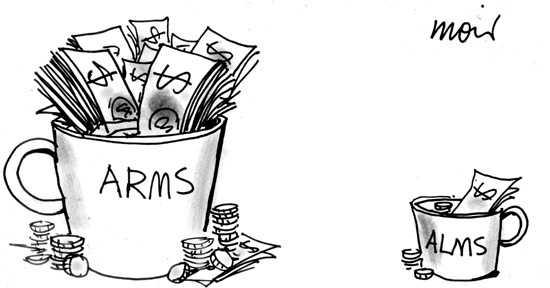
Moir
What is worse is that though lots of big, generous promises are made, many of them are not kept. John Quiggin has more on this side of things.
What is sad is the way the right cannot resist playing politics with this tragedy. Have a look at Gerard Baker's construction of a narrative about the Americans being blamed for the devastation caused by the Sumatran earthquake.I kid you not.
I guess the reasoning is this. You have to blame someone don't you, and, as God is dead, so it's either a cruel nature or the Americans. This then provides an excuse to have a go at the left's rabid anti-Americanism. And away Barker goes. This stuff is published in The Times and is then recycled in The Australian.
Just to show that I'm not making this up consider Gerard Baker's anti-Americanism "argument" in this paragraph:
"In the past three days I have been impressed by the originality of the latest critiques of the evil Americans. The earthquake and tsunami apparently had something to do with global warming, environmentalists say, caused of course by greedy American motorists. Then there was the rumour that the US military base at Diego Garcia was forewarned of the impending disaster and presumably because of some CIA-approved plot to undermine Islamic movements in Indonesia and Thailand did nothing about it.
To be fair, even the most animated America-hater, though, baulks at the idea of blaming George W. Bush for the destruction and death in southern Asia. But the US is blamed for not responding generously enough to help the victims of the catastrophe. A UN official this week derided Washington's contribution as stingy.
It is a label that fits the general image abroad of greedy, self-absorbed Americans. They neither know nor care much about the woes of the rest of the world, do they?....I have been sneeringly asked once or twice this week by contemptuous British friends."
Baker goes from the paranoid left, to some British friends, to the UN! Very elastic "reasoning" that. The rest of the article is then taken up with the tight "refutation" of the "argument".It ends with based on a celebration of technology that allows us to control and master nature.
QED. And the old cliches are reinforced to boot.
Amazing. Simply amazing. I read it three times. I'm still shaking my head at the elasticity parading as witty rhetoric. The tectonic plates on the seabed off Sumatra slipped and collided. Nature has real powers. It is not a construct.
It is not just the lack of reasoning that is amazing. What is astounding is that Baker misses the realpolitik politics of America's image in the region by a country mile; and he fails to engage with the substantive argument against the US. The US offer of $35 million--up from the initial $15 million---is a miserly drop in the bucket. It is less than less than half what the Republicans will spend celebrating the Bush presidential inauguration later this month.
Some would say, aw heck, it's the silly season, after all. Give the poor old righties like Gerard Baker a break. And we know the neo-con's next line about the money--it's all about the US needing a strong military to defend freedom from the evil Islamofascist terrorists who hate us for what we are.
I cannot resist a bit of fun. My guess is that The Times is still suffering from from the cheap Xmas drinks put on by its proprietor at the office party.A low budget, cost saving Xmas cheer is what you'd expect isn't it. After all, the proprietor is an American. And Baker lives in Washington does he not? Does not George Bush lives on a ranch in Texas? I meet a journalist once who told that .....The Times has gone downhill because it has been too Americanized etc etc.
See how you can do anything you want with Baker's kind of elasticity.
We should forget the nonsense in the op-ed pages in The Australian and turn to Geoffrey MG's Beyond Wallacia, which is much more informative about what is a happening on the ground in northwestern Indonesia.
Wikipedia has a very good entry on the Indian Ocean earthquake and tsunami.
Update
Wizbang takes a different political tack to Gerard Baker.The right care more about the tsunami and its devastation than the left because the latter have posted less than the right on this issue.
"Still I have to wonder... We are continually told how much more liberals care more about their fellow man than conservatives, yet 60,000 people are presumed dead and many of the liberals hardly mention it...The numbers don't seem to tell the same story."
Best to let that one about liberals lacking compassion go whizzing bye. It is an American game.
Posted by Gary Sauer-Thompson at 08:41 AM | Comments (0) | TrackBack
December 30, 2004
Tsunami disaster #2
Survivors search a photo board of the dead as they hunt for lost family and friends in Velankani beach on the outskirts of Nagapattinam, 350 km south of the southern Indian city of Madras.
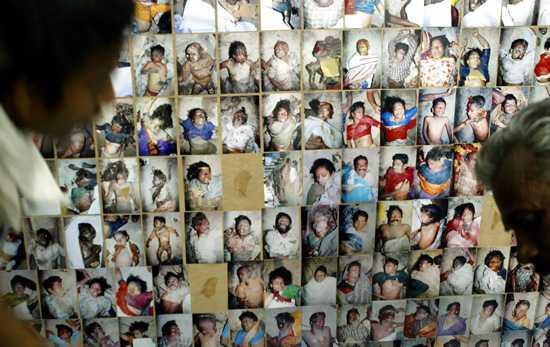
Reuters
Numerous aftershocks of magnitude 5.0 or greater have rocked the southeast Asia region since Sunday, with the most recent one, with a magnitude 5.7 struck 75 km (47 miles) west-southwest of Banda Aceh, Indonesia. These are too weak to cause additional tsunamis.
The Washington Post's map of the Indian Ocean region ravaged by the massive undersea earthquake and subsequent tsunami caused by movement amongst the tectonic plates in the Sumatra-Andaman Islands region. An impact map. The devastation in Sumatra recalls Krakatoa.
The death toll from the tsunamis and the earthquake itself may be matched by people in the devastated communities dying from communicable diseases (eg., cholera, typhoid) as from the tsunamis.
Things are not looking good in Aceh province in Indonesia. Relief is in short supply as the aid arriving at the airfield is not being distributed by the Indonesian military and government authorities. Apparently there is a policy policy of keeping all but members of the military out of the strife-torn province. The relief effort and the recovery of bodies, is only clicking into gear three days after the catastrophe struck. So survivors in Aceh face starvation.
A big failure lies with the lack of an equivalent to the Pacific Tsunami Warning Center, which is responsible for tsunami monitoring in the Pacific Basin. No such warning system exists for the Bay of Bengal where the recent disaster occurred. Can the finger be pointed at the Australian Government for this? Should it?
Update
A comment from IRant
Can the finger can be pointed at the Australian government for the lack of a warning system for Thailand, Indonesia, India etc?
"I think it is poor form to implicate the Australian government for lack of a warning system. The impetus and political will for a warning system has to come from the governments within the affected area. Indeed, such a system was proposed but due to the costs and the fact tsunamis are relatively rare occurence in the area compared to the Pacific such an idea was abandoned.
This article has some more info.I have no problem with pointing fingers when it is justified, but in this instance it is totally unwarranted."
Gary's Response
IRant Maybe. Australia could help to kick things long though.We are geographically part of the Indian Ocean,and we have more scientific resources to do this than Indonesia or Bangladesh.We should be good neighbours on issues like this. We are to turned to the Pacific.
Another, more selfish consideration.
At 1.59am on Xmas eve there was an earthquake measuring 8.1 in the sea north of Macquarie Island. It was one of the bigger earthquakes in the past 100 years and it could have triggered a tsunami, if the tectonic plates had collided rather than slipped past each other. If they had collided we could have kissed Kangaroo Island and the coastal towns along South Australia's southern coast line goodbye. The tsunami would have flooded the western suburbs of Adelaide.
And there would have been no warning.So Australia is cavalier and negligent. The example shows that tsunami's could hit this continent from any direction. Australia needs a tsunami warning system.
That warning system could be linked into one for south east Asia/ the Indian Ocean.
Update
Shaun ((IRant) replies to my response:
"Re you reponse I think Australia has and will be urging the creation of a warning system. Geoscience Australia did issue a report in September last year stating a system should be put in place for the Indian Ocean.
As for your comments re the Macqaurie Island quake, I've emailed
Geoscience Australia as it is a good question. Let you know if I get
a reply. I also found the following discussion from the 7:30 Report on the ABC."
Gary adds that Geoscience Australia is aware of the issues. So is it the federal pollies dragging their heels on this kind of security?
Posted by Gary Sauer-Thompson at 08:24 AM | Comments (0) | TrackBack
comment spam
Due to heavy spamming over Xmas the file mt-comments.cgi has been disabled. So the comments function is turned off. No comments can be made. The trackback function does not work.
These spammers sure are bottom feeders. Their destructive actions indicate the way that capitalism destroys the public commons and why the free market needs regulating and policing.
I am currently in the process of a long overdue upgrade to Movable Type v3.14 plus MT-blacklist as a first step to deal with the pernicious comment spam problem. It would appear that there has been a targeting of MT, due to the popularity of its publishing system, by the spammers.
In the meantime I have been using the old ISP banning method.However, as the spammers had so many domains in their arsenal, trying to add each of them as a Blacklist string was futile. It was fighting a losing battle. I was spending hours over Xmas deleting their comments on a slow dialup.
The reason I stayed put with this for so long was that I've been waiting for Movable Type to fix the bugs in their MT-blacklist software that resulted in escalating comment spam that caused extreme server loads. Movable Type has been working on the problem.
I'm not sure whether the spam comment problem has been solved. People are voting with their feet and moving on: --onto WordPress. I've decided to pay my monies to the now corporatised Moveable Type and to stick with them. Things are changing in the blogging world.
In the meantime--until the upgrade and plugins have gone through--comments can be emailed to me and I will incorporate them into the post as an update, to which I may respond.
Update
The Movable Type upgrade has been successful.However, problems are currently being experienced with the Movable Type comment spam Blacklist plugin. It will be addressed tomorrow with the help of some local tech support.
Posted by Gary Sauer-Thompson at 06:04 AM | Comments (0) | TrackBack
December 29, 2004
Wal-Mart
The discount retailer Wal-Mart is Fortune's most admired corporation. It has taken advantage of the rise of information technology and utilized the explosion of the global economy to outsource its supplies and gained control of the supply chain.
Wal-Mart's low-wage model, technologically efficiency and global reach has changed the balance of power in the business world. It has become the template of American capitalism in the 21st century. It has become one of the most profitable companies in the world and the darling of Wall Street.
Does Wal-Mart represent the future of retailing in Australia? One in which the mass global retailer is the center of economic power?
When Wal-Mart moves into a community, other, smaller retailers get pushed out, because Wal-Mart can undercut their prices 20, 30 percent. Wal-Mart can stay there. Other retailers leave. On the supply side Wal-Mart squeezes its suppliers. They cannot pass higher costs on to Wal-Mart, because Wal-Mart is so big. The suppliers can't make profits and they are finding that they can't meet Wal-Mart prices. So Wal-Mart goes offshore to China and the suppliers go out of business if they aren't able to go offshore to set up low cost production.
Wal-Mart is a world of low wages and poor benefits, sex discrimination against women, tough conformity, a rigid hierarchy and authoritarianism.
It is a new world of the working poor spent scraping by on the poverty line, anti-union company, corporate welfare and exploitation of the working poor as central to its business strategy. This is a workforce which rapidly turns over because the technology means that you can just slot one person into the job with no training and no sort of background.
Is this new American model for employment the future of Australian capitalism, rather than an innovation model based on higher wages, new products and good benefits for Australian workers?
Posted by Gary Sauer-Thompson at 07:27 AM | Comments (1) | TrackBack
a historical eye
A quote from the New York Review of Books. It concludes an article entitled 'On War' by Chris Hedges.
"We are losing the war in Iraq. There has been a steady increase in the assaults carried out by the insurgents against coalition forces. The attacks over the past year have risen from about twenty a day to approximately 120. We are an isolated and reviled nation. We are tyrants to others weaker than ourselves. We have lost sight of our democratic ideals. Thucydides wrote of Athens' expanding empire and how this empire led it to become a tyrant abroad and then a tyrant at home. The tyranny Athens imposed on others it finally imposed on itself. If we do not confront our hubris and the lies told to justify the killing and mask the destruction carried out in our name in Iraq, if we do not grasp the moral corrosiveness of empire and occupation, if we continue to allow force and violence to be our primary form of communication, we will not so much defeat dictators like Saddam Hussein as become them. "
It captures the way the US republic is being overtaken by empire.
Posted by Gary Sauer-Thompson at 07:08 AM | Comments (0) | TrackBack
December 28, 2004
Tsunami disaster
I've been out of action and decoupled from the news for the last couple of days because of the Xmas thing. I've only just caught the news about the natural disaster in south East Asia.
A magnitude 9 earthquake, caused by a slippage in the earth's plates, struck off the west coast of the Indonesian island of Sumatra early Sunday. It then unleashed waves (tsunami's) up to 10 metres high that roared across the Bay of Bengal at 800kph, ripping into Thailand in an hour and striking Sri Lanka and India within two and a half hours. The waves raced 4,500 km to Africa, killing hundreds of people in Somalia and three in the Seychelles.
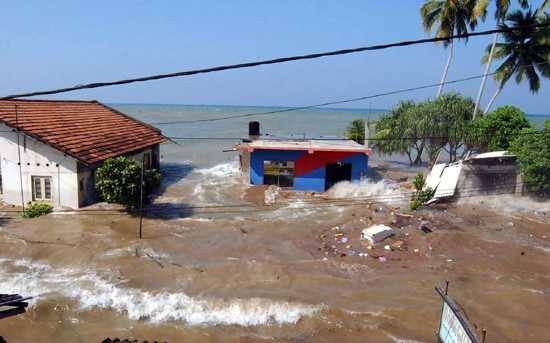
The tsunami crashes through houses at Maddampegama, Sri Lanka, AP
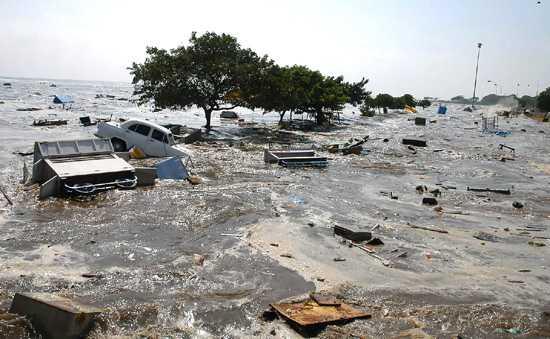
Marina beach in Madras, AFP
Thousands of kilometres of coastline from Indonesia to Somalia were battered by Sunday's deadly waves. Australia escaped.
Current estimates are that the carnage from both the Indian Ocean earthquake and tsunami will be more than 24,000 dead. The Indonesian Government is estimating that up to 25,000 people on Sumatra island alone have been killed, with most of the deaths in Indonesia in the Aceh province, on the northern tip of Sumatra Island. In Sri Lanka the toll is above 18,000; 10,000 in India and 2000 in Thailand.
Uncovered bloated and bruised bodies are everwhere in the midday sun. A lot of fishing villages have been wiped out, along with the means for earning a livelihood. It is a human tragedy.
In philosophy I01 these natural disasters are called "acts of God" rather than the awful power of Mother Nature. What the university lecturers were trying to get at is that there is no moral responsibility for this kind of evil (human tragedy), as it is not caused by human beings.Though it may create problesm for those who believe in an interventionist God.The moral finger can be pointed at the failure to establish a tsunami warning system in the Indian Ocean.
Update: 30 Dec.
One eyewitness account of the tsunami that has left millions homeless in countries from south-east Asia to Africa.
Mass graves are being dug. Bodies burned.
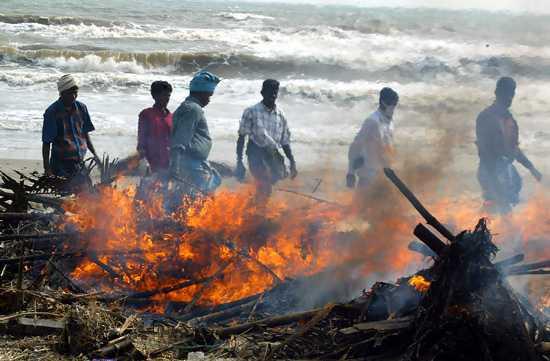
AP, Volunteers cremate bodies recovered from the debris in Nagapattinam, India
Many bodies are so bloated and fly-blown that it is impossible to tell even their sex. The stench of decomposing bodies fills the air as hungry people scavenge to find food and fresh water.
The danger is that waterborne diseases, such as cholera, could kill a lot more people due to contaminated water and food. Cholera is endemic in Sri Lanka and southern India, two of the countries worst hit by the tsunami. The bacterium is likely to be present in mangrove swamps. Outbreaks often follow flooding, when the bacterium can contaminate supplies of drinking water.
The death toll keeps climbing rapidly.The final death toll in the Indonesian province of Aceh, which bore the brunt of the Indian Ocean tsunami, could be as high as 80,000. The death toll could exceed 100,000.
This is shaping to be a major natural disaster and a human catastrophe.
Posted by Gary Sauer-Thompson at 03:41 PM | Comments (0) | TrackBack
December 27, 2004
Gunns v Greens#3
An article in The Age by Steven Curry that responds to Greg Barnes defence of Gunns. Curry in support of my position, that the Gunns suit is a SLAPP designed to damage as many prominent foes as possible and to hurt the protest movement. It is a use of the civil courts to undermine basic democratic values.
In commenting on my criticism of Barnes Rick took issue with my argument about needing to shift from the logging of old growth forests to plantations to ensure a sustainable forestry. These comments are too important to be left in the comments section of that earlier post. I am posting it in full.
Rick says:
"In very approximate proportions, the nation’s wood comes about one third each from plantations, native forests and imports. The main point here is that as native forests close down as sources, the proportion of imports increases. This shift is taking place now, and if the plantations had the capacity to pick up where the native forests leave off, I wouldn’t be arguing with you now.
In terms of sawn wood, the plantations that are ready for harvest now were planted in the 60’s, 70’s and 80’s. There is some wood coming from younger plantations, but this would be from highly productive sites, and thinnings, much of the latter being undersize, marketed as posts or chipped for particleboard and paper.
There is a belief around that we have enough plantation resource to supply everything we need, and there is even a resource economist, whose name escapes me, who has written a paper to this effect. Apparently there is a conspiracy to withhold plantation resources so that we can knock over more native forest. She is, in the opinion of the industry, wrong. I haven’t read the paper, but the fundamental gap in her argument to me is that plantations are expensive to establish, and the longer the interval between establishment and harvest, the worse the economics look. Private and government organisations that established plantations that are approaching final harvest now have been paying interest on those investments for decades. If you do the analysis of the present value of a future sum of money, you’ll see that the long period between establishment and financial return makes sawlog plantations a risky investment. The ever-accumulating interest (govt departments pay interest too) is the main burden. So in this situation, to argue that any plantation owner would deliberately delay harvest for long periods of time is to argue that money is free. Another particularly important point is that plantations reach a harvestable size and then wood production slows down without further thinning. Modern pine mills are also not built to saw large logs, so the cost of milling “over mature” logs begins to rise. There are many details glossed over here, such as early revenue from thinnings and silvicultural strategies, but this will be too long as it is. Basically, a plantation management timetable is determined by silviculture (agronomy for trees) and economics. Conspiracy theories about this are like most conspiracy theories; a shred of evidence and a lot of imagination.
It is normal to say “they” should have planted more plantations in the 70’s and 80’s. Back in those days, social attitudes were different, support for plantations was much less and hindsight has always been excellent.
More plantations should be established now, I don’t think there is any disagreement between us on that. A few points:
1. New sawlog plantations will not come onto the market for many years, and we need to be discussing where our wood should come from in the interim decades. The current situation looks to me like we will import much/most of it from the rainforests of Asia because that’s the cheapest source.
2. Long rotation sawlog plantations don’t look very attractive compared to a pulpwood plantation harvested once at age 10. At present most of the private investment goes to pulpwood. Why? 10 years fits within a working life. Not many people early in their working life have the wealth to invest in longer rotation plantations. Consequently most of the sawlog investment comes from corporations, of which Gunns is one of the most prominent.
3. From the industry side, things look bleak. Our opponents may say “they have brought it on themselves”. But they must realise that an industry with an uncertain future doesn’t attract finance readily for 20-40 year investments. As evidence, Wesfarmers, who bought Bunnings and have sold the timber production side of the business as quickly as possible. Meantime, the timber and hardware sales side of Bunnings is an economic flagship. We are collectively busy buying wood, but we don’t understand what it takes to make it.
4. I have mentioned previously that there have been concerns expressed by Brown that too much prime farmland is being swallowed up by bluegums. The most vitriolic criticism of forestry is directed at woodchipping. The modern bluegum plantations are a deliberate strategy, initiated in the late 80’s with levies on native forest woodchip exports in WA, to establish a plantation resource to supplement, and then perhaps even replace, the native forest resource. This is an example of industry financing, under government pressure, the development of a plantation wood resource for a particular market. The result is further criticism and the principal proponent of this strategy has been vilified as the worst thing to happen to WA forestry by the greens and he has been reskilled. The worst fallout from this is the implication that forestry will be attacked no matter what it does. Not a healthy social environment for long-term investment.
5. We already have plantations, even pine, that are impossible or difficult to log because of public concern about the aesthetic impact. This is not public belligerence, but it demonstrates the somewhat irrational nature of the human animal. We all like a sense of continuity and dramatic changes to the landscape cause concern. Hence there is usually strong opposition to the establishment of plantations if they are large scale and impact on the visual character of a district. The next generation of people grow up used to the plantations and then oppose the harvesting phase. Normal behaviour; I’ve heard anecdotes along these lines from around the world.
6. The plantation industry is commonly criticised for using monocultures. This is a basic economic requirement for the production of wood and with the high cost of establishment of plantations on one side and the cheap resource in neighbouring Asian forests on the other, monocultures are here to stay. If you look at European forests, they are very largely monocultures and people there are very attached to their plantation forests as a place of recreation. (They also don’t seem to have much trouble, to my knowledge in Sweden, Finland, France, Germany and Austria, with harvesting those forests in the full view of the public.) I have noticed anecdotally that there is mounting opposition from green people to the bluegum plantations in WA due to this monoculture concern.
7. There is discussion about, and some trials, growing mixed species of native trees in plantations. These will be more expensive to manage, but we could pay more for our wood, especially when the Asian forests run out in the future. But if there are instances of people becoming attached to their neighbourhood pine plantations, there is a strong possibility that today’s mixed native species plantation will be tomorrow’s high conservation value forest. This happens virtually every time a regrowth native forest (argued by most people to be appropriate for timber harvesting) approaches final harvest. This point also demonstrates the irrationality of, or at least circular logic of, the belief that harvesting forests “destroys” the forest.
In general, you are arguing sensibly that there should be a move from native to plantation forests, and most people do the same. As individuals. But if you take the general form of public opinion, which is what influences political behaviour and policy, the situation is different. Public opinion sloshes around under the influence of many factors, but it is comparatively easy for a dissenting minority to stir up support AGAINST many issues. It is very difficult to harness such unified public support FOR a complex reasoned argument. When it comes to intergenerational resource production and management, we don’t seem to be coping very well.
The RFAs were an attempt to develop a negotiated long-term strategy, with all parties at the table. I am not aware of the details nationally, but my understanding is that the major green groups refused to participate in this process because by standing aside from the negotiating table, they were free to then attack the Agreements as soon as they emerged. It must have been difficult for the greens to sit at the table with the industry if government and industry have responsibility for supplying the nation with the wood it consumes. There will always be a gulf between those with ideals and those with responsibilities. Politically, this has been a most successful green strategy and it even calls into question, are they about responsible resource management, a genuine practical balance between our consumption of resources on one hand and the protection the environment on the other, or are they just out for political influence? When your genuinely held fundamental aim is to “save the world” (who can oppose such an ideal?), almost any means could be justified by the end.
In terms of responsible long-term resource management, the RFA process seems have been a disaster. Decisions were made without the benefit of a stronger conservation influence. The situation is now more chaotic than it was before. Why are we surprised that there is inadequate plantation resource being established?
I consider it reasonable to conclude that the core of the green movement is indirectly working for the removal of commercial forestry from this country. They don’t have that as a formal part of their platform, probably very few if any of them recognise what impact they are having. But the net real effect of their efforts is that commercial forestry in this country is too expensive and subject to too many wild swings in the public mood (measured over the length of a forest rotation). The industry here will diminish further and responsibility for our wood resource will move off shore, because there is a lot of cheap old growth forest over there, at the moment."
Posted by Gary Sauer-Thompson at 10:46 PM | Comments (0) | TrackBack
December 26, 2004
Santa's complaint
I've always seen the Bush Administration as engaged in the rollback of environmental legislation that was designed to protect public health and the environment.
Santa is not overly happy with the environmental state of affairs in the US:

Sounds like the US is not doing all that great a job in maintain healthy air quality by controlling air pollution these days.
It wouldn't have anything to do with the Bush Administration protecting the energy industry by allowing it to continue polluting without using state of the art mercury controls, would it? The Bush adminstration is weakening the clean air laws, and that means that millions more tons of soot, smog, and toxic pollution to be spewed into US air each year.
Presumably public health takes second place to profits in a Republican USA. A blind Republican eye is turned to airborne mercury pollution from smokestacks rains down on our rivers and lakes where it accumulates in the food chain, especially fish. Anyone who eats contaminated fish, particularly children, is at risk, since mercury exposure can cause irreversible damage to the brain, kidneys, and cardiovascular system. Exposure to mercury is also known to reduce fertility.
Posted by Gary Sauer-Thompson at 09:25 AM | Comments (0) | TrackBack
December 25, 2004
Xmas in Iraq
The offical line from Washington is that Iraq is a part of the war on terror, the war was going well, and that anyone who reckons otherwise is a defeatist liberal uninterested in bringing democracy to the Middle East. There is an Iraqi insurgency, but it is made up exclusively of foreign fighters led by the Jordanian-born terrorist Abu Musab al-Zarqawi.
So have a read of Dahr Jamail's Iraq Dispatches

Too strong?
Then read Riverbend.
It is catch 22 for the US. The insurgency required forceful action to put down but that any such action could further alienate the Iraqi population, thus fueling the insurgency.
What is not being said is that a majority of Iraqis angry at Americans. Americans have invaded their country, have killed anywhere between 10,000 and 100,000 civilians, plus an unknown number of combatants in the regular Iraqi army or the resistance, and have vowed to transform their country politically—beginning with the banishment from public life of scores of thousands of Baath Party members who ran things for thirty years before the Americans came.
As Thomas Powers says it's a classic scenario: "an invasion followed by military occupation backing a client government has encountered resistance. What else would we expect?"
Yet the Americans persist in saying that opponents of the occupation are a mixture of die-hard Baathists, dead-enders, and Saddam Hussein loyalists and foreigners generally described as loyal to Abu Musab al-Zarqawi, who is said to be an ally of Osama bin Laden or an associate of al-Qaeda.
You can only infer that the White House refuses to concede that what is happening on the ground: that the actual resistance the US meets in Iraq is angry and nationalist in an uncomplicated way.
Posted by Gary Sauer-Thompson at 08:10 AM | Comments (0) | TrackBack
December 24, 2004
God's commands
Whilst we in Australia relax and enjoy ourselves over the next few days, let us remember all those in the Middle East whose lives are at risk on a daily basis.

And when we have a quiet mo in celebrating a Christian festival that defines Xmas, let us remember the way that religion has been, and is used, to justify political claims.
A contemporay example is the way the Israeli right assert that the Old Testament has given Israel the divine right to take possession of the Holy Land and to forcibly expel the indigenous population.
That biblical mandate is being fulfilled by the settler movement. This is a political program sanctioned by religion and it both justifies, and distorts, the Zionist program of a Jewish nation state.
A look into the contents of the political unconscious of the right wing settler movement. That movement has bought about the integration of the territories in Israel, or more accurately, the deepening of the annexation by the Israeli state.
Few expect Sharon to dismantle the main settlements in the West Bank, which slice that territory into cantons. Despite this, Israel is undergoing a political crisis of the occupation.
Posted by Gary Sauer-Thompson at 03:45 PM | Comments (2) | TrackBack
December 23, 2004
the new crusade
The Americans are in a state of denial about Iraq.They are in a situation where their crusade to democratise the Middle East and turn it into a dependency in their empire has become bogged down into a Vietnam War-style scenario.

As David Day observes in The Australian:
"It is a situation in which the towns and cities of Iraq will continue to be laid waste by the devastating firepower of the US air force and artillery while the deadly bombings of the insurgents take a similarly indiscriminating toll on the inhabitants."
As long as US forces remain in effective occupation, the insurgency will continue. The rubble of the neo-conservative strategy lies all around Iraq.
The Bush administration's obsession with shock and awe is a result of its misunderstanding of the war it is fighting, which is political and not military. The "shock and awe" of American regional dominance [is] turning into a daily spectacle of ineptitude and failure because the military commanders have no sense of politics or diplomacy.
My judgement is that in the long run Iraq will have a Shi'ite-led regime in aligned with Iran. What then for the US? Continuing to define its Middle East strategy in terms of Israel's national interests and take a hard line based on bombing Iran's nuclear facilities and engineering regime change? Continue to caricature Iran's regional foreign policy in terms of Iran being a "rogue" power that aims to overthrow its neighbors?
Iraq's future alignment with Iran suggests that the neo-conservative dream of total American hegemony without need of allies or international law is being exposed as an impossible one.
To see the limits or constraints of the neo-conservastive's geo-political strategy can be seen in the Middle East go to this post at the excellent chez Nadezhda
Posted by Gary Sauer-Thompson at 01:33 AM | Comments (2) | TrackBack
December 22, 2004
wishful thinking
Climate change is hurting Australia - increased droughts and bushfires, the destruction of our coral reefs. Over the next 50 years there will severe damage to Australia's ecosystems: to Kakadu National Park, extinctions in North Queensland's highland tropical forest and the probable destruction of the Great Barrier Reef.
Senator Campbell, the Environment Minister, would know all of this when he went to Buenos Aires last week. He would also know the implications it has for Australia's miracle economy. One would hope that he has been so briefed.
So what is Australia going to do post-Kyoto---after 2012?
So 
Moir
I'm not certain that Australia has been that courageous in breaking with the US, which increases emissions while pretending to do reduce greenhouse intensity. The US is not going to do very much to reduce to reduce domestic greenhouse emissions, even though it is world's largest producer of greenhouse gas emissions.
Australia and the US have previously firmly stood together on their objections to signing the Kyoto protocol on climate warming, which comes into force next year. What Senator Campbell says is that Australia does not agree with the US stance against future greenhouse gas targets, or its claim that economic growth and technology were the answer to reducing heat-trapping emissions.
But Australia is not going to met its Kyoto commitment by joining an international emissions trading markets, which start early 2005. Nor is going to put a price on greenhouse pollution through a revenue neutral carbon levy.
Nor is Australia going to pour billions of dollars into clean energy research to utilize the natural sunlight advantage we have? Australia is not going to support the development of a stronger renewable energy industry through a Mandatory Renewable Energy Target of 10% by 2010 and 20%.
So what happens when Australia can no longer rely on reductions in land use to buffer its growth in energy-related emissions.
Are not energy production and transport related emissions predicted to rise by over 30 percent by 2012, from 1990 levels? Does that not mean Australian industry will have to invest heavily in order to meet future emissions reduction targets?
There is very little action at this stage.
Update
Is it not strange the way that the gungho free marketeers, such as Alan Oxley writing in the Australian Financial Review, (20 12 2004, p. 47) oppose the use of markets to help reduce greenhouse emissions?
Oxley fogs the issue of governance of the global economy by following the US line that says that the science, which supports the contention that global warming is partly man made, is unravelling. So there is no greenhouse problem. It is about green activists creating state of fear. This is the denial argument.
The insurance companies are not fooled by this kind of faulty reasoning. They know about the rapidly rising payments resulting from more severe and frequent hurricanes, heat waves and flooding. They acknowledge that extreme weather patterns have always existed, but they maintain that their frequency and intensity has been increasing because of global warming.
Oxley backtracks. In the next paragraph to the one above he talks about Australia rightfully following the lead of the US in focusing on "practical policies to reduce emissions and avoid the economically damaging strategy of energy costs". So there is a greenhouse emission/global problem after all.
What is astonishing is that the Australian Financial Review continues to publishes this kind of twaddle. Presumably they hold that anything that hinders or reduces economic growth is bad. By economic growth on this issue they can only mean the profits of the energy intensive industries. That is what is being defended. Energy policy in Australia is currently run to protect the economic interests particular groups of energy industries.
Where then are Australia's practical programs to reduce emissions and avoid raising energy costs?
Is that not a question the AFR should be asking of the Howard government? Is that not a challenge of governance as much as tax cuts and welfare reform?
Posted by Gary Sauer-Thompson at 05:39 AM | Comments (6) | TrackBack
December 21, 2004
Gunns v Greens#2
I'm reposting this comment by Rick Giles from an earlier Gunns versus the Greens post. These comments are too valuable to languish in the comments section of an old post. They represent a different perspective to my one, and so present the other side of a public debate.
Rick's post is more than a much needed corrective, to my own views. They are also more informed about current forestry practices than my own views which are that logging of old growth forests should stop, there should be a transition to plantations, and that Tasmania should shift away from a reliance on wood chips to a knowledge economy. This, if you like, is the other side of the debate.
Rick Giles
'Is there a difference in principle between making defamatory accusations against a person in order to cause them financial harm, and running a public campaign to destroy an industry? I would say they are two similar shades of grey.
The forests debate is founded upon the truism that logging is bad, and as Gary says, the forests debate will be decided in the court of public opinion. But surely there are good grounds to say that the forests debate should also be conducted on technical grounds. Logging is undeniably an ugly (as in lacking aesthetic values) practice, but is it the most destructive form of land use? In some instances it is very bad, but if logging is conducted properly and followed by successful regeneration, it is much less destructive than farming, where ecosystems are eradicated permanently.
In my home state, there is strident opposition to logging, but not a word of opposition from anyone about broad-scale strip-mining of the same forest, which involves logging, clearing and burning of the residue vegetation, removal of 3-4 metres of bauxite ore, replacement of 0.5m of topsoil and revegetation. The soil profile is substantially and irreversably changed by mining due to the removal of most of the well-structured soil, leaving a shallow topsoil on top of a kaolin clay. The fact that logging is not opposed when it is followed immediately by mining, but is opposed if followed by conventional forest regeneration, suggests to me that much of the forests debate is about emotive responses stimulated by some politicians and a number of unelected activits for their own personal benefit.
Perhaps Gunns will be able to force their opponents to have their assertions about the impacts of logging tested in court, or perhaps they are as you say, just forcing defendants to expend their resources in legal defence. I'm sure there will be a number of lawyers who have strong opinions about forestry, something that they know almost nothing about, who will provide a defence pro bono.
If the purpose is to force the matter to a head, it could be seen as a test case for the question, is it legal to conduct forestry in Australia? If the decision is no, or if as you say the court of public opinion decides no and overrules the legal court in any case, where should Australia gets its wood? Wood and wood products are already our third largest import, and much of it comes from forests being cleared to palm oil plantations in Asia. Substitute materials such as plastics and steel are heavy net emitters of carbon dioxide (construction wood sequesters more CO2 than it emits).
It is understood that forestry is perceived to be the worst form of land use known to man, but good forest practice is not. Let's see this tested in a court, where simple slogans and hysterical claims (from either side) can be exposed to some rigorous analysis.
If people elect to continually slander others for personal gain (whether the gain is in the form of a sense of self-worth, prestige, power, or political influence), then they must appreciate that at some point the subjects of their attack may seek to defend themselves. The reason why some argue that Gunns should not be permitted to defend themselves is that forestry is believed to be morally indefensible, even by the public who use the fibre it produces. Furthermore, it is assumed that Gunns' opponents are morally pure and not tainted by vested interest. This is a charmingly naive assumption.'
Rick Giles
Rick's position is supported by this op-piece by Greg Barnes who contest my own view that Gunns are using SLAPPS to silence debate. He says:
"In other words, there is a balance that needs to be achieved in any democracy between the right to freedom of speech, and potential harm done to others as a result of the exercise of that right. In the Gunns case, it is important to protect the right of the company to go about its lawful business, just as it is important to allow individuals and groups to protest against the company's business activities."
Barnes adds that if companies have no rights to seek legal redress to protect their rights and interests against what they regard as unlawful actions then the result will be anarchy.
Posted by Gary Sauer-Thompson at 05:01 PM | Comments (8) | TrackBack
December 20, 2004
Xmas cheer
You could say that Australia's energy policy is a black hole.

It is a bit of a stalemate in terms of energy independence, security and sustainability. For the right, writing in The Australian Financial Review, energy policy is all about the coal industry and protecting the energy intensive industries. It claims that limiting greenhouse gas emissions is so costly that it will wreck the economy; that wind power is a confidence trick; and that renewable energy is an industry that loses millions of dollars.
Meanwhile, the aspirational suburban project homes---McMansions--- continue to be built on little blocks of land in suburban wastelands with little public amenities and a reliance on private transport. The McMansions have little energy or water efficiency, have little insulation and rely on airconditioners in the winter and summer that depend on the electricity generated by coal-fired power stations. The environmental impact of fossil fuels is ignored.
The right in the media thunders that urban design and planning strangles the market, threatens jobs, and takes away people's choice. And the green activists, nay, zealots go round threatening other people's livelihoods in order to make themselves feel good or enhance their social lives.
The failure to align the market with environmental policy is the reason why Australia's energy policy is a blackhole.
Posted by Gary Sauer-Thompson at 09:43 AM | Comments (4) | TrackBack
December 19, 2004
voice of the past
In Wednesdays Australian Financial Review there was an op ed piece from the US economic liberal Milton Friedman. As I recall Friedman was at the cutting edge of the critique of Keynesian economic management in the 1970s. He was a leading advocate of the monetarist doctrine that money supply and monetary (not fiscal) policy is (almost) all that matters.
Remember all that policy advice that Government's should not attempt to lower unemployment below the natural rate (5%?) since it is costly to maintain and temporary anyway. However, government should attempt to lower inflation which is permanent and relatively costless in the long-run. So governments should disinflate by aiming for an unemployment level higher than the natural rate, to achieve lower rates of inflation. Inflation was the key policy concern.
Now remember that Friedman was also opposed to the welfare state on principle. The free market always yields the best of all possible worlds. The poor unemployed.
So what is the old political warhorse saying today? He says:
"To summarize: after World War 11 opinion was socialist while practice was free market; at present opinion is free market while practice is heavily socialist. We have largely won the battle of ideas (though no such battle is ever won permanently); we have succeeded in stalling the progress of socialism, but we have not succeed in reversing its course. We are still far from bringing practice into conformity with opinion."
At one level this is quaint. Friedman conflates communism, socialism and social democracy into "socialism." Hence, the welfare state, that historic compromse between capital and labour, constructed by social democrats to ensure security and social justice, is the equivalent to the centrally planned socialism of Soviet Russia. Social democracy and socialism are two different forms of social organization.
Now Friedman does draw a distinction between 'welfare' and the traditional socialist belief in public ownership of the means of production, seeing the former growing at the expense of the latter he still uses socialism as a blanket label.This conveniently ignores the areas of the social life where free markets do not work as well as public provision (eg., health, police, law, social security, aged care, punishment ). The implication is that there is one opposing view to Friedman's libertarianism.
John Quiggin has more on this.
At another level Friedman's duality of 'opinion and practice' is a reworking of economics and politics that collapses politics into the economics of free enteprise, self-regulating markets and individualism.
As Friedman says elsewhere his basic long-run objectives are political freedom, economic efficiency and substantial equality of economic power. He reckons that all three objectives can best be realized by relying, as far as possible, on a market mechanism within a competitive order to organize the utilization of economic resources.
These political views are an expression of a libertarian political doctrine that argues for expanding individual freedom by limiting government.
The economics is the arguments about the stability of a market system that adjusts automatically to market-clearing equilibrium. Since the economic system is inherently stable, it is the mistaken policies by monetary authorities and other government agencies that destabilize it.
Posted by Gary Sauer-Thompson at 10:59 AM | Comments (0) | TrackBack
December 18, 2004
political portraits
I don't really care all that much about ranking the Australia's Prime Ministers as to who was the greatest.
That view presupposes the great man view of history, which I reject in favour of great historical forces sweeping us vulnerable and fragile human beings along. It is the mass of humanity within economic and political relationships that drives history.
Those historical forces trash our sacred laws, tear at our bodies, leave us damaged, wounded,and scurrying for safety. If you look back on where we came during the 20th century we see wreckage upon wreckage piling up, and discern the "grief" and "helpless sadness the tragedies and monstrous sacrifices have caused.
History may well be a slaughterbench upon which the bodies an virtues of innocents have been sacrificed. But history is more than a "slaughter-bench," more a series of senseless tragedies, since the the basic structure of reality itself is rational. You can discern rationality at work in the struggle for freedom.
Oh well, that's enough Hegel for the weekend.
The composite image of our Prime Ministers as noble characters and historical beings appeals to me for some reason. Maybe it is because we can begin to understand that these individuals were limited by the constraints and forces in a particular period of Australia's national development.

Where are portraits of our Prime Ministers from the 1st half of the 20th century? Does our historical political consciousness only go back to 1940? Does our historical understanding acknowledge that none of these individuals overstepped their time---the world in which they found ourselves in?
The lives of these noble characters are suspended somewhere between the beasts and gods. Their good character, concern and care for others as they bult a state and nation was corrupted by historical adversity. They then used language as a persuasive force inside the game of power and revenge.
You can read the history they were a part of as the destruction of convention and the betrayal of trust. You can smell the blood, feel the lust for revenge, discern the hint of cannabalistic desires (politically speaking) and hear the screams as these friends tear the flesh of their opponents to bloody shreds.
This is history as tragedy. We are characters in the political machinery of that tragedy.
Posted by Gary Sauer-Thompson at 08:53 AM | Comments (0) | TrackBack
December 17, 2004
a telling quote
All the signs are that the Australian economy is set to enter next year with low growth rates, a growing trade deficit, a dying housing boom and high household debt. That downturn was starting to happen during the federal election but the ALP did not notice. It did not connect the big election spend to a slowing economyand point out the dangers.
In this context this is telling quote from Ross Gittens, which I found on the Crikey website. It is from a paper Gittens gave to the Australian Business Economists Annual Forecasting Conference. Gittens says:
"But, as Lindsay Tanner has pointed out, Labor's lack of credibility on the economy runs far deeper than just the crazy tactics it adopted in this campaign. Economists look back on Labor's time in government with not a little respect, but the Howard Government has worked assiduously for the past eight years to trash Labor's reputation as an economic manager, with Labor doing little to try to counter that assault. Why? Because, as Tanner says, since Paul Keating's defeat in 1996 his successors have been ambivalent towards Labor's record on economic reform. Labor's wanted to be seen as opposed to economic reform, not as the primary instigator of it. Little wonder it's lost whatever economic credibility it once had."
Very apt, even if Gittens is recycling the argument of Lindsay Tanner. Tanner has cause for concern. Why has there not been money spent on modernizing Australia's aging and dilapidated infrastructure (such as the rail network, electricity, telecommunications)? Where was the money to addres the skills shortages?
One needs to ask why the ALP's ambivalence to the reforms it initiated under Keating, given Latham's neo-liberal reform creditionals. What is preventing the ALP from developing a new economic narrative that includes Australian's experience of the profound change from the effect of globalisation and the information revolution on our daily lives. As Tanner says:
"We need to find new ways to maintain prosperity, social equity and economic justice in this radically different world in which we find ourselves. We also need to reconnect communities and tackle the growing problems of social dislocation in today's world."
Why cannot the ALP connect that insight to the need for Australians to lift their exports, without pulling the resources rabbit out of the hat.
Update
I see that Julia Gillard has made a speech in Melbourne saying that the ALP needed a new economic reform agenda. From reading Mark Davis' report in the Australian Financial Review it would appear that reform agenda would consist in using market forces to deliver more effective public services and a better environment.
Posted by Gary Sauer-Thompson at 11:01 AM | Comments (0) | TrackBack
December 16, 2004
anti-democracy tendencies
Gunns' is suing environmental activists opposed to its ecologically destructive logging practices in Tasmania.
Gunns has served writs on 20 individuals and groups, including Senator Bob Brown, Tasmanian Greens leader Peg Putt, the Wilderness Society and Doctors for Forests, citing their "ongoing damaging campaigns and activities" against the company.
The company has no commitment to arguing its logging case in public. It prefers using SLAPPS as a means of transforming public debate into lawsuits. Though this legal instrument fails legally, it ties people up because of the substantial investment of money, time, and resources to defend themselves. The resulting effect is a "chill" on public participation in, and open debate on, important public issues.
There ought to be a law that protects people from SLAPPs and defends the right of political speech of citizens in a liberal democracy. Gunn's anti-democratic response may well reflect the state of politics in Tasmania. Richard Flanagan writes:
"In Shakespearean terms, Tasmania is the play within the play; it always has been. Tasmania is now a corporate state. It has a supine government and an opposition that is an opposition in name alone. Its Labor Premier, Paul Lennon, demonstrated during the recent federal election campaign that his loyalty to the logging industry outweighed his commitment to a national Labor victory."
In the corporate state of Tasmania you are slapped down and punished for speaking out about the destruction wrought by logging the old growth forests.
What Gunns, as the SLAPPer, is trying to do in Victoria is to sue persons and groups in the green movement because they have communicated their views to government officials and tried to influence government action to stop the logging the old growth forests.
The concern about these kind of lawsuits is the negative impact they have on citizen participation and deliberatiion in our liberal democracy.
That does not concern Tim Blair. Both he and Steve Edwards over at the Daily Slander support Gunns in the power struggle to make Australia a more sustainable place to live. So they reject the notion that a healthy liberal democracy is based on the free exchange of ideas, and that citizens should be able to freely organise to influence public policy.
Steve Edwards says the Gunn SLAPP a good idea, since:
"keeping the Greens tied up in court will reduce their campaign funds, and therefore their ability to win Senate seats, hold the balance of power, and do untold damage to the Australian economy."
This is one indication of growing conservative intolerance for allowing dissenting voices to speak, let alone be listened to.
My judgement is that Gunns will lose in the national court of public opinion.That is where the battle for the forests will be decided.
Posted by Gary Sauer-Thompson at 08:32 AM | Comments (11) | TrackBack
December 15, 2004
mutual obligation#2
The public debate on mutual obligation as a mode of governing welfare dependency that has construct indigenous people as victim, continues. Some movement in sorting through the issues has been made by Pat Dodson and Noel Pearson. I will spell out what they say on this because they have cleared away some of the rubbish lying around.
They affirm that mutual obligation is a cultural principle of traditional Aboriginal society and say that government has a role in assisting Aboriginal communities to restore responsibility through mutual obligation. They then say:
"The mutual obligation agreement struck with the Aboriginal community at Mulan in Western Australia has been supported by the community's leadership, and should therefore be supported by the wider Australian community."
They qualify this affirmation of the Mulan agreement by asking a question about the detail:
"...what is the logical connection between the obligations that the government wants the community to commit to, and the incentives that it is offering in return? It is hard to see the natural connection between children's hygiene and the more convenient provision of petrol."
Dodson and Pearson then generalize the principle of the Mulan Agreement as the right pathway, and so displace the rights versus duties as the central issue of the debate. They say:
"Government and indigenous communities who no longer wish to sit on their hands while blindness is caused by trachoma, kidney failure is caused by scabies and deafness is caused by unresolved ear infections, should be supported."
A this point we should not forget to add that those indigenous communities who no longer wish to sit on their hands about violence against women by men, caused by alcohol and drugs, should also be supported:

Leak
Dodson and Pearson then address the responsibilities of Aboriginal people and those community leaders who are charged with engagement between the community and governments. These indigenous people:
".... have a responsibility to ensure that in the negotiation of the new relationship between Aboriginal people and governments, they obtain the resources needed to sustain their culture, language, physical wellbeing and other aspects of their lives for the future of our people - but not at the expense of the basic human rights of those whom they represent."
There is the key point. Mutual obligation should be directed at ensuring Aboriginal communities have both the resources and basic rights to enable them to live a flourishing life. We have shifted to thinking about a positive (enabling) conception of power, rather than working within the liberal negative conception of power as a paternalist imposition on individual rights.
What then are the problems/difficulties/roadblocks associated with this new mode of governance? Dodson & Pearson say:
'...the Federal Government's "practical reconciliation" agenda is at present not sufficiently well developed and funded....It is also very important that the notion of "mutual obligation" is not trivialised...The Federal Government must restrain its bureaucrats from playing at social engineering, otherwise the important principle of mutual obligation will be discredited.'
Robert Corr highlights another problem: the difficulties local indigenous communities will have in being able to strike a good deal with the federal government to ensure that can deliver the outcomes they desire. They will need help to strike a good deal for themselves. Where is that help going to come from?
Mark Bahnisch is rightly concerned about the implications in this mode of governance for liberty and racial equality. This provides him with a criteria to make a distinction between good and bad approaches. He says it makes a big difference whether mutual obligation:
"...is a piecemeal approach applied in paternalistic and bureaucratic fashion, or whether it is actually directed towards empowering Indigenous people and creating genuine economic opportunities and recognising cultural dignity and specificity."
He comes down in favour of the empowering pathway because it is more likely to ensure liberty and racial equality.
We have travelled a fair distance in a short amount of time in achieving a tentative policy consensus.
Posted by Gary Sauer-Thompson at 02:06 PM | Comments (0) | TrackBack
December 14, 2004
mutual obligation
Mutual obligation is back. And we even have a public debate. Things are looking up for our nascent deliberative democracy.
The background context to the current round is described by this editorial in The Age:
"Last week, reports of an undertaking by the remote Aboriginal community of Mulan in the north of Western Australia to meet hygiene standards in return for petrol pumps and health checks revived the issue of mutual obligation in another context. Mutual obligation agreements - contracts in which benefits are exchanged for agreed undertakings - are part of the Government's new approach to Aboriginal affairs. Earlier this month, Mr Howard met Aboriginal leaders Noel Pearson, a champion of mutual obligation, and Pat Dodson, a champion of reconciliation, to talk about how to improve the lot of indigenous people. After the meeting, Mr Dodson said indigenous leaders agreed with Mr Howard on mutual obligation, but he would like to negotiate how it was imposed."
Petty thinks that mutual obligation is an unequal relationship, that it is unfair (lack of choice?) and it is wrong:

More background is provided by Robert Corr over at Kick and Scream.
Mark Bahnisch over at Troppo Armadillo argues that this policy approach sacrifice liberty for benefits, and ought not to be applied only to one part of the community, based on race. Others see it in terms of sternness and paternalism.
However, Noel Pearson and Patrick Dodson think otherwise. Dodson says:
"The mutual obligation stuff has a lot of resonance within Aboriginal culture and within Aboriginal notions of kinship. This concept has a grounding within our culture and society. It is not just a Western concept and this is how we need to see it."
Noel Pearson says:
"There is no argument with the principle of mutual obligation if we are going to get things fixed. The mistake we made in the past was to think indigenous salvation came from legal and political acts. This is part of it. But we must assume responsibility and recognise these things are achieved through social and economic progress. You don't need to tell a parent who works that they need to wash their kid's face or feed their stomach."
Is mutual obligation at Mulan a first step to overcoming passive welfare dependency, by giving communities more freedom to negotiate what they want and need most - including jobs and access to training?
That is what is being debated.
The ALP is unsure and divided over this system, in which welfare benefits are made conditional on the recipients’ satisfying certain obligations and duties to the state.The principle is that indigenous people are not straightforwardly entitled to government benefits; rather, the benefits they recieve are conditional on their fulfilling a range of duties.
Some argue that mutual obligation is philosophically flawed.
Not many are suggesting that there is an implied sense of personal responsibility in the justification for the Scheme, which unfairly blames the indigenous people for their situation. And that is a big shift from that of the earlier round of mutual obligation associated with unemployment, welfare dependency and welfare to work.
Posted by Gary Sauer-Thompson at 01:41 PM | Comments (2) | TrackBack
December 13, 2004
economic critique
In the absence of critical commentary by the Canberra Press Gallery or the ALP that contests the Howard Government's rhetoric on the economy, we have to turn to the cartoonists for economic critique:

Moir
Fortunately, we also have the ever reliable Ross Gittens. He quickly summarizes the situation Australia is in:
"The Aussie is well above its long-run average of about US70c and this is probably one of the factors contributing to the blow-out in our trade deficit and thus our current account deficit ..... The most obvious explanation for the strength of our dollar is the weakness of the greenback. It's been declining since February 2002 and is widely agreed to have further to fall. The question is whether the fall stays as slow and steady as it's been to date, or whether it will reach what's been euphemistically described as a "sharply defined tipping point".
Gittens then gives an explanation for why this is happening along conventional lines:
"Why is the greenback falling? Because America's huge current account deficit, equivalent to 5.7 per cent of US GDP, is widely agreed to be unsustainable. And reducing a country's exchange rate - so that its export and import-competing industries become more price competitive - is the market's way of trying to bring trade deficits into line."
Then he asks the right question that the ALP"s Wayne Swan and the Canberra Press Gallery should be asking but do not:
"But hang on a mo'. If the Yanks' current account deficit is unsustainable at 5.7 per cent of GDP, why isn't ours unsustainable at 6.5 per cent? And if the market's downing the greenback to reduce the Yanks' trade deficit, why won't it soon be subjecting us to the same fate?"
Is our trade deficit unsustainable? Why is that question not being asked? Where is the criticism of our current account deficit our deficit of $50 billion a year being unsustainable?
There is room for an economic critique: the current account has blown out; our export performance has been weak for a long time; we are not changing from domestic-led to exportl-led growth; the high dollar is not providing a boost to our international price competitiveness.
Where then is the ALP? Wayne Swan, the shadow Treasurer is not on the ball. His website says that he is still the shadow minister for family and community affairs. We can only infer that Wayne Swan is not on top of the shadow Treasurer's job.
Posted by Gary Sauer-Thompson at 07:10 AM | Comments (0) | TrackBack
December 12, 2004
global economy
What of the global economy? What can a political hack who writes badly say?
It looks as if the world's central banks are trying to prop up the American consumer by continuing to shore up the US dollar. According to Brad Setser the signs are that the world's central banks are not dumping dollars; in fact they are continuing with the old strategy of buying US dollars.
Why?
Here is one indication from General Glut over at Globlog:
"Japan is keen to develop a missle defense system with the US [to counter China]... Cooperation with the US can't be a one-way street. If the US is to cut Japan in on missile defense, Japan has to help the US out and the easiest and most significant way to do that is not sending a handful of troops to Iraq or a billion dollars to reconstruct Afghanistan. It's to buy hundreds of billions of dollars in US treasuries."
America's twin deficits may be the US's problem but the solutions have to be provided by the others. That's the ethos of US economic policy. We do not hear much about Americans needing to make sacrifices to ensure fiscal responsibility and budget discipline. There is no way the US is going to go on a starvation diet.
When are we going to hear some truth about the economic policies of the Bush administration? When is the Whitehouse going to be called to account?
I do not see that will we have a situation where the world’s central banks continue to provide the US with financing, on the proviso that the US takes credible steps to puts its financial house in order. A profligate US economy is going to defer the economic adjustment needed to reduce its external deficit from $650 billion to $600 (or $550 billion), and to get its fiscal deficit under sustained control.
As the Americans say our dollar, your problem.
So we will continue to have growing global imbalances, an ever increasing US external debt, the decline of the US dollar and pressure on China to revalue its yuan. We have yet to reach the tipping point of the great corrrection.
Posted by Gary Sauer-Thompson at 07:47 AM | Comments (3) | TrackBack
December 11, 2004
economy not looking good
Whilst opinion makers continue to thunder down all sorts of missiles at the ALP's lack of economic creditability, we have some bleak economic news surfacing.
Matt Wade reports that:
"The trade deficit is too big, exports are flagging and the economy faces a tougher year ahead... Australia racked up its 36th straight trade deficit yesterday, underscoring its export woes. The $2.24 billion October deficit was the fourth worst recorded. It came on the back of a 2 per cent drop in exports, which fell despite a strong world economy and the best international trade prices for 30 years. But imports remained near record highs, fuelled by buoyant domestic growth and the strong Australian dollar, which keeps the prices of imports low."
The trade figures are terrible and there is no sign of the long-awaited export recovery. Poor export growth is such a contrast to the good news stories about booming growth, the jobs boom and record unemployment, isn't it.
It is not headline stuff yet, but this bad news would appear to undermine the Coalition's creditability as sound economic managers? The Coalition is media managing already. They are saying that it will not be plain sailing for the Australian economy next year. Stormy seas are forecast.
Maybe Costello is banking on the US consumption bubble to continue? What if the US consumption bubble popped?
So where is the critical comment by the Canberra Press Gallery on this? I cannot find any. Aren't the journalists the people who should be representing the public and challenging the politicians? How come they are letting this stuff go through to the keeper? As Mungo McCallum observes:
"... if you get used to Government by press release, by pic-fac, by photo-op, you know, whatever, then I think - well, everybody suffers. I mean, journalism suffers and the public suffers. And the quality of Government suffers. I mean, I would like - there are times, I think, when the public is obviously lulled into a false sense of security about what's going on. That they feel everything in the garden's lovely because a lot of things that aren't lovely are insufficently reported, as much as anything else."
We have an acquiescent media. It no longer has fire in its belly.
Where is the ALP counterattack on the trade deficit? Non-existent? Or filtered out by the Canberra Press Gallery? Where is the reclaiming of the Hawke/Keating economy legacy (a dynamic, export-orientated knowledge economy), and the reworking of this legacy for a rapidly changing Australia from the impact of globalisation. Where is the account of the place of the Australian economy in the global one?
Nothing much, apart from some rhetorical remarks from Wayne Swan about the Coalition being deceitful on the economy during the election.
Pretty impressive huh. You have to admire Swan's snappy intellectual grasp of economic dynamics and respect the depth of his understanding of economic policy. Where is the contending economic vision?
I appreciate that the ALP politicians were eager to drag themselves out of Canberra to relax for the Christmas break, but you'd reckon they'd be jumping all over this economic bad news to get on the front foot policy wise.
The Prime Minister was. He has got very good at the news management.
Posted by Gary Sauer-Thompson at 10:12 AM | Comments (0) | TrackBack
December 10, 2004
the ways of empire
Whilst US soldiers in Iraq are up-armoring their vehicles with scrap metal for protection to help make the country safe for fair and free elections, U.S. veterans from the war in Iraq are beginning to show up at homeless shelters around the US. Such are the ways of empire.
Fallujah is now a city of broken streets strewn with corpses, crumbling houses and fallen mosques. The city has been liberated. The only way to root the insurgents out is to destroy everything in your path. Hence the US air war against urban areas.
Fallujah as a wasteland means that thousands of Iraqi's now have no place to go and seek shelter in temporary camps, schools, mosques and vacant commercial buildings in Baghdad and surrounding cities.
This kind of planned destruction from the skies is meant to bring democracy to the region. Can you bring about democracy through the use of military force? One answer.
Fallujah was deemed to be a turning-point for the United States. Fallujah was herald a “success” with the insurgents in retreat. If you believe the Washington spin the occupation and reconstruction of Iraq is still going well. The main strategic threat to "the West" has been contained.
How does the ban on US embassy staff taking the 10-mile-long road from the capital to the airport, because their lives cannot be assured on it, fit into Washington's success story? How come we still have this kind of news?
Some are thinking otherwise to the Washington spin:

Martin Rawson
Many will dismiss this cartoon's satirical critique of the empire's Orientalism and the larger discourse of imperialism as too extreme. However, have a read of Riverbend. She writes:
"Elections are a mystery. No one knows if they'll actually take place and it feels like many people don't want to have anything to do with them. They aren't going to be legitimate any way. The only political parties participating in them are the same ones who made up the Governing Council several months ago- Allawi's group, Chalabi's group, SCIRI, Da'awa and some others. Allawi, in spite of all his posturing and posing, has turned himself into a hateful figure after what happened in Falloojeh. As long as he is in a position of power, America will be occupying Iraq. People realize that now. He's Bush's boy. He has proved that time and again and people are tired of waiting for something insightful or original to come from his government."
As I understand the situation is one of a struggle over Iraq's election date which has divided along sectarian lines.
Sunnis, whose religious authorities have largely disdained the elections, want a delay.They are using the election boycott in an attempt to regain something like their former political ascendence. It is a strange strategy.
Shiites, whose powerful religious leaders pushed hard for the poll, won't budge from the scheduled election date of Jan. 30. The stalemate is exacerbating tensions between Iraq's Sunni minority and its majority Shiites, who are keen to take power after years of rule by a Sunni elite. So the Shi'ite majority in the country looks set to take power. Sistani will use the elections as a step towards Iraqi independence.
I have lots of questions.
What happens to the secular parties in the scenario of Sistani's theocracy? Wil it be a theocracy? Where do the Kurds fit in? What happens if the Sunni majority boycott election and are not represented in Parliament? Civil war? How are the Americans going to work with an Islamic theocracy? What if Shiite Baghdad and Shiite Tehran form a new axis?
It would appear that the neoconservative commitment to pluralistic democracy in Iraq has been dumped. See John Quiggin for the way the neocons are in retreat. But the neocon view of a centralized Muslim civilization---- one Muslim civilization--- that has failed to adapt to modernity remains in place. Their Orientalism lives on.
We should remember that the neocon conception of the world is based on the United States being the unipolar center of world power. On this account the United States is the unchallenged superpower.The inference is that the US is in Iraq primarily because of Iraq’s immense geopolitical importance to US security, not to impose democracy on the region.
Posted by Gary Sauer-Thompson at 04:10 PM | Comments (2) | TrackBack
December 09, 2004
media, politics, democracy
There have been several opinion pieces on the relationship between the big media/political party currently floating around cyberspace. None explore the relationship between the media, democracy and political parties in a post election Australia; the role of the media vis-a-vis democracy with the Coalition controlling the House of Representatives and the Senate after June 2005, a deregulated media market after the abolition of the cross-media laws and the media wars.
None of the op-eds engage with the insights developed through Margo Kingston's Webdiary about the concentration of media ownership, the political connections between the elites of Big Parties, Big Business and Big Media, and the implications for our democracy.
The significance of these opinion pieces is their acknowledgement of the reality of a partisan media in Australia. The fiction of a neutral, objective media has well and truely gone. What the opinion pieces do is begin to explore the consequences of a partisan media.
A couple of days ago Tony Abbott wrote about a partisan media in The Age. He observed:
"It's not odd that journalists should favour Labor when the ALP is politically ascendant. What's odd is that political journalists should support Labor even when the federal parliamentary Labor Party looks like a bunch of professional losers. If it is self-evident that an Anglo-Saxon police force can't deal with ethnic crime, or that English-speaking-only administrators can't mastermind the reconstruction of Iraq, or that a celibate priesthood can't fully grasp the stresses of family life, why isn't it equally self-evident that a left-leaning media will never really understand the workings of a conservative government or the instincts of a conservative electorate?"
Abbott says that as recent elections show, media partisanship does not stop the Coalition winning elections. Instead, the media taking sides rebounds on the liberal media because it deprives journalists of contact with the "enemy" running the government.
This account is coy, as it overlooks the politicans media management of a partisan, media that will become even more deeply split between conservative and liberal over the next decade. Abbott neglects to say that the Coalition has fostered this division; that it has a very clear strategy of favouring, and working with, the conservative print, radio and television media; and that its media management involves attacking and undermining the independence of the ABC as a public broadcaster.
The relationship between the big media and political parties is more complex than Abbott makes out. Thsi is indicated in this account by Derek Parker of how the Canberra Press Gallery works in The Australian. Parker says:
"Politics may be a game of swings and merry-go-rounds but at the moment Mark Latham must feel that it is mainly about slippery slides.Only a few months ago, key members of the Canberra press gallery -- the self-appointed judge and jury of Australian politics -- were among his biggest backers, some even proclaiming the race all but over and consigning John Howard to the scrapheap of history. Now the only real division in the gallery is between those who think Latham's leadership is in serious trouble and those who think he is, to use Michael Costello's phrase, a 'dead parrot'".
Parker refers to the herd mentality of the Canberra Press Gallery. He characterises this as operating in terms of consensus (groupthink); making a distinguishing mark by going a bit further than everyone else but in the same general direction; and simple momentum of each step being a bit more extravagant than the last. So Latham is on a downward slide and the Canberra Galley keeps pushing him down.
Canberra is a hothouse bubble and the Press Gallery has become an inhouse echo chamber with the focus on the nuances and rumors of the politics inside the hothouse. What is lost is the idea of the media defending our democratic freedoms.
The other opinion piece is this one by Peter Murphy in The Age. He says that left-leaning media bias is hurting the Labor Party, and that media bias is irrelevant to electoral outcomes.
A left leaning media hurts the ALP because:
"Parties need tough love. Yet friendly media live off hope. Rather than unsentimental assessments, we get sly assertions of faith. If the faith is questioned, the price is excommunication....That's the problem with media bias. If only your friends write you up, you'll always be a shining knight - until you crash and burn. What are required are lots of contrary devil's advocates to test whether you have the right stuff."
He is right. But then politics is the conflict between friends and enemies.
Murphy assumes the media has the capacity to play devils advocate. That is questionable. We have the deskilling and dumbing down of the corporate media in Canberra. Many hack journalists in Canberra do not understand the policy issues of the day; whilst those who are interested in, and do understood policy issues, face editors who do not allow them to be too controversial. Being too critical means that the editors face presusre from, and the wrath of, big business and big government.
Murphy's reason for saying that media bias is irrelevant to electoral outcomes is this:
"Mark Latham was the media's candidate. John Howard won the election - and the Senate. The brutal fact is that media gatekeepers matter less and less in elections. In the internet age, people prefer information to opinion. They make their own judgements. They smell a rat when opinion is wrapped up as news."
True. But being inside the Canberra hothouse means that the public issues that concern ordinary citizens are not on the radar of the Canberra Press Gallery. The Canberra Press Gallery has problems. It is in need of reform. It has to find ways to reconnect with informed citizens.
The significance of a partisan media is that there need to be a shift away from the closed mentality partisan media to political deliberation in a democray-- to a deliberative conception of democracy, not just a liberal one. We need to find, and create alternative spaces for political deliberation by citizens concerned about the fate of our democracy.
Posted by Gary Sauer-Thompson at 11:36 AM | Comments (3) | TrackBack
December 08, 2004
passive observers
I observed the political theatre of Question Time in the House of Representatives this afternoon. Most of the questions from the ALP were directed at De Anne Kelly, the Veterans Affairs Minister.
The Gillard strategy aimed to ensnare De Anne Kelly in contradictions and to show up the Coalition bias of an inexperienced Speaker.
The tactics delivered the result wanted.
Labor is clearly engaged in a drawn-out battle against a struggling, defensive Speaker in the House of Representatives.
And yet....

The little bloc of the ALP in the House looked a rabble. They came across as disunited, frustrated and humilated. Most were bodies on seats doing their own thing. They have collapsed from the defeat.
This was such a contrast to the large, disciplined Coalition bloc whose central strategy was to use Abbott and Costello to humiliate and mock a very wounded ALP. John Howard smiled whilst his two senior ministers played their game of rubbing salt into the wounds.
It was a very raw and naked display of political power.
As Costello mocked, the ALP faces a long march to economic and political creditability.That is the problem the ALP currently faces with the media and the electorate.
Posted by Gary Sauer-Thompson at 03:51 PM | Comments (14) | TrackBack
December 07, 2004
electricity problems
This article by Keith Orchison is good. It analyzes the gap between demand and capacity of electricity in NSW that leads to power blackouts. Demand is increasing and is outstripping supply. That requires new capacity to be built. That means big money to build the new infrastructure.
How is this going to happen? Keith says:
"The likelihood of private investors risking about $1.5 billion to build a modern coal-fired plant in NSW, given the greenhouse gas politics of the state, is not high. Where, given other demands on it for infrastructure development, will the State Government find the money?"
In other words it is crunch time.
Will it be coal-fired or the more environmentally friendly gas-fired power station? The NSW 's Government Energy Options Paper is here. There is little emphasis in Australia on establishing signals to the market (eg., through emissions trading)to encourage investment in greenhouse friendly technologies.
Keith says that electricity is a now very political commodity. Nothing is more political than the lack of a reliable, acceptable-cost supply - and time is against the NSW Government in sustaining this situation to the end of the decade.
And likewise for other state governments. The future can be seen in SA, where around 1300 families have been disconnected from electricity and now live without power. Their households are powered by candles.
The other significant point is that emissions from transport (cars) are set to rise by 42% whilst those from electricity generation are projected to grow by 46% over the next decade. There is little movement in investing in clean energy and greenhouse friendly technology. Australia, as a Kyoto refusenik, continues to rely on a one-off boost to meeting its Greenhouse targets (ie., limit its 2008-12 carbon emission levels to 8-10 % above its 1990 levels) through land-clearing restrictions in Queensland.
Why the head in the sand? Well Australia is an energy producing nation with energy intensive industries and large variations in regional energy use. These industries cannot be placed at risk by regulation, caps, pollution taxes or even emissions trading. So Canberra defends these industries.
Update: Dec. 8
The state's are still trying to develop their own national emissions trading system. Here is Victoria's proposal Today's editorial in the Australian Financial Review sneers.
"It is a limp document. It mouths all the right sentiments but is devoid of any explanation of how a national emissions trading system might work. Instead, it blames all its shortcomings on the lack of federal government involvement."
No support is offered for developing market signals to enable investors invest in new electricity plants and avoid unacceptable levels of greenhouse risk.
So the AFR sacrifices market instruments s to protect the energy intensive industries.
Posted by Gary Sauer-Thompson at 08:51 PM | Comments (3) | TrackBack
December 06, 2004
pork-barrelling
There is no need to add anything much about the money bucket called the Regional Partnerships program. It is just the latest example in a long bipartisan tradition of porkbarrelling for electoral purposes with little transparency of process.

Pryor
What few words that can be said is that the National Party, as an agrarian political party, is in terminal decline. They failed to represent its traditional heartland properly. So they try to cheat political death.
They've also being doing a bit of rebranding as they are now The Nationals. Does that mean they recognize that their agrarian mythology is looking very tattered.
Oh, and I would like to add that the Senate would not have looked into the pork barrelling engaged in by the Nationals after June 30 2005. It will be a new era.
Update: Dec.8
The regional pork rorts finger is being pointed at De Anne Kelly, the Veterans Affairs Minister. She is now defending herself against evidence that she splashed out large amounts of government funds, without proper process, for electoral advantage.
She will be protected by Howard as she faces growing public pressure to quit.
Update: Dec. 9th
The Prime Minister admitted that De-Anne Kelly had breached the rules of ministerial conduct in her employment of a staff member with a potential conflict of interest. She failed to lodge the required form giving details of the staff member's financial interests, including potential conflicts of interest. Since the mistake was minor there was no need for her to be sacked.
Posted by Gary Sauer-Thompson at 08:03 PM | Comments (2) | TrackBack
December 05, 2004
Iraq: time to go?
Nicholas D. Kristof in The New York Times says that the US should continue to stay in Iraq. The context of this debate is this report about malnutrition in The Washington Post, the earlier Lancet study on civilian causalities and the neo-con doctrine of empire:


Kristof's reason for the US staying the course is a Hobbesian one. Leviathan, in the form an imperial power is needed to prevent chaos, a bloodbath and anarchy; to prevent Iraq becoming a world where "there is a war of every man against every man, [with the] consequent; that nothing can be unjust [as the] notions of right and wrong, justice and injustice, have there no place." Kristof says:
"If U.S. troops leave Iraq too soon, the country will simply fall apart. The Kurdish areas in the north may muddle along, unless Turkey intervenes to protect the Turkman minority or to block the emergence of a Kurdish state. The Shiite areas in the south might establish an Iranian-backed theocratic statelet that would establish order. But the middle of the country would erupt in bloody civil war and turn into something like Somalia.
What would that mean? If Iraq were to sink to Somalia-level child mortality rates, one result by my calculation would be 203,000 children dying each year. If Iraq were to have maternal mortality rates as bad as Somalia's, that would be 9,900 Iraqi women dying each year in childbirth."
Hmm.What is ignored that the consequence of the US invasion is that a civil war already exists.
Now Kristof does acknowledge that the invasion of Iraq was a mistake and that the US has to pull out some time. However:
"....our mistaken invasion has left millions of Iraqis desperately vulnerable, and it would be inhumane to abandon them now. If we stay in Iraq, there is still some hope that Iraqis will come to enjoy security and better lives, but if we pull out we will be condemning Iraqis to anarchy, terrorism and starvation, costing the lives of hundreds of thousands of children over the next decade."
The US is responsible for the worsening life condition of Iraqi civilians. And the Australian Government is to be judged harshly for its pretence and spin that all is well in Iraq.
The neo-cons in both countries routinely assign their impassioned critics to the realm Hobbes famously called The Kingdom of Darkness. The unlearned critics dim the clear light of (imperial) reason through their obscurantism, errors and dark purposes. The political strategy of the frightened critics is to keep us in the dark.
Some critical and reasoned commentary can be found at Body and Soul ( here and here); and by Juan Cole.
My response to Kristof is that it is also inhumane for the US to stay the course and to solve a political problem of building democracy in Iraq with its military tactics of levelling Fullejah and the continual aerial bombardment of civilian neighborhoods.
Posted by Gary Sauer-Thompson at 11:59 AM | Comments (4) | TrackBack
December 04, 2004
James Hardies: corporate governance
The saga of James Hardies' evading its responsibilities and liabilities for the abestos-related diseases (eg., mesothelioma) caused by the use of asbestos in its products from the 1940s onwards, is accurately captured by Allan Moir.

James Hardies first knew that asbestos was dangerous as far back as the 1930s. Not only were the workers kept in the dark about the danger of blue asbestos causing cancer, the company grossly under-funded the Medical Research and Compensation Foundation, the fund which allocates compensation to asbestos claimants. James Hardies Industries was not willing, to properly fund it. They gave the MRCF $293 million, and washed their hands of the whole compensation problem.
The AMWU anticipates that around 53,000 people will be affected by their contact with asbestos products between now and 2020. Most authorities predict that claims will total $1.5 billion plus — a figure that would leave an unfunded liability. The Foundation is facing liquidation.
James Hardies washed their hands of the whole abestos compensation problem by packing up and leaving Australia for good. They moved their headquarters to the Netherlands in 1996, and JHIL became JHINV. At the same time, Hardies set up two companies, Amaba and Amaca and handed over its asbestos products interests to the two new corporate entities.
This legal move enabled Peter MacDonald, Hardies ex-CEO, to make these kinds of public statements about asbestos products:
"The products were the products of Amaca and Amaba. They weren't the products of James Hardies Industries Ltd which was the holding company. It's never itself produced these products. So the liability lies with those companies."
This view, which implied that the parent company had no moral or legal obligations to dying Australians, was said with a straight face.
This is an act of corporate bastardry and you can see why Hardies was dragged kicking and screaming before a NSW government inquiry--the Jackson Inquiry. Macdonald was found to have broken trade practices and corporations laws during James Hardie's three-year campaign to rid itself of liabilities to asbestos disease sufferers.
Meredith Hellicar, the new chair of James Hardies Industries, apologises to victims. Offers of compensation to all victims are still tied to a statutory compensation scheme with strings attached. James Hardie Industries is moving for tort law changes to reduce victims' rights, and its strategy is to continue to play hardball.
This saga is good example of bad corporate governance in Australia.
Posted by Gary Sauer-Thompson at 04:29 PM | Comments (0) | TrackBack
December 03, 2004
Ukraine: power politics
Ukraine is conventionally seen as part of the Russian sphere of influence, subordinated to an autocratic Russia's imperial interests, and a problem in east–west relations. It is not seen as an independent country in its own right.

Martin Rowson, Ukraine's Election Crisis
The political struggle in Ukraine is more than one about an election it is a geopolitical struggle. The traditional response is these kinds of European views, criticised by Timothy Garton Ash in The Guardian.
Standing up against an autocratic client regime is people power, in the form of massive, peaceful protests protesting election fraud. From what I can gather the “orange revolution”, formed from a desire for statehood independent of Russian tutelage, connects back to Solidarity in Poland, autonomous social institutions of civil society and Poland's escape from the old Soviet empire. If this interpretation is on the right lines, then the old dictatorial, communist, political class in Eastern Europe is once again resisting a popular, democratising wave.
The conflict around the push for democracy in the Ukraine continues. Whilst the Supreme Court cosniders the election results, the manoeuvring between the main protagonists in the crisis continued. The forming consensus is that some kind of solution to the election impasse appears to be edging a little closer.
The tense situation is still in a standoff. It is one of dual sovereignty: a corrupt, authoritarian client regime backed by the population in Ukraine’s Russian-speaking eastern provinces and Russia’s political elite; and the opposition candidate Viktor Yushchenko backed by millions of ordinary citizens- ethnic Ukrainians, Russian-speaking Ukrainians, ethnic Russians, and other minorities---who want a more democratic, independent Ukraine.
Australian commentary on this issue of Ukrainian democracy can be found over at John Quiggin's place here and here and here.
My judgement is that the best option for the authoritarian regime of the old communist political class of the Kuchma-Yanukovych regime is an ordered withdrawal, under some consensual compromise, which will allow a more liberal democratic, market-oriented and western–oriented Ukraine.
Update:4 Dec.
On Friday the Supreme Court declared the results of Ukraine’s disputed presidential run-off election invalid, and ruled that the run-off should be repeated by Dec. 26. The court said its ruling was final and could not be appealed.
The space for democratic freedom is opening up. More news here, as interpreted from the orange revolutionary perspective.
Is my interpretation a fairytail narrative?
Posted by Gary Sauer-Thompson at 09:26 AM | Comments (0) | TrackBack
Israel: Disturbing images
I've been reading Margo Kingston's impassioned Not Happy John whilst flying to and from Canberra this week. In chapter 13 she challenges the claim of the privately-funded neo-conservative think tank, the Australia/Israel & Jewish Affairs Council (AIJAC) to speak for the Jewish people. She questions the 'the', and argues that the Hanan Ashrawi affair in 2003 indicated the diversity of Israeli voices in Australia.
Margo refers to the political intimidation around the debates on the Israeli-Palestinian question in Australia:
"This intimidation, and the internal pressure on those in the Jewish community who do not support Zionism or the Sharon Government in Israel to shut up about it outside the community, means people such as Colin Rubenstein and AIJAC Chairman Mark Leibler dominate the media and politics on the matter, purporting to speak for the Jewish community."
One way to counter the anti-Palestinian stance of the AIJAC is to highlight the questioning amongst Israelis. Consider this report from The Guardian.
And this different Israeli voice in Haaretz:
"The fact is that the [Israeli] checkpoints are not a product of the intifada. When the truth is written about the history of the checkpoints, and not from the chronicles taken from the desk of the army commanders, it will become clear that the checkpoints gave birth to the intifada..... The checkpoint system is not part of the intifada, but it did grow and strengthen "thanks" to it. The checkpoint system is also not going to end when the intifada is over. The checkpoint system belongs entirely to the Israeli unwillingness to give up all of the territory of the West Bank, including all of the settlements. The checkpoint system is aimed at ensuring Israeli control over the lives of the Palestinians."
The right wing Israeli strategy is to split the Palestinian territory in every way in order to control them. The AIJAC does not acknowledge that the settlements are the problem.
Some more commentary.
Posted by Gary Sauer-Thompson at 08:36 AM | Comments (0) | TrackBack
December 02, 2004
Costello's spin
Have you noticed the way Peter Costello, the Federal Treasurer, is media managing the Australian economy these days?
The economic horizon is darkening. Australia's growth rates are declining. The last quarter was the lowest rate of growth (0.3%) since the introduction of GST. That does question Treasury's prediction that the economy will expand by 3.5 per cent for the next four years.That forecast rests heavily on the assumption that exports will fill the void left by the end of the housing boom.
Is it likely that exports will take over as the economy's next growth engine as domestic demand growth slows?
Costello's response to the darkening horizon, as it was reported in the Australian Financial Review, is evasive:
"... the economy is cooling ...however, the economy's prospects were bright thanks to the government's pre-election stimulus....the slowdown is on track....the economy is growing in a consistent and sustainable way..."
And so on. Costello is talking things up. He is saying that he has things under control, despite the fall in exports and a growing current account deficit.
If exports are falling, then they will not fill the void left by the end of the housing boom will they? That means declining economic growth.
Though Costello is talking about the slowdown in domestic spending, he is saying little about the dangers to Australia flowing from America's twin deficits. What he did say about the international economy was that China needed to revalue its currency to help our exporters.
Why not the option of Australia becoming a more high value-adding knowledge economy? Is that not a better long-term option for Australia, than repeating the old Fraser trick of pulling another resource boom out of the hat to plug the gap opened up by the end of the housing boom and the failure of exports to take off?
Costello is all smoke and mirrors.
Where is the ALP? Did not the dazzling glimmer twins say that they would be working extra hard to establish the ALP's economic creditionals? So where is Wayne Swan, the new Treasury spokesperson? Do we bloggers have to do the critical job whilst the ALP continues to lick its wounds.
Those who are more critical are dismissed as mere economic Cassandra's, opines the Australian Financial Review. We cannot have any criticism of the economic managers or their economic governance can we? That is talking things down.
The editorial in the AFR then offers some advice to Costello:
"Despite talking matters mildly up yesterday, he can now tell cabinet that things are really crook, insist on spending cuts and accelerate reforms. In the long run that is the only guarantee of prosperity."
The 'only' guarantee? There is no other option?
Do you get the impression that a lot of neo-liberal economics is really politics and media spin? You pay $2.50 to the AFR for that advice. And it is saying very little about what is happening in the US economy. The AFR does across as the ascetic priests whose straightened conception of utilitarian morality is to make us suffer.
Posted by Gary Sauer-Thompson at 08:47 PM | Comments (9) | TrackBack
December 01, 2004
the long march
Michael Long is soothing his blistered feet in the Murray River at Albury whilst walking his way to Canberra to see the Prime Minister.

Petty
In Canberra Senator Ridgeway raised the issue of Aboriginal deaths in police custody, the recent race riots in Redfern and on Palm Island, off north Queensland, and the fact that black Australians go to jail at 15 times the rate of white Australians.
Ridgeway mentioned the death of Cameron Doomadgee. on Friday, November 19, at 11.20pm, Cameron, an Aborigine, was found dead in his Palm Island police cell an hour after he was locked up for "causing a public nuisance". Ridgeway said that: "He was walking along the street, drunk and singing, and an hour later he was dead from internal injuries." Doomadgee died, with four broken ribs, a punctured lung and a ruptured liver.
How come?
Two witnesses claimed the man had been "punched and beaten by police". The unreleased autopsy report said his death "was not the direct result of the use of force". I understand a second autopsy report is being done. We sure need one.
Aden Ridgeway puts this event in context. He says that:
"Indigenous people in this country are 15 times more likely to be imprisoned than anyone else in Australian society. Last year 75 per cent of deaths in custody of prisoners who were detained for no more than public order offences were indigenous Australians."
Michael Long has ended his walk from Melbourne to Canberra after the Prime Minister John Howard agreed to meet him to discuss Indigenous issues.
Update
An account of government policy for indigenous people by Senator Kim Carr, Labor's spokesman on indigenous affairs and reconciliation.
Posted by Gary Sauer-Thompson at 01:08 PM | Comments (0) | TrackBack