« January 2005 | Main | March 2005 »
February 28, 2005
The Financial Review and the Governor
I read today's Australian Financial Review editorial on the Reserve Bank (RBA) and Ian MacFarlane, its current Chairman. The occasion is the RBA's forthcoming decision to raise or not to raise interest rates by a small percentage.
The Review is positively fauning towards the Governor. Here is part of the Review's editorial:
The RBA should not be panicked into a premature rare rise But Mr Macfarlane's record is so good because he has been prepared to on occasion to make unpopular, pre-emptive rate increases to avoid worse latter. The issue furrowing his brow now is that the supply-side constraints have put the speed limits back on the economy, more than a decade after we have shrugged them off with bold market-opening reforms.
The man is a guru, an delphic oracle of wisdom on how to sustain prosperity.
The AFR says that the long expansion has left our economy running at or near full capacity. So until the supply side reforms go through it is necessary to peg growth to sustainable levels. But don't worry, the Governor has seen the inflationary pressures coming as demand outstrips supply, and he has his hand firmly on the monetary levers.
Now, I'm not arguing against the pulling the monetary policy lever. I just note the narrrowness of the economic policy. It's just a matter of turning down the heat under the economic pot on the stove a tad. A bit of delicate technique is all that is required. The assumption is that the economic fundamentals are right.
Are they?
Nothing is mentioned about an ecologically sustainable economy; nor about the need to re-regulate the market to ensure efficiency and competition. Nothing about the importance of knowledge and research and development for national development. There is nothing about the failure of micro-economic reform to establish competitive markets or about the need to ensure that gains and pains of necessary adjustments are fairly shared.
And suprise suprise. There is a big silence about the current account deficit.
Nor is any of this mentioned in the feature article by David Bassnese in the AFR (subscription only) about 'leading economists questioning the wisdom of raising interest rates now.' That is a very narrow perspective. What has happened to the critical economic commentary in the AFR?
Posted by Gary Sauer-Thompson at 2:37 PM | Comments (0) | TrackBack
February 27, 2005
Big changes on the way
The ALP victory in WA was a good one and well deserved. Unlike the federal ALP, the WA state ALP was able retain its hold on the marginal mortgage belt seats with their aspirational suburban votes. For how long? Given that working class culture is fundamentally aspirational and so foreign to the levelling impulse of bourgeois liberal culture.
It's marked isn't it: failure at federal level, success at state level. Are Australian citizens voting strategically?
Let us hope that the Gallop Government stays with the desalinisation option and is not tempted to build the Kimberley/Perth canal because of the allure of big development, the Ernie Bridge tradition, and a water cargo cult mentality. Maybe, just maybe, it's mode of governance will edge closer towards shifting to a sustainable economy, as well as helping to build a knowledge nation.
A shattered Federal Labor takes the Gallop Government's victory as a morale boost. Let us also hope that, with the ALP continuing to control all the states, the federal ALP now begins to defend federalism and the regions. These need to become a form of countervailing power to resist the strategy of the conservative centralists to concentrate ever more power in Canberra. A big battle is looming.
So what of the ALP strategies over the next six years to ten years? Do they fully realize what is going to happen under Howard? Have they moved beyond their concentration on the survival tactics of the short-term? Are they addressing Australia's long-term problems?
The Howard Government will use its power in the Senate to fundamentally alter the government's responsibility to its citizens, as it realigns the nation in favor of the stock-market-invested rich and against the interests of the poor. We are talking about an enormous change here, and it will be well nigh impossible for ALP to put the welfare state back the way it was. An example. This is such a huge change that it will be permanent; the ALP cannot put it back once it's done.
So how will this roll back of the welfare state be sold? Consider this simple image that tries to capture the complexities of building democracy in Iraq.

Consider the conservative response. Those who think like this--the anti-war crowd--support terrorists, are anti-American, are against family values, are Bush haters pure and simple and want the US to fail in Iraq.
See Miranda Devine's column in the Sydney Morning Herald for some of this. Commentary on this column can be found over at Road to Surfdom.
The next move is to say that the ALP is soft on national security and traditional values since it panders to the elitist inner city latte liberals who despise ordinary Australians living in the suburbs.
All very familar.
Now that has been the story being told to the conservative working class.It is a strategic move that places culture above class and economics as a way of dealing with the effects of downsizing, outsourcing, casualisation, and layoffs on lower-income workers during an economic boom.
For the ALP it is not just a simple case of getting the economic story right to gain economic credibility and respectability. It is also a matter of tackling the way the culture is used to further the conservative economc agenda and the roll back of the welfare state. The conservative strategy is to mobilize cultural anger to achieve free market economic ends.
Posted by Gary Sauer-Thompson at 6:47 AM | Comments (4) | TrackBack
February 26, 2005
How to sort Iran out
The article Taking on Tehran by Kenneth Pollack and Ray Takeyh in Foreign Affairs is well worth reading, as it is one of the better accounts of Washington versus Iran.
Washington has little time for the current regime and it certainly wants to derail Iran's nuclear program. But how does it do so? Using diplomacy? The military option? Bombing the nuclear facilities? Pollack and Takeyh suggest a possible pathway:
"With Tehran divided over how to balance its nuclear ambitions with its economic needs, Washington has an opportunity to keep it from crossing the nuclear threshold. Since the economy is a growing concern for the Iranian leadership, Washington can boost its leverage by working with the states that are most important to Tehran's international economic relations: the western European countries and Japan, as well as Russia and China, if they can be persuaded to cooperate. Together, these states must raise the economic stakes of Iran's nuclear aspirations. They must force Tehran to confront a painful choice: either nuclear weapons or economic health. Painting Tehran's alternatives so starkly will require dramatically raising both the returns it would gain for compliance and the price it would pay for defiance."
Interesting eh. It gives a different meaning to regime change.
Pollack and Takeyh conclude:
"Given Iran's economic frailty and shifting power dynamics within its leadership, a strategy offering strong rewards and severe penalties has a reasonable chance of discouraging Tehran from its nuclear plans, especially if the Europeans and the Japanese are willing to participate in full. In fact, it is the only plan that has any real prospect of success at present."
For the moment the imperial president Bush has accepted the need for a united Euro-Atlantic front on Iran strategy.It is better than trying the usual US policy of fostering a counter-revolution in Iran a through CIA-planned coup d'état.
Posted by Gary Sauer-Thompson at 12:24 PM | Comments (0) | TrackBack
February 25, 2005
Treasury comes clean
Now the Reserve Bank of Australia may downplay concerns about the US current deficit, widening global trade imbalances, the likelihood of sharp swings in currency markets and rising interest rates.
The RBA trusts the market to do the work to ensure that the US current account shrinks. Is the technocrat McFarlane following the idealogue Alan Greenspan, Chairman of the Federal Reserve, on this? Read Evan Jones over at Alert and Alarmed.
However, the federal Treasury is worried about the consequences of the US current account deficit, and what this may mean for Australia. In a speech to Asian Treasurers Ken Henry, the Treasury Secretary, said:
The issue is the sustainability of such a large imbalance..there are some reasons for concern. For one thing, in the absence of a slowdown in the US economy, the current account deficit is likely to grow even further. One reason for this is that imports are now about one and a half times exports. Even if the world economy grows in a balanced manner, and imports and exports grow at the same rate, the US current account deficit will deteriorate further.
The problem of this trajectory is highlighted by Ken Henry:
...the greater the build-up in structural imbalances, the greater is the risk of a large and sudden adjustment to the US economy, global capital and currency markets; and the more likely an adverse shock to all of our economies.
Will Asia continue to provide the finance the US needs for the system to keep on going?
South Korea recently announced that its central bank is diversifying its foreign exchange reserves away from the greenback to include more currencies. Will other Asian central banks follow suit?
The dollar is vulnerable to any moves by Asia to spread risk by reducing the proportion of reserves held in dollar assets.The risk is that Asia will not be able to fund the US deficits,and so U.S. will struggle to finance its huge current-account deficit. This may lead to a US dollar collapse.
Ken Henry observes:
There is general concern that dollar depreciation by itself won’t do much to reduce the US current account deficit on a sustained basis.
This is an important issue because the domestic governance of the economy requires the development of resilence to international shocks.
There is little point in ignoring or downplaying these shocks, as does the Australian Financial Review. Australia's premier business/economics paper barely comments on the twin deficits in the US or its consequences for Australia. It rarely steps beyond the national horizon of strong economic growth, resource boom, the capacity constraints of skills shortages and infrastructure bottlenecks and the future inflation risk looming. It is all about our resource export industries being unable to get the stuff out of the ground fast enough and the rail and port bottlenecks preventing them shipping the minerals overseas to China.
Evan Jones over at Alert and Alarmed has some good comments on the decay of the Financial Review.
Posted by Gary Sauer-Thompson at 10:52 AM | Comments (3) | TrackBack
Iraq: a religious modernity?
A useful insight into Iraqi democracy as designed by the Washington neocons:

You could call it federalism. We do need to remember that the Washington was initially opposed to these elections and wanted them defered until after the constitution had been written. It was Grand Ayatollah Ali Sistani who pushed for the elections.
Those who think critically like this obviously support terrorists and hate family values. So say the conservatives. Read Evan Jones' incisive comments over at Alert and Alarmed on the lapdogs.
Iraq democracy may very well become an Islamic State. As Waleed Aly points out in The Sydney Morning Herald:
True, the religious parties, having captured about 48 per cent of the vote, will not have absolute authority in Iraq, and it is probably too early to say how the political tensions among the elected will play out. But one thing from the emerging picture is clear: this will not be an Iraq in which secular forces predominate.
This is not suprising. As Waleed says:
Civilisation in the Middle East reached its zenith under religious government. This was a time of intellectual growth and social justice that, while far from perfect, was enlightened for its age, particularly compared with Europe. By contrast, oppression in the region is principally a modern, post-colonial phenomenon that, with some exceptions, has been experienced at the hands of secular rulers, many of whom were hostile to public religiosity.
So bringing democracy to the Muslem world through occupation produces an Islamic state.
That is not what the US-led coalition of the Willing had in mind when they talked about using their military power to bring freedom and democracy in the Middle East.
Posted by Gary Sauer-Thompson at 9:20 AM | Comments (0) | TrackBack
February 24, 2005
pork barrel as a political attack weapon
I'm reading an old Bulletin---last weeks, which I found lying around. It seems to be so very thin in the way of content, with little to say that is of much public interest. It appears to be on its last legs. It's circulation is dropping. And there is now some nostalgia being expressed for The Bulletin's better days.
Is there any space for weekly print magazines these days with the burgeoning virtual media?
The Laurie Oaks' 'Power Play' columns in The Bulletin are worth reading. His regional rorts running up to the federal election in this old issue are interesting. He says:
Like Sports Rorts, Regional Partnerships helps government MPs to defend marginal seats. But it is also designed as an attack weapon to dislodge opposition MPs.
Oaks says the Sports Rorts under the Keating Government were essentially defensive in political intent. The primary aim was to help Labor hold on to its marginals in the 1993 poll. Labor MPs could shore up support by securing grants for projects, usually sports-related, in their electorates.
How did the Howard Government's Regional Partnerships achieve their attack objectives? Oaks spells it out:
Before last year’s election, when grants went to seats held by Labor or independents, the sitting members were left out in the cold. Announcements were made by “patron” Liberal or National Party senators assigned to those seats, with Coalition candidates involved as prominently as possible. It was a means of boosting the profile of Liberal and National Party candidates. “A Coalition candidate could be made to look like a more effective local member,” claims a Labor frontbencher.
Sounds about right to me.
Such are the ways that Australian Governments try to entrench themselves in power. A lot of the politics we see being played out are about retaining the hand on the levers of power.
Posted by Gary Sauer-Thompson at 12:47 PM | Comments (0) | TrackBack
February 23, 2005
Iraq: Australian contradictions
There was no strategic reason for Australia to be in Iraq in the first place. Is it the same for the Japanese, given that their presence in Iraq is an unpopular? The Dutch, who protected the Japanese, are leaving Iraq. The erosion of support for the international coalition in Iraq continues. So we step into the breach to protect the Japanese Ground Self Defence Force engineering contingent in a noncombat zone.
Why? Presumably because the former puppet government of Prime Minister Allawi failed to stop the insurgency that has developed into a guerrilla war. And we have obligations being a fully paid up member of the invasion force.

The neoconservatives in the Pentagon bear a great deal of the responsibility for the mess in Iraq today; a mess that increasingly borders on a civil war in which Iraqi's shoot and bomb one another. The mess is a contradictory process of peace giving rise to civil war.
The war party's current rhetoric is about tipping points in Iraq, and it being the wrong time to pack up and go home. Yet ADF troops are being quietly shifted into a combat role, even if not going to do any of the heavy lifting. John Quiggin is not persuaded by the war party's rhetoric. Neither is Margo.
Here is another contradiction. The Australian Government has increased our troop numbers to help out a sovereign Iraqi government, that is on the way to becoming an Islamic state. Australia is supporting an Iraqi government that looks as if it will be led by Ibraheim Al-Jaffari, the head of the pro-Iran Da’awa party, which calls for an Islamic Republic modeled like Iran.
Baghdad Burning addresses the possibility of the hope of a secular Iraq fading fast. This issue is not being addressed in the Australian media. Just read the Murdoch Press.
She puts it thus:
It’s not about a Sunni government or a Shia government- it’s about the possibility of an Iranian-modeled Iraq. Many Shia are also appalled with the results of the elections. There’s talk of Sunnis being marginalized by the elections but that isn’t the situation. It’s not just Sunnis- it’s moderate Shia and secular people in general who have been marginalized.
And the women. They are going to suffer. As she says, there is constant pressure in Baghdad from these parties for women to cover up what little they have showing; pressure in many colleges for the segregation of males and females; the threats, and the printed and verbal warnings, and sometimes attacks or insults.
She takes the possibility of Iranized Iraq seriously:
The list is frightening- Da’awa, SCIRI, Chalabi, Hussein Shahristani and a whole collection of pro-Iran political figures and clerics. They are going to have a primary role in writing the new constitution. There’s talk of Shari’a, or Islamic law, having a very primary role in the new constitution. The problem is, whose Shari’a? Shari’a for many Shia differs from that of Sunni Shari’a. And what about all the other religions? What about Christians and Mendiyeen?
Fundamentalism is returning and that is what Australia is providing security and help for.
Now, wasn't it only yesterday that the dualistic neocon discourse coonstructed a fundamentalist Islam as the enemy to be destroyed? Now they are our friends in Iraq who need our support to ensure they retain their hands on the levers of power. Should I re-read Orwell's Animal Farm to get my bearings in this topsy turvy world where things mean the opposite of what they appear?
Posted by Gary Sauer-Thompson at 6:44 AM | Comments (2) | TrackBack
February 22, 2005
Telstra, competition and regulation
So Telstra has finally been fined by the ACCC for anti-competitive behaviour. This conduct was associated with its aggressive pricing in the broad band internet market that was designed to shut wholesale customers out of the game.
Senator Coonan, the Federal Communications Minister, said it proved the regulatory regime of the telco market was working effectively.
So, do we have a competitive market that operates competitively for the benefit of consumers?
The fine is $6.5 million, when Telstra was facing a fine up to $300 million flowing from a competition notice. It took a year to resolve the issue, the fine is a slap on the wrist (a parking fine from a negotiated deal with the ACCC), and Telstra used the aggressive pricing to gain even more market share. It has a million broadband customers and broadband revenue running at $600million a year. So competition notices are an ineffective way of ensuring a competitive telecommunications market.
Secondly, the fundamental flaw of the telecommunications market is unchanged. As Paul Buddle observes Telstra has an infrastructure monopoly as the country's only owner of a natural copper wire broad-band network, which supplies ADSL technology for high-speed broadband.
In order to prevent Telstra from acting in an anti-competitive manner, you really need to establish competition, so that for commercial reasons they [the Howard Government] can't do it...This is not improving the underlying situation in the industry and that's my worry. We have been unable to utilise this situation to actively prevent Telstra from doing it another time.
So Senator Coonan is wrong. She is speaker as a shareholder of Telstra, not in terms of governance of the telecommunications market to get its structure right. This event suggests that the Howard Government is not interested in ensuring a competitive market through a good regulatory regime once Telstra has been privatised and the government has the $30+ billion cash in its kitty.
If the Howard Government is not going to empower the ACCC, or bring Telstra under the court-enforced processes of the Trade Practices Act, then some structural separation of Telstra is required to ensure market competition. But don't hold your breath for this. This is not a government committed to competition. It is one that cannot get tough on telecommunications regulation leading up to the T3 sale because this would adversely affect Telstra's share price.
So what would the post T3 regulatory regime of the telecommunications market look like? One that would facilitate the building of a competitive and innovative industry that contributes to Australia's productivity, international competitiveness, and civil society. I've seen no sign of such a regime. Anyone else seen anything?
Update: 23 February
There are some comments by Meg Lees on thie structural separation of Telstra. For once, the editorial in Australian Financial Review is good. It reinforces the point made in the post:
Communications Minister Helen Coonan's hasty embrace of the outcome as evidence the system works merely confirms that the government, as shareholder, vendor and archcitect of the regulatory system, is hopelessly conflicted.
The editorial then goes on to add new information about the credibuiilty of the government as architect of the regulatory system:
Senator Coonan has whistled up a departmental inquiry, but it explicitly excludes the options of separating Telstra from its basic network and pay televiosn busisnesses, presumably because this would only complicate things. It also lacks the independence that outside groups would bring to bear.
The AFR's concern is with the wider public interest of getting the competitive structure of the telecommunications market right. It says that:
...the broadband saga as not dispelled the suspicion that competitive regulation in telecoms isn't working. It's time the government whistled up some expert advice as to how it might work better.
What is the best way to do that? The AFR says in "the circumstances, the wider public interest requires an inquiry by an independent expert group or a credible agency such as the Productivity Commission." That's good advice.
Posted by Gary Sauer-Thompson at 12:44 PM | Comments (0) | TrackBack
secrets & lies #2
Robert Manne has a good article in The Age on the questioning of the Defence Department at last weeks Senate Estimates. He reminds us that Defence Minister Robert Hill reported to Parliament that "Australia did not interrogate prisoners" on June 16 2004. That has been the position since then.
So what is an interrogation? The definition was debated in the Senate Estimates last week. Manne says:
Lieutenant-General Peter Leahy described interrogations as "the systematic extraction of information from an individual, either willing or unwilling". For Brigadier Steve Meekin, however, the idea of a willing participant at an interrogation seemed to make no sense. For him an interview became an interrogation when the prisoner was non-compliant. For his part, Pezzullo thought that an interrogation necessarily involved methods of duress. By the end of the hearing what Defence actually understood by an interrogation was more obscure than when the hearing had begun.
The Defence strategy was to fog the issue, whilst saying that the difference between an interview and an interrogation would be obvious to people with a defence background. The end point was to reach a situation where one knew what was going on and few cared.
Manne makes another good point about Greg Barton's involvement in what he says were interrogations of high-value Iraqi prisoners. He says:
Soon after arriving in Baghdad, he [Barton] came to the view that the interrogation procedures of the ISG [Iraq Survey Group]were a mess. With the agreement of its head he called a meeting of the 45 or so interrogators of the Joint Interrogation and Debriefing Centre attached to the ISG. After this meeting a new operational structure was devised. Barton was, thus, not merely involved in one high-level interrogation. He actually initiated a reform of the ISG interrogation procedures.
Time to call a spade a spade me thinks.
It is time to call this Department to account. It is unable to get its financial act together and get its books in order. There was more delay and fog on that issue as well.
Posted by Gary Sauer-Thompson at 11:59 AM | Comments (0) | TrackBack
February 21, 2005
Health reform: doctors rule
I see that The Australian is running its Sustaining Prosperity Conference again in association with the Melbourne Institute. Health reform is the issue today and it is not just about tinkering with the federal/state adminstrative machinery.
These remarks by Mary Anne O'Loughlin are to the point on health reform in Australia:
We are constantly told of the high and increasing expenditure on healthcare. But the fact is too many health resources are used to provide services to people with diseases and conditions that are known to be preventable.
The implication is that more resources should be devoted to prevent people from becoming sick in the first place. That makes sense doesn't it. It is better public policy to help keep people from getting sick than treating them in hospital when they are sick. Cancer caused by smoking is a good example of this approach.
Mary Anne points out that:
Reform is needed, but the debate has focused more on waiting lists for elective surgery than preventing the need for admissions in the first place. Most of the ill health, disability and premature death in Australia today arise from chronic diseases, such as cardiovascular disease, cancers, diabetes and asthma. A large proportion of this is preventable.
Alas that approach to public health is not happening. Why?
Mary Anne O'Loughlin is quite clear on this. She says:
In Australia, the debate about healthcare reform is overly concerned with how to get more people into hospital more quickly. At the federal election last year, the centrepieces of both the Coalition and Labor health policies targeted access to hospitals: the Coalition through an extension to its private health insurance rebate; and Labor through its Medicare Gold policy...
The emphasis is hospitals, not on primary health care that prevents people from becoming sick and ending up in hospital.
And, we can add, on primary health care the focus is on doctors as gatekeepers to the health system and not on allied health professionals.
That heavy hospital/doctor emphasis is the key to health reform in Australia. The lock is the trade union politics that keep the doctors running the health system.
Posted by Gary Sauer-Thompson at 3:21 PM | Comments (0) | TrackBack
February 19, 2005
Economic Reform: RBA style
Australia will have to get used to years of stunted growth and higher interest rates as the economy hits the limits of its productive capacity. So said Ian Macfarlane, the Reserve Bank governor, to the House of Representatives Standing Committee on Economics, Finance and Public Administration.

That kind of reform package means that reforms of the 1980s and '90s have run their course. The good times are on the skids.
It is a simple message. Too simple. McFarlane is not worried about the US current account deficit. He reckoned the rest of the world will continue to finance the US current account deficit. If it did not, all that would happen would be a fall in the US dollar, which would not have serious consequences. I find that suprising.
In making the above reform proposals the RBA is stepping outside its monetary policy brief. Fair enough. But its limited understanding of economics shows.
Note that there is nothing about making a policy shift to a sustainable economy. What sort of world does the RBA live in that it can talk about economic reform without mentioning environmental reform? Does it not understand the hard fact is that a certain amount of global warming is inevitable and this has to do with energy, that this energy powers the industrial machine, and that we have energy markets?
The RBA's world appears to be one in which there is no awareness of the economy contributing to Australia's continuing environmental decline, or our growing environmental knowledge, or the steps that have been taken in environmental repair.
The RBA plan is all about boosting economic growth by addressing the supply side of the economy: slow growth comes from capacity restraints on export industries. This is an anachronistic understanding of the economy as it makes no mention of the insights of ecological economics into the way the economy is dependent on ecology.
Posted by Gary Sauer-Thompson at 10:58 AM | Comments (3) | TrackBack
February 18, 2005
secrets and lies?
I watched as much of the Senate estimates as I could yesterday. What I saw was Rick Smith, the head of the Defence Department and Senator Hill, block, obscure, confuse, set up red herrings, procrastinate and split hairs in their responses to the probing from Senator's Faulkner and Evans. Nothing was going to be conceded under any circumstances. Any information had to be dug out
The tactic was to defend their position that no Australian defence personnel were involved in the interrogation of prisoners. They were protecting their butts, and they seemed utterly indifferent to their public image, as they sailed close to the edge of lying to Parliament. Margo Kingston has the background on this kind of strategy.
They've conceded that Australians were involved. Involved in what is the question? Interviews not interrogations, says the Defence Department.
This 'protect the Government's butt at all costs' strategy means that Senator Hill and Rick Smith hde to keep putting out on bushfires that flared up. First we had the serious allegations made by Rob Barton's, the Australian intelligence analyst, seconded to the Iraq survey Group. Interviews not interrogations says the Department, and it then tried to stay on the implausible line.
Then we have this bushfire by David Kaye, the one time head of the Iraq Survey Group on ABC Lateline:
TONY JONES: The Australian Government says that none of them did any interrogations. They make the distinction between interviewing and interrogations. Under the circumstances you're outlining, do you see that that's a real distinction?
DAVID KAY: Look, it's not a distinction I make. I assume that anyone - and operated under ground rules that anyone that was in a room with a prisoner was engaged in interrogation. You weren't playing bridge, and so you had to play by the rules that were established for interrogation. Interrogation involved interviews, involved questions, involved discussions, and I'll tell you, as someone who has conducted interrogations, if you want to get good information out of prisoners, you try to do it on the friendliest, most cooperative ground; you try to become their best friend, their only hope for gaining their freedom or whatever they're interested in - good treatment for their family, messages - you're there and you try to establish a basis of cooperation. I wouldn't tell a prisoner I was conducting an interrogation; I would say, "Let's have a chat, let's have a talk. I need to follow up on some questions raised by things you've said or others." So I actually, if I was talking to someone, would have said, "I've had an interview, I've had a discussion". I didn't often use the word "interrogation", but that's what it was.
TONY JONES: So that's a false dichotomy, is it?
DAVID KAY: Well, I don't understand the basis - I don't understand the distinction between the words.
TONY JONES: "The interrogations were taking place with some form of duress."
DAVID KAY: No, in general - well, look, if you're a prisoner, you're under duress. There was always a military guard in the room. But was the prisoner constrained? No. I mean, certainly every high-value target I talked to, you offered them Cokes, coffee, tea. They were not shackled. They were there to talk, and you would try to engage - because it's the way you elicit information - in a professional conversation with people who you thought knew something about something you wanted to learn about, and that's the atmospherics of the discussions, the way we conducted them. Remember, the high-value targets in most cases involved with the WMD program were people who had travelled extensively in the West, often been educated in the West, spoke fluent English or French or German or Russian. These were people who you wanted to establish a relationship with to get to the truth.
So we have the interrogation of high value Iraqi prisoners conducted in the style of an interview.
Posted by Gary Sauer-Thompson at 12:00 PM | Comments (8) | TrackBack
February 17, 2005
work and politics
This is a good article by Barbara Pococke in The Australian about the changing patterns of work and its implications for party electoral politics. The points Pocock makes are that participation is paid work is increasing, the sex of the worker has changeing as Australian women join men in work, and the new jobs are in the retail, property and business services, health, education and community sectors.
What then are the implications for the ALP? Pocock says:
The ALP is watching the wrong bellwether if it thinks blue-collar workers hold the key to electoral recovery. This worker is increasingly rare in the labour market. Re-wedding him to the ALP is fiddling while Rome burns -- and the ballot box swells with the votes of women, service sector, casual, part time and professional workers, who live in every electorate.
And the implications for the Coalition?
...the union bogy and strikes are lost in history, while the daily struggle to work reasonable hours for a fair wage that covers debt and allows a decent household life is front and centre. The remade worker is no longer an assured vote and a standard sort of guy - instead he is diverse and politically unattached, but someone to whom work continues to matter a great deal.
Pocock should say 'she' as well 'he' since male participation in paid work has fallen steeply whilst the particpation of women has risen steeply.
Posted by Gary Sauer-Thompson at 1:14 PM | Comments (0) | TrackBack
February 16, 2005
cancer: cures and healing
This is a more philosophical post than is normal on the public opinion weblog. But it is about cancer and the Senate cancer inquiry initiated by Senator Peter Cook.
I've found the book online that Senator Cook mentioned was important to him in helping deal with his cancer, and which motivated his concern to set up a Senate Inquiry into evaluating different cancer treatments. It is Michael Lerner's 'Choices In Healing: Integrating The Best of Conventional and Complementary Approaches to Cancer'.
I notice that Lerner has also made the connection between health and the environment, in particular the way
...people are troubled by scientific evidence that manmade chemicals, the depletion of the ozone layer, climate change, and the new infectious disease agents emerging from habitat destruction may threaten their health and the health of those they care about.
After reading the Preface, Introduction and the first two chapters of Choices In Healing I realized that here is the modern verison of the classical conception of a therapeutic, ethical philosophy as a way of life, or an art of living well.
This conception of philosophy is motivated by a therapeutic concern to remove those poisonous beliefs and values that make our way of life sick. The task is just like the medical doctor, namely, to identify what makes us sick, offer a diagnosis and suggest a remedy that will cure the sickness. The basic argument is that many of the ills we suffer from are due to mistaken beliefs about what is truly good, by which is meant a flourishing life well lived. The diagnosis is that we have invested our hope in the wrong things, or at least invested it in the wrong way. Our capacity to flourish and be happy (to attain eudaimonia) is dependent upon our own characters, how we dispose ourselves to ourselves, to others, and to events generally. The aim of this conception of ethical philosophy is to help us to live flourishing lives by dealing with those ideas, values, beliefs and practices that help to make us sick.
How does Michael Lerner reconnect with this classical conception of philosophy that has been all but forgotten?
He does so with his distinction between curing and healing, which he says lies at the heart of all genuinely patient-centered approaches to cancer treatment and care.He says:
...a cure is a successful medical treatment. In other words, a cure is a treatment that removes all evidence of the disease and allows the person who previously had cancer to live as long as he would have lived without cancer. A cure is what the physician hopes to bring to the patient. Curing is what the doctors hope to do...
On the other hand, healing is an inner process through which a person becomes whole:
Healing can take place at the physical level, as when a wound or broken bone heals. It can take place at an emotional level, as when we recover from terrible childhood traumas or from a death or a divorce. It can take place at a mental level, as when we learn to reframe or restructure destructive ideas about ourselves and the world that we carried in the past.
Cure and healing are intertwined.
Lerner says that the starting point for informed choice in both mainstream and complementary cancer therapies is the patient's recognition that s/he can play a crucial role in the fight for his life through the healing process. It is the healing process that enables each of us to reach beyond choices about therapy to choices about how we intend to live each day for the rest of our lives. Healing is Lerner's name for the classical conception of philsophy as a way of life or the art of living well.
If we re-describe the cure/healing distinction into public health policy terms we have the discourses of biomedicine and allied health (which Lerner calls biopsychosocial medicine).The biomedical discourse is about physical processes of disease, the relief of pain and physiological process of curing. The allied health discourse is about the human experience of disease (illness), pain (suffering) and the human experience of healing.
Biomedicine's knowedge/power (science plus the biomedical-industrial complex) works to separate itself from allied health and biopsychosocial medicine. The knowledge-power of biomedicine understands the physician-scientist to be a technician who offer the patient his technical/expert skills, and deploys the mind body duality to stay out of what they describe as psychological and spiritual issues. The medical gaze of biomedicine sees allied health as inferior practice rather than a complimentary one.
An interview with Michael Lerner.
Posted by Gary Sauer-Thompson at 8:17 AM | Comments (0) | TrackBack
February 15, 2005
media and democracy
This is an interesting article on the media and democracy by Michael Gawenda in The Age. Refering to recent changes in the America media he says:
If the US is a divided nation with the virulent Bush-haters matched by equally virulent Bush supporters on the other side of the divide, the American media increasingly mirror this division.In the punditocracy, the battlelines are clearly drawn--in newspapers, on TV and on radio--and as far as this correspondent can tell, especially on television, no one has anything surprising (or nuanced) to say.
The mediascape in the US is a battleground between conservative and liberal. What has been dumped is the old liberal ethos of objectivity, neutrality and truth by the media acting as the watchdogs of democracy. Gawenda says:
...increasingly, commentators and journalists who write for newspapers are paid by the TV networks to do battle on their so-called current affairs shows, and they are not paid to say the world is a complex place and that sometimes Bush is right and sometimes wrong; they are paid to be partisan. They are paid handsomely to yell at each other and over each other.
Is this the future of the Australian media after the crossownership laws are changed post June 30th by the Howard Government?
Update: Feb 16
An example of a journalist doing battle is Alan Wood from the Murdoch Press. Writing in The Australian about Kyoto he says the following:
TODAY the Kyoto Protocol on greenhouse gas emissions comes into force. If you believe the climate change propagandists, it is the first step in saving the world from the terrible consequences of global warming. The truth is Kyoto is a joke.
Note 'propagandist'. That means untruths, lies and deceit for political purposes.
And then:
...the Australian approach risks pouring a lot of taxpayer's money into dubious renewable energy projects and doubtful technologies. With Kyoto dead in the water, it is time Australia rethought its approach, including its unquestioning acceptance of the science behind greenhouse, which is being challenged on several fronts.
Note the 'dubious' for clean energy technology and 'unquestioning' for climate change scientists.
Posted by Gary Sauer-Thompson at 4:03 PM | Comments (2) | TrackBack
going nuclear
Public policy debates are aften marked by stark either/or duality that are designed to eliminate any middle ground. One side of the duality is disparaged leaving us with there is only one way.
An example is Victoria's big problem with sustainability and energy. These are placed in contradiction. This description in an editorial in The Age captures it:
...to journey to the Latrobe Valley today is to witness Victoria's greenhouse emissions problem writ large. Here is the unavoidable evidence of the state's record of pumping a cocktail of fine ash and carbon dioxide into the atmosphere. The gas clouds are visible night and day, the ongoing price of cheap, reliable power that Victorians have enjoyed for generations.
Building the cheap, reliable energy to drive the machinery of industrial capitalism was done when resources of brown coal were to be fully exploited without any consideration for the environmental consequences. That kind of development was called nation building.
The environmental consequences of producing electricity from coal-fired power stations are global warming produced by greenhouse gases. A sensible environmental policy would, at the very least, involve the short term option decommissioning existing coal-fired power stations when they approach the end of their economic lives.Long term such a policy would involve carbon emissions being factored into the price of electricity.
Is the short term option being taken up?
Hazelwood, which as built in the 1950s, is the worst greenhouse gas emission plant in Victoria and hence Australia. So it should be decommissioned. The plant was due to close in 2009, but the Bracks Government gave it a new brown coal contract--extending its life to 2031--in return for the owners investing to reduce its greenhouse gas emissions.
Now the Bracks Labor Government is all for reducing Greenhouse gases and signing up to Kyoto. Yet this state government has just committed itself to allowing Australia's worst greenhouse polluting power plant at Hazelwood to remain in operation until 2031.
The Age's solution to the contradiction between cheap energy and sustainability? Lets go nuclear!
The middle ground? Designing the national electricity market so that it becomes an ecologically sustainable one, as well as being efficient and competitive. That is not so hard. But it is not being done.
The reason is that cheap energy is demanded by the energy intensive industry (eg., alumminium industry) who threaten to go off shore, if they are made to pay a carbon tax for the environmental damage they are causing. No costs should be placed on a heavily subsidized industry is the mantra. The environmental costs should be born by the public.
For the energy intensive industry there is no possibility for the middle ground in the form of a tradeoff between economic cost and environmental benefit. It would seem that the Bracks Labor Government concurs.
Update:17 Feb
Kenneth Davidson's op.-ed in The Age gives soem facts and fitures about Hazelwood. He says:
According to The Age energy expert, Rod Myer, for every megawatt it produces, Hazelwood produces 1.54 tonnes of greenhouse gas, compared with 1.2 tonnes for more efficient brown coal plants, 0.86 tonnes for black coal and 0.45 tonnes for modern gas-fired plants.
The deal cut by the Bracks Government was for a new brown coal contract (thereby extending) its life to 2031 in return for the owners investing to reduce its greenhouse gas emissions to 1.43 tonnes per megawatt. This still leaves Hazelwood as the dirtiest power station in the country.
Posted by Gary Sauer-Thompson at 2:57 PM | Comments (0) | TrackBack
February 14, 2005
The politics of President Bush's Budget
I know the imperial President's Budget is last weeks news. I was going to blog on it when in Canberra last week, but I did not get around to it. I lacked the energy to work through the figures. However, the post is justifiied because there has been little commentary in Australia and the budget's anti-welfare Republican politics is significant.
The headlines reflected the budget's rhetoric about "taking the steps necessary to achieve our deficit reduction goals", and it set a goal of reducing the deficit by half by 2008. But it omitted all spending for the wars in Iraq and Afghanistan, and had it contained even more tax cuts for the wealthy.
Brad deLong, says that not even the Republicans were impressed. Nouriel Roubini was shocked by all the voodoo magic.
From an Australian perspective the proposals to privatize social security are deeply problematic:

Mike Thompson, Barrel o'Monkeys
Bush wants tens of millions of Americans to take a loan from government (using their future social security payments as security) and use the loan to buy stocks. Paul Krugman gives us the low down on how the strategy of borrow, speculate and hope works:
Here's how it would work. First, workers with private accounts would be subject to a "clawback": in effect, they would have to mortgage their future benefits in order to put money into their accounts.
And the implication of this? Are workers better off by playing the stockmarket?
Krugman says no:
Jason Furman of the Center on Budget and Policy Priorities estimates that the guaranteed benefits left to an average worker born in 1990, after the clawback and the additional cuts, would be only 8 percent of that worker's prior earnings, compared with 35 percent today. This means that under Mr. Bush's plan, workers with private accounts that fared poorly would find themselves destitute.
If the investments go wrong, benefit cuts would leave people poorer than if they had never opened that private account.
I do remember reading about lots of cuts to domestic programes as a gesture to fiscal responsibility. I thought at the time that it was designed to undermine Roosevelt's New Deal, which was put in place to protect Americans against the extreme economic insecurity of the 1930s. Social security is a key part of the welfare state and Bush's proposals cut a big hole in its foundations.
The welfare state is on the chopping block by the Republican president. Krugman again:
..the budget proposal really does take food from the mouths of babes. One of the proposed spending cuts would make it harder for working families with children to receive food stamps, terminating aid for about 300,000 people. Another would deny child care assistance to about 300,000 children, again in low-income working families.
These savings are small change compared with the budget deficit, yet they will harm hundreds of thousands of the most vulnerable Americans.
The politics of the budget is that the welfare state of the republic has to go as part of the shift to the empire's warfare state.
Posted by Gary Sauer-Thompson at 4:49 PM | Comments (1) | TrackBack
fostering a deliberative democracy
The Canberra bureaucracy can be, and often is, a law unto itself. The Immigration Department is an example. It has closed down the shutters on its massive maltreatment of Christine Rau, an Australian resident, who was classified as an illegal,imprisoned without charge, and incarcerated in a detention system with no proper medical supervison.
The Rau case effectively undermines the "them" and "us" rationale used by the national security state. However, the Immigration Department is protected by the Howard Government:

The failure to have a full and open judicial inquiry into the Rau case means that no light is going to be shined inside the solitary confinement cells, or on the systematic inhumane treatment. With the Senate backing off from conducting its own inquiry into the secret activities of the mandatory detention system we citizesn are unable to call the Immigration Department to account.
Given the historical record of the mandatory detention system is not a good one, it is significant that the social work academics will launch their own inquiry. Accordding to Andrea Jackson in The Age , this will investigate whether there are "any more Cornelia Raus" hidden away in the system, and compile a dossier of cases of detention neglect. Jackson says that the inquiry plans to:
to sit in Melbourne, Sydney and Adelaide '[and] would accept oral and written submissions from detainees and former detainees, health and mental health professionals, former and present detention centre staff, non-government social service agencies and lawyers, with provision for confidential submissions.
This is a good move, as it is the only way to provide citizens in our deliberative democracy with much needed information, given the current failure of the Senate to stand strong and push the boundaries.
Chris Goddard and Max Liddell say there is a need to ask some pressing questions:
Why was it that those who are among the most marginalised Australians, the Aboriginal community in Queensland and those imprisoned in Baxter, were apparently able to recognise someone in desperate need of help when professionals were not? Why was it that it was those same marginalised people who were the ones who showed kindness and concern?Why do we treat those in need of help so brutally? Why do we imprison those who are ill? What is it in us that makes us place "suspected non-citizens" behind wire in the desert, in an environment so remote, harsh and damaging?
Good questions. Let us hope that we can hear the diversity of voices that tell us about the humiliation and ill-treatment of asylum seekers and stateless people, such as Peter Qasim. The picture that is forming is that the detention system is the cause of serious harm to those incarcerated.
Why not offer permanent residency to the 700 who have been accepted as refugees and are in the community on temporary community visas? As Petro Gorgiou has argued, the flow of boat people has all but ceased, and the vast majority of the boats had benen carrying genuine refugees.
Hopefully, the academics inquiry will be a placeholder for the much needed review of the mental health risks to asylum seekers by the mandatory detention system.
Posted by Gary Sauer-Thompson at 11:48 AM | Comments (0) | TrackBack
February 13, 2005
Cancer, politics, ecology
On Thursday when I was in Canberra I noticed that the Senate had agreed to set up an inquiry into cancer treatment in Australia by the Community Affairs References Committee, which will look at the various options for cancer treatment in Australia. This provides a venue for authentic deliberation within the formal institutions of the state.
Hopefully, the inquiry will also look into the causes of this disease, since the why question is a very important one. Information about the causes of cancer in Australia should be publicly available, given that around one-half of all the world's cancers occur among people living in industrialized countries, even though such people are only one-fifth of the world's population. We need a three-part inquiry: a looking into past exposures, a reassessing of the present situation including the various treatment options and imagining an alternative future.
Hopefully, the Senate inquiry will explore the first two parts and begin to tackle 'the talk about cancer' in terms of social medicine: as a medical discourse and the oppositional allied health ones; instead of an aggregation of individual public opinions in the public sphere outside the institutions of the state.
I first become aware of the importance of the why question from reading Sandra Steingraber's book Living Downstream: An Ecologist Looks at Cancer and the Environment several years ago. It's a very good book. Do read it, if you can, as it questions the rigid assumptions of the cancer establishment in a way that makes sense to those living downstream of the Murray-Darling River system, as I do.
We should thank Senator Peter Cook for his efforts to establish the Senate inquiry. As far as I could see this event was not reported in the media. So the many kinds of silences that surround cancer issues-personal and political, individual and collective-continues. However, Alan Ramsay in the Sydney Morning Herald picks up what Senator Cook had to say, and provides the background.
It really is about time this inquiry happened.
Cancer is a big killer in Australia. One in three Australian men and one in four Australian women will develop cancer before the age of 75.Over a quarter of all deaths each year in Australia are due to cancer. Though our current knowledge suggests that least one third of all cancers are preventable (eg., those caused by smoking and damaging levels of sun exposure) there is is a growing awareness that many cancers are caused by the pollutants, pesticides and toxic chemicals in our environment.
The causal role of environmental pollutants (PCBs, DDT, and DDE (a DDT breakdown product) is rarely mentioned in Australia, even though these organochlorine pesticides (products of the chemical industry) are increasingly in our bodies.
Maybe the Senate inquiry will provide a political space for the many stories to be told; will enable Australians to become better informed about the link between toxic chemicals, body burdens and cancer; and give them the information they need to start making some noise.So many Australians are being amputated, irradiated and dosed with chemotherapy. They--and they are unknowns--expire privately in hospitals and hospices and are buried quietly.
In his statement Senator Cook said that the inquiry into services available to cancer patients and into treatment options, including less conventional therapies, is aimed at practical help for the one in four Australian families hit by cancer that causes enormous peronal suffering. He adds:
Specialist health care [here] is among the best in the world. But there is a bewildering number of adjuvant therapies and less conventional approaches which offer varying degrees of help, some overstated, some not, which can be significant if not decisive. Doctors tend to stick with proven treatments, whereas patients are often desperately looking for the most promising options to improve their odds. This dichotomy and the dismissive attitude conventional medicine often exhibits towards less conventional treatments can leave patients worried and confused.
It is about time this door was opened up on the medical cancer establishment's governance of cancer, because cancer cells are mostly created, not born. Families share environments as well as chromosomes, as our genes work in communion with substances streaming in from the larger, ecological world. Hence the modern biomedical trend to focus on the genetic causes of cancer, is a sidepath. We should be looking at the toxic world we live in.
Senator Cook then addresses the politics of cancer treatment:
The health debate is understandably dominated by doctors, heath-care professionals, health bureaucrats and academics, all with the apparent needs of the patient at heart but with transparent self-interests of their own. If this inquiry can stand in the shoes of patients and unambiguously take their point of view, it will be a breath of fresh air.
Most of the medical research by the medical establishment is basic scientific research at the cellular and molecular levels, which is done in an effort to detect, diagnose, and treat disease. Apart from smoking and sun screen little effort is being devoted to prevention by reducing our exposures to cancer-causing chemicals in our air,water, and food.
It is sad to report but the powerful cancer medical establishment continues to deny the importance of environmental factors and that view continues to be perpetuated. It is stated that only two percent of cancer deaths are due to environmental causes. But how many Australians is that? Is it more than more than the number of women who die each year from hereditary breast cancer? Is it more than the number of nonsmokers estimated to die each year of lung cancer caused by passive exposure to secondhand smoke in pubs, bars and resturants?
Posted by Gary Sauer-Thompson at 9:22 AM | Comments (4) | TrackBack
February 12, 2005
peace in our time?
Given the long cycle of violence on both the Palestinian and Israeli sides this is called progress:

It results from the promises and agreements that were achieved at the recent Sharm el-Sheikh summit. The chance for a total end to the conflict is not great, but there is a chance for a prolonged cease-fire. The hopes for peace need to be tempered with caution, given the history of previous peace plans.
Why am I pessimistic? Is there any reason to be? Yes.
Israeli occupation of Palestinian territories has been censored out of the West's historical narrative of the region. This article by Avi Shlaim rightly says that Israel's occupation of the Palestinian territories since 1967 is the underlying problem:
Occupation transformed the Zionist movement from a legitimate national liberation movement for the Jews into a colonial power and an oppressor of the Palestinians.By Zionism today I mean the ideological, ultra-nationalist settlers and their supporters in the Likud-led government. These settlers are a tiny minority but they maintain a stranglehold over the Israeli political system. They represent the unacceptable face of Zionism. Zionism does not equal racism, but many of these hard-line settlers and their leaders are blatant racists.
The settler version of Zionism is problematic. It is this form of Zionism that needs to be questioned.
As Avi observes, there is:
no getting away from the fact that attitudes toward Israel are changing as a result of its own shift towards the Zionism of the extreme right and of the radical rabbis. During the years of the Oslo peace process, Israel was in fact the favorite of the West because it was willing to withdraw from the occupied territories.Israel's image today is negative not because it is a Jewish state but because it habitually transgresses the norms of acceptable international behavior.
The religious Zionist settlers see their actions in terms of God's will. These religious conservatives have rejected the Enlightenment and modernity, and they conflate ther understanding of Judaism with the Israeli nation and state.
Posted by Gary Sauer-Thompson at 9:58 AM | Comments (2) | TrackBack
February 11, 2005
beware the reborn centralists
Huge reform expectations are now building up around the Coalition's control of the Senate after June 30th. With no effective opposition in the Senate for the next decade, the diverse political tensions and oppositions will now shift elsewhere.
There are many faultines within the Howard Government. The succession is definitely one of them:

Will there be an orderly transition on time (next year)? I doubt it. Howard looks as if he is digging in for another election
Unlike Keating, Costello has not made a big mark on public policy since 1996. What has Peter Costello done by way of fundamental reform of the economy? Hasn't his 8 year reign as Treasurer been mostly about the administration of the deregulated economy established by Hawke and Keating? Is that a plausible account of the last nine years?
Is the Treasurer, and PM aspirant, hopeful and heir apparent, now going to start making his mark now? Peter Costello hasn't really distinguished himself from John Howard and stated what he actually stands for. Perhaps he's now going to step out of the shadow and find his voice? Will we now hear much more talk of supply-side tax cuts growing tax revenues and the economy?
Industrial relations is seen as a component to an "enterprise culture". Business is putting lots of pressure on the Howard Government to seize the historic opportunity of Senate control and go for broke in radically reforming the labour market.
Is the need to find his own voice the reason why Peter Costello is returning to his New Right roots and publicly campaigning for radical industrial relations reforms, and using the constitutional head of power (corporations power) to override the states and form a national industrial relations system?
Costello is going to use his hands on the levers of power to treat the states as constitutional pariahs. He is acting like a wolf to shake the independent life out of the states. Why would you trust the commonwealth on this?
Will the states voluntarily give over their power to Canberra, or will the Commonwealth impose its will by using the corporations power?
Why should the states kowtow to Costello's latest centralist enthusiasm? Why should the states contribute to their own culling and allow themselves to become clients of the feds? Would that not be the end of the federalism of the constitutional founders and framers.
Posted by Gary Sauer-Thompson at 3:51 PM | Comments (0) | TrackBack
February 10, 2005
mental health
It is not often I agree with Miranda Devine but I do this time. Her op. ed on mental health is bang on target. She hopes that the Cornelia Rau case forces the longstanding disaster of our treatment of the mentally ill to the top of the national political-media agenda. So do I.
Devine says:
But far from being an anomaly, [Cornelia Rau's] tragic case is the norm for many psychiatric patients. They lurch from one psychotic episode to another, and wind up in the jail system, which has evolved over the past decade or so into a de facto mental institution without adequate treatment facilities.
Devine highlights two problems in the treatment of the mentally ill. The first is that:
A national shortage of acute-care psychiatric beds means psychiatrists in public hospitals have had to "raise the bar" on just how ill a person needs to be before being admitted.
The other problem is that:
...there is no systematic provision of community-based, hostel-style accommodation, offering various types of support for the mentally ill as their illness fluctuates. For instance, attached to Cumberland Hospital in the 1980s, says Barclay, were "villa wards", a type of hostel with 20 patients, each in their own room, with a central kitchen where patients could be served or prepare their own meals, and a clinic where a nurse supervised medication and kept an eye on them.
These problems indicate that primary mental health care should be a key policy priority as it the ssytem is close to collapse and urgently in need to revitalisation and additional resources.
Most Australians who seek help mental health problems usually see their GP first. However, Australia has only begun to take primary mental health care seriously and only begun to link it to allied health and mental health experts.
There ought to be a Senate inquiry on this issue set up before 30th June. Will the ALP have the political courage to take up the motion of the Australian Democrats to set up an inquiry?
Posted by Gary Sauer-Thompson at 9:35 AM | Comments (6) | TrackBack
February 9, 2005
beyond economic atmospherics
It is good to see that Kim Beazley has decided to fight the government on the economic battleground when they finally raised, and pushed on, the issue of Australia's poor trade performances and its $50 billion current account deficit. That is a major economic failure, is it not?
The Government's answer was strong economic growth sucking in imports, the drought reducing exports, Asian recession, SARs and a rising exchange problem. The deficit was not really a problem as Australia's all powerful economy could afford the interest repayments with ease.
The Government was ready and the standard lines came rolling out from all and sundry. There was lots of negative rhetoric about high interest rates under the ALP, its $10 billion budget deficit, its $90 billion public debt and throwing a mllion people out of work in the early 1990s. So the ALP has no economic credibility. In contrast, the Coalition will continue to grow the domestic economy through the structural reform in the labour market and workplace.These reforms will increase the efficency and productivity of the mighty economy. But the ALP wil oppose them and so it will block economic growth. The ALP has no economic credibility.
The implication? The Howard government is not responsible for the current account deficit. Anyway it is not even a problem.
However, the issue is on now the public agenda. The ALP have to work hard to rollback the rhetoric and establish its economic credibility. It is going to be a hard slog.
What has been pushed to one side is that the possibility of interest rates rising when the economy is doing exceptionally well. As Ross Gittens points out this is a situation which you would expect to see interest rates rising.
Why? Because that's when demand is most likely to be running ahead of supply, putting upward pressure on prices. And the early signs of gathering inflation pressure are starting to emerge.
He mentions some of the signs, then adds:
With the economy now in a record 14th year of growth since the last recession, it's hardly surprising that signs of constraints in production capacity are starting to show. Shortages of skilled labour are emerging and wages are rising rapidly in the construction industry.
That does not bode well for those with high household debt and big mortgages.
Posted by Gary Sauer-Thompson at 1:08 PM | Comments (0) | TrackBack
February 8, 2005
strangers in our midst
Otherness is treated suspiciously by the national security state.It is becoming increasingly preoccupied with ensuring sameness in the form of 'illegal'. Those who are strange are quickly seen as illegals.
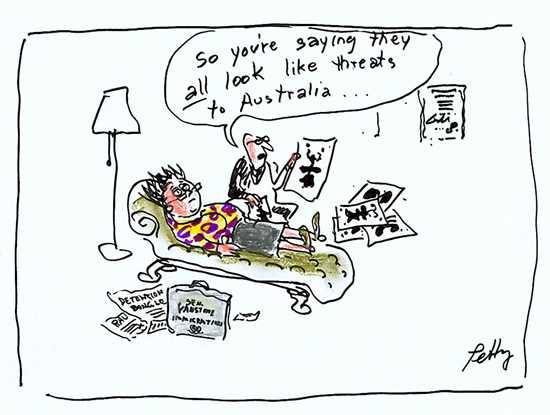
An example is Cornelia Rau, a schizophrenic who walked out of a mental institution in Manly, New South Wales, in March 2004 and ended up in Coen, North Queensland. In a bad way she was reported to the police by aboriginal people concerned by her obvious mental distress. Rau informed the police that she was an illegal German immigrant, and she is treated as an illegal non-citizen by the Queensland police in Cairns and the Commonwealth Immigration Department.
Despite being a permanent resident, a former Qantas airhostess, and mentally ill Rau spent six months in a Queensland jail. She was incarcerated by immigration authorities in Brisbane Women's Correctional Centre on April 5, 2004, where she remained until she was transferred to Baxter Detention Centre in South Australia on October 5.
There she was treated by a tough law and order regime. She is isolated for a week and locked in a room for 18 hours a day, despite exhibiting disturbed behaviour indicating mental illness, despite being the subject of a national appeal by the NSW police who were trying to find her.
So a mentally ill Australian permanent resident is wrongly held in a prison and detention centre. A mistake perhaps?
Possibly. If so, then the mistakes were serious. However, the real tragedy is that this is not an isolated case. It has happened over and over again. The Rau tragedy does not represent a failure of the system of immigration detention; it is a product of the system.
Difference as strangeness is increasingly being treated in terms of sameness of an ‘illegal’: a person in Australia unable to satisfy the authorities that he/she had a legitimate right to be here. What the Rau case shows that, as illegals have no human or civil rights, so they can be locked up in harsh prison conditions, denied contact with the outside world, and given little pyschiatric help.
The key problem lies with the immigration detention system and its harsh regime of surveillance and discipline. This regime has become disconnected from a duty of care. The crucial question how people in detention are treated, and the way their mental health problems are left inadequately addressed, and then exacerbated by the disciplinary regime.
Claire O'Connor, an Adelaide lawyer fighting to have three Baxter detainees moved to a psychiatric hospital, has said that:
They (the three detainees) said 'there's a poor woman here, she's screaming she's yelling, she's eating dirt and sometimes she runs around without her clothes on'...They told me that, but I can't go in to see anyone. No lawyer can go in to see anyone at Baxter who isn't already instructing them.
South Australia's Public Advocate, Jonathan Harley, says he spent more than two months trying to get authorities at the Baxter detention centre to look into the case of Cornelia Rau. He said that Ms Rau's plight came to his attention in December last year, but he was met with silence from the Department of Immigration and officials at Baxter and was forced to threaten legal action before they acted. The officials at Baxter did not act when Harley contacted them because as a state official he had no jurisdiction to intervene.
Update Jan 9
Commentary can be found over at DogfightAtBankstown at Troppo Armadillo and A Landownunder.
Documents tabled in Adelaide's Federal Court by Claire O'Connor, a South Australian Legal Services Commission lawyer, indicate that Group 4 Falck, the company that runs Australia's detention centres, and the Department of Immigration, had breached their duty of care by failing to provide adequate psychiatric care for three mentally ill Iranian men at the Baxter detention centre.
The incarceration regime works to undermine, break down the personality of the inmates, and then to drive them mad.Their protests become those of self-harm.
Update
A reconstruction of Cornelia Rau's missing months in The Age. See Fixing Australia. An Australian was "lost in detention" for 10 months? If Cornelia's sister, Chris Rau, had not seen a report in The Age describing her sister's circumstances, then Cornelia Rau could have been detained at Baxter indefinitely without any rights.
As Peter Mares argues in The Age immigration detention has been
...deliberately constructed to be legally impregnable, precluding independent oversight or judicial review of the decision to lock people up....Detention is designed to be opaque, to prevent meddling by lawyers, human rights activists, priests, do-gooders, psychiatrists, public advocates, journalists and other busybodies who might concern themselves with the fate of detainees, their health and their treatment--the very kind of people who eventually managed to alert the Australian public to Cornelia Rau's situation.
The Rau tragedy is a product of the system.
Posted by Gary Sauer-Thompson at 9:03 AM | Comments (0) | TrackBack
February 7, 2005
I'm reading
I've started reading Michael Keating's Who Rules: How Government retains control of a privatised economy. John Quiggin has read the book and his comments are here.
Keating says that the main purpose of the book:
..is to critically examine [the] contention that marketisation of government necessarily leads to a loss of state power and policy direction. Instead of viewing the relationship between markets and government as a struggle for power, their mutual dependence should also be considered.
That is a fruitful perspective and it is one that Keating adopts. He rejects the libertarian view that government is unwelcome intruder into the sovereignty of individualist market forces.Keating also rejects the political Left view of rolling back the market and re-regulating capital markets.
Keating then goes on to say that the thesis he will explore is:
...that markets can be most often managed to assist in the achievement of many of the state's policy directions and goals. Indeed, a principle theme is that the shift to marketisation largely represents an attempt by governments to enahnce or restore power to achieve the economic and social objectives, while minimising any loss of efficency.
So the book is a middle way between the critics of marketisaton of the state, who claim that the state has lost its capacity to govern, and those who argue for a minimal state role in favour of totally free markets.The middle way places an emphasis on the power and the capacity of the state to decide and implement preferred courses of action to make a difference to the economy and society.
This overlaps with Foucault's governmentality approach, but Keating makes no reference to Foucault.
Posted by Gary Sauer-Thompson at 9:58 AM | Comments (0) | TrackBack
February 6, 2005
spreading democracy around the world
As Justin Raimondo says the Bush administration can:
...rightly claim success in creating, if only for a day, the security conditions that made the election possible. But they can't keep Iraq in lockdown forever. After the three-day lockdown, the roads will be opened, the border controls will be relaxed, the insurgency will continue to take its deadly toll – and the momentum for a political settlement will begin.
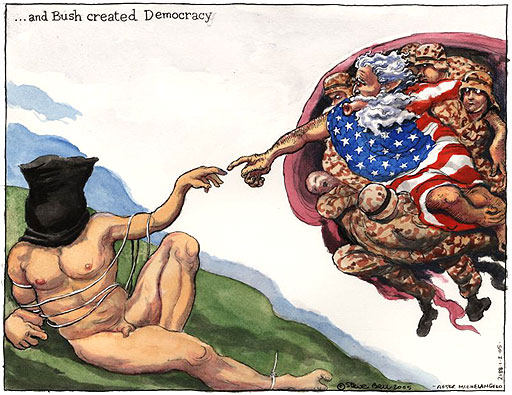
The winner looks to be Grand Ayatollah al-Sistani's coalition slate(United Iraqi Alliance), as it is out-polling the slate put forward by Iyad Allawi, the interim Prime Minister, by three votes to one. A secular democracy is not about to be formed in Iraq. The theocrats of Iran, not the neo-conservatives of Washington, now appear to hold the keys to Iraq's future. Iran is being increasingly targeted by the Bush Administration.
The other side of spreading democracy to the dark regions. I guess something similar to this is probably what happened to Mamdouh Habib.
So how much power will the new National Assembly have? Will it be able to establish its legitimacy outside of the parameters set by the US occupation authorities? That is doubtful since Bush said in his SOU speech that US troops would not be tied to a timetable, even if asked to provide one by the new political leaders in Baghdad.
Posted by Gary Sauer-Thompson at 2:54 PM | Comments (0) | TrackBack
February 5, 2005
The ALP's glimmer twins
In an earlier post I began an argument that the ALP is missing good opportunities to establish its very tarnished economic credibility. In an update I mentioned that I had came across an op.ed by Ross Gitten.This had been written after Kim Beazley's media conference/interview just after he had re-gained the ALP leadership. I said that this op-ed confirmed my judgement that the ALP was not doing a good job in restoring its lost economic re credibility.
Gittens puts it far more forcefully with his image of the dead (economic) hand. He said that Beazley's statement in that first news conference about making sharp differences between the ALP and the Coalition explicit was okay, but it lacked any policy grunt. He then asked the right question:
All fair enough, but where are the actions to back up the words? Not there. A bit early for that, you say? No, not at all.
I thought that Gittens was a bit quick to judge, after only one press conference. However, Wayne Swan's small target response to the OECD Report on the Australian economy effectively undercuts Beazley's commitment to making the sharp differences have some policy substance.
What has gone wrong? Why have the glimmer twins(Wayne Swan and Stephen Smith) gone off the rails so early. They were meant to be the lead act in re-establishing the economic credibility the ALP says it has to re-acquire, if it is to have any hope of winning the next election.
Gitten's suggestion is a persuasive one:
Neither of these two [ie., Beazley bovver boys-Wayne Swan and Stephen Smith] has any significant record of interest in or commitment to micro-economic reform. Rather, they're highly experienced political operators. So Labor's continuing its post-1996 folly of having shadow treasurers who are professional pollies-- Gareth Evans and Simon Crean-- trying to fake it as economic rationalists.
He's right. Gitten's judgement is quite damming:
Surely it's clear by now that they can't pull off the act. They can't inspire or even convince the coterie of economic opinion leaders whose granting or withholding of their imprimatur has a subtle but significant influence over the public's general impression about which party's economically competent and which isn't.
I reckon we should let that judgement lie on the table. It judges the ALP according to its own criteria.
Gittens reminds us that the policy debate around the reform of the economy will not be won by clever tactical moves on the floor of the House of Representatives during Question Time.
Posted by Gary Sauer-Thompson at 11:06 AM | Comments (0) | TrackBack
February 4, 2005
President Bush's SOU Speech
I didn't watch President Bush deliver his State of the Union Speech to Congress. I've read it though. So much applause. The text reads as if it were delivered to a rent-a-crowd. It's all about aspirations.
Bush said that his administration must be good stewards of this economy, and that it would renew the great institutions on which millions of our fellow citizens rely. He said that "America's economy is the fastest growing of any major industrialized nation and when When action was needed, the Congress delivered -- and the nation is grateful."
Now we must add to these achievements. By making our economy more flexible, more innovative, and more competitive, we will keep America the economic leader of the world.(Applause.) America's prosperity requires restraining the spending appetite of the federal government. I welcome the bipartisan enthusiasm for spending discipline. I will send you a budget that holds the growth of discretionary spending below inflation, makes tax relief permanent, and stays on track to cut the deficit in half by 2009. (Applause.) My budget substantially reduces or eliminates more than 150 government programs that are not getting results, or duplicate current efforts, or do not fulfill essential priorities. The principle here is clear: Taxpayer dollars must be spent wisely, or not at all. (Applause.)So Bush is going to address the growing budget deficit ($412 billion) by cutting government spending. If expenditure on the Iraq is going up and Republicans are not very keen on cutting back on certain expensive new weapons systems either, then the 'squeeze spending game plan' means what? Does it mean that Bush is going to privatise Social Security? A large chunk of his speech was devoted to social security.
And the trade deficit? What about that? Narry a mention. Did not Bush say that his administration must be good stewards of this economy? Strikes me that there is big gap between rhetoric and reality in all of this.
Posted by Gary Sauer-Thompson at 5:27 PM | Comments (0) | TrackBack
February 3, 2005
the wind is blowing one way
Which policy direction is the ALP going to take, now that it has given the Coalition control of the Senate, and decided that it must engage in hand-to-hand trench warfare in the House of Representatives?How will it endeavour to re-establish its foregone economic credibility?

Now we know the direction the policy wind is blowing. It is a neo-liberal pro-market, involving significant changes in industrial relations and welfare. It's a Treasury wind fanned by the OECD. The OECD pretty much runs the Treasury line says John Quiggin. I notice there is no mention of the current account deficit. Presumably Treasury is covering that up.
This provides an opportunity for the ALP to establish some economic street cred. Remember the ALP said it lost the last election mainly because it had little credibility on economic issues. People were up to their eyeballs in mortgage debt and they did not trust Labor to manage the economy. The public preferred the Coalition.
So, does the ALP use the opportunity provided by the OECD Report go in hard? Does it float in the wind? How would the ALP govern the economy? What is its course of its policy action? What are the faultlines between the ALP and the Coalition, now that the ALP has rejected playing the small target game?
Ross Fitzgerald's op ed piece in The Australian has a suggestion. He starts by saying that "...the ALP now begins the difficult internal debate about the economic and social policy settings it needs to reclaim government." He then links this to the backbench call tax reform to the top tax rates:
Radical industrial changes and hard-hearted welfare reforms could ... have a significant negative effect by changing lives and eating away at the nation's sense of the fair go. Tax reform of the kind proposed by the federal Government's newest ginger group would reduce the amount of money available for social services such as schools and hospitals. This agenda, which is almost certainly being orchestrated by the Treasurer, represents a fundamental leap to a US-style society.
Should federal Labor drift along with this. Should it dig in and fight? If so where? What is the ground it is going to fight on? What does the ALP tell us about these questions?
It is hard to tell. So far there has been no response by the ALP's economic glimmer twins (Swan and Smith) to the OCED's advice to the Howard Government, that the Australian economy needs a reinvigorated reform program to prevent it sliding back to lower growth and lower living standards. The ALP is slow off the mark, suprisingly so when Costello says that the OECD report endorses the Government's economic management and legislative agenda.
Well he would, woudn't he. The OECD document supports the Treasury line. So what is the reform agenda?
The editorial in the Australian Financial Review describes a rough reform agenda that is already in place:
It includes workplace, tax and welfare reform to entice more people into the workforce; deregulating captive public health and school services; and completing the deregulation of vital energy, water and transport infrastructure to attract investment.
So where is the ALP? Is it not meant to be going in hard over the next six months?
When are the glimmer twins going to take the fight to Costello? Do they have what it takes to do so?
Update Feb 4th
The ALP's response eventually came. It says that economic reform under the Howard Government has stalled and this jeapordises Australia's future economic growth. Wayne Swan says:
In a damming indictment of the Government's economic credentials the OECD says that economic reform has slackened off and needs to be reinvigorated. The slacking off has occurred across the board, with all the drivers of economic growth being neglected, including labour market participation, productivity, tax and education.
So what economic reform does the ALP favour, given the free market account of the reform agenda outlined in the AFR?
Wayne Swan mentions marginal tax rates, top marginal tax rates and labour market reform including skills shortages.Is this not the Government's agenda?
There is nothing about the trade deficit either. Is not that silence the Treasury's agenda?
When then is the ALP's economic reform agenda? I reckon it is playing small target by default.
One possibility is tax reform to ease the high marginal tax rates for those people moving from welfare to work? That is necessary and good policy but it is a very expensive bit of reform. Is the ALP serious about this? Or is it shadow boxing? My judgement is that Swan and Smith are faking it.
Ross Gittens agrees. he says that Swan and Smith are political operators who are unlikely to establish the ALP's economic credibility vis-a-vis Costello in the quality press.
Posted by Gary Sauer-Thompson at 11:07 AM | Comments (2) | TrackBack
February 2, 2005
living in a neocon world
This is a world in which the US cop on the international beat creates conflict:

Heng Kim Song, Editorial Cartoons, Lianhe Zaobao, Singapore.
This is a world order imposed by US power that aims to remake the world in the image of the free society in the US: a combination of law, liberal freedoms, competitive private enterprise and regular, contested elections with universal suffrage.
It is a world order in which Saddam Hussein's Iraq did not represent a substantive existent threat, but the US deposed Saddam and occupied the country anyway.
Iran and North Korea are now marked for regime change. Iran is seen as a regional threat that needs to be contained, destabilized, and rolled back as part of the strategy to permanently transform the regional balance of power in favour of Israel. So is Syria. Is the US exit strategy from Baghdad through Damascus?
Posted by Gary Sauer-Thompson at 5:20 PM | Comments (4) | TrackBack
February 1, 2005
Mark Steyn's twisted truth
I see that Mark Steyne is being downloaded in The Australian these days. Towards the end his op-ed piece on why there is no civil war in Iraq he writes:
What happened on Sunday was a victory for the Iraqi people and a vindication for a relatively small group of Western politicians -- most notably the much-maligned US Deputy Defence Secretary Paul Wolfowitz, whose faith in those Iraqi people turned out to be so much shrewder than the sneers of his detractors.
Really?
Note that Steyn's grand freedom on the march narrative fails to mention the role played by Grand Ayatollah Ali Sistani in. Factor Sistani into the birth of democracy in Iraq narrative and another story can be told. It was Grand Ayatollah Sistani who stood tough and fought for these elections.
It was Sustani's determination that made them happen when, as Juan Cole reminds us, Bush and Bremer Bush, Iraq desired a soft dictatorship under Chalabi; or a stage-managed election with an electorate consisting of a handful of pro-American notables.
Posted by Gary Sauer-Thompson at 11:24 AM | Comments (1) | TrackBack
changes in world economy
A simple but effective representation of the changes in the political economy of the world economic order.

Salih Memecan, Editorial Cartoonist, Turkey.
The new kid on the power block is China, not Japan or the European Economic Union. So we have a multi-polarization of the world economy.Will the United States continue to exercise leadership or gravitate toward self-centered policies?
China is calling for reform of the inequitable world economy. 'Inequitable' is not a word you often hear from Reserve Bank and Treasury officials. Li Ruogu, the Assistant Governor of People's Bank of China, said that:
China strongly urged the developed countries to expedite capital and technology transfers to the developing countries, provide broad market access to the developing countries, and truly implement the Monterrey Consensus. The developed countries should realize that their aid to the developing countries is not a charity or a favor, but a necessary means of correcting the uneven distribution of the benefits of globalization.
The Sino-American friction has its roots less in a "laundry list" of various contentious issues, and more in the more basic question of how the world is to be ordered.
Posted by Gary Sauer-Thompson at 7:59 AM | Comments (2) | TrackBack