« August 2005 | Main | October 2005 »
September 30, 2005
Questioning medical dominance
Do we have the beginings of health care reform in Australia, as opposed to the day to day political management of media headlines by the states in relation to to hospital queues and mental health? We saw some signs of this with federal Treasury's recent interest.
Treasury is obliged to do so because health spending is rising. Today's Australian Financial Review reports that the Australian Institute of Health and Welfare publication Health Expenditure Australia 2003-2004 states that health spending accounts for 9.7% of Australia's economy, that it is rising faster than both inflation and economic growth, and that households are bearing the brunt of rising health costs.
Yesterday the Productivity Commission released an issues paper on the health workforce. Entitled 'Australia’s Health Workforce' it acknowledges a key problem, namely:
There are considerable pressures on Australia’s health workforce — as evidenced by shortages of supply in some professions, particularly (but not only) outside the major population centres, and a significant reliance on overseas trained professionals. In the future, ageing of the population will compound the impacts of other factors that will increase demand for health workforce services.
This supply shortage is well known in terms of primary health care, emergency and acute hospital services and specialist services. The Commission then opens up two ways to address this shortage:
Initiatives to boost the numbers of education and training places will be an important part of the response to both current shortages and increased future demand for health workers. But there is also scope and need to increase the productivity and effectiveness of the available health workforce and to reduce its maldistribution. Addressing a range of systemic impediments will enhance the capacity of the workforce to respond in an efficient and timely manner to the challenges of the future.
That puts an emphasis on increasing the productivity of health professionals as well maintaining high standards. The AMA mostly talks in terms of safety and standards and protecting doctors as gatekeepers of the health care system.
The Productivity Commission's economic approach to health care reform has implications for GPs, biomedicine and medical dominance because the continual propping up of GP's and medical specialists to ensure high health safety standards will not ensure a healthy population or wellness. The medical bodies have a lot of poiltical clout, and their big union, the AMA, consistently runs a safety fear campaign whenever their patch protection, cash flow, closed shop culture and status is criticised and challenged.
The Federal Government does recognize this. Tony Abbott, the Minister of Health and Ageing, is reported as saying:
The Government has no wish to diminish the role and the standing of the medical profession. But while respecting the knowledge, the commitment and place of the medical profession we obviously want to make full use of the whole of our health work force.
That means an increased role for allied health care professionals. The writing is on the wall in that it challenges the AMA's position that health care reform threatens standards and that only doctors can, and should, deliver health care. As they see it, they own Medicare. However, as yesterdays editorial in the Australian Financial Review pointed out, Australia has needed health care refrom for decades. The health system can be reformed without threatening standards.
What does this mean in terms of health care reform? Does it mean simply streamlining the system to ensure a cost-efficient health service? Not necessarily. One pathway of reform is for the state governments to allow hospitals to step in and coordinate the allocation and supply of all health care workers. Another pathway is suggested by Federal Treasury in the 2005 Winter issue of Economic Roundup. The relevant article is by Janine Murphy and it is entitled ">Health Promotion. Another reform pathway is to shift the focus away the medical institutions and their patch protection battles to the consumer. This would loosen up the medical market through competition to allow consumers to express their choice and sovereignty about the health they wanted.
Good public health policy should move into a reform mode to ensure the wellbeing of the Australian population. That means making sure that the neo-liberals do not succeed in increasing tax cuts by cutting back on health services to deal with the rising costs of health. It also means making sure that growth expenditure is addressed through health care reform to achieve population wellbeing and not cost cutting by razor gangs in the Department of Finance to keep the budget in surplus.
Maybe, just maybe, the pressures within the health care system have built up to a point where the Howard Government will accept the Productivity Commission's recommendations to increase the productivity of the health care workforce.
Posted by Gary Sauer-Thompson at 8:39 AM | Comments (0) | TrackBack
September 29, 2005
going nuclear
Have you noticed the way that the current media push for Australia to go nuclear by the unreconstituted technocrats often takes some very strange twists?
In this sales pitch we've had neo-liberal politicians saying that nuclear power is the solution to global warming, without even bothering to do the economics sums, or acknowledging that nuclear power is more expensive than solar or wind. Others are saying that we should sell as much uranium to China, not to solve Australia's balance of payments, but to have a say in preventing China from becoming a nuclear power. Others reckon that Australia can make lots of money by becoming the dumping ground for world's nuclear waste.
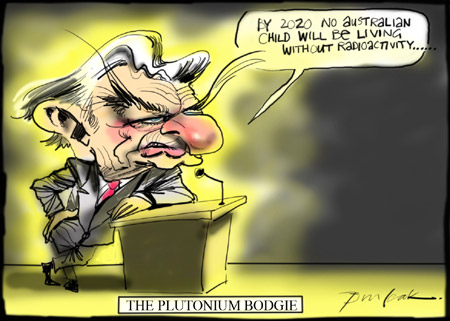
Bill Leak
When I listen to all this reborn political enthusiasm for all things nuclear I reckon these salesman and spruikers have lost it. As they step back into the past they've lost any understanding of what life is about, or that politics is about achieving the good life.
It is a technocracy that talks the language of redemption whilst boasting that nuclear power is the cheapest power available. The boast is based on the old smoke and mirrors trick of counting the cost of operating the nuclear power plant, not of constructing them. Nuclear power plants are very expensive, due to the cost of borrowing money for the decade or more that it takes to get these plants up and running.
So massive government intervention and subsidy is required. That 's where the technocracy bit surfaces with its intermingling of scientific-technical rationality, power and culture.
Posted by Gary Sauer-Thompson at 8:12 AM | Comments (1) | TrackBack
September 28, 2005
London calling
It was no suprise that the national security state adopted a tough counter terrorism line all round at yesterday's CoAG meeting between the Commonwealth, state premiers and territory leaders. All the Labor Premiers had been looking tough and muscled up in the lead up to the CoAG meeting, and they kept talking about a safer Australia. The state premiers just didn't roll over. They were enthusiastic supporters of a tough counter terrorism, gave narry an opinion about ensuring that Australia remains a model of a workable, cosmopolitan multicultural future in a globalized world, and failed to achieve a balance between security and freedom.
The National Security State has used the 9/11 terrorist attack, the recent London bombings and intelligence information to introduce tough new anti-terrorism policies with limited review and "sunset" clauses. Under the new legislation, police will be able to get control orders that allow them to track people, including by attaching electronic devices. Suspects can be detained preventively without charge for up to 14 days, whilst police will have increased powers to stop, question and search and can seek penalties for people who "incite" terrorism.

What evidence was put forward to justify measures that undermine Australia's tradition of liberal democracy? Why were they deemed necessary? Who is making Australia unsafe? Why the need to be so tough on easing our constitutional freedoms?
The Howard Government allowed ASIO and Office of National Assessments to talk publicly about 800 Muslim "extremists" living in Australia being motivated to carry out a London-style attack. There is no mention of sleeper cells in Australia. Conservatives talk about people needing to be heavily fined for leaving their baggage at any transport hub. So we can presume that the threat is profiled as homegrown Muslim terrorists, with an agenda of hate, violence and bigotry towards a permissive, hedonistic society, blowing up our transport hubs.
This kind of talk creates enough of a climate of fear and suspicion that is ready made for the tabloid press. It also legislation that would allow citizens to be locked on an arbitrary basis of having only a reasonable suspicion without proper legal safeguards to protect their civil freedoms. The effects are an undermining of Australia's liberal and democratic foundations.
Behind these counter-terrorism policies sit the ideas about combating extremism, “evil ideologies”, and enemies within. The emphasis is not on building positive community relationships and so the tough approach will reinforce a siege mentality amongst the Australian Muslim community. Young Muslims will be increasingly targeted in the new climate of fear and speculation about the phenomenon of home-grown terrorism. Do we have a situation where the moderate Muslim groups are gaining access to policy-makers, whilst the extreme groups are gaining access to young Muslims in search of certainty, fellowship, meaning and direction in life, and a cause?
What is not being asked is how come a migrant family in a passive community that keeps to themselves have children who are full of anger, hatred and susceptible to radical ideas? What is not being done is reaffirming our historical memory to renew Australia's identity of a liberal and democratic nation state in the faced of potential moderate terrorist threats.
Posted by Gary Sauer-Thompson at 6:44 AM | Comments (0) | TrackBack
September 27, 2005
living the good times
I notice that Alex Erskine over at Henry Thornton is saying the following about the Australian economy:
Interest rates are about to rise ....What has been blindingly obvious for a year or more is about to come true. The boom in the resource states is overwhelming the bad times in the latte-society states. The housing bust is not restraining the economy sufficiently; the exchange rate has been too low in the face of such extraordinarily favourable terms of trade; the labour market has been too tight for too long; and high and higher oil prices have been too high for too long and are leaking into wage rises.
Blindingly obvious? We haven't heard much on things turning pear-shaped from the corporate media or the Howard government. What we do hear about is low unemployment rates, ever increasing budget surpluses and skills shortages holding back the booming economy.
Listening to the media leads me to think that we never had it so good because of the astute and prudent economic management by the Howard government. That is why we need all that new industrial relations reform based on individual contracts ---to keep the good times rolling on. The new era in industrial relations, we are contantly told, will herald in a new level of prosperity.
Now we hear that price pressures are everywhere. Innflation is lurking in the back of Treasury's mind. And the Reserve Bank as well? Nope. They still think in terms of terms of smooth market adjustments and stability.
Alex Erskine pointed out that it was the Assistant Treasurer Mal Brough who was unusually forthright in his recent comments on the economy on Sydney radio about the need to slow the economy. Is he pointing to a slowing economy facing higher interest rates? One that will see some people fall off the edge fo the new level of prosperity?
Posted by Gary Sauer-Thompson at 2:57 PM | Comments (1) | TrackBack
September 26, 2005
Israel: false promises
The Israeli government's withdrawal from the Gaza Strip (a tiny strip of land, a mere 5 miles by 25 miles) was primarily for security reasons but it promised peace. The dream of settlement and expansion, which in many ways defined Zionist Israel, could not be sustained there. Israel could not have hung on to Gaza for ever.
Hasan Abu Nimah argues that the Sharon Government:
realised that the stubborn insistence to keep fewer than 8,000 of its settlers amongst 1.3 million devastated, impoverished and mostly displaced Palestinians, in the most densely populated area in the world, has become a huge burden. Israel decided to withdraw the settlers and has now completed the move. As was the case in Lebanon, Israel sought to present its decision as a gesture for peace, rather than a security necessity, or, worse, rather than have it be seen as a defeat imposed upon them by Hamas and the other resistance factions.

The rest of the Palestinian territories -- the West Bank, including East Jerusalem -- remain occupied. As this article, states the Gaza withdrawal masks other developments by Israel that do not promise peace in the region:
Israel has been expanding the settlements in the West Bank and East Jerusalem where 400,000 settlers live. Sharon hinted long ago, that as part of the bargain, if Israel gets out of Gaza (just 3% of Palestinian territory), Israel will regard the five major settlement blocs in the West Bank as a permanent part of Israel, a move which defies all international norms and laws. Hundreds of new apartments are being built in the settlements which run a ring around Jerusalem, and penetrate deep - sometimes 20 km - into the West Bank. These settlements already carve up the land with a web of 'Jew-only' roads and hundreds of checkpoints, confining 2.5 million Palestinians to physical enclaves from which they are unable to escape and in which they cannot make a living.
This is the reality on the ground.
Posted by Gary Sauer-Thompson at 11:39 PM | Comments (2) | TrackBack
September 25, 2005
imperial illusions
I notice that Geoff Hoon, the former Defence Secretary, has admitted that Tony Blair and his ministers underestimated the level of fanaticism in Iraq when they declared war on Saddam Hussein. Hoon said that Britain and the US were unprepared for the violence perpetrated ever since by extremists bent on preventing democracy taking hold. I guess Australia can be included in that.

Suprise.Suprise. Didn't they understand themselves to be an imperial force invading a sovereign nation. Didn't they forsee the consequences of the US Fallujah campaign? RiverBend points out the equation from 9/11:
For the 3,000 victims in America, more than 100,000 have died in Iraq. Tens of thousands of others are being detained for interrogation and torture. Our homes have been raided, our cities are constantly being bombed and Iraq has fallen back decades, and for several years to come we will suffer under the influence of the extremism we didn't know prior to the war.
The fanaticism and extremism is partly a nationalist (Sunni and Shi'ite) insurgency. What did the Anglo-Americans expect from their violent and ongoing occupation of Iraq? Love, kisses and flowers?
I guess that it never occurred to the Anglo-American occupying forces that they were a part of the problem as well as a part of the solution in Iraq; or that, as long as the Anglo-American military occupied the country, matters would just get worse.
Is not the reality one of an Iraq on a trajectory of disintegration? The Saudi's are pessimistic: they see the development of disintegration dragging the region into war. Some Iraqi's see Iran filling the vacum.
Posted by Gary Sauer-Thompson at 11:32 AM | Comments (0) | TrackBack
September 24, 2005
US alliance & blank cheques
The stories about prisoner abuse by the US in Iraq and Afghanistan keep on surfacing don't they? The stories are forming a pattern: torture is an integral part of a system of imprisonment by an imperial power.
Then we read this spin from the US Army in Nation Review Online with scepticism. It is part of the standard response of the Bush administration to prisoner abuse: what Marty Ledeman describes as 'disingenuous legal analysis; unprecedented assertions of Executive authority; dissembling, cicumlocution, and unwarranted secrecy on some of the most important public questions in the current war; etc.'
And Australia? Where does it stand? Interesting question, given this
When Kevin Rudd, the shadow Foreign Affairs spokesman talks about the differences between Liberal and Labour on the question of the US/Australia alliance, the US treatment of prisoners is not mentioned. Rudd says:
"...that the big difference between Labor and the conservatives on the US alliance is that we have never regarded it as a blank cheque:.Labor did not support the unilateral US attack on Iraq in March 2003, a position that is standing well over the test of time as Iraq turns into a quagmire and prospects of a possible civil war between Sunnis and Shias become evident.
Labor does not support the US position on the International Criminal Court and, unlike the Liberals, fundamentally and publicly opposes US attempts to gain exemption for its combatants from the reach of the court.
Unlike the conservatives, Labor does not support the US position of hostility towards Kyoto.
Labor has attacked attempts by the US ambassador to the UN, John Bolton, to water down the UN's commitment to the Millennium Development Goals to reducing global poverty."
Rudd's silence is interesting isn't it? I woldl have thought that the US torture of prisoners would have been a key difference, given the ALP refusal to give a blank cheque.
Posted by Gary Sauer-Thompson at 12:08 PM | Comments (0) | TrackBack
September 23, 2005
nuclear proliferation
As I understand it Iran is legally entitled to develop the nuclear fuel cycle, as are all signatories to the non-proliferation treaty. Is there not a double standard here: the US and Europe says no to Iran but yes to Israel, Pakistan and India? Did not the United States build Iran's first nuclear plant at Amirabad, and knew that the Shah had began a low-grade weapons research programme in 1967?

The US is pushing to bring sanctions against Iran for a suspected "nuclear weapons programme". The current battleground is at the International Atomic Energy Agency, where the Bush administration proposes to refer Iran's civilian nuclear programme to the UN security council.
As an editorial in The Guardian points out the world's five "official" nuclear powers, led by a unilateralist United States, could do more to meet their own NPT obligations to move towards disarmament, and been less than tolerant towards a nuclear-armed Israel, India and Pakistan operating outside the treaty.
Is not the Bush adminstration busy investing in another generation of nukes? Why so when the ciold war over/?
Strikes me that a lot of nonsense is being talked around nuclear power (and energy).
Posted by Gary Sauer-Thompson at 12:48 PM | Comments (0) | TrackBack
September 21, 2005
The corruption of the Canberra media
Mungo McCullum has an op. ed. on the coporate media establishment in The Age that is a response to the arrows fired by Mark Latham. It makes for interesting reading. McCullum acknowledges the arrows: journalists are targeted by Latham with just as much loathing as his Labor colleagues, that Latham had to suffer an inordinate amount of muck-raking from sections of the media, and that Latham is talking about the media establishment not just individual journalists.

Warren
McCullum understands that his job to defend the fourth estate from the Latham arrows, and that he needs to do more than the standard Canberra Club response of ranting and raving about how much Latham has damaged his own credibility; or being so caught up in vitriol, that they fail to address many of the key issues raised. McCullum's key move is to distinquish between the hack pack and the senior journalists in the Canberra Press Gallery. He then says this:
What they [the senior Canberra Press Gallery] can perhaps be accused of is lack of leadership; along with other gallery veterans such as Michelle Grattan, they have let the Government get away with far too much over the years. It is true that Howard exercises a more totalitarian control over government information than any of his predecessors and that he has instituted something of a reign of terror in the public service, but that is no excuse for meekly accepting ridiculous strictures in the name of commercial-in-confidence, or privacy considerations, or the all-purpose national security. Kelly, Oakes and Grattan never would have copped it in the old days.
Age has wearied them is the argument. So they perform their watchdog duties too lightly. Maybe so. However, that defence does not engage with the corruption of the fourth estate by power, media frenzies, or the role of the journalist as an attack dog.
To his credit McCullum understands this, and he addresses it. He says:
There is nothing wrong with taking sides, as long as it is done openly and honestly. The crime of Akerman, Bolt, Jones et al is not that they are partisan, but that they pretend to be objective. Latham, of all people, should understand that there is nothing wrong with being passionate about your job. It's the cold and devious ones you have to look out for.
The pretence of the attack dogs about them being objective is a good point. But McCullum does miss Latham's key point----that the journalists are players in the game of power. It is no longer just a question about being passionate. about the job.
Notice that McCullum says nothing about the relationship between the media and democracy. That has dropped tight off his radar. It is no longer even a consideration. What that devaluation of the highest values of the fourth estate discloses is the corruption of the Canberra media. Thsi corruption has the appearance of peddling rumor, innuendo off-the-record briefings and presenting the personality without the policy attached.
The corruption of the media is an issue that was not touched by the recent Media Watch on the saga of the Latham diaries. Media Watch was more concerned with the competitive role of the media in selling the Latham diaries and constructing a narrative of who did what. It did not address the issues raised by Latham. Even the watcdog has failed to see the bigger picture.
Posted by Gary Sauer-Thompson at 9:46 AM | Comments (4) | TrackBack
September 20, 2005
media and democracy
I interpret this image by Cathy Wilcox as an interesting attempt to connect the public image of Mark Latham the politician to the person:--a homedad in a Sydney suburb who is doing a bit of writing that reflects on his experiences as leader of the federal ALP in 2004.
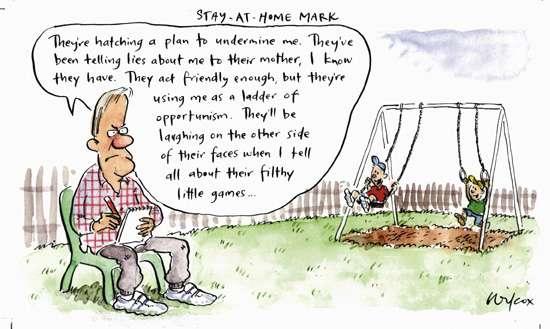
True, Wilcox does not gesture to the tabloid image of the Latham as the mad dog:--she gives us the more sophisticated paranoid and narcissistic personality image. This gives rise to a hater who cuts a path of waste and destruction to all around him in the ALP. From the ALP side Latham's Diaries stand for betrayal of trust and political bastardry.
Wilcox's cartoon misses the mediating role of the media between the hater image and the stay at home person entirely. She publishes her cartoon in the corporate media, but she does not reflect upon the role of the media as a player in the political process.
Very little of the journalist commentary around the Latham Diaries concentrates on the role of the media in our political culture. Paul Sheehan is an exception. He says:
Latham's behaviour is not so far removed from what the media serves up every day as it subjects politicians and the electoral process to an unremitting campaign of belligerence, cynicism and ridicule. The media condescends towards democracy because it competes with democracy. It competes for power and control of the national agenda. The biggest contest in Australian politics is thus not between the Coalition and Labor, but between the elected and accountable against the unelected and unaccountable.
The broadsheet journalists are not watchdogs of democracy. They (eg., Glen Milne) are players in the political process, and they are very partisan in both a party political and a party factional sense. Mark Latham, for instance, claims Glen Milne is a Costello-booster.
They are publicists writing for a political cause and their sources are drip feeds, anonymous backgrounders, rumors and leaks from their political contacts. The journalists in the corporate media are maintaining a collective silence about Latham's exposure of the way they routinely trash the objectivity ethos of journalism they profess to uphold. They are players, not defenders of the public interest or democracy. They are playing very hard to demonize Latham. They have closed ranks and they want blood.
We have to start talking otherwise about the media: maybe about the independent media in contrast to the corporate media. An independent media that picks up Latham's truth telling, and then develops it to help us to understand our political culture better. A media concerned with enlightening citizens as opposed to one that engages in mass deception.
Posted by Gary Sauer-Thompson at 10:39 AM | Comments (13) | TrackBack
September 19, 2005
United Nations reform
It is widely acknowledged that the UN does need to reform, improve its accountability, reduce corruption. and cut out excessive spending and waste. It does need to be addressed, and the 2005 World Summit was a good time to redefine the UN for the 21st Century, put in place management changes, and take action to meet the UN's millennium goals to reduce poverty and promote development. The UN has taken this concern on board.
The United States says that it is prepared to help lead the effort to strengthen and reform the UN. However, the US continues to act as a spoiler in relation to the UN. The US has pretty much been engaged in blocking plans for a far-reaching reform of the United Nations, the UN's plans for poverty reduction through the the millennium development goals, and the attempts by the UN to reach an agreement designed to prevent terrorists acquiring weapons of mass destruction. The Republican US is in favour for reform of the UN, not because it wants a stronger multilateral U.N. that lives up to its expectations/ideals, but because reform is a device to strangle an ailing patient.

President Bush said that the way forward in tackling poverty was for the world to drop all obstacles to free trade.
"Today I broaden the challenge by making this pledge: The United States is ready to eliminate all tariffs, subsidies and other barriers to the free flow of goods and services if other nations do the same."
This is familar Bush rhetoric.
The rhetoric is being spun even though the Bush administration is aware that the EU or Japan will not embrace free trade with respect to agricultural commodities.
Nor will the US. The Free Trade Agreement the US signed with Australia is a good example of the big protectionism existing behind Bush's free trade rhetoric. We have free traders who were very protective of the sugar (and now the textile) industry in the U.S.
Few of the reformers in the US or Australia are willing to admit that the UN’s complex and inefficient machinery results from deep political disagreements among its members and between other contending forces in the global system. The unilateralism of the US and Australia indicate that they want a weak UN with a small budget and scarcely any voice in economic matters.
So it is no suprrise that in the end, the world leaders approved an embarrassingly weak document, filled mostly with empty platitudes.
Posted by Gary Sauer-Thompson at 9:38 AM | Comments (2) | TrackBack
September 18, 2005
truth telling in politics
I'm finally back on deck. I've been very busy in Melbourne at meetings since early Friday and I had little chance to post until now.
Over the weekend I did mange to catch the Latham interviews on Enough Rope on Thurday night and Lateline on Friday night--but not he legal manoeuvrings. I saw a more measured Latham to the over-the-top one of the diaries. The latter is being characterised by the ALP and media as being so full of resentment, anger and envy that he can only unleash a river of bile on his former colleagues.

Suprisingly, it is the Murdoch press leading the charge against Latham--- the rant and ravings of an embittered madman is the line. Well, I'm with Latham on this. He's telling the truth about the way both the ALP and the media conduct their business. He is opening things up about the political culture for all to see. And we should look long and hard.
Latham has wounded Labor. He meant to. And he has good reason to do so given the appalling way that it treated him. Unnamed ALP sources going on about Latham being a rat is not going to cover up the deeper insight that we will gain into the poisonous workings of the federal ALP. That is the value of Latham's diaries.
Will the ALP openly address what we citizens know? Address the divergence between what Labor members felt about the way the factions operated and the machine politics of the Labor's factional system? Or will the factional machine regain control of the ALP and ensure the conformity of the factional ALP culture?
I didn't have the time to read the op ed. commentary in the print media. Some think the issue is just not worth it. From what I've seen by way of the headlines the general tendency has been to continue to cast Latham as a mad dog----to attack his flawed character, exaggerated claims and anger. They do not address the issues about the brutality of machine politics, the dysfunctionality of the ALP, the corruption of the media, the breakdown of community or the decay of ethical life, or the way that political parties are becoming out of touch with their members and with the electorate.
That kind of response ---character destruction not policy debate ---is the game that is played by the political culture. That says something does it not?
I have yet to see any critical self reflection by the media about the way that Latham has exposed the media and the Canberra Press Gallery conducts its business in terms of the drip feed, innuendo and rumor based on unmamed sources.
How many of the Canberra Press Gallery will defend, endorse, or welcom the truth telling in the Latham Diaries about the way journalists work; and then be willing to stand up to the heat from their unmamed sources and colleagues? The strategy of the corporate media, like that of the ALP's political establishment is to demonise the Diaries and Mark Latham.
Posted by Gary Sauer-Thompson at 11:54 PM | Comments (3) | TrackBack
September 15, 2005
Welcome to executive dominance
The Telstra legislation passed through through the Senate last night. Michelle Grattin points out that the T3 episode shows how the Government will actually treat the Senate when it wants to get important bills passed quickly: committee hearings will be minimal, debate will be gagged, and due parliamentary process will be treated with contempt. We can expect more of the same kind of guillotining with the industrial relations and work -to-welfare legislation.
This arrogance and contempt happened despite the basic flaws in the legislation about regulatory governance and competitive markets in relation to Telstra's monopoly of the basic telephone network. Because it still owns most basic phone network its competitiors have to use and to pay it for the privilege. Telstra is being allowed to write the rules for the use of this network. It sure won't establish a level playing field between it and its competitors.
What sort of governance is that, given the sale is more than a year away, and the network has been run down?
This governance is not one that would faciitate what Ross Gittins says is most needed:
....competition that would improve the quality of service, encourage innovation, hasten the introduction of the latest technology and cause the cost savings from that technology to be passed on to customers.
Telstra will now slash costs to drive profitability whilst fighting to protect its monopoly privileges. Gittens observes that this suggests that:
...as soon as Telstra has its freedom from government ownership, it will be doing all it can to obstruct the regulators and avoid its legal obligations to the bush and any other unprofitable users.
That does not bode well for the necessary upgrade of the network to enable high speed broadband across the nation.
So how is that going to be achieved?
Posted by Gary Sauer-Thompson at 8:10 AM | Comments (6) | TrackBack
September 14, 2005
welfare to work & disability
I just managed to catch a glimpse of this briefing in Canberra on the effects of the welfare-to work reform on disabled Australians organized by National Foundation for Australian Women on free-to air television last night. The briefing was based on research conducted by the National Centre for Social and Economic Modelling(NATSEM).
Under the Howard Government's proposals people with disabilities who are assessed as being able to work at least 15 hours a week will have to look for jobs after July 1 next year or be moved from the disability support pension to the lower paying unemployment benefits.The consequence is that single parents and those with a disability who do not find work will find their income falling by about 20 per cent because they will be placed on the unemployment benefit. The report found people with disabilities who do not work will be $46 a week worse off under the changes.
The justification for the reforms is that if people are capable of working part time, then there's an expectation they should work. If people are living in poverty it is because they are unemployed and do not work.
NATSEM director Ann Harding said that their scrutiny of the proposals showed they would "trap a new group of Australians into poverty" by shunting some disabled people and sole parents off higher-paying pensions and onto the dole. At the same time, the changes would give them less financial incentive to work because they would keep less of any earned income. She added:
The way to get out of the Newstart poverty trap is effectively to get a full-time job (but) sole parents and the disabled have got restrictions on their ability to undertake work.
Those who find work will discover that the Government takes more money out of their pay packet because of a harsher income test and the requirement for them to pay income tax. At the moment those who do not work under the current arrangements receive $254. Under the proposed system, those who work the 15 hours a week required of them, on the minimum wage, would receive $288, including their welfare allowances.The report found the difference of $34 equated to 15 hours' work at just $2.27 an hour.
Professor Harding said the Government's proposed changes did not create a financial incentive for people with disabilities to find work because they would only be working part time.
Posted by Gary Sauer-Thompson at 10:31 AM | Comments (0) | TrackBack
September 13, 2005
loose talk indeed
There is a common position in political discourse in Australia that contrasts the inner city latte lefties with the aspirational outer suburbanites. It is a conventional wisdom that functions as a philosophical lodestone.
You can see it at play in this post over at Catallaxy, where Andrew Norton is discussing Judith Brett's new quarterly essay, Relaxed and Comfortable: The Liberal Party's Australia. An extract of the Brett essay can be found here
The relevant quote is this:
Meanwhile the social movements [of the 1960s and 1970s]created their own sub-culture, what is now known as the 'latte left' or the 'chattering class'. Though their issues have changed, they still define themselves against Australian society, denouncing various 'phobias', and failing to talk the language of the majority. Howard, by contrast, has 'command of the banal idiom of everyday Australian life'. His very ordinariness is, I think, part of why they despise him so much. And it is their rejection of the common sense and morality of ordinary Australians that means they never could have been or can be supporters of the Liberal Party.
It is the phrase 'they still define themselves against Australian society, denouncing various 'phobias', and failing to talk the language of the majority'. This implies that they once defined themselves against Australian society.
Really? You would expect that from conservatives, such as Andrew Bolt, Piers Ackerman, Miranda Devine; but not from classical liberals from Catallaxy, who do understand that 'leftism and conservatism are in a sense both reactions to the changes caused by liberal capitalism.'
On Vietnam yes. Similarly, with removing the constraints on sexual morality by the libertarians of the Sydney Push. On urban development no. Not at all.
Were not the Whitlamite liberals and social democrats supportive of the outer suburbs with aspirational middle class values and beliefs?
My understanding is that they were influenced the urban development work of that period was sympathetic for ordinary Australian suburban life, was premised on the suburbs being a legitmate way of urban life and that the conditions of this mode of life needed to be improved. So the social liberal state was used by the Whitlamites to improve the conditions in the outer suburbs.
How is that being against Australian society?
Do we not have a rewriting of Australian history? One that reads the 1970s though the lens of 1996? Or are today's market liberals really cultural conservatives. Or are the market liberals saying that Australian society is market liberalism.
Posted by Gary Sauer-Thompson at 4:44 PM | Comments (0) | TrackBack
September 12, 2005
The welfare state is the problem
The once-vibrant, but racially divided and economcially impoverished New Orleans, has been reduced to a toxic wasteland by Hurricane Katrina. Now that the city has been virtually emptied of people, there is no shortage of emergency supplies, or food or water stacked for the dead bodies rotting in the hot sun.

This quote by Robert Tracinski is an example of why the Statute of Liberty is floating facedown in the toxic cesspool:
People with values respond to a disaster by fighting against it and doing whatever it takes to overcome the difficulties they face. They don't sit around and complain that the government hasn't taken care of them. And they don't use the chaos of a disaster as an opportunity to prey on their fellow men.But what about criminals and welfare parasites? Do they worry about saving their houses and property? They don't, because they don't own anything. Do they worry about what is going to happen to their businesses or how they are going to make a living? They never worried about those things before. Do they worry about crime and looting? But living off of stolen wealth is a way of life for them.
People living in piles of their own trash, while petulantly complaining that other people aren't doing enough to take care of them and then shooting at those who come to rescue them—this is not just a description of the chaos at the Superdome. It is a perfect summary of the 40-year history of the welfare state and its public housing projects.
The welfare state—and the brutish, uncivilized mentality it sustains and encourages—is the man-made disaster that explains the moral ugliness that has swamped New Orleans. And that is the story that no one is reporting.
That is the American Republican Party (GOP) for you. Tim Dunlop over at Road to Surfdom notes something similar.
Makes you wonder how they are going to rebuild the city doesn't it?
Posted by Gary Sauer-Thompson at 4:39 PM | Comments (1) | TrackBack
September 11, 2005
energy bull
This is an American cartoon:
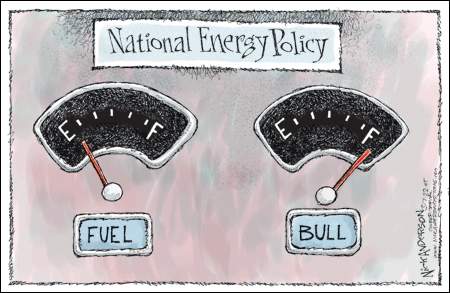
But it is relevant to Australia. The bull in Australia on this issue is over the sustainability of energy. You can see it here despite this.
And you can see it in Ian Campbell, the Environment Minister's, support for the use of nuclear power and a significant expansion of uranium mining as part of a wide-ranging strategy to cut greenhouse gas emissions despite this.
The real issue is what to do about climate change. Australia's effective position is not to restrict our economy's carbon emissions whilst acknowledging the consensus of climate science that our climate is changing because of the additional greenhouse gases we are adding to the atmosphere; and that Australia is 'very vulnerable' to climate change.
Australia is not doing very much about climate change.
Posted by Gary Sauer-Thompson at 5:27 PM | Comments (0) | TrackBack
September 10, 2005
networks of surveillance
The Government's proposed new anti-terrorism laws that will tighten civil liberties. The spin from the national security state is that the changes are small compared with a far greater civil liberty: people's right not to be blown up on their way to work. Consequently, civil liberties may have to be eroded to protect Australian citizens from terrorist attacks.

The central dilemma is how to protect citizens within the rule of law when "fragile" intelligence did not amount to clear-cut evidence.
The justification for the new networks of political surveillance is that there is a war on and this provides the grounds for such incredibly tough measures. The threat is based on the tacit, unspoken claim that it is likely that terrorists will strike in Australia's homeland within the next two years. Tis an unrealistic threat, but this politics is about fostering fear, is it not?
The Howard Government proposes some tough measures that build on the substantial widening of ASIO's power that had been passed the Federal Parliament.The new measures are:
■ Detention for terror suspects without charge for up to 14 days.
■ Increased police powers to stop, question and search suspects.
■ Electronic shackles and other limits for terror suspects.
■ Fines for leaving baggage unattended at an airport.
■ New offence of inciting violence, including against Australian troops overseas.
■ ASIO and police access to air passenger information.
■ Greater use of cameras and random bag searches at major events and transport hubs.
■ ASIO given more time to use secret surveillance and conduct searches.
■ Crackdown on money laundering to fund terrorism.
■ More terror groups to be banned.
■ Tougher criminal background checks on citizenship applicants.
■ Citizenship applicants to wait three years instead of two for approval.
■ Crackdown on charities raising money for terror groups.
The Howard Government now controls the Senate.That means Labor and the minor opposition parties (Democrats and Greens) are impotent to defend our civil liberties. It is now up to the Labor states and the backbenchers--but don't hold your breath that either group will challenge these proposals on the grounds that they pose a danger to our democracy and freedoms even their rationale is to protect our representative democracy and freedoms.
Posted by Gary Sauer-Thompson at 11:17 AM | Comments (3) | TrackBack
September 9, 2005
'balancing and blending'?
It strikes me that the factions in the Liberal Party--conservative, classical liberal or libertarian and social liberal--- are more formalised than this account by Allan Moir, based on a reworking of Wassily Kadinsky:

The Liberal self-description is that the Liberal Party is a broad church or a family. But that is misleading given this Alas, none of the articles are online. So it is hard to know what they understand by Australian conservatism. I understand it as a one nation conservatism that is hostile to liberalism.
John Howard, the Prime Minister, spells out his understanding of the 'broad church':
We should never as members of the Liberal Party of Australia lose sight of the fact that we are the trustees of two great political traditions We are, of course, the custodian of the classical liberal tradition within our society, Australian Liberals should revere the contribution of John Stuart Mill to political thought. We are also the custodians of the conservative tradition in our community. And if you look at the history of the Liberal Party it is at its best when it balances and blends those two traditions.Mill and Burke are interwoven into the history and the practice and the experience of our political party.
Instead of a 'balancing and blending' of economic liberal and a social conservative I see contradiction. All the proposed national security state legislation about fighting terrorism is a constraining of liberty as understood by John Stuart Mill.
The political surveillance of this conservatism is an illiberal in its restriction of our civil liberties and in targeting the Muslim community.
Posted by Gary Sauer-Thompson at 4:16 PM | Comments (1) | TrackBack
September 8, 2005
folly and surreality in New Orleans
New Orleans may well be Bush's anti-9/11, the point when the glossy images and myths around the imperial war president begin to splinter and crack and the incompetence and callousness is disclosed. When the people of New Orleans needed help most that help was not there.
Of course, the Republicans (GOP) are in 'protect Bush at all costs' mode. They are shoring up the myth by spinning the idea of the 'can do' president who solves problems for his people. Tony Parkinson, our homegrown neo-con writing in The Age, swings into action on cue as a good cultural warrior fighting the enemy. He says:
As happened after September 11, the blame game is under way, with Bush cited as the reason for every ill visited upon his nation. The Jonah of the White House. On any calm analysis of cause and effect, of course, much of this hyperventilating is ludicrous, the product of anger, panic or hysteria. Some of it can be put down to partisan point-scoring.
Parkinson forgets to mention that the Rovian strategy is to play the blame game by pointing the finger at the state and local government. Has Parkinson been reading the onground reports of Kathleen Blanco the Lousiana Governor, Ray Nagin, the Mayor of New Orleans, local authorities or Republican senators about the slow federal reaction?
Or reading about the FEMA blocking local efforts to help people? Is he reading about the questioning coming from the American media. Where were the buses, the planes, the food, the police, the promised troops? Where was the planning for a catastrophe that news organizations had been warning about for years?
Nope. Our homegrown neocon is talking about the 'anger, panic or hysteria' of 'the international left' and the
'fanatics, whether green, anti-war or Islamist, who will never allow observable reality to intrude on their anti-Bush, anti-American narrative. For them, the fact of Katrina as force majeure - a freak of nature - is something to be wilfully ignored.'
In contrast, Tony Parkinson inhabits a rational universe and he understands that human civilisation has been struck cruelly by nature's fury.
Okay, stuff happens. A city has gone. Parkinson, as a cultural warrior, is trying to block the climate change account that 'global warming will make - and possibly already is making - those hurricanes that form more destructive than they otherwise would have been.' More debate on this issue can be found over at Jennifer Marohasy.
I reckon that Leunig has a much better grasp of the incompetence, folly and surreality around New Orleans:

An example is provided by this article about firefighters voluntering to help save and help people. They were used as FEMA community relations specialists and then, when a team was finally sent to the region, this happened:
As specific orders began arriving to the firefighters in Atlanta, a team of 50 Monday morning quickly was ushered onto a flight headed for Louisiana. The crew's first assignment: to stand beside President Bush as he tours devastated areas.
What we have is a devastated New Orleans full of human suffering being used as a stage for a political performance for the television cameras.It is what the Americans call showbiz: firefighters forced to act as human props as Bush walked around pretending to do his problem solving stuff.
Posted by Gary Sauer-Thompson at 8:18 AM | Comments (3) | TrackBack
September 7, 2005
Telstra fallout
Well, Telstra has become a hot political potato. Suprisingly so, as the Howard Government's T3 bill for privatisation is being introduced into Parliament today. Little time has been allowed to the opposition to look at the legislation in the House; or for the Senate to take evidence and review the legislation through its committee system. The Government's political timetable is very tight as it wants to get out of owning Telstra at all costs.
The political temperature over T3 has risen for two reasons. First, Telstra has leaked the extent of the poor quality of the telecommunication infrastructure, an aging workforce, and the need to keep dipping into reserves to pay big dividends to keep the share price up.

These are well known problems and the previous spin (by Telstra and the Howard Government in unison) about things going very well in improving services has been blown open by Telstra.
That does create a problem for the 'great deal' spin by the Nationals, as the ALP points out. Their $3billion represents the additional investment in operating and capital expenditure that should have been spent over the past 3-5 years. Maybe the Nationals will now turn their attention away from the $3billion they scored, and shift to ensuring that the new regulatory regime is a good one. John Quiggin offers some advice:
The only sensible policy option still available to us ...[is]...selling off the peripheral bits of Telstra (Foxtel, Bigpond and perhaps the mobile network) and renationalising the rest.
The second reason for the fallout between Telstra and the Government is Telstra's strategy to influence the regulatory regime accompanying T3. The company has highlighted the impact of regulation on Telstra and its ability to compete and continue to cross-subsidise the bush.
Telstra wants a light regulatory regime not a competitive one and so it is spilling the beans. Telstra argued that the proposed regulatory regime is daming the flow of cash that have supported its ability to make sub-economic investments in the bush. It is facing steady market share losses in mobile phones and an accelerating leakage of revenue from its copper-based fixed line network. Consequently, its earnings will continue to fall--7 to 10% this year.
It is not a convincing argument. It is competition not regulation that is challenging Telstra's market dominance. It is Telstra nearly doubling its charges on its fixed line network that have caused people to leave the fixed line network, not competition. Telstra needs to be regulated because it is the dominant player in the industry with a track record of anti-competitive conduct and bad governance.
Yet Telstra, as John Durie pointed out in yesterday's AFR under the new regulatory regime the Howard Government retains the Ministerial power to have discretion over the terms, including pricing under operational separations plans. This sidelines the Australian Competition and Consumer Commission. The Howard Govermnment is also proposing to leave intact existing powers to appoint more directors to the board after the sale.
Instead of concentrating on this kind of bad public policy Telstra has been transparently using the Telstra share price as leverage against the Government, to undermine the T3 process if Telstra doesn't get its way on regulation. War has been declared with Canberra as Telstra sets about stripping value from the Government's shareholding. The share prices has dropped 14.2% since Trujillo came on board with almost $9 billion being wiped off the market value of Telstra.
Instead of this scorched earth strategy with Canberra to ease the regulatory regime, Telstra should really be concentrating on reducing costs and improving product and service delivery so that is better prepared for the new competitive regime, given the rapid switch by consumers from fixed-line to mobile phone calls. Telstra has a record of poor services, bad customer relations, and innovation to ADSL-2 broadband and wireless broadband.
The Australian Securities and Investments Commission has launched an investigation into Telstra on the grounds of a breach of disclosure laws. Material information---that Telstra would be unable to maintain its previous level of dividend---should have been disclosed to the ASX as well as the Government.
Telstra is not really playing it straight. They are using the regulatory regime as an excuse for the continued loss of market share due to bad business decisions in the past.
Posted by Gary Sauer-Thompson at 7:52 AM | Comments (6) | TrackBack
September 6, 2005
White House under siege
New Orleans sits in a bowl surrounded by levees, so when the levees break or are breached the soup bowl fills with water as Lake Pontchartrain drains into the bowl.
The flooding of New Orleans caused by Hurricane Katrina disclosed that race determined who got left behind and that limited government means neglected infrastructure. The fallout from an devastated, abandoned New Orleans looks as if it will become a hinge event in the second term of the Bush Presidency.
The White House now faces a political crisis: the help came late and was limited.
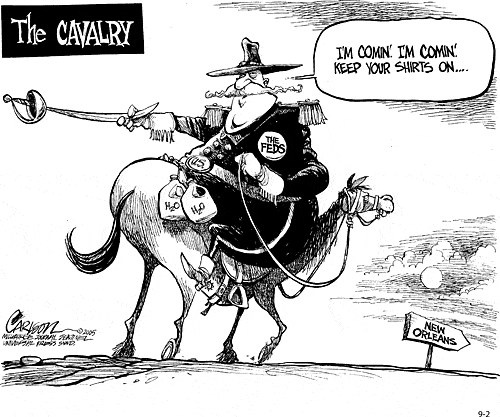
Stuart Carlson
Limited government plus incompetent public administration is a lethal combination. It may well leave a toxic wasteland of industrial compounds, sewerage and household chemicals mixed with the floodwaters.
The political climate has changed as the Republicans look vulnerable. The Rove spin machine is now in action to contain the political damage. The Rove strategy is to shift the blame away from the White House and toward officials of New Orleans and Louisiana.
The machine has to spin that story because the earlier line of arguing for the impossibility of predicting what happened, was implausible.Washington knew Katrina would happen as they had ample warming. Lots of computer simulations of the flood from burstlevees had been run, whilst New Orleans was a classic case in civic disaster courses in American universities. Even though Louisana, Mississippi and Alabama are Republican territory, Republican Washington did nothing for too long.
Two interesting transcripts:
One is from msnbc.com's Meet the Press which I saw on television last night:
MR. BROUSSARD: I'm telling you most importantly I want to thank my public employees...
MR. RUSSERT: All right.
MR. BROUSSARD: ...that have worked 24/7. They're burned out, the doctors, the nurses. And I want to give you one last story and I'll shut up and let you tell me whatever you want to tell me. The guy who runs this building I'm in, emergency management, he's responsible for everything. His mother was trapped in St. Bernard nursing home and every day she called him and said, "Are you coming, son? Is somebody coming?" And he said, "Yeah, Mama, somebody's coming to get you. Somebody's coming to get you on Tuesday. Somebody's coming to get you on Wednesday. Somebody's coming to get you on Thursday. Somebody's coming to get you on Friday." And she drowned Friday night. She drowned Friday night. (Broussard is crying)
MR. RUSSERT: Mr. President...
MR. BROUSSARD: Nobody's coming to get us. Nobody's coming to get us. The secretary has promised. Everybody's promised. They've had press conferences. I'm sick of the press conferences. For God sakes, shut up and send us somebody.
Another is from Laura over at War and Piece who says that Dutch viewer Frank Tiggelaar writes:
There was a striking dicrepancy between the CNN International report on the Bush visit to the New Orleans disaster zone, yesterday, and reports of the same event by German TV.ZDF News reported that the president's visit was a completely staged event. Their crew witnessed how the open air food distribution point Bush visited in front of the cameras was torn down immediately after the president and the herd of 'news people' had left and that others which were allegedly being set up were abandoned at the same time.The people in the area were once again left to fend for themselves, said ZDF.More here
What was a natural devastation of the city from a hurricane quickly turned into a Hobbesian state of nature in which rescuers came under fire from snipers.
There is going to be lots of political reverberations from this event.
Posted by Gary Sauer-Thompson at 9:21 AM | Comments (0) | TrackBack
September 5, 2005
the shining glory of great deeds
I missed the watching Question Time on the House of Representatives today, as the ABC free-to-air broadcast showed Question Time in the Senate.
Politics is about performance. If the politics in Senate is an expression of deliberative politics, then the House of Representatives, is a stage for political theatre. We citizens, watching through the live television feed of the action in this publicly organized space, are the audience.

Heinrich Heinz The united Coalition team
The players, or rather actors, are evaluated in terms of the style of their performance. The performance model of politics gives us freedom as virtuosity, then the appropriate criteria for judging action is greatness.
This kind of politics is driven by a fierce agonistic spirit in which everybody has to distinquish themselves from all the others through unique performances to show that he was best of all.
It is a politics for the sake of politics.
Posted by Gary Sauer-Thompson at 10:23 PM | Comments (0) | TrackBack
September 4, 2005
New Orleans: limits of neo-liberalism
Though Hurricane Katrina hit the New Mexic Gulf around August 30th the civil disaster response was very slow, even though it was clear by that Katrina had caused immense damage along the Gulf Coast.
Thousands of Americans are dead or dying because they were too poor or too sick to get out without help--and that help wasn't provided.. Many have yet to receive any help at all. This suggests a lack of both preparation and urgency in the federal government's response.
Why?
Kevin Drum over at Washington Monthly's Political Animal says that whilst no:
"....one could predict that a hurricane the size of Katrina would hit this year, but the slow federal response when it did happen was no accident. It was the result of four years of deliberate Republican policy and budget choices that favor ideology and partisan loyalty at the expense of operational competence. It's the Bush administration in a nutshell."
The Republicans are committed to a limited role for the federal government and downsizing, privatizing, and placing greater reliance on state and local government to provide essential services.

Steve Bell
When the federal government opts out of essential services such as disaster relief, then that leaves the states to take the lead in looking out for their own needs and the private sector helping to rebuild the Mexico Gulf Coast.
Paul Krugman, writing in The New York Times concurs with this argument:
At a fundamental level, I'd argue, our current leaders just aren't serious about some of the essential functions of government. They like waging war, but they don't like providing security, rescuing those in need or spending on preventive measures. And they never, ever ask for shared sacrifice...So America, once famous for its can-do attitude, now has a can't-do government that makes excuses instead of doing its job. And while it makes those excuses, Americans are dying.
Posted by Gary Sauer-Thompson at 12:31 PM | Comments (1) | TrackBack
September 3, 2005
It's on--destabilization
Whilst the factions in the NSW Liberals continue to eat one another with relish, judging by the "tax debate" or flareup between Howard, Turnbull and Costello of last week, the leadership battle in the federal Liberal Party is now on in earnest. Costello's current campaign to display his breadth is about destabilising the status quo.

The pressure is building and the movement and manoeuvring amongst the leadership group for the deputy leadership is now quite open. Tis countdown time.
Political success and power. It is so seductive. It is like a narcotic. You crave the adrenalin more and more. Why ever more power? For its own sake, not for the good of the country.
Have you noticed that there is very little substantive policy talk about improving the productivity of labour through clever thinking and innovation? A smarter Australia is not on the agenda.
That means that we ordinary citizens observing the political plays in the media, are obliged to continue to work longer and longer hours to ensure economic growth and Australia remaining internationally competitive. We now spend more time getting to and from work, getting ready for work, worrying about work, losing our jobs, and looking for other jobs.
In the global economy leisure is now squeezed around work. Leisure is the time off the job. Often leisure means recovery from work, replenishment for further work, stress management and consumption. Gone are the days of the easy life. Work is a responsibility (a moral duty). We have a moral obligation to work to contribute to the wealth of the nation, and human fulfilment comes from work.
We feel that we are being squeezed for time. And we don't like it. Our increased standard of living has been purchased with a more demanding worklife. Much of what we spend our money is compensation for all the work.
Posted by Gary Sauer-Thompson at 1:55 PM | Comments (0) | TrackBack
September 2, 2005
Iraq: beyond the myths
The neocon narrative about Iraq depicts the struggle in Iraq as a battle between the freedom-loving Iraqi people and terrorists.
These rarely mentions that the two leading parties in the Shiite coalition are pursuing an Islamic state in which the rights of women and religious minorities will be sharply curtailed, and that this kind of regime is already being put into place in parts of Iraq controlled by these parties. And it overlooks the almost unanimous desire of Kurdistan's people for their own independent state.

Juan Cole, in discussing the draft Iraqi Constitution, says that this constitution enshrines a single-chamber legislature, which will likely be controlled by Shiites for a long time. Does that mean most of the power resides here?
He says that the U.S. presence in the Sunni Arab areas over the past two and a half years has made things progressively worse, that the presence of U.S. troops is pushing more and more Sunni Arabs into the insurgency, and the insurgency will continue to grow in power.
Posted by Gary Sauer-Thompson at 3:59 PM | Comments (0) | TrackBack
September 1, 2005
after the media frenzy
Most of the focus in NSW of late has been on the John Brogden's drunken behaviour, his 'mail order bride' comments at a bar in the Hilton Hotel, his resignation from leadership of the Liberal Opposition Party, and then his attempted suicide due to media and political pressure, shame and humiliation.
More recently, attention has shifted to the Liberal's factional warfare and the dirty hands of the senior social conservative (Catholic) right and the dirt pushing in its cultural war with the social liberals, the role of the tabloid media (The Daily Telegraph) in recycling unsourced and salacious gossip, and where to draw the line between private and public spheres. There are no such lines for the attack dog tabloid media of News Ltd.
A key political issue here is the failure of the NSW Liberals to lay a glove on an unpopular NSW Labor Government. They've got problems.
What has been forgotten in the murky world of the media feeding frenzy after Brodgen's resignation, is the poor state of the infrastructure in the global city of Sydney and in NSW.

John Hewson, writing in the Sydney Morning Herald, highlights the infrastructure problem:
If they run at all, the trains don't run on time and they are of questionable quality. Despite what the Government claims, hospital queues are lengthening, many hospitals are poorly demographically located and, in some cases, the quality is deteriorating. Similarly, many schools are deteriorating, are underfunded, and there is a constant debate about quality. Roads policy is, at best, ad hoc, as is planning. The public sector in many cases is bloated and needs to be reviewed in terms of numbers, quality and, most importantly, culture.
Though Hewson has not mentioned water, energy and the sustainability of the city, he mentions enough to indicate that we have a classic example of bad governance by the state government.
However, the NSW Liberal Party cannot turn this state of affairs to its advantage. It is more consumed with protecting factional colleagues and adding to them to gain control fo the party, than worrying about bad governance in NSW. It is the faction, definitely not the good of the citizens of NSW, that is now the chief concern.
They are even more concerned with the factional blood-letting than the good of the Liberal Party itself. In so turning on itself, the Party has lost sight of the goal of winning government in NSW.
Posted by Gary Sauer-Thompson at 8:37 AM | Comments (0) | TrackBack