« May 2007 | Main | July 2007 »
June 29, 2007
political blogging is untrustworthy right?
A joke. I have no idea who Darren Levin is apart from him being a staffer and blogger at the Australian Jewish News; a newspaper that dislikes voices critical of the actions of the Israeli government.
Levin's views on political blogging need to be taken with a grain of salt. He starts thus:
the blogosphere - a virtual soapbox of citizen reporters, self-proclaimed experts and armchair commentators - is looking less like Drudge's utopian vision and more like the wild west. Populated by anyone with a viewpoint and an internet connection, it's a daily ping-pong match of unfiltered opinion.
Unfiltered opinion? A lot of the opinion on political blogs in Austrlaia is informed and is a part of a national conversation.
By unfiltered Levin seems to mean unaccountable. Levin asks: 'without the traditional checks and balances of mainstream media, can we really trust what's being said?' My response is why should we really trust what the op-eds in newspapers say? Aren't many of these polemical and partisan?
Levin quotes Mark Pesce, from Sydney media and technology consultancy FutureSt., to the effect that there are checks and balances exist in the form of bloggers being accountable to each other and their readers. Levin is not convinced, as he asks whether this vote-with-your-feet model is enough when bloggers are becoming major players on the political scene?
Levin says not. This is how he argues his case--by appealing to the authority of Crikey:
In Australia, despite the veracity of opinion on sites such as Mumble and Poll Bludger bloggers have failed to make the same impact as their US peers. The most frequented news sites are still those owned by corporate media."I don't think blogging has particularly set the world on fire here in terms of political coverage or political results," says Stephen Mayne, the founder of the influential Crikey.As blogging proliferates, it's becoming more of a cacophony," he says. "How do you know where to go to find a good blog? If anything, there's going to be a throwback to trusted, reliable media."
So Mayne dismisses political blogs to defend the accountability of the online commentary of Crikey in an internet world where being online means cheap and untrustworthy. Levin uses this viewpoint to defend the trustworthiness of the poltiical bloggers at the Jewish News.
So which political blogs in Australia do Mayne and Levin have in mind in making their judgements about political blogging? Levin says:
Outside the political sphere, bloggers have become influential voices on everything from gadgets and technology to music, film and popular culture. But unlike political blogs, which are mostly approached with a grain of salt, consumers are relying more and more on gadget sites like Gizmodo (www.gizmodo.com) and engadget (www.engadget.com) for product reviews.
None are mentioned. There is no engagement or evaluation of any political blog in Australia. All political blogs are dismissed as untrustworthy. It's a joke.
Posted by Gary Sauer-Thompson at 6:55 AM | Comments (11) | TrackBack
June 28, 2007
Ken Henry's stool
It is often held that the politics of left and right use the Aborigines to defend highly predictable partisan positions. For instance, the left has refused to acknowledge the social disaster for fear of perpetuating stereotypes; the right has been willing to talk honestly but in order to defend past practices and resuscitate the policy of assimilation. Can we step beyond this frame?
Ken Henry, the Treasury Secretary, says that decades of passive welfare provision have delivered dependency, not capability; indeed, it is dependency that has eroded capability. He acknowledges that there remains some controversy over this position, but responds by saying that we will never make progress in any area of policy unless we are prepared to deal honestly and analytically with the underlying causes of the problems we face.

Sharpe
A quote from Henry's address to the Cape York Institute conference in Cairns:
Indigenous welfare has been provided passively. It has encouraged a state of dependency. And that dependency has contributed to the undermining of indigenous development. These are propositions on which we should be able to agree. And the sooner we can reach agreement on these propositions, the sooner we can start to work on more effective means of securing indigenous development.
I accept that proposition.
The aim is not self-esteem--it is economic development.It is about Indigenous enterprises becoming more established, organised, and confident, and the Aboriginal leadership shifted its emphasis from providing a welfare function to a more commercially oriented view.
Posted by Gary Sauer-Thompson at 8:41 AM | Comments (12) | TrackBack
June 27, 2007
political scepticism
An example. Sometimes the scepticism gives way to panic. There is reticence and fear on the part of indigenous people in how they interact with white Australians. There is also an arrogance and intimidation on the part of white Australians towards indigenous people.

Matt Golding
A different response is the address to the Cape York Institute conference in Cairns by Ken Henry, the Treasury Secretary about the need to end "passive welfare". He argues that the core reason for the limited success in indigenous policy over many years is that too little of this policy has been focused on addressing the underlying causes of disadvantage.
There are three key interdependent foundations of indigenous disadvantage: poor economic and social incentives; the underdevelopment of human capital and of capability in general; and an absence of the effective engagement of indigenous Australians in the design of policy frameworks that might improve social and economic incentives and build capabilities.
Henry operates in terms of a three legged stool of positive incentives, well developed human capital and effective policy engagement. These have much the same functioning as the legs of a three-legged stool in that all three must be strong and supported together to ensure that our approach to overcoming indigenous disadvantage is well-balanced. Weaken or remove one leg and the stool collapses. Henry says:
Getting the incentives right and building human capital will best come through indigenous engagement in policy development. It is essential to achieving better outcomes. Policy reforms are more likely to be successful where they are informed by those affected; those who are uniquely placed to understand their own needs and preferences. Moreover, the opportunity to participate in policy development is, like education and good health, a development outcome in itself, contributing directly to higher levels of wellbeing. Research suggests that indigenous groups with more autonomy in decision-making fare better in key socio-economic indicators.
That takes us to the heart of democracy doesn't it---citizens having the capabilities, voice and power to shape the policy agenda. Positive welfare incentives in the welfare system that reward work and study above passivity and dependence and human capital (good health and education) to overcome poverty as capability deprivation and to take advantage of positive incentives do not give democratic voice or power.
Posted by Gary Sauer-Thompson at 6:30 AM | Comments (13) | TrackBack
June 26, 2007
creeping authoritarianism?
Two events indicate the disturbing trend of squeezing free speech. On Friday the former public servant Allan Kessing copped a nine-month suspended jail sentence for his crime of leaking reports to a newspaper about the chaotic state of security at Sydney Airport. A latter investigation--after the whistleblowing--- justified Kessing's concerns. So much for shielding whistle blowers protecting the public interest.
Yesterday two journalists joined Kessing in the ranks of the criminal class when Chief Judge Michael Rozenes, in Victoria's County Court, ordered convictions be recorded against Melbourne Herald Sun staffers Michael Harvey and Gerard McManus, and fined them $7000 each.Their story revealed the Government had opted to accept just five of 65 recommendations on ways to improve benefits for war veterans, thereby saving about $500 million. They refused to reveal their sources.
Couple the prosecuted whistleblowers and journalists with academics bullied, the military silenced, the neutering of Canberra's mandarins, the curtailing of parliamentary scrutiny, and the failure of freedom of information laws, which the High Court last year confirmed gives federal ministers virtually a free hand to withhold documents from the public.
The inference? The Howard Government is squeezing public debate in the name of security, and it shows little tolerance for dissent within the party, the government and the bureaucracy. Silencing dissent is the informed judgement. Or the corruption of public debate
What we have in the public sphere is the tendency of the traditionally elite conservative political forces to mobilise a concept of “popular opinion” through the construction of “latte left elites”, the articulation of a populist rightism in the news media , a rejection of liberal views of the media (that is to say, concerns about objectivity, truth and so on) and "pomo-bashing" of the culture wars, that says the left is morally deficient or repugnant and that it “represents an attempt to usher in a new kind of "left-wing totalitarianism (Marx) via the unlocked back doors of democracies.
Posted by Gary Sauer-Thompson at 8:59 AM | Comments (16) | TrackBack
June 25, 2007
a flawed education policy
In an op-ed in The Age Simon Marginson says puts his finger on the core failure of educational policy in Australia--underinvestment. It's argument is putting the "public" into public policy and it is part of a five-part series of seminars on "Education, science and the future of Australia" at the University of Melbourne.
Marginson says:
Compared to education, training and research in North America, Western Europe, Singapore, Korea and China, Australia is going backwards. Our total spending on education was once well above the OECD average. Now, at 5.8 per cent of GDP, it has fallen below the average and trails the United States and Korea, which spend 7.5 per cent. And, while our spending on private education is higher than average, public spending is just 4.3 per cent, compared with the OECD average of 5.2 per cent.
He says this public policy over the last two decades has left the nation with four crucial weaknesses in this area.
only 42 per cent of Australian three and four-year-olds are enrolled in pre-school programs. We spend an infinitesimal 0.1 per cent of GDP on early learning (one-fifth of the OECD average) and we staff our pre-schools with the worst-paid teachers when they ought to be among the best....Secondly, only 77 per cent of our 15 to 19-year-olds are in education. In Canada, it's 91 per cent. .... The legacy of weak early learning and a divided school system is an underclass of people who leaves school early, with poor job prospects. Thirdly, after early learning, vocational education and training is the most under-funded area of education, the casualty of a decade of buck-passing and blame-shifting between federal and state governments since their funding agreement collapsed in the late 1990s.Finally, higher education is now just 41 per cent government-funded. Since 1995, public funding for each student has fallen by 30 per cent, much the largest such decline in the OECD. Fee-based courses have expanded to fill the gap.He adds that the shift from public to private funding has inadvertently thinned out the capacity of Australian universities in basic research, formerly supported through publicly funded teaching-research positions. International student fees do not generate enough surplus to fund research.Yet research is vital to our future prosperity.
Marginson states that whether public policy can take a long-term, outcomes-driven view might just depend on whether the public interest can make itself heard in policy development.
Posted by Gary Sauer-Thompson at 8:33 AM | TrackBack
June 24, 2007
President Bush: Good v Evil
When President Bush acts in the name of fighting The Terrorists, with the goal of battling Evil, what he does is by definition justifiable and Good because he is doing it. Because the threat posed by The Evil Terrorists is so grave, maximizing protections against it is the paramount, overriding goal.
In this extract from Glen Greenwood's book A Tragic Legacy: How a Good vs. Evil Mentality Destroyed the Bush Presidency Greenwood explores how President Bush, who believes himself to be leading a supreme war against Evil on behalf of Good, is incapable of understanding any claims that he himself is acting immorally. Greenwood says this illuminates a central, and tragic, paradox at the heart of the Bush presidency:
The president who vowed to lead America in a moral crusade to win hearts and minds around the world has so inflamed anti-American sentiment that America's moral standing in the world is at an all-time low. The president who vowed to defend the Good in the world from the forces of Evil has caused the United States to be held in deep contempt by large segments of virtually every country on every continent of the world, including large portions of nations with which the U.S. has historically been allied. The president who vowed to undertake a war in defense of American values and freedoms has presided over such radical departures from the defining values and liberties of this country that many Americans find their country and its government unrecognizable. And the president who vowed to lead the war for freedom and democracy has made torture, rendition, abductions, lawless detentions of even our own citizens, secret "black site" prisons, Abu Ghraib dog leashes, and orange Guantánamo jumpsuits the strange, new symbols of America around the world.
The great and tragic irony of the Bush presidency is that its morally convicted foundations have yielded some of the most morally grotesque acts and radical departures from American values in that country's history.
So we have the never-ending expansions of executive power that overrides due process, the rule of law, that is justified in terms of the terrorists are waging war against tae Us and and so the overarching priority -- one that overrides all others -- is to protect the US, to triumph over Evil. There can never be any good reason to oppose vesting powers in the government to protect US citizens from the terrorists because that goal outweighs all others. There is no good reason to affirm the foundational American value that imposing limitations on government power is necessary to secure liberty and avoid tyranny even if it means accepting an increased risk of death as a result.
Posted by Gary Sauer-Thompson at 10:19 AM | Comments (7) | TrackBack
June 23, 2007
goodbye to all that?
It is true that state politicians have ignored the plight of Aborigines. The most recent example was NSW Premier Morris Iemma, who allowed last year's comprehensive Breaking the Silence report to vanish into a bureaucratic limbo of government inaction. In the NT, Chief Minister Clare Martin, seems so paralysed as to how to solve indigenous problems that we have a Commonwealth takeover in the Northern territory; one that pushes the rights of adult Indigenous people to one side in the name of a national emergency to protect the children.
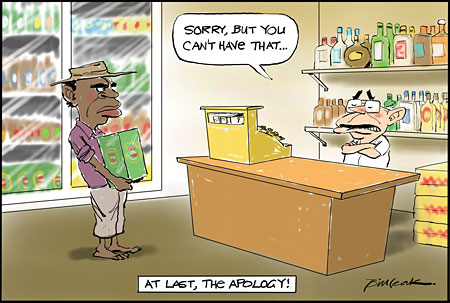
Bill Leak
The absence of consultation with indigenous people, the NT Government, the medical community, the states and the police indicates that the changes appear to have been sprung on all of them. That is causing unease and qualification leading to a questioning.
Has there been a change in the mode of governing indigenous communities? My response is here at philosophy.com.
The judgement of Nicolas Rothwell, writing in The Australian, is that there has been a fundamental change in the mode of governance: self-determination has been dumped:
Let there be no mistake: yesterday's declaration of a national emergency by John Howard ranks with the referendum of 1967, or the passage of land rights in the Northern Territory, as a turning point in Australian history: in what direction remains to be seen. In sweeping measures, so astonishing to political veterans that their scope and feasibility were still being weighed up last night, Canberra tore up the long-established political compact in remote Australia: the unspoken deal whereby indigenous communities have broad freedom, a tithe of welfare, and substandard social services, almost imposed by their sheer remoteness from mainstream society. Now, in the wake of Howard's highly charged announcement of a 'national emergency', all is changed. The last vestiges of the rhetoric of self-determination have been tossed away.
The compulsory Commonwealth acquisition of Aboriginal townships and the compulsory transfer of them to five-year leases, (with compensation paid) is what was rejected by one indigenous community recently. It said it was concerned this was an attempt to remove people's right to land, something hugely important to traditional indigenous people. Now, it's happening by force.
However, few commentators are arguing that indigenous cultural self-determination is a reason to reject this level of intervention in indigenous communities.
Update: 26 June
Peter Balint writing in the Canberra Times highlights the ethical conflict between the two modes of governing.
Children are not viewed as fully formed autonomous citizens and therefore, unlike their adult parents, we see little problem with a paternalistic approach to children and their welfare.The Federal Government is morally justified in intervening in cases of child abuse. Indeed, it has a moral duty to do so the welfare of children, indigenous or otherwise, is their responsibility. But it is also their duty to not trample on the rights of adult citizens. The proposed intervention in NT Aboriginal communities highlights a clash of these duties..While the Federal Government must intervene to uphold the welfare of all Australian children, it must also do so with the minimal amount of paternalism towards its adult citizens.
Balint says that all acts of paternalism must be strictly necessary to protect the welfare of indigenous children.
Posted by Gary Sauer-Thompson at 2:19 PM | Comments (16) | TrackBack
June 22, 2007
"rivers of grog"
Now we have the graphic image of "rivers of grog" which have been blamed for an epidemic of child sexual abuse in the Northern Territory. The rivers flow out of Darwin, into the tributary towns of Alice Springs, Tennant Creek and Katherine, and eventually to the camps that ring them and into the remote communities serviced by them.

Alan Moir
So we have a Commonwealth solution: an alcohol ban for six months on Aboriginal land; licensees required to view photographic identification and record the buyer and destination of alcohol; the NT Government required to develop a comprehensive anti-alcohol plan; and withholds welfare payments to compel school attendance.
This plan by John Howard to curb the "river of grog, removes the autonomy of Aboriginal areas in the Northern Territory, and imposes state controls that do not apply to white society. Is it a regression to the ancien regime, where indigenous Australians possessed no civil rights, and were seen as being in need of the civilising influence of white society.
Maybe the prohibition of alcohol won't work, as it's a recipe for sly-grogging as Mick Dodson claims. But what could work is an attempt to address health issues, such as the poverty related conditions of malnutrition, chronic ear disease, anaemia, rheumatic heart disease and persistent lung infections caused most suffering among Aboriginal children. These have a greater priority than sexual abuse which would rank about number 20 or 30 in importance among children's health problems in the Northern Territory.
So argues Paul Bauert, the head of pediatrics at Royal Darwin Hospital, who advocates a full medical check for the territory's indigenous children, provided it iss backed up with access to relevant treatment and specialists.
Update: 22 June
Mike Carlton in the Sydney Morning Herald says in relation to Howard's plan:
Let us hope to God it works, or that even some of it works. But I very much fear that this is a paternalistic, ideologically motivated attempt to stuff the genie back into the bottle. The Little Children Are Sacred report is emphatic that there must be consultation with indigenous people. If we revert to bossing them around again, to imposing white solutions upon them from the top down, yet another failure is certain.
"Bossing them around again "is the most general concern about Howard's national emergency plan.
Posted by Gary Sauer-Thompson at 6:01 AM | Comments (21) | TrackBack
June 21, 2007
Gillard on the culture wars
Deputy Labor leader Julia Gillard, last Monday night, marked the 75th anniversary of Australian Quarterly with some comments. She said:
Our culture, and the advantages it gives us, is endangered. I find it bizarre that when our culture has so much to offer our country, some want to undermine it through a vindictive, short-sighted and imported culture war. Their attempts to denigrate people such as our philosophers, artists, writers and even climate scientists as out-of-touch, inner-city elites, and to claim our egalitarian values are unsuited to new economic necessities, risks subsuming us into the blancmange of an emerging global monoculture.
The assumption that is questionable is "imported'. True the conservatives have adopted some aspects of the culture wars from the Republicans in the US, but it is also a homegrown conflict.

Australians are deeply divided as is our culture. It fractured from the impact of globalization during the 1980s with the floating the dollar, liberalised financial markets, a freed up labour market regulations, reforms to the ramshackle tax systems, and the national agenda of competition policy under Hawk and Keating.
Australians have responded differently to the ongoing effects of globalization --eg., nativist and cosmopolitan-- and these differences have been politically developed to create a divide between two sides of politics --conservative and liberal. Its' a crude dichotomy but it indicates that a unified Australian culture does not exist. Nor am I persuaded that the conservatives are subsuming us into the blancmange of an emerging global monoculture, as they oppose aspects of a global culture --Hollywood and explicit sexuality of consumerism.
Gillard then addresses the Australia's responses to a global monoculture:
In terms of world culture, we're unique: young, unusual, at times exotic and usually undermining authority. We can choose our path. We shouldn't feel we have to sing along in harmony with the rest of the world to have a positive effect on it. But we can dance like no one else. The last thing we need is culture warriors trying to force us to conform. It's by doing things our way and by continuing to nurture and celebrate our own culture that Australia will best confront our challenges and go from strength to strength.
Gillard indicates a nativist response in terms of a dynamic Australian culture standing up top a mass global (American?) culture. But Australia's national "unified" national culture of the 1970s has fractured along regional lines. Australians live in diverse regional states(Victoria, Queensland, WA, Tasnamia etc) as well as the nation-state
Posted by Gary Sauer-Thompson at 8:09 AM | TrackBack
June 20, 2007
talking sense about productivity
There has been a lot of fuss about the "leaked" Productivity briefing paper by the conservative side of politics. They say that the event shows Kevin Rudd battling to prop up his economic credentials after the Coalition highlighted his lack of understanding of productivity. Rudd's a fraud who deceives the public say Steve Lewis and David Uren, two senior journalists at The Australian. Dennis Shanahan is explicit:
The Australian yesterday published the story of a Labor briefing paper that confirmed Kevin Rudd was mistaken about, or ignorant of, a rise in economic productivity. It was a damning indictment of Labor's core economic attack on the Coalition, and a repudiation of the Opposition's Leader's grasp of the subject, and/or it showed he was prepared to dissemble. It was politically devastating, and Labor knew it. But the way the Labor leader handled the breach has made the media treatment much worse - it's not just an issue now of his economic credibility, but also of his competence and perspective.
These simply repeat, recycle and exaggerate the Coalition's assertions and claims rather than evaluate them, thereby indicating just how much The Australian is spinning for the Coalition. Rudd is consistently being dammed as bad.
What does the "leaked" productivity paper by Tim Dixon, John O'Mahoney and Ankit Kumar say?
It basically says that Costello argument that he has turned around the long term decline in productivity growth on the basis of two quarters of productivity growth is flawed. The briefing paper affirms the downward trend in productivity growth in Australia since the late 1990s (3.3% from 1993-4 to 1998-9; 2.1%from 1998-9 -2003-4; Treasury's forecast of 1.5% from 200-2009.) The 2007-8 Budget papers anticipate productivity returning to 1.7% in the forward estimates, and this indicates that there is no real lift in productivity growth from government policies.
So it is the Coalition who has a problem with productivity growth not the ALP. The ALP 's account about a long-term decline in productivity is in line with the accounts by the Reserve Bank, Treasury and the Parliamentary Library. Rudd is just plain right on Australias’ productivity. It's Costello and Howard who have the problem. Shanahan is plain wrong with his claim that Rudd is “mistaken about, or ignorant of, a rise in economic productivity.” So you can see just how much the Australian is into spin, with its 'Rudd has no credibility on productivity' line. The Australian is simply the media arm of the Coalition.
The briefing paper acknowledges that whilst the National Accounts show that there is a 2% growth in the past two quarters after two negative quarters, this still indicates that Australia is stuck in a low productivity cycle. This is still the case even if there is an upturn in September after the release of the June quarter National Accounts. The ALP's account does not deny the upturn ---it argues that the upturn does not negate the low productivity cycle. In its Intergenerational Report Treasury estimates that productivity will remain at 1.7% for the next three decades.
So the ALP's argument that there is a need for policies to increase productivity is the right policy approach. Hence the need to invest in education and infrastructure. The response by the Coalition in Question Time was an expression of hysterics: Rudd was foolish, deceitful, discredited, ignorant, dreary, pessimistic, untrustworthy, disgraceful, fraudulent, flailing, drowning, opportunistic and a pretender. The ALP is quite right to press on with its low productivity argument
Alan Wood in The Australian dutifully does the Rudd beatup routine. He says that raising standards of living depends on rising output from workers. He then asserts that the only ones opposed to this are the "self-proclaimed intellectual Left, who regard our economic prosperity as a source of universal unhappiness." Then Wood dismisses the link between broadband and productivity because fast broadband is about downloading movies, music, internet scams and pornography faster. Lots more bash bash of the ALP etc etc.
However, Wood is not willing to deny that Rudd is right---Australia’s long-term productivity performance is a matter of enormous importance. Wood's economic credibility means he has to acknowledge the truth---Australia’s productivity performance in recent years is weak.
Posted by Gary Sauer-Thompson at 8:43 AM | Comments (4) | TrackBack
June 19, 2007
uranium enrichment, nuclear futures
Uranium enrichment is consistently denied as not being an option in Australia, but it is being discussed and planned for away from the public's eye. The nuclear industry has always been secretive. Secret men's business as it were. So we don't really know what is really going on concerning the Howard government's thinking about nuclear energy.

We can piece together bits and pieces. We know that the sites for that are being talked about for uranium enrichment plant are Caboolture north of Brisbane and Redcliffes (Port Pirie) north of Adelaide in South Australia. Uranium is hot and uranium mining is being treated the same as any other mining. So why not value add?
We know that is the position of John Howard. He says that the export of uranium requires looking at enrichment as there is significant potential for Australia to increase and add value to our uranium extraction and exports. The Olympic Dam mine, owned and operated by BHP Billiton, holds the world’s largest known uranium ore deposit, with about 66% of Australia’s proven reserves. The mining and enriching uranium at Olympic Dam in South Australia is linked to exporting uranium to India and China via the Adelaide-Darwin rail line. Does that mean re-importing the waste the same way for storage at the former nuclear test site at Maralinga?
On this kind of logic it makes sense for a private firm to build an enrichment plant at or near the Olympic Dam uranium mine. Hence it is no surprise that Nuclear Fuel Australia is planning to present a uranium enrichment feasibility plan to the Government.
The signs point to the Howard Government 's nuclear policy including enhanced exports, nuclear waste imports, uranium enrichment, nuclear waste reprocessing, and even nuclear power generation, thereby rekindling Australia's early Cold War nuclear ambitions.
Posted by Gary Sauer-Thompson at 8:33 AM | Comments (14) | TrackBack
June 18, 2007
Post Hamas victory in Gaza
Daniel Levy, writing in Prospects for Peace, highlights the emerging plan that is being articulated over the last days from many quarters to deal with the Hamas victory in Gaza. This was the response to the way that Israel and America sided with a faction within Fatah, whose goal was the collapse of the unity deal between Fatah and Hamas after Hmas won the democratic elections.
Levy says that it is in danger of becoming entrenched, even though it is a fantastical one – divorced from reality and far too similar to the previous failed policies that helped create this disaster.
The emerging plan is known variously as promoting Fatahland, while punishing Hamastan, or West Bank first, or feed the West Bank/starve Gaza. There is no detailed elaboration of the plan yet, but its outline would look something like this. Use the new reality as an opportunity to drive home the division between the West Bank-Fatahland and the Gaza-Hamastan.Visibly demonstrate to the Palestinians that Fatahland is a happy place with an advancing peace process, while Hamastan is a dark and hopeless place excluded from this march of peace. Ultimately, so the story goes, the Palestinians embrace the Fatah alternative. Hamas peacefully accepts the consequences or is militarily defeated and we all live happily ever after.
So why is this divorced from reality?
It turns the clock back to 2005 and ties to wish away the last 24 months. Hamas democratically won an election deemed to be free and fair by outside observers. From that moment on, the policy pursued by Israel, America, most of Europe, and the Arab world has not been helpful. Round one of defeating Hamas militarily has failed.
Posted by Gary Sauer-Thompson at 5:07 PM | TrackBack
political frustrations
Gee the Coalition has just discovered high spreed broadband. Ministers are tripping all over themselves to sell their wonderful policy as they stumble over unfamiliar words like 'wireless connection', (WiMax) and 'fibre-to-the-node'; and then struggle to connect that to the claim that the incompetent, hypocritical ALP will destroy all that is good and decent and take the country to ruin with their broadband policy. It's confected tabloid outrage in overdrive mode (ALP raids the Super Fund, rob our soldiers and police of their superannuation, sob sob, doesn't rely on government being a partner etc etc).

Alan Moir
The heavy hitting Liberal message is not getting through as the ALP lead in the polls remains and it has dipped only slightly. Though The Australian carries on about 'Howard closing the gap' (Dennis Shanahan calls it a comeback for the Coalition and a polling breather) the Coalition is now sounding frustrated and worried in Question Time. The tone of desperation is still there despite the public mask of no worries, we've been here before, and we came out winners.
I guess that comedy form of political theatre doesn't work that well. It's not just the policy or the politics that counts as it's performance on the issues that counts.
Broadband in Australia is a disgrace, and the substance of debate in Australia over broadband has been close to a farce. The Government has been desperate to counter Labor's plans for a high-speed broadband network, which it says would be jointly owned by the taxpayer and the private sector, which might or might not be Telstra. The Coalition has now effectively neutralized broadband as an election issue, and probably just begun to understand the need for high-speed national strategy and infrastructure.
Government announced Opel, a joint venture between Optus and Elders, had been awarded $958 million from the Broadband Connect Infrastructure Program to build a wireless internet network in regional Australia. In addition, Opel will contribute about $900 million of its own funds to the network. So the Coalition is subsidizing the mix of ADSL + wireless broadband to the bush. It's a cheaper option to the ALP one, and it appears to give a two tier broadband system --one for the cities and one for regional Australia.
Whilst Wi-Fi hot spots --as we have in Adelaide with Internode --provide wireless Internet access over distances of up to 100 feet, Wi-Max networks cover distances up to 30 miles. This means you browse the Internet on a laptop computer without physically connecting the laptop to a wall jack. Wi-Max has the potential to provide broadband access in rural areas that are too far from exchanges to provide wired or Wi-Fi access. It is appropriate in areas where people live too far from an exchange to get broadband, or the terrain is too hilly to lay cables. In that situation, Wi-Max, with its base station (1321) does something that DSL can't and it has an upgrade pathway.
Once Intel incorporates Wi-Max into laptops and PCs in the same way it currently builds in Centrino for Wi-Fi connectivity, then the cost comes down. So WiMax has the potential to deliver increased broadband competition, lower prices, and more freedom. That's a combination worth some consideration for regional Australia.
The announcement of the taskforce or panel to set the framework for a tender to build an urban fibre-to-the-node network that came without any timelines Canberra has recognized that that the network will have to be monopoly infrastructure, requiring legislation to prevent the building of competitive infrastructure. This means that there will be uncertainty about the eventual outcome, and this is likely to persist for a considerable period if anyone but Telstra wins the tender after the election.
It is highly unlikely that the Government subsequently destroy the profitability of Telstra's core business by allowing a competitor a legislated monopoly that displaces the copper network. So the two-year impasse over the construction of the network continues. However, Telstra will now be under pressure to put forward a proposal with access prices and terms acceptable to the Government and the ACCC.
Posted by Gary Sauer-Thompson at 2:56 PM | TrackBack
June 17, 2007
Middle East--resolving conflict
Sometimes the issues and causes of conflict in the Middle East are rather clear cut:

More often than not, however, they are complex and this is especially the case in the Palestinian occupied territories.
As Tony Karon observes over at Rootless Cosmopolitian the reason for the violence between Hamas and Fatah:
is not that Palestinians have not “sorted out their politics” — they’ve made their political preferences abundantly clear in democratic elections, and latter in a power-sharing agreement brokered by the Saudis. The problem is that the U.S. and the corrupt and self-serving warlords of Fatah did not accept either the election result or the unity government, and have conspired actively ever since to reverse both by all available means, including starving the Palestinian economy of funds, refusing to hand over power over the Palestinian Authority to the elected government, and arming and training Fatah loyalists to militarily restore their party’s power.
That US/Israeli siege strategy, directed by Elliott Abrams, the US Deputy National Security Advisor, now lies in tatters. Fatah is no longer a credible fighting or political force in Gaza. Hamas is in power because the Palestinian people want it to their government.
Another step would be for Israel to give up being a Jewish nation-state.
Posted by Gary Sauer-Thompson at 1:37 PM | Comments (2) | TrackBack
June 16, 2007
Canberra Watch
It is winter time in Canberra and it is cold. However, it is less numbing than listening to Joe Hockey, Employment and Workplaces Relations Minister, cram the words 'union thugs' and 'union bosses' in as many times as he can into an interview he's doing. It is no longer fun counting:

Alan Moir
The shock and horror jokes about trade union thugs monstering little old ladies receiving meals on wheels with hammers and sickles, which were designed for the daily TV news battle, did fall flat. Desperate stuff. Unsuprisingly, the jokes about democracy and corporate bosses engaging in paid advertising on industrial relations were few and far between.
The political debate is now pretty deadening, and as we move to closer to the long winter break, we have steady leaks of stories designed to disrupt the media strategies of both political machines; or the economy being seen as a finely tuned F1 machine only Costello and Howard can drive. Economic management is like driving a racing car and you cannot trust an inexperienced, ill-prepared Rudd/Swan team controlled by the unions to run the economy.Thus the politics of fear.
The economic debate is becoming the political debate even though Wayne Swan endeavours to make it a non issues whilst having something to say about the economy. So we have the ALP 's economic narrative about growing inequality and declining productivity needs to be broadened. Productivity underpins Rudd's policies for education expansion, broadband development as these are designed to raise the nation's skills.
Why don't they argue that the F1 analogy highlights the need to make the shift to sustainability and reducing pollution from coal fired power stations? Why not argue that Costello is driving the highly engineered racing car at high speed in the wrong direction? Don't we need a car that is fuel efficient? Non polluting? One that allows us to make our lives better? Do we really need a racing car economy?
How come the ALP, which is bursting with ideas, is not arguing this way? What are the parliamentary tactics of not asking about climate change ("the greatest moral question" of our time) and concentrating on fundraising at Kirribilli House? Trying to reinforce the image of John Howard as arrogant, out of touch, mean and tricky and as a leader "for the rich"?
Posted by Gary Sauer-Thompson at 12:18 PM | Comments (16) | TrackBack
June 15, 2007
economic prosperity plus
Glenn Stevens, the Reserve Bank governor, sent a strong signal yesterday that he will probably raise official interest rates again in the coming months. However, four rate rises have not disqualified the Government from being accepted by the electorate as a better economic manager than the ALP. Costello and Howard sure do thump the economic drum in Question Time about their greatness and Rudd's incompetence.
The political reality is that Labor has not been able to persuade Australia that it can be trusted with the economy---(meaning a job and an income). I cannot see a fifth increase in interest rates before the election making much difference. Nor can Peter Hartcher

Allan Moir
Nor will this kind of inequality despite a decade of economic prosperity.
This is "serious national housing crisis" characterised by "reductions in public housing stock, soaring private rental rates, an acknowledged housing affordability crisis and no real reduction in the number of homeless". And yet , as Glenn Steven, points out:
The global economy has continued to grow faster than its long‑run average, oil prices have risen a lot further, compensation for risk in financial markets remains remarkably skinny, Australia’s economic expansion has continued and Queensland is still experiencing stronger economic conditions than the average for Australia. But the fact that all those things are still occurring is quite remarkable. The Australian economy is on the cusp of the seventeenth year of the expansion which began in the second half of 1991. There is, at the moment, moreover, a high degree of confidence about the future, with share prices near record highs, property markets firming again and borrowing proceeding apace.
This means that inflation is a concern in the medium term as the pressures build from the economy operating at near full capacity. So further monetary tightening will come, though not in the immediate term is the message.
Posted by Gary Sauer-Thompson at 8:53 AM | TrackBack
Medicine's Working Group + PBS
One of the research projects of Thomas Faunce, a senior lecturer in the medical school and the college of law at the Australian National University, is investigating the impact of international trade agreements on Australia's medicines policy.
In a recent op-ed in The Age he argues that the Medicines Working Group, established under the free trade agreement between Australia and the United States, has played a significant role in creating the controversial changes to reference pricing arrangements for patented medicines under the Pharmaceutical Benefits Scheme, now in legislation before the Senate.
Faunce asks whether the agenda of the Medicines Working Group is similar to that of the US negotiators to the trade agreement, who had been required by legislation to seek the "elimination" of reference pricing under the PBS. He says that:
Australia's approach, expressed clearly in Annex 2C of the free trade agreement, was to value pharmaceutical innovation scientifically through expert assessment of its "objectively demonstrated therapeutic significance". This is the task of the existing Pharmaceutical Benefits Advisory Committee. It is a crucial part of such transparent, evidence-based assessment that new patented products be assessed for innovation against all available therapies, generic or even non-medical, for the same main clinical indication. If a new drug can't prove that it works better and is safer for a reasonable price difference than an existing generic competitor, why should the community have to pay more over time for its technical molecular flamboyance or associated advertising?
He says that the position of the the US medicines negotiators to Annex 2C (on pharmaceuticals) of the agreement was that new patented medicines should not have their claims to "innovation" assessed by comparison against cheap generic medicines.
This is crucial as one of the key drivers of rising health costs over the next decade is the PBS. The agenda of the Medicines Working Group would increase Australia's health care costs. We know that the text of the Agreement increase the pricing power of US drug companies operating in Australia. So it is unlikely, based on past practice, that they will not make use of that new pricing power.
Most of the measures in the FTA apply to new drugs rather than existing ones. In a submission to the Senate on the FTA and the PBS Faunce, Drahos and Henry argue that it is:
plausible that the gap between US and Australian drug prices could be cut in half. We estimate, very conservatively, that Australia’s PBS will have to pay at least one third more for its drugs with the FTA than without it. If the likely FTA effects are applied to 2003 figures, the extra cost to of the PBS to the government last year would have been around $1.5 billion for the same drugs at the same levels of use and with no increase in the health benefit to Australian patients. Similar pressures would be felt by other buyers of prescription pharmaceuticals, particularly hospitals.
Drug prices are around three to ten times lower than in the US because of this reference pricing policy. Will there be a new category of medicines (known as F1), which will not be subject to reference pricing, and for which the government will pay much higher prices?
What does that mean for co-payments? Isn't the commonwealth government seeking savings of $580 million over four years due to lower wholesale prices paid by the government for generic versions of some common medicines with expired patents? Will the higher prices be passed onto consumers?
He asks whether the agenda of the Medicines Working Group is similar to that of the US negotiators to the trade agreement, who had been required by legislation to seek the "elimination" of reference pricing under the PBS. He says that:
Australia's approach, expressed clearly in Annex 2C of the free trade agreement, was to value pharmaceutical innovation scientifically through expert assessment of its "objectively demonstrated therapeutic significance". This is the task of the existing Pharmaceutical Benefits Advisory Committee. It is a crucial part of such transparent, evidence-based assessment that new patented products be assessed for innovation against all available therapies, generic or even non-medical, for the same main clinical indication. If a new drug can't prove that it works better and is safer for a reasonable price difference than an existing generic competitor, why should the community have to pay more over time for its technical molecular flamboyance or associated advertising?
He says that the position of the the US medicines negotiators to Annex 2C (on pharmaceuticals) of the agreement was that new patented medicines should not have their claims to "innovation" assessed by comparison against cheap generic medicines.
Posted by Gary Sauer-Thompson at 12:32 AM | Comments (2) | TrackBack
June 14, 2007
the media's psychosis
The Australian's recent editorial entitled Reality bites the psychotic Left argues that by refusing to face modern realities, the Australian Left has dealt itself out of the national debate. It goes on to assert that closely related to the Left's hatred of the US is their contempt for capitalism. It then says that:
On one of the burning topics of the day, climate change, this profound hatred of capitalism has led them down another philosophical dead end which advocates a romantic vision of suffering for a cause. Rather than objectively assess the realities of climate change and the practical task ahead they advocate symbolic, but ultimately futile, penance. By persisting with a misguided campaign to turn back the clock and demonise the Howard Government for not being harsh enough, once again, the debate has passed them by. Kyoto is giving way to a new global compact at which the US and Australia are at the centre. As research into clean coal technology for electricity generation looks set to become not just a reality but much quicker than even optimists had expected, those who advocate a return to dark nights and cold showers again look foolish.
This is from a newspaper that has used every tactic to support any strategy to stall action on climate change to stem the green tide. The editorial goes on to claim that todays Left has allowed itself to become trapped in a parallel universe, out of touch and far removed from the mainstream where the real Australian discourse takes place.
Really? On climate change it is The Australian's trenchant denialist position that is marked by "distorted perceptions of reality" surely. It has traditionally held that a strong case could be made that no scientific consensus on climate change exists, and that it was the climate change scientists who were the true believers.
The Australian understood its stance to be one of scepticism, and it has continued to cling to this even though most Australians judged climate change to pose a real threat to their mode of life and a real danger to that of their childrens. It has dealt dealt itself out of the national debate on climate change with its vitriol and hysteria rhetoric about the neo-Arcadian Left being anti-affluence, anti-wealth, anti-economic growth. The Australian is resolutely anti-green underneath its practical approach, adopts a bully boy approach to its critics, and it lost the climate change debate by a long way. Ideology was no match for the enlightening science of climate change.
It is The Australian that looks out of touch and ridiculous as it whips up its mock outrage into a form of hysteria about the "psychotic" Left. So what is it going to do about its denialist position now that it has been left stranded on the far shore. It has to cover its retreat in some way.
Posted by Gary Sauer-Thompson at 8:27 AM | Comments (5) | TrackBack
Tony Blair on the feral beast
In the dying days of his political career Tony Blair has a few words on the media. Much of what he says is true. He is critical of the 24 hour news cycle, instant forms of journalism, views the media as feral beasts that eschews balance or proportion, and raises the need for more regulation and accountability.
The result is a media that increasingly and to a dangerous degree is driven by "impact". It is all that can distinguish, can rise above the clamour, can get noticed. Impact gives competitive edge. Of course, the accuracy of a story counts. But it is secondary to impact. News is rarely news unless it generates heat as much as, or more than, light. Second, attacking motive is far more potent than attacking judgement. It is not enough for someone to make an error. It has to be venal. Conspiratorial.
And:
The fear of missing out means today's media, more than ever before, hunts in a pack. In these modes it is like a feral beast, just tearing people and reputations to bits. But no one dares miss out.
Blair acknowledges that the media is deeply into interpretation of what a politician says and devotes reams of commentary to its significance.
It is true that the media face intense competitive pressures; that commentary trumps facts; that a politician's error always becomes part of a venal conspiracy; and that hidden meanings matter more to the media than what a politician actually says.
What Blair doesn't address in his speech to the Reuters Institute is the way some sections of the media engage in politics. In picking in the Independent in the UK he ignores the way the Murdoch Press in Australia and Fox News in the USA frames issues for a conservative audience, beats them up and does so by aggressively casting the other side as enemies to be destroyed. Oh, and the media stars use of anonymous sources in the Canberra court to further the right wing agenda; or the way they are more interested in influence than reporting.
Blair was largely dismissive of the democratising, diversifying potential of new media, preferring to emphasis its downside; ignored the way ministers leaked to selected journalists, downplays the politicians' more manipulative approach to supplying news; or lied about the Iraq war dossiers and the Hutton report.
Posted by Gary Sauer-Thompson at 12:55 AM | Comments (2) | TrackBack
June 13, 2007
so much for competition
The nation's politicians are falling over each other to give the ACCC greater powers to regulate the petrol industry--ensure competition, break cartels and lower petrol prices--- but, when it comes to telecommunications, the same politicians are acting to sideline the regulator. Strange is it not?

Pryor
And yet Telstra's strategy is to double the price of broadband and re-establish its monopoly through its proposed fibre- to-node network It also wants to clip the wings of the ACCC. The politicians are not falling over themselves to ensure greater competition in the telecommunications industry, even though Australia ranks around 42 in the world in terms of new digital infrastructure.
Good high speed broadband--- fibre-to-the-home--is some way off in Australia. As Alan Kohler observes in The Age the current situation is one in which:
Telstra wants to build FTTN, to re-establish its monopoly. Its competitors have proposed their own version to head off Telstra. The ACCC supports the competitors because that is what it does. And the two main political parties are getting involved because optic fibre broadband sounds really cool.
He says that everyone in the telecommunications industry knows that using neighbourhood exchanges (nodes) and retaining the last kilometre of copper is a temporary solution, mainly because the old copper is degraded and requires expensive maintenance.
Want more competition in the telecommunications industry? Then split Telstra into an infrastructure and retail company. None of the politicians are even talking about that. Kohler says that:
the best solution for Australian telecommunications...would be a split-up of Telstra, followed eventually by a fibre-to-the-home network built by the Telstra infrastructure fund as an open network available to all at a regulated price that reflects the capital cost.
Posted by Gary Sauer-Thompson at 8:36 AM | Comments (4) | TrackBack
June 12, 2007
Blogging the Adelaide Festival of Ideas, 2007
The Adelaide Festival of Ideas is back (5-7July) with its interesting theme of 'which way to the future'. It is also a very opportune theme in the light of climate change, the changes in industrial relations, reforms in healthcare, radical changes in the media and a public mood that suggests Australian citizens are deliberating about whether its time to consider changing the commonwealth government.The election can be interpreted as being about the future of the country.
I have mentioned the fifth festival in passing here at junk for code in relation to the history of the festival. One innovation in this years festival is the use of bloggers----Kerryn Goldsworthy at the wonderful Pavlov's Cat and Tim Dunlop of the innovative Blogocracy at News.com.au and myself writing at public opinion at Thought Factory. Kerryn discusses the Festival of Ideas in relation to Writers Week and the Adelaide Festival of Arts.
Introducing blogging is an important development into the Festival format, given the squeezing of our public culture due to the decline in the quality of commentary in the media as it shifts to infotainment, and the struggle for survival by our little magazines. The internet opens up possibilities to broaden the festival beyond the face-to-face events in Adelaide and to continue the conversation amongst the audience that has been activated by the ideas introduced by the invited speakers.
People discuss the ideas amongst themselves and Adelaide audiences are intelligent, well informed, articulate and so equipped to engage in good practical reasoning about these ideas. The philosopher Michael Oakeshott, in an essay, The Voice of Poetry in the Conversation of Mankind, talks about the importance of a continuing historical conversation. He observes that a multiplicity of voices need to be heard, to be a part of the public discourse. However, that conversation has been blunted by the deceptions, untruths and spin of the publicity industry over the last decade.
So why not begin to use the comments technology in the blogging publishing system to enable a sharing of this conversation amongst those living outside of Adelaide? This kind of publishing system is much more of the moment than the commentary in the monthly Adelaide Review. That would enable the ideas to be kicked around a bit, hopefully winnowed and sifted by those participating in the conservation (including other Australian bloggers), an adversarial presentation of competing arguments, and maybe facilitating a connection of these ideas to other kinds of material.
Australian citizens deliberating about possible futures for their nation-state embodies a different understanding of democracy to the economic conception, which emphasizes voting for political elites as the central institution in democracy; or to parliamentary democracy's self-interested and coercive bargaining or negotiation associated with legislative changes. The deliberative conception of democracy is sustained and deepened by the national conversation, as it is one way to counter the media's poor performance of its watchdog for democracy function.
Blogging has been criticised by professional journalists and commentators in the mainstream media and dismissed in the name of ghost blogs. Blogging has its defenders from those who claim that the good work of the professional journalists is being drowned out by a fierce, bullying, often witless tone of intolerance that has overtaken the left-wing sector of the blogosphere. That negative view overlooks the bloggers shared commitment to an active engagement in local, state and national politics and our public culture.
The Festival provides an opportunity to show what Adelaide bloggers can do by way of assessing ideas. It is not something that journalists are well known for. What the internet offers is that audiences need no longer rely on reviews by journalists or comment from familiar political commentators telling them how they should think on important issues. More voices have been added--their own.
Posted by Gary Sauer-Thompson at 6:41 AM | TrackBack
June 11, 2007
US v Russia etc
They're at it again. The US and Russia are warring over the deployment of missile and defensive shields in Europe The US plans to base a new missile defence system including interceptor and radar, sited in the former Warsaw pact countries of Poland and the Czech Republic. Russia objects. Its response is an angry, nay a belligerent, one. Tony Blair chips in to say that the West "worried and fearful" at the political direction of Russia.

The US continues to push ahead with the missile defence system bequeathed by the Reagan administration---the so-called star wars---in Europe and the Pacific Rim in Asia. The hawks in Washington, Whitehall and Canberra appear to want an arms race to ensure a unipolar world.
Their justification, that these defensive shields were aimed at "rogue states such as Iran and North Korea" is ludicrous. But Blair and Howard swallow it without a moment of embarrassment. They appear to love a cold and chilled relations that results from America’s military expansion, attempts to install a new extensive global missile system designed to box in Russia and China and keep them consigned to being a secondary powers. Yet Russia scorned this explanation from the start, seeing the plan as clearly targeted against its own interests in the region, and considers it necessary to counter the possibility of a unipolar world.
As Paul Rogers observes at Open Democracy tha:
neither the Russians (nor, for that matter, the Chinese) will allow the United States to develop a unique strategic offence/defence combination. In the last resort they will both expand their own strategic nuclear arsenals to give them the potential to swamp any future US missile-defence installation. That is the way that arms races start.
It is one that Australia is willing to risk as it throws its support behind the US missile-defence installation in the Pacific Rim.
Update: 12 June
Francesca Beddie writing in the Canberra Times says:
Russia wants to see a world where stability is maintained by a balance of powers rather than superpower rivalry. This harks back to the 19th century Concert of Europe which, international relations expert Coral Bell argues, offers a model for the post-Cold War era. She suggests the unipolar phenomenon of the 1990s is already in retreat and a new global balance is emerging, made up of six great powers: the US, the European Union, China, India, Russia and Japan... This is not an aberration in Russian foreign policy: the deviation came in the euphoric years immediately after the collapse of the Soviet Union, when it seemed that Russia's only course was to integrate with the West. With many other choices now open to Russia, it's time other nations thought more about where this new power might be heading rather than from where it has come.
Posted by Gary Sauer-Thompson at 3:24 PM | Comments (1) | TrackBack
June 10, 2007
political memories
I was in meeting in Sydney all day yesterday and I arrived back in Adelaide late last night. I had little chance to read the newspapers or post. So I'm trying to catch up. This cartoon caught my eye from the archives whilst I quickly scanned the papers over breakfast:

It's the other side of the previous post. You have to admit that Keating has given a welter of material to the Howard Government to work with over the next fortnight in Parliament as they attempt to wound Rudd and Gillard. It may work as the ALP is scared of their own shadows.
The Hawke/Keating economic reforms----floating of the Australian dollar, deregulating the banking sector winding back import tariffs, opening the Australian economy to global competition, driving a wave of competition at a state level, introducing enterprise bargaining to boost productivity growth and introducing compulsory superannuation---were important.
Keating argues that these reforms underpin Australia's contemporary prosperity and yet Labor does not want to claim the fruits of their reforms as their own. Labor has made a mistake in distancing itself from the Hawke and Keating reform legacy under Beazley and Latham.
Why so? Is it the focus group advisers? The ALP union Right into numbers and strategy? Well, the consequence is that Labor in Opposition has handed the mantle of economic reform to Howard during the last decade; and it is struggling to stake its claim as economic reformists in a global world. This defence of Keating is not being part of Keating's cheer squad --it is a keen puzzlement at the way the ALP has walked away from its economic reformist credentials. Why so?
Posted by Gary Sauer-Thompson at 9:12 AM | Comments (22) | TrackBack
June 8, 2007
Keating lets rip
I caught the Lateline interview with Paul Keating last night. It was a gem, a sterling performance, that went beyond just defending his reformist legacy. He starts thus:
Hawke and I have been put out to grass because we had interest rates up in 1989. That's 20 years ago in two years from now. Bear in mind this Tony, Bob and I won the '90 election with interest rates, cash rates at around 16 per cent, housing rates about 16 per cent. I won in '93 when interest rates were not an issue. They were not an issue in 1996. So how come they became an issue in 2004, or in any way an issue now? The answer is because the Labor Party's inability to get across the argument and put it.
So what is the argument? Keating says that:
The real question today with the economy growing so rapidly and unemployment so low is why doesn't the tinder box go off? That is, why don't we get the big bang? The big bang in inflation and in wages back into the old dismal cycle? The answer is because of the structural changes. Nothing to do with Mr Costello's economic management.
The structural change was opening up the economy, floating the exchange rate, doing away with tariffs, and real wage reductions to get that competitiveness. So maintaining low inflation now is all about these structural things.
Today we have a focused group ALP that turns its back on the Hawke Keating years. Keating's response is that:
They'll do him no good. Because in the end those kind of conservative tea-leaf-reading focus group driven polling types who I think led Kim into nothingness, he's got his life to repent in leisure now at what they did to him. They're back, they're back....The Labor Party is not going to profit from having these proven unsuccessful people around who are frightened of their own shadow and won't get out of bed in the morning unless they've had a focus group report to tell them which side of bed to get out.
The current Federal secretary is the author of "don't fight them on interest rates" at the last election. So you wouldn't put much faith in the ALP embracing the Hawke/Keating heritage.
Posted by Gary Sauer-Thompson at 8:30 AM | Comments (11) | TrackBack
June 7, 2007
blowing hot +speaking cool
The debate in Australia about global warming and greenhouse emissions is largely a political one shaped by the forthcoming election. It has become one of slogans and messages from entrenched positions whilst the policy insights of Warwick McKibbin into the political compromises remain the background of the election year theatrics.

Leunig
This black and white contest from within the middle ground is how our political culture works. The rhetoric works on the underlying emotions of the electorate, who are now sophisticated enough to analyze the messages in terms of the gap between what is being said and what is done. Politicians can blow hot and strong on global warming then spend their energy making sure little happens so as to protect the coal industry and heavy energy users.
Kenneth Davidson in an op-ed in The Age sums the debate up well:
Labor has emissions targets for 2050. They aren't much good without firm signposts along the way. The Coalition promises a cap-and-trade system without announcing the cap and promising free pollution permits to the biggest polluters.This is absurd. It is like a state government responding to public outcry about road carnage with a promiseto introduce speed cameras and booze buses without setting speed and blood alcohol limits first, and promising alcoholics fine rebates when the limits and penalties are decided.
The way the debate has been framed by the Coalition is just as bad:
Who do you trust most to manage the economy and deal with global warming? Give me a break. Howard doesn't seem to understand that without the environment there is no economy, that dealing seriously with climate change will provide opportunities for Australia to partake in a multibillion-dollar global industry.Labor recognises the environment bus is leaving the station, but Howard has spooked the Opposition into believing that if they make an open and honest run for it, a majority of voters will stay with the Government.
As Paul Kelly observes in The Australian Howard has trust on the economy but not climate change. So he seeks to redefine climate change as an economic issue, and so focus on the risks in emission reduction rather than the opportunities.
Howard has basically embraced the Bush position when he agreed that Australia would set an aspirational target for cutting emissions some time next year.For both Bush and Howard this first-time commitment to the principle of an (aspirational rather than mandatory) target involves postponing any decision on the size of any such target until after their next elections. It's self-regulation for the polluters.
McKibbin says that:
a promise to cut emissions whatever the cost, as with voluntary actions, lacks credibility. This is also the key problem with the present Labor Party platform of deep cuts by specific dates without knowing the costs. The Labor deep cuts easily can be implemented in the blueprint if the timetables are replaced by sensible ways of managing cost without destroying the credibility of the long-term target. ..The key to enhancing credibility of long-term carbon goals is found in the need to create long-term carbon permits equal to the long-term target. These long-term permits should be taken out of the hands of government and issued to key participants, then traded in a domestic carbon market to set a price of carbon into the long-term future.
He says that credibility is achieved by complete allocation of all long-term permits to all households and industry. At set times in the future (five-year steps) a maximum annual carbon price is announced for the next five years as a safety valve against spikes in carbon prices in case there are not enough long-term permits around in any year (but there is no cap on long-term carbon prices). Every five years a review of emissions is conducted and new bundles of permits of different duration are auctioned.
McKibbin adds that:
the Government should act in the national interest by making a stronger longer-term commitment to the goal of emissions reduction and thereby generate less long-term price uncertainty. Households should also receive a substantial allocation of longer-term permits. The Opposition should fold the taskforce ideas around its deep-cuts policy by implementing the deep cuts through a blueprint-style long-term permit allocation with a safety valve to manage the timing of cuts.
I doubt if we will see these ideas considered or taken up until after the election.
Posted by Gary Sauer-Thompson at 8:19 AM | Comments (2) | TrackBack
the return of the newspaper?
Tom Plate in The Age argues that important and complex matters cannot be seriously addressed in soundbite sentences on television. These can only be addressed by newspapers. Plate says:
My emphasis on newspapers is rooted in the core belief that political civilisation may depend in some circumstances on their flowering. Whether arrayed clinically on a digital computer screen, or splashed across newsprint that inevitably leaves ink on your hands as you pore over it, the newspaper at its best is a carrier of complexity. Any idiot news medium can handle the Paris Hilton story, but only a truly good newspaper can hope to offer you any wisdom at all on the daunting complexities of international currency imbalances, the Russian resurgence and China's weird stock market — not to mention the entire sprawling complexity of the Muslim world.
Even with the astonishing rise of the internet, the dominant media of mass communication probably remains television. However, it is newspapers that offer educated story selection, sophisticated analysis and more than the three-second soundbite, and with the internet this become more available to a greater number of people.
This is true. I can now read the Washington Post, New York Times, The Guardian, The Times online whilst in Adelaide or Canberra, as well as the Australian or the Sydney Morning Herald. Yet some of the analysis in these analyses can hardly be called sophisticated. Many are partisan and party political with the media companies seeing their core business of the company is the soliciting and publishing of advertising with journalists becoming content providers. So there is a need for quality content online both text-based and video.
Plate says that an example of quality online newspapers is The Times of India, and he acknowledges that the Wall Street Journal will probably be owned by media baron Rupert Murdoch, and that in 10 years it would probably not be the Wall Street Journal that more or less as we know it today under the Bancroft family. Murdoch will use his control of the Journal's parent company ravage it for profits or save it for posterity. No matter we still have the Times of India.
As the editorial in the Wall Street Journal says capitalism is dynamic, and as the Journal extols the virtues of Joseph Schumpeter's "creative destruction" for others, it can't complain when it sweeps through our own industry in the form of the Internet breaking up long-time media business models. Not when its classical liberal ethos is one of "free people and free markets." In doing so capitalism changes the nature of journalism to being content providers. That means a shift away from the Packer style media baron to private equity capital that works by increasing debt levels and improving margins of profitability by stripping costs and maximising returns; then reselling in 5-7 years.
A financially stringent new media model , that undergoes a technological overhaul to go digital, also means turning away from the big national debates , a dumbing down of content and embracing infotainment. So who generates the content that Sky News takes from the free-to-air networks, puts in some of its own content and plays it out. Someone has to, as Sky News has cameras without operators.
Posted by Gary Sauer-Thompson at 8:04 AM | Comments (3) | TrackBack
June 6, 2007
shaking up broadband?
So political pressure has seen the Howard Government willing to lessen the regulatory regime for the telecommunications industry. It has backtracked from its opposition to big changes to laws that regulate how the owner of the broadband network must share access with competitors. This backtracking is meant to be the political circuit-breaker. Does this mean turning to Telstra to broadband the nation?

Dyson
There will be an expert panel to consider and then to assess the competing fibre projects, presumably from Telstra and the G-9 group. The ACCC will remain a key player in the process, as it should, since it represents consumer interest.
Fibre connects the exchanges and there is little reason to assess the need for a fibre-to-node network. Broadband is not akin to a cargo cult, even if some economists have questioned the link between broadband and increased productivity.
The government's plan is all about regaining momentum on telecommunications--being seen to do something that is proactive, given Telstra's capital strike. The ALP is way ahead on this and its plan to replace the aging copper fixed line has broad industry support. The Howard Government has really made a mess of telecommunications --- did not separate Telstra into public infrastructure and retail services delivery firm--and most of the fuss about the lack of competition and Telstra's anti-competitive behaviour has its source in that policy failure.
Turning to a expert panel to assess the tenders is a step in the right direction and to be applauded, as it prevents Telstra from trying to cut a backroom deal with the Howard Government. The Howard Government must have been very tempted to cut a deal with the devil at the crossroads. Telstra really desires is control of the fibre network to exchange, street corner and the home. This would entrench its monopoly power as fibre to household would make its competitor's infrastructure obsolete.
The political spin from Costello is all about allowing private companies to built the network and not the government as proposed by the ALP. Its spin because the Howard Government is increasing the amount of public money to help build new telecommunications networks in regional areas.
Posted by Gary Sauer-Thompson at 8:32 AM | Comments (10) | TrackBack
June 5, 2007
power price surge
Finally, Australia is now committed to the introduction of a market for carbon emissions trading as both major parties are committed to introduce a "cap and trade" mechanism for pricing carbon. Everybody nods wisely and business says that Australia is going in the right direction. As Ziggy Switzkowski observes on Lateline, if the framework and principles is the first step, then the next step has to be a glide path with time lines and targets.

John Spooner
Something needs to happen quick and smart as the national energy market is a shambles in both regulatory and sustainability terms. Gaming --big generators using market power to force up average prices to extract monies from consumers is rife. And the talk is about building new coal-fired power stations to handle the increased demand for power.
50% or more (80% in Victoria) price increases for electricity are already in the pipeline, before we even begin to talk about $20 or more for a ton of carbon emitted over the cap. That is more than what would happen with the $20 per tonne under the cap and trade mechanism for pricing carbon. Yet the Howard Government is not talking in terms of recession, the destruction of the economy, jobs going offshore, or the lights going out. Nor is it talking about energy efficiency.
The problem is a serious one. As Ziggy Switzkowski says the science of climate change is very sound. The forecasts that suggest we have to get a 60 reduction relative to 1990 levels by 2050 speaking globally, are also appropriate. So that's where we must head. He adds:
The fact that no country, no economy has a plan to get us from today to there is an issue. As is the issue that is noted in the report. And that is in the year 2010, only three years from now, global emissions will be 40 per cent higher than 1990 levels. So we are as a globe on a trajectory of increasing emissions. We have to make a screeching U-turn to come down to minus 60 per cent in the remaining 30 or 40 years, and the means to do that, the technologies, the policies simply aren't visible in any part of the world.
Posted by Gary Sauer-Thompson at 9:02 AM | Comments (16) | TrackBack
Iran: confrontation
There is still a huge wall of distrust between Iran and the US and powerful figures on both sides are actively opposed to the nascent dialogue between the two camps. This cartoon views the Middle East though the eyes of the imperial power--the US-- who is building permanent US bases in Iraq as well as a giant embassy.

Alan Moir
Will the struggle the struggle over Iran’s nuclear program evolve into a decision by the Bush administration to resort to force against Iran. Does Vice President Cheney believe the diplomatic track with Iran is pointless, and is he looking for ways to persuade President Bush to confront Iran militarily? In Iran,I Iran it is the conservative, ideological factions within the regime - represented by Mahmoud Ahmadinejad and his allies among the Revolutionary Guard who are in favour of confrontation.
The geo-politics of the region are changing as the British are planning their exit strategy from Iraq, and it looks as if the 7000 British troops currently garrisoned in Iraq would be out by the end of this year.The old hope, that Iraq would make a rapid transition to a relatively peaceful client state of Washington (dependent on US military power centred on a few large bases), is now gone.
The strategic importance of the Gulf makes a complete US withdrawal highly unlikely in the next few years. Paul Rogers at Open Democracy observes that the policy is to ensure that:
a powerful US military presence is maintained in the heart of the Persian Gulf, forming part of a chain that goes on down to Kuwait, Bahrain, Qatar and Oman, with further facilities in Djibouti and Diego Garcia. It should certainly be enough to contain Iran, given a long-term US presence in Afghanistan, and may well - given the strategic value of Gulf oil reserves - be acceptable to any future United States president.
Posted by Gary Sauer-Thompson at 8:39 AM | Comments (2) | TrackBack
June 4, 2007
The Big Scare
So John Howard at the Liberal Party's federal council embraced the need to do something about climate change with a plan for an emissions trading scheme by 2012 .It involves the "aspirational goal" for reducing emissions to be set next year and short-term caps to be set in 2010, and so cannot be taken as a serious policy to address a key problem. There is a disconnection between any meaningful policy platform and the rhetorical objectives.
What the speech was about was developing a scare campaign--a Garrett recession resulting from cutting greenhouse gases at the expense of the economy.

Was there any modelling referred to? Nope. The proof is that Labor had set a target to reduce Australia's greenhouse gas emissions by 60 per cent of 2000 levels by 2050 and an 20% cut in emissions cuts by 2020. This would shut down the country's entire coal-fired electricity network and take every car off the road. As there were no targets or no measures Howard is addressing climate change as a political problem.
Trust me says Howard. I'm not a destroyer. I'll protect you from recession. But he doesn't talk about price to make the shift away from greenhouse emissions. The price will be set by the market. Price presupposes caps. There are no caps to to cut emissions.
Why trust Howard when the modelling that has been done does not produce doomsday predictions. Rather, it shows the size of the Australian economy will double by 2050 even with big reductions in greenhouse gas emissions:
Modelling last year by the Allen Consulting Group for the Business Roundtable on Climate Change estimated gross domestic product would rise at an annual rate of 2.1 per cent if Australia adopted a target of 60 per cent reduction in greenhouse gas emissions by 2050 compared with 2.2 per cent if nothing was done.The analysis showed the economy, now about $1 trillion, would reach $2 trillion by 2047 if there was no greenhouse gas policy change. But it will only take another 2½ years to reach that level with a 60 per cent greenhouse gas reduction target.Another way of putting it is that GDP will be about 5-6 per cent lower than it would have otherwise been by 2050, with an ambitious abatement scheme.
A paper by the economists Steve Hatfield-Dodds, of the CSIRO, and Philip Adams, of Monash University, built on the Allen Consulting Group modelling, says that with a 60 per cent reduction in carbon emissions the economy will grow by 169 per cent over the 45 years to 2050, rather than by 184 per cent.
So we have a Liberal campaign about fear on interest rates (the economy) the unions (IR) and climate change (economy). It's all been reduced to creating fear about managing the economy and scaring the voters. Not very future orientated, is it.
Posted by Gary Sauer-Thompson at 7:46 AM | Comments (27) | TrackBack
June 3, 2007
John Curtin, empire, WW2.
Last night I watched a copy of the ABC 's television docudrama on John Curtin about the early months of his wartime prime ministership. Made during a period of conservative political ascendancy it's narrative was simple: it was Curtin who insisted against Winston Churchill that the Australia divisions that had been fighting in the Middle East had to come back to Australia and not be sent to confront the Japanese in Burma. Churchill was an obstacle to the survival of Australia and he acted in an devious manner. Curtin finally prevailed.
 What is shown is how the responsibilities of office gnawed at Curtin's body so that he was frequently unfit for action. It implied that the job cost Curtin his life.
Though he stood up for Australia against an embattled British Empire and fought the entrenched conservatism and Anglophilia within Australia.
Australia had always until then accepted that decisions would be made in Whitehall for Australia and that Australians would do as directed by Britain. It stands marked contrast to the whole Gallipoli campaign in WW1.
Curtin's brillance was that he clearly recognized the threat to Australia came from Japan, that the momentous struggle for Australia was with Japan, especially in PNG and the Dutch East Indies, and that Britain was unable to provide military assistance to Australia. So Curtin turned to the United States of America for support: he handed over responsibility --- ceding control-- -of the Pacific war to the Americans and let Macarthur run things.
True the characters were decidedly wooden in the docudrama the prose stilted, and there was myth making. But the technical production were good, and the use of the post cards about Canberra was insightful. It was good to see our own TV/film industry focusing on Australia's remarkable political history in an insightful way.
It was a truncated docudrama since what was left out was the conflict between Earl Grafton Page and Menzies, and the crossing of the floor by the two independants, the role of Evatt, the political background of Curtin (he came from the left of the ALP), or that Australia that did not have the resources to defend itself. Another docudrama is needed to explore the political history of conscription for service in New Guinea, the arrival of MacArthur in Melbourne, and the crucial battle of the Coral Sea, the partnership between Macarthur and Curtin, mobilising Australian industry for the war effort, the tensions in the ALP over strike action and Kokoda.
The docudrama undercuts the conservative's central argument that the ALP stood for appeasement, isolationism Little Australia, and shirking international treaty obligations.
Posted by Gary Sauer-Thompson at 9:05 AM | Comments (5) | TrackBack
June 2, 2007
Blair + liberal internationalism
Christianity matters to Tony Blair. There was a missionary element to his rhetoric. He looked and sounded like a preacher man. True, there was less religion in Blair's public rhetoric of an 'ethical foreign policy' than the good and evil rhetoric of the Bush administration.
Like many Europeans I always found the religion of the Bush administration a big problem. I just switched off when I heard the God squad talk. If a bellicose nationalism is one of the reasons American political culture is alien, then another reason is the deep religious current in American political life.

Peter Brooks
I was initially attracted to Blair's respect for international law, his desire to go through the United Nations, his emphasis on aid, on the Third World, his support for the welfare state, for social justice, and his approach to Israel and Palestine. Blair was a good advocate for liberal internationalism--- that the West should try consistently to promote respect for human rights, pluralism, democracy.
During the 1990s Blair's Christian ethos of the good Samaritan who should help the stricken suffering from despotism, looked good. Military intervention has a place, particularly in order to forestall humanitarian disasters.
Liberal internationalists see the moral case against despotism abroad as a principle that trumps sovereignty. They reject the monopoly of states over international relations, pointing to other actors, the many international non-governmental organisations, like Human Rights Watch. They want to see international institutions enforce justice against recalcitrant states. So we ought to send troops to Darfur, and that it was right to send soldiers into the former Yugoslavia.
They are in contrast to he realists in international relations who take the nation state, pursuing its interests, to be the irreducible element of international relations, and so set a relatively high store by the concept of state sovereignty. They tend to be sceptical of state-building and democratisation programmes. They counsel the foreign policy objective of maintaining a 'balance of power' and rejecting the idea of permanent alliances.
Yet when liberal internationalism was put into practice by practice it looked seedy, tacky and compromised when it aligned itself with the destructive unilateralism of the neo-conservative Bush administration under the banner of the values of the United West. It became a pro-American stance---an acceptance of American exceptionalism ---because Bush never really listened to Blair and his advocay that international legitimacy should be delivered through a new multilateralism.
Posted by Gary Sauer-Thompson at 4:38 PM | Comments (2) | TrackBack
June 1, 2007
medicine's woes
Is medicine facing an era of perplexing stagnation? It would appear to be so. Consider the remarks below by Richard Horton in the New York Review of Books, made whilst reviewing James Le Fanu's The Rise and Fall of Modern Medicine: The argument of the book is that despite the significant advances in combatting disease which reached their peak in the post-war years, the promise of modern medicine at the end of the century has failed to materialise. Horton says:
Doctors are disillusioned by their profession; they increasingly have to deal with "the worried well" rather than the genuinely sick; they have to contend with the puzzling and, for many physicians, irritating popularity of alternative medicine; and the costs of diagnosis and treatment are escalating at a rate that is not matched by advances in knowledge. From the 1970s onward, there has been "a marked decline" in innovation. And, worst of all, doctors have experienced a "subversion, by authoritarian managers and litigious patients, of the authority and dignity of the profession.
The medical profession has problems and is in trouble. Le Fanu's account is one of the fall of medicine. After the golden age---when medical science has reached its natural limit---medicine has suffered from the retreat from rationality that marked the latter part of the twentieth century.
Le Fanu, who longs for the past authority enjoyed by doctors and for the deference that such authority demanded from patients, argues that the intellectual vacuum of the late 1970s was filled by two different sets of ideas, which emerged from two specialities which up until then had played only a marginal role in postwar medicine: genetics and epidemiology (the study of the patterns of disease). The developments in "the new (molecular) genetics," opened up the possibility of identifying the contribution of defective genes to disease. The epidemiologists insisted that most common diseases, such as cancer, strokes and heart disease, were due to social habits-an unhealthy lifestyle or exposure to environmental pollutants. Le Fanu says:
the great promise of the new genetics or of the social theory of disease has not held up according to the author. The amazing strides in our knowledge derived from molecular biology led to the rapid acceptance of the possibilities of gene therapy but these have emphatically failed to deliver, despite the intellectual satisfaction that these smart ideas generate. Similarly, in the wake of studies showing a clear epidemiological correlation between smoking and lung cancer the social theory has sought to link almost every disease for which there is not an obvious infectious cause to some lifestyle or nutritional source mostly blamed on Western society.
Le Fanu's opposition to the social theory of disease---how you live influences how you die-- is greater than his skepticism of genetics.
Their failure explains "the fall" of modern medicine and the source of its present discontents associated with unhappy doctors and the worried well. Raymond Tallis in Hippocratic Oaths: Medicine and Its Discontents gives expression to the former.The crisis in medicine is not a crisis in the practice of medicine or within the system of our health care. The crisis lies within the profession and is due to the acute loss in status that doctors have felt in recent years. Medicine is in danger of becoming "the first blue-collar profession". Doctors are now little more than tradesmen. Tallis sees medicine through doctors' eyes--not the eyes of autonomous patients'.
Posted by Gary Sauer-Thompson at 2:41 PM | TrackBack
Canberra Watch
Parliament has a break for a week or so before it returns for the June sitting. So what happened in the last fortnight? I agree with Michell Grattin in The Age when she says that although Kevin Rudd and Julie Gillard have some serious problems with their IR policy they are not counting against them with the voters.
In contrast, Howard suffers from being seen as expedient. He looks all over the place because he is. He wants to appeal to voters as the leader who won't throw away jobs and growth for the sake of climate, while also sounding fair dinkum on an issue that is resonating.
Howard is also deeply troubled that he has not been able to get Rudd's measure, and that is affecting his performance.

Rocco
The Howard Government is increasingly isolated at home and abroad in its inaction on the climate change. For 10 years it has blocked a national emissions trading scheme. However, as Peter Hartcher says in the Sydney Morning Herald it has grown harder and harder for the Howard Government to pretend that global warming is some sort of confected neo-socialist Eurocentric moral panic.
The Howard Government now faces its last chance to get it right and that the task group report that Howard received yesterday is the platform for his policy announcement. Hartcher observes that:
Unfortunately, the report seems designed to help Howard not in dealing with the environmental threat to civilisation but in beating back the political threat to the Government.The report gives the Government licence to procrastinate for another few years. While it does propose the essential policy tools for dealing with global warming - an emissions trading system and targets for cutting emissions - it suggests that Australia take four years in getting around to it.This is all designed to allow Howard to commit in principle to fixing the problem, but without committing to any specifics before the federal election. Why? To give him licence to portray Kevin Rudd, with his target of cutting emissions by 60 per cent by 2050, as an environmental fundamentalist who will wreak economic devastation.
The difficulty with this strategy is that informed people in the business world reckons that Howard need to do something about climate change to actually cut emissions.
Posted by Gary Sauer-Thompson at 5:54 AM | Comments (4) | TrackBack