« July 2007 | Main | September 2007 »
August 31, 2007
Pax Americana in the Middle East
Unlike the Howard Government, which continues to engage in imperial flag waving in support of fighting al-Qaeda in Iraq, it is now widely accepted that the U.S. has created an intractable mess in Iraq. The insurgency has viewed the foreign presence as an occupation, not liberation.
The quagmire may well worsen, if Vice President Cheney gets his way on bombing Iran. A desperate and increasingly shrill President Bush is drawing on Graham Greene to offer selective "lessons" from U.S. military involvement in Vietnam arguing that leaving Iraq would provoke the kind of bloody retribution that followed U.S. withdrawals from Indochina. Presumably, Vietnam, for Bush was a self-inflicted defeat, not a disastrous war from the start, whilst bombing Iran is equivalent to Nixon bombing Cambodia in the Vietnam war.
Many in the Middle East are well aware of the limits of American power, and the fact that it is on the wane in this region. The signs are there when the regimes most dependent on direct U.S. military support — Iraq and Afghanistan — are simply ignoring the Bush Administration’s injunctions against consorting with Iran.
Another sign of the collapse of Pax Americana in the Middle East is David Walker, comptroller general of the US, saying that the US government is on a ‘burning platform’ of unsustainable policies and practices with fiscal deficits, chronic healthcare underfunding, immigration and overseas military commitments threatening a crisis if action is not taken soon.
As it is accepted in the Middle East that the U.S. must begin withdrawing from Iraq in the coming year and that the surge was only a temporary U.S. excuse to prolong a losing hand in Iraq, so the regional power politics is about the nation states deciding on what strategy they will pursue toward a post-American Iraq. Will they side with Iran in supporting a Shiite government in Iraq, or will they side with Saudi Arabia in supporting the Sunni resistance?
Presumably, the U.S. will muddle on with the present order, perhaps drawing down its troop levels and relying more on air power to essentially manage the conflict at more or less current levels. Maintaining the present level of civil war may now be all that’s possible with the leverage available to the U.S. acting more or less alone.
Update:2 September
Scott Burchill has an op-ed in the Sunday Age on the diminished power and significance of President George Bush when compared to the man who addressed the Federal Parliament in 2003. He writes:
More than most, the Bush Administration has been characterised by illusions, fantasies, ignorance and incompetence in foreign policy. Washington refuses to acknowledge the limits of its power and does not understand that military force rarely translates into geopolitical influence and success — wars are won politically or not at all....The great paradox for Bush is that at a time when the US has never been more militarily powerful, it has never felt less secure. Iraq and Afghanistan have been calamitous and incompetent interventions, disastrous for the people of both countries and the image of the US around the world.
Rightly said. It is in contrast with the past In the past, when Washington's strength rested on its ability to convince other nations it was in their vital interests to see the US prevail in its global role. Bush's strident unilateralism after 9/11 squandered much goodwill and effectively undermined this diplomatic approach.
George Bush has asked Rudd to rethink Labor's policy to withdraw troops from Iraq in interviews with Australian journalists ahead of his scheduled arrival in Sydney on Tuesday for the annual APEC leaders meeting. The ALP is holding firm: Rudd rejected any change to Labor's policy of a phased withdrawal of Australian troops in consultation with Washington.
Well, that's a relief. There is still a point of difference between the Liberals and Labor. For the latter, the alliance with the United States does not mandate automatic compliance with the United States on every element of foreign policy.
.
Posted by Gary Sauer-Thompson at 1:54 PM | Comments (6) | TrackBack
Friday humour
The cartoon is black humour I guess. What will the gamblers and punters do?
The industry is in lockdown in order to quarantine the equine flu whose source is the Eastern Creek quarantine station. It's not just the cancellation of the Spring Carnival in NSW and phantom meetings ---it's also the lost of income and jobs of those battlers in the racing industry.

Moir
There was a breakdown in the quarantine system---poor federal quarantine procedures---by all accounts. Compensation is being talked about. Emergency relief is already being given. However, the maladministration at the government quarantine centre affects not just the thoroughbred racing industry but tens of thousands of recreational horse riders.
Posted by Gary Sauer-Thompson at 7:34 AM | Comments (2) | TrackBack
August 30, 2007
big target strategy
In a discussion of Labor's IR announcement over at Blogocracy JWH of Kirribilli (the cheek) comments "This was Rudd's big chance to differentiate his party's policies from the coalition but he has essentially defered it to the next election"
As it turns out, the differentiation lies not in current policy, but future plans we haven't heard yet. We've already heard that the coalition has more plans for deregulating IR which has the potential to frighten a lot of people, including some who feel they're doing OK so far.
What might those future plans entail? How much worse can it get?
These sorts of questions undermine the devil you know, who can you trust, battler's friend and safe pair of hands arguments that have served Howard so well.
The (incorrect) impression that Labor will take over all public hospitals is already out there. Howard has taken over one, seemingly on a whim, and his future plans for others remains a mystery. One by one maybe? In what order?
On education we know Rudd plans an Education Revolution, which has a universal ring to it. Howard on the other hand wants history taught differently and the future of public education is anyone's guess.
You never know with Howard whether you're going to get a hospital takeover, a nuclear power plant or a plebiscite. He seems to make these things up as he goes along.
What we do know, and what Rudd will no doubt remind us of at every opportunity, is that he does have plans to further deregulate industrial relations. We don't know exactly what those plans are, but it's unlikely to be pleasant.
Commenter JWH went on to say that Rudd "is determined to have the election decided on personal image rather than policy" which seems to be true. But it looks very much as though the spotlight will be on Howard's image and Howard's unannounced policy. IR is still Rudd's big chance, he's just reorganised the location of the target.
Posted by Lyn Calcutt at 12:34 PM | Comments (9) | TrackBack
Health reform: first steps?
How far is the political system willing to push for reform of the health care "system", now that the problems of the current are coming to the surface, eg., adverse events and saving hospitals from closure or downgrading due to the lack of qualified staff. How is the health "system" to be reformed to meet the health needs of the ageing population? What instruments will be used to govern reform? Which political party--Liberal or Labor--shows more commitment to the reform process?
An insight can be gleaned from this recent op-ed by Leslie Russell in the Canberra Times Russell, a research fellow at the Menzies Centre for Health Policy says that the origin of the problems currently facing all public hospitals is the way in which public hospitals are funded:
by joint contributions from the Commonwealth and the states and territories through five-year Australian Health Care Agreements, and the lack of any incentives in these agreements for innovation to improve patient outcomes. When the last agreements were signed in 2003, the Commonwealth ignored calls for reforms around better integration of the primary, acute and aged-care sectors, information technology and e-health, quality, safety and workforce, and a push for better indexation of funding. The states and territories received almost $1 billion less under the 2003-08 agreements than expected, and the Commonwealth contribution to the costs of operating public hospitals has fallen so that is now about 40 per cent. The agreements have only one performance indicator on which funding is contingent [on] a commitment to provide public hospital inpatient services at an agreed level.
Russell, a former Labor health adviser to Julia Gillard, comments that at a time when the focus in health is turning to prevention, screening and better management of chronic illnesses, the Commonwealth's approach is a short-sighted one , as it rewards the provision of isolated episodes of treatment for illness rather than efforts to ensure ongoing health.
One can only agree with this interpretation. The five-year Australian Health Care Agreements between the Commonwealth and the States, which is due to be resigned, is not being used as a lever to reform the health care "system" in spite of CoAG's commitment to health care reform. Russell then pinpoints the exact failure:
The agreements fail to recognise that, increasingly, health services are delivered in day surgeries, outpatient clinics and patients' homes. They do nothing to provide resources to ensure that patients can access affordable GP services rather than attend busy emergency departments, and that there are residential aged-care beds for frail elderly patients so they are not left inappropriately in expensive hospital beds.
So which political party is in willing to tackle health reform? Russell argues that it is Labor. She says that its policy
begins the process of moving the funding relationship under the Health Care Agreements towards a greater focus on patient outcomes by offering financial incentives to the states and territories to implement programs to reduce avoidable hospitalisations and readmissions, reduce non-urgent emergency department presentations, tackle waiting times for elective surgery, and help get the frail elderly out of hospital into residential aged care.
What Russell shows is that we have the first steps being taken to a reform pathway. It is not one that begins to engage with the need to deal adverse events and the closure of professional ranks, the failure to keep the public informed of adverse events, the regulation of health professionals, a greater autonomous role of allied health professionals, or the challenge to medical hegemony in funding.
Posted by Gary Sauer-Thompson at 7:16 AM | TrackBack
August 29, 2007
pulp mills and political cynicism
The quote below is from Jeff Malpas' article, Truth, Democracy and Politics, which is hosted by Tasmanian Times Online. Malpas describes our political world as:
....a world in which there is a general cynicism about politics and public institutions; in which public figures are not only assumed to lie, but appear to do so as a matter of course; in which what is thought to matter in the media is not truth, but rather political balance; in which the threat to security is used, even in a time of peace, to counter public criticism or open discussion; in which views that are in opposition to the government of the day are dismissed as un-Australian or un-American, and those who express them are derided and disregarded; in which lies and deception are regularly used to legitimate governmentally enacted violence, injustice and illegality; and in which the Prime Minister himself can blatantly deny what appears as well-grounded fact – and not even appear embarrassed...
This is also the political world in which big business gets its way---eg., Gunns with proposed its pulp mill in Launceston, Tasmania; the coal industry with its resistance to global warming and slow strangulation of the solar renewable power industry;or the denial of global warming from an anti-science perspective is seen as acceptable.
Malpas is right. The contemporary political situation here in Australia--- as well as in the United States and Britain---is one where political cynicism is widespread, and the rise of such cynicism has been accompanied by an enormous decline in confidence and trust in public institutions and in the political system as such. Gunns and the pulp mill in Tasmania is a perfect illustration of the process of corruption in liberal democracy that has led to political cynicism and distrust.
Posted by Gary Sauer-Thompson at 5:18 PM | Comments (7) | TrackBack
bending in the wind
The ALP's transitional arrangements indicate that its plans to "rip up" the Howard Government's industrial relations legislation has been postponed until 2010, in the name of striking a balance between flexibility and fairness. The thrust of the policy Rudd outlined yesterday - which builds on a Labor document released in April - is directed at appeasing the concerns of big business.

In addition to a five-year period for phasing out AWAs, a future Labor government would remove award regulation altogether for employees on more than $100,000 a year, and allow employers and individual workers to tailor award rules to their circumstances. Labor would also retain Work Choices' restrictions on union officials' rights to enter workplaces and sanctions against illegal strikes such as secondary boycotts and pattern bargaining where unions pursue industry-wide agreements.
So it is tough on unions.
By promising to abolish Australian Workplace Agreements Rudd is certainly rolling back Howard's laws. Rudd and Gillard say that AWA's go because they have been used to drive down pay and conditions for many workers in sectors such as retail and hospitality, so they are sticking to the ALP's plan to scrap them, subject to the protracted phasing-out arrangements.
Posted by Gary Sauer-Thompson at 8:17 AM | Comments (8) | TrackBack
August 28, 2007
Health system + adverse events
Peter Martin in an op- ed in the Canberra Times refers to the adverse events in our hospitals, and the 1995 ‘Quality in Australian Health Care’ study:
Each year some 18,000 of us die in hospitals. By comparison, fewer than 2000 Australians die on the roads. The 18,000 deaths, six out of 10 of which were avoidable, were identified, along with 50,000 cases of permanent disability, in a landmark 1995 study that has never been repeated.
And yet we rarely hear about this. Unlike road deaths they are not publicly reported. Politicians confidently repeat that we have a good health system, whilst the media challenges this by focusing on waiting lists and hospital queues:

Neil
Martin goes on to say that ten years later in 2005, an editorial in the Medical Journal of Australia asked whether a decade on we could "confidently state that health care is safer for patients"?
It concluded:
Unfortunately, the answer is no. It is regrettable that we have not measured the frequency of adverse events in Australia in a way that allows us to assess how we have fared since 1995; how we compare with other countries; and whether any initiatives have been effective in reducing patient harm.
It is not deemed important enough to keep these kind of figures on a national level. What we have is a fundamental failure of governance by both the State and the Commonwealth governments--separately and together --- and the lack of willingness to respond appropriately at both the bureaucratic and political levels. A curtain is being pulled over adverse events.
Professor Jeff Richardson, the foundation director of the Monash Centre for Health Economics, says that an estimated 50 Australians die in hospitals every day. Another 140 are permanently injured. Richardson describes the reported rate of preventable deaths in hospitals as "equivalent to a Bali bombing every three days". He adds that we are probably justified in thinking about those deaths in the same way as we would a casualty rate in a war.
Posted by Gary Sauer-Thompson at 7:09 PM | Comments (8) | TrackBack
August 27, 2007
Business Council on education
The Business Council of Australia has stepped beyond its traditional economic, taxation and workforce concerns to intervene in education debate with its Restoring our Edge in Education: Making Australia’s Education System its Next Competitive Advantage, paper prepared by Australian Council of Educational Research head Geoff Masters.

The BCA argues that high-quality school education is crucial to our future innovation, productivity and standard of living and it identified two main problems with the school system that required immediate action.
The first is that the number of young people who fall behind in their learning during their school years, and achieve only minimal educational outcomes. The second is the shortage of young people with the knowledge and skill required for effective participation in modern workplaces.
Presumably, teenagers achieving only the minimal educational outcomes means that there is a shortage of young people with the knowledge and skill required to effectively participate in work. Sounds a good diagnosis, doesn' t it?
So what does the knowledge and skill required for effective participation in modern workplaces mean?The BCA adopts a conservative educational approach to public education as it favours the three R's rather than literacy as in media or critical literacy. Why so? People in the workplace need a solid knowledge of the basics not the capacity for critical thinking. That kind of education (ie., one for for democracy and participation in public life) is seen as "esoteric".
The 3 R's as vocational education is hardly a well educated workforce or a high quality education, is it? It strikes me as a working class education provided by public schools to fill working class jobs. Presumably the high quality education is provided by the private school system.
Posted by Gary Sauer-Thompson at 6:10 PM | Comments (12) | TrackBack
their own devices
Two interesting points were raised by commenters on Matt Price's blog about Rudd and Roxon's hospital plan which, since late last week, seem to have converged and morphed into a handicap for the coalition.
First commenter off the block, Embrace the truth, thinks it's "a PR win" for Labor, and that Howard is "the author of his own dilemma" here. If he wasn't such an authoritarian he wouldn't have his health minister in the awkward position of having to attack his own idea. It's a good point.
Fourth comment down from Keith Gregg points out that Costello is sitting on "seventeen billion dollars of OUR money" while the health system goes down the tubes.
TripleJ's Roy and HG made a similar comment on the weekend - that the federal government is socking money into mysterious funds, but the states are borrowing to keep things running. Mind you, they also felt a series of plebiscites should be held on decisions regarding the sporting facilities, toilet blocks and tuckshop at an imaginary Don Bradman Primary School.
The thing that struck me about all of these is how easy people are finding it to ridicule just about everything the Howard government does. It's not that they're not being taken seriously anymore. The ideas behind aspirational nationalism alarmed many, but the term itself and the attitudes behind it were cause for much mirth.
That can't be good if you're trying to convince people you can effectively run a country.
Most comments threads at News.com descend into slanging matches between a handful of regulars brawling over well-worn territory. By the third page of comments there's usually little original left to be said anyway. The news and current affairs nomads have made their point and moved on.
Price's blog is an interesting one to watch for a sense of who's winning the arguments. He's not overtly partisan and his style is hardly serious political commentary. That may not be what we expect from print media, but it opens up a space where his readers can make their own arguments and work things out for themselves.
Left to their own devices with Rudd's hospital announcement, Labor supporters located it in the Howard strategies of war against the states and federal surplus. There wasn't much the Howard crowd could do. Supporters can only work with the material their leaders supply and, at the moment, the coalition script is being read as slapstick.
Posted by Lyn Calcutt at 10:42 AM | Comments (5) | TrackBack
August 26, 2007
editing Wikipedia
I see that the Howard's Department of Prime Minister and Cabinet, the Department of Defence and the NSW Premier's office have been rewriting political history on the online encyclopedia Wikipedia to the point of falsification.

Wilcox
It's a new style of public relations as the Coalition is looking down the barrel of a devastating defeat that would put it on the opposition benches for at least six and probably nine years. It is the development of the WikiScanner (which traces the ISP origin of the person editing pages) which has highlighted that organisations such as the CIA, the Vatican as well our own Defence department and Office of Prime Minister and Cabinet editing information. And there are many others including Fox News. Now why isn't that a suprise?
Update: 27August
Though Wikipedia is my first port of call for information, I do not view Wikipedia to be a neutral and truthful information source, as it is a series of interpretations written from different perspectives. Tamsin Lloyd, in an op-ed in The Age entitled Why we can still trust Wikipedia, argues for neutrality:
Instead, it relies on a knowledge community, editors coming together from around the world to share their expertise, research and abilities in the interest of creating a repository of knowledge that anyone can access and contribute to; a noble goal in anyone's mind. No single entry is created by a single person. Every topic in the jungle of ideas is collaboratively edited, reshaped, added to, changed and perfected incessantly. But many cooks do not spoil the broth-instead they ensure that all possible opinions and views are heard, neutrality is maintained, and developments are added correctly.
Neutrality is a fiction as the posts are sites of conflicting interpretations that need to be critically viewed or read. Just like many a text.
However, what is different with Wikipedia is scrubbing Wikipedia entries to make a government look better and to attack their political enemies. What Fox News is doing is editing posts that don't fit in with partisan network’s political agenda.The next step would be for Fox News responding to being caught by taking aim at Wikipedia and undermining the cause of the network’s embarrassment at being caught. No doubt Fox News would claim they’re simply trying to make things fair and balanced, but the rest of us would see little more than revisionist history.
Posted by Gary Sauer-Thompson at 3:41 PM | Comments (12) | TrackBack
August 25, 2007
Gunn's pulp mill
I'm in Hobart and a lot of the talk in the newspapers is about Gunn's proposed $1.7 billion pulp mill in the Tamar Valley near Launceston. The debate opens up the conflict between the 1960s and 1970s culture of heavy industrialization and big resource development and a more sustainable development on smaller tourism projects that also provide flow-on benefits and jobs to small businesses.
It is highly unlikely that increasing concentration on one heavily-subsidised industry is a sustainable development strategy for Tasmania, especially when there are around 41 new pulp mills (excluding Gunns and Protavia in SA) that are due to come on line.
An economic report handed to Tasmania's Legislative Council members last week in a special briefing claimed the pulp mill, which is expected to create 280 jobs, could cost 216 lives through respiratory disease and log truck accidents. The report, commissioned by the Tasmanian Roundtable for Sustainable Industries (TRSI), and funded by the Launceston Environment Centre along with agricultural, winery and fishing businesses, said the mill would also cost 1044 jobs and a $1.1 billion loss in the tourist industry.
The Roundtable's economic analysis was led by Graeme Wells, an economist at the University of Tasmania.
The economic study of the costs and benefits of the planned pulp mill north of Launceston was commissioned by the TRSI after businesses in northern Tasmanian were shocked that the State Government had asked for a benefits-only analysis as part of its fast-track mill assessment process. This indicated an economic bonanza for Tasmania should the mill be built.
The assumption in the debate had been that the mill project was worth trading off some environmental costs and loses. However, that assumption had not been examined in terms of the hidden cost , such as subsidies, lost agricultural product, lost jobs in tourism and fishing and human health issues.
The Wells economic analysis points out that the tourism industry contributes $1.3 billion to the state economy each year, only slightly less than the forestry industry's contribution of $1.4 billion, yet the former industry employs 3 times more people.
Posted by Gary Sauer-Thompson at 8:41 AM | Comments (23) | TrackBack
August 24, 2007
A Mussolini from Manuka?
The phrase is that of Greg Craven in an op-ed in the Australian Financial Review. He is addressing several questions: What are we to make of Howard's 'aspirational nationalism'? Will it be a defining moment of his career? Is it a cover for someone hooked on power? What is Howard doing to federalism? Where does Howard as a conservative stand on federalism?

Alan Moir
Craven says that Howard has permanently turned his back on federalism and its limitatinon of power through a series of checks and balances. Howard, as an aspirational nationalist sees limiting political power as a bad thing. Federalism, for Howard is a mistake. The gloves are off.
Craven adds that there seems to be two main bases for Howard's reasoning:
Philosophically, he simply is not a conservative: he genuinely cannot see any reason to limit power, so long as he wields it. Politically, he sees in the prospect of unlimited constituional power the perfect opportunity to cherry pick titbits of state jurisdiction: well placed hospitals, schools in marginal electorates, spunky issues of the day.
Craven says that the wider political design is that Howard 'is prepared to abandon the last sherrick of conservative ideology if this helps him stigmatise the Labor states with their creaky under-funded service delivery systems, as proxies for a Kevin Rudd administration. '
Craven mixes up conservatism with federalism here. There is a difference. Conservatives, properly so called are place the authority of the state as paramount, and so centralize power.This is Howard. Federalists, on the other hand, put checks and balances in place to limit and decentralize power. Howard is not a federalist.
The Liberal Party is not the party of federalism. It is about the centralization of power with minimal checks. The ALP, which used to be hostile to federalism, is becoming the party of federalism, in the form of a co-operative federalism. The states are deemed to be constitutionally important.
Posted by Gary Sauer-Thompson at 6:25 AM | Comments (3) | TrackBack
August 23, 2007
Michael E. Porter on health care reform
I've been digging around the internet looking for pathways --information flows--- that would take me outside the current horizons of the Australian media, magazines and bloggers. I'm finding it a bit insular, the quality of the contents of the op-ed columns in the mainstream media is dropping, the online subscription based media are not breaking new ground and there is not much interaction between political bloggers and journalists.
I've come across something that is connected to my interest in health care--- an independent group-blog on health care called World Health Care Blog. Independent here means that there a number of health bloggers run their own blogs but contribute to a group health blog set up under the Corante umbrella.
It is US in orientation, and all the bloggers reside in the US, which undercuts the blogs claims about being a world blog.There is a link to a 4th Annual World Health Care Congress, which once again is about the USA. The session on competition in health care led by Michael E. Porter, at The Institute for Strategy and Competitiveness is interesting. On the video Porter highlights the need to restructure the delivery of health care to increase value.
This is more than cost containment (a dead end) and reducing administrative costs, as the vast majority of cost are in the actual delivery of care. The restructuring needs to be major on not an incremental one.
This is because the management and organization is a 19th century one whilst the medical technology is 21st century. The best approach to getting improved value is to move the organization from medical specialties to medical conditions, a cycle of care and integrated practice units.
Yet competition has not delivered on improving value in health care delivery. Why so? Porter argues that what we have is bad competition in health care, as it is concerned with zero sum competition (cost shifting, capturing more revenue and restricting services etc) and not with the health outcomes for consumers. The fundamental flaw in the health care sector is not competition, but the wrong kind of competition. Healthy competition is competition to improve value for customers.
Porter's talk is based on his book Redefining Health Care This text clearly recognizes that the U.S. health care system is on a dangerous path, with a toxic combination of high costs, uneven quality, frequent errors, and limited access to care. The many disparate kinds of evidence, taken together, lead to the same overwhelming conclusion: the system is broken, and the magnitude of the problem is staggering.
it is is similar situation in Australia. The health "system" is on collision course with demographic and economic reality. Reform efforts have failed because the diagnosis of the problem was wrong and the attempts to treat the system have addressed the wrong issues or offered piecemeal, ultimately ineffective solutions aimed at symptoms rather than causes.
Posted by Gary Sauer-Thompson at 1:58 PM | Comments (3) | TrackBack
Economist woes
The public face of economists is that of market economists on TV providing economic commentary on the issues of the moment. These talking heads often spell out the implications for the Australian economy of event X, but it is often difficult to understand what they say. Are they actually saying anything of significance? Or are they spruiking for the market institutions?
They appear to be doing a publicity gig for the financial institutions. I guess that makes a change from the economist as a neo-liberal ideologue defending the free market and attacking the social democratic state.
in his op-ed in The Australian Alex Millmow confirms this judgment about financial market economists:
The talking heads on our television screens spell out the implications for the Australian economy, but all these commentators hail from financial institutions rather than academe. Only their voices are heard when it comes to commentary on current economic issues. This has implications for economic policy since these economists are paid to uphold the interests of their employer and the constituency they represent. In contrast, academic economists suffer from a lack of recognition and reach in the media, which biases the promulgation of economic policy options in the broader community.
Millmow, who is a member of the Centre for Alternative Economic Policy Research asks: Are these financial market economists medicine men advising the economy or merely weather men forecasting it? Either way, they are now the major spokespersons of the tribe -- prominent media commentators on the state of the national and global economy, more visible than their academic brothers.
Millmow highlights the shift away from academic expertise. He says that with the high public exposure of financial market economists, the common perception of an economist becomes one who predicts -- and often gets wrong -- future movements in interest rates and who considers the implications that the latest economic statistics will have for the economy and market sentiment. He adds:
Economics as a policy vehicle has also suffered as a result of this move away from academic media input. In terms of the debate of economic policy in the media, academic economists are generally not out there attempting to shape the views of the public on important issues such as budget deficits, interest rates, industry policy, industrial reform, taxation reform or even broader issues of economics like the environment.
Millmow's argument is to make academic economics relevant again through an engagement with the economic issues of the day in Australia via economic media commentary instead of leaving it to the standard journalist perspective of economics and the oracles in the tribe of the financial market economists.
Well the academic economists could go online more than they have done so. Where, for instance, is the blog of the Centre for Alternative Economic Policy Research, which aims to bring 'together people of like mind who are opposed to current neoliberal economic policies - to discuss, formulate and disseminate alternative policies by means of research, meetings, publications, publicity and a website'.
Academics still appear to look at the digital world with disdain or indifference and I'm not persuaded that academic economists, as experts, want to participate it the national conversation. It's too crude, vulgar, uniformed and irrational.
Posted by Gary Sauer-Thompson at 6:44 AM | Comments (8) | TrackBack
August 22, 2007
self sabotage
We haven't seen much in the way of discernible campaign strategy from either side of federal politics this week. Not directly anyway.
Howard hasn't been able to do much about Rudd, so he's taken Textor's advice and is apparently running against the states instead. Naturally the states are unimpressed, but it would be interesting to know how the state opposition parties feel about being frozen out of the nation's political future.
I wonder what they think of the prospect of being demoted to local council status? Or being made redundant altogether?
While the superficial level of things had a field day with Rudd's little accident, Howard was putting the finishing touches on a set of quite strange ideas. Who is his target audience here?
Among other things, political leaders are important symbolic figures for what we're accustomed to call ideologies. The need support from other public figures to build and keep momentum. No matter what we may think of Alan Jones, Andrew Bolt, Kevin Donnelly or Christopher Pearson, they've all contributed to Howard the Movement in their own ways. They've also put some distance between Howard the politician and themselves recently.
One by one they don't amount to a lot of influence, but in aggregate their loss is quite substantial.
As Gary pointed out, the bigger ideas in this latest announcement are recycled old ones. Preaching to the converted on economic management.
Meanwhile, Howard has effectively told his state coalition partners to start updating their CVs. Not the sort of thing that's calculated to encourage his supporters at a state level, or the constitutionalists who've been so important to him over the years.
Nobody worth their marketing degree would suggest that ordinary Australians will start calling themselves aspirational nationalists anytime soon. Unless they were joking. So he's not pitching to his usual battler demographic.
The pork barrel initiative is a tried and true strategy for both sides that usually serves incumbents very well. But it's not an overly bright way of keeping your issue focused buddies onside, or those state-level friends with medium or long term futures in mind. Marginals might get you re-elected, but if leadership of something substantial is your goal, surely you'd want to keep that something relatively intact?
Posted by Lyn Calcutt at 4:15 PM | Comments (6) | TrackBack
"aspirational nationalism"?
So the 2006-07 budget surplus ended up $3.5 billion more than Treasury had estimated even in May confirms that the economy firing and that the Howard Government will have far more money to throw around than the budget foreshadowed. That means pork barrel: buying votes bigtime. As Tim Colebatch says in The Age:
The "aspirational nationalism" Howard outlined in his speech to a Liberal Party fund-raiser on Monday is a euphemism for Government plans to spend our money wherever it will buy votes, even if they are not areas of Federal Government responsibility. Your taxes at work to re-elect the Government.
I've read Howard's speech. It's mostly about his economic achievements and it uses the language of reform, which is then cashed out in terms of large budget surpluses and lowering the tax burden of working Australians. Lowering the tax burden is equated with tax reform.
True, reform does means more than budget surpluses of 1% of GDP in future years with surpluses locked away in a fund so that only the earnings would be available for investment in infrastructure. Presumably, any surpluses over the 1% is available for vote buying. Howard's reform narrative says that he is going to try harder:
Going the extra mile on economic reform today means maintaining strong budget surpluses, keeping downward pressure on interest rates, saving for the future, investing on the nation's infrastructure, ensuring our workplaces are flexible and competitive, and keeping the tax burden as low as possible on Australian workers, savers and risk takers.
Not very inspiring for a fifth term policy agenda is it? It's all about the economy.This reform is the key to locking in more growth, prosperity and opportunity. The new synthesis of aspiration and fairness is the 2004 election package. Has nothing changed?
What about sustainability, water shortages and climate change? How does that square with freedom of choice and reward for individual effort, within a secure community based on strong families? The holes are papered over.
In terms of electoral politics Howard is basically selling fiscal restraint as a cover for interfering where he likes in the realm of state governments, and then bypassing the states to work with local communities. This selectively taking over state responsibilities in an ad hoc, one off way undermines co-operative federalism and the CoAG process. It makes a mockery of that process. Aspirational nationalism implies that federalism has failed.
What we have is a power grab--centralising power---with the "aspirational nationalism" slogan functioning as an apology for Canberra cherry picking projects to retain its hold on power. The Howard Government is constantly berating the states for proposing to borrow $70 billion to fund infrastructure investment over the next five years. The justification for centralism is that the states are ineffective, incompetent and inefficient, even though the Commonwealth is intervening against the Queensland state government that is reforming local government to make it more efficient and to reduce unnecessary duplication.
Posted by Gary Sauer-Thompson at 7:58 AM | Comments (5) | TrackBack
August 21, 2007
fast capitalism
There is a nice account of the architecture of the financial markets by Robert Reich on his blog. Reich, who was recently in Adelaide to give a public lecture and work as thinker-in residence, is commenting on the credit squeeze or crunch.

Courtesy of The Onion
Reich says:
The system has become so fast and so loose that many of the fancy financial instruments now in use, and the mathematical models on which they’re based, are too complicated for anyone except a computer to understand. Fortunes have been made exploiting tiny opportunities for arbitrage or devising new derivatives on the basis of data and risk assessments far less certain than they’re assumed to be.
That financial markets are highly complex systems is also argued by Richard Bookstabber in this article in Time Magazine and in his book A Demon of Our Own Design: Markets, Hedge Funds, and the Perils of Financial Innovation.
Reich continues:
Hedge funds have been operating huge financial casinos without having to disclose what they’re betting on, or why. Credit-rating agencies have cut corners or averted their eyes, unwilling to require the proof they need. They’ve been too eager to make money off underwriting of the new loans and other financial gimmicks on which they’re passing judgment. Banks and other mortgage lenders have been allowed to strong-arm people into taking on financial obligations they have no business taking on.
Posted by Gary Sauer-Thompson at 11:07 AM | Comments (1) | TrackBack
mass deception
The 'Work Choices' advertisements run by Big Business (an alliance of 19 business associations) are truely awful. They are deeply political and deceptive and look as if they are part of the big business pro-Liberal IR advertising campaign on an issue that hurts a lot of working Australians.

Alan Moir
That the business alliance responsible for the currently running pro-WorkChoices ads— the Business Coalition for Workplace Reform—insists with a straight face that their ads aren’t political will fool few people.Though Big Business can pretend that their ads are just about factual information on the effects of rolling back “WorkChoices”, people have become quite sophisticated in critically interpreting adverts. They have learned to do so from watching the mass of adverts on free-to-air television.
So we read the ads as part of a political campaign designed to achieve the particular political outcome of the defeat of the Labor Party at the next election. That the ALP has explicitly rejected rolling back industrial relations to pre-1993 levels is irrelevant.
Big business is using an economic model commissioned from Econtech to justify their claims that their advertising campaign supporting the Federal Government's WorkChoices legislation is objective rather than politically partisan. Econtech was asked for a model to analyse what would be the economic impact should all the major industrial relations reforms in Australia from 1993 onward be reversed. This includes the Keating Government industrial relations reforms in 1993.
Econtech predicts a dire financial outlook should Labor be elected and abolish the Government's Workchoices package. This would reduce Australia's economic output, iinflation and unemployment would rise and wages would fall. The key here is the phrase abolish abolishing Workchoices and all other economic reforms since 1993. It is deceptive as neither the unions nor the Labor Opposition plans to wind back those reforms and it is unlikely that this kind of wind back would be supported in the Senate, even if they did. After all, it was Labor that abolished centralised wage fixing in the 1990s.
Posted by Gary Sauer-Thompson at 8:34 AM | Comments (2) | TrackBack
August 20, 2007
political blogging #3
Michael Skube comments on political blogging in the LA Times, recognizes that bloggers are more than being amateur journalists.Though Skube's argument is not clear, he refers to the idea of public debate, and so moves the debate on from blogger v journalists, which is the media's framing of the issue. However, he remains blind to contemporary journalism's dumping its watchdog for democracy function, and he does not explore the way that bloggers are becoming the watchdogs that watch the watchdog.
Skube starts by raising the issue of public debate. He references Christopher Lasch's argument in his "The Lost Art of Argument," in The Revolt of the Elites and the Betrayal of Democracy (1995). In this essay Lasch sheds light on the issues of superficiality and bias in the media. The media is full of badly written political propaganda, celebrity news, sports and entertainment and lifestyle information. Consequently, we citizens are losing contact with the debate over vital issues and are becoming disengaged from the democratic life of our cities and nations. Skube quotes Lasch's words:
What democracy requires is vigorous public debate, not information. Of course, it needs information too, but the kind of information it needs can only be generated by debate. We do not know what we need until we ask the right questions, and we can identify the right questions only by subjecting our own ideas about the world to the test of public controversy.
Skube is sceptical about bloggers arguing and debating about public issues and so helping to form the vigorous public debate that Lasch calls for. The blogosphere, for Skube, is the 'loudest corner of the Internet, noisy with disputation, manifesto-like postings and an unbecoming hatred of enemies real and imagined.' Bloggers are more than that though. They are involved in public debate.
Skube does not reckon that bloggers are achieving the public debate that Lasch was calling for. He says:
now we have the opportunity to witness it in practice, thanks to the blogosphere, and the results are less than satisfying. One gets the uneasy sense that the blogosphere is a potpourri of opinion and little more. The opinions are occasionally informed, often tiresomely cranky and never in doubt. Skepticism, restraint, a willingness to suspect judgment and to put oneself in the background -- these would not seem to be a blogger's trademarks.
He acknowledges that bloggers are changing what is euphemistically called the national "conversation." He asks: what is the nature of that change? Does it deepen our understanding? Does it broaden our perspective?
Skube's answer is obvious--it's all opinion not reasoned argument in the blogosphere. In fact argument is a word that elevates blogosphere comment to a level it seldom attains on its own. He concludes:
The more important the story, the more incidental our opinions become. Something larger is needed: the patient sifting of fact, the acknowledgment that assertion is not evidence and, as the best writers understand, the depiction of real life. Reasoned argument, as well as top-of-the-head comment on the blogosphere, will follow soon enough, and it should. But what lodges in the memory, and sometimes knifes us in the heart, is the fidelity with which a writer observes and tells.
Skube's affirmation of old -fashioned gumshoe reporting--- thorough fact-checking and verification and, most of all, perseverance---ignores the way that this is not a characteristic of mainstream media either. So why dump on bloggers and not question the practices pf the media?
Posted by Gary Sauer-Thompson at 9:07 AM | Comments (33) | TrackBack
August 19, 2007
when panic rules
The image of the crisis in global financial markets is no longer that of a wrecking ball, as it was in the Asian crisis of the late 1990s. It is now that of a big wave of panic and turmoil threatening to swamp the shore of the money markets where a Darwinian ethos rules. As does uncertainty.

Moreland
This increasingly looks as if it is more than a rash of mortgage lending to Americans who were in the habit of falling behind in their mortgage repayments. The loses suffered by the unregulated hedge funds are too great for that. Debt markets have tightened up. Measurable credit risk is being repriced. Banks no longer trust other investment banks or mortgage companies. Fear of the unknown is causing the market to panic.
There is little accountability in the financial system, the shadows are everywhere, and people are offloading their junk credit packages (collateralized debt obligations or CDO's) It's a classic example of market failure. Corpses, identified as those of the masters of the universe, are floating in the water.
Bernanke & Co and the US Federal Reserve have lost a lot credibility with their “subprime is contained” story. Now they are trying to sell the “housing is contained” story.
Should the Federal Reserve be bailing out hedge-fund managers? Should it reassure investors and save some money managers from well-deserved oblivion. Well that would be great for the masters of the universe on Wall Street wouldn't it.
Update: 20 August
Will the Federal Reserves recent discount rate operation re-liquify totally frozen credit markets? Can the credit problems, which are creating the market turmoil, be solved by liquidity injections? I'm not sure. Paul Krugman, in his recent It’s a Miserable Life op-ed in the New York Times, describes the situation as one in which:
many investors, spooked by the problems in the mortgage market, have been pulling their money out of institutions that use short-term borrowing to finance long-term investments. These institutions aren’t called banks, but in economic terms what’s been happening amounts to a burgeoning banking panic.On Friday, the Federal Reserve tried to quell this panic by announcing a surprise cut in the discount rate, the rate at which it lends money to banks. It remains to be seen whether the move will do the trick.
He comments that the problem, as many observers have noticed, is that the Fed’s move is largely symbolic. It makes more funds available to ... old-fashioned banks — but old-fashioned banks aren’t where the crisis is centered. And the Fed doesn’t have any clear way to deal with bank runs on institutions that aren’t called banks.
Posted by Gary Sauer-Thompson at 9:21 AM | Comments (10) | TrackBack
August 18, 2007
hustling uranium
It now looks as if Australia under the Howard Government is willing to sell uranium to anybody the US Bush administration approves of. It's business ---wealth creation---and the nuclear Non-Proliferation Treaty (NPT), is of little or no concern or relevance.
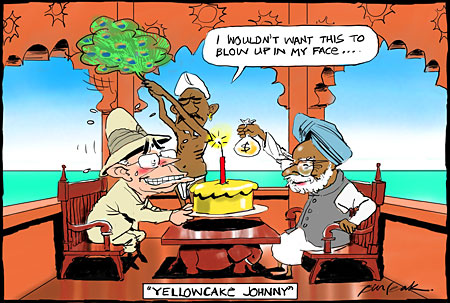
Bill Leak
Rudd to his credit is willing to say no to Australia selling uranium to nations outside of, and who have not signed, the nuclear Non-Proliferation Treaty. India says that it retains the right to conduct nuclear texts. For the Indian Right India's independence is of primary concern and that means less restrictions on its nuclear programme the better. So we have the possibility of India contributing to a nuclear arms race in the region.
So why sell uranium to India?
Australia falls into lockstep with the global strategy of Republican Washington as always. Under the US deal, India gets access to civilian nuclear technology and fuel, without having to give up its nuclear-weapons program. It is even allowed to reprocess spent nuclear fuel, though under the safeguards of the International Atomic Energy Agency (IAEA). India has also pledged not to pass on any US technology or materials to third parties. Many on the Right in India claim that this deal will give the US too much leverage over Indian policy.
Ashton Carter, an assistant secretary of defense in the Bill Clinton administration and now a professor at Harvard's Kennedy School of Government, defended the deal in the July/August 2006 issue of Foreign Affairs, writing:
Washington gave something away on the nuclear front in order to gain much more on other fronts; it hoped to win the support and cooperation of India - a strategically located democratic country of growing economic importance - to help the United States confront the challenges that a threatening Iran, a turbulent Pakistan, and an unpredictable China may pose in the future. Washington's decision to trade a nuclear-recognition quid for a strategic-partnership quo was a reasonable move.
That is the strategic reason for the closer US ties to India. Howard and Downer fall into line and echo that position.
Posted by Gary Sauer-Thompson at 4:13 PM | Comments (3) | TrackBack
August 17, 2007
conduct unbecoming
Last night's Lateline interview with Kevin Rudd started to consolidate some of the more symbolic behaviour behind Rudd's Labor.
There's no point trying to get around what has become the institution of Prime Minister John Howard. Traditional Labor voters didn't start voting in 1996 for the Liberal philosophy which brought them Workchoices. They've been voting for Howard, which works splendidly until somebody points out the distinction between the office and the man currently holding it.
The Labor Party disappeared into the Christmas break last year with a new leader, and emerged from that with a whole new bearing. They seem to have spent the break at charm school. There was, and still is from time to time, a bit of fuss over Julia Gillard's new look, but there's more to it than that.
Labor have been performing the dignity of office. Even on the odd occasions when Labor have taken a blow you'd never know it from looking at them.
All of the more memorable outbursts, tantrums, indignant snortings, smirks and various other explosions have come from the government side. Howard has been visibly rattled. Downer, Hockey, Turnbull, Costello and occasionally Abbott slouch in their chairs through interviews and question time. They're not far away from chewing gum, flipping the bird and scratching their armpits.
If you weren't paying attention you could easily get the impression that Labor had already won, which is precisely the point. Rudd's Labor have been conducting themselves like office-bearers and Rudd behaves like a man to be taken seriously. He's already assumed the conduct of the office of prime minister.
It's only natural then for him to point out, as he did last night, that the government is behaving like an opposition and that's not the way to govern a country.
Posted by Lyn Calcutt at 1:02 PM | Comments (18) | TrackBack
Market turmol
A turbulent day say the finance commentators about the volatility of global finance markets and as they work to try to reassure everybody that their company is not caught up in the repricing of credit that is taking place due to the fallout from the US sub-prime market.

Alan Moir
The bottom line is that credit is now more expensive, the hedge funds dump the Australian dollar to finance their loans, and borrowing money is going to become more expensive for both businesses and households.This is no Beltway issue. It is another blow for Howard's battlers.
It was no suprise that John Howard and and Peter Costello quickly seized on the global financial market turmoil to bolster their economic credentials and warn voters of the risks of changing government. As if the Howard Government controls the re-pricing of credit. Financial instability highlighted the need to keep economic management in safe hands was their message.
Posted by Gary Sauer-Thompson at 5:57 AM | Comments (3) | TrackBack
August 16, 2007
media insights
I've downgraded myself to a Crikey squatter. For the moment I am quite happy to squat and receive freebie email. Yesterday's refers to The 7.30 Report going public about Peter Costello shooting his mouth off over dinner with three senior Canberra journalists in 2005 on his Howard challenge that never eventuated.
Those three journalists agreed not to print the story when Costello pulled it afterwards saying it was 'off the record.' Crikey makes an interesting comment:
But Costello's reported words are important this time for other reasons, not because of what the Treasurer said, but because of the decision the journalists involved made not to report it. Here is proof positive that journalists, when pushed by the authority figures whose affection and fellowship they crave, are happy to put two things to one side: first, their duty of care to their reading public and the trust given to our democracy's fourth estate and second, their sense of professional competitiveness. What a supine, self-serving, clubbable lot.
What we are offered by this event is an insight into the drip feeding and the media management--the secrets of the Canberra Gallery are being disclosed.
Posted by Gary Sauer-Thompson at 10:40 AM | Comments (11) | TrackBack
more Republicans bail out
Karl Rove, who is called 'the architect' by President Bush and 'Bush's Brian' by others, is bailing out of the sinking Republican ship. I presume that Bush is referring to Karl Rove campaign acumen, as he was good at winning elections for the Republicans.
I would have thought that it was 9/11 made the Bush presidency, gave it right-wing control of Congress, neoconservative dominance and justified the Bush Presidency's endless liberty-infringement and lawbreaking at home and the abductions and torture abroad.

Alan Moir
Rove stood for using the biggest, nastiest partisan club he could find. Extreme polarisation was his style as he tried to establish Republican dominance in Washington. Rove has helped corrupt the political process, debasing public debate and polarising a divided electorate.
The Iraq war broke the Bush Presidency and rolled back the Republican tide. In Anthony Cordesman's recent report of his perceptions of a recent trip to Iraq we find these two paragraphs:
The US intervention in Iraq has driven more than two million Iraqis out of the country, including much of its most educated and professional citizens. It has displaced over two million more Iraqis inside Iraq, many of which have lost their homes and their businesses and jobs. Estimates of the total percent of underemployment and unemployment exceed 50% in virtually all of the country.
And:
The number of Iraqi civilian dead now total at least 100,000, and no one knows howmany have been wounded. Basic services, infrastructure, and security do not exist in many areas, and sectarian and ethnic cleansing continue in much of the country, including the area around Baghdad and virtually every area with mixed Sunni and Shi'ite populations. Various estimates put the number of Iraqis that have suffered severe hardship as a result of the war and its aftermath at close to 8 million and rising --although such estimates are really “guesstimates” at best.
It's a great record. 'Strategic patience ' is the new Washington buzz word, despite this record. 'Strategic patience refers to keeping US forces at significant levels, for giving Iraqi political leaders more time, and for a strategy that would carefully phase down the US presence in reaction to actual political and military success.
Posted by Gary Sauer-Thompson at 8:23 AM | Comments (2) | TrackBack
August 15, 2007
University education: soaring costs
An editorial in The Age says that:
From next year, more than 100 full-fee university degrees in Australia will cost more than $100,000. The rise in courses costing this much money has been extraordinary and is a grave cause for concern. In just four years the total courses costing more than $100,000 has more than doubled. In 2005, 45 degrees cost that much or more. In 2006, the number rose to 60, and this year it climbed to 97.
It comments on this situation thus:
The revelations will fuel the bitter ideological battle that is being fought between the Coalition and Labor over university degrees and, more broadly, the future of education, especially in the tertiary sector. One of the key pitches to voters of Opposition Leader Kevin Rudd is the "education revolution". However, for Prime Minister John Howard, it will mean facing down his comment in 1999 to Federal Parliament: "The Government will not be introducing an American-style higher education system. There will be no $100,000 university fees under this Government."
What ideological battle? I'm hearing nothing about higher education. Hasn't the ALP quietly accepted the $100,000 degree? Hasn't the ALP quietly accepted the scrapping of the 35 per cent ceiling on full-fee degrees.
Presumably, the ALP's education policy is still based on Australia’s universities helping to build a strong economy and a smart future for Australia. Education is central to a prosperous future for Australia.The ALP aim is to deliver world-class universities to give Australians the best possible education and training to compete with the rest of the world.
We don't have world class universities. The ones in the top 100 are sliding down the scale.
Posted by Gary Sauer-Thompson at 5:59 AM | Comments (8) | TrackBack
August 14, 2007
double standards
In an article entitled Lack of respect will not help indigenous children in the Sydney Morning Herald Banduk Marika draws attention to the disturbing aspects of the Howard Government's intervention in indigenous affairs in the Northern territory.

Alan Moir
Marika, a community leader and artist in Yirrkala, Arnhem Land, says that:
now it seems that our whole culture is being blamed by government and media for the problems associated with grog, poor education, a lack of jobs, houses and health care. The main problem our culture is being blamed for is child abuse....We live in circumstances that are not of our own making and without the kind of support that other people in Australia have had for many years. The small number of persons who go against their families and bring shame on us all must be held accountable - but it is not the fault of our society as a whole. Many of us do not drink or take drugs, and we protect, respect, love and care for our children, our families and our cultural traditions.
This contests the failed state metaphor deployed by Minister Brough to legitimate the law and order approach with its underlying policy of assimilation.
Marika adds that the Howard Government:
is now trying to say that land, community councils and the permit system are also part of the reason for child abuse. But this is a lie. Has any non-Aboriginal council ever been taken over by the government because of child abuse occurring in its area? Has anybody in non-indigenous Australia had their land taken away because of child abuse in their community? I don't think so.
She points out what is obvious th the indigenous people's relationship to their land has nothing to do with child abuse. Or alcohol for that matter. The issue is clearly stated:
So I want to say that we do honestly welcome any real help with the problems created by our contact with non-indigenous society, and by past failures to fund and deliver basic services, but we will not be treated as though we have no rights in our own land or lives. Like our elders before us, we will continue to stand up for what is right and fair. And for who we are. I
The charge is that the Howard government is using the children as an excuse for stealing the land away from indigenous people.
Posted by Gary Sauer-Thompson at 6:52 AM | Comments (9) | TrackBack
August 13, 2007
Oh Lord,
Is the US economy more about massive consumption on borrowed money than one based on saving, investment and production? Does it matter?

Bruce Petty
Not really. Not for the free market boys who comment on the market. They are talking in terms of central banks' actions as the confidence booster the market needed". "Rationally it wasn't necessary, but because markets fire on confidence rather than rational explanation, you need this as a circuit-breaker.
The self-correcting mechanisms need a confidence boost to get working , and there is nothing wrong with the market that requires any form of form of regulation.
Posted by Gary Sauer-Thompson at 7:13 AM | Comments (7) | TrackBack
August 12, 2007
Spuiking for Jesus
Spuiking for Jesus is just not pork barrel, is it? The Christian culture, especially the evangelical strand represented by Hillsong, is based on programmed fear about sin, evil and damnation. So it fits snugly with the conservative politics of fear that is designed to engender obedience to traditional authority.

Matt Golding
But it goes deeper than that. The political discourse today is all about working families as the foundation of political life and that excludes non-working working families, couples without children, single parents and singles. ''Working families" stands for a nuclear family, an overworked mum and dad, both of whom are in the workforce, a couple of young kids earning dollars with part time jobs, living in suburbia, and are hard done by. No one else really matters in this conservative discourse even with Rudd's talk of inclusiveness
That inclusive talk was before the conservative makeover of Rudd to make him the mirror image of Howard who has always talked about " the family". Families are sacred, with family values being bedrock. That means traditional morality or value, Christianity as the source of morality. The decay of community and a common culture in civil society is attributed to the breakdown of Christian family values. Howard's social conservatism is more than personal nostalgia for his 1950s Methodism.
The twist with the Hillsong evangeklcal strand is that you should guilty about making money. God has selected you from the resentful surly horde to be a success. Rich is good. This is the prosperity gospel. those who see aspiring, money making capitalists as bad --like Dante---clearly are bitter old sadists.
Captialism, the ‘hellish thing’, has successfully co-opted evangelism’ into its own ambiguously religious rhetoric. In the process, religiously inflected social conservatism has become firmly enmeshed with right-wing economic thought. However, the two are joined at the hip in that moral strength, as a form of asceticism., means being self-disciplined and self-denying. Otherwise you are weak and self-indulgent, and such moral flabbiness ultimately helps the forces of evil. So welfare is immoral and promote evil because it is seen as working against self-discipline and self-reliance.
Posted by Gary Sauer-Thompson at 11:02 AM | Comments (4) | TrackBack
August 11, 2007
brand Howard
According to Dennis Shanahan in yesterday's column (thanks Nan), perception is everything. Putting aside for the moment what perceptions the title of the piece, "howard can't lose if he's seen as a winner", were meant to convey, Shanahan argues (via Textor) that "public perceptions and the polls feed off each other". It's an interesting idea that would probably sit nicely in a fashion theory framework, Finklestein's chic theory meets federal politics.
Is it too shallow to suggest that Howard is simply the political equivalent of long socks with sandals? After all, Keating's Zegna suits and antique French clocks are commonly thought to have worked against him, as is Beazley's weight, which is pretty shallow. By a lateral kind of extension, is it just unfashionable to be a Howard supporter?
Working on the assumption that the shallow end of politics and policy-free perceptions are significant, consider the relevance of being perceived as yesterday's man. What self-respecting fashion victim would be caught dead in last season? Or just as bad no matter the style, a passe label?
Shanahan also pointed out that "rattled was a term that recurred in the polling", which should come as no surprise given how often it's been used to describe Howard, his ministers and a few of his media supporters. Rattled has joined the ranks of several labels associated with the House of Howard, many of them quite catchy. Mean and tricky, clever and cunning, whistle and wedge, fear and smear.
It's not beyond possibility that the polls themselves are a signal to the trend conscious that Howard is just not the done thing anymore. Living in chronic fear is outdated. It's hard these days to move Whistle and Wedge even at a fire sale, but of course there's one at every social gathering - one of those tragics stuck in a time warp who can't tell hip hop from reggae, yet not sufficiently removed to be retro. It's cruel, but it's something Howard should understand well, given that built in redundancy is just one part of that glorious beast we call the free market.
Posted by Lyn Calcutt at 3:31 PM | Comments (22) | TrackBack
masters of the universe
Well now, the economy has become the centre of public and political debate hasn't it. Isn't that where Howard wanted it? It's his territory and he easily repels all raids on the citadel.
Howard and Costello have spun their wares about them being the greatest economic managers in the history of the nation for a decade or more. Nay, in the history of the nation. They are the ones in charge and they take the hard economic decisions to ensure national prosperity, etc etc.

Bill Leak
Only trouble is Costello is on the defensive. The recent events of global negative economic flows spinning out from the sub-prime market in the US indicate that they don't have things under control. Not even the boys at Macquarie Bank have either. Global economic flows are highly volatile, and Howard and Costello just stand and watch them happen.
So they are ducking for cover, crossing their fingers that the mining boom does not go bust, and talking fast and often about the economic fundamentals being in place. Not that they would admit ducking for cover, of course. And you can understand why: it would mean that they are no the masters of the universe.
Posted by Gary Sauer-Thompson at 10:03 AM | Comments (10) | TrackBack
August 10, 2007
classical liberalism and global financial flows
I just love classical liberals. They construct their elegant theorems from human nature to show that the good government depends on the functions of government being minimal---strictly confined to ensuring security of life, liberty and property--and that other functions, such as the redistribution of wealth, are morally impermissible. So is the welfare state as it represents gargantuan government.
So how are global markets to be governed? We have a global market turmoil turning ugly today forcing the ECB and the Fed and central banks in Japan and Australia to inject liquidity--$100's of billions--- in the financial system. The concerns about subprime mortgages, credit and debt have turned into a full blown liquidity run and crisis. Liquidity is drying up and cash rates are soaring. So the central banks are pumping in lots of cash .
In my understanding that kind of intervention into free markets to address toxic debt---is not warranted by classical liberalism. So how would classical liberalism deal with this kind of turmoil? Talk in terms of market corrections? Market corrections of a high base. They ---Peter Costello--is referring to the falls in the stock markets, and he says that the sub-prime market does not affect Australia. What we have is just normal central bank operations.
On that scale? Give me a break. This global market turmoil is more than a liquidity crisis. It looks as if classical liberalism is going to be mugged by economic reality.
Is the global market turmoil a situation where the risks of a systemic crisis continue to rise. Presumably, the liquidity injections and lender of last resort are designed to bail out insolvent borrowers - however necessary and unavoidable during a liquidity panic. Will they work? Or will they only postpone and exacerbate the eventual and unavoidable insolvencies?
Posted by Gary Sauer-Thompson at 9:04 PM | Comments (6) | TrackBack
Canberra watch
Okay, so interest rates increased because of a booming economy running at full capacity. There is a need to apply the monetary brakes to slow down the inflationary forces. The problem for the PM is that in his muscular approach to economic management of global market flows is that his electoral strategy is to spend big time, thereby putting the foot on the accelerator. As Chris Richardson from Access Economics quips, there's lots of blue smoke.
It's a great way to drive Costello's finely tune Formula 1 racing car isn't it?--one foot on the brake and the other on the accelerator. But the problem goes deeper than the flaws highlighted by using the politician's frame the economy as a machine metaphor. Howard's credibility is also involved:

Alan Moir
It's the spin, as he and Costello gave the strong impression that every fall in interest rates has been due to their fantastic abilities and experience as economic managers. Only they could deliver the good times. Trust me the spin says. And the electorate did in 2004. Howard is making the same pitch again--the Government's economic performance is all he has judging from the embattled look in Question Time. Only this time we have 5 interest rate rises on his watch.
Now there is significant disillusionment with Liberals on the issue of broken promises and dishonesty. Howard, in walking from the Liberal party advertisements of 2004 with his ducks and weaves, reinforces that mood. His character and relationship to citizens comes into play. It's now no longer a question of the judgment and experience of the person driving the car. The driver is no longer trusted. He may crash the car.
So the lower white collar and upper collar working families start abandoning the government because of their experience of mortgage stress. Many of these reside in marginal Liberal seats and that spells trouble.
Posted by Gary Sauer-Thompson at 8:18 AM | Comments (14) | TrackBack
August 9, 2007
health governance, Howard style
Jeff Richardson, a health economist and Foundation Director of the Centre for Health Economics at Monash University, is critical of the Howard Government's $45 million intervention in Tasmania to "save" the Mersey Hospital. As we know the Lennon State Government, after a second review of services had announced in May that the Mersey would not close. It would lose its intensive care and many specialist surgery units and be downgraded to an elective day surgery and rehabilitation centre. Richardson comments:
The state plans were to add aged services, renal dialysis, rehabilitation, a 24-hour emergency centre and high-speed ambulance services to nearby Burnie. Many small population areas in Australia have a far inferior service...Howard's intervention will cement in place a system in which adverse events will flourish and in which Tasmanians will die unnecessarily. First-class specialists seek to practise in centres of excellence and it is hard for Tasmania to achieve these even in Hobart and Launceston.
In 2004, he undertook a detailed study of the Tasmanian health system in which he recommended a scaling back of complex procedures in smaller country hospitals because they couldn't get the specialists with the necessary skills and experience to perform such procedures safely. Even if they could, the population of north-west Tasmania is too small to generate the clinical workload to keep their skills honed to world standards.
The study recommended that one large, not two small hospitals in North West Tasmania should provide comprehensive specialist services. This would allow the delivery of safe world class, not second class, specialist services.
It's not just a case of skilled staff being flown in from time to time. We also have the problem of adverse events--- mistakes which would not have occurred in a higher quality system. Richardson refers to a study in 1995 on quality of health care in the Medical Journal of Australia that estimated that at least 10 per cent of hospital admissions are associated with an adverse event including up to 9000 unnecessary deaths annually. He points out that:
these events are not primarily the fault of doctors (who make mistakes like all of us) but of systems which have not been properly designed to avoid errors and which force doctors to work in unsafe hospitals.
So there is a danger that adverse events would continue in a "saved" Mersey hospital. Richardson says that for political reasons, it is unlikely that Burnie specialist services will be trashed. It is more likely that two hospitals will be allowed to struggle for existence, providing second class medical care as in the past — thus ensuring the continuation of adverse events.
Posted by Gary Sauer-Thompson at 2:24 PM | Comments (5) | TrackBack
back to the past
The 500 pages of legislation for the Howard Government's controversial plan to intervene in the Northern Territory to deal with a national emergency of child abuse in indigenous communities was introduced into Parliament this week. An editorial in the National Indigenous Times by Chris Graham comments on this plan. Graham says that:
There is no point "intervening" if the method isn't going to work. It wastes money and time, resources that Indigenous people don't exactly have in droves. There is also little point in having a bunch of white politicians in Canberra producing decisions that will affect the next generation of Aboriginal people without Aboriginal consultation.
Rightly so. However, Howard and Indigenous Affairs Minister Mal Brough have no time for those who argue that deliberation and consultation is essential if the intervention is to succeed. The legislation passed through the House of Representatives like a dose of salts. Brough says that he wants the Senate to do the same, as it all needs to be tidied up by the end of the week. Any Senate inquiry into the legislation was unnecessary.
So much for the Senate as a House of Review. Mal Brough is not a man for for checks and balances. He's an army kind of man who thinks in military terms.
There needs to be a review as a lot of the Northern Territory legislation is about resolving the constitutional and legal questions of the takeover, in particular the Commonwealth's takeover of township leases and its attempt to prohibit the trade in alcohol and pornography to indigenous communities. As some of these proposed measures are contrary to the provision of the Racial Discrimination Act, the legislation has clauses exempting it from compliance with that Act.
A good reason for a review of the legislation by the Senate don't you think?
The three bills,which allow the government to compulsorily acquire Aboriginal land in the Territory for five years in addition to compulsory control of how individual welfare payments are spent, appear to be draconian, and to go beyond paternalism and assimilation. For instance, under the Families, Community Services and Indigenous Affairs and Other Legislation Amendment (Northern Territory National Emergency Response and Other Measures) Bill 2007 all Aboriginal people in the NT communities who receive welfare will have half their welfare benefits controlled, regardless of their past spending habits. Non-aboriginal welfare recipients around the nation will only be subject to the financial control orders if they 'trigger' a series of criteria, such as not enrolling their child in school or having reports of child neglect filed against them by government agencies.
Moreover, whilst white welfare recipients inside the Territory, and all welfare recipients outside it, will be able to challenge the financial control orders through the normal administrative appeals processes (such as the Social Security Appeals Tribunal and the Administrative Appeals Tribunal) the proposed legislation seeks to prevent Aboriginal people from seeking a review of the controls.
So you can see why the legislation has clauses exempting it from compliance with the Racial Discrimination Act. It's racist legislation---racially discriminatory.
Posted by Gary Sauer-Thompson at 7:54 AM | Comments (7) | TrackBack
August 8, 2007
the shock of the Kevin
There has been much ado about Kevin07 in the last little while as old and new media come to grips with the new communicative strategies in our political landscape, or Kevinscape, perhaps. We are now, apparently, on a first name basis with our alternative prime minister.
Way back, it seems like decades ago now, Kerry O'Brien asked Rudd "Do you think Australia's ready to embrace a prime minister called Kevin?" Chuckles all round. If the comments on the website and the polls are any indication, they've moved beyond a mere embrace. Nor do they seem bothered at the notion of a campaign called Kevin, and they seems to like having a more or less direct line to Kevin himself.
Brand name Kevin has pulled off one surprise after another. We've seen the Maxine McKew surprise, the broadband surprise, the MySpace surprise and, for the policy police among us, the ongoing absent policies surprise. In retrospect though, none of this is really all that surprising.
In October and November last year the leftish literati were granted a special preview of "Rudd the thinking person's politician" in The Monthly. In October we learned that the more humanitarian aspects of religion make a good philosophical framework for governance in the interests of all, emphasis on ALL. In November we were treated to an analysis of the relationship between "free-market fundamentalism" and Howard's culture wars.
In the process we learned that Rudd is reasonably well read, intelligent and articulate. On paper anyway, where he refrains from forks, bridges and mangled metaphors. But the clues to his unfolding campaign strategies were also there in his multiple references to Quadrant magazine and, right up front in the intro "the prime minister's more prominent cultural warriors - including Andrew Bolt in the Herald Sun and Christopher Pearson in the Australian".
Bracket out the content and the combined effect is a nod to the informed left, a refusal of divisive strategies and a poke in the eye for a lot of prominent Murdoch political journalists. He's continued along the same lines ever since, giving nods to the electorate bit by bit, refusing wedges and engaging with alternative communications channels. Whether this heralds a new era of political communications remains to be seen, but so far it's served Kevin very well indeed.
Posted by Lyn Calcutt at 4:30 PM | Comments (20) | TrackBack
economic turmoil?
There is turmoil in the global markets-- yet again. The stock markets are going up and down as if they were on a roller coaster ride, the fallout from the US sub-prime mortgage markets continues to deepen, and the hedge funds are going belly up.
Is it just a temporary glitch (a correction, temporary shock, or transitory turmoil)? Or is it a portend of a more severe downturn with systematic implications?
The financial press and commentators in Australia adopt the former optimistic view: the current financial turmoil is transitory. They love the "hot "money swishing around the financial system; and they don't seem too worried by the increasing mortgage defaults, a deflation of the housing asset bubble that was driven by easy credit, the large sub-prime losses and steadily rising interest rates. Costello still manages the economy, and even if interest rates have hit an eleven year high, inflation is within the Reserve Bank's (RBA) target range. Moreover, the subprime mortgage problem is a "niche problem that is contained". The market has factored in the risks. Investors will bounce back in the stock market.
According to this 'financial wobbles' view we should let investors choose, reduce the red tape, and cut down the costs of investing in a rapidly growing economy surging on the back of Chinese demand for raw materials. The market knows best. It had already decided that inflation has reduced real returns to investors and so it has increased interest rates.The RBA is just playing catch-up.
Let the boom continue so we can all make some money from mining stocks, buy the Ferrari, get some hooker heels and acquire that grand waterfront house with the yacht. This is the gilded age folks, born on the dynamics of globalization.
Yet something is disturbing if you peer beneath the hype of the masters of the universe. Australian households have re-leveraged excessively.This increase in leverage was supported by rising asset prices (housing and, more recently, equity). We have rising consumption, falling and negative savings, increase in debt burdens and over-borrowing, especially in housing but also in other categories of consumer credit.
Are not these "speculative borrowers” who expected to be able to refinance their mortgages and debts rather than paying a significant part of their principal? Do we not have an ethos of light regulation (excess costs are bad for investors) that tries to minimize any prudential supervision and regulation in the context of reckless lending practices by mortgage lenders? Has this not led to a massive housing and mortgage bubble. Why cannot that bubble go bust?
Is not the household sector the most financially stretched? Is there not a housing recession underway in Sydney? Is there not a massive switch in the corporate sector from equity to debt with the cheapness of credit? Is there not a repricing of credit risk underway? Is there not a loosening of credit and lending standards during a credit bubble in the corporate sector? Are not the banks beginning to suffer from their exposure to failed hedge finds? Is there not a credit crunch happening in the LBO and corporate credit markets?
Posted by Gary Sauer-Thompson at 8:20 AM | Comments (3) | TrackBack
August 7, 2007
a wounded Howard
Howard takes a step forward in his electoral strategy only to see the ALP keep frustrating the Government’s attempts to bring Rudd down, divide Labor, and rattle its cage and destroy Gillard in the process. It's a pattern now.
Howard is also suffering blows. One of these is from his own side in the form of a leaked internal report from pollster Mark Textor declaring swinging voters see him as old and "rattled. The Crosby/Textor report, prepared in late June, highlighted voters' perception of the younger, attractive Mr Rudd, who represented the opportunity for generational change.They saw Rudd as strong and competent, "so just like John Howard, but younger", and were disillusioned with the Liberals' dishonesty and broken promises.

Bruce Petty
There is still a besieged Howard's strategy of buying the marginal seats to negate the bleeding of his support to the centre and to Rudd. Will it work against the old and dishonest look? The Crosby Textor report also recommended the Government pick fights with the Labor states. Will this kind of conflict work?
Another blow is the interest rate rises that the Howard Government sees coming. The jump of 0.9 per cent in underlying inflation in the June quarter informed the Reserve it needs to raise rates now or risk having to raise them when the next data comes in three months' time — quite likely in the middle of the election campaign. The underlying inflation rose to 2.75 per cent in the quarter, which is near the top of the central bank's inflation target range of 2 to 3 per cent.
Howard is blaming the big spending Labor states for the rises. What if interest rates go up, and Governor Stevens puts out a statement explaining the reasons. What If the Governor does not blame the states for a rate rise? Won't Howard have a hard time convincing voters that they should? Another body blow?
Another rate rise will worsen the housing affordability problem and make voters even more grumpy. That blow has a kick as it indicates that the Howard Government is not doing its job on economic management.
The Howard era is drawing to a close. Workchoices will be his epitaph. Why then continue in the Presidential mode concentrating all the focus on a wounded leader? The leader is looking to be part of the problem.
Posted by Gary Sauer-Thompson at 8:37 AM | Comments (21) | TrackBack
August 6, 2007
celebrating inequality?
I see that the political Right is becoming more open and public in its core beliefs. So we have American political scientist Charles Murray, who will address a Centre for Independent Studies ideas forum, In Praise of Elitism, next Monday, is reported in The Australian as saying:
Australians talk about this tall-poppy syndrome without understanding where it comes from. It is based on the idea that we're all equal. Well, I've got news for you -- we're not all equal and the sooner we accept that, the better. There's nothing wrong with being elitist and we need to come to terms with that and embrace it."
Murray's position is simple. Inequality is good. Inequality is natural and intelligence is hereditary. By not accepting that we are embracing the second rate and so doing nothing excellence. This is conservatism, not libertarianism, since liberalism has held that equality is a basic or core value of the liberal tradition along with freedom.
Murray, who is a scholar in the W.H. Brady Program in Culture and Freedom at the American Enterprise Institute, is known for arguing that that women lack the evolutionary genetic intelligence to master the highest levels of mathematics and the hard sciences, that whites are intellectually superior to Blacks and that Blacks were by nature more likely to "fail" in society and that welfare needs to be abolished because it encourages women with low intelligence to sprout children who are in turn not likely to be very bright.
How does this relate to an Australia that celebrates egalitarianism along with freedom?
The CIS certainly takes a negative view of Australia. In its blurb for the conference it says that universities are ‘dumbed down’ as entry standards are diluted. Politicians appeal to blatant self-interest as they compete for the votes of an apolitical and uninformed electorate. Television is engaged in a race to the bottom, and the internet (once hailed as the harbinger of the rebirth of Athenian democracy) is full of hard pornography. Has barbarism now triumphed over enlightenment?, it asks.
Presumably, elitism is the conservative answer to this dumbing down tendency in postmodern capitalism. As Murray says:
Whether we like it or not, the future of our culture lies in the hands of the people at the top of the IQ bracket.These young people are not being pushed at all and that's what worries me the most. They are bright but they have no idea what it is to be rigorous. For instance, way too many people are going to university. Statistically, only 15 to 20 per cent are able to deal with a college education, unless, of course, it's not a genuine college education and it's dumbed down. And that's what we have right now, certainly in the US.
Murray holds that believes the education system, as it stands, is a disaster.
We all know that but it's especially a disaster for above-average students. What amazes me is this de-emphasis we have in schools now on learning. This should be the reason kids are there but instead they are asked only to express themselves. They are not expected to interpret correctly but rather they are asked what they feel about the material. This is so harmful for their intellectual development. You never have the right answer because all answers are right. Everyone gets an award at school, no matter how undeserved. But I'll tell you something, kids know; they understand what's going on. This constant praise produces measurably lower self-esteem because kids know they haven't deserved the praise.
It goes deeper than nurturing elitism. What of the non-elite? Murray, and some members of CIS, hold that government programs to help the poor did more harm than good and should be abolished. Poverty, according to Murray, isn't the result of plant shutdowns or layoffs, the boom-and-bust cycles of capitalism or even racial and sexual discrimination. Rather, said Murray, some people are too irresponsible to better themselves. The problem is simple: inferior poor people marry other inferior poor people and produce even more inferior poor children.
They argue that unless the permanent welfare class begins to exhibit certain behavioral changes like finishing high school, like getting married and like being in the workforce, you are going to have an expanding welfare class or underclass which will by the turn of the century be a considerable segment of the population.
But how can an "underclass" that is viewed as being poor because of inferior mental capacity be transformed into a productive, useful -- and profitable -- segment of the working class? Won't "those people" need support, counseling, training, supervision -- and discipline? Won't they need a whole structure to promote those "certain behavioral changes"?
Posted by Gary Sauer-Thompson at 7:41 AM | Comments (10) | TrackBack
August 5, 2007
Sunday cartoon
The cartoon also refers to the photographic work of Bill Brandt as well as Ingmar Bergman's Seventh Seal, that has been much pastiched by Monty Python, Woody Allen, and in David Lynch's Mulholland Drive.

Steve Bell, Bush, Brown Bergman
In Bergman's films we sense the tension of a barely repressed apocalypse in a world that is full of mortality and death, existential dread, and apocalyptic fears. This is life in the shadow of a death that is simply annihilation.
Life is a danse macabre in a drab rational civilization that is paradise gone sour; a cold modernity where bodies are always in the service of others. No-one really escapes the horrific and liberating negativity (nihilism and hopelessness) that lies just beneath the modern world's civilized veneer.
Posted by Gary Sauer-Thompson at 9:57 AM | Comments (4) | TrackBack
August 4, 2007
Telstra as bully boy
I see that Telstra is taking the Communications Minister, Helen Coonan, to court for her decision to award its rivals almost $1 billion for rural and regional areas. Does Telstra--the aggressive gorilla--- have any friends left in Canberra these days?
We all know what Telstra wants: to be able to build its fibre-to-the-node network, the government to get the regulator out of the way, to be able to set prices as it wants and to destroy the competition. Telstra aims to create the next generation of landline asccess network as a new monopoly. This would boost its share price to over $5 a share.
I just cannot see this happening. It would be too blatant, even for the Howard Government, that is wedded to anti-competitive markets. Even that Government stands behind the ACCC and bulks at a Telstra broadband monopoly. So Telstra has a constitutional challenge before the High Court against the competition regulator's powers to set prices for access to its copper wire network. Telstra is attempting to have the regulations that allow access to Telstra's copper network by its rivals overturned on constitutional grounds concerning confiscation of property without just terms.
What Telstra is trying to do is to prevent its competitors from building a fibre network. Broadband is the current battleground to prevent an open access regime, and to ensure Telstra's market dominance arising from its infrastructure monopoly.
The pay TV debacle of the 1990s looms overall this. Telstra's pay television cable system still remains monopolised. So an open access optical fibre network regime is crucial and that means ending Telstra's current monopoly over landline access infrastructure. Does that eventually mean structural separation of Telstra?
Posted by Gary Sauer-Thompson at 12:40 PM | Comments (4) | TrackBack
August 3, 2007
federalism supercharged
Howard is back on his game the commentators say. You can see the grit in his eye as the Howard Government makes a health-funding takeover of the Mersey Hospital in Devonport, Tasmania. It shows that health care is more about winning elections rather than good public policy. It's a political winner in Braddon, but it's an electoral move that makes no sense in terms of strategic health planning. Indeed, it cuts across all the hard work and community consultation that has occurred in the context of the changing nature of hospitals and health care in the region.
The proposal is to establish a trust to rescue the hospital, funded by the Commonwealth but managed by the local community. We have the assurances by the Health Minister, Tony Abbott, that this is not a "power grab", but rather a necessary intervention to prevent the closure of a regional hospital. "Closure ' gives the game away as the Mersey hospital was never going to be closed.

Alan Moir
No one was informed of the commonwealth intervention. It had no connection to state health planning. It ignores health workforce shortages. It's a white knight approach that rides roughshod over months of planning to save the Mersey hospital despite declining intensive care admissions and an ageing population. Abbott says that this kind of intervention may be a model for the future.
Hayden Walters says that in terms of Tasmania's north-west coast, Tasmanians have been left the poisonous legacy of having two district general hospitals pretty close together (a 20-minute drive) with one at the Mersey (near Devonport) and one at Burnie. He adds:
Because of the realities of local funding and manpower constraints, neither hospital is adequately funded, adequately staffed, or adequately supported with technology and staff. Both have been marginally viable for some time. There have been seven external reports, usually produced at enormous cost, over the last 20 or so years, all of which have come out saying there needs to be just one viable and sustainable general hospital serving the north-west coast population (and the smaller population down Tasmania's west coast). In general, Burnie is probably the most suitable place for this but there has been a lot of argument between the communities and no consensus. AMA policy has been that the best way to proceed would be a new Greenfield site somewhere that everybody could agree on (probably Ulverstone).
The Devonport and Mersey Hospital has had enormous problems over the last five years or so in attracting adequate quality staff. Things have recently come to a head and the Intensive Care Unit had to be closed because of dangerous staffing levels.The emergency department is under huge pressure for similar reasons.
Walters says that the Federal Government could have been constructive and invest their $45 million a year to properly construct a single excellent acute general hospital for the north-west with good primary health care. Or different levels of hospital care--low care (rehabilitation and aged care) in Devonport, intensive level care in Burnie, and specialist care in Hobart.
Posted by Gary Sauer-Thompson at 8:45 AM | Comments (33) | TrackBack
August 2, 2007
media +politics
It looks as the Labor left may have gone quiet to ensure the possibility of a Rudd victory, now that Rudd is seen as an election contender-- even by the business community in WA. He looks safe and doesn't rock the boat too much whilst occupying the middle ground.
Or so we are told by reporters/commentators who position themselves as the knowledgeable insiders we can trust to tell us what is really happening in a distant world that only the political elite, lobbyists and staffers have an experience of.
This is the mainstream way of looking at politics:-institutional journalists and their news organizations spend their time and space on the so-called "horse-race" (who wins) and on "insider coverage (the story of political struggle). They spend little time and space on policy analysis or telling the stories of people affected by politics and governance.

Alan Moir
The traditional frame of the mainstream media----the horse-race with an uncertain outcome in 5 months time ---keeps us citizens informed about events that often have low political utility or meaningfulness---eg., the Canberra whispers, rumors, events, and remarks when Parliament sits. Everything in politics is a tactic and all politicians are mere schemers and opportunists according to the Canberra Press Gallery frame.
These remarks and events are then given flash, tone and slant to create drama and interest, so as to sell newspapers. So we have a narrative structure (a horse race to create a causal sense of events) being applied to ambiguous events and words. This narrative of tactics and strategy is more about political myth than it is about history.
If we come back to left Labor being quiet, we can ask, well, where is Rudd on the Haneef case? Haneef has gone and yet Kevin Andrews is still spinning and managing the news. Why hasn't the ALP had a go at the dalek Minister? Cannot they smell a weakness? Vulnerability? A wound? Why don't they fire a few arrows in his direction, instead of saying that everything is hunky dory from the briefings they've been given and calling softly for an independent judicial inquiry.
Things are not hunky dory are they? So why not place pressure on Andrews. Soften him up.
Update
Well the ALP has found some political courage. After much deliberation with his strategists Rudd has stepped out of the political shadows. He's taken 2-3 deep breaths and called Andrews inconsistent. Wow. Such courage! So what is going to do with the anti-terrorism legislation when it comes before Parliament.
Update #2
Maybe more courage will be shown by the ALP in the use of the new media that goes beyond dipping the political toes into YouTube, MySpace or Facebook. The framing there is different to the horserace frame of the Canberra Press Gallery.
Posted by Gary Sauer-Thompson at 10:14 AM | Comments (24) | TrackBack
Robert Reich in Adelaide
Last night Professor Robert Reich, the former Secretary of Labor under US President Bill Clinton and national editor of American Prospect, gave a talk at the Don Dunstan Foundation, on the essentials for a decent working society in the 21st century. He has been in Adelaide for a week or so meeting education and political people advising on the skills shortage and distributing the benefits of the resource boom. The skills shortage in SA arises because teachers, health workers and social workers will go to work in the booming uranium mines to drive trucks and earn $150,000 pa.
I guess we can see it as development in the Festival of Ideas and Thinkers in Residence. Rich, the voice of American left-liberalism, is known for arguing in the Work of Nations: Preparing Ourselves for 21st-Century Capitalism (1991) for the high road response to globalization-- the need for workers to adapt to the new global economy with workers to learn more technology and become more skilled. He predicted the shrinkage of the middle class due to a gap between unskilled and highly skilled workers.
Neo-liberals have reworked this into innovation and entrepreneurship in the knowledge economy. Reich goes further as he talks in terms of a decent working society, since if people lack skills and investing in people (human capital) to develop their capacities as workers and as people. The danger is to avoid just being a quarry by ignoring the other areas of innovation and development.
Reich's new book is Reason: Why Liberals Will Win the Battle for America. Liberal in the U.S. stands for the separation of church and state, economic policy, a mixed economy—not a socialist, not a democratic socialist economy, but a mixed economy—in which corporations have certainly enough profits to continue to invest but there are regulations governing health, safety, and the environment, and the opportunity for workers to form unions. This Liberal consensus is under attack from the radical conservative movement that began twenty years ago and resulted in the split between what is now colloquially called "red America" and "blue America."
Where Ann Coulter comes to bury liberalism Reich comes to save it. For the liberal progressive mind religion is false and degrading, tradition is oppressive, and democracy and true freedom consist not in what the people prefer but in what elite scholars and statesmen conclude is in their best interests. In this talk at the Carnegie Council Reich addresses the American version of Howard's battlers. He says that:
The vast working and middle class has been seduced into Republican conservatism over the past twenty years because median incomes for men without college degrees have been declining adjusted for inflation, generating a great deal of frustration and anxiety. Women have gone into work over the past twenty-five years largely because they needed to do so to prop up family incomes, not because of all the wonderful new opportunities for professional women. Most women have gone into work because non-college male incomes have declined.
And then this point about the left of centre response:
The Democratic Party has not responded to this crisis, and that failure explains part of the void, the vacuum, into which Rush Limbaugh, the right wing, has rushed, because what they are doing is blaming. They are blaming affirmative action, feminists, foreigners, and immigrants. They are using the politics of resentment, and unfortunately, because there is nothing very cogent and powerful on the other side, that void is being filled quite effectively.The people who are listening to Bill O’Reilly, Rush Limbaugh, Sean Hannity and others tend to be non-college men, relatively young, and quite cynical, frustrated, and angry about their plight.
Reich has a tendency to define conservative in the last decade and a half in terms of a Radcon, and to "underplay the diversity of conservative opinions and perspectives.
Posted by Gary Sauer-Thompson at 8:11 AM | TrackBack
August 1, 2007
Murdoch, Wall Street Journal, journalism
So Rupert Murdoch has finally gained control of the Wall Street Journal from the deeply divided Bancroft family to buy Dow Jones & Company, publisher of The Wall Street Journal, for around $5 billion.'Tis a long way in his 55-year empire building from his start in sleepy Adelaide back in October 1952.
 It was in the families' hands after the initial offer of $60 for the $36 shares received board approval. Murdoch wanted the WSJ more that anyone else, including the Bancrofts.
The news pages in the Wall Street Journal are about the smartest and bravest of any newspaper in America. Jack Schafer in Slate says that the Wall Street Journal played it pretty straight in terms of disclosure about conflicts of interest.
Murdoch will now control a broadcast network, a cable news channel and a national newspaper -- three of the small handful of outlets that set the US national news agenda. What we have is a multiple platform approach to gathering and distributing business and financial news, information and analysis
So will Murdoch turns the Journal into a shill for his business interests?Schafer says that:
a Murdoch-owned Journal would be a journalistic disaster because wherever Murdoch goes on the planet, he uses his enterprises to advance his personal interests and his business interests. So, my guess is that no, he wouldn't disclose News Corp.'s conflicts.
Frank Ahrens, a business reporter with the Washington Post, said on Radio National Breakfast that Murdoch wouldn't buy the Journal just to destroy it. Murdock wouldn't destroy it, as he needs the content for his new business channel on Fox that will take on CNBC
But as know from our Australian experience, Murdoch is someone who has molded journalism to serve his business and political interests and the editorial pages of his newspapers routinely call liberals and lefties cowards, traitors and criminals. However, before we get too carried away with the rhetoric about 'the barbarians at the gate' producing swill and rubbish for us, we need to remember that the WSJ's editorial pages had operated with Murdoch-like sleaze because they were run by right wing ideologues.
Media consolidation has replaced investigative journalism with infotainment, foreign affairs reporting with fluff, and local coverage with cookie-cutter content. The emerging Internet outlets do not offset consolidation's affect on journalism, Murdoch isn't going to change his ways and Washington is unlikely to start rolling back media consolidation.
Posted by Gary Sauer-Thompson at 2:41 PM | Comments (17) | TrackBack