« January 2011 | Main | March 2011 »
February 28, 2011
US: the politics of deficit
At nearly 10% of GDP, the deficit of the US Government is resulting in a mountain of debt that threatens America’s future. Unemployment is high and the economy is not growing fast enough. No country, including the US, escapes the deleterious consequences of persistent large fiscal deficits. The US has got some fiscal issues.
In War, Debt, and Democracy at Project Syndicate John Ferejohn and Frances Rosenbluth argue that as the United States takes up the decision to lift its self-imposed debt ceiling (through tax cuts for the rich) we should remember why America’s public debt is as large as it is, and how it matters. They say:
among other things, debt-funded wars – say, in Afghanistan and Iraq – are easier to defend than pay-as-you-go wars that voters must finance up front with taxes...America’s extended conflicts in Afghanistan and Iraq...have already cost more than America’s long war in Vietnam, but they have not increased public vigilance or political accountability at home. Indeed, the younger generation of Americans has greeted military action abroad with a yawn.
They ask: 'What accounts for the stark contrast between the mass protests against the Vietnam War and the muted public reaction to the wars in Afghanistan and Iraq?'
Their answer is that Americans take these wars lying down because the costs are not experienced by the average citizen and the US is paying for these wars with debt. They add that deficit spending on wars does buy political time for US administrations to continue prosecuting ill-considered and expensive wars with little domestic scrutiny.
That's not the full story. As Jeffery Sachs points out both political parties, and the White House, would rather cut taxes than spend more on education, science and technology, and infrastructure. And the explanation is straightforward: the richest households fund political campaigns. Both parties therefore cater to their wishes.
Posted by Gary Sauer-Thompson at 9:41 PM | Comments (1) | TrackBack
February 27, 2011
Borders
The closing of the Borders chain of stores and those of Angus Robertson---as many as 200 Angus & Robertson and Borders bookstores could be sold off or closed---is due to the bankruptcy of the parent company in the US. It's ironic because people in the past have bemoaned the replacement of the local and the quaint by outposts of the big, homogeneous and increasingly global chains. Others welcomed them.
Will the demise of the Borders and Angus Robertson chains lead to a resurgence of independent booksellers?

The failure of AR and Borders will not see a resurgence in the independent book retailer market, given the shift to buying books online because it is far cheaper to do so. Bricks and mortar shops just can't compete on price. The Australian dollar has risen in value in recent months and consumers are turning to the internet to buy books at much lower prices. We pay way more for books than countries like the USA, due to consumers in Australia being both gouged by local distribution networks, and government protection of the Australian publishing industry.
Most of the online trade is presumed to be flowing towards Amazon in the United States and the UK's Book Depository website. The latter offers free postage to Australia.
Bricks and mortar independent booksellers selling and physical books will become a specialist niche (eg., older, hard-to-find books) in a marketplace increasingly shaped by the big discount stores--- Big W, Target and Kmart--- for those who desire a luxury product.
Intensifying competition is lead not just to price reduction but also to a round of creative destruction. Companies that are unable to cope with the demands of consumers in the internet age should be wiped out. Books, magazines and newspapers will be around and be profitable, but online distribution will shrink the independents businesses, and they will need to downsize physically and increase their online presence to be competitive.
The electronic book age is dawning. The smaller independent bookstores, who have historically struggled to compete with the large chains, may be able to begin to benefit from the expanding e-book market--eg., by teaming up with Google Editions, or rather Google eBooks.
Posted by Gary Sauer-Thompson at 10:42 PM | Comments (9) | TrackBack
February 26, 2011
SA government: spruiking nuclear power
Reports are emerging that parts of the crippled Fukushima Daiichi nuclear plant were so damaged and contaminated that it would be even harder to bring the plant under control soon; that the reactor vessel of the No. 3 unit may have been damaged; and that Japanese officials have begun encouraging people to evacuate a larger band of territory around the complex.
Some ministers in the Rann Government in South Australia have become cheerleaders for the nuclear industry in Australia. Thus Tom Koutsantonis, South Australia's Minister for Minerals Resources and Development, recently argued to the Paydirt Uranium conference, that it is now necessary to step up to the plate and argue for nuclear power in Australia.
In doing so he attacked the hysteria around the effects of radiation, given the safety of nuclear reactors in Japan. There were no deaths from radiation unlike the thousands of deaths from the earthquake and the tsunami. South Australia, in his view, should be enriching uranium within 10-30 years and its storage in South Australia.
This is the nuclear industry's spin is good news: despite the events in Japan, nuclear is a safe, affordable and “clean” energy source that does not spew harmful carbons into the environment or rely on foreign producers. It’s nuclear power, or it’s climate change.
Kevin Foley, the ex -Treasurer of SA, then came out and backed Koutsantonis: mine it, enrich it, store the by-product, produce energy, and store the waste. South Australian governments have a long history of spruiking nuclear power plant in SA (at Port Augusta, SA). They reckon it is inevitable, and presumably, they want the commonwealth to subsidize it.
The best that can be said is that the SA Labor Party is now officially divided and that many Labor politicians supported the nuclear industry.
It's a strange time to let the cat out of the bag that the SA Government is behind the push to spruik nuclear power in South Australia, since reports from Japan indicate that there are now abnormal levels of radiation in milk, some vegetables, tap water, sea water and sea food.
My own view is that the nuclear industry is a snake-oil culture of habitual misrepresentation, pervasive wishful thinking, deep denial, and occasional outright deception. For more than 50 years, it has habitually lied about risks and costs while covering up every violation and failure it could. We have seen this once again around the Fukushima disaster.
Posted by Gary Sauer-Thompson at 8:07 AM | TrackBack
February 25, 2011
ALP bites the bullet on climate change?
Whew. The Gillard Government has finally bitten the bullet on structural reform with its framework for a fixed carbon price and an emissions trading scheme to drive the switch to lower carbon economy. Or says that it has.
If it goes ahead it will be a momentous reform as Australia, is just about the world’s largest emitter per capita, and the Australian economy is powered by heavy-emitting fossil fuels – both for the energy that drives its industry and its transport, and the exports which are driving its wealth.
Government and opposition policy is for an unconditional 5 per cent reduction in carbon emissions from 2000 levels by 2020. Government policy also requires 15 per cent reduction if “major economies” agree to comparable reductions and 25 per cent if there’s global action sufficient to stabilise greenhouse gases at 450 parts per million. The Greens policy is for a 25 per cent unconditional reduction.
On February 9, the Department of Climate Change and Energy Efficiency released new projections for Australian emissions in 2020. These showed that without further policy action, emissions in 2020 would now be 24 per cent above 2000 levels. But they’re supposed to be 5 per cent below.
What we have on the table is effectively an agreement to have a discussion about the price; how long it will last; when, how, or if it will transition to a market price; which sectors are covered (there are options to opt in or opt out); the levels of compensation; or even if the electricity sector will have to deal with a carbon price or some sort of white certificate scheme based on emissions intensity.
It’s impossible to say yet whether the carbon price will drive large scale deployment to renewables and to a clean, green energy future. The range of prices being floated $10-25 a tonne of CO2 suggests that it probably won’t. The Green's Senator Christine Milne makes the point:
The carbon price is a very important invention in the market place but it is not going to be enough on its own to drive the transformation to renewable energy in the time frame that we need because we are unlikely to get a higher enough price to be able to do that. So we are still going to need the renewable energy target in my view we will still need a feed in tariff and so on.
Chris Ulhmann, from the ABC, strongly disagrees.
It is also unclear whether this agreement will be designed to reduce Australia’s contribution to climate change, or whether it’s a political fix that postpones the issue of emissions trading yet again. At this stage I'm inclined towards a political fix scenario until events indicate otherwise.
In this round the fight will be about politics — not policy, not evidence, and not science. The Coalition, the big polluters, mining industry and the conservative media will fight this policy to the death.
Posted by Gary Sauer-Thompson at 11:57 AM | Comments (10) | TrackBack
February 24, 2011
Middle East: Qaddafi's end
It was a quaint image: Qaddafi on Monday, responding to claims that he had fled the country by leaning out of something resembling a popemobile holding a white umbrella outside a house that had been bombed by the Americans in 1986.
In his bizarre and rambling speech on Tuesday , with its angry threats, sarcasm, wounded pride and delusions of grandeur, Qaddafi depicted the mass revolt against his regime, which was triggered by economic crisis, as a flare-up of old tribal rivalries.
 Steve Bell
In The Guardian Tariq Ali says that Qaddafi's professed nationalism, modernism and radicalism were all for show:
Despite the oil wealth he refused to educate Libyans, or provide them with a health service or subsidised housing, squandering money on absurdist projects abroad .....At home he maintained a rigid tribal structure, thinking he could divide and buy tribes to stay in power. But no longer.
The Libyan people have had 42 years of arbitrary and destructive policies and repression by Qaddafi's brutal security apparatus. The West reconciled themselves to Qaddafi because they need Libya's oil to run their economy.
In The Guardian Nahla Daoud says:
People who were even faintly critical disappeared. Opposition figures were hunted down worldwide and assassinated – the stray dogs of Libya, as the regime referred to them. Siblings informed on each other. University students were forced to watch the execution of their fellow students on campus. People were questioned if they were out of the country for long. Frequent worshippers at mosques were picked up and "rehabilitated". Wounded soldiers returning from the Chad war were thrown from airplanes over Libya's vast desert to conceal the extent of losses suffered by the Libyan army. Thousands of political prisoners were exterminated in the infamous Abu Salim massacre in 1996.
The country is now divided in two, with the east largely in the hands of dissidents whilst the West --including an eerily silent Tripoli ---still under the thumb of Qaddafi’s security forces. The military in the East has gone over to the anti-Qaddafi rebels. Qaddafi's brutal crackdown seems to be backfiring and if anything may have accelerated the disintegration of his regime.
Stratfor's analysis is that the regime has lost control of the eastern part of the country where a lot of Libya’s oil wealth is located; a number of prominent tribes in Libya have reportedly turned on the regime; and the army is splintering.Without a strong regime at the helm to hold the army together the loyalties of many army officers will fall to their respective tribes, and at that point the threat of civil war in Libya considerably increases.
Posted by Gary Sauer-Thompson at 7:00 AM | Comments (4) | TrackBack
February 23, 2011
the question of coal
The most serious carbon issue today is coal. To avert a disastrous climate change tipping point coal-fired plants must be rapidly phased out to protect the earth. Hence the need for a price on carbon to enable the market to drive energy change and bring down carbon pollution. Increasing the carbon price acts as an incentive for the low carbon investments.
James Fallows in Dirty Coal, Clean Future in The Atlantic (December 2010) argues that the only way to meet the world’s energy needs, and to arrest climate change before it produces irreversible cataclysm, is to use coal—dirty, sooty, toxic coal—in more-sustainable ways. The assumption here is that coal will be used in the future as a substitute for oil and gas when the latter's production has peaked and that new technologies (processing coal into liquid fuel; carbon capture and storage will secure the future of the coal industry's investments.
The immediate response is that the longer we pursue energy from coal instead of committing to renewable energy and reduced energy consumption, he emphasizes, the worse will be the economic and ecological costs and the less likely such a transition will be successful. Secondly, CCS technologies are unlikely to be developed enough to deploy before 2035 at the earliest; these are very expensive; and the peak of higher-quality coal reserves means the shift to lower-quality coal with the social and ecological costs this entails.
Climate policy can create opportunities for massive investment: to expand the supply of renewables; build the power grids of the future; develop the robotics and nanotechnology required for energy-efficient construction materials; facilitate the shift from coal to gas to renewables.
The naysayers--denialists--- say no to price increases on carbon whilst continuing to rely on energy from coal for economic growth. Their old de-industrialise and anti-growth argument seems to been forgotten. They now claim that a socio-political pathology surrounds Australian public policy on climate change.
Europe is on track to comfortably exceed its existing climate change targets of cutting emissions by 20% by 2020, and on current policies will reduce greenhouse gas emissions by 25% by that date.This means that without any extra effort, by 2020 Europe will be well within reach of the higher target of an emissions reduction of 30% which some member states, including the UK, are pushing for.
Australia, in contrast, does not have a low-carbon roadmap with respect to buildings, transport, agriculture etc. It has given up trying to position itself so that it can compete in the €3.5tn global market for low-carbon goods and services. The Gillard Government has foreshadowed a system that would start with a fixed price on carbon, followed by a move to a market-based system in several years.
With the Opposition set to vote against any market-based scheme, the Government will need the support of the Greens and the independents to get the legislation through Parliament. Reduction targets and compensation to industry are again expected to be the main stumbling blocks in negotiations.
Update
The Gillard Government says that a carbon price scheme will be rolled out from July 2012 to begin the move to a clean energy future, The price on carbon would be fixed for a period of three to five years before moving to a cap-and-trade system. This outline of "the framework" is just the start of the process.
However, the starting price has not yet even been discussed, the household compensation package has not yet been discussed, support for emissions-intensive trade-exposed industry has not yet been discussed, the treatment of the energy sector has not yet been discussed.
So the fear campaign begins--the early talking points are that increased electricity prices that cannot be afforded.
Posted by Gary Sauer-Thompson at 1:37 PM | Comments (7) | TrackBack
February 22, 2011
junk economics
In Policy fails to keep up with boom Michael Stutchbury, The Australian's economics editor, says that:
Tighter fiscal policy is needed both to make room for the mining investment boom and to build a reserve fund for when the commodity cycle turns down. Labor should be making the case for an explicit surplus reserve fund to bolster community support for painful decisions....The rhetoric should be pro-enterprise. Taxes on consumption need to increase to help finance sharper incentives to promote working and saving, bolstered by pro-work welfare reform. Tax breaks on saving need to be rationalised to reduce the bias towards housing speculation.
We are in the midst of a resource boom and Stutchbury wants to increase consumption taxes, liberalise the job market, and get people (the disabled?) off welfare.
Though he doesn't say that company tax should be reduced or that the resources tax on Big Mining should be eliminated, we get the message. Give companies a big break and slash into the welfare state. What we cannot have is a tax on profit, as that is an attack on success and prosperity that is fueled by the politics of envy and class warfare. And so on and so on.
And so on and so on--its always the same neo-liberal catechism from The Australian.
Posted by Gary Sauer-Thompson at 5:37 PM | Comments (2) | TrackBack
February 20, 2011
Burchell makes sense on multiculturalism
Multiculturalism was originally an affirmative term indicating the diversity of the "melting pot". Today, however, it has come to be associated with ethnic ghettoes. Rather than celebrating difference and creating respect for pluralism, multiculturalism as a political process--as distinct from diversity as lived experience---has brought new conflicts.
In his Muddled memory of multiculturalism in The Australian David Burchell, for once, makes sense. He writes:
The game of partisans at both extremes is a familiar and symmetrical one: it is to present us with Hobson's choice. We can choose, in short, to have either social integration or cultural diversity, so long as we understand that there is no possible middle ground in between them.Yet if multiculturalism in the Australian context means anything at all it is the recognition of the fact that integration and diversity are not pure opposites, drifting like ideal forms in some philosopher's inner space, but that each has to subsist in some kind of semi-stable partnership with the other in order for both to prosper.
The middle ground is one of integration and diversity--a difference-in-unity or a balance between respect for diversity and a sense of shared national belonging.
What has happened is a trashing of multiculturalism in spite of multiculturalism encouraging the members of different immigrant groups to interact, to share their cultural heritage, and to participate in common educational, economic, political and legal institutions.
What has been rejected is sameness and otherness or identity-in-difference--ie., identity in and through difference. This highlights that the perceived social problem is the management of diversity: delivering its benefits, which are many, while containing the conflicts and costs that it can incur. It is unity in diversity.
The conservative case has been that the doctrine of state multiculturalism encourages different cultures to live separate lives, apart from each other and apart from the mainstream; it fails to provide a vision of society to which they feel they want to belong; and it tolerates these segregated communities behaving in ways that run completely counter to Australian values.
The conservatives in the Liberal Party deny the possibility of national identity-in-multicultural difference.Thus Senator Cory Bernardi has said, "I for one don't want to eat meat butchered in the name of an ideology that is mired in sixth century brutality and is anathema to my own values," by which he means Islam. Bernardi is using the fear of political Islam to stir up Islamophobia. This strategy has allowed many on the Right to blame immigrants and immigration for the social problems in Australian cities.
Will the ALP come to the defence of multiculturalism---unity in diversity? They abandoned a multicultural Australia in the 2010 election campaign due to fear around the issues of immigration in western Sydney. In doing so they started abandoned their attachment and commitment to classical liberal notions of liberty and freedom.
Update
In The genius of Australian multiculturalism speech to the Sydney Institute Chris Bowen, the Minister for Immigration and Citizenship, defends multiculturalism in the context of the attacks on multiculturalism by Angela Merkel in Germany and David Cameron in Britain. Bowen says:
There are, I think three elements which make up the genius of Australian multiculturalism.Firstly, our multiculturalism is underpinned by respect for traditional Australian values...These include the Constitution and the rule of law, parliamentary democracy, freedom of speech and religion, English as a national language, equality of the sexes and tolerance.'...
....the second element of the genius of Australian multiculturalism. Ours is a citizenship-based multiculturalism. To enjoy the full benefits of Australian society, it is necessary to take a pledge of commitment as a citizen....people who share respect for our democratic beliefs, laws and rights are welcome to join us as full partners with equal rights.
The third element of the genius of Australian multiculturalism is its political bipartisanship, particularly at its creation....So multiculturalism cannot be claimed as the exclusive child of either of Australia's two main political parties.
Bowen's understanding of multiculturalism in Australia is in terms of Australian exceptionalism---- the Australian model of multiculturalism is different, even though Bowen goes on to say that truly robust liberal society is a multicultural society.
Posted by Gary Sauer-Thompson at 4:53 PM | Comments (8) | TrackBack
February 19, 2011
the aftermath of the Tunisian and Egyptian revolutions
The popular uprising against autocratic, corrupt regimes in the Middle East and north Africa has now spread to Yemen, Libya and Bahrain. In the latter the protests have been met with violence: a barrage of choking tear gas, shotgun blasts, and police brutality. Similarly in Libya.
 Steve Bell
These one-party states have zero compunction about brutally repressing political opponents, usually by using their security police and armed services to kill large numbers of their countrymen to keep themselves in power. In Libya arbitrary arrest, detention, torture, and disappearance are the norm as well as the continued and systematic abuse of human rights.
In The Nation Juan Cole says:
In recent decades, however, each ruling party, backed by a nationalist officer corps, increasingly became little more than an appendage of the president for life and his extended clan. The massive networks of informers and secret police worked for the interests of the central executive. These governments took steps in recent decades toward neoliberal policies of privatization and a smaller public sector under pressure from Washington and allied institutions—and the process was often corrupt. The ruling families used their prior knowledge of important economic policy initiatives to engage in a kind of insider trading, advantaging their relatives and buddies.
Each uprising different in origin and is marked by a refusal for a return to business as usual.
Update
In Libya, the Gaddafi regime, facing a wave of unprecedented protests throughout the country now including the capital of Tripoli and a pattern of diplomatic and military defections, has unleashed the full force of the Libyan military and its mercenaries on significant segments of the unarmed population. In Open Dermocracy Fred Halliday describes the regime thus:
it resembles a protection-racket run by a family group and its associates who wrested control of a state and its people by force and then ruled for forty years with no attempt to secure popular legitimation...it is a state of robbers, in formal terms a kleptocracy. The Libyan people have for far too long been denied the right to choose their own leaders and political system - and to benefit from their country's wealth via oil-and-gas deals of the kind the west is now so keen to promote.
The Gaddafi regime is desperate and it is fighting for its life. This makes conciliation and compromise, and purposive work between elements of the military, remnants of the old regime and opposition groups towards reform, far more difficult. It is nationalism and social consciousness, not Islamism, that has brought pro-democratic Arabs out onto the streets. It is economic want and inequality as much as political repression.
It appears that the military has split wide open.. If the men with the guns stand their ground for the Gaddafi state, the demonstrators have failed. If some come over, there is some chance of victory.
The broader picture is that the three pillars upon which Western influence in the Middle East was built – a strong military presence, commercial ties, and a string of dollar-dependent states – are crumbling. A new region is in formation.
Posted by Gary Sauer-Thompson at 9:00 PM | Comments (6) | TrackBack
February 18, 2011
Liberals call the shots
I'm in Melbourne attending a funeral and family matters, so blogging is light. I reckon Waleed Aly made the right call on both Immigration spokesman Scott Morrison's attack on the Gillard Government flying relatives to the asylum seeker funerals and Cory Bernardi, Abbott's parliamentary secretary, strident attack on Islam-as a totalitarian political and religious ideology whose adherents seek to upend Australian traditions.

Grattan, by contrast, see the surface play of politics. Aly said that Morrison:
was prosecuting a very clear, honed, persistent line of attack. This was simply the logical extreme of what the Coalition has been urging all along: that the government is soft on border protection and addicted to wasteful spending.So when the government spends money on something even remotely compassionate towards asylum seekers, the talking points write themselves. It's a matter of narrative, and the Coalition's narrative is clear and relentless. Every opportunity will be seized, every news story bent into shape until it fits the script.
Spot on. The appeal is to the hard right. The inference Aly draws from this, that Australian politics is overwhelmingly being argued on the Coalition's terms, within the confines of the Coalition's narrative, is also spot on.
I agree with Aly that the Coalition's narrative is succeeding in that the wasteful spending charge has purchase, as have the associated debt and deficit attacks; and that at no point has the Gillard government decided emphatically not to play on the Coalition's terms and to craft an alternative story.
He's dead right.
Posted by Gary Sauer-Thompson at 7:15 PM | Comments (15) | TrackBack
February 16, 2011
health reform: more local control
The National Health Service (NHS) in the UK is becoming dysfunctional and causing harm to elderly patients. And so we have the market-based reforms from the Cameron Government:
 Martin Rowson
A radical argument for health reform is made by Simon Jenkins in The Guardian. His diagnosis of what has gone wrong with the NHS is that it is too big. His solution is that somehow local responsibility must be rekindled and that GPs and their surgeries must regain the initiative.
He says:
Aneurin Bevan was wrong to nationalise it back in 1948. Morrison was right in wanting a new health service based on charitable and municipal hospitals, as almost everywhere else in the world....Bevan wanted "a maximum of decentralisation to local bodies and a minimum of itemised central approval". He got the opposite....It is significant that every attempt to reform the NHS tries to break it up, by denationalising, regionalising, introducing market forces, contracts, choice, anything to reduce bulk. Each attempt fails. The only conclusion no one dares mention is that the rest of the world was right and a "national" health service is too big....Schumacher was right. Big is ugly. NHS gigantism is like the Pentagon. Its interests are too institutionalised, its lobbyists, especially the doctors, too powerful, and its internal controls so pervasive as to seize up the system.
He adds that all arguments about the state of the NHS on the left, are predicated on the maxim that it must have more central accountability and control. The way to improve hospital care is to castigate the minister, shriek postcode lottery and demand money with menaces. Big is best.
The turn to localism is made in Australia by Armstrong, Woodruff, Legge and Wilson in their Putting Health in Local Hands in whoch they propose the establishment of local Regional Health Organisations (RHOs) across Australia, with each responsible for the health care needs of a defined population within their region:
This model proposes that all current health care funding from local, state and federal governments be pooled within a national agency and equitably distributed to RHOs on the basis of evidence about health care needs. Publicly available information on local health needs and health spending (regularly collected and updated in accordance with national standards) would inform decisions by RHOs about the appropriate allocation of services and resources in that region.
This is the opposition of the centralization model favoured by Rudd and which was premised on the Commonwealth having a controlling share in hospital funding and a Commonwealth primary care takeover. Thus the Commonwealth has majority funding responsibility for the entire health sector.
Posted by Gary Sauer-Thompson at 5:07 PM | Comments (3) | TrackBack
February 15, 2011
Gillard's art of compromise
In the Sydney Morning Herald Geoff Gallop argues that Gillard is a facilitator who works to build consensus for change. With reference to health reform he says:
Gillard had a decision to make – should she plough ahead with the initial plan [that proposed that states and territories give up a portion of the GST] or should she start again? By starting again she was able to get Western Australia and the new government in Victoria into the tent. She listened and they responded.. Leadership is not just strength in the face of conflict but also agility in the face of difference. This requires emotional intelligence as well as political awareness. In other words it is about judgement as well as strength. It is about knowing when to push forward, when to hold your ground and when to take a backward step.
Gillard did this. Gallop says that the Heads of Agreement on National Health Reform signed between the federal government and the states and territories on Sunday represents a significant achievement for Prime Minister Julia Gillard. She managed the traditional Commonwealth versus States/Territory COAG conflict and it was a win for the Prime Minister.
Is it a significant achievement in terms of health reform?
Gallop is right about Gillard's negotiating skills: she is skilled in the art of negotiation and compromise. However, these skills are only useful if they can be deployed to achieve reform to make things better. Therein lies the problem: it is a very small step on the slow road to change.
What was delivered was not health reform. Gillard backed down on the federal government be the dominant funder; backed down on federal funding of 100 per cent of primary care; did not explicitly address the insufficient focus on prevention and primary care in the health system; and did not address the fragmentation that exists at present between hospitals and primary care services.
The emphasis in the new reform plan is about hospital funding.The Commonwealth has accepted the states should retain control over hospitals and that the Commonwealth will have ''no role, directly or indirectly'' in the negotiations by state governments to establish local hospital network services. The states continue to run the hospitals with the federal government guaranteeing to pay 45 per cent of the increase in public hospital costs from 2014, then 50 per cent from 2017.
The states and the commonwealth basically argue that the big problem is the health system is running out of money when the real problem, as Tim Woodruff points out, is that there is no system:
Patients are faced with the nightmare of negotiating the public hospital system, the publicly subsidised private hospital system, the general practitioner system, the community care system, the publicly funded private allied health system, the mental health system, the publicly subsidised private dental system, the public dental system, the aged care system, the private specialist system, the public specialist outpatient system, and a myriad of other poorly connected pieces.
Structural reform to integrate these systems is required, but is not suggested in this plan. What we have is relatively powerless regional organisations---Medicare Locals--- being charged with co-ordinating this maze of primary care services. the Commonwealth's backdown on taking over all primary care funding means that an added barrier to co-ordination will be a continuation of different sources of funding.
Update
The reform of hospital services that are designed to make them more efficient and so better for patients are:
(1) local hospital networks made up of small groups of local hospitals that collaborate to deliver patient care, manage their own budget and are held directly accountable for their performance. This will avoid the fragmentation and duplication that would come from individual hospitals operating independently from other hospitals in their area,
(2) a four-hour waiting time target for emergency department patients. This involves providing $500 million in funding from 1 July 2010 to ensure patients are admitted, referred or discharged within four hours of arriving at an emergency department, where clinically appropriate.
(3) an elective surgery access guarantee designed to reduce the numbers of patients kept dangling on lists, in some cases for well over a year coupled to providing $650 million to fast-track elective surgery patients who have been waiting longer than clinically recommended;
(4) activity-based funding, or casemix, which will work by assigning a notional "efficient price" to each operation and service hospitals provide.
I'm not sure that these will necessarily lead to better patient care in hospitals--though they are steps in the right direction. Activity -based funding, for instance, does mean the government is starting to pay hospitals for what they do deliver.
The old model of block government funding meant that an increase in patient numbers was bad news for hospitals because they had to eke out their budgets further to treat them all.Their response was get patients out of hospital quickly and shifting the costs on to the non-hospital sector.
Posted by Gary Sauer-Thompson at 11:25 AM | Comments (8) | TrackBack
February 14, 2011
climate change policy
Frank Jotzo in Climate policy: a new momentum at Inside Story states that the climate change policy debate is alive again in Australia, even though there is no binding global agreement. What we have tis a bottom-up approach to international climate policy to curb carbon emissions.
Jotzo asks: But what level of ambition should Australia strive for – what level of carbon price and what emissions reductions target? He answers along these lines:
Australia is in a curious position, as the only major developed country that escaped the 2009 recession, and with continued strong growth driven in part by mining and gas extraction. Without new policies, energy use and carbon emissions are on a strong upward trend, projected to rise to 24 per cent above 2000 levels, according to the government’s latest report, released this week. If this translates into a less ambitious emissions target, we can expect no sympathy from the international community including our trading partners: if the highest per-capita emitter of the major countries in the world decided it could not afford more climate change mitigation action because of a resource boom that is making it rich fast, the irony would be bitter and the backlash assured.
We are just nine years away from 2020 - the year both Labor and the Coalition have pledged that Australia's emissions should be 5 per cent below what they were in 2000.
In the Sydney Morning Herald Lenore Taylor says that projections show the nation's emissions are on track to be 24 per cent above that benchmark. Though a carefully phased-in emissions trading scheme--one using the market---is the cheapest way to achieve greenhouse gas reductions, it has never got off the ground in Australia. It's been blocked by the polluters.
The Gillard Government is now proposing a ''hybrid'' model - a fixed carbon price moving over time to an emissions trading scheme - with the aim of legislating by the end of the year. History suggests that we shouldn't hold our breath.
Posted by Gary Sauer-Thompson at 7:15 AM | Comments (1) | TrackBack
February 13, 2011
Egypt: post-Mubarak
In After Mubarak in the London Review of Books Adam Shatz says that reading Western – particularly American – newspapers before the crackdown by Mubarark one would hardly have known the degree of discontent within Egypt.
Mubarak was typically described as an ‘authoritarian’ but ‘moderate’ and ‘responsible’ leader, almost never as a dictator. Popular anger over torture – and over the regime’s cosy relations with Israel – was rarely discussed. Similarly with the collusion between Egypt, Israel and the United States to enforce a blockade meant to undermine Hamas’s control of the Gaza Strip since 2006, when Hamas won the freest election in Palestinian history.
 Martin Rowson
For the Obama administration the uprising in Egypt targeted an old and trusted ally, not an enemy---a “pillar” of the American position in the Middle East, Since Egypt was a pillar of US strategy in the greater Middle East, particularly in the ‘peace process’, Egypt would be better off under a military regime led by Omar Suleiman during a transition that would bring the constructive forces of Egyptian civil society into the polity.
Why the cosmetic changes to the political set-up in Egypt, given the US rhetoric that a global Pax Americana represents the “democracy” and “freedom” of western liberalism? Shatz says that:
Mubarak and Omar Suleiman....worked closely with Israel on everything from the Gaza blockade to intelligence-gathering; they allowed Israeli warships into the Suez Canal to prevent weapons smuggling into Gaza from Sudan, and did their best to stir up tensions between Fatah and Hamas. The Egyptian public is well aware of this intimate collaboration, and ashamed of it: democratisation could spell its end..... Egyptian foreign policy would be set in Cairo rather than in Washington and Tel Aviv, and the cold peace would grow colder.
US strategy in the Middle East is all about protecting Israel, which is the dominant power in the region. The new order will be less favorable to Israel and the United States, both symbols to many protesters of Egyptian subservience. The tectonic plates are shifting with the decline of Pax Americana.
A democratic government in Cairo would have to take public opinion into account, much as Erdogan’s government does in Turkey: another former US client state but one that, in marked contrast to Egypt, has escaped American tutelage, made the transition to democracy under an Islamist government, and pursued an independent foreign policy that is widely admired in the Muslim world.
Will a post-Mubarak Egypt be able to do the same? One answer.
Posted by Gary Sauer-Thompson at 4:38 PM | Comments (7) | TrackBack
February 12, 2011
SA: Labor renewal?
For those for whom South Australia is not on their radar, the political news from the last couple of weeks is that Kevin Foley, has been forced to step down by his own Right faction after nine years as treasurer and deputy premier. He remains in cabinet with lesser portfolios (he retains his defence portfolio - and takes on Police, Emergency Services and Motor Sport). Foley plans to leave Parliament before the next election. There has been a minor cabinet reshuffle.
The upshot? The significance?
South Australia Labor is more in the grip of the Labor right than ever before; in the grip of Senator Don Farrell and Peter Malinauskas, the young union boss Peter Malinauskas, of the Shop Distributive and Allied Employees Association--the powerful "shoppies" union or SDA. That means no major policy changes for years in most areas of significance for South Australia.
Rann of course is spinning this hegemony of the Right as representing a "reinvigorated and renewed" front bench". For those who speak truth to power, the Left was excluded from the "revitalisation", and SA Labor is now akin to the DLP of yesteryear. Rann himself is next for the chopping block as Rann Labor is on the nose in the electorate after the hard line neo-liberal budget and the politics of austerity.
In When consensus gives way to the Right Dean Jaensch says:
The party has fractured, with the Left faction and the Left unions bitter about some Rann policies. The Right wing has made it clear that every effort will be made to keep Jay Weatherill, who outpolls everyone else in the public opinion polls, from climbing the ladder in the ministry, simply because he is from the Left.
The left is pretty weak in SA. It's not clear what they stand for--or what "the left" means these days. Thy mumble something about Don Dunstan but they little clear idea of what social democracy means in a globalized neo-liberal world.
Posted by Gary Sauer-Thompson at 8:36 PM | Comments (6) | TrackBack
February 11, 2011
CoAG and national health reform
Paul McClintock, the chairman of the CoAG Reform Council, has pointed out that COAG's role had changed in the past two decades - from being ''an occasional summit meeting of domestic political leadership'' to being charged with ''the paramount leadership role in the federation, including detailed oversight of the implementation of federally agreed programs''.
CoAG's policy goal is to use deregulatory and competition reform to create a seamless national economy in an attempt to drive productivity growth. The states have been dragging their heels on this and ending the federal-state blame game by stopping the blurring of ''who is responsible for what''.
The co-operative federalism under Rudd is giving away to a competitive federalism under Gillard as more and more state governments dump Labor for Liberal--WA, Victoria and shortly NSW. That means an a shift away from centralized authority; an emphasis on decentralization and local control; the rejection of mandatory conformity; introducing essential features of the market into politics; limiting the central government to the carrying out of protective or minimal state functions.
You can see the shift in health reform. Rudd had hammered out a deal to take about 30 per cent of the states' GST money to pay for an increase in federal funding of hospitals from about 40 per cent to 60 per cent. He also promised a big injection of extra Commonwealth money for growth in health spending. Gillard has ditched the bid for the GST and making the Commonwealth the dominant funder of health. The current strategy is to the states is for the growth money (now at least $16.5 billion) in exchange for the reforms.
What kind of reforms? The talk is about shifting the priority to a greater emphasis on primary and community care rather than hospitals; the commonwealth is proposing to take over the bulk of primary care services through the network of Medicare Locals; and the commonwealth will directly fund local groups of doctors and other health professionals to boost primary healthcare.
It appears that this involves measures to ensure that patients will find it easier to access local doctors after hours from July and the number of government-funded primary health services will increase.Patients will be given information about where they can find these health services, their opening hours will be publicised and the government will report on patient outcomes and rates of preventable hospitalisations. The government will also publish the rates of chronic disease in each community.
Update1
What was agreed to at CoAG was a financial (funding) package--centred around hospitals not a health package centred around primary care and consumers (ie., bringing allied health, dental and mental health care into primary care) and breaking the near-monopoly of Medicare funding by GP's.
Secondly, it is unclear how the Medicare Locals connect with the local hospital networks, the individual primary care providers, community health, and provide quality care in the absence of substantial funding. It would appear that Medicare Locals do not have the levers to turn this analysis of needs and primary care services done at a local level into action and improved services.
Tony McBride, the chairman of the Australian Health Care Reform Alliance, accurately sums up the significance of CoAG's health announcements:
Yesterday's COAG health announcements were not health reform. They do ensure that the Commonwealth will share the cost equally of hospital growth funding, somewhat improving the long-term sustainability of the hospital system. But the agreements will not do more to prevent people getting sick, and they will not do more to treat people early and support them with their chronic diseases in the community. Such moves would have decreased the number of people needing to go to hospital. That would have been health reform.
He adds that the most significant announcement is what is not there – it appears the Commonwealth will no longer take responsibility for funding all of primary health care. This loses the crucial opportunity to create a single (more rational and fair) primary health care system in Australia.
Posted by Gary Sauer-Thompson at 8:32 AM | Comments (6) | TrackBack
February 10, 2011
Egypt: regime change?
Three weeks after protests erupted in Egypt, anti-government demonstrators continue to press for President Hosni Mubarak to leave office and leave the country. Deaths due to the conflict are estimated at nearly 300 now, as Mubarak remains in power and thousands of angry citizens remain in the streets of Egypt.
The military regime, with Suleiman taking over from Mubarak as the head, is fighting to retain the power and privileges of the authoritarian rule of the old order and refuse to suspend the stifling Emergency Law. The old order is a military dictatorship:
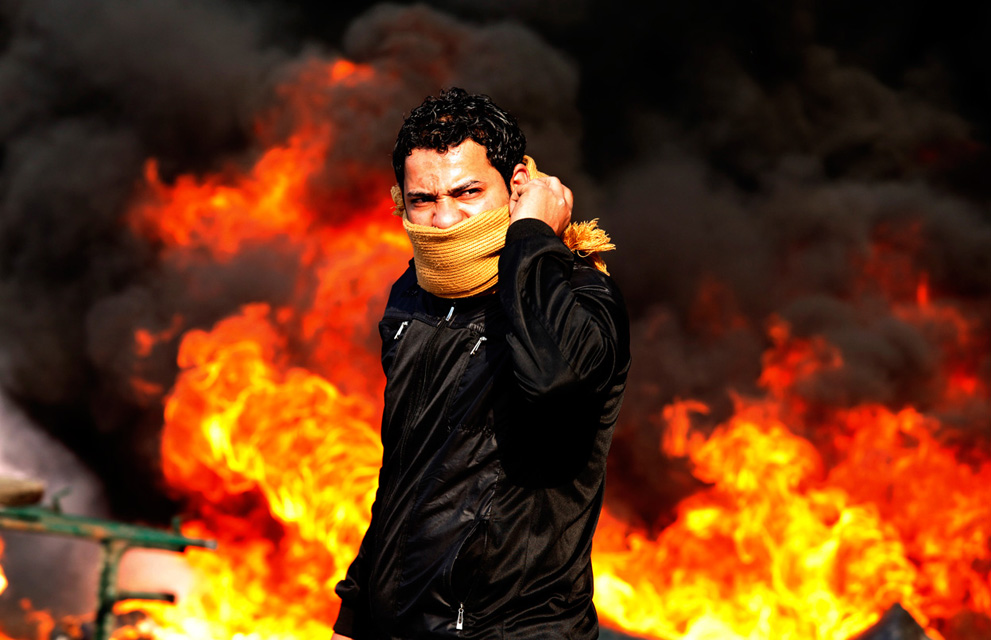 Goran Tomasevic, Reuters, protester +burning barricade, demonstration in Cairo January 28, 2011.
The pro-democracy revolt raises strategic considerations centred around Israel. The anchor of US policy in the Middle East is the Egyptian-Israeli peace treaty, negotiated by Sadat in 1979, maintained by Mubarak, and supported by the military.
Washington can only consider its relationship to Egypt in terms of whether its political developments are good for Israel or not. Washington continues to define its own interests in the Middle East largely in terms of whether they are compatible with those of Israel. So we have arguments that Israeli and American foreign policies are and need to be identical based on shared opposition to international terrorism and other such "values" are fallacious and are based on constructs that are essentially false.
What Washington fails to consider is that Israel has become a United States national security liability.
Update
PBS NewsHour's Margaret Warner's interview with Egypt's Foreign Minister Ahmed Aboul Gheit; Gheit basically tells the US that its expectations are out of line with political and time realities in Egypt.
It shows the political establishment in Egypt seems to be regaining its balance, pushing back and resisting pressure from those protesting in the street as well as the US government; pushing back against the assertive collective empathy created by multitudes fighting for the control of urban space. Tahrir Square is a liberated zone.
Update 2
Gastón Gordillo points out at his Space and Politics blog that:
What has coalesced as a powerful, unstoppable force on the streets of Egypt is resonance: the assertive collective empathy created by multitudes fighting for the control of space. This is why the Mubarak regime has desperately tried to shatter it. The state attempts to disrupt the internet, cell phones, Al Jazeera, and the work of the international media are all attempts to disable the technologies through which resonance propagates and expands. When these moves failed, the regime sent paramilitary units to attack the main source of resonance: the bodies of the multitude in Liberation Square in Cairo. The Egyptian Revolution became for several days a pitched battle fought with stones and Molotov cocktails over the control of its main node of resonance.
Gordillo adds that everybody feels the resonance reverberating from Egypt and is trying to make sense of it, to name it. But the words seem inadequate, partial, incomplete: enthusiasm, energy, passion, anger, contagion, electrifying, domino effect. These terms name features of resonance but miss its salience as a physical, affective, political force made up of living bodies.
Update 3
As the spectre of Islam continues to haunt the West consumed with its fears of an Islamic takeover in Egypt, Mubarak has announced that he will not be dictated to by foreigners, that he will continue to remain President until September, that he had delegated power to Suleiman, and he refused to immediately lift the emergency law.
Mubarak's speech is designed to provoke the multitude. A confrontation looms. People were expecting that Egypt would then move into a transitional period where there be a government of national unity, to carry on for a year to prepare for fair and free elections.
Mubarak is president in name only, after transferring all the powers of the presidency to his vice president Omar Suleiman. If Mubarak is a phantom authority, with the power shifting to Suleiman and the military, then the military is consolidating its power. The Egyptian military's goal is not to save Mubarak but to save the regime founded by Gamal Abdel Nasser.
Fareed Zakaria says in The Daily Star:
Egypt is not a personality-based regime, centered on Mubarak, despite reports of his wealth and efforts to establish his son as his successor. Since the officers’ coup in 1952, Egypt has been a dictatorship of, by and for the military....The military seems to have decided to sacrifice Mubarak but is trying to manage the process of change to ensure that it remains all-powerful. Egypt, remember, is still ruled by martial law and military courts.
The danger is that Egypt will become not Turkey--where the military as modernizers slowly relinquished power--- but Pakistan, a sham democracy with real power held in back rooms by generals. Is the military divided?
Update 4
Mubarak is deliberately pushing Egypt further into crisis. He is putting the army in a position where they will soon have to confront either the Egyptian people or the president and his presidential guard. In the current situation, after Mubarak's speech, the military faces three choices in the face of massive demonstrations in Cairo and other cities.
The first is to stand back, allow the crowds to swell and likely march to the presidential palace and perhaps enter the grounds. The second choice is to move troops and armor into position to block more demonstrators from entering Tahrir Square and keep those in the square in place. The third is to stage a coup and overthrow Mubarak.
Update 5
Mubarak has departed. The military pulled the plug. Egypt rejoices and celebrates. It was achieved without a wave of bloodshed. al-Jazeera's role was that of the voice of the Araba public. Will Switzerland freezing Mubarak's assets?
The democratic transformationbegins. Will the Army truly allow the emergence of a pluralistic, representative model government? Will the interim government have the savvy to present such a road map early enough to placate activists?
Posted by Gary Sauer-Thompson at 11:22 AM | Comments (14) | TrackBack
February 9, 2011
make the polluters pay for the harm they cause
Probably Gillard's big test of leadership in 2011 is her capacity to make headway on a carbon price – a job looking increasingly difficult as the Greens dig in on scrapping the Rudd-designed compensation packages for trade-exposed carbon polluters. Failure on this issue will damage her, badly, even though politics is now a spectacle.
At this stage Gillard is indicating that she plans to continue to subsidize the trade exposed industries big time. Is that what she means by achieving consensus?

Gillard's climate change policies are increasingly being reduced to putting a (low?) price on carbon and allowing the market to drive the changes in behaviour in response to changes in the prices we pay.
Without a price on carbon more new coal-fired power stations will be built and that will send the country’s emissions account higher ---and make it difficult for Australia to even meet its pledge to the Copenhagen Accord. That is a lowly 5% reduction from 1990 levels by 2020.
I find this reduction problematic, even though it with address the externality whereby coal fired power stations can dump hundreds of millions of tonnes of carbon dioxide into the atmosphere (thereby making makes coal fired electricity far cheaper than it would otherwise be). Making the polluters pay for the harm caused by pollution is the right principle, and it will also raise lots of money to compensate households.
However, nothing is being said about removing the wide range of existing subsidies and tax concessions that work to artificially reduce the price paid for fossil fuels in Australia. The reduction, in other words, Gillard is displacing the complimentary polices that would help reduce greenhouse gas emissions.
The argument of Richard Denniss and Andrew Macintosh from the Australia Institute in their Complementary or contradictory? An analysis of the design of climate policies in Australia is that:
Even if all of the contradictory policies that encourage fossil fuel use were removed, and a carbon price consistent with the harm that greenhouse gas emissions cause was introduced, a significant role for complementary policies would still be required.
What we have with the Gillard Government is the creeping cuts to the complementary measures - will this continue with the targeted energy efficiency and renewable energy target policies?
Posted by Gary Sauer-Thompson at 11:17 AM | Comments (3) | TrackBack
February 8, 2011
ALP: lacking vision or principle?
So far economic growth has gone hand in hand with the growth of greenhouse gas emissions in industrialized countries such as Australia, as they have an energy system that relies almost exclusively on fossil fuels.
So the Earth is warming up. The regularity and severity of recent events--drought, floods, cyclones and bush fires are increasingly a result of global warming in that a warmed up world leads to stronger force cyclones, more severe floods and more intense bushfires.

Climate change certainty is needed for increased investment in generator capacity. The trouble is that we are in the midst of a renaissance of coal, because oil and gas (sic) have become more expensive, but coal has not.
It is the national climate policy uncertainty that remains the major factor in preventing investments in renewable energy and low carbon sources of energy. As Frank Wolak observes in The Guardian:
The choice is stark: either we can continue to wait to implement the perfect climate policy, and in the meantime pay higher prices for oil, and watch countries like China that are able to provide climate policy certainty to investors move forward with this new industrial development; or we could commit to a modest climate policy and so unleash the new technologies and new jobs made possible by this more favourable investment environment.
Australia is going to have bit the bullet sometime because it needs to invest in much more electricity capacity to meet rising demand.
We need energy from renewables, and we need jobs. Renewables can deliver both. The 2020 target is quite low--20 per cent of our electricity to come from renewable energy sources by 2020--not the replacement of the fossil fuel energy infrastructure. So we are stuck with power stations, cars and homes that use carbon-based energy sources.
The big miners and their publicists are not convinced by the need to invest in wind and solar power They say that the real solution for cost effective and reliable electricity in an industrial society is to go nuclear is their spin. They add what happens when the wind stops blowing or the sun stops shining. The lights go out. So renewables cannot provide base load power. Only nuclear can do that. The bottom line is that these will not be privately funded--they are hugely expensive, dangerous and will take too long to build.
The problem with this kind of spin---myth making--- is that nothing will happen when the wind stops blowing simply because it never stops blowing, suddenly, over the whole of Australia. The sun does stop shining at night, but that means the national electricity grid or network requires diverse sources of energy--an energy mix.
Is the policy to run down existing carbon-polluting energy sources rapidly and to replace them with atmosphere-friendly equivalents? No. The political reality is that Australia is going to build new fossil fuel power stations in the near future. It's the light touch in energy policy.
Posted by Gary Sauer-Thompson at 7:11 AM | Comments (7) | TrackBack
February 7, 2011
Al Jazeera: discussion on Egypt
In the light of David Burchill's op-ed in The Australian there is this interesting discussion of the uprising in Egypt on Al Jazeera English features two well-known intellectuals: Tariq Ramadan, a Muslim scholar at Oxford whose grandfather, Hassan al-Banna, founded Egypt's Muslim Brotherhood in 1928, and Slavoj Zizek a Slovenian philosopher.
In Egypt, religion is not an dominant factor in the uprising, which so far is a informal, spontaneous people's protest. The people have revolted against an oppressive regime, its corruption and poverty, and demanded freedom and economic hope. Even though religion is a crucial component of the unfolding dynamic, the possibility of Egypt becoming a second Iran is small--ie Khomeini's successful hijacking of the revolution in Iran in 1979.
Many are warning of the risks of Egypt descending into some sort of Islamist dictatorship that would tear up the peace treaty with Israel, engage in anti-American policies, and deprive women and minorities of their rights (as if they had so many rights under the Mubarak dictatorship).
What is likely is that whether, Islamist or secularist, any Egyptian government "of the people" will turn against the neoliberal economic policies that have enriched regional elites while forcing half or more of the population to live below the $2 per day poverty line.
Update
Mona Seif, an Egyptian woman and blogger, gives her graphic account of the violence unleashed by Mubarak's regime.
It indicates that no correspondent, even those who are free to move around Cairo with their equipment, is able to provide the range of information and views coming from the Egyptian citizen journalists using Twitter.
Posted by Gary Sauer-Thompson at 8:29 AM | Comments (10) | TrackBack
February 6, 2011
economic crises: why?
In How Much Is Too Much? in the London Review of Books Benjamin Kunkel says that Paul Krugman, discussing Roubini’s book in the New York Review of Books, agreed with him that what Ben Bernanke called the ‘global savings glut’ lay at the heart of the crisis, behind the proximate follies of deregulation, mortgage-securitisation, excessive leverage and so on.
Kunkel adds:
Originating in the current account surpluses of net-exporting countries such as Germany, Japan and China, this great tide of money flooded markets in the US and Western Europe, and floated property and asset values unsustainably. Why was so much capital so badly misallocated? In the LRB of 22 April 2010, Joseph Stiglitz observed that the savings glut ‘could equally well be described as an “investment dearth”’, reflecting a scarcity of attractive investment opportunities. Stiglitz suggests that global warming mitigation or poverty reduction offers new ‘opportunities for investments with high social returns’.
Kunkel adds that the neo-Keynesians’ ‘savings glut’ can readily be seen as a case of what a more radical tradition calls overaccumulated capital---it is the broader and more systematic Marxist perspective that ultimately and properly contains Keynesianism within it.
The Marxist account of crisis is that it is caused by the over accummulation capital which, means by definition, that it can’t easily find a profitable outlet in increased production. Capital overaccumulated in one place can flow to another which appears to boast better ultimate prospects of profit.
Overaccumulated capital, whether originating as income from production or as the bank overdrafts that unleash fictitious values, can postpone any immediate crisis of profitability by being drawn off into long-term infrastructural projects, in an operation David Harvey calls a ‘spatio-temporal fix’.Not only Americans and Britons but the Irish, Spanish and Emiratis live today among the ruins of a broken spatial fix. They are experiencing what David Harvey calls a switching crisis.
Harvey argues that the resulting temptation to the overaccumulation of capital, will be for capital to sidestep production altogether and attempt to increase itself through the multiplication of paper (or digital) assets alone. Kunkel says:
Both the new factories at home (China) turning out exports for the US, and the deliriously appreciating houses abroad rested on the premise of continuously rising American incomes. But among Americans, wage growth had ceased and household incomes could no longer be supplemented by the mass entry of women into the workforce, something already accomplished. The issuance and securitisation of debt alone could substitute for present income. But in the end so much fictitious capital could not be redeemed. Whatever the destination of future Chinese savings gluts, they can no longer sponsor American consumption in the same way.
Posted by Gary Sauer-Thompson at 6:47 PM | Comments (1) | TrackBack
February 5, 2011
little more needs be said
There is lots of rhetoric from the ALP on its policy about putting a price on carbon and making the necessary shift to a low carbon economy these days. This rhetoric says that the Gillard Government takes climate change seriously and that it is determined to act on it.
However, there's not much of a need to say more than Alan Moir's cartoon, which really says it all:

We are now in a situation in which unprecedented weather events are to be expected, but for some reason we still don’t expect them. We also know that once-in-a-century weather extremes are now going to become more common. Yet the scenario is one return, rebuild, restart within a a cycle of repetition, with little thought given to mitigation. As Jonathan Nott observed on the ABC's Lateline programme:
We were prepared in terms of the response to the emergency at the time and right now when we're going in and trying to repair things like electricity and make sure that people are safe and sound. We're still not thinking seriously enough about where people should live and how to keep them safe and how to keep them out of the road of danger.
Ross Garnaut has warned that global warming will lead to more severe weather events such as rainfall events and floods, and more extreme bushfires, cyclones and droughts.
When Bob Brown argued that as the planet gets warmer, these rains and floods, droughts and cyclones will become more frequent and more destructive of life and the environment, he was shouted down. Why? Brown connected the turbulent weather conditions to global warming and pointed out that, as this caused by greenhouse gases partly caused by coal fired power stations,then the big miners should contribute to rebuilding the infrastructure damaged caused by extreme weather events.
Though climate change has lost its media mojo in Australia, markets in various countries (eg.,China, Spain and the US) are creating a competitive demand for green technology.
Update
In his Droughts, Floods and Food post at the New York Times Paul Krugman, in arguing for a link between global food shortages and climate change, says that:
As always, you can’t attribute any one weather event to greenhouse gases. But the pattern we’re seeing, with extreme highs and extreme weather in general becoming much more common, is just what you’d expect from climate change.The usual suspects will, of course, go wild over suggestions that global warming has something to do with the food crisis....But the evidence does, in fact, suggest that what we’re getting now is a first taste of the disruption, economic and political, that we’ll face in a warming world. And given our failure to act on greenhouse gases, there will be much more, and much worse, to come.
Both droughts and floods are natural consequences of a warming world: droughts because it’s hotter, floods because warm oceans release more water vapor.
Posted by Gary Sauer-Thompson at 3:20 PM | Comments (8) | TrackBack
February 4, 2011
fatism
Food and everything that surrounds it is a crucial matter of personal and public health. Changing sedentary, high-cholesterol, high blood pressure, high blood sugar fat people into more active, low-cholesteral, normal blood pressure, normal blood sugar fat people improve their health and wellbeing.
We can see from this on John Birmingham's Why is fat such a fractious issue? in the Brisbane Times in which it is mentioned that obesity skews significantly towards the lower income groups for a whole bunch of reasons.
In an earlier post --A weighty issue----Birmingham writes that from his own painful experience personal responsibility for what you eat and how you burn off any excess energy is, for a lot of the population, one hundred percent of the issue. He then asks:
Is it inevitable as the rate of obesity increases in Western society, that obesity will come to be defined as the norm? I ask that as somebody who has been obese. Not just clinically obese. But morbidly obese. I'm not any more, but only because I got so sick at one stage from carrying that much weight, that I suddenly dropped a couple of kilos and decided to kick on and see if I could get rid of the rest of it. I was very lucky in having both the money and the time to be able to do so. Not everybody does.
He wonders whether or not obesity might well become as politically fraught in the near future as smoking has become over the past decade. Will it get to a point where the word 'fat' is no longer considered appropriate in polite circles, because of the offence and hurt it might cause?
Even though obesity is deadly and crippling and is killing people Birmingham's answer is that there a concerted effort to 'normalise' fat as a condition in the form of the 'human right' to be fat, not to feel bad about it and to contest the argument that obese equates to being unhealthy.
Obesity is a public health issue, so a policy response is appropriate, but there won't be much of one, because of the power of the food industry. The situation is that we sell junk food while telling people not to eat it.
Despite our our diet being unhealthful and unsafe it is highly unlikely that there will be a tax on junk or high processed food food; or that government subsidies to processed food are ended; that Agricultural Departments whose goal is to expanding markets for agricultural products for junk food become an agency devoted to encouraging healthy eating; factory animal feeding operations are discouraged whilst encouragement is given to the development of sustainable animal husbandry; provide food education for children in public schools as part of the national curriculum; mandate truth in labeling.
Even though public health is an accepted role of government, the reaction to the above would be that this is nanny-state paternalism ; that it’s time we “stop harassing people about their weight”; and that we are in the midst of a moral panic.
Posted by Gary Sauer-Thompson at 1:07 PM | Comments (8) | TrackBack
February 3, 2011
Egypt: Mubarak's violence
The current part of the process of political contestation in Egypt may be an end game for the Mubarak regime, but Mubarak is not going any where fast. He is now using his security forces and police to unleash violence against the pro-democracy protesters. He is trying to ride out the protests and to hold on.
Egypt, he says, faces a “choice between chaos and order”. Hence the state-sponsored violence to create chaos----The violence is organized. The army stood by and watched as the pro-Mubarak forces tried to reclaim the streets by spilling blood.
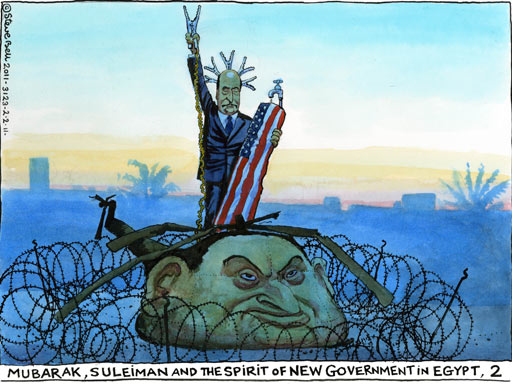 Steve Bell
Mubarak's tactics are to create chaos to justify his continued rule in the name of order. It indicates that Egypt’s order and stability is dependent on coercion and unleashing violence and chaos on the nation’s youth. The violence is a prelude to demands that the army take control to keep the "two sides" apart.
This is the regime and its backers in Washington Plan B, which is to ride out the uprising with their basic authoritarian prerogatives intact. Suleiman and his entourage intend to stage an “orderly, peaceful transition” (to use the Obama administration’s phrase) from the reign of one arbitrary autocrat to another, adorned with the trappings of more liberal democracy.
Simon Tisdall in The Guardian says in reference to the state violence:
This was not the performance of a defeated man. Mubarak may be down but he's not out. And judging by today's events in Tahrir Square, he and the military-dominated clique around him clearly feel they have done enough, for now, to get the Americans off their backs, flex their still considerable muscle, and reclaim the streets for the regime. All the talk about reform and elections and negotiations can wait, whatever Barack Obama says.Today's immediate message to the people from an unvanquished, still vicious regime: it's over – go home, or else.
This is the counter revolution without the mask of reasonableness of the last few days that was worn to keep the Americans at bay. Presumably the army is willing to allow the protests to the point Mubarak would agree to stand down, and for the pro-democracy protesters to accept that concession and go home now.
The protesters are no longer willing to accept an autocracy backed by the US because of Israel and Iran.--ie., Egypt is an anchor of stability in the Middle East. Most secular liberal activists in Egypt reject with contempt the argument that regional stability can come at the expense of their right to choose their government. The problem for the US is that there’s no way for Egypt to be democratic and exclude the Islamists from political participation.
So we have the Muslim Brotherhood conspiracy theory from Fox News, the neocons and the Israel lobby. This holds that this deeply conservative sect is “really” the driving force behind the movement to overthrow Mubarak. The Brotherhood is cast in the role of the Leninists in 1917--ie., the popular protests presage a takeover of Egypt by the Muslim Brotherhood. The subtext is that regime change is bad for a nuclear armed Israel because a more democratic Egypt would be far less willing to keep the Palestinians penned up in Gaza.
Israel, of course, supports the Mubarak regime unquestionably. They want Arab allies to support their long term strategy to have an Arab majority ruled by a Jewish minority between the Mediterranean Sea and the Jordan River. Prime Minister Benjamin Netanyahu responded to the ongoing events in Egypt by urging that "regional stability and security" be preserved and he asked Western governments to work to save the regime of President Hosni Mubarak.
Update
Even if Mubarak continues to hang on, what is clear is that a transition of power is already under way. The structures of a police state have been challenged by the people and found, to the surprise of many, to be weaker than imagined.
Posted by Gary Sauer-Thompson at 7:02 AM | Comments (12) | TrackBack
February 2, 2011
Tropical Cyclone Yasi
The Bureau of Meteorology says that Cyclone Yasi is likely to be more life-threatening than any experienced during recent generations. The cyclone is expected to cross the coast in the Innisfail area at about 10pm.
Yasi’s immense size and power will surpass that of Australia’s deadliest and most notorious tropical storm, Cyclone Tracy. Tracy hammered Darwin on Christmas Eve in 1974, all but wiping out the Northern Territory capital and killing 65 people.
Tracy was far smaller than Yasi, but the fact it made landfall on top of Darwin was the deadly blow. Yasi will make landfall south of Cairns near the coast at Innisfail.
This cyclone is a deadly event. The latest tracking map of the cyclone from the Australian Government Bureau of Meteorology

The first waves of Cyclone Yasi hit the Esplanade in Cairns around 8am this morning. Rain is now falling in Cairns. The wind is pickling up. A real time map of Yasi.
Update
Cyclone Yasi is expected to hit around midnight local time tonight. It is not expected that the cyclone will diminish in intensity. 6.6. metres waves hit Townsville this afternoon; now they are 9.6 metres. This is the latest tracking map from the Australian Government Bureau of Meteorology:

The low-lying coastal areas in Yasi's path are going to devastated with waves going through houses. Those who have not fled these homes, and who have been advised to shelter in the smallest rooms in their houses to wait out the storm, are in danger. They cannot go outside and cannot be rescued, as emergency services are in lock down.
Why are people allowed to build in these low lying areas by the local and state governments? They would have maps of areas impacted by rising sea levels caused by global warming.
Posted by Gary Sauer-Thompson at 11:51 AM | Comments (5) | TrackBack
February 1, 2011
Egypt: goodbye Mubarak?
It increasingly looks as if the Mubarak regime in Egypt is finished. The military's decision not to fire on the protesters, because their demands for political freedom were legitimate (eg., "freedom of expression through peaceful means is guaranteed to everybody") may well be the tipping point.
 Steve Bell
Mubarak will try and hang on by avoiding political reform and trying to ensure a return to stability but the regime's legitimacy is gone. So its goodbye Mubarak as the revolt intensifies and Egypt's economy grinds to a halt.
Presumably, regime change in Egypt will send shockwaves across Jordan, Saudi Arabia, Yemen, Algeria, Libya and Syria as the Arab people resist domination through the extensive and systemic use of torture by the police and security services. Stephen Walt observes that:
Egypt is not a major oil producer like Saudi Arabia, so a shift in regime in Cairo will not imperil our vital interest in ensuring that Middle East oil continues to flow to world markets. By itself, in fact, Egypt isn't a critical strategic partner. .... the real reason the United States has backed Mubarak over the years is to preserve the Egyptian-Israeli peace treaty, and to a lesser extent, because Mubarak shared U.S. concerns about Hamas and Iran. In other words, our support for Mubarak was directly linked to the "special relationship" with Israel, and the supposedly "strategic interest" involved was largely derivative of the U.S. commitment to support Israel at all costs.
A more democratic Egypt would be more critical of Israel's treatment of the Palestinians and its refusal to accept a viable two-state solution. It will also be less willing to collude with U.S.-backed policies such as the counter-productive and cruel siege of Gaza.
The U.S., finds itself in the unenviable position of being a status quo power in a region where so many detest the status quo, wish to fight it, and may - or perhaps inevitably will - one day bring it crashing down.it is still not sending a clear signal to the Egyptian people that the US support their democratic aspirations and that the US will no longer offer unqualified support to a post-colonial regime that systematically represses those aspirations.
Posted by Gary Sauer-Thompson at 11:38 AM | Comments (19) | TrackBack