|
February 3, 2011
The current part of the process of political contestation in Egypt may be an end game for the Mubarak regime, but Mubarak is not going any where fast. He is now using his security forces and police to unleash violence against the pro-democracy protesters. He is trying to ride out the protests and to hold on.
Egypt, he says, faces a “choice between chaos and order”. Hence the state-sponsored violence to create chaos----The violence is organized. The army stood by and watched as the pro-Mubarak forces tried to reclaim the streets by spilling blood.
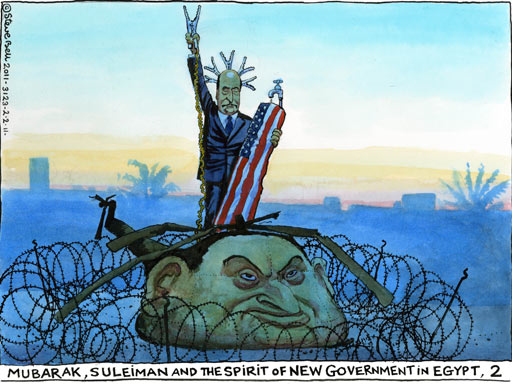 Steve Bell
Mubarak's tactics are to create chaos to justify his continued rule in the name of order. It indicates that Egypt’s order and stability is dependent on coercion and unleashing violence and chaos on the nation’s youth. The violence is a prelude to demands that the army take control to keep the "two sides" apart.
This is the regime and its backers in Washington Plan B, which is to ride out the uprising with their basic authoritarian prerogatives intact. Suleiman and his entourage intend to stage an “orderly, peaceful transition” (to use the Obama administration’s phrase) from the reign of one arbitrary autocrat to another, adorned with the trappings of more liberal democracy.
Simon Tisdall in The Guardian says in reference to the state violence:
This was not the performance of a defeated man. Mubarak may be down but he's not out. And judging by today's events in Tahrir Square, he and the military-dominated clique around him clearly feel they have done enough, for now, to get the Americans off their backs, flex their still considerable muscle, and reclaim the streets for the regime. All the talk about reform and elections and negotiations can wait, whatever Barack Obama says.Today's immediate message to the people from an unvanquished, still vicious regime: it's over – go home, or else.
This is the counter revolution without the mask of reasonableness of the last few days that was worn to keep the Americans at bay. Presumably the army is willing to allow the protests to the point Mubarak would agree to stand down, and for the pro-democracy protesters to accept that concession and go home now.
The protesters are no longer willing to accept an autocracy backed by the US because of Israel and Iran.--ie., Egypt is an anchor of stability in the Middle East. Most secular liberal activists in Egypt reject with contempt the argument that regional stability can come at the expense of their right to choose their government. The problem for the US is that there’s no way for Egypt to be democratic and exclude the Islamists from political participation.
So we have the Muslim Brotherhood conspiracy theory from Fox News, the neocons and the Israel lobby. This holds that this deeply conservative sect is “really” the driving force behind the movement to overthrow Mubarak. The Brotherhood is cast in the role of the Leninists in 1917--ie., the popular protests presage a takeover of Egypt by the Muslim Brotherhood. The subtext is that regime change is bad for a nuclear armed Israel because a more democratic Egypt would be far less willing to keep the Palestinians penned up in Gaza.
Israel, of course, supports the Mubarak regime unquestionably. They want Arab allies to support their long term strategy to have an Arab majority ruled by a Jewish minority between the Mediterranean Sea and the Jordan River. Prime Minister Benjamin Netanyahu responded to the ongoing events in Egypt by urging that "regional stability and security" be preserved and he asked Western governments to work to save the regime of President Hosni Mubarak.
Update
Even if Mubarak continues to hang on, what is clear is that a transition of power is already under way. The structures of a police state have been challenged by the people and found, to the surprise of many, to be weaker than imagined.
|





The US's support for Mubarak echoes of the winter of 1978-9, when US and British politicians rushed to Tehran to prop up the shah as millions demonstrated against his brutal regime.
Tony Blair, a neo-con, said that the Egyptian president had been, "immensely courageous and a force for good" – this is a man who has jailed and tortured tens of thousands of political prisoners – because of his role in maintaining peace with Israel.
Change in Egypt had to be "stable and ordered", Blair explained, because the Muslim Brotherhood might be elected and public opinion in the Middle East could "end up frankly with the wrong idea".
Netanyahu's gloomy predictions are that Egypt becomes a new Iran. What then for Israel if Egypt becomes an Islamic Republic ?