« January 2012 | Main | March 2012 »
February 29, 2012
Fukushima: a year on
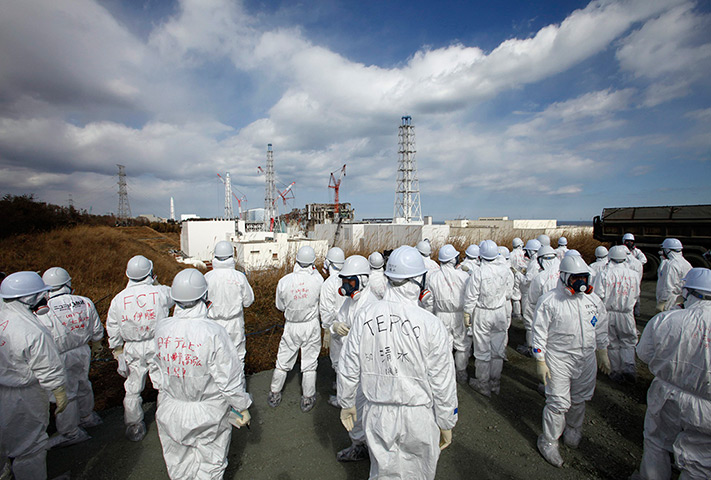
Justin McCurry from The Guardian visits Fukushima Daiichi and Tepco's nuclear power plant. Fukushima is classified as a grade 7 accident on the International Atomic Energy Agency scale - denoting “widespread health and environmental effects.” That's the same severity as Chernobyl, the only other grade 7 accident in history.
 Issei Kato/Reuters
The cleanup has started. Of the three reactors that went into meltdown, one is covered with tarpaulin and another appears intact, but the third is a mess of tangled metal. They have installed storage tanks to store contaminated water from the reactor buildings. The water is then purified and used again to cool damaged fuel. They also need to remove the melted nuclear fuel, which will prove difficult.
McCurry highlights two things from his visit. First, the surrounding Fukushima exclusion zone:
the towns and villages....exist in name only, their residents having been sent fleeing a year ago. Homes and shops lie empty, the roads are deserted. In the town of Naraha, groceries sit untouched on the shelves of a convenience store; a handful of cars punctuate a supermarket carpark, abandoned by their owners amid the panic that followed the first explosion at one of the Fukushima Daiichi plant's reactor buildings.
It sounds like an unusable wasteland. Long-term evacuation over extensive decontamination was the Soviet response. The Japanese response is to decontaminate the landscape.
Secondly, McCurry says that the destruction is more insidious than collapsed roofs and ruptured tarmac:
Almost everywhere, beeping monitors alert visitors to the invisible foe that has befouled entire communities: radiation. While temperatures inside the reactors have stayed below the required boiling point, radiation is still too high for workers to enter some areas. The utility's contamination map shows radiation inside reactor No 3 as high as 1,500 microsieverts/hour.
Radiation levels inside reactor No 3 are still too high for people to enter. Radiation may be invisible, but it is incredibly persistent and incredibly damaging to all life forms. The release of contaminated water from the crippled Fukushima nuclear complex last year stoked concerns about how that radioactivity might affect marine life in the Pacific.
The meltdown also contaminated large areas of farmland and forests. At least 1,000 sq km of land will be cleaned up as workers power-spray buildings, scrape soil off fields, and remove fallen leaves and undergrowth from woods near houses.
The capture of the Japanese government by the nuclear industry as has also happened in the US and in UK If the machinery of the Japanese government, and the ministers it serves, is 100% behind the plans of the nuclear industry, then the myth of safety of nuclear power plants that Japanese authorities had maintained for decades to gain public support as the country embarked on massive nuclear power programmes has well and truly fractured.
Ten months after the nuclear disaster trust in the authorities is nearly non-existent due to the industry spin and collusion. The distrust stems primarily from the fact that the meltdown of the Fukushima reactors was not reported to the public immediately, causing huge health risks to the local population from radiation leaks.
Posted by Gary Sauer-Thompson at 8:07 AM | Comments (3) | TrackBack
February 28, 2012
corporate rule anyone?
The pollsters keep telling us that people hate the minority government, even the parliament is working effectively in passing reform legislation and the negotiations represents representative democracy in action. Business dislikes, if not hates, the Gillard minority government.
They express this in terms of the authority of the leadership being diminished and the illegitimacy of the Gillard Government. This rhetoric, especially around the Fair Work Act, can be seen as a means of protecting corporate power against democracy. Clearly, for business, less democracy is better.
 Martin Rowson
Behind this rhetoric sits a corporate power that is antagonistic to the shift to a low carbon economy and acts to ensure that Australian life is built around the demands and interests of big business. The antagonism to the Gillard Government and desire for an early election to restore the Coalition to power is premised on corporations gaining ever greater powers and being subject to less democratic oversight and restraint, in the form of regulation and reform.
What lies behind this is the corporate assault on democracy that has been gathering pace for the past 5 years whose trajectory is a shift to corporate rule. The rhetoric large corporations are benevolent institutions that should be minimally regulated because what is good for them is good for society as a whole. Strong government for them means that government should protect business activities against the excesses of democratic regulation and that the power of the state should become subordinate to corporate interests.
If this assault on democracy to protect corporate interests requires the destruction of effective public healthcare and reliable state education, then so be it, as these are of no concern to an economic class that uses neither.
Posted by Gary Sauer-Thompson at 8:55 AM | Comments (13) | TrackBack
February 27, 2012
ALP: where to now?
Federal ALP have had their cathartic therapy session in the form of a leadership spill about office politics. The after the event speeches of the winners and losers (71 to 31 for Gillard) were pretty standard. Neither addressed the view that what would have been best for the Gillard Government to avert a conservative Abbott government in 2013 would have been for Rudd and Gillard to complement each other in senior positions.

Of course, self -interest will ensure the ALP will unite after the therapeutic purge. Despite all the pledges it will be "unite" after a fashion, since federal Labor under both Rudd and Gillard has a track record of shooting itself in the foot.
A fractured Gillard Government is now fighting for its survival with one leg missing. Or is that one arm?
All the rhetoric about healing should be taken with a grain of salt. The wounds are too raw and deep, there is a fundamental disconnect between the Gillard Government and the broader Australian electorate, the Gillard Government faces the existential threat of being destroyed in the 2013 election, and the Abbott-led opposition will only increase the grenade throwing.
This is a government under siege. It is fighting issues of authority, legitimacy and trust in difficult times amidst the angst stirred up by its policy reforms.
Posted by Gary Sauer-Thompson at 11:55 AM | Comments (12) | TrackBack
February 26, 2012
Syria: a wider conflict?
There is a grim tragedy unfolding in Syria. The Assad Baath regime in Damascus has intensified its campaign of massacre against the besieged people of Homs. It is using heavy artillery against the civilian district of Baba Amr. There is now the humanitarian crisis in the besieged cities and towns.

Saudi Arabia sees the emerging conflict in Syria as an opportunity to push back the influence and power in the region of Iran, the principal local backer of Assad's regime. Saudi involvement risks a proxy war between the two powers in Syria and the wider threat of conflict between Sunni and Shia across the region.
It appears that the Assad regime can only survive with Russia's support and that Moscow, which arms and sustains Assad. Will Russia---ie., Vladimir Putin's Russia---- eventually abandon the regime out of self-interest? Does Russia desire to see Assad give up power and for Syria to embrace democratic reform?
And the US? Is its goal goal is to help the Syrian people or to hurt an Iranian ally? In a policy brief for the Centre for a New American Security Marc Lynch argues that the available military options have little chance of quickly or decisively turning the tide against Assad's regime. They are more likely to simply ratchet the violence up to a higher level, while badly harming the chances of any kind of political transition which could create a stable, inclusive Syria.
Posted by Gary Sauer-Thompson at 9:43 AM | Comments (1) | TrackBack
February 25, 2012
Murdoch rises?
Murdoch launches a new Sunday tabloid in the UK-- the Sunday Sun or more accurately the Sun on Sunday. It's a bold move given the decline of the newspaper industry and the ongoing inquiries into phone-hacking and alleged corruption of the police at the News of the World by the Leveson inquiry.
The tabloid replaces the closed down News of the World. News International now acknowledges that senior employees and directors" knew about phone hacking and sought to conceal it by destroying evidence of wrongdoing, which evidence included a very substantial number of emails" and the computers of journalists. Murdoch is using his old tactic of sinking his competitors by predatory pricing.

Murdoch has been only too willing to unleash the full force of his media empire against anyone who tried to tame him.The politicians in Australia and the UK have only made token gestures to break up his media ownership. They have feared the consequences of moving against him and bi-partisanship on the issue has been lacking.
The other aspect of this is that by 2006 the Metropolitan police already knew that phone hacking had been conducted on an industrial scale and that several News of the World staff were probably involved but they kept the inquiry narrow to protect News International. We now discover that payments and retainers running to tens of thousands of pounds were paid to the police by the News International's newspapers.
Posted by Gary Sauer-Thompson at 9:31 AM | Comments (3) | TrackBack
February 24, 2012
flicking the switch to vaudeville
From what the anti-Rudd cabinet ministers are saying it is clear that the majority of the cabinet hold deep resentment towards Rudd about his administration being chaotic and dysfunctional. There also appears to be an element of trying to justify their past mistakes under the Rudd administration, such as not pulling Rudd into line over his autocratic and abusive governing style, and never clearly explaining to the public why he had to go.
The venom of the attack on Rudd does make it look that any form of reconciliation between them and Rudd is out of the question. Rudd has been underminimng the Gillard Government. On the other hand, it also looks as if Gillard's leadership is terminal. The lines from Rudd, McCelland and Ferguson that Gillard can't defeat Abbott have a ring of truth.

It does look as if the Gillard Government will continue its relatively conservative set of policies that focus on economic growth over social wellbeing and downplay environmental sustainability. So the massive educational inequality highlighted by the Gonsky Review will remain. There will be little change to the decline in Australia's school performance on international rankings. which coincide with the skewing of Federal Government money away from government schools and towards independent schools.
We have reached the limits of reform. The government is not looking for a fight on the education. Gillard moved quickly to put a distance between the government and the review she commissioned in another era.
Posted by Gary Sauer-Thompson at 6:23 AM | Comments (11) | TrackBack
February 22, 2012
Rudd challenges Gillard?
Rudd has resigned as Foreign Minster. Will this-- a pre-emptive strike by Rudd?---bring the matter---it's personality, ego and power --- to a head?
The cycle of leadership tensions have flowed from when Gillard ousted Rudd and taken the form of an undermining campaign in the media. This has now developed into a crisis consuming the Gillard Government. The shadow boxing is over.
The media has been less than honest about how they as insiders have been part of the campaign run by anonymous sources. They have hidden their role in the media/political nexus, and they have deceived us about what the way they have both been manipulated by Rudd's destabolizing campaign and their role in manufacturing the leadership crisis.

Senior Ministers (Tony Burke, Wayne Swan, and Craig Emerson) are now going public about the extent of the dysfunctionality of the Rudd Government. The ALP needs to sort this real quick--eg., Gillard calling a caucus ballot on Monday--- given the context of the Queensland state election. The federal crisis is currently causing a lot of damage to the Bligh campaign for re-election.
Will Rudd exit Parliament and cause a by-election if he loses? That's hardly likely, as he will be just trashing his significant legacy which he wants to protect. Presumably he would sit on the back bench and continue to stoke the leadership tensions and continue top use the media to destablize the Gillard Government -- that is, adopt a two-part strategy. Leadership challenges in Australia often follow a pattern of an initial assault followed by retreat, regrouping and then a final assault that succeeds.
The problem for Gillard is that Labor's primary vote has been constantly stuck around 30 per cent and the reforms have stirred up resentments and animosity in the electorate. It is likely that this will continue---the Australian people do not approve of Julia Gillard---- and so Rudd's challenge remains alive. Dozens of Labor MPs face an electoral wipeout under Gillard on current polling. So Rudd looks attractive.
Posted by Gary Sauer-Thompson at 6:24 PM | Comments (12) | TrackBack
the digital economy
Paul Buddle observes that people are shifting from the view that the National Broadband Network (NBN) means more than just fast internet access. It is part of the transformation of the Australian economy into a digital economy:
Those who are still talking about broadband as an end in itself do not understand the situation. Broadband is simply the tool that will further enable and advance the digital economy. So those who are looking at broadband in isolation are totally missing the point.....Included in this group is the Liberal opposition in Australia...To them broadband is ‘it’ – they are completely missing the point of the digital economy.
Over at The Drum Nick Ross agrees. He says that healthcare, education, business innovation and, in many quarters, society in general will be revolutionized for all Australians-- - particularly for those in rural areas plus the elderly. The NBN is an infrastructure which provides a platform for business, services and innovation.
You can see the emergence of the digital economy with the effects the internet is having on the music industry, the publishing industry, the retail industry, the media, the commercialisation of web 2.0 space by Facebook, Google; and more subtly with e-education, e-government, e-banking and e-health.
In this newly emerging economy information in digital form is facilitated by the digital devices that allow the free movement of vast amounts of information in the shortest time possible between people in different parts of the world. We are becoming aware that a digital economy and knowledge is increasingly becoming a substantial driver of economic growth and that it will underpin the majority of future job creation in Australia.
When the mining boom is over it is the national broadband network which will provide Australia with the opportunity to become a global hub for digital talent, and for the high value technology-enabled and content-driven businesses that depend on that talent.
Posted by Gary Sauer-Thompson at 1:29 PM | Comments (3) | TrackBack
February 21, 2012
Gonski review
Behind the ongoing leadership tensions the ALP's reform momentum continues. This time it is the Gonski review into funding arrangements for Australia's educational institutions and system.
This is a split system that has many problems, including top-down testing, extensive tracking, highly variable teachers, state federal conflicts, multiple tensions over funding and a 30-year drift of middle class families out of public schools and into the private education system. The review is the biggest review of school funding in decades --the first comprehensive schools funding review since Whitlam.
It was needed given Australia is failing to maintain a knowledge and skills base that can change and adapt to keep up with other nations tin a global economy. It was needed because of the kids currently sitting in crumbling classrooms in underfunded schools surrounded by other kids with complex layers of difficulty and disadvantage.

The report is the biggest review of school funding in decades and it recommends an injection of A$5 billion to the education sector, three-quarters of which would go to public schools---about $3.8 billion for the public system, which educates the vast majority of disadvantaged students. There is no hit-list in the report, no attempt to contain non-government schools funding.
It came up with a needs-based funding model that could be applied across private and public schools. Its reworking of the Australian system leaves most of the essential features in place, while attempting to improve the performance of the schools on the bottom, which mostly happen to be public schools.
The Gillard Government has refused to commit to additional funding, repeatedly citing the need to return the budget to surplus. The states will yell loudly. The Coalition will scream class warfare on the private schools in the form of hit -list evoking Mark Latham.
Posted by Gary Sauer-Thompson at 7:19 AM | Comments (8) | TrackBack
February 20, 2012
Iran: bizarre media fantasies
The report below by Erin Burnett on CNN---"Is Iran planning an attack in America?" ----indicates that the war drums in the US are being played in the US media. It's the 2002 Iraq war script being replayed. The standard stories in the US media suggesting that Iran is on track to build a nuclear bomb have been broadened by using anonymous official sources to speculate that the Iranian regime may strike the United States, perhaps in collusion with terrorists.
The media drum beats sound so familiar. The script is one of misinformation and scary storylines whose logic is regime change in Iran. Why even New York city is under threat from Iran or Hezbollah. The media's fantasies are bizarre.
The reality is that though Iran might acquire a nuclear weapon, and is capable of doing so, according to the IAEA there is no definitive proof that they have yet decided to try. Moreover, it is Israel that is talking about a preventative war (bombing Iran before Tehran moved its nuclear facilities beyond reach, deep underground); hyping the Iranian threat; and sabre rattling. The US continues its efforts to restrain Israel as it implements UN sanctions against Iran.
There are American attempts to persuade Iran's Asian customers -- China, India, Japan, South Korea -- to stop buying Iranian oil by persuading them that the only alternative is war. The formula is portray the supposed threat as dire and growing; try to convince people that if we don't act now, horrible things will happen down the road; then say that the costs and risks of going to war aren't that great.
Glenn Greenward calls the media campaign against Iran for what it is. He observes:
Many have compared the coordinated propaganda campaign now being disseminated about The Iranian Threat to that which preceded the Iraq War, but there is one notable difference. Whereas the American media in 2002 followed the lead of the U.S. government in beating the war drums against Saddam, they now seem even more eager for war against Iran than the U.S. government itself, which actually appears somewhat reluctant.
The American media depict Iran as the threatening, aggressive party. Iran’s aggression must be contained, and it is leaving the U.S. and Israel with no choice but to pre-emptively attack it. The reality is that it is Israel that is seriously considering preventive war whilst Iran's threats are retaliatory: if you attack us, we will attack back.
Posted by Gary Sauer-Thompson at 12:04 PM | Comments (2) | TrackBack
ALP: a self-inflicted madness
The Gillard Government is increasingly caught up in some kind of self-inflicted madness. It now looks as if the trajectory is one of self-destruction if Rudd continues his campaign for the leadership. Rudd doesn't have the numbers (around 30-35?) but he is doing everything he can to build momentum. He is causing trouble.

The momentum for an end to the civil war continues to build. Gillard should call a spill and end the speculation, rumours, gossip, whisperings, outbursts, bad mouthings, leaks etc when Parliament resumes next week. Rudd goes to the back bench and Gillard stands on her own.
The strange thing about this is that there is not much policy difference between Rudd and Gillard. Gillard continued with the policies of the Rudd Government and all the indications are that Rudd would continue with Gillard's policies.
Yet the ALP is tearing itself to pieces with its bawling. Over what? Electoral reality? If Gillard is a walking political corpse, facing a massive electoral defeat, then all Rudd can do is try and sell the same policies better. Then what? Electoral defeat?
In his The Labor Leadership: a time of peril and opportunity op-ed at The Drum Malcolm Farnsworth makes a good point:
It's de rigueur now to profess disgust at this turn of events. Serious minds decry the brutality, the ambition, the lack of policy debate. They bemoan a political system that has somehow failed. They proclaim a weariness with politics as usual. But I'm having none of it. These are marvellous times for politics. These are the times when you see how things really work. This IS the system working, not failing. These are the times when character is revealed, when political judgment is on the line, when boldness potentially pays big.
The system for Farnsworth is the factions in the ALP and the way they operate in exercising their power. It is the ALP's political culture that is destroying it.
Posted by Gary Sauer-Thompson at 8:17 AM | Comments (14) | TrackBack
February 18, 2012
populist conservatism US style
The lull in the Republican presidential primaries allows us to assess what is going on with conservatism as America continues its conservative drift during its economic crisis.
Mitt Romney is still the front runner (he's electable according to the Republican elite) and the spoilers (Newt Gingrich and Rick Santorum) rise up and down. The GOP’s positions have shifted far to the right as the candidates espouse an anti-government ideology to capture the Tea party vote with their heady rhetoric of roll back “Obamacare,” empower “free enterprise,” and slash taxes, whilst being very careful to leave Social Security and Medicare untouched.
So much for the libertarian principles of “limited government" and getting government out of the picture altogether. The Tea Party populist conservatives demand that bankers be freed from red tape and the scrutiny of the law, and whilst standing in the bread they weep for the banker lounging on his yacht.
In Will the Tea Get Cold? in the New York Review of Books Sam Tanenhaus observes:
The impracticality of this war against government, which in fact offers no serious plan to scale government back, suggests that the conservative populism of our moment is rooted not in a coherent worldview so much as in a “mood” or atmosphere of generalized undifferentiated protest.....Richard Hofstadter, an early astute observer of modern right-wing passions, gave such a position the name “pseudo-conservatism” in 1955 and asked, “Why do the pseudo-conservatives express such a persistent fear and suspicion of their own government?”
Hofstadter’s account of populist conservatism is one of provincial resentments, suspicion, and nativism rather than the constitutional principles of limited government, US sovereignty and constitutional originalism.
The culture wars witnessed white working-class Americans willing to sacrifice the welfare state and labour rights to align with a rich elite who played to their distaste for abortion, homosexuality, secularism and immigration. They accepted the ideology of "market populism", a strand of philosophising among the elite, who justified themselves while undoing the social compact by arguing that market forces most truly represented the popular will and the order of nature and God.
The Tea Party still embraces a top-down, money-driven conservatism. On this account capitalism, left to itself, is infallible. It must have been government regulatory interference that caused the banks to push sub-prime loans, inflate the real-estate bubble, and hide this ticking time bomb from itself in opaque and unregulated derivatives.
The Harvard sociologist Theda Skocpol and her research student Vanessa Williamson have done helpful demographic and interviewing work---The Tea Party and the Remaking of Republican Conservatism ---which suggests that the Tea Party consists primarily of middle-aged and senior citizens, economically comfortable, already conservative Republican, and more likely than the average to be evangelical Christian. What matters about the Tea Party is not that it represents the grief of ordinary Americans at vanished savings, lost jobs and underwater mortgages. On the contrary, it has articulated the fears of a small propertied class, past the age of educating children or raising families, which worries that it will have to pay a price for the rest of society, and which nurtures a pre-existing rage at immigrants and a liberal black president.
Posted by Gary Sauer-Thompson at 7:26 PM | Comments (3) | TrackBack
the political fog
Apparently these are the worst of times. We have a once-in-a-century investment boom in the resources sector and an economy in transition, but the public mood is one of depression and anxiety. The Coalition taps into this despair with its rhetoric of an "avalanche of job losses” hitting the Australian economy. That is accepted as telling the gospel truth about the way things are, even though unemployment continues to fall and economic growth continues.
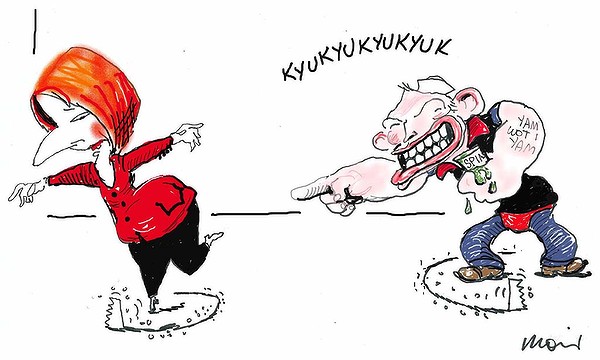
Another irony is that the success Gillard is having in passing legislation through the Parliament---eg., the private health rebate means test legislation and a bill to abolish the Australian building and construction industry court---is increasing the despair about her leadership.
Those with an eye to the marketing aspect of politics would say that the Gillard Government cannot communicate--ie., sell---its reform successes, or even the good news on the economy. The Gillard Government is generally seen as an anti-business and directionless government. It is weak.
Philip Lowe in The Forces Shaping the Economy Over 2012 describes the positive spill-over effects of the mining boom thus:
The indirect effects come through a variety of channels. Day to day, they can be hard to see but they do percolate through the economy. In effect, there is a chain that links the investment boom in the Pilbara and in Queensland to the increase in spending at cafés and restaurants in Melbourne and Sydney. This chain starts with the high terms of trade that has pushed up the Australian dollar. In turn, the high dollar has meant that the prices that Australians pay for many manufactured goods are, on average, no higher than they were a decade ago, despite average household incomes having increased by more than 60 per cent over this period. The stable prices for many goods, combined with strong disposable income growth means there is more disposable income to be spent on services in the cities and towns far from where the resources boom is taking place. As I said, this chain can be hard to see, but it is real, and it is one of the factors that have had a material effect on the Australian economy over recent years.
At the same time, the high exchange rate is having a contractionary effect on other parts of the economy, as it reduces the international competitiveness of industries such as the manufacturing, tourism and education sectors, some parts of the agriculture sector and in some business services sectors.
So we have countervailing expansionary and contractionary economic tendencies ---an economy in structural transition. Lowe concludes his speech thus:
...the Australian economy started 2012 in relatively good shape. Growth has been around trend and inflation is consistent with the target, and there are reasonable prospects for this to continue. We also have much more flexibility to deal with unfolding events than almost any other developed economy.
This kind of analysis has little to no effect on the public mood of despair. The despair narrative sees Australia in decline. It's all gloom and doom. This public mood accepts that economic doom and gloom makes sense, and it's insecurities means that it buys the Coalition's calculated rhetoric that the economic decline it talks up can only be reversed by the politics of austerity---savage spending cuts.
Posted by Gary Sauer-Thompson at 8:40 AM | Comments (10) | TrackBack
February 16, 2012
King Coal not interested in going green
Recall that in 2008, Kevin Rudd, the Australian Prime Minister created a new body to lead the way: the Global CCS Institute. Its brief was to get the industry moving by assisting projects and bridging knowledge gaps. It was cashed up, with $100 million a year in federal seed funding.
The dream was "clean coal"; even though it is widely known that the carbon capture and storage technology would not be commercially viable for at least another two decades. Judging from this report the reality of King Coal going green is that almost every major carbon capture and storage project around the world that has been started in the last few years has either been delayed, stopped or cancelled outright.
 Gary Sauer-Thompson, coal slagheap, Zeehan, Tasmania, 2011
Moreover, it would appear that the coal industry believes it has no obligation to increase its contribution to funding the development of the only technology that it says would appear capable of guaranteeing its future.The coal industry despite its near $1 trillion of annual global revenues, chooses to invest less than one tenth of one per cent in the technology that could best secure the place of coal in a low-carbon economy.
King coal is extending its kingdom. Thanks to coal, the world’s economy is becoming more carbon intensive because coal remains the world’s cheapest fuel for electricity generation and industrial heat and power.
Proponents say driving up the cost of coal generation will push utilities to seek out cleaner alternatives. It should stimulate a boom in construction of gas-fired plants, given the huge new supplies of shale gas unlocked by the combination of deep horizontal drilling and hydraulic fracturing, or fracking. Hence the use of a market mechanism – the emissions trading scheme – to curtail emissions-intensive industrial developments.
“Clean coal” is a clever piece of sophistry by Big Coal. It doesn't look likely that the coal industry will scrap its smaller and older plants.They are more interested in building new coal-fuelled power plant for the Latrobe Valley. Coal mines are expanding --eg.,the proposed Wandoan coal mine in the Queensland, the coal state) principally to service the export market in India and China. So the coal rush rolls on, with no one really challenging the legitimacy of coalmining in the face of climate change.
The corporate spin is that coal is meeting a demand that continues to expand, regardless of black lungs, methane leaks, global warming, and the growth of renewables and that humankind will benefit more from cheap and abundant energy. Coal is the backbone of reliable, low-cost power.
However, the health and environmental externalities of coal combustion are not considered. These are some of the hidden costs of coal.
Posted by Gary Sauer-Thompson at 12:43 PM | Comments (4) | TrackBack
February 15, 2012
junk political theatre
I've been watching Question Time in the House of Representatives this week. It's been bad---real bad. I know that Question Time is political theatre designed for the Canberra media galley, but the theatre this week has been low grade junk. It is much worse than Moir's representation of politicians as clowns in a pantomime whose inept performance is sad rather than funny:

It's cartoonish politics. In Question Time the Coalition claimed that the government was going to kill the aluminium industry with its carbon tax whilst the government claimed that the opposition didn’t care about manufacturing jobs except to exploit their loss politically. On and on they went oblivious to how they sounded like schoolyard idiots playing nasty, petty games.
Oh, we've revisited the ABC's Four Corners trashy journalism on the Rudd assassination in June 2010, and the media's misrepresentations of the recent tent embassy event.
As Bernard Keane points out in Crikey with respect to the Gillard Government:
we’re at the same stage as previous leaders reached before their demise, when even the most trivial things are attributed significance. Get confused over your Roves, or be upstaged by your opponent who speaks Mandarin, or comment on a junior reporter’s outfit, and it dominates the media cycle, drowning out everything else. A politician needs clear air to communicate, and leaders die when the media cuts it off.
This is at a time when the Gillard Government passed the legislation to means test the private health insurance rebate ---a major reform that helps to reduce the blow out in the health budget in the near future. That was pretty much downplayed, even though some of the most difficult choices in the near future are likely to be about how to manage the scale of health and pension costs associated with ageing.
Parliament is not a clearing house of ideas. It is a hothouse increasingly divorced from the everyday life that citizens live in their daily routines. What is "debated" bears little connection to our daily life and is becoming marginal to it.
The Canberra media gallery just see the decline of the Gillard Government and the end game of Gillard's leadership and delight in being players stirring the plot. What they ignore is Parliament being trashed by the junk political theatre and the slow, steady collapse of its political authority.
Posted by Gary Sauer-Thompson at 4:44 PM | Comments (21) | TrackBack
February 14, 2012
policy contradictions
In his Labor's Policy Confusion in the Australian Financial Review Luke Malpass argues that the current situation of Alcoa (reviewing the viability of its Point Henry smelter) highlights the divisions within the Labor Government.
Last week the plight of Alcoa highlighted the mutual incompatibility of new Labor and old Labor. One Labor Party is trying to save jobs and manufacturing in Australia, and the other is enacting a carbon tax that is designed, over time, to destroy many of these jobs ... Prime Minister Julia Gillard’s “new economy” of green jobs will supersede the “old economy” of presumably dirty jobs.
His argument is that over the medium term, the two policy objectives – loosely defined as jobs and carbon reduction – are fundamentally in conflict. Whilst the government claims it is in the Hawke/Keating tradition of reform, trade policy aside, its policy settings look like a mixture of 1970s fortress Australia remedies at one end, and postmodern green fixes at the other, with Hawke and Keating nowhere to be seen.

Malpass, who is a Policy Analyst with the New Zealand policy unit at The Centre for Independent Studies, interprets this to be a confusion about ends and means. The government has conflicting objectives, and employs means that work against each other. The so-called new economy cannot work without an artificial price to see out the old, and the old economy is being propped up and encouraged through subsidies and “transitional assistance”.
Malpass is not a free market economist who denies the existence of market failure. He is opposed to Australia's emissions trading scheme--Australia should reconsider its ill-fated scheme--- because he judges it to be poor policy. He is in favour of an emissions tax that could be linked to corporate tax cuts.
What he overlooks with Alcoa's current situation is that the Point Henry operations is caused by a high dollar and falling prices for aluminum. He also ignores the corporate welfare--the huge subsidies--- given to this multinational firm by state and federal government have been there from the beginning. It is estimated that Alcoa Australia has received a total of $4.5 billion in subsidies for its plants at Point Henry and Portland.
The old economy has been propped up from the very beginning--and not just by Labor Governments. The industrial policy of the newly federated nation state was to use the protectionist recipes of the mercantilists to industrialize and to defend its defend the nascent manufacturing industries against British and American predominance.
Manufacturing is now in long term decline as Australia goes through long term structural change driven by the global economy. It is an economy in transition. The current electricity subsidy arrangements are coming to an end in 2014. There are no reasons why aluminium smelting should continue in Victoria. It is not part of the new economy and it is definitely not clean and green. The workers in the old smelter plant---the 30 year old Point Henry smelter is out of date and inefficient---should be assisted in the processes of retraining and job search.
Posted by Gary Sauer-Thompson at 7:22 AM | Comments (9) | TrackBack
February 12, 2012
poor Greece
Poor Greece. The imposed harsh austerity--- wage and pension cuts, tax rises and cost-cutting reforms--- is pushing Greece towards economic and rebellion and a trajectory to collapse. Greece is smouldering.
Without the new bailout, Greece will be unable to redeem more than €14bn of debt on 20 March, leaving the country in sovereign default and ushering in an even bigger crisis in the eurozone's distressed periphery. Default on its debt next month may well mean that Greece would be forced out of the euro.
The price of the "troika" of European Commission, ECB, and IMF officials €130bn rescue package includes €300m in pension cuts, an additional cut of 150,000 government jobs by 2015 and a 22% reduction in the minimum wage from about €750 a month. The bailout now on the table also involves a partial default to private sector creditors such as banks. The bond market investors take a haircut.
 Martin Rowson, Greek crisis
The aim of the second Greek bailout in two years is to cut the country's debt from 160% of gross domestic product now to 120% by 2020. That still amounts to insolvency. A debt level of 60-80 per cent of GDP by 2020 – is probably the most that a weak economy like Greece could cope with. Greece's hands are tied, since it cannot devalue its currency because it uses the euro.
As there is no mechanism to allow growth, how can the Greeks service their debt, even with the reduced debt burden? The deficit reduction won’t come when you deflate a rapidly declining economy into the ground. Nor is it simply a loss of wealth and income or lesser income/social mobility. It also means a health care crisis: severe cutbacks in hospital staffing, which in turn means greater infections in hospitals and more people dying in hospitals. Third world status is the result of the endless cycle of austerity and bailouts designed to salvage the debt-ladened country.
Greece will not be able to squeeze more revenue out of an economy that is in its fourth year of recession. The problem for Greece with respect to economic growth is that the country doesn’t make a lot of products to export It makes feta cheese and olive oil, and it has tourism. So it needs to devalue--become much cheaper than than Spain, Italy and Portugal. It can do this if it leaves the euro and go back to its local currency.
The problem is that whilst Greece is teetering on the edge of economic collapse it is also on the brink of becoming ungovernable and its institutions barely functioning. The central government is not capable of designing and implementing the growth-boosting reforms that Greece desperately needs. Its public administration is dysfunctional.
Posted by Gary Sauer-Thompson at 9:58 PM | Comments (9) | TrackBack
February 10, 2012
big energy
Ellen Fanning has an interesting and informative article on Australia's surging power bills in The Global Mail. It is entitled The Hidden Cost of Infinite Energy and in part one she argues that the increasing costs come primarily from cost of upgrading the network to meet growing peak demand, for air conditioning and other energy hungry appliances:
Now more than 70 per cent of Australian households have air conditioning, so suddenly we need an electricity system that can cope when everyone turns on those air conditioners at once on a sweltering summer afternoon in the suburbs — without turning anything else off. It is called peak load. And it happens a handful of times each summer — sometimes for only 40 hours a year in all — mostly between the hours of about 2 and 8pm when Australians arrive home on one of those 35-plus-degrees days.
What that means is that the bulk of a customer’s electricity bill is not the actual cost of generating however much electricity they use. It is the cost of shifting the electrons through the grid, down the poles and wires to their home from the coal-fired power station.
What is also pointed out is that big energy makes money out of consumers using more power: the retailers make money by selling more electricity, the generators make money by selling more power… and the electricity networks make money from every kilowatt hour that goes through their network.
In the second part of the article Fanning highlights the inefficiency of the electricity grid caused by generating electricity hundreds of kilometres from where it is used. You end up with less than 30 per cent of the primary energy generated at the power station. Most of the electricity is generated is lost. Yet maintaining the long-distance network of poles, wires, cables and substations needed to get the electricity to the cities is very expensive.
The way to address this is increased energy efficiency in the premises and to allow premises--households, industries, rural communities, universities, hospitals, sporting arenas or convention centres to supply power to the national electricity grid from their renewable resources or tri-generation systems.
Posted by Gary Sauer-Thompson at 2:20 PM | TrackBack
February 9, 2012
reshaping capitalism
The overarching theme of the 2012 World Economic Forum in Davos, which has just ended was The Great Transformation: Shaping New Models. Last week, in the run-up to the World Economic Forum Martin Wolf of the Financial Times launched an essay on “Seven ways to fix our system’s flaws”. Wolf argued that the system is already in crisis and requires a new direction and new wave of sustainable investment.
He lists problems with pro-cyclicality in financial markets as well as regulation, rising inequality across the world, the incentives to manipulate and loot under current corporate governance regimes, the need for taxation in order to redistribute, to invest, to employ and provide for (global) public goods. He also seeks to protect politics from being purchased by private interests by providing more direct public financing to political actors and parties.
The Great Transfomation refers to Karl Polanyi's book on rise of the market economy. Polanyi argued that the development of the modern state went hand in hand with the development of modern market economies and that these two changes were inexorably linked in history. His reasoning for this was that the powerful modern state was needed to push changes in social structure that allowed for a competitive capitalist economy, and that a capitalist economy required a strong state to mitigate its harsher effects.
For Polanyi, these changes implied the destruction of the basic social order that had existed throughout all earlier history, which is why he emphasized the greatness of the transformation.
A similar transformation today, given the urgency of the climate crisis, would be the shift to a low carbon economy in which there is a surge of economic growth through a transition to clean energy. This is a shift away from the western model of capitalism---neo-liberal capitalism that gives primacy to the market--- which assumes that nature is an infinite source of resources and an infinite sink for wastes, and that the whole economic growth machine would be powered by fossil fuels forever. It is a model that fosters the privatization of profits and the socialization of losses.
Standing in the way of this transformation are the fossil-fuel companies (the coal and oil industries) who defend their threatened interests with a campaign of heavily funded denialism, and record campaign contributions and their association with the libertarian think tanks in manufacturing doubt about science. In the US they have been able to keep at bay even the tamest efforts at reining in greenhouse carbon emissions.
Their disinformation campaign --climate change is natural not man made----has been very successful. The media accord the same weight to the "skeptics" (eg.,Christopher Monckton, Bob Carter) as it does to mainstream scientists. This is done in the name of journalistic balance---- different sides were given equal treatment---when the reality is that media cannot be bothered to inform themselves about the science through reviewing the literature. The media's construction of a raging scientific debate when there wasn't one indicates the negligence of the mainstream media. They were trading in illusions.
Posted by Gary Sauer-Thompson at 4:16 PM | Comments (3) | TrackBack
February 8, 2012
means testing private health insurance
The government’s bill to means test private health insurance rebates for high-income earners is scheduled for debate on Thursday in the House of Representatives. Currently, anyone who takes out private health insurance receives a 30% government refund on their premiums, courtesy of the Howard Government. The Liberals finally came to accept Medicare but then used a succession of carrots and sticks to get people back into private health insurance.
 Diane Cordell
Under Labor's proposed scheme, singles with health insurance earning more than $80,000 and couples earning more than $160,000 would receive a rebate of 10% to 20%. Singles earning $124,000 and couples on $248,000 would no longer be eligible. The bill includes a penalty for higher income earners who don’t take out private health insurance – the Medicare levy surcharge.
These measure are part of Labor's agenda to roll back some of the middle-class welfare that Howard introduced to health and social security payments.
However, these measure have been knocked back by the Senate, mainly because of the Liberal Party who just love a big welfare state in spite of the small government rhetoric.
They also love the idea means testing welfare payments (welfare should be a safety net) but are opposed to means testing the private health insurance rebate. Hence they support the big social democratic welfare state they say they are deeply opposed to.
The proposals have the benefit of removing a glaring inequity in our present arrangements, which direct subsidies disproportionately to the well-off and underpin a middle class entitlement culture. Class war say the Liberals, even though the money saved could, and should, be used to improve public health services.
The policy issue here is that if we accept that private hospitals serve an important function, then they should be funded by means other than through private Insurance. Public funds for private hospitals should be paid directly to them, rather than being churned through private insurance where around 15 percent of that money goes in administration and profits. That would also be fairer to those Australians who pay for private hospital care from their own pockets, without being dependent on insurance.
Secondly, private health insurance is an expensive and clumsy way to do what the tax system and Medicare do so much better — that is to distribute funds to those who need health care.
Posted by Gary Sauer-Thompson at 3:50 PM | Comments (7) | TrackBack
February 7, 2012
why South Australia matters
Greg Craven opens his recent Keep the constitutional change simple in the AFR with this witty rhetoric:
There used to be only three certainties in life: death, taxes and the irrelevance of South Australia. Now we have two more. The first is that the current initiative to recognise indigenous people in the Constitution is doomed to failure. The second is that the position can be retrieved, but only if we act quickly to produce a modest, precise proposal.
Yep, WA and Queensland are the dynamic mining states whose resources will drive economic growth in Australia and ensure its future prosperity. SA, in comparison is the rustbucket state relying on handouts from the (socialist) federal government. These handouts ultimately come from the wealth generated by the mining boom.
 David Rowe, Carbon Tax, AFR
However, from another perspective, that of making a transformation in the way energy is produced SA does matter. It has a high profile in terms of clean tech--- especially wind. The amount of wind power that is fed into its electricity systems in South Australia is 22 per cent wind, one of the highest in the world. SA represents the future.
The recent Grattan study---No easy choices: which way to Australia's energy future--- says that Australia is capable of substantially expanding the amount of wind power that is fed into its electricity systems. Wind power could provide more than 20 per cent of Australia energy needs (it currently provides just 2 per cent) and that it is the only low emissions power technology that is ready for rapid scale up in a short period of time.
What is holding back this development is the national electricity grid --it needs to be improved for remote sites and interstate interconnectors built for electricity to flow to the eastern states. Existing transmission networks and network regulation are designed around the assumption of centralised ‘baseload’ power supply and are not well suited to remote or distributed generation.
Posted by Gary Sauer-Thompson at 11:57 AM | TrackBack
February 6, 2012
Australia: generating electricity with near-zero emissions?
The Grattan Institutes recent report on renewable energy--No easy choices: which way to Australia’s energy future? --- makes a familiar argument about how our energy is produced in a world climate change and the need for an energy transition.
The age of cheap oil and cheap coal is over and economic growth that increases GDP at the expense of our natural capital, is now “uneconomic growth”. The Australian economy is about to go through one of the most dramatic transformations since the industrial revolution. This will be driven by the need to act on climate change, energy security and resource scarcity.
The argument is that Australia must substantially and relatively quickly change the nature of its electricity supply. It must shift to clean-technologies that generate electricity with near-zero emissions, given that the Commonwealth’s goal is to reduce Australia’s greenhouse gas emissions to 80% below 2000 levels by 2050. The study says that these new, low-emission technologies are wind, solar PV, geothermal, nuclear, concentrating solar power, carbon capture and storage and bio- energy.
Some then say that technology will save the day. By this they mean that technological innovation will always extend resources and reduce prices through efficiency gains and substitution. It's the mastery of nature argument.
The Grattan study states that it is widely accepted that the federal government's emissions trading scheme will change the behaviour of Australian businesses, especially those in the energy sector. For instance, in the short-term, the scheme will make gas prices competitive with coal, and investment will shift accordingly. So an energy transition is under way. But gas will not deliver the emission reductions required and is at best a bridging technology.
However, it adds, what businesses will not do, under the current policy mix, is to invest in new, low-emission technologies – at least not to the degree which many hope and expect. As a result, Australia is at grave risk of not being able to meeting its carbon emission commitments by 2050 while at the same time keeping electricity affordable.
The report argues that any one of these technologies has the potential to be scaled up sufficiently to play a role in meeting Australia's energy needs. However, all face major obstacles to achieving their full potential, and none can deliver the bulk of Australia's needs alone. Despite current projections, it is possible that none of the technologies can produce power at a scale and at costs similar to today’s electricity.
In other words existing policies will not on their own produce the transformation in energy that we need.The carbon pricing scheme, while a good start, is not enough. So what is to be done? The report argues that:
Markets must be the primary mechanism by which Australia reduces its emissions.To ensure markets work properly, government must also remove barriers to deployment of several technologies, such as transmission connection hurdles and subsidies to incumbent technologies.
The current regulatory regime is designed to favour the incumbent gas and coal technologies; and these are supported by between $8 billion and $9 billion of annual subsidies. Imagine the resistance and opposition from the mining and coal interests and their allies to further government intervention to remove these subsidies.
If that is not enough, the report makes another point:
Yet even then, it remains unlikely that enough funds will be invested in the short term to give any of the low-carbon technologies a chance to deliver ... Governments should therefore support research and development in areas of national interest, and demonstration and early-stage deployment of a suite of technology options.
The battle lines over clean energy finance are being drawn up.
The Grattan report says that says regulatory reform is essential if the national electricity grid is to integrate sources such as solar, wind and geothermal, and not merely serve to protect incumbent gas and coal generation. Right now, the grid is designed essentially to connect major coal basics to capital cities. It needs to evolve to include wind and solar and other sources, and it needs to get smarter--- ie., substantial new transmission capacity is necessary including greater interconnection capacity between state regions to cater for variability in wind and solar.
Australia has just taken a few hesitant steps down the path of energy transformation, and it's political institutions have been convulsed by the effort. Imagine the effect the necessary policy interventions beyond the emissions trading scheme is going to have on them. Imagine the resistance and opposition to further intervention to support renewable energy from the mining and coal interests and their allies. This energy transformation is going to be a long and bitter battle.
Posted by Gary Sauer-Thompson at 3:23 PM | Comments (4) | TrackBack
February 4, 2012
Canberra gaze: summer fever
I quickly glanced through The Australian this morning whilst having coffee before doing the shopping at the Central Market. It was full of commentary about the leadership tensions in federal Labor. The message was pretty simple. ALP is in turmoil. The knives are out. Gillard is toast.
The Canberra media gallery loves this stuff. This is real politics, not that vague, wishy washy policy stuff. The political journalists are counting the numbers for Gillard, Rudd and the undecideds--those who have quietly withdrawn from Gillard’s camp but can’t commit themselves to Rudd. Labor is now the main story, and the commentary is about the shadow plays within the shadow plays based on the usual informed sources.

I didn't bother reading the commentary. There was no need to. The headlines and cartoons said enough. The airwaves will be filled with ever more speculation about when the factional bosses will cut off Gillard's head when Parliament resumes next week. On their interpretation the power struggle has come to paralyze national politics.
If Rudd returns to power that means an early election to hold the ALP in line and Labor's major reforms, including the carbon tax, mining tax and the national broadband network will be flushed down the plughole. That's great news for Australian conservatives and the Coalition is already talking post-Gillard strategy. Their assumptions are that Gillard will not survive much longer as Labor leader and Rudd will replace her.
If things are as grim as portrayed by the press gallery's doomsaying fever, then Gillard should push through as much of her substantive reform agenda in 2012 as she can, given that the Gillard Govt is running out of time to implement its reforms. The neo-liberals are just inching to get back into power to start the slash and burn required to cut back big government (ie., the environmental state) and allow things to return to normal (the resentful mining industry runs public policy on iron ore, coal and the environment.)
Posted by Gary Sauer-Thompson at 1:28 PM | Comments (19) | TrackBack
February 2, 2012
it's more than lazy journalism
Wilcox's cartoon leaves out an important player in her representation of the tent embassy protest event in Canberra. Where is the media? More specifically, what is not represented in the cartoon is the Canberra media gallery and the way their political journalism constructs and distorts the political event.

It's yet another indication how those who work in the media have very little critical awareness of the media as a player in political life. They cannot see beyond a Gina Rinehart buying into Fairfax to create a bigger platform for her political views.
The standard response to the criticism that the media consistently misrepresents and distorts political events is that this lazy journalism arises because of the less profitable (than 20 years ago) newspapers trying to make the transition to the digital world. This time and money pressure argument states that journalists don't have time to do their job properly. Not only has demand for content increased with the emergence of the internet, but the same digital technology has undermined the newspaper's ability to adequately fund the profession.
This argument is correct in so far as it goes. The journalists don't have much time to fact-check the politician's spin or to assess the claims they make in their speeches. So we do have lazy journalism.
However, time and money pressure argument misses the main point of the criticism. The media are political players with their own agenda and they are spinning just like the politicians. They both spin together and the spin of both often reinforces each other--as exemplified by the recent tent-embassy protests in Canberra.
Let's face it, journalists are ideologues-- their job is to misrepresent and distort reality to further the political and economic interests of the media organization. If they don't they are out of a job.
Posted by Gary Sauer-Thompson at 7:31 AM | Comments (3) | TrackBack
February 1, 2012
the new Abbott?
Moir's cartoon depicts the highly successful negative strategy adopted by Tony Abbott to remove the minority Gillard Govt from power. One consequence, though, is that Abbott is commonly seen as a boofhead and headkicker who opposes everything the Gillard Government does. He just pounds away.

In his "My Plan for a Strong Economy and a Stronger Australia", speech to the National Press Club Abbott endeavours to present a more positive persona. He begins by saying that Labor is hapless, lazy, complacent and hopeless at everything but deception and dirty tricks.
Abbott's message is that Labor trashes the economy, it shouldn't be trusted to remain in power, and it is only interested in its own political survival. Abbott is no one trick pony though. He has positive message for voters:
The only foundation for a successful country is a strong economy. The only way to take the pressure off family budgets, to increase job opportunities, and to have the better services and infrastructure that every Australian wants is to build a stronger economy....My vision for Australia is to restore hope, reward and opportunity by delivering lower taxes, better services, more opportunities for work and stronger borders....At the heart of our plan for a stronger economy is getting government spending down and productivity up so that borrowing reduces, the pressure on interest rates comes off, and taxes can responsibly come down.
His plan for a stronger economy is to scrap unnecessary taxes, cut government spending and reduce the red tape burden on business. So it will be cutting and cutting to get the budget into surplus, beating up on the public sector and all things governmental (except the military) and doing so in the context of the widespread recession in the US and Europe. The Right does this nonstop, since all their talking points disparage the role of an oversized federal government: government is nothing but oversized, wasteful, bureaucratic, corrupt, and oppressive.
Contradictions run through Abbott's speech. He favours economic responsibility and a quick return to a surplus budget on one hand, but expensive new social benefits on the other, such as a paid parental leave scheme, dental treatment on the Medicare schedule at a cost of $4 billion a year, and a disability insurance scheme for another $6 billion. These are not Magic Pudding promises since the contradiction is resolved by saying that once the budget is strongly back in surplus, then the government can provide the additional services .
Abbott says that he favours a capable manufacturing sector, a growing knowledge economy and a sophisticated services sector as well as strong resources and agricultural industries, but the national broadband network will be dumped and better broadband will once again be delivered through market competition, just like the old days. The inference here is that the Coalition's emphasis will be on Quarry Australia not on a knowledge economy, since funding for the National Broadband Network (NBN) and a number of other tech projects would be redirected to building roads and tax cuts.
Abbott's emphasis is on a strong, prosperous economy moving from one state of equilibrium to another that will be delivered through small government, low taxes and individual freedom. That means that the end of a carbon emissions trading scheme since Labor’s "carbon tax" is just socialism masquerading as environmentalism. The best approach to greening the economy is not the market, but big subsidies ($10 billion) to the agricultural industries and industry to reinforce what businesses are already doing plus volunteerism and “self-organization”
Abbott says nothing about how the prospects for future economic growth rest on the ability of governments to wean societies off fossil fuels; or the need for big government to deal with big storms and floods caused by an unraveling climate system.
Posted by Gary Sauer-Thompson at 7:02 AM | Comments (11) | TrackBack