« February 2012 | Main | April 2012 »
March 31, 2012
Labor's Follies
In The Long Goodbye: Explaining Gillard’s Collapse in The Monthly Robert Manne argues that the strange and rather sudden collapse of the Gillard Labor government is grounded in a series of mistakes and miscalculations, beginning with Rudd in 2008, spiralling out of control in 2010, but only becoming irreversible and lethal with Gillard around the middle of 2011:
Federal Labor's woes rest on a string of particular, mostly avoidable, tightly interconnected, strategic blunders. As a consequence of these blunders, Tony Abbott now seems certain to be prime minister before the end of 2013
The grave structural weaknesses within the contemporary federal Labor Party and the deep factors threatening the future of all parties within the social-democratic tradition are not responsible for the federal Labor government’s present discontents.

There's nothing about the way that focus group research, polling, messaging and spin has colonized politics.
Posted by Gary Sauer-Thompson at 9:02 PM | Comments (3) | TrackBack
March 27, 2012
political speculation
Will this happen to federal Labor in 2013?
 David Rowe
The political fallout suggests that it sure doesn't look good for federal Labor.
Many commentators on the conservative side of politics seem to think so. Labor's brand has been trashed and it cannot be rebuilt. It's all done and dusted and there is little more to say other than the storms are building up.
However, George Megalogenis in The Australian doesn't seem to think so. His argument in Federal State Divide Offers Gillard Some Hope is that:
predictions of a federal wipeout for Labor in the rugby league states are premature.The evidence to date is that voters distinguish between federal and state in numbers large enough to deliver a split ticket, where the Coalition thrives in one jurisdiction while faltering in another.....It may be a long shot for the Gillard government, history suggests the next federal election is still winnable.
It's now a case of holding your political nerve in the context of poor polls, a very low primary vote, the unpopularity of Gillard in Queensland, the use of focus groups and the obsessive reliance on polling.
Labor is still a party bogged down in the past, still a captive of its shrinking trade union base and still poll-driven apparatchiks whose overwhelming priority is hanging on to power.That is not going to change in the next 18 months.
Posted by Gary Sauer-Thompson at 7:43 PM | Comments (6) | TrackBack
March 25, 2012
and so it ends
Labor now barely exists as a political force in Queensland after the state election. It's the end of an era.It has so few seats---seven or is it six?---that it cannot even be an effective opposition to the triumphant 'can do' Campbell Newman LNP.

The average swing against Labor of 15.8 per cent and the loss of 44 seats will be difficult for the ALP to comprehend. Labor's primary vote across the state was around 26.5 per cent. The defeat claimed most of Labor’s front-bench, as well as the sitting Premier herself.
The constellation of rural and regional conservatives and urban Liberal Party voters is now the dominant majority in Queensland politics. Within that political constellation the urban Liberal Party is now dominate.
You would have to say that Labor has big problems on its hands. It was such a massacre that it could be 12 years before Queensland Labor becomes an effective political opposition. With no upper house Campbell Newman has a blank cheque to do what he likes.
Update
In New Matilda Ben Eltham refers to Queensland Labor's heritage. He says that:
Compared to the Bjelke-Peterson government, therefore, Labor has governed substantially better and more competently, dragging the state into the 21st century. South-east Queensland, in particular, became a more normal place, more like the rest of Australia, with normal problems like traffic congestion, rather than special problems like a compromised police force. In the end, it started to experience more normal politics, too, with voters gradually forgetting the Bjelke-Peterson years, and focusing instead on Labor’s shortcomings.
How much will the conservatives wind the clock back? Will they try?
Posted by Gary Sauer-Thompson at 9:34 PM | Comments (20) | TrackBack
March 23, 2012
dump the subsidies to the big miners
So Holden will only stay in Australia and produce cars if it is subsidized by the federal and state governments. These days the subsidy is badged as co-investment---a strategic co-investment, not a handout says the PM.

From what I can gather manufacturing is being hammered by the high dollar, and Holden General Motors would have left town without government subsidy. Its a strange old world isn't it when governments pay the big miners making super profits from the mining boom a diesel fuel tax rebate that now costs the federal government about $2 billion a year.
Pulling the plug on that rebate to the big miners--not just tighten it---would be a good way to address the ongoing problem with revenue shortfalls and help bring the budget back to surplus. It represents spending cut which is what will be needed to get the budget back to surplus.
In The Australian Judith Sloan critiques the propping up of the car industry from a neo-liberal perspective. She says:
let the car firms get into shape and, if they want to quit Australia, let this happen. We can then devote resources to assisting the displaced workers. With unemployment close to 5 per cent and structural adjustment creating jobs in other sectors, the timing is close to perfect. Alas, the government has come to a fork in the road and taken the wrong path. By propping up an uncompetitive industry and sucking resources from elsewhere, we are all poorer and less equipped to meet future challenges.
She doesn't mention the subsidies to the miners or the aluminum or coal industry. Presumably these are competitive industries, whilst the car industry isn't? So the issue isn't government intervention per se that is the problem----it's the protection of uncompetitive industries.
Posted by Gary Sauer-Thompson at 2:24 PM | Comments (5) | TrackBack
March 21, 2012
Australian forest industry
Tasmania is still caught up in the conflict over logging native forests for export woodchip, even though Gunns is on its last legs, half of Australia's chip exports now are plantation-based, and the native forest industry is on life support through government subsidy.
Lyndon Schneiders in The Age reminds us that it was in the 1960s and '70s that export wood chipping of native forests became entrenched:
Export wood chipping was portrayed to sceptical Australians as a sensible way of finding a market for those parts of a logged tree that could not be processed by a sawmill. But within a few years wood chipping became the only economic reason for logging native forests. By the 1990s, millions of tonnes per year of native forest woodchips were exported as sawmills quietly closed across the country. Now, with changing market expectations, the world has lost its taste for woodchips from Australia's ancient forests.
Demand has dropped and the native forest industry is dying. Without considerable government input the forestry industry could not survive.The time is opportune for governments in Australia to shift virtually all of the wood production out of native forests and into the plantation area.
Judith Ajani says that commodity wood production becoming a part of agriculture would allow native forests are valued primarily for their contribution to biodiversity conservation, climate change mitigation and water conservation. She argues that the forestry industry:
should be a plantation-based industry. That’s where the industry is actually heading to. I mean it’s struggled, of course, to get there, but it is getting there. And if we overlay the plantation resource with a processing [industry] policy which we all know has got the wealth and the jobs, and much more in the processing levels than exporting raw materials. Then we have got the potential to have a very vibrant and very prosperous and jobs-rich forestry industry.
I'm not sure what has happened to the ‘peace deal’ between the forestry industry and the environmental groups over 430,000 hectares of old growth native forest in Tasmania.
Posted by Gary Sauer-Thompson at 9:28 AM | Comments (4) | TrackBack
March 20, 2012
a different narrative
The Gillard Government is hardly adrift or marooned in the sense of its capacity to pass legislation. It is actually is being very successful at doing this. Gillard has now passed the second of the three agenda items she promised to fix when she assumed the prime ministership nearly two years ago.
Yet the tendency in the mainstream media is interpret the country through our leaders. The argument---if there is one ---goes something like this. Gillard is unliked by ordinary Australians. She has a credibility problem. Her speeches are flat and dull. Therefore Labor is increasingly on the nose. Most voters oppose key policies. That is why the Opposition would win an election hands down. Australia is a conservative nation.
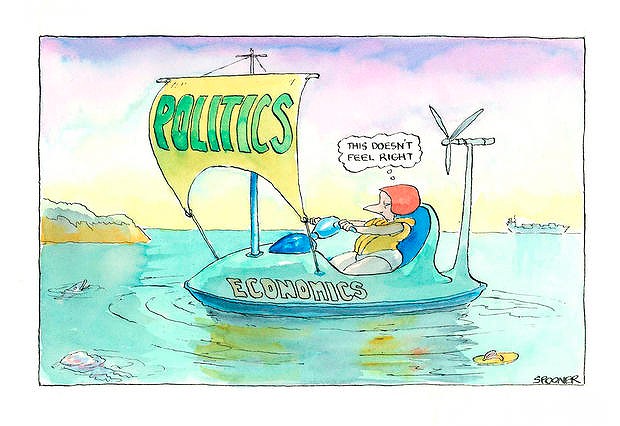
The hard reality is that Australia's economic fortunes and well being primarily depend on the sustained demand for commodities from the major five Asian countries (China, India, Indonesia, Japan and Korea) not on Gillard's personality or lack of it.
Unless there is continual economic growth in the economies of the US and the developed world and therefore the Asian countries, then the demand for Australian mineral resources will fall. Australia's economic growth will then flatten.
Posted by Gary Sauer-Thompson at 9:12 PM | Comments (14) | TrackBack
March 19, 2012
out of sync
I've been photographing in and around Queenstown Tasmania for the past week or so and the postings on junk code have been non-existent. As I haven't had time to read the newspapers online because I've mostly been out on location, I'm kinda out of touch with the various events in the Canberra beltway.

Queenstown, and the south-west of Tasmania in general, is still about mining. Development is mining. Despite the growing tourism, the world from Queenstown is seen through the eyes of the mining industry. Hence the mining tax becoming law is what is significant.
It is taken for granted that the mineral resources rent tax would dent investment in resource development and damage the mining industry. What is is interesting is that the resources boom appears to have little economic impact on Queenstown---the wealth is not being spread around.
The town remains depressed. It desperately needs investment in regional development and skills. There is little investment coming from the state government. So the way the proceeds from minerals resource rent tax (MRRT) will be used with respect to infrastructure investment is crucially important.
Posted by Gary Sauer-Thompson at 9:03 AM | Comments (8) | TrackBack
March 14, 2012
US: Romney falters
The conservative Republican base (evangelical Christians, blue collar and middle-class voters, and rural dwellers) sure doesn't want Mitt Romney to be their Presidential candidateto take on Barak Obama They much prefer Rick Santorum, even though Romney's grip on the GOP nomination is much more firm and more electable than Santorum.
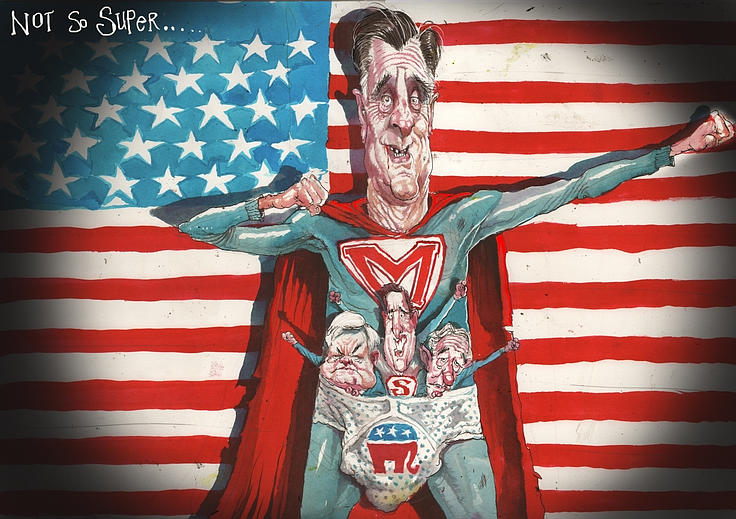
On the other hand Santorum knocked off Newt Gingrich who had pitched himself as the South’s candidate. The big question is: will the anti-Romney conservative base ever united behind a single candidate? This is now Santorum.
Posted by Gary Sauer-Thompson at 10:18 PM | Comments (4) | TrackBack
March 13, 2012
taxing the miners
The mining magnates or the chief executives in the mining industry sure complain a lot as they go on about an outrageous assault on their industry by the state.The way they act and speak its almost as if they own all the gold, iron ore, coal and uranium that is in the ground and the state is a mere rentier.

The reality was stated clearly by Ken Henry's 2010 tax report:
The community, through the Australian and state governments, owns rights to Australia's non-renewable resources and should seek an appropriate return from allowing private firms to exploit these resources.....'Current charging arrangements fail to collect a sufficient return for the community because they are unresponsive to changes in profits.
The Liberal/National Coalition has fallen in line with the Big Miners---ya gotta ease the tax burden on the miners because they are carrying the country on their back and the load sure is real heavy. Or something like that.
What's even worse than their moaning and groaning is their charade about clean coal---its just a public relations tool to stop meaningful policies to reduce greenhouse gas emissions--- even though Australia’s land and oceans have continued to warm in response to rising CO2 emissions from the burning of fossil fuels.
The huge resources projects going ahead in Queensland and Western Australia are proving to to mean real pain ahead for the many workers and small businesses caught in the cross-fire of a soaring dollar and uncompetitive local industries.
Posted by Gary Sauer-Thompson at 12:37 PM | Comments (5) | TrackBack
March 11, 2012
the ADF's Skype sex scandal
It's good to see Stephen Smith, the Defence Minister, taking on the Australian Defence Force (ADF) hierarchy by standing up for Kate the woman whom two of her fellow students filmed her having consensual sex and then broadcasting it on Skype. Kate was then subject to abuse and vilification for going public about the incident.

Senior Defence officials are still circling their wagons to protect one of their own---Commodore Kafer, the commandant of ADFA, who allowed a separate disciplinary investigation into Kate to continue while her claims of sexual misconduct were investigated. The military bureaucracy seem incapable of dealing with the embedded sexism of the ADF. Their reflex reaction of this the culture is to close ranks against outsiders and civilian criticism. of its behaviour.
Kafer now presides over an academy which is still home to five of the six young men who allegedly took part in or watched the sexual encounter last year. The sixth male cadet has quit. Two of the six were charged and have pleaded not guilty. Kate remains in Defence but far from the academy, her career on hold.
Stephen Smith should be applauded for his efforts to modernise the obstinate culture of the Australian Defence Force that traditionally explained the sexual violence and misconduct towards woman as the conduct of a few bad apples, when it is the military culture that is the problem.
Posted by Gary Sauer-Thompson at 10:17 PM | Comments (3) | TrackBack
March 9, 2012
Australia: an independent foreign policy?
I've been on the road to Tasmania and experiencing poor connection from Telstra's mobile broadband on the journey. So I haven't had much chance to read the newspapers online or to post. I'm currently in Tunbridge, the service is barely okay (it's limited) and I'm able just able to post.
I'm just catching up with what has been happening since last Friday--eg., Gillard's cabinet reshuffle and Bob Carr becoming Foreign Minister. I see that Hugh White in The Age has nailed the core international relations issue for Australia:

White says:
The issue is how Australia positions itself between the United States and China as the strategic rivalry between them grows. Our biggest trading partner and Asia's leading power faces our traditional ally across a widening gulf of mutual antagonism....The orthodox view is that we have no choice but to support Washington in whatever policy it decides to adopt towards China. As an ally it is unthinkable for us to do anything else. We just hope that America gets it right, and that China either doesn't notice, or doesn't mind.
I've always suspected that to be the case: the little Americans rule Australia's foreign policy and Gillard was firmly in their camp. They advocated a policy of containment against China to ensure that the US remained the dominant power in the Asia-Pacific.
White comments that Carr rejects this view. He believes:
that America should turn away from Obama's containment policy and explore ways to accommodate China's ambitions where possible while constraining them where necessary. On this view, America should continue to play a central role in Asia, but not necessarily the dominant role. It should be willing to share power with China.
Does this imply that the Gillard Labor Government is going to shift to a more independent foreign policy? One that is critical of the old Pax Americana doctrine defended by the little Americans in Australia.
We can but hope.
Posted by Gary Sauer-Thompson at 10:22 AM | Comments (7) | TrackBack