« March 2012 | Main | May 2012 »
April 30, 2012
e-publishing
As we know the digital revolution is disrupting the music industry, photography, newspapers, television and book publishing. With respect to the latter the e-book looks to become the publishing market's primary engine. Authors will go digital-first and the most successful will land a traditional book deal with legacy publishers.
Jason Epstein, in an interesting post on the US government's Justice Department’s suit against Apple and several major book publishers for conspiring to fix retail prices of e-books on the New York Book Review blog, highlights how digital technology is a disruptive technology for book publishers. His succinct observation is that:
The revolutionary process by which all books, old and new, in all languages, will soon be available digitally, at practically no cost for storage and delivery, to a radically decentralized world-wide market at the click of a mouse is irreversible. The technologically obsolete system, in which physical inventory is stored in publishers’ warehouses and trucked to fixed retail locations, will sooner or later be replaced by the more efficient digital alternative.
Amazon is leading the way. It set out to charge $9.99 per e-book download, considerably less than it was paying publishers for their e-book inventory. Amazon’s own pricing strategy—which, unlike Apple’s and the publishers’--- is to sell e-books below cost to achieve market share and perhaps a monopoly.
Amazon’s competitors could not afford such a costly strategy. Publishers wanted to be able to set the price of titles for sale on the site, not Amazon and ensure DRM to prevent piracy. Publishers have countered Amazon’s pricing policy by adopting the agency pricing model, in which inventory is not sold to retailers, but consigned to them as agents who are compensated by a fee. The retailer in this model does not purchase content but acts only as the publishers’ representative, and so they has no right to determine the retail price.
The publishers’ move has triggered ongoing antitrust investigations in Europe and Washington, D.C., over whether book publishers and Apple illegally colluded to raise e-book prices. We have shifted t from the near-monopoly we had before the agency model, via the oligopoly we have today. What we don't have is a truly competitive retail market that also supports midlist sales.
There have been are lots casualties on the information highways, and no doubt, there will more. The traditional music industry, for instance, was devastated by the onslaught of the digital economy and also refused to adapt and went into all sorts of legal battles trying to protect their traditional market. Ultimately they failed. Apple then became one of the largest players in the digital music market with 220 million iTune users.
Posted by Gary Sauer-Thompson at 9:32 AM | TrackBack
April 28, 2012
"you scratch my back, I’ll scratch yours.”
This cartoon is pretty much how the sleaze looks to many with respect to corporate power media power and politicians. They are seen to be shamelessly courting" the media mogul and doing his biding-- the Minister for Murdoch-- as they duck the need for increased media regulation, more competition, and less concentrated media ownership.
In doing so they tacitly agree with Murdoch's reduction of democracy to different media in the deregulated market, and that the good life is one of the exercise of power for profit making in a commodified world.
The relationship between media and politicians was described by Murdoch at the Leveson Inquiry in terms of "you scratch my back, I’ll scratch yours.” Bite Murdoch and he'll put you down. He will also betray you when you are no longer useful to his commercial interests--as the News of the World journalists can attest.
 David Rowe
What stood out during Rupert and James Murdoch's performance at the Leveson Inquiry was their willingness to blame former executives for all the bad stuff. They--the News of the World's former legal manager Tom Crone and the then editor Colin Myler -- were engaged in a coverup of the phone-hacking saga. Rupert Murdoch even included his colleague of 50 years, Les Hinton - for (allegedly) keeping him in the dark about the phone-hacking saga.
In his listening to Rupert Murdoch at the Leveson Inquiry I came to realize that this more than crony capitalism. Murdoch's market philosophy holds that any imaginable object or transaction is, and should be, capable of being exchanged for measurable material gain. It draws no line between what is and what isn’t exchangeable, and what can’t be reduced to commodity terms.
This philosophy of the universal commodification of life has radically distorted how we view public services and education for the last few decades and, in the form of neo-liberalism, it has had a very easy run. It indicates that markets are corrosive of ethics to the extent that they define what is humanly desirable and good strictly in terms of material profit.
Posted by Gary Sauer-Thompson at 11:35 AM | Comments (8) | TrackBack
April 27, 2012
public debate in Australia
Over at The Conversation Stephen King interviews Graeme Samuel. The issues are wide ranging but they do centre around the quality of public debate in Australia. Samuel central argument is that that we are really looking at a very, very bad political debate. By bad he means:
bad as being highly populist, and therefore less principled. Less focused on fundamental principles, fundamental philosophy and fundamental attitudes about what’s in the public interest, rather than looking much more at what is popular in the short term. We’re seeing debates occurring now which are recidivist, in economic terms, in a way that I thought would never, ever occur...we are talking about issues such as subsidies for different areas in the manufacturing industry. We are seeing a potential re-examination of whether or not the value of the dollar ought to be manipulated. It’s called manipulation now, rather than “fixing” the exchange rate..We’re seeing issues about putting in place other forms of protection for different industries. Raising the spectre now of the Foreign Investment Review Board (FIRB) having lower thresholds at which it might examine acquisitions.
What we’re not seeing is the principled, analytical debate that we used to see in the years of Paul Keating, and in the early part of the Howard/Costello regime. So why is this the case?
Minority government. Majority government is one solution. The other is that business has to take up the debate.
I immediately thought of the media campaign of the Big Miners, the coal-fired power station owners, and the Murdoch media's relentless attacking a reforming government. Then I thought of '"feeding the chooks"---the lazy corporate journalism wherein the Canberra Press Gallery uses Tony Abbott's gibes deployed in his ceaseless criticism of the federal government, rather than thinking for themselves.
Posted by Gary Sauer-Thompson at 10:29 PM | TrackBack
April 26, 2012
the decline of liberal democracy
Harry Evans, the clerk of the Senate from 1988 to 2009, has an excellent interpretation of the importance of the Slipper affair in our political life. He puts it into the context of both major political parties being guilty of using the speakership as a place to park people to get them out of the way of the ministry, or to reward or buy them off – simply another job within the patronage of the party heavies, or worse, of the prime minister.
The result has been notoriously incompetent and biased speakers, who have seen their task as helping the government rather than the upholding of proper democratic processes of parliament. Anyone who watches question time in the House of Representatives would be aware of the problems caused by incompetent and biased speakers.
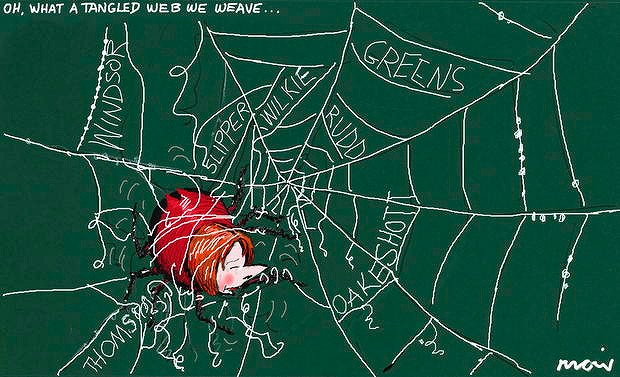
He connects this problem in the House of Representatives to the larger one of the decline of representative or liberal democracy. What Evans has in mind is not the way the democratic processes have been captured by the corporations; or the way that Murdoch's media empire can threaten to shape public opinion in order to persuade politicians so in awe of Murdoch that they leaped to accommodate him without him needing to ask out loud. They allowed him to circumvent the regulatory media law so that his empire could continue to expand.
Evans is focused on the degeneration or decay of the political institutions themselves. The problem he points out is that:
The House is seen as a low-quality debating panel controlled by the prime minister and its speaker as another government hack. There is very little public consciousness of the House as an institution separate from government, as a representative legislature and a control on government. Law-making is seen as something that governments do and lobbying as the way to influence the process. The House as such is not a player. This is a sorry situation for a basic institution of the country.
Those who want to reform the House usually aim to turn it into a true Parliament able to insist on accountability of government. Some minor steps were taken the Independents in their negotiations with the Gillard Labor to form government.
He adds that the next majority government is likely to return to business as usual. The speakership will be a government appointment and the old procedures, so favourable to the suppression of accountability, will be exploited to the full. The effect will be that public cynicism about government and politics will be reinforced; a cynicism we can add, that emerges from the cynical appeals by politicians to narrow self-interests, a bickering among narrow partisan forces; and the use of ideology, spin and symbolism rather than rational discourse as a means of influencing public opinion.
A majority government returning to business as usual means the dictatorship of the executive; one that has been captured by corporate interests that use their power to block reforms that go against their commercial interests. So we have the squeezing of discussion and openess, which are two aspect of the liberal form of democracy--the affairs of states are to be conducted on the basis of open discussion between proponents of competing ideas. The inference is that the unrestrained clash of opinion (competition) will produce harmony.
Posted by Gary Sauer-Thompson at 1:22 PM | Comments (1) | TrackBack
April 25, 2012
Leveson Inquiry: the Murdoch dump begins
The Leveson Inquiry appears to confirm what the critics of the Murdochs have often suspected: that they have exploited their position as newspaper owners to win secret favours from governments. Emails released by News Corp --- they were written by James Murdoch's chief lobbyist, Frédéric Michel--- appear to show that Jeremy Hunt, the culture secretary, and his office passed confidential and market-sensitive information to the Murdoch empire to support its takeover of BSkyB.
The emails show that News Corp expected Hunt to push for the BSkyB deal to be approved; that Hunt providing advice guidance and privileged access to News Corporation, thereby acting as a back channel for the Murdochs; and that Hunt saw his job to help the Murdochs to get their bid for BSkyB successfully past the official regulators.
 Martin Rowson
In The Guardian Nick Davies says that what is emerging is evidence suggesting a deal between the Conservative leadership and News Corp.
In its crudest form, the suggestion is that the Murdochs used the Sun to make sure that Gordon Brown was driven out of Downing Street so that the incoming Conservative government could deliver them a sequence of favours – a fair wind for them to take over BSkyB; the emasculation of the much resented Ofcom; and a severe funding cut to their primary broadcasting rival, the BBC.
It highlights how the political classes – from the time of the Thatcher administration, through the Blair government to the Cameron coalition – who have allowed News Corp to increase its hold on Britain's media estate.
The BSkyB deal was looked on rather skeptically by News Corp in New York, where the view was that it would tie up the lion's share of the company's cash far longer than was advisable. Therefore, the imperative for James Murdoch in London was to move this deal through the regulatory hurdles as fast as possible. Hunt set up a back channel to News Corp to facilitate this, and in doing so effectively acted for Murdoch's interests not the public interest.
As The Guardian editorial points out:
The meaning of "quasi-judicial" is simple enough. A public servant is required to behave like a judge – setting aside all personal prejudices and behaving with such transparency, candour and integrity that people can have total faith in his or her rulings. Judges don't book private meetings with one side in the cases they or their colleagues on the bench are hearing. They don't offer inside information, or appeal for private help in formulating their decisions or covertly demolishing the other side's arguments. They don't suggest PR strategies or brief one side what the other's been saying in confidence. They don't offer winked assurances that they share one party's aims or outcomes. They don't have private chats on their mobile phones to get round official scrutiny or slip confidential information through back channels. Any judge who behaved like that would not command public confidence and would be forced to resign.
In doing this Hunt had behaved in a manner that could not remotely be described as impartial or "quasi-judicial".
The Murdoch's in their anger at the Cameron Government for setting up the Leveson Inquiry into the phone hacking scandal at News of the World are dumping on the Cameron Government. This is being done under the guise of James Murdoch defending News Corporation's insider lobbying tactics for the letting the BSkyB deal through as just normal business. They were just making their case/brief to the government.
Will Rupert Murdoch deny the history of political fixes with Thatcher, Blair, Cameron when he appears at the Leveson Inquiry? Will he spill the beans? Will there be much insight into the political fixes in Australia? Somehow I doubt it.
Update
Murdoch plays powerless broker at the Leveson Inquiry. He defended with well-constructed walls of obdurate denial, reinforced by occasional bouts of forgetfulness and long silences.
The Cameron Government's response to the revelations about the Culture Secretary's contacts with Rupert Murdoch's News Corp followed time-honoured precedent. The wagons were circled around the minister, and the special adviser was thrown to the wolves. The tactic is to erase the minister (Jeremy Hunt) from the picture by spinning the line that everything bad was done by an overzealous and free-booting adviser. The Minister acted properly throughout and did not know what was going on with his feral adviser.
How long will that defence stand up to scrutiny?
Posted by Gary Sauer-Thompson at 9:58 AM | Comments (12) | TrackBack
April 24, 2012
France: presidential elections 1
The big news from the first round of French presidential vote is not François Hollande moving a step closer to becoming the first Socialist president of France in a generation by beating the incumbent, Nicolas Sarkozy. It is the Front National's Marine Le Pen's strong showing --18% of the vote.
This is a party that is openly xenophobic, and campaigned on an anti-immigrant, anti-Islam platform. It attracted the support of those opposed to immigrants who takes jobs and social benefits, Islam, globalisation, open borders, and the euro that drive jobs to faraway countries, with no apparent benefits for ordinary people. This is a rightwing cultural conservatism that is suffused with nostalgia for an always better and often imaginary national past – the era before mass immigration, globalisation, Europe, and international finance destroyed, they believe, the old, white, illiberal, homogeneous nation states of Europe.
More broadly there is a democratic reaction to the German-scripted programme of austerity and legally enshrined fiscal rigour that curbs the budgetary sovereignty of elected governments. This socialist François Hollande's central campaign pledge was to reopen Chancellor Angela Merkel's eurozone fiscal pact, an international treaty signed by 25 EU leaders and currently being ratified. The budget cuts are required by EU fiscal rules that mandate that eurozone countries run annual deficits no more than 3% of GDP, Hollande calls for a refocusing of the crisis-fighting strategy away from austerity alone to include measures to boost growth.
What is being challenged is the austerity decreed by Europe's leaders (Berlin and Brussels) as the answer to runaway debt, soaring deficits and a failing euro. Europe's forced austerity is pushing the continent into recession. Like Greece Spain is already in one, and much of the rest of Europe is on the way into an austerity trap of slower growth and higher unemployment. Since budget cuts depress the economy, to achieve a one percentage point of GDP reduction in the deficit requires cutting by more than one percentage point. And when one misses one's target, even more cuts are necessary.
In the Netherlands the center-right government of Mark Rutte fell, unable to cobble together a coalition to pass budget cuts required by EU fiscal rules. The political crisis was triggered by far-right leader Geert Wilders, who refused to support plans to make up to €16bn of cutbacks. The Rutte government has been hoist on its own petard, since it has been the loudest advocates of the most rigorous austerity for the bailed out countries of the eurozone and of the punitive new fiscal rules.
Paul Krugman says that Spain is the epicentre of the economic crisis:
Never mind talk of recession; Spain is in full-on depression, with the overall unemployment rate at 23.6 percent, comparable to America at the depths of the Great Depression, and the youth unemployment rate over 50 percent. This can’t go on — and the realization that it can’t go on is what is sending Spanish borrowing costs ever higher...Nonetheless, the prescription coming from Berlin and Frankfurt is .... even more fiscal austerity.
So Europe continues on its its present course, imposing ever-harsher austerity on countries that are already suffering Depression-era unemployment. Fiscal austerity is the response to any and all problems.
Posted by Gary Sauer-Thompson at 11:56 AM | Comments (2) | TrackBack
April 23, 2012
ALP: Monday blues
I'd always thought that it couldn't get any worse for the Gillard Government. They remained deeply unpopular in the electorate---it is wipeout on current polls-- but they were pushing on with aged care reform, returning the budget to surplus and laying the ground work for a national disability insurance scheme.
But things do get worse. Federal Labor's determined desire to stay in power has just been undercut by the Slipper affair. The government is again forced to survive on the narrowest possible margin. The government's world of perpetual crisis.
 David Rowe
The judgement is in: the Gillard Government is a lame duck administration. Whether this is a reasonable judgement is beside the point. People have switched off. They are no longer listening. They want a return to majority government. Or so it appears.
Troy Branston in Mud sticks to Labor after its slippery misjudgment in The Australian that supporting both Graig Thompson and Peter Slipper reinforced:
the perception that the Gillard Government would do anything it took to stay in power. Break promises, engage in dirty deals, backstab and cut loose anyone -- all in the naked pursuit of power.... trying to hold on to power at all costs, no matter how damaging it is to government and the party...the government is seen as almost too political: power-hungry, accustomed to game playing and obsessed with short-term tactics rather than long-term strategy.
He says that the Gillard government has only itself to blame if the scandals involving Peter Slipper lead it to lose its parliamentary majority and it finds itself out of power.
Will this public mood shift? Will it darken? What would it take to shift this mood? Or is the die now cast?
Posted by Gary Sauer-Thompson at 10:20 AM | Comments (15) | TrackBack
April 20, 2012
The Australian: wrong again
In this review at Inside Story of two recent books on the political power of Rupert Murdoch's media empire Denis Muller highlights the systematic pattern of suppression, lack of transparency and hypocrisy. It reinforces the view that News Corp has become a toxic institution that operates like a shadow state.
This is significant and important, given the increasing concentration of the legacy media in Australia, and the increasing competition they now face from the internet's media startups. The concept of news as a series of articles published daily or weekly in a paper format is dissolving before our eyes.
Referring to David McKnight's Rupert Murdoch: An Investigation of Political Power Muller says:
The pattern takes several forms. One is journalistic misrepresentation....News Corporation’s newspapers [also] have often engaged in baseless ad hominem attacks on individuals who have challenged its world view. [Thirdly] there is a deliberate strategy to create a conservative brand of politicised journalism masquerading as “balanced.” Allied to this pattern is equally systematic hypocrisy. In Australia, Murdoch’s News Limited has been a driving force behind the Right to Know coalition, a group of twelve Australian media organisations with the stated aim of improving Australia’s “relatively poor world ranking for freedom of speech.” On the evidence presented by McKnight about Murdoch’s covert political activities, the public’s “right to know” does not appear to extend to the activities of Murdoch and News Corporation.
McKnight argues convincingly that it is his leverage with politicians that Murdoch uses to pursue his policy preferences when his financial interests are at stake and that his politics is to reshape the English-speaking world to fit the template of conservative (Republican) America.
We can see this pattern at work in The Australian's bias against and hostility towards renewable energy and sustainability. It is currently expressed in its recent Taxpayers should not gamble on renewables editorial:
Renewable energy is powered more by the winds of the zeitgeist and the flow of taxpayers' money than it is by westerlies or sunshine...he path to a low-carbon economy is taking a tortured route. While this money might have subsidised two or three nuclear plants to generate power at standard prices with zero emissions, we instead will speculate on renewables that will certainly cost more and possibly do nothing to cut emissions unless they reduce reliance on existing baseload generation. Very little will be fuelled, save for the clean energy zeitgeist.These green initiatives are driven by an obsession with renewable energy at the expense of all other options, no matter the benefits involved in lower costs or emissions.
The conclusion is blunt: It is no accident that separate reports recently revealed South Australia had the highest proportion of electricity generated by wind turbines and the most expensive power in the nation.
The reality is otherwise, as Tristan Edis points out in Climate Spectator. The high prevalence of wind power in South Australia’s electricity mix is actually depressing electricity prices in the state, whilst the lion share of increases in SA residential electricity prices to increased expenditure on distribution networks.
The Australian is increasingly shifting to an opinionated and conservatively partisan style similar to that of talkback radio. It's rhetoric of manufactured anger towards liberals, inner city and intellectual elites, and the Greens attracts a polarised audience but, in the process, undermines public trust.
Update
Jay Rosen has a interesting post on his PressThink blog entitled Rosen’s Trust Puzzler: What Explains Falling Confidence in the Press? He says:
So the puzzle is: how do these things fit together? More of a profession, more educated people going into journalism, a more desirable career, greater cultural standing (although never great pay) bigger staffs, more people to do the work … and the result of all that is less trust.
Why?
Let me be clear: I’m not saying there’s no explanation, or that this is some baffling paradox. Only that it’s worth thinking through how these things fit together.
He then suggests a number of answers as part of that thinking through. These include:
(1) All institutions are less trusted eg., the banks, the church etc;
(2) Bad actors meaning the squabblers on cable television, and the tabloid media generally–are undermining confidence in the press as a whole;
(3) Liberal bias in the media for the right. The left's answer is different
(4) Working the refs meaning that the right has learned how to manipulate journalists by never letting up on the “liberal bias” charge, no matter what.
(5) professionaliization of journalism with its insiders ethos, view from nowhere, the voice of God etc
(6) the media is just part of the power structure now
(7) culture war
(8) the stories are too big to tell
Posted by Gary Sauer-Thompson at 1:37 PM | Comments (11) | TrackBack
April 19, 2012
neo-liberalism on the attack
Joe Hockey goes to London and the Institute of Economic Affairs --"the UK’s original free-market think-tank” to call for the end of the welfare state in western democracies. Entitled The End of the Age of Entitlement Hockey says that for western democracies the party is over. The "party" is wanting a lifestyle we cannot afford but are quite happy to borrow from others to pay for.
 David Rowe
The strategy is to reduce the size of government, because we need to give people, individuals, families, small businesses more control over their lives to be able to compete with our nearest neighbours in Asia. Hockey says:
Despite an ageing population and a higher standard of living than that enjoyed by our children, western democracies in particular have been reluctant to wind back universal access to payments and entitlements from the state....It is ironic that the entitlement system seems to be most obvious and prevalent in some of the most democratic societies...So, ultimately the fiscal impact of popular programs must be brought to account no matter what the political values of the government are or how popular a spending program may be.
Whose entitlements is Hockey referring to? Corporate welfare? The diesel fuel rebate? The welfare state? Or middle class subsidies--such as those for private health insurance and wealthy private schools? It's the welfare state of course.
Hockey was primarily referring mostly to Europe, Britain and the US, but Australia is placed in the context of its Asian competitors. He says that in contrast to Hong Kong with its low taxes and no safety net Western democracies:
have enormous entitlement systems spanning education, health, income support, retirement benefits, unemployment benefits and so on...In all these areas people are enjoying benefits which are not paid for by them, but paid for by someone else – either the taxes of those who are working and producing income, or future generations who are going to be left to pay the debt used to pay for these services.
Government revenue in these western economies still falls well short of meeting current government spending initiatives.The difference is made up by the public sector borrowing money. These entitlements have now begun to hang like a millstone around the neck of governments, mortgaging the economic future of many Western nations and their enterprises for generations to come.
What strikes me is not Hockey's candour in speaking out or his courage about cutting back on the entitlement culture in Australia. It is the hypocrisy. Few have done more to promote such a culture than the Coalition Government under John Winston Howard.
Secondly, whilst in opposition the Coalition has fought almost every effort by Labor to means-test or otherwise curb welfare entitlements. True, it has supported budget crackdowns on the proliferation of such benefits as the disability support pension, but it has opposed any move by the government to go after so-called middle-class welfare, such as the private health insurance rebate, the baby bonus or the family tax benefit. It has opposed paring back of subsidies to big miners and the fossil fuel industry, whilst attacking further subsidies for the automotive industry.
Hockey's neo-liberal policy is very clear: increase the incentives and support for business to get growth and profits back (ie., shoring up the private sector) and take a hard look at the welfare entitlements of the people. Some entitlements are better than others and those of the working people who depend on the welfare state for their well being will be subject to the pruning knife.
It is the continuation of the backlash against the welfare state and the push for a new political economic order in the 1970s; a backlash whose fundamental feature is fundamental feature is the disciplining and disempowerment of the working class.
Anytime there is a crisis in a nation state the neoliberals say the problem is the strength of the welfare state, it's the huge expenditures of the welfare state. Their practical aim is to redistribute wealth towards the upper classes. and ensure that it is concentrated there by restoring class power in a very narrow band of the political economic elite.
Posted by Gary Sauer-Thompson at 6:54 PM | Comments (13) | TrackBack
April 18, 2012
Afghanistan: the endgame
And so it has finally come to pass. Australia will pull its combat troops out of Afghanistan by the end of 2013.
It follows the US. It is not before time as it was a bad war, Afghanistan is not a vital Australian interest, and we had come to expect the Australian governments to do or say whatever they could to sustain public support for the war effort, even though trying to win wasn't worth the cost of the massive intervention that would have been required.
The withdrawal is ironic that the Taliban/Haqqani network's extensive and well-coordinated assault on Kabul indicates that the US /NATO efforts to defeat them haven't succeeded. No doubt the hawkish neo-conservatives will spin the result differently--the US and Australia need to stay in Afghanistan until the job is done. What job is that?
 David Pope
The reality is that the US is negotiating with the different Taliban groups. As in Vietnam, the puppet Karzai government is incompetent, corrupt, dysfunctional and illegitimate. This fake democracy has little popular support and civil war is inevitable once the US gravy train leaves town. The US and Australia will declare victory and pull out, and the Karzai government will collapse a year or two later. Maybe even sooner.
As Stephen Walt observes in the New York Times:
Staying longer will not lead to victory, because the Taliban have sanctuaries and allies in Pakistan and will simply wait us out. Their ideology may be deeply objectionable, but they are an integral part of Afghan society while we are intruders from afar. It would be nice if we could protect Afghan civilians from further strife or future repression, but trying to do so will cost additional hundreds of billions of dollars, take a decade or more, and could still fail. The sad truth is: we do not know how to create stable governance in that unhappy country. Building an effective Afghan state is ultimately up to the Afghanis, not us.
The decade long Afghan war was one big disaster with popular anger against the United States continuing to rise across Afghanistan. The Taliban, while bloodied, remain resilient and unbroken by the U.S. military surge.
The Taliban cannot be defeated militarily at a reasonable cost, especially when the insurgency can consistently regenerate itself and launch attacks from the safety of sanctuaries across the border in Pakistan. The only viable approach for bringing bloodshed in Afghanistan to an end is the political process.
Posted by Gary Sauer-Thompson at 8:10 AM | Comments (3) | TrackBack
April 17, 2012
investing in infrastructure
I rarely read The Australian these days now that it is behind a paywall. The exceptions are Meganomics and Mumble and the occasional opinion piece if it looks to have something interesting to say. Few do.
Since George Megalogenis recommended that I read David Uren's We've lost the will to build I went and had a look. It's behind a paywall but Uren argues that Australia has lost the ability to develop infrastructure in the teeth of community opposition.
 David Rowe
He traces this back to 1983 when the newly elected Hawke government used the commonwealth's external affairs power to block the construction of a 180-megawatt hydro-electric project on the Franklin River in Tasmania.
He mentions the failure to build hydro-electric, irrigation or urban water dam projects; coal-fired power stations, and the second airport in Sydney as examples of this failure to build necessary infrastructure. This is important, says Uren because the declining productivity seen in Australia now partly reflects the ageing infrastructure reaching its use-by date.
I have three comments about this. First, Sydney's second airport is a good example of this failure to build crucial infrastructure. The finger can be pointed at both the ALP and the Coalition because they have placed their own interests above the public interest.
Secondly, the other examples chosen--dams and coal-fired stations--- are problematic from an environmental perspective, given the ecological destruction wrought in the Murray-Darling Basin and global warming being caused by the burning fossil fuels.
Thirdly, Australia is building infrastructure in the form of the national broadband network and renewable energy (wind and solar) But The Australian, and News Ltd in general, is deeply opposed and downright hostile to this form of infrastructure building and it conducts campaigns against them; even though Australia is a “late starter” in the transformation to a low-carbon economy, thanks to its reliance on low-cost fossil fuels.
Uren, therefore, basically mentions specific infrastructure that is favoured by particular industries---the irrigators, the fossil fuel industry and the big emitters who want the Australian energy market to remain highly concentrated, and structured around centralised power generation.
Posted by Gary Sauer-Thompson at 3:43 PM | Comments (7) | TrackBack
April 16, 2012
rethinking economics
Most of the commentary in the mainstream media around Bob Brown's resignation as leader of The Greens and his retirement from federal politics- doesn't critically address the philosophy behind The Green's politics. The strong emphasis on the politics is somewhat surprising given The Green's claim that they, unlike the others, are a values based political party.
 David Pope
The Greens reject GDP as the dominant measure of human progress as they are in favour of a more integrated set of ecological, social and economic goals and measures because they consistently highlight the social and environmental costs of the continuation and expansion of capitalism at all costs. They argue that the current economic model or paradigm based on the limitless exploitation of the earth’s limited resources has reached its use by date.
It is surprising given the UN's recent recent conference on a new wellbeing and sustainability based economic paradigm that effectively integrates economic, social, and environmental objectives.
It is a counter paradigm to the neo-liberal one, which as Susan George pointed out, is premised on the idea:
that the market should be allowed to make major social and political decisions; the idea that the State should voluntarily reduce its role in the economy, or that corporations should be given total freedom, that trade unions should be curbed and citizens given much less rather than more social protection. In this model the market mechanism is the sole director of the fate of human beings and their natural environment... the economy should dictate its rules to society not the other way around.
There is little questioning of the neo-liberal economic in the mainstream Australian media because it is culturally hegemonic and it appears to be the only possible economic and social order available to us. It is natural and inevitable. Democracy is an encumbrance.
It is the Australian Greens who challenge and question this economic model. Hence the ideological attacks from those commentators in the mainstream media who support the neo-liberal agenda of flexible labour markets, deregulation of financial markets, removal of protective tariffs and subsidies on essential goods, privatisation of state-owned industries and utilities, commodification of services once provided free at the point of use, and the shift from direct and progressive to indirect and regressive taxation.
Posted by Gary Sauer-Thompson at 12:45 PM | Comments (6) | TrackBack
April 15, 2012
rolling back environmental legislation
The neo-liberal mantra of removing red tape on business is basically a cover for the rolling back environmental legislation and regulation. An example.
This softening of environmental protection laws currently involves blocking solar power, dumping greenhouse targets, cutting the solar feed-in tariff by more than half, opposition to water reform in the Murray-Darling Basin.
 David Rowe
As Bob Brown pointed out Australia's environmental laws are weak and inadequately policed and big business is proposing whole areas be quarantined for their own business interests in seeking profits. An example is allowing six mega coal ports inside the Great Barrier Reef and proposals for this world heritage area as a dumping ground for dredging spoil.
The Coalition states want more power to approve developments and they reject the idea of cooperative federalism.
The default neo-liberal position is antagonism to The Greens' questioning of boundless economic growth, industrial progress and free-market economics in the name of greater sustainability and the need for a shift to a low carbon economy. Hence the neo-liberal hostility to substantive action on climate change and the anger, nay hatred, towards a party which is pro-environment.
Posted by Gary Sauer-Thompson at 11:12 PM | Comments (6) | TrackBack
April 12, 2012
media diversity etc
Foxtel has just got bigger with the ACCC's approval of its takeover of Austar. That means a concentration of the pay TV industry in Australia. Murdoch, in alliance with Telstra, wins again at a time when journalism is on trial, and there is a questioning of corporate power and demands for greater media accountability.
Of course, the neo-liberals will attack the regulatory regime for its heavy handed rules and the regulatory constraint around sporting content that has been imposed by the ACCC to ensure a competitive market place. The neo-liberals do not want an effective media regulatory with teeth.
 David Rowe
In the background the digital revolution is facilitating the merging of broadcasting, telecommunications and broadband/internet and the emergence of IPTV as the national broadband network is increasingly rolled out.
The latter offers an alternative to the legacy institutions of Murdoch-style tabloidism, heavy handed partisan commentary and intrusive journalism. It offers us consumers the promise of the media diversity that many yearn for. The digital revolution that is under way will not preserve the power of unnecessary old media institutions; and so some of these sense the threat the internet poses and try to control it under the guises of piracy and minimal government.
We currently have a wold in world in which media conglomerates act as if they had unrestricted rights of free expression and can exercise enormous power to shape and influence, improve and damage others' lives. The issue is not one of regulating media content but regulating the media process to ensure transparency for audiences/consumers as well as accountability of the powerful.
The principle is one of making corporate media power accountable to the public interest.
Posted by Gary Sauer-Thompson at 9:46 AM | Comments (5) | TrackBack
April 11, 2012
health reform: Medicare locals
A central strand in health reform under the Rudd/Gillard Labor Government is trying to shift the centre of gravity of the health system from hospitals to primary healthcare in order to achieve greater equity and to use resources more efficiently and effectively.
The vehicle being built to do this are the sixty-two new primary healthcare organisations known as Medicare Locals, which are being built from the current regional Divisions of General Practices across Australia to identify and plug the gaps in the current health care system.
They are a first step towards a more integrated health-care system. Their strength will lie in their ability to bring together a wide group of health service providers to address the community’s health problems.
Melissa Sweet in Medicare goes local in search of “disruptive innovation” at Inside Story says that Medicare Locals are being asked to do what may well prove to be impossible: to be a type of super-bandaid patching together a fractured health system.
She says:
Their task is to integrate a fragmented primary care sector by helping GPs, practice nurses, psychologists, physiotherapists, community health workers, allied health professionals, pharmacists and others in the public and private sectors to work more closely with each other. In addition to roping together the silos within primary care, Medicare Locals are expected to develop better links between primary care and public and private hospitals as well as aged care services. They are intended as the glue in a system whose entrenched funding and structural divisions have not been budged by efforts at national health reform..Beyond all this, they are also charged with shifting the focus of primary care to population health.
I cannot see it happening myself. Medicare Locals don't have that much money and little authority to pull the patchwork of private primary care services into networks and to fill service gaps. GPs, for instance, are being asked to share power and influence and to see their own clinical practice and business models in a broader primary care context.
They won’t be in a position to address the chronic imbalance between hospital and community care, and given their birth in Divisions of General Practice, they won't have a broad vision of primary health care (ie., social and community health) that is necessary to help keep people out of hospital.
Posted by Gary Sauer-Thompson at 11:11 AM | Comments (4) | TrackBack
April 10, 2012
cleaning the union stables
Whilst I've been away on a photographic trip in Tasmania I've noticed that the the rage against the Gillard Government continues, and that the appearance of corruption by the Health Services Union (HSU) officials has deepened.
It does look as if the Craig Thomson saga bedevilling the Gillard government will drag on for months. Fair Work Australia (FWA) has referred its investigation into potential fraud and corruption in the HSU to the Commonwealth DPP, The union boss, Michael Williamson, and the former general secretary Craig Thomson, now a federal Labor MP, are alleged to have received kickbacks from a union supplier by way of American Express cards.
The corporate governance of the HUS leaves a lot to be desired. The union movement needs to to some housecleaning to remove some of the stench of corruption and clean up the corruption in the HSU.

The HSU crisis is playing havoc with the union movement as well as and creating headaches for the Gillard government. The decision last week by the ACTU to suspend the HSU from the council of trade unions until they can prove that issues of governance have been dealt with appropriately.
This is not enough. The union movement does appear to be pretty slack about auditing the union bosses use of credit cards and kickbacks.
Even though de-industrialisation and the decline of union power have devastated the working class, destroying jobs and communities, the ALP cannot afford to ignore, or walk away from, that it is dominated by unions; especially by blue collar unions and the conservative catholic led Shop, Distributive and Allied union (SDA). Slick media management to cover this up isn't enough.
Posted by Gary Sauer-Thompson at 7:16 PM | Comments (1) | TrackBack
April 9, 2012
journalism's future
In the Future of Journalism at Open Democracy Angela Philips argues that journalism is not in crisis. For her there is no problem with journalism going digital. That simply isn’t the issue.
She says:
The problem lies not in the journalism itself. It lies in the business models that are failing to support them. Journalism is struggling because the source of income they have depended on for over 150 years has started to desert them....In 2000- 2001 advertising revenue was buoyant and there were no major threats on the horizon. But within a very few years newspaper owners were starting to panic as audiences started to move towards the web. They rushed head-long online assuming (given the existing model) that advertising would follow them and that the reduced cost of distribution on line would cover them for the loss of the sale price of the newspaper. \What they hadn’t bargained for was that advertising would find other places to go and leave news adrift. Nor had they bargained for the collapse of advertising with the crash of 2008.
The newspaper mangers imagined a world in which new media could improve profits and they talked of ‘scale’, centralisation and of multi-skilling.
Phillips argues that journalism's future lies not in finding ways of doing away with journalists and journalism. Or about undermining the quality of what journalists should do. It lies in finding a way to get citizens not only to participate but also to pay for the journalism we all need.
She asks:
Why should payment require anything more than clicking yes to a button that asks us to pay a few pence to view an article? Smart payment systems that are not linked to personal data would really give the web back to the people who matter: the journalists, writers, musicians, app builders, animators and other creative people. Maybe the real reason why we cannot have a simple payments system, that doesn’t require complex and off-putting log-ins, is because that would prevent the big players from getting their hands on all that private data.
Smart advertising is all about us handing over information so that we can be manipulated into buying stuff we didn’t know we needed.
Phillips asks a very pertinent question: Is selling our data, our personal lives, the very heart of our private selves really better than paying in cash for the things we need?
Posted by Gary Sauer-Thompson at 9:02 AM | Comments (5) | TrackBack
April 5, 2012
budget surplus fetish
Will the Gillard government stick to its guns, make some tough decisions, deliver cuts, defy reduced tax revenues and accede to the neo-liberal budget surplus mode of governance? A budget surplus is deemed to be good fiscal policy and is akin to austere (and rather fundamentalist) household budgeting even though , federal tax revenue since the global financial crisis has fallen by the equivalent of 4 percentage points of gross domestic product [about $60 billion a year].

Apparently a budget surplus is a political imperative not a economic one. Debt must be paid off and budgets balanced. If not, then the Gillard Government can be accused of government of profligacy. Look what happened to Greece and Ireland. So argue the fiscal conservatives with respect to the ALP's economic management.
Since the prevailing view in the electorate that the ALP"s Coalition opponents are superior economic managers, the notion of economic management is a fundamental political issue confronting the ALP.
Labor has allowed itself to be locked into the current economic orthodoxy on a permanent basis thereby consigning itself to a very narrow range of economic and social policy choices. In the context of falling government revenue budget surplus means cost cutting. Since the $32 billion military budget remains as sacrosanct as the budget surplus, neo-liberal idea of budget surplus means cuts to schools, universities and hospitals.
Posted by Gary Sauer-Thompson at 9:15 PM | Comments (5) | TrackBack
April 4, 2012
the politics of electricity
Instead of the commentary about the ALP being lost or in the wilderness we should be talking about the politics around energy and the rising price of electricity. Electricity prices are a hot political issue and the price just keeps on increasing.
These have risen about 40 per cent since 2007 and they are now tied in with the pricing of carbon even though the major component of electricity prices (50 per cent?) – is network charges. These are expected to keep climbing to fund infrastructure investment in the national centralized grid--the t current five year program is to spend $45 billion in grid infrastructure.
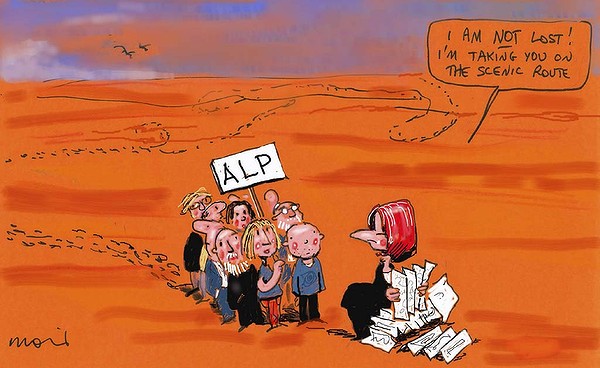
We can expect a federal-state conflict over the impact of a carbon price on households even though the states no longer set the price of electricity. It is the national electricity market that sets wholesale prices and a national regulator that oversees network prices. It is a network that is geared to corporate profit and not to energy sustainability.
Thus we have the the politics of neo-liberalism---‘markets’, when freed from state interference, are the most efficient, and most moral, way of providing goods and services in society. Neo-liberalism is a particular mode of governance in which the state legislates to secure freedoms for capital. In the case of electricity privatisation the main beneficiaries have been corporations rather than consumers and this has been facilitated by a whole host of new state regulations.
One way to counteract this state of affairs is too leave the centralized national grid and shift towards decentralized power generation.
Posted by Gary Sauer-Thompson at 8:40 AM | Comments (4) | TrackBack