« April 2012 | Main | June 2012 »
May 31, 2012
fiscal federalism
The effects of the so-called patchwork economy can be seen in the recent budgets of the Tasmanian and South Australian budgets---the rising public debt highlights the fiscal stress in these two states. South Australia is increasingly becoming stranded between its past – particularly manufacturing – and its future embodied in the BHP's $US20 billion expansion of the Olympic Dam mine project that keeps on being postponed because of falling commodity prices.

Even though Australia is a federation the wealthy mining states--ie., WA and Queensland---want to let the less wealthy states which have a lower capacity to raise revenue to swim on their own or siink. WA in particular is very hostile to horizontal fiscal equalization---its revenue being used to help Tasmania and South Australia through difficult times; even though historically WA has been the recipient of intergovernmental fiscal adjustment from NSW and Victoria in the industrial past.
Australian federalism is characterized by both the high imbalance between state expenditure responsibilities and taxation powers and the states’ own-source revenues account for only 40 per cent of their own-purpose outlays. Hence the poorer states are very dependent on fiscal transfers from the Commonwealth.
Just like the Big Miners who are deeply opposed to 'spreading the benefits of the boom', WA wants to keep its mining wealth for itself in opposition to fiscal equalization. WA has a history of antagonism to federalism.
Update
WA's current antagonism to horizontal fiscal equalization takes the current form of requiring the poorer and more depressed states like Tasmania cutting back on the public services in order to deal with reduced revenue from Canberra. Behind this proposal sits the neo-liberal small state rhetoric that means rolling back the welfare state.
Presumably as the welfare state shrinks the welfare responsibilities of the public sector are shifted to the underfunded community sector. Many of the core functions of government are outsourced to volunteers, community-based groups and not-for-profit organisations.
This logic is applied to the widest conceivable range of services including parks, libraries, post offices, hospitals, welfare-to-work employment programs, prisons, court and tribunal administration, payment processing, fraud, debt and identity-related services, police information and communication technology and training, ‘infrastructure and back-office functions’, health services, housing, planning and schools.
Posted by Gary Sauer-Thompson at 10:02 AM | Comments (12) | TrackBack
May 29, 2012
strange times indeed
It's strange times that we live in. Australia's economy is booming compared to Europe and the US and yet most Australians have been persuaded by the Liberal Opposition's doom and gloom narrative that we are all going to hell in a bucket. The world is going to end in the sense that Australia is becoming like Greece or Spain.
We live in an inverted world in Australia and few notice the inversion. Even though young Greek and Spanish professionals are coming to Australia to look for work and to brush up on their English, or the rest of the world sees Australia as a winner from globalisation because of mining, Australian's are miserable and unhappy. They are angry and full of sob stories, even though the interest rate, the unemployment rate and the inflation rate are all less than 5 per cent.
 Bruce Petty
What is causing the ruination, decline or unhappiness? Why the mining tax. And the carbon "tax". Bad industrial relations. And a minority government. Too much red and green tape. Expensive housing. These are damaging our economy big time.
The arguments in support of the doom and gloom thesis are thin. One popular one is that Greece went downhill because of government debt, Australia has government debt, therefore Australia is going bad. The evidence? These are the worst economic conditions in decades, nay in living memory. How so? We are in debt. The credit cards are maxed; mortgaged repayments are high; house prices are flat; consumers aren't spending; too much money is being spent on the welfare state rather than reducing taxes.
The Coalition is asking for a mandate to undo all the Rudd/Gillard policies that have bought about Australia's "decline". They seek their mandate through a campaign of unremitting negativity designed to show the minority government is causing all the chaos through its reforms. Chaos means political uncertainty--a government lurching from crisis to crisis exemplified in backbench rebellion. The impression is that everything is a crisis.
Big Business says it lacks confidence and can't invest. It won't until there is a majority government from an early election.
Posted by Gary Sauer-Thompson at 8:59 AM | Comments (10) | TrackBack
May 28, 2012
going too far
I've been away in Queenstown, Tasmania on a photoshoot and in coming back to Adelaide I find that the Craig Thompson affair still dominating the agenda of the Canberra media gallery and the 24/7 news cycle.
It is pretty clear that Thomson is a pawn on a political chess board within the hothouse atmospherics of minority government. Tony Abbott has pushed the politics of this too far. Though Thomson is facing serious non-judicial findings after an extensive investigation by Fair Work Australia and is the subject of police investigation, he is entitled to the assumption of innocence in a representative democracy based on the rule of law. Until proven guilty he is entitled to a fair hearing, however implausible his claims.
 David Pope
What has shifted in the week that I have been away is that the media are now in the spotlight for the way they have handled the affair. They have been part of the campaign to push Thomson out of parliament before he has been charged with any offence, let alone convicted of one that satisfies the Constitution for his disqualification.Though there is no basis or precedent for Thomson to resign, and though Abbott has made no convincing argument for such a resignation, the media have acted to judge the guilt or innocence of Thomson.
Though the Thomson affair is unlikely to deliver Abbott the election he wants now that will deliver him the power he needs to roll back the reforms the affair indicates just how deeply we have entered into world of bitterly adversarial politics. It is a media world where politics, like sport, is now part of the entertainment industry,
Posted by Gary Sauer-Thompson at 8:45 AM | Comments (22) | TrackBack
May 21, 2012
strange tales
All that is missing from Pope's cartoon is Craig Thomson, the member for Dobell. He's a star performer. In his speech to parliament it was Thomson against the world. Under the cover of parliamentary privilege he raised the spectre of someone stealing his identity and cloning his phone to make it appear that he was engaging the services of prostitutes on his union credit card.
 David Pope
He was right in his claim that the matter should run its course through the courts if charges are laid. In the court of public opinion and the media Thomson has already been tried and found guilty.
The Canberra Press gallery is preoccupied with the noise around the Thomson affair even though the economy is shredding full time jobs, teenage unemployment is rising and the money is not being spent to bring our public education system up to standard.
Posted by Gary Sauer-Thompson at 5:50 PM | Comments (3) | TrackBack
May 20, 2012
Greece: a hard road ahead
The Greek economy has problems over and above a high level of indebtedness resulting from the Greek government being spectacularly spendthrift.
Nikos Chrysoloras lists them for us.There are the problems of public finance mismanagement, over-reliance on public and private consumption, lack of medium and large export-oriented enterprises, low competitiveness, tax evasion, and weak administrative capacity. In the absence of any export capacity (eg., raw materials) restoring the competitiveness of the Greek economy and changing its structure is the only way for the country to survive in the absence of cheap credit.
 Martin Rowson
It's a hard road ahead for Greece as the hard landing cannot be avoided, even if there is a relaxing of the timetable of Greece's deficit reduction and budget cuts.
Posted by Gary Sauer-Thompson at 10:37 PM | Comments (1) | TrackBack
May 18, 2012
Greece comes to the crossroads
Greeks go to the polls on 17 June after the previous vote on 6 May proved inclusive and no political party was able to form a coalition government. A temporary cabinet is in place.
The new election is probably a referendum on the euro and it appears that while Greeks do not want the harsh austerity imposed by the troika (the European Union, European Central Bank and International Monetary Fund) to secure a €130bn lifeline in March and avoid default--- most of them want to stay in the euro.
 David Pope
Greece is being pushed out of the eurozone by the politics of austerity and it desperately needs measures for stimulating growth if it is to stay in the eurozone. Austerity alone will not solve the eurozone debt crisis.
Mariana Mazzucato argues that:
The eurozone will grow only once weaker countries are allowed to make the strategic investments Germany has. There is much talk about the need for internal rebalancing, to increase the competitiveness of the deficit-burdened south relative to the surplus-blessed north, but this is a limited view. What is required is not that wages fall in Portugal, Italy, Greece, and Spain, but that they make investments that increase their productivity – an impossibility with austerity-driven policies.
If growth is really on the agenda, then the focus should be on the productive investments needed to rebalance Europe, and mechanisms that allow that to happen.
Posted by Gary Sauer-Thompson at 3:51 PM | Comments (3) | TrackBack
May 16, 2012
News International: the screws turn
The News International hacking scandal deepens. Rebecca Brooks, the former chief executive of News International, is now facing three charges of conspiracy to pervert the course of justice over allegations that she concealed "material, documents and computers" from detectives investigating phone hacking at the News of the World and alleged bribes to public officials by journalists at the Sun. They charges have been bought by the Crown Prosecution Service.
 Steve Bell
Brooks was at the heart of Rupert Murdoch's UK newspaper business for more than a decade. She was close to the company's ruling family, particularly during her time editing the Sun from 2003, and after she stepped up to become chief executive of the tabloid's publisher, News International, in 2009.
Posted by Gary Sauer-Thompson at 6:07 PM | TrackBack
May 14, 2012
Greece: the fight against austerity
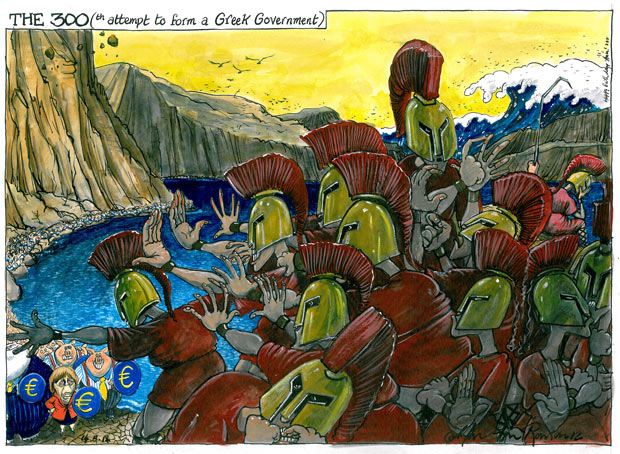
The anti-austerity coalition (Syriza), which emerged from inconclusive elections as the most popular force in Greece, refuses to participate in a national unity government to implement the unpopular austerity policies. They want a moratorium on debt payments and aggressive debt write-offs.
The mainstream New Democracy and Pasok parties were hammered at the ballot box for supporting the harsh terms of a debt relief deal (cutbacks and reforms) drawn up by the EU, the International Monetary Fund and the European Central Bank to keep the heavily indebted economy afloat and repay the debt.
 Martin Rowson
The current round of domestic political negotiations is unlikely to lead to a government being formed, especially one that could continue to implement the terms of the bailout. There will probably be new elections.
Greece's immediate future under the austerity deal is a contraction of the Greek economy by 20%, a jump in unemployment toward 25%, a full-blown humanitarian crisis in the urban centres, and a completely unmanageable public debt. Greece is being forced into Greece into a depression and its population is rebelling against the dictates from Berlin.
The rhetoric from Berlin is that there is no alternative to the agreed consolidation program if Greece wants to remain a member of the euro zone. It is the business-as-usual choice ---“The debts must be paid!” This path increasingly leads to social upheaval, default and exit from the eurozone.
Posted by Gary Sauer-Thompson at 10:48 PM | Comments (1) | TrackBack
May 13, 2012
the future of news
Richard Gingras, head of News Products at Google, recently spoke at the spoke at the Nieman Foundation for Journalism at Harvard on the future of news in a digital world.
This is a media world where accusations are taken as fact. Rumours are news. Opinion is preferred to news gathering and accurate reporting. News and analysis is instant. Answers are demanded, now.
We have live blogging of the event from Matt Stempeck. He reports Gingras as saying that we look back at the 40 golden years of newspaper profitability and distribution as if things had been structured that way forever. But these four decades was triggered by an earlier media disruption: television. The rise of television advertising caused a contraction in the newspaper business, where major metropolitan markets went from supporting 4-5 newspapers to 1-2 papers, and these remaining papers usually had a business agreement of some sort. The limited number of remaining companies allowed monopolistic pricing.
Newspapers' previous dominance was a matter of geography, and to some degree demographics, but not because of their product. The vertical model of a newspaper makes little sense going forward. Gingras compares the metropolitan newspapers' all-things to all-people product to content portals for specific communities. This strategy doesn't make sense given the possibilities. Yahoo!'s initial success was as a portal. But portals have disappeared online as consumers have learned to navigate the web on their own and found the niche sites they love. News companies must disambiguate their content and business models and devolve from the generalist approach, which is hemorrhaging both readers and revenue.
What we are seeing is a disaggregation of content flows as well as advertising as audiences evolve. Audiences are evolving. Just three years ago, in 2009, the typical news site saw 50% of their unique traffic coming to their homepage, 20-25% from search, and 30-35% from story pages. Social was almost nonexistent. We're now seeing the homepage receive only 25% of inbound traffic, search with 30-35%, and the rest going to story pages, a huge portion of which is driven by social networks.
Posted by Gary Sauer-Thompson at 9:46 PM | Comments (1) | TrackBack
May 12, 2012
China to the rescue?
It is now five years since the Great Financial Crisis of 2007–09 began and there is still no substantive sign of a full recovery of the world economy---especially in the US and in Europe. Consequently, concern is increasingly shifting from financial crisis and recession to slow growth or stagnation. Stagnation and financial crisis are now seen as inter-connected judging from what is happening in Spain and Greece.
China is seen to be an exception to this narrative:--the rare ray of sunshine for a global economy in recession. China's massive stimulus package ($585 billion ) enabled it to come out of the Great Financial Crisis period largely unaffected with a double-digit rate of growth and this growth machine is seen to be a counterbalance to the tendency toward stagnation at the global economy level. In Adelaide the local boosters say that everything hinges on BHP going ahead with the expansion of Olympic Dam in South Australia's north. That expansion depends on China continue to boom.
The Chinese exception narrative holds that China's can drive the world economy back into growth, and so keep the developed nations from what appears to be a generation of stagnation and intense political struggles over austerity politics. The complex system of global supply chains that has made China the world’s factory--(think Apple and Foxconn) has also made China increasingly dependent on foreign capital and foreign markets, whilst in turn making these markets vulnerable to any disruption in the Chinese economy.
The disruption in the Chinese economy emerging out of the government’s fixed investment stimulus which worked in part through the encouragement of massive state bank lending, a local borrowing binge and urban expansion that is reliant on the supply of Australia's minerals. What is emerging is serious real estate downturn, a decline in construction and a rise in bad bank loans that is coupled with growing inequality of a factory export machine growth model that is premised on very low wages in the export sector.
The general response to this is that China should transition from export-led growth to domestic demand-led growth. This requires growing the economy’s demand side as well as its supply-side. Fears that the contradictions of the Chinese economy may further imperil the entire world accumulation process—if China is not able to rebalance toward higher consumption, lower debt, and a higher renminbi—are voiced daily in the press of international capital.
In Will China Break? in the New York Times Paul Krugman says in reference to China:
Consider the following picture: Recent growth has relied on a huge construction boom fueled by surging real estate prices, and exhibiting all the classic signs of a bubble. There was rapid growth in credit — with much of that growth taking place not through traditional banking but rather through unregulated “shadow banking” neither subject to government supervision nor backed by government guarantees. Now the bubble is bursting — and there are real reasons to fear financial and economic crisis.
That is not good news for Australia. The RBA , however, reckons that the Chinese state has managed to slow the pace of growth without stalling the fastest-growing major economy. So no worries.
Posted by Gary Sauer-Thompson at 3:57 PM | Comments (4) | TrackBack
May 11, 2012
media and political power
I watched some of Rebeca Brook's appearance at the Leveson Inquiry. The ex-tabloid editor didn't give much away about her career moves and political fixes. She is at the nexus of the nexus of the tabloid press and political power the Leveson inquiry is trying to uncover.
 Martin Rowson LOL
We gained an insight into the close connection/networks in the UK that had developed between the political class and Murdoch's media company in the UK. We are looking back into the decades-long process that made Murdoch so powerful and unaccountable.
If Murdoch is now in the process of being ejected from the politicians' social network for good, then who replaces Murdoch in terms of media power?
Posted by Gary Sauer-Thompson at 7:25 PM | Comments (1) | TrackBack
May 10, 2012
politics as show biz: the routine
The showbiz routine is the old stuff of hard work, small business and reward, insisting the government live within its means just as households have to, reducing the “massive” debt and attacking public servants for wasting all our hard earned money. The pose that is struck is one of big business being the victims of nasty state repression--Soviet style.
 David Rowe
The golden future that is so promised will come through getting of all that nasty debt, and reducing government spending, removing taxes on the miners and the polluters, and greater workplace flexibility”. Hey presto, Australia's economic growth machine will go into overdrive on wealth creation and we will all be relaxed, prosperous and comfortable for evermore.
This is the rhetoric of politics as showbiz----a strong agenda to drive economic growth, productivity and employment.
Posted by Gary Sauer-Thompson at 8:11 PM | TrackBack
May 9, 2012
budget blues
The Gillard Government's 2012 budget has been and gone. Most of it was strategically leaked in advance in an attempt to help transform the government’s bad public image and to fend off another Opposition attack about another "broken promise". It probably change the bad image.
There was no attempt to invest in Australia’s future productivity and growth through genuine funding increases to higher education, scientific and medical research, in nation-building infrastructure, in innovation in small firms throughout the economy, and greater steps to decarbonise the economy---eg., axing the diesel fuel excise rebate.
The budget was designed to give some credence to its claims for economic competence and to put a floor under the downward spiral of unpopularity with new family payments (the long shadow of John Howard's deserving poor) from the new mining resources tax, and the now scrapped 1 per cent cut to company tax. It's wealth redistribution not wealth creation says Big Business through hissed breath. It doesn't build business confidence. Class warfare say others.

All the headlines in the media are about the Craig Thomson affair not the decline in tax revenue (GST), or the real decline in expenditure as it is the former that is the lever for sustained period of conservative political dominance.
The hostility (anger? resentment?) to the Gillard Government won't be shifted by a budget surplus and the increased funding for the National Disability Insurance Scheme, payments for families, funding for indigenous development, dental and mental health, aged care, communications infrastructure, compensation for the pricing of carbon.
Budget surplus, increased funding and retaining Australia AAA credit would be called responsible fiscal management --fiscal conservatism--- if it was done by a Liberal Treasure. Labor is no longer willing to make the argument that employment and growth are more important than reducing debt, and it has abandoned its brief adventure in defending Keynesian economics and the need for a larger role for the state.
The underlying Treasury assumption is an optimistic one of good economic growth because of the mining boom, even though commodities markets have softened and the risks within the global economy have re-surfaced in Europe.
The budget really turns on the economy doing much better than a lot of people now think.
Posted by Gary Sauer-Thompson at 8:36 PM | Comments (12) | TrackBack
May 8, 2012
surviving by a thread
I caught the last bit of Question Time in the House of Representatives. It was the end of a motion to suspend standing orders to move that MP Craig Thomson be suspended for 14 days. The background is the Fair Work Australia's long awaited report into the dysfunctional Health Services Union.
This stated that Thompson to repeatedly provided false and misleading information to investigators over his denial that he used his union credit card to pay for prostitutes. The report recommends civil court action against Craig Thomson Fair Work Australia Australia has referred Thomson’s breaches to the Federal Court of Australia for civil action.
 David Rowe
The Gillard Government survived the vote (70-72) ---Andrew Wilkie is now voting with the Coalition---and it continues to survive by a thread. Why didn't Thomson stand aside from the ALP much earlier? Why didn't Gillard argue for a more open relationship between the unions and the ALP much earlier on?
Wayne Swan will hand down the Federal Budget tonight with all the policy settings set to ensure Australia’s future prosperity and Labor's re-election platform. Will the emphasis will be on the symbolism, given the two-speed economy. Will Swan bring in a surplus by focusing more on the revenue side than on the expenditure side? Will he move away from targeting from low to middle-income earners and shift towards towards high-income earners.
Will it rip the heart our of middle class Australia? Or will it target the high-flying executives by stripping them of some of the tax perks? Will it be the budget of an unpopular government approaching an election, not one that’s tightening the belt? Will it factor in a sharp slow-down in China results in a slump in export earnings at the same time that imports of capital goods soar as miners hurry to finish their major investment projects?
I presume, judging from the past, that Treasury's assumption will be that China’s economic growth will remain robust, even though its largest export market, the European Union, is slumping deeper into recession. China's demand is the key, and if commodity prices fall further, say by another 15 per cent, Australia's resources investment boom will be in trouble.
Treasury is always overly optimistic. China will continue to boom. So will India. Hence so will Australia.
Posted by Gary Sauer-Thompson at 4:21 PM | Comments (1) | TrackBack
May 7, 2012
left + right policy hands
So the Reserve Bank reduces interest rates last week, while a week later, fiscal policy is set to be tightened in an attempt to bring in a budget surplus. That are two policy arms working at cross purposes. The implication of the former is that because the economy is sluggish, the RBA has cut rates to provide a stimulus.
The budget surplus, on the other hand, is contractory in that the fiscal austerity weakens the economy slows economic growth and increases the potential rising unemployment. That would mean the RBA would have to reduce interest rates even further to compensate for a slowing economy.

If the economics doesn't make sense the politics does. The Gillard Government is in such a weakened position that it is forced to prove its credentials as good economic managers. The underlying current is that the Gillard Government can’t be trusted to use our money appropriately and so we should be giving them less of it. The best way to do this is to end the waste and curtail government spending.The rhetoric here is one of 'bloated' or 'inefficient' public services.
Deficits generate debt and the optimum amount of public debt is zero is the position of corner-shop economics or household budget economics. Therefore achieving a surplus or balance the budget is taken as a measure of fiscal responsibility. This is cast in stone, and holds even when Australia doesn't have a fiscal sustainability problem, and that the scenario is one in which fiscal policy will make economic slowdowns even more severe.
The politics of budget surplus in a period of economic slowdown is a political goal with no economic rationale. Will the politics work for the Gillard Government? Or will they be accused in The Australian of fooling around with dodgy figures, constructing surplus mirages and playing around with smoke and mirrors?
Posted by Gary Sauer-Thompson at 10:56 AM | Comments (1) | TrackBack
May 6, 2012
fawning over Murdoch
The conservatives in Britain appear to be locked into defending and supporting Murdoch and News International. Apparently Tory MPs are still fighting to stop Labour and the Liberal Democrats saying that Rupert Murdoch is "unfit to run a public company".

All the evidence points to the senior Conservatives being complicit in promising sweetheart deals to News Corporation to the point of fawning over Murdoch.They appeared to be like the courtiers of the Sun King. Do they fear that Murdoch will destroy them, even though his power is broken?
An editorial in The Australian ways into the debate identifying Murdoch's critics as the Left-liberal clique.
What is the argument? The Australian states that it is right and proper that Rupert Murdoch be made accountability or his conduct scrutinized. However:
for decades his commercial rivals, and politicians who prefer the dominance of government-funded media, have choked on his success. For complex reasons, an anti-Murdoch stance has become as entrenched in the boutique concerns of the trendy leftists in our universities and public broadcasters as anti-US and climate change alarmism. Yet the News Corp ethos demonstrably is one of the open mind. We have extensively covered the British controversy and, in London, Shawcross notes that the reportage in The Times has been "relentlessy fair". So much of the condemnation, here and abroad, has contained more schadenfreude than common sense.
It's not much of an argument. It's more demonizing the critics---much coverage of the UK phone hacking scandal is based on “prejudice, innuendo and vindictiveness’’ against Rupert Murdoch’s News Corporation. It doesn't address the criticisms of way that Murdoch does business with politicians to further his commercial interests.
Posted by Gary Sauer-Thompson at 9:46 PM | Comments (1) | TrackBack
May 5, 2012
France at the cross roads
Much of Europe has returned to recession. The eurozone crisis is out of control again. Unemployment is rising almost everywhere. People across all segments of the societies in the Eurozone are anxious about their status, living conditions, income or job prospects – often all at once.

France's massive challenges are a debt to GDP of about 90 per cent, a worsening trade deficit and an unsustainable public spending ratio. France's public debt is so high that interest repayments alone account for the second highest state expenditure after education. The neo-liberal agenda is the contradictory constellation of restoring competitiveness, job creation and fiscal retrenchment.
Behind this is the conflict between the dynamics of the global economy and the struggle of national politicians to control and temper it. François Hollande's central message is that the global financial markets must be determinedly reined in for the primacy of politics to return. Can a nation-state achieve this? Is it possible? Or can it only be done from within the eurozone?
François Hollande becomes France's first leftwing president since Mitterrand. He was the candidate who promised to avoid the all-austerity programme Sarkozy had committed himself to, committed to altering the French tax system, by dismantling tax breaks for the rich and pushing up taxes for the wealthy. He is also committed to renegotiating the European budgetary pact to include a growth component.
Hollande faces an economic crisis. The country is burdened with a spiralling public debt, where unemployment is at a record high (10%) , growth is stuttering, industry is in decline, competitiveness is low, there is a gaping hole in social security coffers and unions fear a swath of factory lay-offs after a lull during the campaign.
Posted by Gary Sauer-Thompson at 10:05 PM | TrackBack
May 4, 2012
Energy poverty
I heard a report this morning on Radio National's top line Breakfast programme about the effect of rising electricity prices on low income households. This was in the context of the rising cost of living burden.
The neo-liberal program is one of rising fuel prices, deregulation, privatisation, and the rapid escalation of electricity prices paid by households. The substantial increases are far in excess of general price and wage movements during the last few years.The increases are 60% in four states and territories with forecasts increases in residential electricity prices of 37% up to 2014. In NSW the increase is even more. Disconnection rates are on the rise amongst the working poor and those on a pension.

Though it was acknowledged that the price increases were for infrastructure investment--network upgrades for fossil fuel power stations-- the carbon tax (commentators do not use "a price on carbon" language) was seen as an extra burden that was too much to bear. Though compensation for the increased price on carbon was mentioned (those on lower incomes would receive more compensation than the increased cost of electricity) it was dismissed. No one believed it.
I was shocked by the ignorance, distrust and cynicism. There was no mention that the current building of new infrastructure for the small number of days a year of peak use could be better meet by decentralized solar photovoltaic systems sends power into the grid during times of peak demand – in the middle of hot days when air-conditioners are on. Household airconditioning has exacerbated peak demand.
There was no mention that rooftop solar in particular can make a big difference to household bills if feed-in tariffs and other schemes were better targeted to support disadvantaged areas and low-income households.
Nope, it was the carbon tax that was creating all the fear and anxiety in the context of the "eat or heat" syndrome: when poor families must decide between putting food on the table or heating their homes.
Posted by Gary Sauer-Thompson at 6:38 PM | Comments (6) | TrackBack
May 3, 2012
Eurozone crisis: Spain
The economic crisis in Spain continues to deepen, whilst the future of the Eurozone banking system hangs in balance. It increasingly looks as if the eurozone crisis is to a large extent an economic growth crisis.
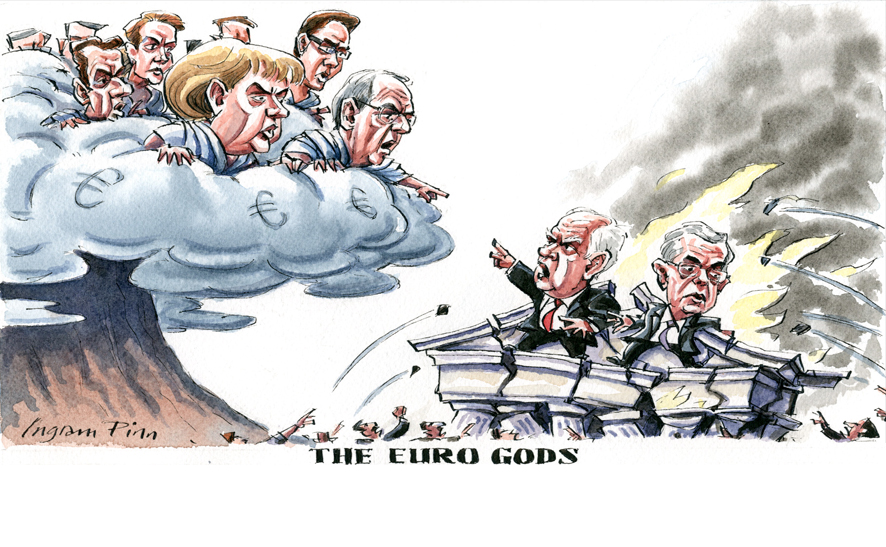
Spain ad an enormous housing bubble and when the bubble burst, the Spanish economy was left high and dry. Spain’s fiscal problems are a consequence of its recession , not its cause. Even though the cities the bars and restaurants in Madrid and Barcelona are full, there is rising unemployment, increasing homeless, increasing numbers of people getting evicted from their homes as banks foreclose on properties bought during the boom; derelict buildings, closed down businesses, banks with lots of bad debts from the housing bubble; business investment is collapsing. The social effects are quite evident in the poorer regions --eg., Galicia.
The politics of austerity continues to rule in Spain even though tightening fiscal policy in the teeth of a recession is very dangerous. This is to pursue self-defeating economic policies. Fiscal austerity of the order required by the EU will simply push the Spanish economy into a slump, which in turn will worsen the debt position of the private sector, amplifying the required amount of deleveraging, and ultimately how much private bank debt ends up on the state's books.
The assumption in the Eurozone is that the eurozone will extricate itself from the crisis – and become a more stable arrangement over the long term – if it ‘Europeanises’ German discipline. Eurozone policy-makers base their confidence in the current strategy on the belief that the private sectors of the hard-hit economies are going to ride to the rescue. Indeed, they believe that austerity and structural reforms will make more households and firms confident to spend and invest.
It is far from clear why already-indebted Spanish firms would suddenly start to invest in the teeth of falling demand. Nor is it clear why households – facing unprecedented unemployment – would increase spending.
However, Philip Whyte points out that the eurozone’s essential character remains unchanged. It is still what it was when it was originally launched: a currency which is embedded in a fiscally decentralised confederation, rather than a fully-fledged federation (such as the US). The thrust of all the reforms has been to reaffirm the eurozone as a rules-based currency union. Whyte says that:
In the end, it is the politics of the eurozone crisis that make its economics intractable – not the other way round. At root, the eurozone is in crisis because most voters still think of themselves as nationals first and Europeans second. The eurozone’s fiscally decentralised structure simply reflects the fact that solidarity is weaker across European borders than it is within them. The upshot is that EU leaders do not have a democratic mandate to complete the currency union. Their political commitment to the euro remains strong. They will do all they can to prevent the eurozone breaking apart, and will probably succeed.
It is hard to see how a European demos (and hence more stable currency zone) can emerge from the economic pain and mounting cross-border resentment that current policies are causing.
Posted by Gary Sauer-Thompson at 10:45 PM | TrackBack
May 2, 2012
media reform?
I cannot see much happening with respect to reform of the media emerging out of the Convergence Review and the Finkelston Inquiry. The Gillard Government is on its knees on the ropes and punch drunk from all the body blows to be be in any position to rock the very powerful media corporations that float on copy from the public relations world. This government is in no fit state to undertake a major overhaul of media regulation for a digital world.
 Steve Bell
The Convergence Review's diagnosis was convincing for a dynamic media world. In a converged digital world it is no longer viable to argue that news and commentary in print media should be treated differently from news and commentary in television, radio and online. Secondly, the new industry-led body should cover all platforms—print and online, television and radio--but not the internet.
Hence the idea of the one stop shop---a converged Press Council and Australian Communications and Media Authority (ACMA) to keep news organisations honest through news standards, adjudicating on complaints and providing timely sanctions for the wrongs. A digital economy regulator that is technology neutral is a good idea.
The problem is that the Convergence Review recommendation is for an industry self-regulation scheme eventually covering all media, with guaranteed funding – mostly from industry and some from government – and the power to impose meaningful penalties and sanctions, including forcing the publication of its adjudications. A statutory authority with a big stick was recommended by Finkelston.
An industry-led regulator, given the concentration of media ownership in Australia, that has been supported by the political class. That degree of concentration means the existing media organisations would have the same power they currently have with the Press Council – the power to do next to nothing. They have little intention of changing their media culture, they will write their own rules, they have little interest in supporting consumer empowerment and freedom in content consumption and they will oppose any tough "fit and proper person" test for a media company to hold a broadcaster licence.
This matters because the behaviour of a corrupt News International in the UK has been found to be scandalous by the House of Commons culture, media and sport committee, with respect to consumers, police and politicians. They used criminal methods to advance their commercial concerns without even noticing! News Corp may well have to pull the plug on its UK newspaper operations.
You see a scenario where the media companies could starve the industry-led cross -media self-regulating body of funds to stymie its investigations into complaints.
Posted by Gary Sauer-Thompson at 11:09 AM | Comments (3) | TrackBack
May 1, 2012
a very Labor sleaze
Can federal Labor claw back the scale of the disaster at the next election? If so, what is the best means of saving them from a wipeout? They face a future where few of them will be left.
The Labor backbench must now be thinking along these lines surely. They must realize that there will be no lift in the polls from a May budget that is in surplus. Nor will the introduction of carbon tax compensation will help the government recover its standing all that much.
The way things stand now an Abbott led Coalition could take control of both houses of Parliament at the next election, and Labor's reform legacy would be gone. Carbon pricing gone. Mining tax gone. NBN gone. Water reform gone. Media reform gone. The road to the future would lead back to the past.

I appreciate that the Gillard Government has been under a barrage of assaults aimed at destablization from the word go by all those vested interests who have opposed reform. News Ltd's aggression and manufactured rage cannot be explained by the performance of the government or the behaviour of the current prime minister.
Gillard Labor have also bought a lot on themselves. My own tipping point was the tactical power-play that used Peter Slipper in order to turn away from an electorally popular policy regarding poker machine reform. They turned their back on a reform that was in the public interest because the NSW Right feared losing some seats.
The result is a smell from the Slipper affair, and that has mixed in with the smell of corruption in the Health Services Union and its association with Craig Thompson, the Member for Dobell. The smell just reinforces the public mood of the Gillard Government as being on the nose.
The routine commentary and analysis of the Gillard Government of the political journalism of the Canberra media gallery is that the government may be doing okay in terms of policy and reform, but it is failing badly in the daily political battle (ratings?) to present a coherent and convincing public face.
Posted by Gary Sauer-Thompson at 3:17 PM | Comments (12) | TrackBack