|
February 29, 2012
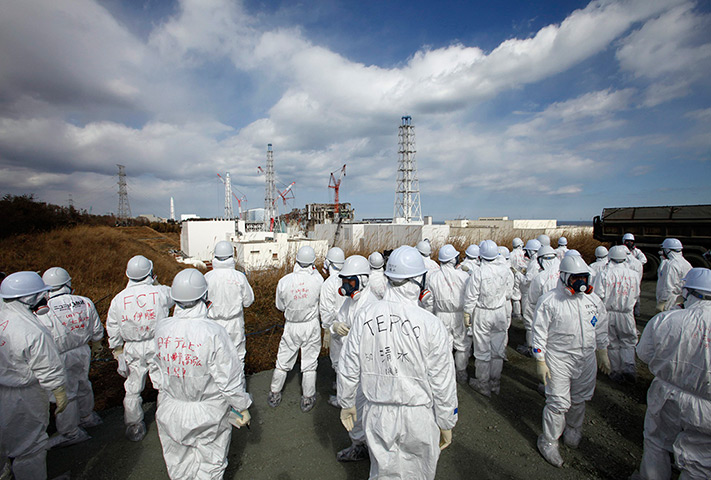
Justin McCurry from The Guardian visits Fukushima Daiichi and Tepco's nuclear power plant. Fukushima is classified as a grade 7 accident on the International Atomic Energy Agency scale - denoting “widespread health and environmental effects.” That's the same severity as Chernobyl, the only other grade 7 accident in history.
 Issei Kato/Reuters
The cleanup has started. Of the three reactors that went into meltdown, one is covered with tarpaulin and another appears intact, but the third is a mess of tangled metal. They have installed storage tanks to store contaminated water from the reactor buildings. The water is then purified and used again to cool damaged fuel. They also need to remove the melted nuclear fuel, which will prove difficult.
McCurry highlights two things from his visit. First, the surrounding Fukushima exclusion zone:
the towns and villages....exist in name only, their residents having been sent fleeing a year ago. Homes and shops lie empty, the roads are deserted. In the town of Naraha, groceries sit untouched on the shelves of a convenience store; a handful of cars punctuate a supermarket carpark, abandoned by their owners amid the panic that followed the first explosion at one of the Fukushima Daiichi plant's reactor buildings.
It sounds like an unusable wasteland. Long-term evacuation over extensive decontamination was the Soviet response. The Japanese response is to decontaminate the landscape.
Secondly, McCurry says that the destruction is more insidious than collapsed roofs and ruptured tarmac:
Almost everywhere, beeping monitors alert visitors to the invisible foe that has befouled entire communities: radiation. While temperatures inside the reactors have stayed below the required boiling point, radiation is still too high for workers to enter some areas. The utility's contamination map shows radiation inside reactor No 3 as high as 1,500 microsieverts/hour.
Radiation levels inside reactor No 3 are still too high for people to enter. Radiation may be invisible, but it is incredibly persistent and incredibly damaging to all life forms. The release of contaminated water from the crippled Fukushima nuclear complex last year stoked concerns about how that radioactivity might affect marine life in the Pacific.
The meltdown also contaminated large areas of farmland and forests. At least 1,000 sq km of land will be cleaned up as workers power-spray buildings, scrape soil off fields, and remove fallen leaves and undergrowth from woods near houses.
The capture of the Japanese government by the nuclear industry as has also happened in the US and in UK If the machinery of the Japanese government, and the ministers it serves, is 100% behind the plans of the nuclear industry, then the myth of safety of nuclear power plants that Japanese authorities had maintained for decades to gain public support as the country embarked on massive nuclear power programmes has well and truly fractured.
Ten months after the nuclear disaster trust in the authorities is nearly non-existent due to the industry spin and collusion. The distrust stems primarily from the fact that the meltdown of the Fukushima reactors was not reported to the public immediately, causing huge health risks to the local population from radiation leaks.
|





There are reports that TEPCO and friends don't know where the fuel in Fuku #1 is located.
It may be in the containment vessel - or it may not, having melted through.
They can't find out cos its too hot [nearly a year after the earthquake wrecked the building].
And will be for 10 years, or more, or less, who knows?
Meanwhile the disaster continues.
More reporting needed from the media, this topic has been put on the back burner.