« April 2009 | Main | June 2009 »
May 31, 2009
Canberra Watch: big on everything
Ross Gittens makes an interesting observation in the Sydney Morning Herald about the style of Rudd's mode of governance. Rudd, he says is just big on everything:
Big on foreign affairs, big on defence, big on education, big on relations with the states, big on Closing the Gap, big on modernising infrastructure and big on a dozen other things" Trouble is, being big in any of these areas costs big money. Trying to be big in all of them costs more than we could ever afford. But Rudd also wants to be big on keeping taxes low, big on being an "economic conservative', big on spending to mitigate the recession and big on getting the budget back into surplus and eliminating the public debt.
And Big on industrial policy to protect old style manufacturing, as in the car industry. Too many Big's Gitten's points out means that Rudd will be forced to choose in terms of priorities:
In the end he'll be forced to choose, and all the argy-bargy of the past three weeks tells us what his choice will be. He's incapable of hiding the inferiority he feels to the Liberals on economic management and the Libs think their best hope lies in skewering him on deficits and debt, so that's what will win in the end.In other words, Rudd will end up delivering reasonably responsible budgets, but will do so at the expense of a long trail of postponed promises and dashed expectations.
Gittens says that all the signs are that defence spending has been deferred in the 2009 budget to hasten a return to surplus. What we are offered is a vision of what the defence force will look like in 2030.
I think that Gittens is right on this. Rudd is on the defensive on spending big since that means debt and deficit, and this debt will slowly work away in the background to undermine the Government's economic management. First, the government's revenue decline means that Rudd and Swan's political preference will be cuts to spending. Secondly, being Big on somethings --such as education --is mostly rhetoric. It is the same with renewable energy:---Rudd and Co are very small on investment in renewable energy.
Rudd and Co are also small on the shift that is taking place in the economy away from routine manufacturing jobs towards towards the knowledge jobs by people who analyze, manipulate, innovate and create. As Robert Reich points out:
These people are responsible for research and development, design and engineering. Or for high-level sales, marketing and advertising. They're composers, writers and producers. They're lawyers, journalists, doctors and management consultants. I call this "symbolic analytic" work because most of it has to do with analyzing, manipulating and communicating through numbers, shapes, words, ideas....On the back of every iPod is the notice "Designed by Apple in California, Assembled in China." You can bet iPod's design garners a bigger share of the iPod's purchase price than its assembly.
Wouldn't it be great if on the back of the new renewable energy technology products is the notice "Designed by X in Australia, Assembled in China." But we know in our hearts that is not going to happen, since for all their talk about making the Big shift a low carbon economy, our politicians just cannot see beyond coal. Coal is king. Australia remains Quarry Australia.
Posted by Gary Sauer-Thompson at 11:53 PM | Comments (8) | TrackBack
May 30, 2009
distractions
If newspapers do end up charging for access to online content they'll have a hard time coming up with stuff people would be prepared to pay for that isn't freely available. Mark Day says
"If the Government makes a press statement, that's going to be free. If a corporation gives its annual report, that's going to be free. If there is a debate in Parliament, that's going to be free."But investigative journalism, the kind of information that does have value, can be charged for."
No mention of commentary and 'analysis'. How much of that sort of content would people pay to access? I'd probably pay for George Megalogenis, but not if it meant a subscription would also support Christopher Pearson.
Pearson regurgitates Gerard Henderson, Andrew Bolt and American pro-life releases. No great challenge in that.
Megalogenis makes original and worthwhile contributions.
Why are we being bombarded with brawls over laminated A3 images of nation building and debt graphs out to 2022? Why can't anybody just calmly explain what's going on? Why, if we're in such deep economic trouble, is the prime minister gadding about in hard hats and devoting all his attention to Malcolm Turnbull and Joe Hockey?
George says,
Pity the voter who is seeking a simple assurance that the Government knows what it is doing and the Opposition has an alternative policy worth considering.To listen to Rudd now is to hear an advertising guru brainstorming campaign themes.
Rudd should be concentrating on explaining the medium and longer term logic of his plan, the way Keating used to when he was treasurer. There should be more of the kind of explanation we saw earlier that produced the 'shitstorm' episode. He took the time to explain the global nature of the mess and forestalled attempts to make it a local issue. Rudd may be a dull, clever pants wonk, but he's also shown he's good at the direct pitch, eliminating media noise and other distractions.
Megalogenis says "Rudd spins because he hasn’t figured out how to translate", but the shitstorm program suggests otherwise. That the media went into nutsville mode over whether he used the term deliberately or not probably worked in his favour, as did the Scores thing.
You could also argue that while running about the country in a hard hat and fluoro safety vest makes for dull media, it's also local campaigning. We see Rudd standing around in front of the cameras, but he's also meeting the locals in the process.
George is right to say that the current messages are garbled, confusing and lack any kind of internal consistency or vision, but he's wrong in thinking Rudd is incapable of doing anything else. He's just not doing it right now.
Posted by Lyn Calcutt at 10:33 AM | Comments (12) | TrackBack
May 29, 2009
Murray River: Twynam water buyback
I caught a grab on TV last night about Rudd and Wong spending $303million to return water to five NSW river systems under the Restoring the Balance in the Murray-Darling Basin program. A figure of 240 gigalitres was mentioned.
Digging around I find that the Twynam Agricultural Group, the nation’s largest private water holder, has sold general and supplementary water licences to five systems—the Gwydir (63.5GL), Barwon (14.6GL), Macquarie (41GL), Lachlan (52.3GL) and Murrumbidgee (68.4GL). The NSW Government reacted to the sale by placing an embargo on any further buybacks in the state and demanded that Victorian irrigators be called on to sell their share of water licences.
Two points can be made. Removing Twynam’s allocation from the system does mean more water over the long-run for environmental flows. However, these licences have yielded, on average, 107GL of real water—or less than half the 240GL entitlement—each year. Climate change may well reduce that amount to less than 100GL in public hands. Though little of that water will make its way to South Australia and to the lower lakes and the Corong, it will help give the Gwyder and Macquarie wetlands a drink.
Secondly, this buyback by the Commonwealth is addressing the bad policy by the NSW state government, which over-allocated the water in the first place--- in the 60s and 70s under Wal Murray-- and which has failed, nay refused, to claw back the over-allocations of water priced far too low. They have ducked the issue of subsidizing irrigated agriculture that trashed the environment.
This is happening at a time when the Victorian state government is building a pipeline to take 75GL for Melbourne. Rudd, Wong and Garrett say nothing. How can taking more water from the River Murray be a good thing? The Commonwealth is saying that health of the Murray-Darling Basin is in decline that available water is currently over-allocated, and this problem is likely to become worse as water availability declines due to climate change.
Posted by Gary Sauer-Thompson at 8:44 AM | Comments (11) | TrackBack
May 28, 2009
the path to Copenhagen
Though the Stern Review on climate change, written for Gordon Brown in 2006, had nothing new to say about the science of global warming, Nicholas Stern did rewrite the story in the language of economics. It is the problem of externality that is global and a market failure to price the damage done. Setting aside a more hostile climate (crashing ice sheets, spreading deserts and super-hurricanes), he warned of an economic crisis 10 times worse than the one we are experiencing now.
That shift to economics was important since prime ministers and ministers usually react to scientific and environmental alarms with incomprehension and give the task to a junior minister cos they see their job as keeping the economy afloat and the growth machine ticking over. So by changing the language Stern made climate change the business of the G20 and the UN security council, not just environment ministers.
The response by the energy, mining and high energy industries to the "cap and trade" system, in which carbon is priced and permits to emit climate-warming gases are rationed, auctioned and traded (thereby lining up the science and the economics to show how the economy can decarbonise itself) has been to come up with "totally implausible" cost estimates for climate change. The second argument is that Australia should do nothing until a global agreement at Copenhagen is signed, sealed and delivered. They fully expect a big failure at Copenhagen, with China and India being the deal breakers. So there is no need to do anything in Australia.
Their story is an anti-growth one, as they explicitly reject the idea of combining growth with cutting emissions to give us low carbon growth. The high carbon growth, advocated by the Minerals Council, cannot be a growth story for much longer, given the cost of carbon and the physical destruction of the planet. The arguments from those who deny the science look more and more like those who denied the association between HIV and Aids or smoking and cancer. Their assumption is that they have the right to destroy the commons.
Nicholas Stern’s lecture at LSE, which was based on his book A Blueprint for a Safer Planet, made two key points. On the science side, the main point was the recognition that the Stern Review underplayed the risks. He cited figures from the Hadley Centre showing that, under business as usual, CO2e concentrations, currently 435ppm, might get to 750ppm or more by the end of our century, which means it is “likely” there will be a 5.5-degree temperature increase. This would mean floods, droughts, crop failures, mass migration, major political conflicts, etc---a transformation of the planet.
The second point is that the understanding and the ability to respond to climate change has deepened. So he is optimistic:
[If] emissions have grown faster than we had assumed and the buffering capacity of the planet has lessened, [then] the pace of technological change has been faster than expected and the level of political commitment is now stronger than it was 2-3 years ago... We will be at 450ppm CO2* within 6 or 7 years anyhow, but it’s possible to hold levels below 500ppm and to then come down from there.
The main points of Stern's blueprint are:
- -We need to keep under 500ppm, or 20 gigatones/yr. For a world of 9 billion people in 2050, that means 2 tonnes/yr/person (the typical UK person emits 10+ tonnes/yr)
- -Considering historic emission stocks, citizens of developed countries should actually have a quota of zero, and pay for their 2 tonnes through trading schemes
- -Pricing CO2 externalities is fundamental and emissions trading has a role to play, but the main parts of the strategy are: energy efficiency, low and zero carbon technologies, carbon capture and a halt to deforestation
- -The developed world should pay for avoided deforestation, but the developing world should be in charge of laying down the conditions. Technology transfer to the developing world is also key.
- -Overall, measures would cost 1%-2% of global GDP to begin with, less in the future as technologies evolve and oil prices rise. And most of this cost is actually investment, which will generate more growth.
The lecture should be required listening for those politicians who say that cutting emissions must be postponed because of the global economic crisis. That's defeatism---we stay with high carbon growth and do a lot of damage from a more hostile climate---rather than attempting to lay the foundations and the challenge is to translate that into developing a strategic plan of action for low carbon growth. That requires an effective and equitable global deal in which the developed countries wear the brunt of responsibility for the flow stock problem.
Hence the global deal requires 80% target reductions for developed countries, carbon trading, sharing of renewable technologies, and stopping the deforestation in developing countries.
Posted by Gary Sauer-Thompson at 11:05 AM | Comments (3) | TrackBack
bio security
I guess the mainstream media doesn't understand the epidemology of how a global virus spreads since they have seen it as a bit of a beatup, scare mongering by the health authorities, or the angst of the worried well. Maybe the media thought that the word pandemic implies that the virus is lethal and capable of causing many deaths as well as meaning the global spread of the virus.
Pandemic is an epidemiological definition that has nothing to do with virulence. A pandemic of influenza occurs when a new viral strain emerges to which the population has little or no immunity.

The health authorities have lost the first stage of containment in preventing the virus from entering the country. Although currently it is only mild, the attack rate of the swine flu strain, which is a variant of the Influenza A H1N1 virus, is now affecting 23 countries is around 25-30%. There are now around 67 confirmed cases and around 4 million Australians are expected to suffer from it.
School closures, on the advice of the Health authorities are now a necessary part of the second stage of the containment strategy to limit the spread of the first mild wave (meaning hospitalization isn't necessary, not that it just produces a runny nose). At this stage we simply have a novel flu strain that has killed less than 1% of the people killed by the "normal" seasonal flu virus, even though it is likely to cause a pandemic as it spreads worldwide. But pandemic does not mean lots of deaths.
Some argue that the second wave of the virus will probably be more virulent. However, the effect with most viruses is that they usually become less aggressive with time not more. Secondly, the problem with the efforts to trace the contacts of everybody with the virus (the containment strategy) is that it quickly becomes unmanageable. So why the containment strategy instead of a 'sustain' strategy that treats the Influenza A H1N1 virus as a normal, seasonal flu?
So why all the politics of fear? Why the big beatup that scares people by the medical authorities when they know that the Influenza A H1N1 virus is mild? Their responses are out of proportion to what is a virus with only low levels of virulence. Treating this as seasonal influenza seems a more appropriate current response.
Posted by Gary Sauer-Thompson at 8:49 AM | TrackBack
May 27, 2009
Coalition buys time
Malcolm Turnbull's response to the Rudd Government's emissions trading scheme legislation is to endorse the Government's greenhouse targets - to unconditionally cut carbon output by 5 per cent by 2020, and by up to 25 per cent in the event that the world agrees to a comprehensive global deal. Turnbull then demanded that the Government defers any parliamentary vote until after the Copenhagen conference and until proposed US legislation now before Congress was clear. Turnbull has bought time-- it's a holding position.
That allows the Nationals and other climate change sceptics in the Liberal Party to continue to cry "we will all be ruined", to oppose the emissions trading scheme along with the Minerals Council, and to come up with more dodgy economic analyses that show the economy will be trashed beyond repair if the emssions trading scheme goes through.
Though the Rudd Government has rejected the Coalition's delay argument the legislation will be effectively delayed because it has little support in the Senate. The Greens refuse to support the legislation because it has been too watered down, whilst the crossbench Senators will not rush the legislation through. However, the Coalition almost certainly cannot get the cross bench's two extra votes for its long-term deferral proposal, as Xenophon says there does need to be some debate on the best scheme design for the Australian economy until September.
The politicians do need to thrash the issue of achieving good environmental outcomes and mitigating the impact of the economy out, rather than continue to duck the issue. Copenhagen and the US legislation is not about the detail of domestic scheme in Australia. Copenhagen is about what emission reductions we are prepared to make, not the detail of how we intend to make them. Australian politicians need to work on the domestic design rather than continue with the cartoon politics.
Delaying the legislation is a stalling tactic and it doesn't solve the problem the deeply fractured Liberals face --if the all brown Nationals have gone feral on the issue, then around a green third of the party room supports passing the legislation. Turnbull is in no position to pass the Australian scheme designed around his endorsement of the Government's greenhouse targets. So the Coalition becomes the political issue. They have placed themselves in the spotlight.
Posted by Gary Sauer-Thompson at 8:04 AM | Comments (20) | TrackBack
May 26, 2009
SA: bikie laws
The local news in SA has reported that the first control order will be issued against a bike gang member ( the outlawed Finks motorcycle gang) in SA. The 42-member Finks, motorcycle gang, were declared SA's first criminal organisation earlier this month. Individual control orders ban them from contacting certain people and attending specific places. The legislation---The Serious and Organised Crime (Control) Act 2008 --- includes association laws to hit those who assist them - --- it is a crime to associate with a person subject to a control order.
The justification for the legislation is that cracking down on the bikie gangs will lower the crime rate and drugs---drug importation, amphetamine production and large-scale hydroponic cannabis cultivation and trafficking Law and order has become a big political issue in SA, and the "get tough on crime" legislation has been put in place by politicians saying on TV that they are they are sickened and disgusted by violence. The legislation outlaws organisations instead of focusing on criminal actions. Meanwhile, the usual state of chaos and lawlessness persists in South Australia.
My understanding is that under the legislation---Serious and Organised Crime Control Act 2008-- the Attorney-General has right to call an organisation, which could be anything from an informal group of people who meet at the local pub for a weekly drink through to a football club or a business, a Declared Organisation. The Attorney-General can use secret and untested evidence in making that declaration, and his decision can’t be challenged in the courts.
Secondly, the substantive issue of motorcycle gang criminality, namely, a criminal conspiracy to commit serious offences using violence or otherwise, is not dealt with by the accepted process of adducing evidence at trial. Rather it is dealt with by a quasi judicial process of prohibition of an organisation by declaration and the imposition of control orders on its members. Severe penalties are then visited upon controlled members who continue some form of contact, even remote contact by post, fax, phone or e-mail – two years imprisonment for a first offence, five years for a second or subsequent offence.
The only trial which is permitted deals with the fact that contact has occurred between persons subject to control orders and nothing else; even the opportunity to show that the contact was innocent, or would not have resulted in harm, is removed. In a democracy governed by the rule of law they are both unprincipled and counter-productive.
In a liberal democracy based on the rule of law these laws abrogate fundamental legal rights for the fair trial of persons accused of criminal offences. They cement in law the concept of guilt by association and would do nothing to lessen the problem of bikie gangs’ violence because they completely miss the point — which is that bikie gangs thrive on our refusal to decriminalise drugs. By continuing to criminalise drug use, the law and order poltiicians ensure that criminal gangs can make a serious buck out of flogging illegal product, with the super profits that inevitably go with it.
There do seem to be parallels between the anti-terrorism laws and the new bikie laws with their emphasis on risk and prevention and the curtailment of individual rights in the larger interests of security. Terrorism is becoming the paradigmatic criminal offence, and in recent months, both arsonists and bikies have been labelled as terrorists by Mike Rann, the Premier of South Australia. When the South Australian laws came into effect in 2005, Mike Rann, the South Australian Premier, said:
"To the civil libertarians let me say this: that we've got legislation across Australia that deals with the threat of terrorism, but these are terrorists within our community who think they can do what they like, and that's why we're standing up to them."
Is this an example of politicians using the language and laws of terrorism (within the body politic) to gain more powers?
Richard Ackland points out in the Sydney Morning Herald that:
If a defendant does not know what is in the statement and is therefore unable to challenge it, one might wonder how the courts can fairly undertake a process of reviewing or weighing. They can't.The authorities have been given the right to present one-sided evidence, the courts have the right to accept it against the defendant and the whole process can still be badged as a fair trial.
Though the legislation has been described as laws against “bikie gangs” and as “gang laws” it is not confined in its terms to “outlaw motorcycle gangs” and its potential reach is much broader.
Posted by Gary Sauer-Thompson at 8:12 AM | Comments (8) | TrackBack
May 25, 2009
Old Labor
Jack Waterford has an op ed in The Canberra Times that gives a good account of "Old Labor"--- or Right wing Labor---- vis-a-vis The Greens on issues around the environment, feminism, multiculturalism, the rights of refugees and Aborigines people. He says:
A good many old Labor stalwarts, including machine people, completely despise and dismiss the Greens and their constituencies. There's the use of phrases such as ''inner city elites'', and the continual charge that some of the social focuses of Green voters are based in living in some sort of la la land where people do not have to encounter ''real'' issues or the ''real'' problems of the economy.....'Old Labor'' claims to respect the drift of such impulses, but to regard them as secondary to bread and butter economic and industrial issues. It thinks that giving them too much attention can symbolise losing touch with the ''real'' voters. Some of them think that Paul Keating's late-premiership attention to such issues sealed his defeat. They view the interests of such constituencies at heart as middle-class issues and self-indulgences, compared with the hard realities of winning and sustaining power from the electorate. And, anyway, they think, those so motivated really have nowhere to go other than to supporting Labor, even on such issues, ahead of the Coalition.
Waterford's argument is that the young, activists, people who want to be involved, and idealists are turning away from "Labor'', which is increasingly a brand name like soap constructed by advertising agents, public relations men and psychologists. They are making the turn to The Greens who they see as willing to address the gut issues. This is a long term trend that works against a morally conservative Labor Party in the inner city seats of the capital cities.
My judgement is that Waterford's account is pretty right and that the inner city seats, particularly in Melbourne and Sydney will be captured by The Greens, who have laid claim to the Labor's ---historic concern with the light on the hill. The Greens will also increase their seats in the Senate at the expense of the Coalition, that is shifting further to the right. Labor will increasing look what it actually is---a middle of the road party bounded by political parties on the right and the left, which it decries as extremist and irresponsible.
The conflict over emissions trading and global warming will intensify this long term shift
Posted by Gary Sauer-Thompson at 9:31 AM | Comments (23) | TrackBack
May 24, 2009
fallout from Guantánamo Bay
The cartoon refers to former Michigan Governor John Engler recently suggesting last week that the more than 200 prisoners currently housed at the soon-to-be-closed Guantánamo Bay, Cuba prison be relocated to the Upper Peninsula of Michigan, the home of the Big 3 auto companies. Michigan must be in a bad way, economically, with Chrysler and General Motors in, or facing, bankruptcy.
 Mike Thompson
Meanwhile, Obama's fine rhetoric about the US Constitution, American values, transparency, oversight, the state secrets privilege, and the rule of law sits uncomfortably with his policy of a system of "preventive detention" without a trial, to keep locked up indefinitely people who, in his words, "cannot be prosecuted yet who pose a clear danger to the American people. That is at odds with the US system of the rule of law that is based on charges or proof of any crime having been committed.
The gap between rhetoric and reality is explicitly covered by "The War on Terror"---meaning the US is at war with al Qaeda and its affiliates in Afghanistan-Pakistan -- and the need for a War President to keep Americans safe and secure. Either there's due process or there isn't. If the USist locking people up because of what they say and not because of what they’ve done, then its a very different democracy to the one lauded by Obama.
Jack Goldsmith, a former Bush OLC lawyer, in The Cheney Fallacy at the New Republic observes:
Former Vice President Cheney says that President Obama's reversal of Bush-era terrorism policies endangers American security. The Obama administration, he charges, has "moved to take down a lot of those policies we put in place that kept the nation safe for nearly eight years from a follow-on terrorist attack like 9/11." Many people think Cheney is scare-mongering and owes President Obama his support or at least his silence. But there is a different problem with Cheney's criticisms: his premise that the Obama administration has reversed Bush-era policies is largely wrong. The truth is closer to the opposite: The new administration has copied most of the Bush program, has expanded some of it, and has narrowed only a bit. Almost all of the Obama changes have been at the level of packaging, argumentation, symbol, and rhetoric. This does not mean that the Obama changes are unimportant. Packaging, argumentation, symbol, and rhetoric, it turns out, are vitally important to the legitimacy of terrorism policies....
This interpretation increasingly looks to be an accurate account of the Obama administration's terrorism policies with Obama's embrace of Bush's policies interpreted as governing from the center.
This is the argument that Glenn Greenward is making. It is a persuasive one. It does seem as if most of the prisoners believed to be dangerous but who couldn't be prosecuted were detained from the Afghanistan-Pakistan region.
Posted by Gary Sauer-Thompson at 12:28 PM | Comments (3) | TrackBack
May 23, 2009
economics of healthcare
In his article in the weekend edition of the Australian Financial Review on the econmics of health care Tom Dusevic sums up his key point thus:
To put it plainly Australians have to get real about ageing and health costs. Who pays for them?What level of service can we afford? Who gets treated? ....Centre for Policy Development director John Menadue says that we need governments to explain to the public that w e can't have all we want in health care. Resources are limited....He believes that unless we effectively and fairly manage demand, our spending on health will continue to realise poor value for money.
Menadue points out that rationing of services already happens and he cites the examples of hospital waiting lists, the neglect of indigenous health and mental health patients.
Dusevic works in terms of the wave of demand for healthcare from an ageing population and the unlikeliness of there being a dramatic jump in the allocation of funds to health. Hence the shortfall in funding and the solution --rationing.
Posted by Gary Sauer-Thompson at 11:55 AM | Comments (11) | TrackBack
May 22, 2009
in America they go hungry
The Washington economic talk in the Beltway is about the economy bottoming out, green shoots of recovery sprouting in all sorts of places and glimmers of hope on the horizon, despite the economy shedding close to 600,000-700,000 jobs a month due to a fall in consumer demand. The standard response, when GM is moving into bankruptcy and the national trajectory is falling wages and jobs, is that there is a lag time for unemployment.
Sasha Abramsky, the author of Breadline USA, says in an op-ed in The Guardian that for tens of millions of Americans, things are looking extraordinarily bleak economically these days. Americans in all types of communities struggle to put any type of food on the table come the end of the month when money runs out and the social safety net isn't there to catch them.
As the economy has tanked, tens of millions of people have, quite literally, become unable to buy enough food to survive.....left to the tender mercies of the market, they would now be slipping into malnutrition, even starvation. They literally don't have either the money or the credit to buy the basic amounts of calories needed to survive. They routinely skip meals in order to put enough food on their kids' plates, or they eliminate necessary foods (in particular proteins and fresh produce) from their diets to save a few pennies here and there.
He says that they aren't starving is because, in the arena of food distribution America's frayed social safety net remains somewhat intact. There are 32 million Americans now receiving for food stamps which provide them with $16-50 a week for food (depending on assets).
Abramsky, a senior fellow at the New York based think tank Demos, adds that there are millions of poor people today who don't access food stamps and these men, women and children live on hand-me-down food, bags of out-of-date breads and old canned produce, past-sell-by-dairy products and ramen noodles.
For middle age working class Americans it is a world of disappearing pensions, slim prospects for new jobs, and vanished medical benefits. Many have, as a result, lost their homes.
Will America's future be one of years of deflation and stagnation?
Posted by Gary Sauer-Thompson at 12:18 PM | Comments (6) | TrackBack
May 21, 2009
Ken Henry, fiscal policy, challenges
Ken Henry in his speech, Contemporary challenges in Fiscal Policy to market economists in Sydney this week takes on his critics of the underpinnings of the 2009 budget. Most of the Australian criticism has been directed at the assumptions underlying forecasts that underpin the medium-term fiscal path to return the budget to surplus. The claim is that they are too optimistic. Henry has provided a detailed explanation of the basis of Treasury's growth forecasts that suggests they are plausible.
A complex issue is the requirement to explain the large budget deficit now and how that deficit would be wound-in over time through a medium-term fiscal strategy. That in itself is not a difficult concept to grasp, even if the way this is to be achieved is complex.
One trenchant critic of the 2009 budget was the Institute of Public Affairs, the sturdy defender of free market capitalism, individual liberty and small government. Their messages are: Free markets thrive on creative destruction. Reduce the regulatory burdens. Let financial markets manage through the crisis on their own since they are self-correcting. These classical liberals hold that market relations should dominate just about every sphere of social collective life, other than the moral order. Utilitarianism is their default moral public philosophy.
This is in contrast to Australian conservatism which holds that social conservatism rules in the moral order. Conservatism today in Australia practically means neo-liberalism + social conservatism.
In his speech Ken Henry says:
Consider the reporting of the budget in the Wall Street Journal Asia last week. According to that reporting, in all of the decisions taken by the Government in response to the global recession, the only ones that will have any stimulatory impact on the economy are the 'tiny' personal income tax cuts announced in the 2008-09 Budget. The journal also informs its unfortunate readers that revenue downgrades alone would not have driven the Australian budget into deficit. And to cap it off, readers were told, in what is surely one of the most ironic sentences ever uttered in macroeconomic analysis, that '(t)his Keynesian revival comes at a particularly bad time, given that tax revenues are falling as the economy slows, a normal feature of economic downturns'. Apparently, the right time for a 'Keynesian revival', involving the spending of large amounts of public money, is when tax revenue is strong and rising, a normal feature of economic boom times.
Henry's comment is that the budget's complex story-telling exceeded the reading age of this commentator, and that newspaper readers in Australia can be thankful that they don't often have to confront material that is quite that bad.
For me this account shows the awful position the conservatives have got themselves in once you step beyond the surface debt debt debt /deficit, deficit deficit rhetoric and ask well, what would you do to address the global financial and fiscal crisis. Their position is that the Rudd Government should not have adopted a highly expansionary fiscal policy, not gone into deficit and just opted for tax cuts. Keynesianism is Big government and that means socialism, which in turn means the crushing of individual liberty by the state.
This often leads them into strange territory such as Oliver Marc Harwich's op-ed in The Australian, which tries to argue that Kevin Rudd's hero, Dietrich Bonhoeffer, was a neo-liberal.Harwich's work for the CIS tries to claim the German "social market" movement -- in which it is argued that the market must be accompanied by state planning, collective economic sectors, and a strong welfare net--- for contemporary neo-liberalism. Contemporary neo-liberalism (the Thatcher /Reagan kind) is opposed to the social market movement.
Once you accept that the worst recession since the 1930s requires a substantial fiscal response the immediate issue becomes the size of the deficits and the quality of the spending. Henry explicitly address the way the budget was constructed in terms of the integrating stories in three time periods: the four year forward estimates period; a 12 year medium-term; and a 40 year Intergenerational Report time-frame:
We developed the medium-term scenario to provide parameters for the medium-term projections of the budget balance. The latter are required to span the gap between the four-year forward estimates period and the 40 year projections contained in the intergenerational reports.In spanning the gap we also wanted to reconcile the short and medium-term GDP trajectory with the long-term projections contained in our IGR modelling. Call us fastidious if you like, but we don't like discontinuities in our economic projections. We wanted to be sure that we were describing a medium-term scenario that is consistent not only with the short-term forecasts, but also with the long-term IGR projections.
The approach is predicated on a gradual recovery in aggregate demand in the final forecast year (2010-11), after which the supply-side drivers of the economy take over, then holding growth in real spending to no more than 2 per cent in real terms until the budget returns to surplus in 2015-16.
This is not the same thing as saying Treasury believes such fiscal discipline will be exercised.That is the realm of politics. The responsibility lies with the Rudd Government to limit real spending to no more than 2 per cent in real terms until the budget returns to surplus in 2015-16. This is another point of criticism.
Posted by Gary Sauer-Thompson at 3:55 PM | Comments (7) | TrackBack
May 20, 2009
parasitical bloggers?
In his post, The myth of the parasitical bloggers, over at Salon.com Glenn Greenward challenges the standard argument of the mainstream media that bloggers and other online writers are "parasites" on their work; and that their organizations bear the cost of producing content and others (bloggers and companies such as Google) then unfairly exploit it for free. This has been, and still is, the standard position of The Australian in Australia.
Greenwald says that this is more myth and stereotype propagated about political bloggers mostly by establishment journalists, eager to demonize what they perceive as their competitors):
The reality has always been far more mixed than that, and the relationship far more symbiotic than parasitical. Especially now that online traffic is such an important part of the business model of newspapers and print magazines, traffic generated by links from online venues and bloggers is of great value to them. That's why they engage in substantial promotional activities to encourage bloggers to link to and write about what they produce....Many, many reporters, television news producers and the like read online political commentary and blogs and routinely take things they find there. Traditional media outlets simply take stories, ideas and research they find online and pass it off as their own. In other words -- to use their phraseology -- they act parasitically on blogs by taking content and exploiting it for their benefit.
If there is a dynamic between establishment journalists and blogs, then the media reality is that, unlike the political blogs in the US, the political blogs in Australia do not engage in substantive original reporting. Nor do they claim to do so. However, these blogs do offer a substantive punditry or commentary, and it is recognized that these offer something that is missing.
Greenward adds that while bloggers routinely credit (and link to) the source of the material on which they're commenting, there is an unwritten code among many establishment journalists that while they credit each other's work, they're free to claim as their own whatever they find online without any need for credit or attribution. Greenward adds that:
The tale of the put-upon news organizations and the pilfering, parasitical bloggers has always been more self-serving mythology than reality. That's not to say that there's no truth to it, but the picture has always been much more complicated. After all, a principal reason for the emergence of a political blogosphere is precisely because it performed functions that establishment media outlets fail to perform. If all bloggers did was just replicate what traditional news organizations did and offered nothing original, nobody would read blogs.
Apart from the ideas and commentary there is the critique of the false balance (he said, she said) and the lame acceptance of fact-free spin in the lapdog media. However, it is true that political blogs, with their unpaid writers, are analogs to the current media system rather than gamechanging or disruptive technologies that change our fundamental ways of relating to the media world.
The myths and stereotypes will quickly change as the old media companies increasingly downsize, and they lose their grip on the “we-control-everything” media status quo. The key question, as Dan Conover says in 2020 vision: What’s next for news is what comes next? We know that the next decade will see great diversity in terms of media funding, mission and identity. Conover says that it will be a decade of experimentation, opportunity and chaos and that we can safely expect that this diverse open-source, networked-media future is going to be radically reorganized by media techologies currently in formation.
This means that our media horizons are expanding, the bottlenecks put in place by the media gatekeepers are being blown up. The new world is much better than the old one.
Posted by Gary Sauer-Thompson at 12:07 PM | Comments (42) | TrackBack
Coalition backs off
I notice that the bring it on pose of the Coalition---"we will block everything so bring it on"--- has shifted to a more realistic stance of passing legislation such as the alcopops tax. Why the change of tactics? They are in a weak position: they need time to build up their debt/deficit message on the economy and they would do badly in a double dissolution election.
Moir overdoes it but you get the general idea:

So what will happen with the emissions trading scheme? Will the Coalition fight to the last man in the trenches or back off. Back off with lots of smoke and spin from the conservative noise machine is my guess.They have to fight on their own terrain and that is the economy and economic management. The conservative base may be onside re the irresponsible government message--judging from reading the comments in the Australian---but not the middle section of the electorate.
As Paul Kelly notes the Liberal Party has got its election issue, which is pinning
the brand of "higher debt, higher unemployment and higher deficits" on Labor, and [asking]: "How many years, how many decades will it take us to pay off hundreds of billions of dollars of Rudd Labor debt?"....This budget draws the battle lines for the next election with the economy as the dominant issue. Rudd will campaign as the leader whose decisive actions saved Australia from the worst brutality of the global recession and Turnbull will campaign to liberate Australia from another long night of Labor deficits.
The Coalition will not deny Rudd's carbon emission scheme and create the basis for a double-dissolution election.Their hardline stand against emissions trading will melt over time in the face of political reality.
By pricing carbon, a cap-and-trade programme would have a tremendous number of beneficial spinoffs from providing incentives to make the shift to clean energy at the provider level and to making individuals more efficiency minded and on and on down the line. But it is not the end of the story, as it will do little to change peoples' driving habits, or to reduce the price of renewable forms of energy.
Posted by Gary Sauer-Thompson at 9:14 AM | Comments (7) | TrackBack
May 19, 2009
increasing retirement age, reducing secondary education
One of the changes in the 2009 budget was raising the retirement age from 65 to 67, with the change to 67 raised progressively from 2017 to 2023. My immediate response is that this good policy measure is undercut by the constant pressure from the markets, governments and companies to get employment numbers down in the name of efficiency. The older workers --- those with bigger accumulations of entitlements and higher salaries ---- are the ones whose retirement will produce a "leaner", and more desirable company or department. So older workers will leave the job early--take early retirement.
Greg Melleuish in The Australian response to this proposal is that it is unfair. He says:
Any government of whatever political persuasion has to deal with the twin issues of the changing age structure of the population and the need to ensure there is intergenerational justice. Governments in Australia have opted for the simple and, it could be argued, unfair solution to this problem by raising the retirement age as well as the age at which one ceases full-time education.
Melleuish says that such a course of action has real problems in that it keeps older people in the workforce at a time when they might not wish to be there. It keeps young people caged up in classrooms when they would prefer to be out in the wider world.
The smarter solution would be to provide young people with the opportunity to escape from the classroom and to gain employment. The truth is that the earlier they start working, the earlier they can retire. This can be done in two ways:
The first thing that could be done would be to slice a year off secondary education...The second thing that could be done would be to make the universities more efficient by insisting on a trimester system that allows for courses to run during summer. This would enable students to complete their degrees in a shorter time and to enter the workforce earlier.
I'm uneasy about slicing a year off secondary education. That effectively means a turn to the pathway of unskilled labour, rather than the pathway of increasing skills to participate in an information/knowledge economy. An indication of why this is such a bad idea.
The path of low skills that leads to a trade qualification is part of the conservative stance of defending the socially conservative battler of suburban and regional Australia against the inner-city professional middle class. Yet in a global world Australia needs knowledge and technical expertise to keep pace, economically and technologically.
Update
Lane Wallace in his Defense of the Liberal Arts at The Atlantic says that:
In an increasingly global economy and world, more than just technical skill is required. Far more challenging is the ability to work with a multitude of viewpoints and cultures. And the liberal arts are particularly good at teaching how different arguments on the same point can be equally valid, depending on what presumptions or values you bring to the subject.
Moreover, if, Australia needs knowledge and technical expertise to keep pace, economically and technologically, it also needs innovators and entrepreneurs creating break-through concepts and businesses. who have the confidence to buck convention. An apprenticeship in a trade is not going to give you that.
Posted by Gary Sauer-Thompson at 8:57 AM | Comments (11) | TrackBack
May 18, 2009
China: behind the headlines
The Guardian has a series on China at the cross roads-- the first articles are here and here and they show a country in a profound transformation. These are interesting and useful, because we do not hear much about what is happening to China in the increasingly downsized Australia mainstream media.
What we mostly hear is that China is being squeezed by the global economic recession and that is bad news for the mining sector. Oh, and China's internet firewall and bad human rights record. And that China is the key to Australia's unemployment problem. China replaced Japan as Australia's number one trading partner in 2007 and the economic recovery road leads to Beijing. This kind of commentary is about Australia and the Australia-China friendship---not about China, and so we hear very little about the widening gaps between the rich and the poor, and between cities and the countryside.
The other undercurrent in Australia's mainstream media is the fear of China---that is usually expressed around China's military intentions and strategic goals. Australia has a history of dependence on powerful friends---Britain and the US---and if it is in Australia's economic interest to have China as a friend, then China is not Britain or the US. It is a totalitarian regime and a flick of the switch activates all the old fears about the 'yellow peril'.
So we have a rather low level of political debate about China that is not that interested in what is actually happening in China.
Posted by Gary Sauer-Thompson at 2:59 PM | Comments (2) | TrackBack
May 17, 2009
Pakistan: civil war
Ahmed Rashid in Pakistan on the Brink in the New York Times Review of Books states that:
Pakistan is close to the brink, perhaps not to a meltdown of the government, but to a permanent state of anarchy, as the Islamist revolutionaries led by the Taliban and their many allies take more territory, and state power shrinks. There will be no mass revolutionary uprising like in Iran in 1979 or storming of the citadels of power as in Vietnam and Cambodia; rather we can expect a slow, insidious, long-burning fuse of fear, terror, and paralysis that the Taliban have lit and that the state is unable, and partly unwilling, to douse.
11 percent of Pakistan's territory is either directly controlled or contested by the Taliban. He says that the army has always defined Pakistan's national security goals.
Currently it has two strategic interests: first, it seeks to ensure that a balance of terror and power is maintained with respect to India, and the jihadis are seen as part of this strategy. Second, the army supports the Afghan Taliban as a hedge against US withdrawal from Afghanistan and also against Indian influence in Kabul, which has grown considerably. Containing the domestic jihadi threat has been a tactical rather than a strategic matter for the army, so there have been bouts of fighting with the militants and also peace deals with them; and these have been interspersed with policies of jailing them and freeing them—all part of a complex and duplicitous game.
Posted by Gary Sauer-Thompson at 8:08 PM | Comments (1) | TrackBack
May 15, 2009
Coalition flexes its muscles?
I watched Malcolm Turnbull's Budget reply address last night whilst cooking dinner. It was a strong presentation or performance in Parliament that was undercut by thin content. He looked a strong leader who had his finger on the pulse of things.
Apart from the tobacco tax proposal, Turnbull confined his comments to previously announced policies including tax relief for small business, an attack on red tape and reform of insolvency law. He also proposed the parliamentary budget office to advise governments and the creation of a Commission for Sustainable Finances to determine responsible spending levels.

Debt debt debt. Deficit deficit deficit. Labor is economically irresponsible was the campaign message for voter land. There was very little about how the Coalition would reduce government expenditure to bring it into line with the large fall in revenue die to the collapse of the boom. Debt debt debt. Only the Coalition had the courage to take the tough decisions, and they up to the task and were ready to take on the job. Bring it on. etc etc etc. The rhetoric remains the same.
What was offered amidst the debt/deficit rhetoric was a proposal to increase in tax on cigarettes as a substitute for removing the government's mean test for the private health insurance rebate. The Coalition was going to stand their ground on private health insurance and oppose it in the Senate. This was done in the name of both individual self-reliance and independence (no mention of the 30% rebate or subsidy of course) and good public health measure to reduce smoking (no mention of the Coalition's entrenched opposition to the alcopops tax of course).
These kind of policy contradictions do not worry the Coalition backbench. They just paper over them with the debt/deficit rhetoric. Nor are they worried that the means test on the private health insurance rebate is reasonable and generous — cutting in for couples at $150,000, and it is only at a combined income of $240,000 that a couple gets nothing by way of a subsidy.
The 'bring it on now' rhetoric---Turnbull is ready to fight an early election over the Coalition's decision to block Labor's plan to cut private health insurance rebates--- is political huff and puff. As Michelle Grattin points out in The Age:
Although it is improbable that Rudd would go to the polls very early, the threat could destabilise the Opposition. It is in the worst of shapes to have to even contemplate fighting an election — without money, without policies and without its leader having built up credibility with the public.This is a shoot-from-the-hip gesture that is badly conceived in both tactics and substance.
No matter. Opposing the means test on private health insurance rebate is a strongly symbolic issue in the Liberal heartland and it gives committed Liberal partisans something to fight for to defend their self-reliance values.
Posted by Gary Sauer-Thompson at 12:02 PM | Comments (38) | TrackBack
Carrara college's 30 percent
If you restrict a school's operating hours to 8am to 3.05pm, would you be excising roughly 30 percent of average school operating hours?
Just trying to get a thirty percent angle out of this.
Following up on the earlier post on the conditions the Gold Coast City Council is imposing on a college they approved at Carrara. Keysar Trad was quoted in the Gold Coast Sun article, so I emailed him to find out why the council required the school to give up 30 percent of its land. He's quoted here with permission.
Council owns 40 metres of land including a creek which separates the college's land from the Dream Centre Church property on the opposite side.
That area is a core flood zone. Council has a guideline somewhere about creating 100 metres for residents to create a bridal way, a walkway and a cycle way for recreational activities.They are seeking to do that by taking 30 metres (along the length of our land which in total ends up being approximately 30% of the land) and requiring us to pay all the associated excise and transfer costs. They are not offering to purchase the land, they are demanding that land and demanding that we effect expensive improvements to that land.
I may be wrong, but to my knowledge schools aren't generally expected to provide public recreational facilities on land they own, but cannot use. Council's developer friends usually benefit from the council's generous provision of infrastructure and sundry public goods.
Last year, Council gave approval for the Dream Centre Church to make some alterations to their land and reallocations without requiring the Dream Centre to give 30 metres like they require of us.
Residential area. Chair of City Planning, Cr Ted Shepherd: it's nothing to do with religion. Residential area.
We are offering to keep that land and create an environmental corridor where we would plant native trees, shrubs and flora which will allow the natural wildlife to return and to maintain that land, but without relinquishing title.We had a meeting today and we put that offer on the table. We discussed the other operational matters and you are quite right, even a fete would require a written application 30 days in advance, and this along with the other conditions would be restrictive and inoperable.
To say that we should face these restrictions because it is in a residential area does not wash. Every school I have been to is in a residential area.
An environmental corridor is a nice idea and an educational resource, and it's true, the residential area excuse is limp. There's clearly something a bit arbitrary going on here, even giving the council the benefit of the doubt on the religion thing.
Trad points out that the other restrictions will prevent the school from running the kinds of open community activities that might put residents at ease. The conditions would force the school to behave differently to other schools, which is exactly what it, and nearby residents, don't need.
I would also think that the education department would have expectations and guidelines about schools providing reasonable access for parents and other 'stakeholders'. If parents have concerns about their kids they can't just wander into the classroom during school hours. Education department brochures are full of managerialese about community partnerships, parental involvement, local business relationships and so on. How is a school supposed to do all of that if it's only allowed to be 70 percent of a school?
Posted by Lyn Calcutt at 9:10 AM | TrackBack
May 14, 2009
Obama backtracks on torture images
President Barack Obama is seeking to block the immediate release of hundreds of photos showing U.S. personnel allegedly abusing prisoners in Iraq and Afghanistan despite promising a new openness in government. Obama two weeks ago announced that he would release these photos and videos. The Department of Defense had told a federal judge that it would release a "substantial number" of photos in response to a court ruling in an American Civil Liberties Union Freedom of Information Act lawsuit.
The reasons for this reversal have varied. The White House has said that the president now:
strongly believes that the release of these photos, particularly at this time, would only serve the purpose of inflaming the theaters of war, jeopardizing U.S. forces, and making our job more difficult in places like Iraq and Afghanistan.
The torture videos, like the torture photos, would, if released, generate anti-American sentiment and make the US look bad. Disclosure of such evidence would harm America's national security is the standard neocon argument.
Seymour Hersh has said in a speech to the ACLU that children were sodomized in front of women in the prison, and the Pentagon has tape of it.
Presumably the Australian Government does not want the facts disclosed about the way that Australian government agents broke the law by collaborating in the torture of Australian citizens (eg.,Mamdouh Habib). They are also intent on covering up the Australian government's wrongdoing.
Obama has form in preventing evidence of the Bush administration's torture program from becoming public. Glenn Greenward says that if the Obama administration actually is worried about inflaming anti-American sentiment and endangering our troops, then:
we might want to re-consider whether we should keep doing the things that actually spawn "anti-American sentiment" and put American soldiers in danger. We might, for instance, want to stop invading, bombing and occupying Muslim countries and imprisoning their citizens with no charges by the thousands. But exploiting concerns over "anti-American sentiment" to vest our own government leaders with the power to cover-up evidence of wrongdoing is as incoherent as it is dangerous. Who actually thinks that the solution to anti-American sentiment is to hide evidence of our wrongdoing rather than ceasing the conduct that causes that sentiment in the first place?
It takes a lot of faith to accept that the American invasion of Afghanistan (which occurred in November 2001) will end any differently from any previous invasion of that country. And it takes even more faith to avoid recognizing that the Taliban crisis in Pakistan is an effect of the war in Afghanistan, rather than a cause — and that Pakistan’s turmoil is unlikely to end before the U.S. winds down its campaign in Afghanistan.
Posted by Gary Sauer-Thompson at 1:46 PM | Comments (5) | TrackBack
May 13, 2009
Matthew Johns
The fallout from Monday night's Four Corners has a way to go yet, but it looks as though Matthew Johns' career prospects are being worked out today. And Kevin Rudd has yet to declare his personal disgust.
Plenty has already been said about the simple, but complicated, issue of rugby league players' off-field behaviour and a continuing pattern of abuse of women. Simple because sexual violence is plain wrong. Complicated for all sorts of reasons, some of them explored in the Four Corners program.
Consent is fuzzy when all parties are drunk. Some women do consider footy star-f.cking a hobby and how are dim footy players expected to know the difference? Players are trained to practice tribal aggression and encouraged to think of themselves as exceptional. The normal rules of reporting assault don't apply when a woman is going to be subjected to suspicion and outrage from clubs, media and fans. Boys will be boys. There's something suspiciously homoerotic going on. And on and on it goes.
Personally, I'd be happy if rugby league sank into oblivion altogether. Matthew Johns is just the current symbolic figure to embody a small part of what's wrong with the whole ideal of televised meathead aggression.
He'd be a significant scalp. High profile playing career, Footy Show co-host, game commentator. He's an all-round media star, which is part of the problem. If Nine and Fox sack him, justice can be seen to be done and we can all forget about it and get on with our lives.
Trevor Cook thinks Johns should apologise, make restitution, and make a difference. I'll go along with that, as long as it's relentless. He should keep his Footy Show job, and his good deeds should be broadcast far and wide.
And dig up another Deb Spillane to take his commentary job. While Johns sets the example for the appropriate treatment of women, a strong female commentator can set the example for a proper female footy fan. And find some token psychologist for league broadcasts to point out the Freudian connotations of just about everything the game thinks is manly and the Footy Show thinks is funny.
Update
Part One of the Tracey Grimeshaw interview with Mathew Johns and his wife on A Current Affair There are three parts to the video on the Current Affair site. It is an excellent interview.
For good commentary on the issue a useful place to start is still the article linked to early in the post---- Michael Jeh's One of the Boys over at Unleashed. This describes the culture of the NFL, which is where a lot of the problems lie, since this is a culture accepting of the degrading treatment of women.
Posted by Lyn Calcutt at 1:31 PM | Comments (112) | TrackBack
bother
The fuss and bother over a proposed Muslim college in Camden last year was a spectacular media event. The people of Camden really know how to do outrage. The residents of Carrara on the Gold Coast, not so much.
The proposed Gold Coast Islamic College, to house 60 students at Chisholm Rd, Carrara, made headlines late last year when hundreds of protesters stormed the city's council chambers shouting Australian slogans while boom boxes blared out Oz rock classics. The project has attracted more than 1000 objections, with only 67 written submissions in support of the school, even though Mayor Ron Clarke said it was just as important to cater for the needs of minority groups as for the masses.
Despite the immense power of Cold Chisel and Australian Crawl singles boom boxed up to 11, the council approved the school.
Bits and pieces have been turning up in local media since then, but nothing terribly substantial.
The free local Gold Coast Sun [not online] has been fairly neutral on the topic, sticking to straight, regular, reporting on developments. Hooray for you, Ed Earl, reporter worthy of the title.
This week, Ed reports that council planners are imposing conditions on the school, seeing as how it's being built in a residential area. A lot like the school not a stone's throw from my house. In a residential area. With residents and houses, and not factories and office buildings and shopping centres.
Unfortunately, Ed doesn't spell out all of the conditions, but they appear to include:
the college also had to give up 30 percent of its land and was forced to build a 200m footpath just to get a green light.
None of which tells us very much. Other conditions are operating conditions which will effect the school's capacity to function like other schools:
These conditions include restricting operating hours to between 8am and 3.05pm, as well as a requirement for council to be given 30 days notice for every after-school function.
No after school care, then. Or after school detention. Or parent-teacher nights. Or after school sports training. Or school plays or fetes or school dances or P and C meetings or band practice or on-site professional development. Or any of the other things schools routinely do in residential areas.
Council planning boss Ted Shepherd conceded the conditions placed on the Islamic school - relating to hours of operation - were not applicable for every school on the Coast.
According to Keysar Trad they're not applicable for any other school on the Coast.
Cr Shepherd said the conditions were introduced because it was in a residential area, and religion did not play a part.
So it's all above board and perfectly reasonable.
The school, given a green light from the Gold Coast City Council in February, was the subject of a series of protests after some Carrara residents claimed it would put them at risk of terrorism.
Out of school hours terrorism in residential areas is just not acceptable. We already have enough to deal with, what with Lamington drives and 3.30pm tennis lessons.
Posted by Lyn Calcutt at 10:48 AM | Comments (14) | TrackBack
Budget 2009 ---good times near
The heavily leaked Budget 2009 is being sold as the third phase of a fiscal stimulus to ease the fallout from the recession. The headline number is an $22 billion investment in the infrastructure that Australia requires to recover, grow and prosper. There is $8.4 billion on roads, rail and ports, $3.5 billion on clean energy, $2.6 billion on education, $3.2 billion on hospitals and the old $4.7 billion investment in the National Broadband Network. The total---$22.4 billion for "building our way to recovery"---is a fairly modest government contribution to infrastructure spending.
This part of the budget proceeds with, and repackages and makes-over, the spending on infrastructure measures decided during an economic boom. The permanent tax cuts that will cost the Treasury $5.3 billion over the first three years were barely mentioned. It is simply adding on top of that the cost of responding to the economic bust. And beyond the recovery in a year or so? What then. Nothing said!

It is not a green budget at all. It fizzes very badly on clean energy being a green shoot as all we have are four Solar Flagship projects. Even though the budget is all about spending the money for the future, the amount for solar energy is small ($1.3b). It shows, yet again, that the Rudd Government is not that serious about greening the economy and using the recession to start making the shift to a low carbon economy.
There is little to indicate that the Rudd Government is freeing itself from eleven years of Howard Government hostility towards renewables, which was encouraged so effectively in the media by the coal and nuclear lobby. There is little to suggest that the Rudd Government will develop a renewables manufacturing industry, creating jobs and export income at the same time as cutting Australia's reliance on fossil fuels.
The attack on middle class welfare has been done with a feather, the unemployed are ignored, whilst the reduction of the big deficit ($53.1 billion) and reducing debt (gross debt of $300 billion or 14 per cent in 2014 and around 4 per cent 10 years from now) is based on optimistic growth forecasts, rather than cutting into middle class welfare (health insurance, family payments, super concessions).
The economy will bottom out in mid-2010, with a recovery beginning in the second half of next year and back to solid growth and good times. China plugs the gap. The "worst recession since the Great Depression" is pretty much coming to a close and the concern is planning what the government will do in the recovery. So how do they reduce the welfare spend that Australia can no longer afford cos the boom is over?
The Labor tradition is an increase in pensions--single age pensioners get an extra $32.49 a week whilst couples will get an extra $10.14 a week--and paid parental leave. Despite the effects of the stimulus package, unemployment in Australia will reach 8.5% next year, yet the budget contains little in terms of measures specifically directed at improving the lot of the unemployed.
How come that unfairness? Is it assumed that they'll all get jobs quickly. However, the long-term unemployed are ignored in favour short-term youth unemployed. So what does what fairness really mean here?
Posted by Gary Sauer-Thompson at 7:30 AM | Comments (14) | TrackBack
May 12, 2009
whither Australia?
The full implications of the current global financial and economic crisis are hard to assess at the present conjuncture, whether in relation to Australia's economy, or with regard to wider political dynamics at the level of the nation state or globally. The range of responses that can be made were explored at the Progressive Governance Conference and Summit in Chile late March 2009
Internationally, the governance task is to devise a more equitable and sustainable system for international cooperation, regulation and intervention which addresses the diverse needs of industrialised, developing and the least developed nations, as well as the emergence of a global society exposed to common risks. Climate change makes that difficult.
Domestically, the response is about rethinking a modern role for the nation state in shaping a more stable economy which combines economic dynamism and growth with a more equal distribution of wealth and life-chances. This requires a critical but forward-looking debate on the issues and options available for reform.The global crisis has led to growing calls for the state to be a more prominent facilitator of growth, by spending on public works and/or by providing incentives for new “green” industries.
Robert Reich makes a useful distinction in his contribution to the conference:
Those who support the economic stimulus as a desperate measure to arrest the downward plunge in the business cycle might be called cyclists. Others, including me, see the stimulus as the first step toward addressing the economy’s deep structural flaws. We are the structuralists. These two camps are united behind the current stimulus, but may not be for long. Cyclists blame the current crisis on a speculative bubble that threw the economy’s self-regulating mechanisms out of whack. They say that we can avoid future downturns if the Federal Reserve Board pops bubbles earlier by raising interest rates when speculation heats up. For structuralists, however, the stimulus is but a first step towards a more sustainable economy.
This reform current to a more sustainable economy appears to have weakened in Australia. What we have is an economic nationalism that props up old industries amidst the rising levels of unemployment and distress.
Posted by Gary Sauer-Thompson at 1:52 PM | TrackBack
May 11, 2009
goodbye to free online newspapers?
Rupert Murdoch said recently that the days of free online content of News Corps' newspapers are about to end. He will shift to a payment model within a year. This is his response to the collapse in advertising revenues and increased competition from web-only rivals this year---newspapers (and magazines online) had to make money from readers as well as advertisers, given that ad revenues will not come back at same level.
Subscription schemes in this context, such as those offered by the Wall Street Journal Online, the Financial Times, and the AFR begin to look attractive for media corporations. Will it work for The Australian? The New York Times introduced Times Select in 2005, putting some popular columnists and archive content behind a subscription wall, but closed it in 2007. Putting a wall around content kept it out of the national conversation and devalued its brand.
I have doubts that The Australian has any content people would pay for since they do not offer a unique product. Or, in another way to put this, is The Australian able to ensure a greater differentiation in quality between print and web in order to justify the price premium? Not with the current product.
The mass media do have to get used to the idea that we consumers have been force fed advertising and we don't really like it. When I look at Foxtel in Australia I'm stunned---the bottom line is that consumers are being charged via subscription for advertising! My guess is that the owners of content rich sites will have to decide, do they want advertising or do they want subscribers? Trying to get both and rip off us consumers will not wash.
The news or entertainment industries will diminish their audience by charging, which in turn reduces advertising revenue. The Australian online is a shop window and it is free as a way of selling the site or the News Corp brand to you. The shop window entices you inside. But there has to be some good content inside, and for News Corp that means more than its standard conservative polemics.
Update
Clay Shirkey's Newspapers and Thinking the Unthinkable is the text to read in response to Murdoch's payment for digital content proposal. Shirkey says that the curious thing about the various plans hatched in the ’90s is that they were, at base, all the same plan:
“Here’s how we’re going to preserve the old forms of organization in a world of cheap perfect copies!” The details differed, but the core assumption behind all imagined outcomes (save the unthinkable one) was that the organizational form of the newspaper, as a general-purpose vehicle for publishing a variety of news and opinion, was basically sound, and only needed a digital facelift. As a result, the conversation has degenerated into the enthusiastic grasping at straws, pursued by skeptical responses.
He says that round and round this goes, with the people committed to saving newspapers demanding to know “If the old model is broken, what will work in its place?” To which the answer is: Nothing. Nothing will work. There is no general model for newspapers to replace the one the internet just broke.
He adds that many of these models will fail. No one experiment is going to replace what we are now losing with the demise of news on paper, but over time, the collection of new experiments that do work might give us the journalism we need.
Posted by Gary Sauer-Thompson at 12:21 PM | Comments (14) | TrackBack
budget 2009
It is hard to avoid next Tuesday’s budget--well the selling the Budget as a Major Event----or the rhetoric of the Rudd Government that it has been mugged by the recession and rising unemployment. The leaks about the big collapse in government revenue, the big deficit, the cutting back on middle class welfare are everywhere in the media. Behind the media management stands the spectre of a generational problem of long-term unemployed coupled to industry's going off-shore. Layoffs, bankruptcy and closures will be the norm.
In the background, despite the upbeat economic messages from the Reserve Bank, the future looks rather austere. It is one of lower levels of growth, less advantageous terms of trade than those to which the miners have become accustomed, and the decline of some industries. Government spending has skyrocketed and projected receipts have plummeted, and it will take many years for revenue to recover sufficiently to ease the structural deficit and return the budget to surplus. That will only realistically happen with a substantial increase in the tax revenue share of GDP.

Let's accept the above account an downgrade the budget from being a Major economic Event and go behind the media stage management. We can ask: does the Rudd Labor Government have a long term strategy beyond saying that the current financial mess is caused by the "global financial/economic crisis" and that downturns call for budget deficits? Does it have a policy framework that links budget cuts and the shorter-term stimulatory measures with longer-terms goals and objectives, apart from an economic stimulus for the short term and sacrifice for the long term.
What are the longer term goals? I do not see a coherent policy framework. Quarry Australia still stands supreme coupled to corporate welfare for the car industry and heavy polluters. The spending on skills and training to avoid future supply bottlenecks is about the trades, rather than a generous response to the Bradley review into higher education, tied to further improvement in how universities operate.
There is little recognition that the arts and creative industries are increasingly being recognised as anchors for economic development, or that universities are the engine rooms of science and innovation, when appropriately linked to incentives to commercialisation.
The rhetoric is one of highlighting the importance of research, innovation and international collaboration to the nation's social and economic wellbeing, especially in this age of economic gloom and doom. It says that the traditional emphasis on structural adjustment is due for reconsideration, and the emphasis should shift to innovation capability and performance and on capability building in firms, with a view to the development of a knowledge-intensive, high wage, high productivity sectors.
However, the talk does not translate into the walk. In contrast to the car industry, there looks to be very little funding to help prime the drying liquidity pump from which promising innovative information and communications technology, renewable energy and biotech start-ups normally drink.
Posted by Gary Sauer-Thompson at 9:31 AM | Comments (7) | TrackBack
May 10, 2009
unemployment
Unemployment can cause mental illness for those thrown out of work or unable to find work, as well as mental illness being a key contributor to the high level of youth unemployment.Depression means extra work for psychologists.
As well as the mums trying to re-enter the workforce we also have the older workers being sacked and the school leavers unable to find work. Unemployment is the most likely thing to push someone into a bad depression. Since work is often a significant source of an individual’s sense of worth and self-esteem losing your job and facing an uncertain future often results in suffering from an eroded sense of self-confidence--especially if it takes a long time to find another job.
 Matt Golding
There has been a big shift away from older workers. During the boom older workers were being kept on due to a shortage of labour. During the bust the older workers are being moved aside to make way for the younger workers in the workforce. It is unlikely that the older workers will find another job.
I guess that the Rudd government will increasingly emphasis active labour market programs that involve intensive job-search, vocationally-focused education and training, social or economic participation obligations (including work or work-type activities) and increased penalties for non-compliance, rather than systems based on passive income support.
Will there also be growing attention to the mental health of income support recipients so as provide opportunities for vulnerable and disadvantaged people as a key aspect of the welfare reform process in Australia?Will an aim of welfare reform in Australia be to reduce entrenched disadvantage by achieving higher levels of economic and social participation?
Posted by Gary Sauer-Thompson at 11:12 AM | Comments (12) | TrackBack
May 9, 2009
fat cat bounce
Down with all this mushy collectivist pseudo-altruism that has become so fashionable of late. Self-interest and competition rules in capitalism. Lets face it the mushy collectivist pseudo-altruism of social justice is just a cover for the loser's jealousy and envy of those who have the talent to be successful in a market society, which rightly rewards those who have the courage to take risks.
 Steve Bell
The loser's resentment assumption of an omniscient and benevolent government to protect against "market failure" ignores the real problem instead of needing to protect us from a government failure. “Boom and bust” has been a feature of capitalism from the beginning, as is inequality. It's a question of who best can adapt to the natural laws that govern the economy.
There is now too great an emphasis on regulation that stifles freedom. We are definitely on the road to serfdom. We need to put things back on track. What is good for Wall Street is good for the world.It is crystal clear that deregulation and privatisation resulted in general prosperity. The truth that needs to be recovered in these dark times is that private, profit-driven economic activity is self-regulating and, when necessary, self-correcting.
The right response to this rhetoric is given by Benjamin M. Friedman in the New York Review of Books. He says:
the major American financial institutions and the markets they dominate turn out to have served the country badly in recent years. The surface evidence of this failure is the enormous losses—more than $4 trillion on the latest estimate from the International Monetary Fund—that banks and other lenders have suffered on their mortgage-related investments, together with the consequent need for the taxpayers to put up still larger sums in direct subsidies and guarantees to keep these firms from failing. With nearly 9 percent of the labor force now unemployed and still more joining their ranks, industrial production off by 13 percent compared to a year ago, and most companies' profits either falling rapidly or morphing into losses, it is also evident that the financial failure has imposed huge economic costs.
That does not represent an effective mechanism for efficiently allocating capital to productive ends.
Posted by Gary Sauer-Thompson at 7:17 PM | Comments (1) | TrackBack
May 8, 2009
Fiji
Small Pacific Island nation.
Capital: Suva.
Features: Skirt-wearing men, mixed Indian/Native Fijian population, resorts with palm trees.
Primary exports: Kava, rugby (League and Union) players, UN peacekeepers.
Primary national pastime: Military coups.
The big knobs of the world have recently decided to get tough on Fiji and coup leader Frank Bainimarama for failing to hold democratic elections when he was told to. Fiji has been expelled from the Pacific Island Forum, kicked out of our temporary work visa scheme and won't be allowed to contribute to UN peacekeeping forces until they shape up and show democracy the sort of respect it deserves.
Anthony Bergin argues that punishment is the wrong approach. Sanctions like these only serve to hurt an already frail economy and dud the civilian population. We know this to be true because we've seen it so often before. Driving the civilian population into poverty and desperation hasn't worked anywhere that I can think of. The only positive outcome that comes to mind is the benefits that accrued to select individuals involved in the AWB setup.
Speaking of Iraq, Fiji was apparently the first country to offer troops to protect UN officials there. Call that sort of thing stupid or heroic, but it seems the UN owes Fiji a debt of gratitude for an endless supply of troops to wherever UN peacekeeping missions care to venture. Like the Fijian military at home, it's one of very few career choices available for Fijian men with families to support. There's not a lot else to choose from. The military, football, or seeing to the needs of white people in resorts.
Still, military coups are undemocratic and shouldn't be allowed to happen. It's not the Pacific way.
Years ago I met a Fijian family who had moved to Australia to find a better life for their numerous kids, and because they felt the race divide between native and Indian Fijians was getting a bit too scary. Yes, the Indians owned everything and had all the money, but Fijians were too lazy to work like Indians did. Still, Fijians were resentful and there were politicians willing to exploit that resentment.
Peter Black has a guest post from Dilan, someone far better informed than me, arguing that the latest coup was about containing racist political opportunism. It's preferable to ditch democracy for a while if it entails the risk of ending up like Sri Lanka.
It sounds like a reasonable argument to me.
Posted by Lyn Calcutt at 1:38 PM | Comments (2) | TrackBack
Pakistan: wobbles more
Counterinsurgency in Afghanistan and Pakistan since 2008 has focused on eliminating the sanctuaries of anti-Western insurgents through joint Pakistan-North Atlantic Treaty Organization (NATO) operations regardless of borders or ethnicity. The discourse of fear of the unnamed "experts" from the military-security apparatus is that Pakistan is a failing state on the eve of another Islamic revolution. Ayatollah Khomeini's 1979 revolution in Iran is tacitly invoked.
We also have the specter of "Talibanisation", the equation of Taliban with "al Qaeda", and the "Taliban gets Muslim nukes". The worst case scenario is left unsaid-- jihadi atomic bombs regularly going off in American cities.
So the US drone war against Pashtun peasants in in Pakistan's borderlands continues, and there is the new round of military operations in and near the Swat Valley in North-West Frontier Province (NWFP) by Pakistan is designed to prevent Pakistan's collapse. The security situation in Pakistan is deteriorating, as the Taliban advances in Buner, with thousands of refugees flee their homes in Swat valley and nearby areas due to the Pakistani's army flattening villages.
Pakistan is at the epicentre of the US's global war on terror and the Obama Administration is demanding that Pakistan "take the fight" to the Taliban forces because they are posing an existential threat not only to Pakistan, but even to the US homeland itself.
 Leunig
Is this discourse of fear part of Pentagon's PR campaign in its long war to prevent the end of liberal civilization as we know it? Is the "global war on terrorism" in the "arc of instability" being rebranded? The anti-occupation coalition in Afghanistan and Pakistan is branded as "Taliban" who "threaten US national interests in the region and US safety at home".
As Steve Clemons points out at Washington Note it is the US drone attacks that are fueling the growth and popularity of the insurgency -- and so the tactical is undermining the strategic. The Taliban, in response, have been able to successfully combine the public outrage over the drone attacks with an anti-American nationalism that is appealing to a broader array of Pakistani citizens.
One can reasonably ask: what are the US national interests in the region? I have to admit that I am somewhat vague about that. If the situation in Pakistan is a "mortal threat" to the US, and its most vital national security interests are at stake, then what are these undefined interests? What US national interests are under threat if the Taliban take over the Federally Administered Tribal Areas of Pakistan? None. That is when the Taliban nuke card is played.
The fear discourse makes Pakistan, a democratic country allied to the United States, as one of the "biggest threats to U.S. national security" in the world just behind Iran and North Korea. The inference is increased US intervention in Pakistan.
Posted by Gary Sauer-Thompson at 7:53 AM | Comments (16) | TrackBack
May 7, 2009
Turnbull's economic politics
In his Press Club address Malcolm Turnbull argued that debt levels were soaring and that we should all be worried. He argues that when governments spend borrowed money they have to make sure they maximise the return for the taxpayer. Instead the debt burden on the taxpayer is increasing. He's creating fear about debt levels:
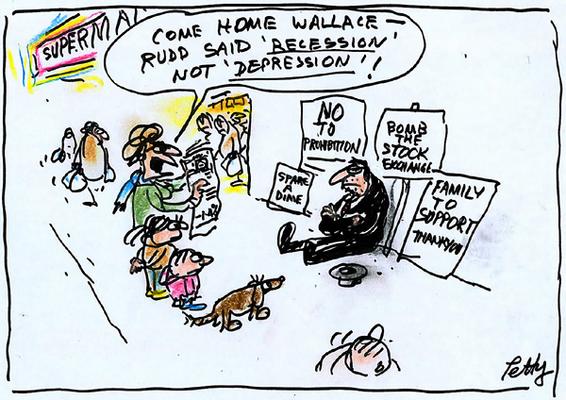 Bruce Petty
Turnbull argues thus:
At the end, after the vacation – the family that’s done that, they’re left with a debt and some snaps in the family album and some nice memories. The family, on the other hand, that borrowed the money to renovate their house is left with an improved asset and something of real value. And it’s exactly the same with nations, exactly the same with Australia. Debt which is incurred to fund investment in infrastructure that increases the productivity of Australia will, in time, pay for itself because it produces a stronger economy, it generates more jobs, more income and, therefore, more revenues to the Government.
The argument is designed to support Turnbull's position that main that implies the Rudd Government does not have are the building blocks of a strategy that is going to deliver that platform for growth that is focused on jobs, jobs, jobs .
Those building blocks are no more debt than is absolutely necessary, keeping the deficits as low as possible, having a plan to restore us to surplus and spending on infrastructure. The Rudd Government, he claims, is maxing the credit card to the tune of $300 billion, splashing the cash, and not spending on infrastructure.
One part of this is disingenuous. The so-called "cash splash"----ie., the stimulus package--- is working its way into the economy in terms of retail sales and pushing forward housing activity. It has softened the impact of the decline (ie., by propping up employment) until the "shovel-ready" infrastructure spending kicks in after next weeks budget. Turnbull is in effect claiming that stimulus package money is ill-spent --hence the phrase "cash splash"--because it is not invested in infrastructure.
Then we have the fear part about the burden of debt:
And this $300 billion means $15,000 of debt for every man, woman and child in Australia. So a family of four, it means $60,000 of debt. That’s what our children are going to be left with by the Rudd Government. It is a frightening prospect for them and it underlines the way in which this Government with its classically Labor addiction to debt has undermined our confidence as a nation, our economic confidence, and above all and worst of all impeded our capacity to recover from this downturn.
As Turnbull said on the ABC's 7.30 Report:
the problem with socialists is that at some point, as Margaret Thatcher said, you run out of other people's money. And that's the problem with the socialists running Australia at the moment: they've run out of the money that was left to them by John Howard and Peter Costello and now they've decided to max out the credit card. And if you think that that level of debt will not be a brake on our recovery, will not result in higher interest rates and higher taxes in the future, then I have to say to you that you're kidding yourself. This level of debt is a heavy burden.
Labor is reckless with money, Always has been. They are bad economic managers. Always have been. That's the Liberal Party's politics. Always has been. That is the subtext of Turnbull's message.
Posted by Gary Sauer-Thompson at 3:38 PM | Comments (10) | TrackBack
May 6, 2009
civic action
The green argument is that governments in countries such as Australia should be far more radical in their response to climate change. The core reality, it is stated, is that the limited government action in reducing green house emissions is proving to be inadequate to the scale of the problem. The inference is that the action is so limited that it represents of wilful neglect.
If the political reality is one of the Rudd Government standing firmly behind the coal industry and the heavy energy polluters at all costs, then there could be an emerging that civil action could well force the government to act. Is there a new social movement concerned to stop climate change emerging? Is there a potential for non-violent direct action on the climate issue to damage its reputation?
It is pretty clear that governments alone won't achieve a climate change agreement. It requires pressure from people in civil society to counter the Government's slack of courage to resist the business groups' begging bowl and resistance to action to limit greenhouse emissions.
I doubt that, Peter Garrett, the Minister of the Environment, will make a speech that calls on civil society to take action onvlclimate change, to put prressure on the Rudd Government to stand up to the heavy polluters.
Posted by Gary Sauer-Thompson at 7:10 AM | Comments (2) | TrackBack
May 5, 2009
Budget forebodings
We know that the global recession overshadows the Rudd Government's budget and that the recession will shape the series of reforms that had been set in place. So what is going to happen? Tax receipts are falling, welfare claims are climbing, the global recession has hit home and there are political commitments to meet, such as the pension hike. What will be pushed into the background?

Lindy Edwards in the The Age says that:
The big gamble of this budget is how deep the recession will be and whether stimulus can effectively offset it. Will some of the more benign local forecasts be right? Or will unemployment spike enough to drive a collapse in housing prices, unleashing a downward spiral and making the IMF's doom and gloom more prescient?
Edwards adds that a milder recession means that a good stimulus package might be enough to keep things on the rails.
However, not being able to escape the worst of the global downturn means that the stimulus money might disappear as a drop in the bathtub as we all go down the gurgler. If the spending isn't initiated quickly enough to avert the worst of the recession, there are no guarantees the Rudd Government will be re-elected.
One consequence of the budget is that we can kiss the education revolution goodbye. As Simon Marginson says most of the recommendations of the Bradley report on higher education and the Cutler report on innovation will be "postponed". Priority will be given to measures that extend the capacity of education to meet unemployment, and advance social equity.
Treasury, he says, is less interested in the education revolution than in growing exports and education is our third largest export sector in dollar terms, behind only coal and iron ore. Education earns more than wheat, beef, wool, gold, tourism and other staples. The growth of commodity exports has been slowed by the recession but education exports will grow in 2009 and look recession-proof, for the time being at least, and those educational exports will be supported at all costs.
Paradoxically it is the public underfunding on higher education that drives the exports since the universities seek to overcome the loss they make on domestic students with international students paying full fees. The price is the decline in the average student-staff ratio, from 15 to 20, and middling research capacity.
Posted by Gary Sauer-Thompson at 9:01 AM | Comments (12) | TrackBack
ETS: backflip
The emissions trading scheme has been delayed for a year. The global recession is the reason for the delay. Fair enough. But wait there is more. Labor will soften the beginning of the scheme with a low, fixed carbon price and a "global recession buffer" of aid for affected industries. They are looking more like the Liberals everyday as the changes are along the lines of what business and the Liberals had been urging. The reason? The global recession.

In the revised package, which the Rudd Government says strengthens the carbon pollution reduction scheme, will:
- Raise free permits to polluting industry from 90 and 60 per cent to 95 and 70 per cent in the first five years of the scheme.
- Fix the price of carbon per tonne to $10 for the first year and offer unlimited permits for that period.
- Provide $200 million to business for building efficiency programs in the next financial year.
There was a move away from brownness and defending the interest of the coal industry, as well as those businesses that will have to pay millions for carbon permits but do not pollute enough to qualify for free permit.
The strengthening spin refers to the heavily qualified pledge of a cut of 25 per cent of emissions on 2000 levels in the unlikely event the December Copenhagen Climate conference endorses an ambitious international agreement. Otherwise it’s the same deal as before: 5% if there’s no agreement, 15% if there’s an international deal short of the 25% cut plus conditions.
What can you say to this? That a mere something is better than nothing? Some sections of big business say that it is a step in the right direction but that it needs even more tweaking. The Liberals, Nationals and Minerals Council say that a fundamental redesign of the ETS is needed; ie., it needs to be hollowed out completely. But they hasten to add, they are all for environmental sustainability it is just that......
Posted by Gary Sauer-Thompson at 7:57 AM | Comments (14) | TrackBack
May 4, 2009
Defence White Paper: strategic confusions?
The Defence White Paper is a huge spend. Defence has identified $20 billion over the next 10 years in savings to help pay for the program. This means real savings of 5 per cent rising to 8 per cent on current costs, without which the program cannot be achieved. Who are they kidding? They haven't delivered in the past on the waste and inefficiency and they are notorious in being unable to make efficiency cuts.
The White paper appears to be geared to high end military conflict in conventional war scenarios that have little to do with the kinds of warfare that Australia has been involved in recently. So it depends on Australia's strategic future Hugh White in The Australian says that it recognises that Asia will be transformed by China's rise, identifies Australian strategic interests throughout the Asia-Pacific that could be threatened as Asia changes, and broadly understands that air and naval forces are vital to protecting them. He adds:
But the Government appears ambivalent and even muddled about what all this means in practice and what Australia should do about it. It is muddled about the future of American power. In some places the white paper says the US will dominate Asia until 2030 or beyond, but elsewhere it says that economic power is the foundation of strategic power and predicts that China could overtake the US economically as soon as 2020, which clearly suggests the opposite.It is muddled about whether China's military build-up is threatening or legitimate. One paragraph says it is natural for China's military reach to grow with its economy. The next says China's neighbours should worry if its reach extends beyond Taiwan. It is muddled about whether Australia's forces need to be able to protect us from China's power in future and, if so, how quickly that needs to be done.
The confusion is puzzling, since t is possible to explain clearly how China's growth changes Asia and raises our strategic risks without necessarily posing a threat of direct attack and what that may mean for the US role in Asia, for our US alliance and for our place in the region.
Posted by Gary Sauer-Thompson at 5:51 AM | Comments (2) | TrackBack
May 2, 2009
SA's gravy train?
BHP Billiton is going to press ahead with plans to turn its Olympic Dam mine in South Australia into the largest open cut mine on earth. Thus five stage expansion will help kick the SA's regional economy back into prosperity, even though the company is sticking to its plan to send uranium-infused copper concentrate to China for processing, if it moves ahead with the multi-billion-dollar expansion of the Olympic Dam copper, gold and uranium mine.
It's all a long way off though. Only the 400 page draft environmental impact statement has been released, and that says the project can go ahead on environmental grounds. That claims need to be assessed by the SA and Rudd Government's. An investment decision is sometime next year, whilst the project requires that BHP build a new desalinisation plant, a railway, additional port facilities, a gas-fired power station and remove the over-burden to convert the underground mine into an open pit.
It's spun as the gravy train for SA. But it is still Quarry Australia--just digging up rocks and shipping them overseas without any value adding. BHP will not go a step further and build a smelter that produces mineral in its almost-pure form, as it will sell its product as concentrate with the processing done offshore.
SA needs a rabbit pulled out of the hat because car manufacturing (GMH) is going into decline (two shifts have been reduced to one at the Elizabeth plant) and as bankruptcy hovers over General Motors in the US.
The other gravy train in SA is defence --building 12 new generation submarines--as part of the Defence White Paper's policy of defence self-reliance and increase in military hardware( frigates and destroyers). The White Paper makes clear that it is the ability to deter or defeat armed attack on Australia will continue to be the primary force structure determinant of the Australian Defence Force and that this means focusing predominantly on forces that can exert air superiority and sea control over our approaches.
Posted by Gary Sauer-Thompson at 12:22 PM | Comments (5) | TrackBack
spot the enemy
What a happy coincidence.
Yesterday, Possum on who voters trust on national defence:
The three historically strong issues for the Coalition – National Security, the Economy and Defence – have all been seriously trending against the LNP since the last year of the Howard government. If they continue trending for just one more polling cycle, it will be the first time ever that an Australian political party is seen as the best party to manage every major policy area.
Today, Greg Sheridan, of all people, likes what the ALP has done in the White Paper, but is concerned about funding.
Joel Fitzgibbon thinks that Australia can afford $100 billion for new defence toys, but doesn't have anything to say about what will be sacrificed in the process.
Malcolm Turnbull thinks it's a bad idea to upset China, particularly just at the moment.
Trevor Cook says it is electorally cynical:
This decision will re-make some of the basic architecture of Australian politics. It turns the ALP into the party of war hawks, outspending the conservatives on defence...In its better times the ALP has been the party of international co-operation and peace, now it’s funding a potentially dangerous arms build-up. That’s profoundly sad, in my view.
The Liberal Party supporters at the Poll Bludger have lost all hope:
What a crying shame. Our last bastion of credibility: national security. What does Turnbull do? Say there are no credible threats. The guy is an idiot.
Posted by Lyn Calcutt at 10:38 AM | Comments (3) | TrackBack
May 1, 2009
fear
Though I don't discount the possibility of a pandemic and support the precautionary public heath measures to prevent the spread of the Influenza A H1N1 (swine flu) virus, there is still an element of politics in this that plays into the politics of fear.
The politics is the constant repetition that The BIG ONE (apocalypse) is coming and this could be it. Then there is the standard reference back to the 1918 influenza pandemic, despite the differences: the existence of antiviral drugs, antibiotics or vaccine. The element of politics is scaremongering. This is it. These things happen in natural cycles.
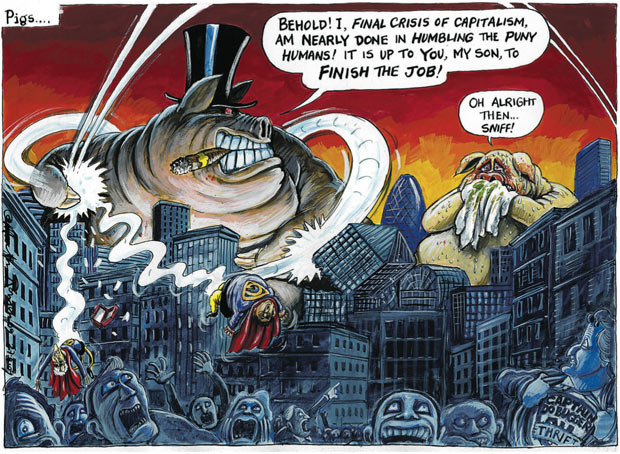 Martin Rowson
The media have certainly played it up even though the normal annual influenza kills far more people than the swine flu.In a typical year, 36,000 people die in the US from flu-related complications. Some 10,000 people die of influenza every year in Britain during the normal winter flu season.Every year approximately 10,000 Mexicans die from the effects of seasonal flu. The vast majority of the reported cases of Influenza A H1N1 have made a quick and full recovery after a mild and short illness.
Why the big fear then, when there there is no reason, as yet, to believe that we are on the brink of a similar disaster as 1918?
Sure, the target population that is dying from this is different from the normal flu, in that it is not the very young and old. But a pandemic? The number of cases world wide is low (275) as are the number of deaths (160) and 159 of those were in Mexico.
Someone says that up to 40% of the world could be infected. Others say that 120 million could die. How in the hell do they know? The epidemiological data is just not there. We do not know. Nor are we sure what the virus is. Is it actually the new emergence of a triple human-swine-bird flu virus? Or a variant on a hybrid virus we have seen before? Yet we have fantastical scenarios flowing through the airwaves and newspapers---an unconscious collective dread surfacing in the media.
Update
The standard reference to natural cycles in reference to influenza pandemics happening in 1889, 1918, 1957 and 1968 is also misleading. What is right is that through human history, viruses have mutated, and sometimes they have taken nasty forms that have swept through the human population. This is an inescapable natural reality we just have to live with, like earthquakes and tsunamis. However, things have shifted with industrial factory farms, as these become the incubator for viruses and their mutation. Thus:
In most swine farms today, 6,000 pigs are crammed snout-to-snout in tiny cages where they can barely move, and are fed for life on an artificial pulp, while living on top of cess-pools of their own stale faeces ... the virus now has a pool of thousands, constantly infecting and reinfecting each other. The virus can combine and recombine again and again. The ammonium from the waste they live above burns the pigs' respiratory tracts, making it easier yet for viruses to enter them. Better still, the pigs' immune systems are in free-fall. They are stressed, depressed, and permanently in panic, making them far easier to infect. There is no fresh air or sunlight to bolster their natural powers of resistance. They live in air thick with viral loads, and they are exposed every time they breathe in.
Instead of a virus only having one spin of the roulette wheel, it has thousands and thousands of spins, for no extra cost. It drives the evolution of new diseases. With the massive concentrations of farm animals within whom to mutate, the new swine flu viruses in North America appear to be on an evolutionary fast track, jumping and reassorting between species.
Update: 2
For those interested in the more scientific medical aspect of the flu virus could start by looking at the virology blog run by Vincent Racaniello, Professor of Microbiology at Columbia University Medical Center. He talks in terms of a novel strain of H1N1 swine influenza virus and adds:
The influenza season is nearly over in the northern hemisphere - it usually does not continue beyond May. Increasing temperature and humidity are likely to curtail transmission of the virus very rapidly. The same virus could return in the fall, but by then a vaccine could be produced and distributed.The southern hemisphere is another story - the influenza season there is just starting. It is certainly possible that this swine virus might cause extensive epidemics.
The phrase"'novel strain" is crucial since pandemic influenza has always been a consequence of viruses of a new subtype whereas the swine virus is of the same subtype as the currently circulating human H1N1 strain.
Posted by Gary Sauer-Thompson at 9:30 AM | Comments (9) | TrackBack