|
May 1, 2009
Though I don't discount the possibility of a pandemic and support the precautionary public heath measures to prevent the spread of the Influenza A H1N1 (swine flu) virus, there is still an element of politics in this that plays into the politics of fear.
The politics is the constant repetition that The BIG ONE (apocalypse) is coming and this could be it. Then there is the standard reference back to the 1918 influenza pandemic, despite the differences: the existence of antiviral drugs, antibiotics or vaccine. The element of politics is scaremongering. This is it. These things happen in natural cycles.
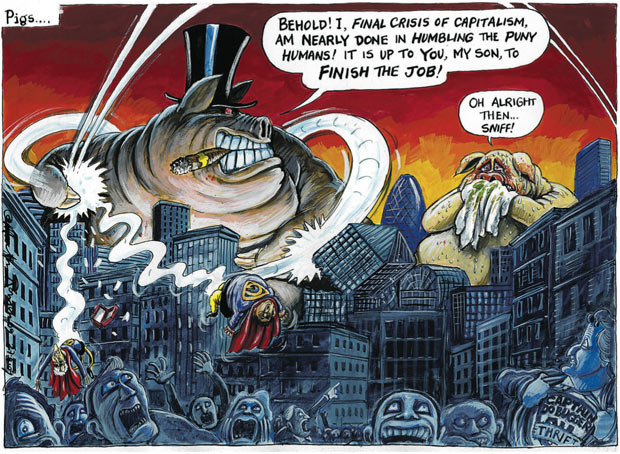 Martin Rowson
The media have certainly played it up even though the normal annual influenza kills far more people than the swine flu.In a typical year, 36,000 people die in the US from flu-related complications. Some 10,000 people die of influenza every year in Britain during the normal winter flu season.Every year approximately 10,000 Mexicans die from the effects of seasonal flu. The vast majority of the reported cases of Influenza A H1N1 have made a quick and full recovery after a mild and short illness.
Why the big fear then, when there there is no reason, as yet, to believe that we are on the brink of a similar disaster as 1918?
Sure, the target population that is dying from this is different from the normal flu, in that it is not the very young and old. But a pandemic? The number of cases world wide is low (275) as are the number of deaths (160) and 159 of those were in Mexico.
Someone says that up to 40% of the world could be infected. Others say that 120 million could die. How in the hell do they know? The epidemiological data is just not there. We do not know. Nor are we sure what the virus is. Is it actually the new emergence of a triple human-swine-bird flu virus? Or a variant on a hybrid virus we have seen before? Yet we have fantastical scenarios flowing through the airwaves and newspapers---an unconscious collective dread surfacing in the media.
Update
The standard reference to natural cycles in reference to influenza pandemics happening in 1889, 1918, 1957 and 1968 is also misleading. What is right is that through human history, viruses have mutated, and sometimes they have taken nasty forms that have swept through the human population. This is an inescapable natural reality we just have to live with, like earthquakes and tsunamis. However, things have shifted with industrial factory farms, as these become the incubator for viruses and their mutation. Thus:
In most swine farms today, 6,000 pigs are crammed snout-to-snout in tiny cages where they can barely move, and are fed for life on an artificial pulp, while living on top of cess-pools of their own stale faeces ... the virus now has a pool of thousands, constantly infecting and reinfecting each other. The virus can combine and recombine again and again. The ammonium from the waste they live above burns the pigs' respiratory tracts, making it easier yet for viruses to enter them. Better still, the pigs' immune systems are in free-fall. They are stressed, depressed, and permanently in panic, making them far easier to infect. There is no fresh air or sunlight to bolster their natural powers of resistance. They live in air thick with viral loads, and they are exposed every time they breathe in.
Instead of a virus only having one spin of the roulette wheel, it has thousands and thousands of spins, for no extra cost. It drives the evolution of new diseases. With the massive concentrations of farm animals within whom to mutate, the new swine flu viruses in North America appear to be on an evolutionary fast track, jumping and reassorting between species.
Update: 2
For those interested in the more scientific medical aspect of the flu virus could start by looking at the virology blog run by Vincent Racaniello, Professor of Microbiology at Columbia University Medical Center. He talks in terms of a novel strain of H1N1 swine influenza virus and adds:
The influenza season is nearly over in the northern hemisphere - it usually does not continue beyond May. Increasing temperature and humidity are likely to curtail transmission of the virus very rapidly. The same virus could return in the fall, but by then a vaccine could be produced and distributed.The southern hemisphere is another story - the influenza season there is just starting. It is certainly possible that this swine virus might cause extensive epidemics.
The phrase"'novel strain" is crucial since pandemic influenza has always been a consequence of viruses of a new subtype whereas the swine virus is of the same subtype as the currently circulating human H1N1 strain.
|





Yes if medical science is really no better prepared to help us through a bout of the flu than it was in 1918, its research priorities have been somewhat skewed for the last 80 years.
I sense the presence of eager departments of internal security, all keen to justify their existence and demonstrate how vital increased funding is even though the Islamobeasts don't seem to be blowing up quite as many people as they predicted. And as you suggest, politicians love any chance to do their calm guardian-of-the-nation shtick in response to any threat for which they can't be held responsible.