« March 2005 | Main | May 2005 »
April 30, 2005
the australian connection
Tony Blair has been forced to publish the Attorney General's crucial legal advice on the Iraq war in the last week of the election. In the newly published advice of March 7, Lord Goldsmith warned Mr Blair that the government would be vulnerable to legal action were a second UN resolution not secured:
"There are a number of ways in which the opponents of military action might seek to bring a legal case, internationally or domestically, against the UK, members of the government, or UK military personnel."
The attorney general had a lot of caveats in his warnings to Tony Blair about the potential dangers of going to war. Then Lord Goldsmith caved into pressure from No 10 because 10 days later, on March 17, Lord Goldsmith dismissed all his earlier caveats. And in a single bit of paper, in a parliamentary answer, he says that Iraq was in breach of its disarmament obligations. The legality of the war was no longer in question.
If the Iraq war has irupted then Blair himself has become an issue in the election campaign, thanks to the Australian connection of dirty dog whistle politics practiced by Lynton Crosby.

The Conservatives supported the war enthusiastically. They still support the war. They also think that it was a legal war.
However, a presidential Blair has failed to stem the Conservative-led assault on his battered integrity arising from his deliberate underplaying the known legal risks inherent in going to war against Saddam Hussein, when presenting these to parliament. He must have come close to misleading Parliament as the papers published for MPs were quite different to the legal advice of March 7, which the Blair Government has sought to keep secret.
Update
I've only been following the British election at a distance through the corporate media. By all accounts Labour should win. The Liberals, are hovering around 20% are likely to improve. The Conservatives are stuck at 30% and can't get moving, even though they, with Crosby's help, are doing their best to frighten people.
I have been reading this blog by Austin Mitchell's wife. Whilst campaigning in the Midlands (the Grimsby electorate) she observes:
This is the kind of street where "Our People" live. For a quarter of a century the party has told me this is where we must go to "get the vote out". These are supposed to be the people who will vote Labour whatever happens, but I don't think it's true anymore. These people are quite frankly fed up. The tellies bring the world of Westminster to them every night and they hate the sight of all those politicians promising the good life. Nothing ever changes round here. All these people are struggling through on two or three hundred pounds a week. Scrimping and saving to make ends meet. The promises of middle class lifestyles seem as far away as ever eight years after that landslide in May 1997. Can't help feeling that this will be the year when they will stay at home on polling day to try to teach us a lesson.
It sounds like the dynamic well-scrubbed Blairites have turned their backs on their traditional constitutency. This is the other election.
Posted by Gary Sauer-Thompson at 11:51 PM | Comments (2) | TrackBack
April 29, 2005
modernist water dreaming
For the return of more technocratic modernist dreams we only need to look at the way the states are dealing with water shortages arising from the declining rainfall in south-west Australia and the Perth region in the last decade or so.
Dams and increased storage capacity are back on the policy agenda. The Queensland Government flagged a new $149million dam, Wyaralong Dam, in the hinterland behind the rapidly growing Gold Coast, as part of its new $55billion infrastructure investment. Dams depend on rain in the hinterland or catchment.

Sydney, for instance, is faced with big water shortfalls and it keeps on talking about needing to build new dams to increase storage capacity. They are still in love with one big massive structure with a several billion dollar price tag. However, the decline in rainfall from a drying climate means that the rains aren't there to fill the dams already built. Though the water shortfalls will continue to increase, the NSW Carr Labor Government continues to resist recycling the storm and waste that gushes from the city drains into the sea.
Sydney's water strategy is one of finding more water to waste, rather than saving the water it already has. it highlight's the Carr Government's reluctance to reduce the megacity's ecological footprint and ensure environment protection, restoration and an improved quality of life.
Over in Western Australia they continue to talk about bringing water down to Perth from the Kimberleys. The Gallop Labor Government is seriously considering four options: various kinds of pipeline proposals including that Ernie Bridges; a canal; shipping water along the coast in tankers; and tugs towing water bags. The big projects for a big country means that there is very little mention of recycling storm and waste water, despite plans to build a desalinisation plant for Perth. At least Perth, unlike Sydney, recognizes that the big rains aren't going to return on a regular basis.
What seems to have been completely forgotten in all of this modernist infrastructure dreaming is the pricing water to reflect full cost recovery. Though that was an integral part of the COAG water reform process, it has been quietly sidelined. So the water reform process has stalled and old frayed dreams have become the new reality.
Update: April 30
An editorial in the Sydney Morning Herald talks straight.It says that we should not excuse the Carr Government's failure to deliver on water reform.
It has had a decade to confront neglect. Yet it still treats the city's water shortage as a short-term emergency, hoping temporary water restrictions will tide us over until a sustained downpour blesses the city's optimistically named "catchment" area. Crisis management is no substitute for a sustainable long term plan. This must begin with control of demand by firm regulation of use and pricing that properly reflects scarcity. These are not measures for the time being, but for the foreseeable future, to re-educate a community that for too long has been able to avoid the full seriousness of Sydney's water problems. But restrictions on private consumption have severe limits; what is needed is recycling.
It adds that the technology is there to re-use grey water, storm water and even sewage, to meet more of Sydney's water needs than will the proposed desalination plant.The desalination project perpetuates the flawed central thinking of last year's Metropolitan Water Strategy which, despite offering many welcome initiatives, put little emphasis on re-using water.
Posted by Gary Sauer-Thompson at 1:15 PM | Comments (1) | TrackBack
April 28, 2005
an old moderrnist dream returns
The modernist's technocrat dream was one of a nuclear powered for electricity generation, a thriving nuclear industry, and a nuclear Australia. A nuclear Australia would be a modern industrial Australia. By going nuclear Australia would be truely modern, and it would really be able to throw off the shackles of the 19th century agrarian past.

Spooner.
Alas, the utopian dream turned to a nightmare with the catastrophes of Three Mile Island and Chernobyl. Who wanted to live in dystopia?
Today the dream returns with a difference. Nuclear power is being hawked as the only solution to Australia's need for sustainable energy. Nuclear energy is held to be the only non-greenhouse-emitting power source that can effectively replace fossil fuels and satisfy consumer demand is the new spin.
Unlike some I would argue that global warming is a serious threat, even more so than global terrorism. It is a threat because the planet has a fixed capacity to absorb the greenhouse gases that are closely associated with that growth, and the damaging consequences of ignoring this fact are already evident. Given that emissions have to come down, the continuing promotion of energy-intensive activities and industries is a cause for concern.
But nuclear power as the only source of sustainable energy? Nuclear power as the only solution?
The nuclear power publicists say that those--like me---who think otherwise to them have dumped science, embraced raw emotion and sensationalism, and allowed themselves to be misguided. It is said that opposition to nuclear energy is based on irrational fear fed by Hollywood-style fiction, the Green lobbies and the media. It is then added that these fears are unjustified because nuclear energy, from its start in 1952, has proved to be the safest of all energy sources.
'The safest of all energy sources'? Solar power is not safe? It is at that point, where the technocrat's tired old reason/emotion riff, acts to dismiss renewable energy as irrelevant and useless, becomes publicity in the form of deception not enlightenment.
Yet nuclear power is still beset with insurmountable problems of risk, particularly in waste storage to be the solution to global warming problems. So both climate change and radioactive waste both pose deadly long-term threats. Should we not minimise the effects of both instead of an either or that says we can only choose between the two threats?
On the other hand, renewable energy is recognised as a key element of both national and state energy and greenhouse policies, and as an integral part of Australia's future energy mix.
What we need is a debate about global warming that addresses the increasing energy demand within the long-term context of climate change and its impact on Australia.
Posted by Gary Sauer-Thompson at 1:41 PM | Comments (6) | TrackBack
April 27, 2005
Is the ALP Right going feral?
The ALP Right has big plans to revitalize the federal party. It does need rejuvenation as the power has shifted to the states.
Now the bruvvers on the Right constitute a strange political animal with stange ways. We saw the strangeness here. That little policy proposal was about increasing the rate of the GST and broadening the GST by including food to help the states get rid of their own tax base. Now they have got more strangeness.
This time it is Bill Shorten, national secretary of the Australian Workers Union and aspiring MP. Bill is all about ditching the inner-city, chardonnay lefty set and getting back to basics.
Back to basics? What would that mean today? It means downplaying caffe latte issues such as the environment, refugees and multiculturalism? It means turning away from pseudo-Green left policies that play in only five or six inner-city federal electorates. It also means moving away from the (big) Left, returning to the blue collar base, and appealing to the centre or middle Australia? That is how I understand it. Confirmation
What are the policies then?
Shorten gives it straight in a recent speech. He said that the top personal tax rate should be brought into line with the 30 per cent rate paid by companies. Presumably this is how Shorten understands the ALP being the party of the big economic ideas that give confidence to all Australians. Presumably tax cuts come before increases in publicly funded health care and education.is that what Shorten means when he says that its time for the ALP to move to the Centre of Australian politics by focusing on the broad economy.
Apparently he also said the rich should pay less tax, taxpayers should fund wealthy private schools and the Medicare rebate should be scrapped.
Back to basics as an agenda for renewal? It's a sharp contradiction to ALP policy and values don't you think? What is the ALP Right up to, embracing the basics of the Liberal Party, in the name of Labor Unity. That embrace implies that the goals of public policy are to promote prosperity and ensure that Australia becomes the wealthiest nation in the world.
Shorten was giving his ideas on on how Labor could win the next election in marginal Labor seat of Isaacs, in Melbourne. Honestly, I cannot see how becoming a neo-liberal clone of the Liberal party will get the ALP re-elected. Shouldn't the ALP be different from the Government? Isn't that the tried and tested strategy?
Posted by Gary Sauer-Thompson at 11:09 PM | Comments (2) | TrackBack
not a good idea
I first heard it mentioned on Radio National as Tim Fisher's big idea. What wass presented was Australia's version of a Mt Rushmore-style rock carving as a memorial to Sir John Monash, one of Australia's more successful generals from World War One.
The former deputy prime minister has even selected a possible site for the gigantic rock carving - just below the snow line in Victoria's High Country.

I think that we can let that big idea float bye don't you. There must be other ways of honouring Monash.
And Tim Fisher? Well I read his book Outback Heroes. T'was about the struggle for survival of small Australian towns, why some are succeeding and some didn't, positive thinking, the will to succeed, and our dreams becoming reality.
McLaren Vale featured in the book with Fisher celebrating the innovative export-orientated wineries. He gave an upbeat account without even considering the sustainable use of ground water in the McLaren basin. Yet the basin had been run dry from overuse. Sustainability was not a big concern for the ex-Leader of the National Party.
Posted by Gary Sauer-Thompson at 4:32 PM | Comments (6) | TrackBack
April 26, 2005
where's the economic analysis?
At long last. The media are now reporting on the imbalances in the international economy in the relationships between the US and China. Radio National reported on the issue this morning. I listened to the report with interest as we drove back to Adelaide from Victor Harbor.
The report did not really focus on the US's out-of-control trade situation, even though the US trade deficit is on track to be around $700 billion for this year.

The report broke new ground in that it gave a space for Chinese voices to speak on the issue, and an explanation that the Chinese need to keep their economy growing at 7-9% in order to absorb their labour force. Can they sustain that level of growth? The question was not asked.
However, it was basically a recycling of the American position: it was all about the bad Chinese not floating their yuan and the poor American manufacturers suffering terribly from being so competively disadvantaged. A revaluation that reduced East Asia’s current account surplus was presented as the only option. That was the only reason presented for the slowing of the US economy.
The critical tone in the piece was directed at the Chinese not the Americans. The assumption of the report was that the US huge trade deficit, due to imports growing much faster than exports, was not an American problem. It was a Chinese problem.
There was no mention of the possibilities of dramatically growing US exports, or the possibility of a marked reductions in US import consumption (i.e. a US recession) through increased interest rates, due to US consumers living beyond their means. The question: 'why are US exports to countries, such as Canada, the EU, Mexico and Japan, stagnant?', was not even asked. Nor was any mention made of the US dependence on the export of its debt to finance its enormous trade deficit, or the need for the US to raise interest rates to ensure that East Asian central banks keep on supplying about 3/4 of the net financing of the US current account deficit
I'm now convinced that Australian journalists have little understanding of the workings, imbalances and relationships of the global economy. That is why they provide no analysis. That is why they just repeat the American spin as economic analysis.
Posted by Gary Sauer-Thompson at 8:29 AM | Comments (13) | TrackBack
April 25, 2005
Anzac Remembrance
'Tis Anzac day.
I planted trees in the public reserve outside the holiday shack at Victor Harbor early this morning. It was my way of countering the history of forgetting and the appropriation of the Anzac tradition by the culture industry.
Gallipoli is now well established in Australian nationalist mythology, but not as romantic success. Gallipoli is seen as a defeat in which Australian troops proved their valour and forged a new country. It is a foundation myth of the Australian nation: heroes who died for freedom.
Hence war is celebrated by the conservatives who say that it is sweet, proper and noble to die for your country. This kind of patriotism celebrates Australia as a warrior nation, whose sons are willing to sacrifice themselves for heroism. The diggers are the noble warriors, and the Legend pits the commitment to nation, duty and mateship against the effete, anti-war, inner city urban lefties.
Now we can think otherwise to this heroic narrative of the conservative keepers of the patriotic flame:

One can be opposed to bad wars and still celebrate Anzac Day: not by remembering it as a "legend of failure"; but by remembering all those innocent lives lost on both sides. One can, and should remember the horror and pain of this war. One should not forget this history.
These lives were wasted on behalf of the bad imperial strategy of the British, which was designed by Winston Churchill, when he was at Admirality. His strategy to knock off the Ottoman empire by capturing Instanbul (Constantinople) from the sea with some big battleships was an utter failure. The straits were mined and the Turkish forts that guarded the sea entrance to the Dardenelles. Hence the need to land some troops to capture the forts.
The lives of the young men were sacrificed by politicians, generals and sealords. It was not worth it. That is the history that should not be forgotten amidst all the mythmaking.
Update: 26th April
The editorial in The Australian says that Australians' interest and respect for our military heritage has changed over the last decade. This:
....was a change for the better, demonstrating how we had become a more reflective country, capable of remembering, and honouring, past achievements in an imperfect world. Anzac Day is truly the one day of the year, the date on which Australians assert their love of country and offer respect to all those who have answered the call to defend it.
So, as a more reflective nation at ease with our Anzac heritage, we can think in terms of strategic policy formation about national security. In the light of the invasion of Iraqi we can, and should be, asking ourselves a simple question: 'what stategic national interest was Australia defending at Gallipoli?'
After all, Gallipoli also stands for an invasion of a foreign country in the Middle East,even though Turkey did not threaten the national security interests of continental Australia.
Some commentary can be found at philosophy.com and John Quiggin
Posted by Gary Sauer-Thompson at 2:01 PM | Comments (2) | TrackBack
April 24, 2005
Israel: The Wall
Israeli/Palestinian politics have a low profile in Australia. When the conflict does surface in the media it is the Israeli perspective that is adopted as a given. The issue of the Israeli wall is a case in point.

The Israeli The Wall snaking across the West Bank. (Photo: Arjan El Fassed)
By August the wall surrounding East Jerusalem will be in place thereby cutting it off from the West Bank. The Palestinians who live there will be able to leave only with permits. The centre of life in the West Bank will become an enclosed prison.
Tanya Reinhart says:
According to United Nations data, 237,000 Palestinians will be trapped between the wall and the Green Line and 160,000 others will remain on the Palestinian side, cut off from their land...What is to be expected for those people, for the farmers who lose their land, for the imprisoned who are cut off from their families and their livelihoods?
Presumably, they will live in poverty in the West Bank.
Posted by Gary Sauer-Thompson at 1:46 PM | Comments (0) | TrackBack
April 23, 2005
Israeli disengagement
The process of Israeli disengagement from the Gaza Strip, which involves the relocation of thousands of settlers–--some unwilling--- and their homes, jobs, businesses and schools, has been postponed. The pullback from the Gaza Strip has been delayed until the latter half of August.

So for now the disengagement from Gaza exists only on paper. On the ground, no settler has yet received compensation, even those who agreed to accept compensation are still waiting.
The disengagement plan specifies that "Israel will supervise and guard the external envelope on land, will maintain exclusive control in the air space of Gaza, and will continue to conduct military activities in the sea space of the Gaza Strip". In other words, the Palestinians will be imprisoned from all sides, with no connection to the world, except through Israel. Israel also reserves for itself the right to act militarily inside the Gaza Strip. In return for this "concession", Israel would be permitted to complete the wall and to maintain the situation in the West Bank as is.
That leaves the Palestinian Authority and its leader, Mahmod Abbas, with little authority and power to prevent a descent into the morass of disorder and revolt.
Posted by Gary Sauer-Thompson at 7:58 PM | Comments (0) | TrackBack
April 22, 2005
it's not just dodgy backs
In an article in the Australian Financial Review Marcus Priest tackles a key problem in the welfare-to work reforms. He says:
...the problem for government is not just that there are a larger number of people receiving DSP [Disability Support Pension], but that those receiving DSP are overwhelming older males who have been out of the workforce for an extended period. During this time out of the workforce, many skills possessed by DSP recepients have become increasingly out of date as workplaces and technology rapidly change--making it even harder for them to return to work.
The unskilled blue-collar jobs took the brunt of the economic reforms of the 1980s. That has been the product of the restructuring over the last 20 years.
This skill deficit problem is compounded because many of those on DSP, who have come from the unskilled and semi-skilled blue collar professions, also have musculoskeletal and pyschological (eg., depression and lack of confidence) conditions.
There's an opening for primary health care to help restore wellbeing. Would the Treasurer pay for that?
The upshot is those who are on DSP require extensive assistance if they are to re-enter the workforce to work in the jobs in the new service economy. However, the funding is not there for the intensive assistance required.
So, for all intents and purposes, the DSP has been operating as a de-facto early retirement scheme.
Posted by Gary Sauer-Thompson at 5:06 PM | Comments (0) | TrackBack
April 21, 2005
hard road ahead
I was having a coffee in Adelaide this morning on the way to work and I glanced through today's AFR. Bob Hogg, a former national secretary of the ALP, has an op.ed which outlines a bold new reform agenda that he reckons the Howard Government should adopt.
I'm always interested in the policy advice the ALP's ex-movers shakers offer to their political enemies. Peter Walsh and Gary Johns come to mind.
Hogg says that his reform agenda is one that requires a lot of political courage, but the country requires it. The opportunity to implement the tough new reform agenda has arrived as the control of the Senate passes to the Howard Government this July.
That caught my eye. What then is the agenda? No no, it's not about Australia going nuclear to ensure sustainable energy. Hogg's concern is state taxes and the GST. Hogg's policy advice is:
Howard should increase the rate [of the GST] to 12.5% and seek to make it variable by plus or minus 1 per cent. Food should be included in the GST regime, with an appropriate compensation package. In return, the states would have to agree to to either remove or substantially reduce stamp duties on housing, as well as removing other inequitable taxes.
Wow! An ex-ALP national secretary is saying that? That makes him such a good neo-liberal bedfellow with Senator Minchin, the Finance Minister. Nay, Hogg is further to the right than Minchin in defining what 'economically responsible' is.
Now this is not a clever way to help defeat the Howard Government by raising gungho reform expectations within the Government that would then be difficult for Howard to manage. Hogg actually believes this approach to tax reform is the right and proper thing to do for the country.
Posted by Gary Sauer-Thompson at 4:28 PM | Comments (4) | TrackBack
April 20, 2005
debating global imbalances
Finally, there is some commentary on international global economics in the Australian press. In an editorial in yesterday's AFR it was stated that:
Once again, the global economy is traversing risky terrain, in large part due to the failure of policy makers to redress economic imbalances....Only last weekend the G7 issued another communique urging member nations to vigorously pursue economic reform. The requirements are well known: the US to tackle its budget deficit, Europe and Japan to breathe new life into their moribund domestic economies; Asia to boost domestic demand and free up exchange rates. Once again the call to reform may fall on deaf ears. If so, it leaves the risk of a destablising correction in the US dollar, increases in US interest rates and slowing global growth.
There is nothing about the US needing to reduce its current account deficit. Does this mean that reducing the fiscal deficit will tend to reduce US domestic demand growth and that will, in turn, will bring the trade deficit down.
We find a similar line here:-the argument that it is China's fault as it needs to revalue its currency. The US Treasury line is being recycled with little critical awareness. Does this signify the view that the US current account deficit does not matter? Or is the deficit a sign of strength, not a potential weakness? The implication is that there is no need for precise commitments from the US to reduce the deficit.
Is this the case? Are there alternative approaches?
In an op.ed. in the AFR Malcolm Cook and Mark Thiriwell say that:
The US is increasingly reliant on Asia to fund large external deficits which in turn leaves Asia increasingly exposed to any adverse dollar movements. One result of this codependent relationship has been that the central banks of China, Taiwan, South Korea and India are the world's largest holders of foreign exhange reserves. This leaves Asia as a key player in determining the value of the dollar and hence the stability of global monetary conditions.
So how do we address the global imbalances? Cook and Thiriwell do not say.
An alternative approach is the symmetric adjustment.Brad Setser says that this involves:
adjustment by both the surplus country (China) and the deficit country (the US), rather than adjustment by just the surplus country or just the deficit county. Adjustment by the surplus country alone -- a Chinese revaluation without any change in US policy to reduce its need to borrow savings from the world -- risks leading to large rises in US interest rates, as China would have less savings to lend to the US, while the US need for savings would remain unchanged. Adjustment by the deficit country alone -- a US fiscal retrenchment without any offsetting changes in the rest of the world -- risks leading to a contraction in global demand and slower global growth. That would slow US export growth: the trade deficit would fall, but because of falling imports, not rising exports …
Posted by Gary Sauer-Thompson at 11:12 AM | Comments (0) | TrackBack
April 19, 2005
These guys have got problems
Well, I guess its all right to go around the world kicking butt whilst playing at being the deputy sheriff in the Pacific Rim. But, suprise suprise, some of our neighbours do not like their butt being kicked:

All that macho pre-emptive strike cowboy stuff just hasn't gone down well around the Pacific Rim. Australia has been ostracised. It merely echoes the neocons in Washington.
Hell, what if China embraced the pre-emptive strike doctrine with enthusiasm? What then? I recall that Downer stuck his neck out in Adelaide during the federal election when he said that he had no problems with our neighours employing pre-emptive strike to hit the Kimberley's to wipe out the terrorists. For China terrorists means the Tibetians, does it not? And that means....
Let us just say that problems begin to abound everywhere with that kind of reasoning. So it is good to see that others in our region have more sense and are willing to bring the hot heads to heel.
Posted by Gary Sauer-Thompson at 11:11 AM | Comments (0) | TrackBack
Treasury is running health policy
I flickered through the Sydney Morning Herald this morning in Canberra, as I don't generally see the print edition in Adelaide. I came across Louise Dodson's article about the fourth term agenda of the Howard Government. Dodson is a senior journalist at Fairfax and so she knows what's what in politics.
She makes two points that I found of interest. She says that the Federal Treasurer, Peter Costello, is:
"...increasingly behind most of the Government's fourth-term policy agenda. He was the first to publicly back increased skilled migration, he has been pushing for greater participation in the workforce by encouraging older people and those on welfare to work, he has raised the issue of infrastructure bottlenecks and he has been advocating productivity increases through industrial relations changes."
I concur. But it is broader than this kind of economic policy, as Treasury has also grabbed hold of health care policy and placed it under the sign of fiscal sustainability.
We can see this from the second point that Dodson makes. She says that this economically-driven policy agenda has its roots in:
the Treasury's inter-generational report three years ago warning of the impact of the ageing population. Since then Treasury's mantra for improving the economy has been population, participation and productivity.
That 2002-3 Report was Budget Paper (No.5).The core argument was that the federal government "will need to make policy adjustments to maintain a sustainable fiscal position over the next four decades."
Dodson sees the population, participation and productivity drivers, which are the levers the Report says will help to reduce future budget pressure. Suprisingly, Dodson misses Treasury's emphasis on Australia's steadily aging population placing significant pressure on Commonwealth finances; and that technological advances in health care, plus community expectations of accessing the latest health treatments, would place increasing demands on taxpayer funds.
Dodson misses health stuff entirely. She is more focused on Costello's leadership challenge.
The detail of this skeletal policy framework of health care as a financial burden weighing down on younger generations is being sketched in by the Productivity Commission Reports. The core of
Treasury's Intergenerational Report is that the budget pressure from health care can be alleviated or eased by the effects of increases in population, participation and productivity. These drivers will help to grow the economy.
Had Dodson actually read the Intergenerational Report closely (Part IV, p.57), then she would have seen that Treasury's projections indicate that it is health and aged care costs that are going to blow the federal budget big time. It will be increasingly larger deficits from 2014 onwards, due to costs outrunning revenue. Disaster beckons.
Now Treasury's goal is to maintain an efficient and effective medical health system, complimented by widespread participation in private health insurance.Treasury is different from the Department of Finance run by bean counters, as it says that its aim is to manage economic policy to improve the wellbeing of Australians in a way that can be sustained over time.
However, wellbeing as the end of economic policy can only be achieved within the limits of ensuring that future generations of taxpayers do not face unmanageable bills for government services to the current generation. And those bills will become unmanageable after 2015. So we have to do something now by way of making cost savings to the health budget. This is being economically responsible. That is the new policy mantra.
I guess that Dodson is good on politics (leadership) and poor on policy.
Posted by Gary Sauer-Thompson at 10:42 AM | Comments (0) | TrackBack
April 18, 2005
what is going on?
I presume the PM is farewelling the navy as it starts yet another tour of duty in the far away Middle East? 'Trust us guys, we'll look after you', he seems to be saying.

Shouldn't our sturdy Australian conservatives be worried about the military buildup in China?
The Chinese are modernizing their army, building missiles, going high tech, stirring the regional pot by clipping the wings of our Japense ally in the Middle Eastfor regional ascendancy, and crusing our Pacific in their submarines. Soon the Chinese will be able to take out Australia's North West Shelf, and launch air attacks on our friends in the US.
And what are we doing to defend our national resources in the face of the threat from the north? Why, the Canberra politicans are running down our military equipment (F-lll and Sea King helicopters) instead of muscling up, that's what. We are even going to backflip on pre-emptive strikes on our Asian neighbours and give up being deputy sheriff for the US in the Pacific Rim.
Things are drifting, the centre no longer holds, and we've lost touch with our true Australian values. Greg Sheridan has gone missing in action; Tim Blair is nowhere to be seen; Andrew Bolt is preoccupied with art; Janet Albrechtsen is caught up in her obsession with judges; whilst Miranda Devine is watching wrestling on tv.
Posted by Gary Sauer-Thompson at 2:24 PM | Comments (0) | TrackBack
global economic imbalances
The IMF is concerned about global imbalances. The G7 communique says that vigororous action is needed to address global imbalances. A correction coming up if the problem is ignored. What are they talking about?
Stephen Roach puts it simply and well:
"There seems to be no end in sight to the widening of America’s gaping external imbalance. A record $61 billion trade deficit for February is only the latest in a long string of warning signs for an unbalanced US and global economy. The rebalancing required to temper these deficits requires significant adjustments in macro policies. Yet with America’s fiscal and monetary authorities basically frozen at the switch, politicians are asserting greater control over the adjustment process — firing one protectionist salvo after another. The tradeoff between policy adjustments and political actions lies at the heart of the sustainability debate for ever-mounting global imbalances. A tipping point could be close at hand. There’s really no other way to put it — the latest trade numbers in the US were simply terrible."
Brad Setser thinks that the US external trade imbalance will be worse in March, as there is no evidence of a slowdown in US imports. General Glut says that the key concern is the stagnant US export performance of late. Will the gap between import growth and export growth continue to widen? The disturbing point is that the U.S. trade deficit continues to widen, despite dollar depreciation.
As gloom settles around Wall Street over the stockmarket fallout, investors panic, and fears about it getting ugly circulate on finance street, the policy response by Congress to the US deficits is to remain firmly within its protectionist tradition.
The global economic situation is one in which the world’s leading economic power is running chronic trade deficits and is the world's largest foreign debtor. The US economy is living dangerously beyond its means and fiscal and monetary discipline is needed to avoid a big debt/dollar crisis. What Roach calls tough love.
This situation stands in sharp contrast with the experience in the first "golden era" of globalization in the years leading up to World War I. In that earlier period, trade was the engine of economic development as assets were shifted from colonial powers to their newly settled colonies. Today, it is the surpluses in the Asian developing world that is funding the chronic deficits in the US through the mechanism of capital inflows.
A sign of the shift in global economic power is this piece of news in the Washington Post:
"The Bush administration yesterday stepped up its appeals for China to let its currency rise, as pressure mounted in Congress for tougher action on a host of Chinese practices that allegedly fuel the burgeoning U.S. trade deficit."
Note "appeals". The US cannot kick butt. It does not have the power to do so. And the G7 talks in terms of coaxing.
Of course, what the US should really be doing is getting its own house in order. Yet there is very little evidence of that. As Brad Setser says "America’s fiscal and monetary authorities [are] basically frozen at the switch." That is political paralysis in the face of growing debt problems isn't it?
That means a correction is coming up, doesn't it.
Posted by Gary Sauer-Thompson at 9:14 AM | Comments (0) | TrackBack
April 17, 2005
clever
I watched the ABC's Insiders this morning. It is something I rarely do as I hardly ever watch the Sunday morning current affairs shows on free-to-air television. I'm generally online reading this kind of material.
Most of the commentary on Insiders was devoted to the Medicare backflip and the implausible justification given by the Government about just becoming aware of the "economic blowout" of the Medicare safety net and the Government needing to be economically responsible.
There was a section on Insiders called Talking Pictures which discussed the week's political cartoons with Bruce Petty. That is innovative section as some of the best commentary in Australia is by the cartoonists. Why not bring in cultural studies academics to comment?

Matt Golding
Very clever don't you think?
The significance of the backflip is pointed out by Michelle Grattin in The Age. With control of the Senate, the Howard Government, "is not just determined, after July 1, to get through legislation that's been rejected; it will feel free, when it chooses, to unpick and redo things previously legislated after compromises." It's called rollback.
Posted by Gary Sauer-Thompson at 12:34 PM | Comments (2) | TrackBack
Iran, energy, geopolitics
I've always found it odd how infrequent oil figures in the geopolitics of the Middle East in the corporate media in Australia. The geopolitics of energy is a non-subject.
It should figure more given that the industrial economies of the West are dependent on oil, the Middle East has lots of oil in reserve, the oil prices just keep rising, we are fighting a war over in Iraq as part of an occupying force, and the US is gearing up for an attack on Iran. There have also been reports of talks between U.S. and Israeli officials about a possible Israeli strike on Iranian nuclear weapon facilities.
So it is refreshing to read this Oil, Geopolitics, and the Coming War with Iran by Michael T. Klare over at Tom Dispatch. He says that:
Iran occupies a strategic location on the north side of the Persian Gulf, it is in a position to threaten oil fields in Saudi Arabia, Kuwait, Iraq, and the United Arab Emirates, which together possess more than half of the world's known oil reserves. Iran also sits athwart the Strait of Hormuz, the narrow waterway through which, daily, 40% of the world's oil exports pass. In addition, Iran is becoming a major supplier of oil and natural gas to China, India, and Japan, thereby giving Tehran additional clout in world affairs.
These geopolitical dimensions of energy, as much as Iran's potential to export significant quantities of oil to the United States, that would govern the Bush administration's strategic calculations. Iran will play a critical role in the world's future energy equation. Why so?
While the world currently consumes more oil than gas, the supply of petroleum is expected to contract in the not-too-distant future as global production approaches its peak sustainable level -- perhaps as soon as 2010 -- and then begins a gradual but irreversible decline. The production of natural gas, on the other hand, is not likely to peak until several decades from now, and so is expected to take up much of the slack when oil supplies become less abundant.
China, India and Japan have signed long term contracts with Iran to supply gas to fuel their economies.
The significance of this account of the geopolitics of Iran is that pulls into focus the Bush administration officials two key strategic aims: a desire to open up Iranian oil and gas fields to exploitation by American firms, and to try and block Iran's growing ties to America's competitors in the global energy market. From the Bush administration's point of view, the obvious and immediate way to achieve these aims is by inducing "regime change" in Iran and replacing the existing leadership with one far friendlier to U.S. strategic interests. That was the situation with the authoritarian Shah of Iran, prior to the Iranian revolution.
Australia, as a loyal ally, supports the US on this. Our foreign policy in the Middle East is all the way with the good ole USA. We presuppose that Iran constitutes a regional threat and consider it right and proper that America should eliminate this threat.
Posted by Gary Sauer-Thompson at 11:54 AM | Comments (3) | TrackBack
April 16, 2005
Medicare rorting
The fallout from the Howard Government's Medicare safety backlip continues about commitments that were:

The anger and criticism is justified because the Howard Government knew about the cost of the safety net, and that it would be extensively used by the middle class going to see the specialist. They were prepared to wear the cost and they trusted the specialists to do the right thing.
I mentioned here that all the fuss being made about economic responsiblity, economcially sustainable health system, the broken promises, the lack of political credibility and the bucket loads of deceit and spin obscures the real issue whichis what is being ignored: the open rorting of Medicare by the specialists.
Well The Australian carries a report of the rorting by Adam Cresswell. Cresswell says that a medical specialist has accused his fellow specialists of fuelling the safety net blowout by charging hundreds and even thousands of dollars extra to the scheme - a direct challenge to the Government's claims that medical bills are not rising.
In a rare example of a doctor breaking ranks, the specialist said he knew of one case in which a doctor planning a patient's breast reconstruction surgery had charged $5000 for a preliminary consultation that was normally bulk-billed.The operation itself, which normally cost $5000, was then peformed for just $10 - a reversal of charging practice that ensured the vast bulk of the fee came under the safety net scheme. Because the safety net covers out-of-hospital costs but not in-hospital costs such as operations, the arrangement meant the patient could have recouped up to 80per cent of her out-of-pocket charges from the safety net.
Rorting is common practice, not an isolated example, and its existence is well known in policy circles. It often takes the form of increasing the (AMA-recommended) fee for a consultation of $130, to multiples of that ($500) as a way of transferring the in-hospital gaps on to the safety net.
This corruption highlights the flaw in current health policy that is not being addressed.
A lot of commentary repeats the Treasury line that:
"...the overriding aim of health policy should be to control demand - and its impact on the price of services. How else are governments to have any hope of managing soaring costs driven by escalating patient expectations?"
Given this kind of economic reasoning what is suprising is the silence of the Howard Government, the AMA and the ALP about this rorting, even though the Health Insurance Commission, which administers Medicare, has issued warnings to some specialists about their obsene behaviour.
If you were serious about containing costs, then you would seek to remove the rorting of crony capitalism in which a trade union has captured the Canberra Health bureaucracy and runs health policy. So I'll repeat my charge.
Both the Howard Government and the ALP lack the political courage to take on the AMA and clip its trade union wings.
Posted by Gary Sauer-Thompson at 12:04 PM | Comments (0) | TrackBack
April 15, 2005
privatisation US-style.
The big issue in the US is the Bush administration's policy to partly privatise Social Security by directing some of the Social Security payroll taxes to accounts invested in stocks and bonds.
Under one version of the President's reform, younger workers (under 40) would be allowed to opt-out of most of their social security payroll taxes. Instead they would put aside 4% of their income in a personal retirement account which they could invest in the stock market. The workers can dabble in stocks and shares, earn some good money, and become new stock-owners.
This Republican proposal is seen as as the first step to the complete privatisation of social security.

Presumably the Wall Street free marketeers would say that the government has no business running an insurance service. The welfare state should be opposed on principle as the free market always yields the best of all possible worlds. So it is a good idea to allow workers to invest their Social Security contributions in the stock market. Support the Republican privatization plan and help build an ownership society.
I mentioned the welfare state. To the average yank that means all that hammer-and-sickle/ socialist stuff so loved by the foreign Europeans. It means the kind of state interference that is not tolerated in the freedom-loving USA, where a man stands on his own two feet, fends for himself and fights to ensure that everyday life is free from Big Brother.
Posted by Gary Sauer-Thompson at 3:48 PM | Comments (2) | TrackBack
public health & Treasury's hand
The health 'crisis' is usually represented as being one of rapidly rising spending on health care generally, and not just the public part of health care currently paid for by taxpayers. Health costs are escalating. Something has to be done.

Rising health care spending is due to both medical price inflation (eg., specialists such as radiologists and obstetricians) and the increase in the range of things that medicine can do with better technology.
The news today is that the Howard Government lifting the Medicare threshold for out-of-pocket medical expenses incurred out of the hospital. Families, pensioners and health card holders will now have to spend $500, up from $300, before the government picks up 80 per cent of the tab.For others the threshold will be lifted to at least $1,000, up from $700. The reason is a budget blowout.
That is the hand of Treasury. And the ALP follows the Treasury line by saying it is unsustainable and the Howard Government always knew it to be so.
What is being ignored is the failure by Tony Abbott to address the rising costs due to the medical price inflation caused by specialists increasing their fees. These price increases need to be capped and the rorts stopped. As there is no health regulator for the private health industry the market rules. What should be addressed is the lack of courage in tackling the AMA union.
The AMA is silent on this rorting. Sure it condemns the increases in the safety net threshold in the name of good medicine. But it protects its own by saying nothing at all about obstetricians changing their billing practices so that inhospital maternity costs not covered by Medicare are restructured as outpatient consultation fees.
And the senior journalists in the corporate media? How are they holding the Howard Government accountable? Louise Dodson in The Sydney Morning Herald merely reports the issue. Michelle Grattin in The Age concentrates on the broken promises and says nothing about tackling the specialists.
The Australian's editorial touches the issue then shies away to follow the Treasury line:
"The Government's decision can be criticised by doctors who assume the health of their bank balances is an excellent indicator of national wellbeing. And arguments it will hurt people who make most use of the health system are incontestable. But as it stands, the costs of the safety net cannot be contained, and this may not be the last change we see in the life of the Government. Mr Howard mistook throwing money at problems for a health policy in the last election campaign. All taxpayers, not just people who benefit from the safety net, are now paying the price of his profligacy."
Few are willing to take on the specialists. Not even the health economists from Australia Institute (Richard Deniss) or the Monash University Centre for Health Economics (Jeff Richardson). Only the Doctors Reform Society is willing to call a rort a rort.
Posted by Gary Sauer-Thompson at 12:56 PM | Comments (0) | TrackBack
April 14, 2005
Murdoch, media, internet
I came across a recent speech by Rupert Murdoch over at Margo Kingston's Webdiary, along with comments by some US bloggers.
The speech to the American Society of Newspaper Editors makes some good, informed points about the digital changes taking place in the mediascape. This is a world in rapid flux, despite the Howard Government's fetters imposed on digital TV to protect commercial free-to-air TV.
Murdoch's primary concern is with the survival of newspapers in a digital world. He opens by saying:
What is happening is, in short, a revolution in the way young people are accessing news. They don’t want to rely on the morning paper for their up-to-date information. They don’t want to rely on a God-like figure from above to tell them what’s important. And to carry the religion analogy a bit further, they certainly don’t want news presented as gospel.
Instead, they want their news on demand, when it works for them. They want control over their media, instead of being controlled by it. They want to question, to probe, to offer a different angle.
The corporate media have been slow to respond to this critical way of reading the media. Hence their declining circulation, the constant staff downsizing, the dumbing down of reporters into hacks and their decreasing relevance in a digital world. Thus a new publication in Adelaide, The Independent Weekly, which aims to provide a different approach to Murdoch's tabloid Advertiser in South Australia, has no substantive online presence. It's irrelevant to me.
The solution?
As you would expect Murdoch is up to the challenge. He says that today's newspapers (eg., The Australian and The Age are just papers. Tomorrow, they can be a internet destination. By this he means that instead of people traditionally starting their day with coffee and the newspaper, in a digital world they will start their day online with coffee and a newspaper website.
That's me now. I start at 6.30 am. I basically see the journalists and the op.ed commentators as a starting-point for a discussion about on-going topics.
What I find offered by The Australian broadsheet is pretty thin web presence. I scan the site in minutes then move on. Some newspapers (Australian Financial Review) are even locking up their online content behind paid registration walls, instead of freeing up archives for use in the public domain.
Murdoch, to his credit, realizes that a poor web presence is not god for business. He responds in two ways. He says:
"..we have to refashion what our web presence is. It can’t just be what it too often is today: a bland repurposing of our print content. Instead, it will need to offer compelling and relevant content. Deep, deep local news. Relevant national and international news. Commentary and Debate. Gossip and humor."
Well compelling and relevant content is not happening. However, the internet site will have to do still more if it is to be competitive with news aggregators, such as Google:
For some, it may have to become the place for conversation. The digital native doesn’t send a letter to the editor anymore. She goes online, and starts a blog. We need to be the destination for those bloggers. We need to encourage readers to think of the web as the place to go to engage our reporters and editors in more extended discussions about the way a particular story was reported or researched or presented.
I guess that is the democracy bit. That is not happening at the moment. The public conversation is fostered by bloggers and Webdiary. The Australian's reporters and editors are not interested in more extended discussions with bloggers. They continue to pretend that blogging does not exist in Australia; or if it does exist it is of no relevance. Their boss thinks otherwise.
Murdoch makes a suggestion that the Sydney Morning Herald is moving towards and The Guardian is already doing:
"...we may want to experiment with the concept of using bloggers to supplement our daily coverage of news on the net...[bloggers] may still serve a valuable purpose; broadening our coverage of the news; giving us new and fresh perspectives to issues; deepening our relationship to the communities we serve. So long as our readers understand the distinction between bloggers and our journalists."
So The Australian on this has a long to go if it is become internet destination in the digital media world. It is more likely that the newspapers will transform their offline classified businesses into online marketplaces. But the flow of online advertising depends on the newspaper being a successful internet destination. To achieve this requires a complete transformation of the way newspapers think about their product and their readers.
I cannot see much of newspapers reshaping themselves to become part of a digital world in Australia, can you? Me thinks we have to build on the new digital forms to develop the public conversation on issues of concern to us citizens.
Posted by Gary Sauer-Thompson at 1:48 PM | Comments (6) | TrackBack
Israel: stirring the pot
Things look bad in Israel, due to the settler movement's response to Israel's slow withdrawal from the Gaza strip. That movement is hostile to 'full autonomy' for the Palestinians, or 'self rule,' or 'self government.' Having failed to convince the Knesset to block Israel's withdrawal from Gaza, the settler movement is taking to the streets to foster ethnic/religious conflict around the mosques of the Temple Mount.
Israel has said that it will continue with further West Bank settlement growth, despite pressure from President George W. Bush not to allow it to happen because it would be in violation of the internationally backed "road map" peace plan. Israel intends to add 3,650 homes to the West Bank's largest settlement, Maaleh Adumim, which would cut off Arab neighborhoods in Jerusalem from the rest of the West Bank. Doesn't this expansion undermine the possibility of a viable Palestinian state?
In Australia the Australia/Israel and Jewish Affairs Council (AIJAC) finally acknowledges the settler movement's actions in its latest Review. That would have to be a first, would it not?
However, what is not acknowledged by The Review is that successive Israeli governments did not establish the 200 or so settlements because of security from terrorism. These and the massive infrastructure that links the settlement blocs irreversibly into Israel were constructed as part of a program of expansion.
We can presume that the AIJAC, being part of the Israeli Right, does not oppose settlement expansion by the Jewish state.
Posted by Gary Sauer-Thompson at 11:55 AM | Comments (0) | TrackBack
April 13, 2005
Australian nationalism?
Some call it Australian nationalism, and they say that they have little time for state parochialism. This kind of nationalism implies that there is little inherent virtue in that part of the Australian federal system that is designed to protect the powers of the States vis-a-vis the Commonwealth. It sees the States as obsolete and in the way of the national interest.

Petty
Yet we citizens live in a nation composed of diverse regional communities, and our history is one of coming to ironically respect those differences. We also live in a nation-state whose constitution and political reality is one of a plurality of political power centres to ensure that no one political entity controls the entire policy agenda. The States are not accidents of history, even if the ferderal system is riven with conflict.
This means that John Howard's nationalism emphasizes unity at the expense of diversity; it is a nation-building, conservative nationalism that rides roughshode over regional diversity in the name of parochialism.
More is involved in the current biff than the conservative centralists wanting blood--itching for the State's ALP blood. The Commonwealth just keeps on broadening the areas of dispute. Today TAFE is the new battleground. Now, I had thought that the Commonwealth would leave the state-run TAFE system to founder and drift, whilst it pushed ahead with the new technical colleges.
But no. That was last year. Today all is different because the Howard Government has gained control of the Senate. With the Senate captured (thanks to the tactics of the ALP in Victoria) that now leaves the States and the High Court as the bulwarks of the federal division of power.
The Minister of Education is now saying that federal training funding will be reduced by the Commonwealth, unless the States introduce industrial relations reform, open up their training systems to private providers, and create extra training places for those with disabilities and older workers in regions with skill shortages.
This kind of reform is fine. Pressure does need to be put on the states to lift their game with repect to vocational education. It is the way the Commonwealth is riding roughshod that is the problem as it is always penalties and never incentives. Michelle Grattan in her op.ed in The Age puts her finger on 'roughshod':
"...you can't run a federal-state system satisfactorily on sustained political thuggery. The Howard Government mightn't care much, because all the states are run by the enemy - indeed, it thinks it is helping the state oppositions - but it's bad for everyone in the long term.
Either the present system needs to be conducted more smoothly or, if the PM and Treasurer think the states are as bad as they say or imply, on everything from infrastructure to accountability, they should consider radically reshaping the landscape again."
I reckon it's not a question of if but is: the Howard Government is currently involved in radically reshaping the political-scape of the nation state.
It is a concerted campaign against the states currently being rolled out: it is a major assault on our federal constitution, which works on the basis that you divide and balance power to make sure that power is not abused. The Howard Government is radically reshaping the federal politicalscape by underming the divisions of power and centralize it.
Greg Craven concurs with this interpretation of radically reshaping the federal politicalscape. He says:
"...this is not an isolated series of instances. This is a general advance on federalism. We've got things happening in health, we've got things happening in education, in industrial relations and in defamation. All of these things are happening, and it basically amounts to, I think, a wide-fronted attack on the principle that power in Australia is divided. Now, I don't think that's a view that is held universally among Australian Liberals and conservatives. I don't even think it's a view held universally among the Federal Government. But reading these types of speeches and seeing this type of rhetoric, one could be forgiven for thinking that Liberals and conservatives had always been in favour of untrammelled centralism."
Petty has got it pretty right with his cartoon. The question is: will the High Court come to the defence of the States?
Posted by Gary Sauer-Thompson at 2:34 PM | Comments (0) | TrackBack
Productivity Commision & health care reform
Health care reform in Australia often centres around our public hospitals. The story that is told is one of patients waiting longer for elective surgery, despite ever more money being poured into public hospitals by the federal and state governments.
In some states patients are waiting months longer for many common surgical procedures in 2004 than they did in 2002. Our public hospitals are under unprecedented pressure to meet budgets by cutting bed numbers and limiting access to operating theatres. In market terms the demand for medical treatment exceeds the number of doctors, nurses and hospital beds available.
One obvious solution is to shift the hospital-centric focus on the care of people who are ill and in hospital, and spend more on public health schemes that are designed to prevent illnesses. Receiving earlier primary care treatment by a GP or an allied health professional would keep many patients out of hospital.
Australia has a high level of hospitalisation because our level of primary care is fragmented, inadequate and too doctor-centric.
Into this debate steps the Productivity Commission's Economic Impacts of an Aging Australia. that had been commissioned by the Federal Treasurer. Addressing the issues before the baby boomers become old and sick provides us with an opportunity to think ouside the tight health, hospital, doctor nexus. The Report's economics of ageing paints a picture of rising health costs over the next 20 years that would have to be covered either by massive increases in taxes or containing spending and expanding the economy.
The Productivity Commission argues that keeping people over 65 in the workforce, reducing government spending on pensions, and removing remaining incentives for early retirement in the superannuation system could help governments meet the financial burden of an ageing population.
A lot of the response has been on expanding the economy by saying that the key is participation in work for the over-55 jobless. It's more work less play. Treasury, as you would expect, is talking about cost-effective health care provision meaning containing spending through Australians shouldering a bigger share of their own health care costs.
The federal Treasurer is talking about welfare-to work reforms that will form the centre of the May Budget.He means to shift thousands of people from welfare to work. His justification is that Australia will need to lift workforce participation rates to avoid a massive budget blow-out and tax burden.
The Australian Financial Review says the key is increased productivity, meaning getting more out of the diminishing workforce and making it more flexible. Then it goes on about reforming federal state relations to avoid duplication, rural producers paying market price for water, containing Telstra's vast monopoly etc etc; little of which has anything to do with health. It uses the issue to push its own reform barrow.
Hardly anybody is talking about reducing future health costs through preventive medicine that would keep an ageing population healthy, and so out of our public hospitals and aged care facilities.
Interesting silence that, don't you think. All the chatter is about short term politics. It commands attention for a while then dies down. The long term policy concerns are not addressed. Treasury's representation of the health care crisis is just accepted.
Posted by Gary Sauer-Thompson at 1:09 PM | Comments (3) | TrackBack
April 12, 2005
UK: Dog whistle politics
Michael Howard, the leader of the Conservative Pary in Britain, is attempting to turn the electorate's focus onto strong Conservative issues such as taxation, crime and immigration. He is doing so by tapping into the murky politics of fear over crime and immigration:

The party's campaign slogan is, "Are you thinking what we're thinking?" It's the gypsy, asylum and immigration policies that are the nudge and a wink issues that contain coded messages. As Australians well know the aim of this kind of politics is to voice what voters are thinking implicitly, but not daring to say out loud, and then to hit them in the gut with fear.
Posted by Gary Sauer-Thompson at 8:32 PM | Comments (1) | TrackBack
Australian federalism: dumping Menzies?
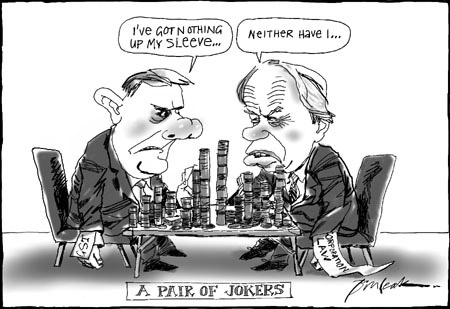
It may be a longish game of federal poker with hands yet to be played:
Leak
The Prime Minister has just made an aggressive case for more federal power in major policy areas, arguing that state incompetence is forcing him to reshape federalism in a more centralist style. That case was made at the Menzies Research Centre in a speech entitled Reflections on Australian Federalism.
There he unconsciously aligned himself with those (Whitlamites) in the ALP who have been unsympathetic to federalism because they see it as an inconvenient and unncessary conservative impediment to necessary reforms. Replaying Whitlam's emphasis on unity and nationhood in place of the old fashioned federal divisions and State rights, Howard outdoes Whitlam to embarking on the greatest centralisation of power in Australia since World War II.
The irony is that, whilst honouring the Menzies heritage, the PM dumps on Menzies' Burkean tradition's respect for tradition, the rule of law, the federal constraint on political power, and the checks and balances of liberal democratic constitutionalism.
More power to the Commonwealth in Canberra means more individual freedom is the PM's argument. That argument has very little to do with liberalism based on a minimal state to protect individual freedom. Howard's reversal of classical liberalism is an expression of a Hobbesian-style conservatism that favours the strong central state.(Leviathan)
For Hobbes politics is based on the desire of power and the fear of death. The social contract is one in which a multitude of men gave up their rights and freedom to an authorized sovereign authority to act on their behalf. The sovereign must be absolute to overcome the haunting fear of death that we have in a state of nature. A nation-state's primary reason for existence is for the safety of the population.
So Howard is asking us citizens to give Canberra all the power to encroach on our liberty to ensure our security in a fearful world full of threats and terror.
Is Howard trashing the Menzies' tradition of federalism?
Menzies himself retained a federal balance whilst removing the excess on both sides. He says:
"...Australian federalism has already sustained a great change which affects the originally designed balance or distribution of powers. Centripetal movements are not likely suddenly to halt themselves. Except in the unlikely event that there is a wide public demand for confining financial demands upon the Commonwealth to those matters which fall within Commonwealth legislative power, and for re-establishing the independent taxing power and responsibility of State Governments, the centripetal movement must be accepted."
Sounds like a support for Howeaerd doesn't it? However Menzies continues:
If this be the position, we are confronted by two tasks of great practical importance. One is to see that the growing financial power of the Commonwealth is exercised in such a way as to permit the States to discharge their own constitutional duties. The other is to abandon, not the principles of federalism, but that excessive emphasis upon purely local rights which is proving such an impediment to the creation of a truly national sentiment and pride.
If you shift beyond the excessive emphasis on state rights and parocialism, then you shift to a position in which the States can, and should be, in a position to discharge their constitutional duties.
Howard's centralization is a taking over the duties of the States and concentrating evere more power in the Commonwealth. Howard is dumping the Menzies' tradition of co-operative federalism, which was continued by the national competition policy of the Hawke-Keating ALP government working with Liberal state governments. It is a fundamental rupture.
Posted by Gary Sauer-Thompson at 12:10 PM | Comments (0) | TrackBack
April 11, 2005
Federalism: the biff deepens
Many say that our system of federalism has ended its shelf life and that a major reform of Australia's federal structure is long overdue.
Their narrative is that the constitution is a product of its nineteenth-century drafting, and that we now live in a national economy regulated by a central government. The framer's vision for the Australian Constitution was a federal one of a system of six states with a weaker central Commonwealth. During the 20th century, in recogniton of Australia being one people, in one land, with a national economy and laws, the High Court, starting from The Engineers case in 1920, shifted the balance of federal power to make the Commmonwealth the centre of Australia's economic and legislative power. And it was right to do so.
Others, such as Mark Bahnisch, have a different view.
How did this come about? In his Conversations with the Constitution Greg Craven makes a good suggestion. He says that there is a serious design flaw in the Constitution, namely that of finance:
From the beginning, the founders faced the difficult problem of how to ensure the fiscal security of the states....Given that under the Constitution the states would retain most of their extensive functions, there clearly needed to be some mechanism that ensured a lightly burdened Commonwealth, presumably awash with money ... returned most of its loot to the states.
The history of the 20th century has seen the states become the financial captives of the Commonwealth with lots of help from a centralist High Court. The result, says Craven:
"..the states are no longer masters of their own destiny.The commonwealth exerts enormous influence in such fields as health and education, not because they are confided to it under the Constitution, but simply because it provides the relevant funds."
For the states Canberra is the big problem because it grinds away at their authority and undermines their power.
You can see that grinding away with the GST.
The GST, as a growth tax, was designed to counter centralism, by giving the States some much needed income of their own. This implies that the States were, and are, sovereign power centres in a federal polity. The Commonwealth is currently playing fast and loose about requiring the States to stick to their (non) agreement to abolish a raft of business taxes in return for GST revenue. Calling a review of taxes an agreement to abolish, the Commonwealth is saying that the GST is a federal tax, and that it can, and will, call the shots on the bad States.
For once the states are sick of being kicked and are showing signs of doing something about it. Ken Parish over at Troppo Armadillo has some suggestions on their options.
The Australian reports that Queensland and Western Australia are saying that two can play these unco-operative games. SO they will refuse to refer their corporations powers to the commonwealth in relation to corporation law when the 5 year agreement comes up for renewal. The states lend/refer the Commonwealth power in five year blocks, and this referral is due for renewal. See Meg Lees for more on this.
A fight over federalism is shaping up. If the Commonwealth is not going to co-operate on GST, neither will the States co-operate on regulating areas of business enterprise. Business will not be pleased by the recent turn of events.
Update: 12 April
George Williams has an op.ed. in The Sydney Morning Herald. He says:
"The GST is a federal tax and it is possible for the Commonwealth to withhold the money or to pass on the revenue under different conditions. The states could take the matter to the High Court, but its earlier decisions clearly state it is up to the Commonwealth to determine the terms and conditions upon which it makes the grant."
A centralist High Court, one would have to add? Will the High Court change its modernist colours and begin a rethink of federalism? After all, the High Court has moved a very long way from the founders' conceptions of federalism in the Convention debates during the 1890s.
Posted by Gary Sauer-Thompson at 12:16 PM | Comments (0) | TrackBack
booms & skills shortages
The talk these days is about the export blocks to minerals from Quarry Australia going to the booming industrial machines of China.The port infrastructure cannot load the increase outflow of minerals (eg. Dalrmple Bay in Queensland is rolled to make this point) to the ships. These now sit offshore for days on end waiting to be loaded. And there is just not enough skilled labour in Queensland and WA to work the big machines during the minerals boom.
The miners are saying the delays, blocks and shortages are causing them to lose big money fast. The Government has to do something quick smart. The nation's economy depends on resolute action.
Hang a mo. Aren't the miners also responsible for training skilled staff in a market economy? Isn't that what the apprenticeship schemes are about? How come the miners are not responsible for the skills shortage? Did they not slash their workforce during the 1990s? Did they not fail to invest in new apprenticeships in the 1990s?
So why aren't the miners pointing their blame finger at themselves? They created their skills mess through bad planning.
Posted by Gary Sauer-Thompson at 11:25 AM | Comments (0) | TrackBack
April 9, 2005
saying no no no to Kyoto
The Kyoto Protocol agreement to reduce greenhouse gas emissions is back in the news, as the US, Australia go their own way to develop an alternative to the Kyoto protocol.

The energy intensive industries in Australia are also resistant to change. They want to put off taking action for as long as possible. The impression you get fromeading htei comments in the media is that these are people who have a knee-jerk negative reaction to any kind of environmental regulation—---or, for that matter, any kind of government regulation. But they continue to hold out their hand for government subsidies for their old polluting industries.
These business interests determined that the international climate negotiations were a threat to their livelihoods and profits.
They persuaded the Australia Government not to sign the Kyoto Protocol. Australia, it was said, should not agree to anything that might harm its economy. Their goal is to put off that day of restrictions on carbon emissions for as long as it is politically possible to do so. Their blindness is not the scepticism about science. It is that they do not see that the drive for climate solutions is a business opportunity: producing and selling alternative fuels, becoming exporters of renewable energy, attracting high-tech businesses, or even selling carbon emission reduction credits.
However, Australia is vulnerable to the effect of climate change from an economic and environmental perspective, and so restrictions on carbon emissions in this country are inevitable. So are the requirements that the largest greenhouse gas emitters disclose their emissions. That is why the states are beginning to establish a bottoms-up emissions trading system with targets and caps. Hopefully climate change becomes one of the drivers of energy policy.
The states say that they are doing their bit to make climate change a driver of energy policy with their in-pinciple agreement about a state-based emissions trading scheme. But are not these same states also going ahead building new coal-fired power stations, which cause the greenhouse emissions in the first place? Does not Queensland desire to be Australia's electricity generation powerhouse through providing cheap electricity with ever more coal-fired power stations?
Posted by Gary Sauer-Thompson at 1:13 AM | Comments (0) | TrackBack
April 8, 2005
World Bank: decline of $US
I've mentioned the Australian Financial Review's poor coverage of international economics and finance and international geopolitics before. Here is another example of the decline of quality journalism at Fairfax under Fred Hilmer.
The AFR missed the warning contained in the World Bank's 2005 Global Development Finance Report. This is more than a warning that, despite strong growth in China, global economic growth is slowing to the point of recession. The warning is about the growing threat of big losses from a sudden decline in the exchanage value of the greenback. In its overview of the Report the Bank remarks that:
"Countries that have accummulated large [US] dollar-denominated reserve holdings face acute pressures and large potential investment losses from the weakening dollar."
And there is more. The next paragraph indicates the fragile state of the current international financial system:
"If the dollar were to depreciate by more than projected, it would likely overshoot its long-run equilibrium level. Should it remain low for an extended period, this could induce a costly restructuring of world industry that would have to be undone in the following years as the dollar returned to its equilibrium level."
Personally I don't think that markets actually work so as to attain harmony or equilibrium (Pareto optimality).I'm an old fashioned contradiction man myself. But let's leave the metaphysics to one side and return to the World Bank.
The Bank says the grave risk is that a deep and disorderly US dollar decline would create financial market volatility and push up interest rates. The current situation is one in which dollar's value is largely dependent on a handful of Asian central banks, which between them control almost $2.5 trillion in reserves. These are now beginning to become more public in their desire to hold fewer greenbacks.
What that means is that Australia needs to manage the vulnerability inherent in global economic and financial imbalances. Now that is something the AFR should be reporting on, don't you think? How come it isn't? At $2.50 a copy you would expect to be kept informed of the global economic and financial imbalances would you not?
And shouldn't the AFR be doing some good economic analysis that connects the above risk to the following?
The US's debt loads caused by its huge balance of payments deficits; the decline in the US manufacturing base; the inability of the US to cope with large rises in interest rates; and the US's lack of a credible set of policies to reduce its need for external financing before it exhausts the world's central banks' willingness to keep adding to their dollar reserves.
Isn't Australia at risk if the U.S. economy is decaying at its core and becoming exceedingly vulnerable because of its indebtedness? Have not the Asian central banks already begun to lose confidence in the Greenspan-led Federal Reserve's ability to rein in U.S. financial and economic excess? Are not these central banks quietly shifting their substantial reserves into non-dollar holdings? Does this not mean in the absence of renewed foreign private sector inflows, the dollar will plunge? Of course, the US could always US repudiate some of its debt.
All this sugests that our leading economic policy makers should be discussing "global economic imbalances" and how to deal with the falling dollar. The whole tenor of the discussions should be focused on Australia, like Asia, taking defensive, pre-emptive action to safeguard its own interests. What we sould not be doing is advocating that Asia should continue to extend a further helping hand to the US.
Posted by Gary Sauer-Thompson at 1:08 PM | Comments (0) | TrackBack
health, federalism, politics
Despite the irony it looks real bad:

Leahy
But it is not just Queensland. It is all the states in our federation. They are the ones who manage our large public hospitals. State governments have been given their public hospitals limited budgets and told to make do with less. This has meant rationing their services through ever growing lists and queues.
Now the states have been partly to blame for the chronic hospital waiting lists, (along with poor school standards, infrastructure lagging behind development, and broken promises on taxation). Their style of management during the 1980s and 1990s has been a form of economic management based on budget surpluses designed to preserve, or regain, their credit ratings instead of providing government services to reasonable standards.
The states have not been very smart on the politics of this. They've tried to deflect their responsibility by saying that the problem is Canberra, as it has cut back funding on the necessary funding.The states are not smart because they've being saying this whilst GST revenue has been rolling into their Treasury coffers. Being Labor states they continued to denounce the GST as a bad tax, even though it is growth tax that will give the states the financial independence they always wanted. It smacked of opportunism.
What the ALP state governments were doing was trying to disguise the way they had allowed themselves to be prisoners of Treasury group-think; and letting their neo-liberal Treasurys run human services in the name of sound finance or disciplined fiscal policy.
So the finger should be pointed squarely at the states as they really do need to lift their game. But the responsibility finger should not be just at the states.
The economic's profession is also partly responsible as they have advocated a particular economic mode of governance.
Their neo-liberal politics is about rolling back the welfare state, and they have said that good (rational) economics is to run budget surpluses based on cutting costs and reducing government services. The mentality behind this is that it is good that people suffer, as they will then appreciate that services cannot be provided free, and that they ought to pay for them through the market.
One consequence of this mode of governance by the states is the current commonwealth talk about a fundamental overhaul of the public health system; one that would bypass the states and fund regional authorities to oversee the provision of medical services and care. This basically means an increasing centralism with the commonwealth avoiding any dealings with the independnent states. Under this centralizing tendency the states will be increasingly sidelined, reduced to service deliverers, and given little role to play in national policy making. For more see Ken Parish's excellent post over at Troppo Armadillo.
It is an attack on federalism as it is an attempt to do away with division of powers in a federal polity. Power is going to the commonwealth's head.
Posted by Gary Sauer-Thompson at 11:14 AM | Comments (0) | TrackBack
April 7, 2005
wait and see
The independent Reserve Bank of Australia is in a 'wait and see' mode. Waiting to see the data come in over the next month about the inflationary pressures in a weakening economy.

The inflationary pressures (wage and price increases), due to the disequilibrium between overheated demand and capacity constraints, are still there. And so is the ongoing decline of a weakening Australian economy. And the record level of household debt is still there at a time when the fallout in the property market (especially investment housing in Sydney) continues apace.
What suprises me in all of this is the heated political debate by the economic commentators, most of whom focus their light on the Reserve Bank. I cannot help but notice how most of the economic commmentary in Australia is structured around an obsession with interest rates and an indifference to the current account deficit that borders on silence.
Why so? Why all the emphasis on the interest rate tree and not on the economy forest? Why buzz around the Reserve Bank's eyes like flies in the market place? Why all the emphasis on the Reserve Bank's brain trust and on one economic policy instrument?
One suggestion is that central-bank driven monetary policy has now become the preferred and principle way in which modern freemarket economies are governed to deliver growth without the boom and bust cycles of the past. It is a market doctrine that makes us feel secure and safe. In the RBA we place our trust that the asset bubble will not burst and we drown in debt.
Hence the criticism directed at the RBA. Consider Bob Shwartz's op.ed in today's The Australian Financial Review (p.62):
In a move that basically amounts to an admission that it got the timing of its last decision dreadfully wrong, the Reserve Bank of Australia kept official interest rates on hold yesterday. This begs the question: why did it raise interest rates last month? A single quarter-percentage point rate just manages to upset people, but won't change their habits. Instead of just looking like a schmuck, like it did last month, the bank now looks like a schmuck with egg on its face.
Huh? Pretty strong.
Now Schwartz does make a case. He says that the inflation squeeze should have happened towards the end of 2002. Schwartz says that if so, then the RBA
"would now be in the position to support a weakening economy by lowering interest rates."But he pours it on in his conclusion, By getting it so wrong, he says "the only thing left to the bamk is sit back, try to finesse its cards, bluff the economy, and pray."
Huh? Schwartz does science whilst the RBA does religion! That is so over the top that it's macho overkill. But he does have a point: the Reserve Bank is currently trying to minimize the impact of an asset bubble and consumption party that its monetary policies have created. That means deflation with a debt hangover.
So what is the significance of all that buzzy surface commentary on interest rates? Andrew Bartlett's suggestion is that all the market buzz reflects uncertainity and apprehension. I reckon that we have a credibility problem with our economic commentators. Most of the talking head commentators are either ideologues paid to run the company/industry line in a little media grab; or they are prophets divining the tea leaves as they try to outguess the RBA oracle they've placed on a pedastal.
The commentary of the talking econheads is s not scientific analysis and it's not cultural analysis. Most of it on radio and television (the chatter in the Finance slot) makes little sense. It's more a mythological chatter that acts to dull your brain.
Then again, maybe the doctrine that central-bank driven monetary policy as the principle way to deliver growth in a modern freemarket economy is just too simple. It's a bit too like a Catholic catechism.
Maybe our economic commentators do not think of the trajectory of the Australian economy within the ebb and flow of the international economy (Japan and Europe with declining growth; China stretched to the limit in terms of manufacturing capacity; the shaky US in recession) or the effects of the twin deficits of the US economy is having on the international economy.
Let us wait and see shall we.
Posted by Gary Sauer-Thompson at 12:52 PM | Comments (0) | TrackBack
April 6, 2005
Gruen on economic policy
We are at what economists call the turning point of an economic cycle. Hence the need to match economic policies to particular circumstances.If you miss the match up things could turn real bad.
In addressing this issue, and the skill required to do it Nicholas Gruen refers back to 1989-1993 period. This period, he says, highlights the way economic policies were not matched to circumstances. It stands in marked contrast to the golden age of economic management of 1983-1987 where policies were so matched.
On the 1989-1993 period Nicolas says:
"Our loss of improvisational élan can be dated to 1989 when we faced a ballooning current account deficit and rising inflationary pressures - déjà vu anyone? We turned to monetary policy - déjà vu anyone? The problem was, as we knew at the time, tighter monetary policy was not only a blunt instrument, carrying the risk of misjudgment and recession, but its short-term benefits came with counter productive long-term costs."
We ended up with high interest rates of around 17% to stifle the boom. Giving us the recession we had to have sent many people to the wall. That recession does not stand for heroic leadership: it signifies a disastrous policy call.
Gruen says that an alternative option to slow consumption would have been to require workers to pay some small share of their wages into their newly established superannuation funds. It was rejected.
He connects the economic situation of the 1989-1993 period to the one now:
"So here we are again. Our once yawning current account deficit is now coming to resemble lockjaw. The labour market is tightening, with skills shortages emerging as they were in 1989. And in the absence of action by the Government, the Reserve Bank considers that it’s being forced to slow the economy with the wrong instrument - higher interest rates. Exports have stalled and, though mineral exports will lift soon, our dollar is already overvalued."
This time around the Reserve Bank is being more cautious with using that blunt monetary instrument. Commentary is mixed: see John Quiggin and Ambit Gambit
So what action can the Government take?
Gruen advocates increasing compulsory superannuation: this would have the effect of decreasing consumption, increasing savings, lowering the cost of capital and the exchange rate, and therefore lifting exports.It would certainly address the too much consumption and too little saving syndrome in Australia.
That still leaves us the skills shortage and the bundle of government polices that cut back on education, training and on research and development assistance. Is there not a need to shift government spending priorities away from the election bribes and towards more investment in skills, infrastructure? Do we not also need better incentives to move from people from welfare to work?
And what do we do about the current account deficit lockjaw? Continue to rely on the rapid industrialisation of China, which has increased global demand for oil and other forms of energy and for various minerals, pushing up their world prices, to rescue us? We need to supplement being a quarry for foreign miners with an industry policy.
What about all the investment in new infrastructure that is required? Should we do away with the dumb Department of Finance logic of budget surpluses in all situations and begin to borrow to invest?
Posted by Gary Sauer-Thompson at 12:31 PM | Comments (0) | TrackBack
April 5, 2005
state of exception?
Suprise suprise. Not content with Peter Lewis becoming an ex-speaker and isolated backbencher, due to his failure to substantiate his claims about pedophiles in high places, the Rann Government in SA has decided to up the ante, big time.
Last night the Rann Government rushed legislation--The Parliamentary Privilege (Special Temporary Abrogation) Bill 2005- into state Parliament. This bill allows police to search Peter Lewis's Parliamentary offices to prevent a serving MP, a former MP and two serving police offices from being named in relation to pedophile activities. It will also strip parliamentary privilege from MPs who attempt to name any public officials accused of criminal sexual conduct.
That is an extraordinary turn of events. What is going on?
Peter Lewis is still an elected member of Parliament and entitled to parliamentary privlege to speak out on pedophilia. Yet today's Advertiser, is silent about the attempt to gag Peter Lewis from speaking out under parliamentary privilege. Unlike The Australian, it has nothing to say on the subject of this legislation; even though a political crisis is now developing out of the Rann Government's response to Peter Lewis allegations about pedophiles in high places.
Police raids on Parliament? Isn't Parliament off limits to police raids on MP's offices? Negating Parliamentary privilege? Doesn't Parliament have its own privileges committee to deal with MP's who use privilege for bad purposes? Removing privilege for debate on any subject? Isn't this suspension of tradition and convention of parliamentary privilege due to paranoia and political panic?
Does not this muzzling legislation set a precedent that would allow a future government in SA to strike down privilege on other MPs?
'Parliament is master of its own destiny' says Premier Rann. Really? What the Premier actually means is an authoritarian executive without control of the Legislative Council and little time for Parliament. What Rann has overlooked is that Parliament is not master in a federal system. Parliament works within the rule of the constitution as interpreted by the High Court. Parliament regulates itself within the bounds of a constitutional democracy.
You can hear the justification for the emergency measures in the wings. The exceptional circumstances of the present require the suspension of the conventions of the Westminster political system.
Is not Premier Rann's claim, that Parliament is master of its own destiny, another step in the abolition of the distinction between the executive and the legislature? Is it not another step to prevent MP's from defying the executive by speaking out on sensitive issues?
Do not these 'emergency measures' exemplify a tendency that is becoming a lasting practice of government--increasing executive power? Emergency measures that indicate the emergence of constitutional dictatorship?
So what was once a political circus is now developing into a political exception, driven by an emotive argument about gagging the possibility of allegations so as to protect the families of those accused of pedophilia. The argument shows that its advocates are willing to strike against democracy to expand the powers of the executive powers by eroding the powers of Parliament.
However, this is less a case of a classic state of exception of the law (eg., war time), and more a case of revenge, desiring blood on the floor, and really bad law.
Will the SA Australian Democrats in the Legislative Council stand firm against the bill? Will they buy the state of exception argument? Or will they defend the powers of Parliament against an arrogant executive manufacturing an emergency to expand its own powers? Will they defend the traditions of Parliament against political recklessness.
Posted by Gary Sauer-Thompson at 12:44 PM | Comments (2) | TrackBack
April 4, 2005
crisis, politics & sex abuse- SA style
Sex abuse and politics is a very explosive mixture as the example of NSW Labor MP, Franca Arena, in the NSW Parliament attests. She waged a one woman war on paedophile protection in high places, even going so far as to accuse Premier Bob Carr and Royal Commissioner James Wood of a coverup.
That explosive mix has been bubbling away in Adelaide during the last month or so. The fallout from the political explosion is the likely downfall of Peter Lewis, the controversial Speaker of the South Australian Parliament. But it could go wider than that due to a political crisis.
 Lewis, is an Independent Liberal, whose support enabled the Rann ALP to gain power after the 2002 election. Lewis turned his back on the Liberals to help the ALP overcome a hung Parliament. Lewis used his compact with the Rann Government to push for political reform.
The political explosion over sex abuse represents a falling out between Lewis and the ALP. The original compact has disintegrated.
Last month, in the wake of the murders of two gay men in Adelaide, Peter Lewis went public with claims that a state government MP--has been involved in gay activity in the South Terrace beat in the Adelaide Parklands. The Speaker said the gay men had met his staff before their deaths, and they had alleged paedophile activity by the MP at a known homosexual haunt in Adelaide's south parklands.
That allegation created a stir.
Lewis failed to produce evidence to the police backing his claim. All his office has are statements from people claiming to be victims or witnesses to pedophilia or abuse. There are no smoking gun photos or videos. In failing to keep quiet about the allegations, Lewis undermined his political credibility.
This created a little political circus in Adelaide town. Things became surreal when Wendy Utting (a child abuse advocate) and Barry Standfield, two volunteers in Lewis' office, took the matter into their own hands last Friday and distributed material containing names of an MP and two senior police they claim had been involved in pedophilia. They released a statutory declaration naming the politician at the centre of the allegations and also named senior police and members of the judiciary as sex offenders.They were supported in this by Liberal MP for Makin, Trish Draper.
As you can imagine all hell broke lose in Adelaide's political world on Friday about that transgression of public law. Though Peter Lewis distanced himself from the volunteer's actions, things exploded. The Rann Government finally decided to pull the plug on the loose canon.
Lewis faces the prospect of a no-confidence motion supported by both sides of Parliament when Parliament sits this afternoon. His time is up as both the Rann Government and the Liberal Opposition want him gone. He has the option of resigning first before a no confidence motion in the Speaker is introduced.
Though Peter Lewis will probably announce his resignation from Speaker of the SA Parliament, there will be pressure on him to leave the political arena for good. With an election due in a years time Lewis' days as a MP are numbered. Sacrifice is required. Blood needs to be spilled. Atonement needs to be made.
Update: April 5
Peter Lewis resigned as Speaker as expected. As the Rann Government had developed an insurance of policy of bringing two other independents on board-- Rory McEwan and Karelene Maywald--it no longer depended on Lewis' vote to stay in power.
Yet the fallout continues in the form of a developing political crisis in the form of attempts to gag him as a backbencher and seek revenge.
Update:April 7
The political fallout continues. The police raided the home of Wendy Utting looking for documents relating to the MP, a former Liberal State politician, and two serving police officers. Lewis has declined to hand over any further information in his office, citing parliamentary privilege. The police are persisting in their attempts to gain access to Parliament and raid Lewis office.
'Tis strange because my understanding is that Peter Lewis' office had handed the relevant information over to the police whilst he was Speaker. It looks like political payback to me.
Meanwhile Peter Lewis has set up an child abuse office in the CBD to expose child sexual abuse and assist victims of pedophilia. Wendy Utting's Child Protection Watchdog group has a political focus, as it has moved beyond healing to lobbying to bring pedophiles to account, and extract justice for victims of child sex abuse.
Posted by Gary Sauer-Thompson at 12:34 PM | Comments (0) | TrackBack
April 3, 2005
Beazley on economic reform
Yesterday afternoon I read Kim Beazley's speech to the Australian and Melbourne Institute's Sustaining Prosperity Conference. Beazley has been developing the much needed economic narrative that would map out the ALP's pathway to economic credibility through the pathway of reform.
This is an important speech in the campaign to establish the ALP's economic credibility at a time when the Australian economy is on the slide. If it is to help re-establish the ALP's economic credibility as enlightened reformers, then the campaign needs to go beyond the 'bash the Howard Government' style of tactics of the parliamentary tacticians to developing good policy.
Beazley's economic narrative comes in two parts. The first celebrates the Hawke-Keating ALP Government as the party of economic reform. Beazley says that this tradition of economic reform is an enlightened one:
"...a story of how in government in the 80s and 90s, Labor rose to the historic challenges it confronted, abandoning its own prejudices to pursue an aggressive program of economic reform... There was urgent work to be done. And though it was often tough, we set aside our own ideological prejudices. In the face of rigid opposition--from our supporters, as well as our opponents--we achieved structural changes that over two decades, turned our economy around. It was what the times required."
Okay we can give him that. It was the social consequences of the economic reform that were badly handled.
The second part of the Beazley narrative highlights the lack of economic reform undertaken by the Howard Government since 1996. John Howard, says Beazley:
"...has failed to abandon his own prejudices to make the changes that could have moved Australia forward to its next stage of growth. Instead of embracing a clear-eyed approach to reform, he has spent the balance of his prime ministership distracted by his own personal obsession, a culture war in which he has sought to recreate the imagined Australia of his childhood. And while he has enjoyed the dividends of Labor's past reforms, he has neglected and sometimes even weakened Australia's longer term economic prospects."
It is the ALP that stands free of prejudice and bias to do what is best for Australia's national interest. That claim ignores Howard's introduction of the GST, and the ALP's opposition, even though Keating had argued for the GST on rational economic grounds.
This kind of economic enlightenment narrative places the onus squarely on the ALP to identify what the times require, to put its bias and prejudices to one side, and then devise good policy that address the problems. The ALP now has to show that it understands the reform agenda and that it has the courage and will to further the reform agenda with good policy.
It's a big promise. Does Beazley deliver on this over and above identifying the warning signals that signify economic decline? Yes and no.
He does take some steps. Taking his guidance from the economic enlightenment signpost of the Hawke and Keating Governments---a clear-eyed, far-sighted approach---Beazley says that it is necessary to get Australia's reform priorities right:
"Today's economic challenges are different to those we faced in the 80s and 90s. Our greatest economic need is to restore strong productivity growth. Because it's only by restoring strong productivity growth that we can simultaneously achieve higher growth rates, low inflation, rising real incomes and improved international competitiveness."
He then asks: "how do we generate the next wave of productivity reforms"? He answers by returning to a familar argument:
"The scope for productivity gains from the old reform agenda of deregulation, privatisation and industrial relations reform is largely exhausted. There's still some unfinished business - in particular, in electricity and water - but with the large-scale structural changes mostly behind us, we won't repeat the windfall productivity gains of the 90s. Labor believes in labour market policies that help people to work smarter. That means investing in the know-how of Australian workers, not returning to a 19th century world of dog-eat-dog industrial conflict."
That is a quick dismissal of the need to ensure that the Australian economy is an ecologically sustainable one; too quick given all the warning signs of an ecological stress in Australia. We can infer that Beazley's embrace of the economic enlightenment presupposes a 1980's understanding of the economy, and it does not include an ecological enlightenment. It is at this point that we encounter the bias and prejudices of the neo-liberalism entrenched in the ALP. It is a limit-horizon of the ALP beholden to a conservative understanding of the economy disconnected from ecology.
What Beazley does say is that to improve productivity of capital, we need long term investment in the nation's infrastructure; and to improve productivity of labour we need long term investment in skills and training. And there it more or less ends.
It ends at the current point of the public debate. So Beazley is basically only restating what we already know. He is not breaking new ground about how the much needed reforms are going to be tackled. What we do not know is how the ALP's understanding of reform differs from the Business Council, ther Australian Financial Review, the OECD, etc? Does it have its own voice?
Posted by Gary Sauer-Thompson at 9:30 AM | Comments (6) | TrackBack
April 2, 2005
Costello under fire
The best criticism of Peter Costello's defence of the Treasury brief on welfare-to work reform comes from Judi Moylan. She sees the connection between the Howard Government's planned shake-up of welfare-to-work and industrial relations. She says:
"We must make sure people get a decent living wage. We can't have a situation where people are taking home pay of $4 an hour and grinding away for long hours at the expense of their child rearing responsibilities. If our children are not looked after, then you have a huge social cost."
Costello's Treasury brief says that single mums should travel on their pushbikes to where the work is, accept the low rates of pay on offer for casual work, and get the grandparents to volunteer their time to baby sit the children.Families that work together stay together.
Judi Moylan also pointed out the consequences of Cabinet plans to tighten eligibility for the disability pension in terms of the impact of plans would have on those with mental illnesses. She said that:
"Whatever policy is introduced we have to make sure it is adequate for people experiencing mental health problems.If such people were forced to look for jobs it could exacerbate their illness."
And we can add some people with disability would be capable of some work, but they would not be able to work at the level required by the Newstart criteria. Shifting these onto Newstart would mean that they would be unable to meet the various mutual obligation requirements and so they would drop through the welfare net and would then need to be supported by their families.
Is that the Howard Government's brief?
Posted by Gary Sauer-Thompson at 2:10 PM | Comments (0) | TrackBack
April 1, 2005
Costello's welfare-to-work reform brief
I see from the media that Peter Costello, the Federal Treasurer, addressed the Australian and Melbourne Institute's Sustaining Prosperity conference last night. Presumably the speech is a keynote address as Costello is being interpreted as speaking for the whole Government.
Costello has always struck me as contributing to public debate in terms of acting as a barrister with a brief from the government. Often the arguments to support the brief are shonky, highly repetitive when in Parliament, and often circular and bowbeating when part of an interview in the media. Truth is subordinated to persuasion whilst persuasion is subordinated to aggressive dissembling. This comes as no suprise since Costello treats the public arena (agora) as if it were a court room where the high profile barrister reigns supreme.
The fracas over the GST is a recent example of aggressive dissembling. Costello has been arguing around the traps that the states have breached the 1999 InterGovernmental Agreement with respect to stamp duty and he is going to bring them to order. All that agreement calls for is a review of the need to retain stamp duty by the ministerial council in 2005. The states then must agree to the removal. There has been no review and the states haven't agreed.
So what's Costello's brief? To deflect attention from his poor economic management that has allowed the economic machine to splutter and miss? What we really have with Costello's GST performance is his well-honed forensic skills being used in a stage-managed set piece political stunt. Watching the performance I'm reminded of Johnnie Cochrane, OJ Simpson's lawyer, when I watch Costello's performances: if you can't stand on the facts then you stand on the table.
So we have a political spectacle. But for what purpose? The styel is too grand for it to be just a counter to the negative judgements in the financial pages:---that he is not doing enough as an economic manager.
What happens when the brief is Costello's own? Do things pick up? The the content on the non-economic stuff is often thin. A good example is his understanding of social capital in terms of recycling the Judeo-Christian tradition. This showed the poverty of Australian conservatism.
To give credit where credit is due, Costello's big contribution as Federal Treasurer is his work on the policy implications of the issues thrown up by an aging population. The barrister then quickly tied this to the Treasury's neo-liberal brief for ongoing budget surpluses.
So we come to welfare-to-work reform.
As I understand it Treasury's neo-liberal brief for the welfare-to work-reform is that our tax and welfare systems had to deliver incentives to work by ensuring the low skilled can enter the employment market below the minimium wage. Am I wrong on this? Is this the way industrial relations reform and work-to-welfare reform overlap?
We can judge this by looking at what Costello said at the Sustaining Prosperity conference. In his speech he linked the issue of welfare reform to the long-term shortage of skilled labour, and argued the broader case for reform.
He said that it was no longer acceptable to have a system where a group of people on welfare who were capable of work were not required to try:
We need to create an income support system that focuses on workforce participation first; a system where work requirements are appropriately set, so that people are required to search for work where they are capable of work. Work can bring so much for people compared to a life on welfare – greater social contact, higher self esteem, another avenue to contribute to society and higher income. It is our duty to ensure that these benefits are realised for as many Australians as possible.
The Treasurer then mentioned those on single-parenting payments:
A system that has no work requirement--not even a part-time work requirement--for a parent of school age children is a very generous one and an inappropriate one in a country with possible labour shortages and the long term ageing of the population.
What is not said is that those moving from welfare to work (those on disability support and single parent payments) need, and should, be reskilled so they can obtain employment in the rapidly changing economy.
Now the Treasurer's speech explictly addresses the issue of needing to reskill to obtain work in the Australian economy. He says that:
.... education and training is becoming increasingly important to sustaining employment. The rapid pace of technological and structural change means that people often need to up-skill to perform more sophisticated roles required in their current job, or to re-skill to enable them to change occupations or industries where their employment becomes vulnerable. Furthermore, while overall employment growth has been strong, the threshold level of skills required to access the labour market is rising as many low skilled jobs are disappearing from the Australian economy.
We can infer from the silence abouting link this theme to those on welfare means that these Australians can, and will, take up the low skilled jobs that are disappearing from the Australian economy.
And as there is no mention of helping out with child care, it is assumed that the Costello's social capital talk from last year reappears.
Tis a Treasury brief that Costello is defending.
Posted by Gary Sauer-Thompson at 12:13 PM | Comments (0) | TrackBack