« January 2006 | Main | March 2006 »
February 28, 2006
unhealthy lifestyles
There is little sense that the changes we need in the health care system are happening. There is a sense of stasis.
The graphic cartoon is one reason why the focus of the health care system needs to shift to preventative health and primary health care: Australians are getter fatter:

Overweight indicates how the pressure and burden on our hospitals from chronic illness can be lifted if we all took more responsibility for our own health through changing what we eat and doing more exercise.
Alas, no one owns the territory of primary care, and it is deeply contested by the different health groups.
Australians are getting fatter. The recently released Australian Bureau of Statistics national health survey, ,found 62 per cent of men and 45 per cent of women were overweight or obese. However, only 32 per cent of men and 37 per cent of women saw themselves that way, despite millions spent by state and federal governments on promoting a health lifestyle.
This indicates that only about 1 in 3 adults believe themselves to be overweight or obese, yet more than 1 in 2 adults are overweight or obese. If some adults ... parents... believe themselves to be a healthy weight when they are not. How can Australians get it so wrong?
Posted by Gary Sauer-Thompson at 6:47 AM | Comments (0) | TrackBack
double standards
Read this about the burqa. It sure is a conservative style of Islamic dress, but so what? I don't much like it as a fashion, but what's the problem with some people wearing it?
Now look at this cartoon:

Alan Moir
See what I mean by the double standards? As the ccommentators say in other contexts the Prime Minister still has work to do. But then again, the commentators say that the PM understands the aspirations and dreams of ordinary Australians better than the ALP.
Presumably the ordinary Australians are the one nation Sydney conservatives, the Tory working class and the South Park conservatives.
What has happened to personal freedom to wear your own style of clothes? Isn't freedom meant to be an iconic "Aussie" value? Why is a style of dress an affair of state? Isn't saying no to conservative Muslims wearing a burqa in Australia a form of Islamophobia; an Islamophobia that is encouraged and becoming politically correct?
Posted by Gary Sauer-Thompson at 12:06 AM | Comments (2) | TrackBack
February 27, 2006
some questions?
According to a recent media reports the US & Israel have a strategy to undo the results of what appears to have been a fair election in Palestine because they do not like the results. Hamas has been elected and it is taking control of the Palestinian Authority and its institutions. So the Israelis are applying the first of their economic sanctions and Americans are planning the same. Their strategy is to subvert it the democrat result.
Isn't this an example of the gap between America's moral pretensions of bringing democracy to the Middle East and its actions in deny it? Dosen't that highlight the hollowness of the Bush Adminstration's rhetoric about freedom and democracy? Isn't the US rhetoric one of democratic states automatically make good neighbours of other democratic states?
It looks me as if the US position is clear. It provides support for the Israeli Right, which is committed to the permanent expansion into the West Bank.
When will it be accepted that Arab democracy mean the ascendancy of Islamism?
Posted by Gary Sauer-Thompson at 8:35 PM | Comments (3) | TrackBack
February 26, 2006
Iraq: order amidst chaos?
Time flies, doesn't it? The 3-year anniversary of the Anglo-American invasion of Iraq is approaching. Isn't it about time to demand a timetable for the US withdrawal from Iraq? The longer the US stays the greater the conflict, the more the carnage mounts and the more likely Iraq will be in flames.

Matt Golding
There is order amidst the chaos in Iraq. The Shiite religious parties probably have the cohesion to form a relatively stable government. But chaos is dominant. The attack on Wednesday that destroyed the soaring gold dome of one of Shiite Islam's holiest shrines signifies that. It is being interpreted by most Shiites as a direct attack on their faith.
Will this be a seminal moment in Iraq's low-intensity civil war? The response was Shiite reprisal attacks by militiamen on Sunni mosques and civilians. The dynamics of religious war between Shia and Sunni communities are in place.
The prospect of forming a government of national unity, that can guard Iraq's borders and apply the rule of law, is a vital cog in the mechanism of the Americans' declared exit strategy. That prospect grows ever dimmer.
Osama Bin Laden's strategy is working:
We want to bring the Americans to fight us on Muslim land. If we can fight them on our own territory we will beat them, because the battle will be on our terms in a land they neither know nor understand.”
The Americans are fighting on Muslim land in a long war of attrition, and they are not doing very well.
Posted by Gary Sauer-Thompson at 2:42 PM | Comments (3) | TrackBack
February 25, 2006
targeting Muslims
The conservative attack on multiculturalism is becoming clearer isn't it, with Peter Costello's call for radical Muslims to assimilate or move to another country, following on from the Prime Minister's remarks about some Muslims of bringing jihadist views and opinions about women that did not fit in Australian society. Nothing was ever said about the views and opinions of those white Australian men whose violent treatment of Australian women did not fit Australian society. It's only Muslims is the message clear and straight.

Geoff Pryor
The Muslim threat is being raised to undercut multiculturalism. It is part of a government agenda.
Now Costello's argument in his recent speech to the Sydney Institute was not that new. He was more or less building on his previous remarks. He argued that Australian values were not optional, and that migrants who did not share them should be stripped of their citizenship; that migrants should be forced to honour their pledge of allegiance to Australia or face the prospect of being deported; and that anyone who believed Islamic sharia law could co-exist with Australian law should move to a country where they felt more comfortable.
In reading the speech I could not help but think of all the Australian-Britians who regarded Britain as home, who barrack for the England sports teams when they played Australia, or intensely following English soccer. Wasn't there a big attempt to make Australia like England?
Where are the Australian values there? Where's the allegiance to Australia? So why aren't they also stripped of their citizenship and told to go back home? Or told not to come to Australia because they do recognize and respect Australian values.
This 19th century part of Australian history is forgotten (remember the Irish?) and the deep divisions glossed over. The finger is being pointed at Muslims to make the case for replacing multicultural diversity with assimilation. Assimlation is the name for all the remarks about social cohesion and national unity for Australia's conservatives.
Posted by Gary Sauer-Thompson at 12:38 PM | Comments (17) | TrackBack
February 24, 2006
NSW ALP struggles
Whilst Premier Rann in SA looks ever more presidential in the TV adverts currently flooding the state's media flows, the Lemma ---oops Iemma ---Government in NSW looks increasingly embattled, as its budget surplus declines and turns into a deficit. The property boom is over.and unemployment is rising. The government is talking up investment and jobs, cutting back on the public service, overhauling the state bureaucracy by creating super departments, and giving modest assistance to business. They are 'open for business ' is the spin.
Will the attempt to take control of spending by bringing it back in line with revenue increases be enough to save the necks of the ALP Right?

Alan Moir
They have around a year to turn things around with their cost cutting. How does cost cutting ---as opposed to productivity improvements---increase economic growth?
The message that the ALP wants to send out is that serious about reform. But their political machine, which is run by a few machine men (factional chiefs and union bosses), is geared to the status quo and retaining power. So we cannot expect much by way of innovative policy. As Mark Latham observed in the Latham Diaries (p.192) the the factional heavies in the machine culture are more concerned about the tactics to get through the next power play than serious policy around water, health, transport.
You could say that the Carr NSW government has mismanged the period of economic growth since spending was running at 6% a year whilst revenue increases were running at 5% a year. That's a negative of around $400 million a year. You can also say that there will be no real reform for some time.
What we have at the moment is a government in a panic as it looks at the general election next March.
Posted by Gary Sauer-Thompson at 11:59 AM | Comments (7) | TrackBack
February 23, 2006
questioning medical power
And so the undermining of the power of the medical profession by the government has begun.
It's taken the initial form of the state health ministers appealing to the ACCC to review the Royal Australasian College of Surgeon's ability to decide how many surgeons are trained. The College---a doctor's club---is seen to be limiting the number of trainee surgeons. They control the numbers so it is not just a question of a lack of funding for trainee posts. The College is a monopoly controlling access to a profession. It's a closed shop that needs to be busted open for the public good.
How to do this is the problem? It is going to require some heavy lifting to remove the closed shops and monopolies throughout the health system. Bringing in other competitors is the answer. Who then would provide high quality training for surgeons? The universities could, if they worked together says the editorial in the Australian Financial Review:
The good news is that it is not up to the ACCC to bust open this particular closed shop. The regulator's authorisation permits the monopoly, it doesn't stop anyone else entering the market. When the authorisation was renewed, the ACCC noted with evdent relief that high-quality alternative systems for training surgeons could exist...all it would take is a group of major universities to band together and the club of surgeons would no longe rhave a monopoly.
They would need help to break the monopoly. Will the state governments do that? Or will they and the federal government baulk at taking on the vested interests of the AMA and the medical colleges.
Posted by Gary Sauer-Thompson at 1:11 PM | Comments (2) | TrackBack
February 22, 2006
Guantanamo
The state of play in the US under the Bush Administration from a critical or radical perspective:

Notice what is missing? The problem of the problem of detainee abuse at Guantánamo involving physical or in-depth psychological abuse--- eg., sleep deprivation, deprivation of water, heat, dogs etc--- that had been authorized at the highest levels in Washington. An account of the fight from the inside against this policy in the New Yorker.
Some of these detainees are not even terrorists According to this Report less than half of the detainees are accused of committing any hostile act against the USA or its allies. Thanks to the excellent No Right Turn for the links.
Posted by Gary Sauer-Thompson at 7:25 PM | Comments (1) | TrackBack
Telstra flexes its muscle
We are increasingly seeing signs of what a privatised Telstra would do, and it is what we expected. It goes for the money, dumps public services to cut costs, wants as little regulation as possible, it puts a commercially based view, is increasingly less responsive to political imperatives and engages in misleading spin to manage angry customers and politicians.
The latest sign is the leaked plan to reduce the number of public pay phones that are often used as emergency backup, and by those who cannot afford to use mobile phones. The public phone is still an important community service. Hence the strong political response.

Telstra argues that it is not properly funded to carry out its public service obligations, and it wants the government or the industry to pay for the "universal service obligation" that requires it to adequately service country areas.
It's a political problem for the National's. The agrarian socialists bent over to sell Telstra without putting in place a strong regulator to ensure competition in the telecommunications market
We shouldn't expect anything else from Telstra, should we? Telstra's profit margins on mobile phones are lower than those on the old fixed lines, its profits are falling, and it failed to spend on capital investment in Australia.
Posted by Gary Sauer-Thompson at 7:32 AM | Comments (1) | TrackBack
February 21, 2006
close Guantanamo Bay
A Report by the United Nations Commission on Human Rights has said that the U.S. should close its anti- terrorism prison in Guantanamo Bay, Cuba, immediately, and try all of the detainees or release them.
It is arbitrary detention with many of the detainees having been tortured and held for more than three years without charge. It said the US should refrain from any practice amounting to torture or cruel, inhuman or degrading treatment.

The people in the US naval base prison at Guantanamo should get a fair trial. No doubt the UN demand to shut down Guantanamo will fall on deaf ears in the Bush administration. Thankfully, due to a recent U.S. Supreme Court ruling some detainees have the right to challenge their imprisonment in federal courts.
The Howard Government should now state that there is a need to close the Guantanamo camp and say that it is opposed to holding people "in perpetuity". Like the British government, the Howard Government has been complicit in the seizure and mistreatment of many of the victims of Guantánamo, and the still more secret prisons beyond.
Guantánamo Guantanamo should be shut down.
Posted by Gary Sauer-Thompson at 8:05 AM | Comments (0) | TrackBack
SA election
When I flew into Adelaide from Melbourne late yesterday afternoon I noticed that the election posters were up on the electricity polls on the drive into the city. I drew the taxi driver's attention to them to start up a conversation, but he was indifferent. He had his probelms withe fees being charged by the company running the new Adelaide airport. At least the main road into the city was not a toll road.
The public mood is one of who cares? Apathy, disengagment and disenchantment are pervasive, and it is coupled to a withdrawal from civil society and civic participation. It is a politics of 'me' not of 'we'; one that dreams of McMansions, 4 wheel drives, large televisions and overseas trips to provide meaning in our lives.
The ALP is cruising to gain majority government for the first time since 1985 (on track to win 7 seven seats), whilst the Liberals are due to go backwards. So why bother? Who has faith in the system of state government to make our lives better?
It is hard to raise any enthusiasm for a right wing ALP government, whose slick feel-good spin is about leadership, the economy, paying off debt, and being tough on law and order; whilst ignoring a troubled health system, the mentally ill, the environment (sustainability) and urban living. They have little vision for the future of the state apart from economic growth, and little by way of policy. Social justice is but a distant memory. Today it has something to do with social exclusion. The 'you've never had it so good' spin is usually just a collection of soundbites.
SA is a better place than the 1990s when the State Bank disaster was a deadweight on economic activity and the cause of despair for the 1.5 million citizens. SA was depressed. Today it is more prosperous. But the small economy remains vulnerable. It does not have the mineral resources of a Queensland or a WA, and historically it's old economy was largely dependent on tariffs to protect its job-rich manufacturing industries. Today the decline in the car industry (Holden and Mitsubishi) is being counterbalanced by a strategy to make SA the nation's defence industry hub in the new economy. It is not a diversified economy.
For the moment Rann's ALP machine will keep things ticking over, and they are more competent than the dysfunctional Liberals. The only game in town for local citizens is to make sure theALP does not control the upper house, and so ensure there is some accountablity and check on the power of the machine men who have no time for the quality of life. Mark Latham pointed out in the Latham Diaries: that 'machine politics demands compliance, and those who step outside the system and voice their experiences and concerns are relentlessly targeted.' He says that 'dissidents and independent thinkers are systematicvally attacked and marginalised by factional bosses. What the power bosses cannot control they destroy.'
Posted by Gary Sauer-Thompson at 7:27 AM | Comments (0) | TrackBack
February 20, 2006
a question about housing in Sydney
The Sydney property market has now become so expensive that most young couples will never be able to pay off their mortgage within their lifetime. So The Daily Telegraph reported on Saturday. It went on to say that “the cost of buying a home in Sydney is now $518,000, far outstripping other cities and that the average annual salary in Sydney is $61,000." And Reserve Bank governor Ian Macfarlane stated that household indebtedness has grown at a rate well in excess of the growth in household incomes.
How can someone on $61,000 get a mortgage to buy a $518,000 house? It just ain't possible. The banks only lend around 4 times annual salary, not 8 times.That means many people cannot afford to buy a house in Sydney. It is quite probable that many in Sydney who do own have mortgages greater than the values of their homes.
What is going to happen? People will vote with their feet and leave Sydney? Probably. Sydney is growing slower than Brisbane or Melbourne, companies are not moving there, and the people are not coming. The allure of the global city is fading for ordinary Australians
Posted by Gary Sauer-Thompson at 8:55 PM | Comments (0) | TrackBack
February 19, 2006
AWB: hard to believe
The Wheat scandal. It really is hard to accept that the efforts of Saddam Hussein's regime to make money from the oil-for-food program were not well-known in Canberra quite early on.

Matt Golding
On the one hand, the Howard government was publicly involved in supporting UN sanctions against the Sadam Hussein regime in Iraq; on the other hand, it was doing everything possible to ensure the Australian Wheat Board (AWB) sold wheat to the same regime. The price for the paradox was kickbacks to the regime, which the AWB willing paid. The kickbacks continued with the provisional government after 2003 to prevent the Amercians from capturing a slice of the Iraqi wheat market.
Yet the line of defence has been that no Australian minister or bureaucrat even twigged to what AWB was doing ---systematically breaching UN sanctions. Nor was anybody in Australia responsible for ensuring that AWB wasn't breaching UN sanctions. So nobody in the Department of Foreign Affairs and Trade (DFAT) was informed by AWB or investigated the breaches?
Nobody was doing their job.That 's the obvious implication. That is hard to believe.
Isn't this an indication of a culture of concealment that seeks to evade accountability and checks on its power? The Department of Foreign Affairs and Trade is playing a blocking game. All the indications show that AWB had kept DFAT in the loop and that DFAT knew what was happening.
I presume that the fallout from the AWB kickbacks scandal will continue to spread through Coalition ranks opening up divisions within, and between, the Nationals and Liberals.These fissures are becoming ever more explicit around AWB's monopoly status---its continuation as a single desk that holds the power of veto of all bulk exports. Losing a wheat market is what really counts isn't it?: not kickbacks, breaking UN's trade sanctions, or the failure of accountability. Trade is what is placing the squeeze on the unity of the Coalition.
Presumably documents (emails) will begin to surface that will indicate that Canberra knew what was going on, despite the assurances of AWB that everything was okay. It will be a case of drip, drip, drip and a steady revision of the stories being told by senior bureaucrats and Ministers in Canberra. That will happen when Commissioner Terence Cole's inquiry turns from its focus on AWB to the tacit knowledge of the kickbacks by the bureaucrats and ministers. Presumably, we will begin to hear stories that they knew bits and pieces earlier than they are currently admiting.
Posted by Gary Sauer-Thompson at 7:27 AM | Comments (0) | TrackBack
February 18, 2006
a future economic scenario
In The Australian's Inquirer section there is an article by George Megalogenis entitled 'After the house party end', which states the following scenario:
A weaker economy, rising interest rates and household debt setting new records virtually every quarter is a cocktail Australia has never trried before.
Ian McFarlane, the Governor of Reserve Bank, has foreshadowed tha the next movement in interest rates is lilkely to be upwards, the household debt boom from mortgages in capital cities continues to increase, and the resources boom has a limit as the economy is operating near full capacity. That could result in a large number of home buyers finding themselves in deep financial trouble.
Posted by Gary Sauer-Thompson at 12:24 PM | Comments (0) | TrackBack
February 17, 2006
double standards
A new gallery of images of the systemic and widespread abuse of detainees by American soldiers in Iraq's Abu Ghraib prison in 2003 has been published by the Dateline, the current affairs programme at SBS.
The gallery includes pictures of bleeding and hooded prisoners bound to beds and doors, of naked men handcuffed together or in a pile, of corpses, of dogs snarling at the faces of prisoners, of cigarette burns on buttocks and wounds from shotgun pellets, and of even more graphic sexual torture.

The Bush administration has fought hard to prevent these images from being published. Gee. I thought the conservatives were running hard on the right to freedom of expression on the grounds that it was indispensable for the survival of Western civilization in the war on terror.
There's the hypocrisy: freedom of expression is deemed okay for offensive anti--Muslim imagery (eg., the free speech versus intolerant Muslim fanatics re the Danish cartoons); but it needs to be put into cold storage when it comes to images of war crimes commited in the name of bringing democracy and freedom to Iraq.

So why freedom for expression for one and not for the other? What's the criteria for deciding what to do?
The Washington Post has a go at answering these questions.
Another answer:

The gap between rhetoric and reality discloses the counter-enlightenment.
Posted by Gary Sauer-Thompson at 10:35 AM | Comments (1) | TrackBack
February 16, 2006
Crikey:a dissenting voice?
I subscribe to Crikey Daily that arrives in my mailbox around midday. I rarely read the Crikey website as it is an archive of the Daily, rather than anything new. by way of extended pieces.
I've been noticing the recent changes under the new Beecher management. It has gone upmarket whilst continuing to make waves in political, media and biusiness circles. It is now more a commentary on the op.ed. commentary in the media internet, and so it provides a useful service for those who are too busy at work to read six newspapers or surf the internet.
The result says Hugo Kelly, who has been recently axed because he's been "putting a few noses out of joint", is that we have:
"...a more cautious Crikey. Subscribers have to wade through up to 40 items of commentary to find a couple of nuggets - flashes of the old Crikey humour, bravado, and actual news. The daily email has a sober, over-edited feel about it. And that's because it's run by people who aren't quite switched on to what made Crikey a success in the first place. "
Kelly, writing in The Australian, adds that this has seen subscriptions and advertisments increase.
So Crikey is a sucessful model of internet media. But where is the new content? The different voice to that of the Canberra Press Gallery? The Crikey Daily says little to me because I've already the op. eds. over morning coffee.
In the Latham Diaries Mark Latham says that one of his justifications for publishing the Diaries was the limits of the Australian media. He says:
For many years I've been a strong critic of the Australian media, objecting to the shallowness and inaccuracy of their reporting. In many cases, it is not actually reporting but a series of personal agendas and prejudices dressed up as jpurnalism. The Diaries offer a couintervailing view of events and a critique of the media's role in public life. I believe that dissenting voices are important in a democracy, and the Diaries are a chance for mine to be heard.
Is the new Crikey Daily a dissenting voice in Australian liberal democracy?
Posted by Gary Sauer-Thompson at 9:03 AM | Comments (2) | TrackBack
ministerial responsibility?
I couldn't let this slip, as it is an accurate representation of the modern political culture in liberal democracy.
The theory is that Ministers set the policy direction and the departmental secretaries manage the administration of policy. If things get out of hand within a dysfunctional department, then that is the responsibility of the departmental secretary, as these are failures of public administration. That's what I heard Peter Shergold, Secretary of the Department of Prime Minister and Cabinet, say at the National Press Club yesterday. He justified this by appealing to the Public Service Act.
Where then is the Ministerial responsibility? What are they responsible for? Where then is their accountibility to Parliament and to Australian citizens? What are they accountible for?

Pryor
Don't Ministers manage the politics of an issue with the help of their departments?Are not the senior bureaucrats political appointees, selected because they are sympathetic to the government's understanding of politics and democracy as well as its policies?
The line between department and minister is not as wide or clear cut as Shergold makes out.
Departments--such as Health and Treasury--- have their own politics do they not? Do they not seek to persuade the Minister to adopt and push these policies? Treasury certainly does. What about all the lines between the Department and the Ministerial staff? Is the Minister responsible for his staff?
Shergold says that if a government minister was aware of the AWB kickbacks and failed to stop them he should resign. Does that mean the Department acts to ensure that the Department is not aware in terms of leaving no paper trails?
More over at John Quiggin.
What is not addressed by Shergold is the emergence of Posted by Gary Sauer-Thompson at 7:07 AM | Comments (0) | TrackBack
February 15, 2006
political damage
I've been watching Mark Vaile, the Minister for Trade, in Question Time, these last couple of days, as he was being questioned about his knowledge of the bribery conducted by AWB associated with slipping money to Saddam Hussein. Vaile has become Labor's prime target as the sleaze affair starts to begin to turn into a scandal.

Matt Golding
It's increasingly becoming more and more of a 'bluster and bluff' defence as Vaile stone walls with his I knew and heard nothing line to evade all ministerial acountability. It's the UN that is at fault, you see. It was their oil-for-food program, they failed to excise oversight. It has nothing to do with the Australian government. Unbelivable. Utterly implausible.
Vaile looks inept and complicit as he revises his blind eye story to cover his deceit and evasion of ministerial responsibility. Even with the Speaker protecting his irrelevant answers, it's an embarrasing performance, as he thrashes around in desperation in a tough- it-out- mode about how he knew nothing about all the warnings coming into Canberra from everywhere over a two year period.
What kind of agri-politics is it when Saddam Hussein's regime received more money in per tonne in kickbacks than the AWB recieved for its wheat? Why defend that?
What we are seeing is a failure of Parliamentary accountibility, given the gagging of the bureaucrats before the Senate estimates committee about matters before the Cole commission on the AWB kickbacks scandal.
The ALP attack has achieved political damage.The Howard Government is looking arrogant and corrupt, whilst the days when the AWB acts as a single desk export monopoly is finished.
Posted by Gary Sauer-Thompson at 3:08 PM | Comments (8) | TrackBack
February 14, 2006
hijacking Greeenhouse policy
I watched the ABC's 4 Corners program on the Greenhouse Mafia last night. It came as no suprise.
I fully concur with what Guy Pearse, a speechwriter to Robert Hill, the Environment Minister 1997-2000, had to say about the influence of the fossil fuel lobby on government policy:
Well really I’ve discovered why ah Australian policy, greenhouse policy is being driven by the mining and energy sectors, ah which I thought was curious along the way, given that they have such a small contribution to the economy. Um in 1900 the commodities generated 30 per cent of our GDP and our employment. Ah today that’s more like eight per cent. The mining and energy sectors only generate about two per cent of our jobs
These industries are declining, yet the lobbyists from the high-energy-using industries undermined the Environment Department and they have blocked any greenhouse reforms. They run Greenhouse policy, they have privileged access to the inner circles of power and they see any scheme producing delectricity by renewable power sources (such as wind, hydro and solar) as potentially threatening their source of cheap electricity supplied by coal-fired power stations.
The mantra from these industries in the old economy is that access to cheap energy is critical to Australia’s economy being competitive.The block comes into play around the unwillingness of the heavily protected, and anti-competitive, fossil fuel industry to clean up its own act. So Australia will continue to get warmer and experience more extreme weather events.
The industry players have the inside running on greenhouse policy and the scientific experts have been silenced in terms of greenhouse policy around Kyoto's mandatory trading, targets for reducing emissions and the polluter pays principle. We have a heavily subsidised industry (tax, concessions direct expenditures) that generates two per cent of our employment has got the keys to the greenhouse policy car.

The hands of the fossil fuel lobby (coal, aluminium industry and petroleum industry) were all the 2004 Energy White Paper. This did not increase the mandatory renewable energies target (MRET), did not to ratify the Kyoto protocol, did not have a target going beyond the Kyoto target and did not enter into emissions trading which provides the mechanism for the free market to decide the best way.They are behind the push for technology (geosequestration for coal) as the saviour in the absence of emissions targets and trading.
So there is no incentive for the fossil fuel industy to invest in the technology. So they are not going to clean up their own act. They will continue to block the development of the new companies that will provide the future jobs. in the new economy.
Posted by Gary Sauer-Thompson at 7:44 AM | Comments (13) | TrackBack
February 13, 2006
junk food as sin?
We are living longer and getting fatter. Obesity is seen to be the fastest growing illness in Australia. People even talk about obesity in terms of 'epidemic' and toxicity.
One of the key issues in health care reform is shifting the focus to primary health care and to prevention. Obesity is a good example of the need for this approach--good diets and fitness prevent diabetes, heart disease and blood clots. if not prented then then we take up for weight loss medication and, if that is not successful, then bariatric surgery where your stomach, usually the size of a large melon, is reduced to the size of your thumb. The pouch in the uppermost part of the stomach, is literally stapled off from the rest of the stomach.
Are we not repulsed by fatness? Is it not held to be morally reprehensible to allow yourself to become fat? Do we not come to loathe ourselves if we are fat. It's an individual responsibility issue conservatives say. I choose to be fat. Yet we are surrounded by advertisements that tempt us to become fat.
Maybe we should start treating junk food the way do cigarettes and cigarette advertising and use the money to fund nutrition and exercise programs.
Posted by Gary Sauer-Thompson at 6:47 PM | Comments (1) | TrackBack
political crazies
I've just a report on ABC television about Danna Vale MP outliningg her reasoning for opposing the bill to shift the decisions for the safety of RU 486 from the Health Minister to the Therapeutic Goods Administration (TGA). Vale said:
I've actually read in the Daily Telegraph where a certain imam from the Lakemba mosque actually said that Australia is going to be a Muslim nation in 50 years' time. I didn't believe him at the time but when you actually look at the birthrates and you look at the fact that we are aborting ourselves almost out of existence by 100,000 a year — a guesstimate.You multiply that by 50 years — that's 5 million potential Australians we won't have here.
We will be outbreed by the Muslims was the reasoning. What has that got to do with the TGA I wonder? And this person was once a Minister?
Australians are aborting themselves out of existence? Huh. And the Muslims will take over because Muslim families continue to breed. Huh. So down the drain goes the Burkean British heritage. Really?
The statement is a suitable candidate for psychoanalysis. Is it not the political unconscious of conservatism that has been disclosed by this 'us-and-them ' statement? The fear that ' they' (Muslim fanatics) will succeed in turning us into Taliban-style Muslims? Since we freedom lovers don't want that kind of life, then we are in for a long war-- a permanent war.
Posted by Gary Sauer-Thompson at 6:32 PM | Comments (0) | TrackBack
February 12, 2006
biopolitics
"Life", "living being", and the "process of life" are at the heart of new political battles and new economic strategies along with the possibility of controlling and modifying them.

We usually associate the patenting of the human genome and the development of artificial intelligence; the redesigning of humans by biotechnology and the harnessing of life’s forces for work as biopolitics. We can see that these strategies put in question the forms of life itself.
The struggles around the RU486 drug are also about the body and its potential, life and shaping life. It indicates the way that biopolitics is a new form of governance concerned with population as a political and scientific problem, to that of governing the economy, or the welfare state, which are concerned with sovereignity (right, duty and contract). The conflict over RU 486 indicates the way that we have moved to towards the control of the population through the intertwining of life and power.
Posted by Gary Sauer-Thompson at 8:43 AM | Comments (0) | TrackBack
February 11, 2006
CoAG: smiles all around
Everybody is singing the praises of yesterdays CoAG meeting between the states, territories and the commonwealth. This human capital reform agenda has been mostly driven by the Bracks' Government in Victoria and the line is that the COAG meeting would look to unlock the power of "human capital" in a new wave of reform.
Though they were unable to reach an agreement on how to pay for the reforms the commonwealth, states and territories have signed up a national reform agenda aimed at lifting productivity through better education and health, increased infrastructure investment, and cutting business red tape in exchange for a qualified promised from the federal government when they meet specific targets.
Yet the approach to the shortage of doctors and the need for medical reform is this:

One of the reforms is for an extra 60 students to start medical training over the next four years — but only if they can afford to pay up to $216,000 for a degree. That is why I'm a little sceptical about the health care reforms.
Most of the CoAG empahsis was on improving productivity and skills through increased investment in "human capital" by improved education and skills training, and by attacking health problems, such as diabetes and mental illness which hold back workforce productivity and participation. More skilled and healthier workers makes for a wealthier Australia. Small investment now, big dividends latter is the argument.
Most of the spin has been about the new sense of co-operation between the states and the commonwealth and the way the politics of federal-state relations have changed. It has been seen as 'historic' because it signals the end of buck passing and duck shoving between the commonwealth and the states.
My interpretation is that there was broad agreement on the need for a new wave of national reform to fix some of the worst aspects of the health systems (mental health and aged care) and training regimes (national recogniition for vocational qualifications and skills accreditation) and the overhauling of infrastructure regulation.
However, the vision of CoAG is more one of making people healthier so they can stay in the workforce longer. It is more about and keeping Australia competitive with the rest of the world than a reform of the health care system to shift its emphasis away from hospitals to prevention and primary health care. You can help to solve the hospital problem by reducing the demand for hospital services through primary care prevention. Since most health funding is spent on curing the sick, and only a small portion is spent on preventing people from getting that way, then that does means structural reform, not just tinkering at the margins.
That means displacing the emphasis on high-tech and high-cost hospital care for primary health care. CoAG continues to see hospitals as the epicentre of health and it failed to to give chronic illness and disease prevention and treatment a much greater share of the funding.So the talk about health care reform remains talk.
Posted by Gary Sauer-Thompson at 8:34 PM | Comments (0) | TrackBack
February 10, 2006
Canberra watch: Gillard on health
Though I haven't been in Canberra this week I've been watching the happenings in Parliament---noting the Nationals ongoing disintegration, the festering Coalition tensions, the politically confused attack by the ALP in taking the fight to the fight to the Government over the kickbacks by the Australian Wheat Board Kim Beazley's backwood looking speech to the National Press Club, the debate over RU486 and the way Simon Crean is being allowed to hang out to dry.
The only bright spark was the speech Julia Gillard gave on health care to the National Press Club on Wednesday. it was tightly focused on prevention: on preventing the emergence of an American-style health system; adding prevention to the debate involving population, participation and productivity; and placing prevention at the centre of the health care system.
The implication, as Gillard, was quick to draw, is to:
"...abandon the language of post-war policy that puts a brick wall between 'social' policy and 'economic' policy and accept that there is an inextricable link between the health of our people, the health of our health system, and the health of our economy."
Rightly said. The majority of spending in the Australian health system still goes on treating existing problems when they become chronic conditions--billions are spent on spent on managing diseases rather than preventing them in the first place. Australia really does need an an integrated primary health care and prevention strategy.
So how does Gillard propose to do this?
She says that in an earlier speech to the National Press Club in April 2004 she mapped a pathway:
I outlined how Medicare fee-for-service fails to provide the right incentives to encourage regular checkups and screening and the provision of health advice.The problem is that at the moment, the only time a GP gets paid is when they see a patient, and the only time they see a patient is when the patient is sick. The proposed new Medicare payment for wellness checks falls in to this category. If you go to the doctor - fine. But there is still no incentive in the system for the doctor to look at his or her patient load and come and find you for a wellness check.
What is required is a proactive component. Which is? Another limitation is the concentration on GPs's delivering health care. Wjere is allied health?
Posted by Gary Sauer-Thompson at 3:11 PM | Comments (2) | TrackBack
February 9, 2006
media, conservatives, multiculturalism
Anthony Lowenstein "argued that 'after the recent publication of the Latham Diaries Mark Latham articulated the sad reality of today's media: its job is not to serve the public interest, but to maximise profits. A statement bound to disappoint idealists, but a challenge to the rest of us.' This interpretation misses the political agenda of News Ltd.
An example is the conservative position on nationality which is plainly stated here. This expression of the conservatism advocated in Murdock's Australian and Fox Television is articulated by James P. Pinkerton, a republican, columnist for Newsday, White House staffer under Presidents Reagan and Bush, contributor to the Fox News Channel and a Fellow at the New America Foundation. Unlike Tim Blair, Pinkerton is more than a simple conservative partisan warrior.
The position he advocates refuses multiculturalism in the name of political and cultural assimilation. Parts of Pinkerton's op-ed. piece in Newsday were recycled in todays cut & paste section in The Australian. Pinkerton says:
The lesson of the Muhammad cartoon controversy is: Multiculturalism between nations is inevitable, but multiculturalism within nations is disastrous....Differences between the West and the Muslim world can be chalked up to just that - differences. That's the truth about world ethnicity, and no amount of politically correct wishful thinking will change that truth. Countries that ignore that basic lesson of history and political science put themselves at grave risk of internal discord, subversion and civil war. Either a country is united in its common culture or it becomes disunited in its multiculturalism.
The implication is clear, isn't it. National unity means saying no to multiculturalism because it spells disunity. What is required is social cohesion. This is the Prime Minister's Australia Day speech about social cohesion and national unity.
Pinkerton is quite clear on the implications. He says:
Short of worldwide war, followed by occupation, there's not much the West can do about Muslim culture in Muslim lands. That's international multiculturalism, alas. But on the issue of intra-national multiculturalism, there's plenty we can do. We can monitor, we can insist upon political and cultural assimilation and we can impose strict controls on immigration and travel visas - down to zero if need be. We might not be able to change them, but we can keep them from changing us.
Now we know. The 'we' in Australia would be the Australian-Britains, would it not?
Bruce Page, writing in New Matilda says that his term for the Murdoch product:
"... is 'privatised political propaganda'; that is, governments' own ideologies, made to order. The return it generates is business concessions in print and broadcasting — monopolies preferably — which enable a basically mediocre outfit to pump itself up to world rank...
Page sees Murdoch and his heirs monopolizing the sedate trade of apologising for entrenched and incompetent power.
Tis more than an apology for the Howard government we have here. The Murdoch newspapers have their feet in both the market and political life, and the use the freedom of the press to fight a cultural war against non-market liberals. In doing so they have turned their back on the pen being the key to public enlightenment.
Posted by Gary Sauer-Thompson at 7:56 AM | Comments (4) | TrackBack
February 8, 2006
wither West Papua?
Will Canberra put concerns for the bilateral relationship with Jakarta ahead of growing public support for Papuan independence, and do so in the name of support for Indonesia's territorial integrity? That is the issue raised by the 43 Papuan asylum seekers now being processed on Christmas Island. A grant of asylum by Australia would mean that Canberra accepts their claims of repressive persecution.
The history of the relationship between Indonesia and Australia is one of foreign policy elites ignoring public sentiment and appeasing Jakarta over East Timor. Will the same happen with respect to West Papua? In many ways it depends on what Indonesia does. Independence for Papua is out of the question for Indonesia, and Australia does not support Papuan independence. However, Hugh White says that:
In last year's state of the nation address, President Bambang Susilo Yudhoyono listed it as agenda item one in his program, along with the peace agreement in Aceh. He has been prepared to promote a quite far-reaching special autonomy package for Papua. But others in Indonesia are less accommodating, and there is significant evidence that elements of the Indonesian military are repeating some of the repressive tactics that have done so much damage elsewhere.
That kind of autonomy implies a political shift from a unitary state to a federal one, which, presumably, is what the hard line elements in the Indonesian military resist and oppose.
Posted by Gary Sauer-Thompson at 12:10 PM | Comments (0) | TrackBack
February 7, 2006
12 cartoons: Tim Blair + Andrew West
I've commented on the publication of the 12 Muhammad cartoons under cartoon wars over at junk for code. Here I want to place them in the context of a multicultural Australia and the possibilities of liberal pluralism. Tim Dunlop over at Road to Surfdom raises the issue of conflicting goods--- when two "goods" of free speech and mutual respect collide-- in the cartoon wars.

A key issue is that the right to freedom of expression is not absolute:---the right to say anything, in any way, against anybody--- as we have laws in Australia that address behaviour that incites hatred, serious contempt, revulsion and severe ridicule of others because of their race and religion. I presume that Tim Blair's publication of the 12 cartoons on his weblog was provocative in terms of the "clash of civilizations" and caused offence, but was it a villification of Australian-Muslims because of their race or religion? Probably not.
In the Australian multiculturalism context, Blair's rejection of any nurturing of a sense of civic responsibility through mutual respect of the cultural and religious sensitivities of Australian-Muslims, represents using the media as a weapon of war. He confirms his conception of the conservative journalist as an Republican-style attack dog for an anti-Islamic movement, whose tactics are designed to enrage and infuriate. These tactics are based on power, and the flaunting of power, and they aim to demonize Muslims as bloodthirsty--- sword-wielding, limb-choppers or suicide-bombers, and religious fanatics. Hence the movement's "call-to-arms" against "Islamism".
what was expressed by the cartoons was contempt for Muslims, then Blair continues with the conservative manufacture of the clash of civilisations that effectively silences the voices of moderate Muslims. The routine discrimination against Muslims on suspicion that they are terrorists in Australia means that these cartoons served only to compound such prejudice.
What of those who base their case on defending the Enlightenment in the face of religious and political extremism? Andrew West in his blog, The Contraran which is hosted by the Sydney Morning Herald, says that:
There is an uncompromising first principle at stake here: Muslims, and the adherents of any other faith, living in liberal societies must accept that, in such societies, a critique of religion, however juvenile and insulting, is not only permissible but intrinsic to democracy. You must have the right to tell me that what I believe is bunkum (as so many do on this site so often!).
West is right. The right to freedom of speech which allows newspapers to publish provocative cartoons has been hard won, is inextricably essential to liberty, and should be robustly defended. If free speech is to be sunstantive and meaningful, then the right to this freedom involves embracing views that a majority - or a minority - finds distasteful, offensive, or hurtful.
However, West's liberal assertion of the inalienable right to freedom of expression does downplays the measured exercise of this freedom in the context of the diverse religious sensitivities that compose our multicultural Australia. The cartoon of the prophet wearing a turban that conceals a fizzing bomb is offensive. It just isn't true to say that the teachings of Islam's founder---the prophet Muhammad --- bear responsibility for suicide bombers.
West's downplaying of respect for the values of Muslim-Australians has the effect of imposing liberal values on a pluralist society. Hence the sense of coercion that undercuts the claim of liberal pluralism.
In both cases the two goods---free speech and mutual respect---colliding are made to melt away. So we need to figure out a way to give equal weight to the conflicting goods.
Posted by Gary Sauer-Thompson at 5:42 PM | Comments (2) | TrackBack
February 6, 2006
third tier of government
We know that more services are being increasingly being dumped on local councils by state governemtns without adequate funding from the state or commonwealth. So how are they coping.? We see the infrastructure being run down, we read about them being captured by developers, we experience constant rate increases and we suspect they are not coping very well.
Ross Gittins in the Sydney Morning Herald makes sense of what we observe with local councils in tersm of the way they conduct their finances. He says:
The councils are in chronic operating deficit but are avoiding borrowing to cover those deficits. Rather, the deficits are being funded largely by running surpluses on their capital accounts.This means capital grants, capital contributions and the proceeds of asset sales are used mainly to prop up operating costs rather than to finance capital renewals and enhancements.
Gittins says the implication is that:
...councils are failing to raise sufficient revenue to cover their expenses but are concealing the deficiency by running down the quality of public infrastructure. One way or another, part of the funding of services consumed by current ratepayers is being shifted on to future ratepayers.(The "infrastructure" we're talking about, by the way, includes local roads, bridges, kerbing, paths, traffic facilities, stormwater drains, plant and equipment, buildings, parks, libraries, swimming pools, etc.)
The inference is an emerging infrastructure crisis. So the way local councils are currently financed needs to be addressed.
That is not on the policy agenda is it? There are sounds of silence when local government raises the funding issue.
Posted by Gary Sauer-Thompson at 8:58 AM | Comments (6) | TrackBack
February 5, 2006
political theatre
I missed George Bush's fifth State of the Union address. By all accounts it was pretty flat as a piece of piece of political theatre. It provided a string of television soundbites about alternative fuel technologies to combat high fuel prices complete with the excited applause from the assembled politicians at the public relations.
Where's the scepticism about the funding for green energy? I reckon the Bush legacy cannot be salvaged.
This cartoon makes the point about the standard Republican rhetoric of the past that undercuts all the rhetoric about all the science teachers and professional mathematicians and scientists that will be drafted into classrooms to combat the spectre of the US being overshadowed economically by China and India.
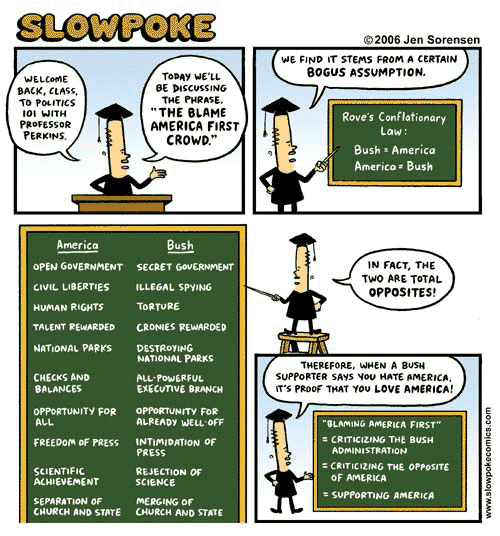
This conservative categorization of the left is political junk. It is being recycled by the conservatives associated with Murdoch's Australian with little awareness that they are drafting themselves as part of the counter-Enlightenment.
The Whitehouse Republican's assumption of international primacy of the US and the Bush crowd's strategy to achieve unquestioned American authority is undercut by the realities of a multipolar world. Goodbye Bush.
Posted by Gary Sauer-Thompson at 8:42 PM | Comments (0) | TrackBack
February 4, 2006
ministerial responsibility
This image about the oil-for-food scandal captures what we citizens have understood to be happening within liberal democracy in these postmodern times.


So does US Senator Coleman---he sees evidence of the Australian Government's knowledge of, and complicity in, the corrupt kickback practices of the AWB.
They--our ministers---needed to do it to help the struggling wheat farmers, you understand. The latter had to be protected from the way US senators used Senate inquiries to play politics with Australian farmers' livelihoods. The liberal state has to protect the interests of Australian farmers in a global world whilst its diplomats had to lie to a US Senate sub-committee for the good of the government.
Why so? Because the US senate investigations conducted by Senator Coleman into the Australian Wheat Board's corruption were motivated by dirty US agricultural politics aimed at boosting US commercial (wheat ) interests. That insidious lobbying could not be allowed to be successful. The end justified the means.
What of the ministers bearing some responsibility for the ineptitude of their departments? No such thing you understand. The Westmionister doctrine of ministerial responsiblity was ditched some time go, don't you remember? Some time in the late 1990s, wasn't it? Gee, and here's me thinking that the Howard Government was serious about respecting and protecting Australia's British heritage.
So any inquiry is only going to get us as far as departmental officials. And that is how it should be, isn't it. That's what relativism is all about, you know--different kinds of truth infiormed by power.
Those of us who think otherwise are just driven by timidity and weakness, not by a hard-headed and clear assessment about Australia's national interest; and they just adopt a condescending tone to the noble British tradition of politics.
The commercial interests of Australia's wheat farmers are identical with Australia's national interest? That is a bit hard to swallow, isn't it. Surely it is the welfare of the Australian population? Nope. The 'national interest' simply equates with Alexander Downer's attempts to limit the damage to the Howard Government coming from all the exposures, leaks and disclosures.
Posted by Gary Sauer-Thompson at 3:33 PM | Comments (0) | TrackBack
February 3, 2006
of course they knew
Whilst I've been away holiday in Tasmania for the last week I see that the inquiry into the Australian Wheat Board (AWB) is closing in around the Howard Government:

Alan Moir
The Government's message has been that it didn't know about the kickbacks and that the AWB had never let the Government know it was involved in kickbacks.
Of course we citizens suspected the Howard Government knew about the kickbacks, bribes and corruption. And the evidence?
The evidence is beginning to drrip. The first thing that I saw in the media when I stepped out of the wilderness was an old headline that Michael Thawley, the former Australian Ambassador to the US, had successfully lobbied Congress against a Senate probe/investigation into AWB's deals in Iraq. Thawley, a Howard man, would have been acting on instructions from Canberra to make representations to Senator Coleman to stop his subcommittee investigating the AWB scam. Thawley's riding instructions would have been to keep the lid on AWB's Iraq kickbacks.
Tis about time the scope of the Cole Inquiry into into Australia's alleged abuse of the UN's Iraq oil-for-food program is widened to include the conduct of Howard Government's Mnisters, MInisterial staffers the Canberra bureaucracy and the diplomats. Tis about time some of the AWB's senior executives come clean and blow the whistle. They've got nothing to lose. Their careers are finished, as is the AWB as a single desk market for wheat.
I've no idea what the ALP has been saying. I presume they've been going for it hammer and tongs looking for the smoking gun?
Posted by Gary Sauer-Thompson at 3:27 PM | Comments (0) | TrackBack
catching up
I've been away in Tasmania for a week on holidays travelling in the south central and south west of the Island--in that part of Tasmania some people call wilderness. I've had a week being disconnected from all media.
Hamas had won the elections in Palestine as I was leaving for my holidays and the Fatah leaders had promised to serve as a democratic opposition and allow Hamas to form a government. The party campaigned mainly on domestic issues such as corruption and welfare, drawing widespread support and it stood in contrast to the feuding, mismanagement and corruption of the late Yasser Arafat's Fatah party.
The US, Israel and Australia just did not like the result. They were beginning to make sour noises just before I left. America has pursued the idea that democracy is the answer to Islamist terrorism---and had presumed that free elections would produce pro-American and pro-Israeli governments in Arab countries. Then the Palestinian people spoke and they have voted for the radical Islamists. These are deemed to be terrorists by the US but its fighters are seen as the armed defenders of an otherwise-helpless people by the Palestinians.
Then I lost contact with events.

Leunig
It looks like things have been brewing whilst I've been away. Everybody is kicking Hamas. The Islamic radicals are the result of liberty beginning to spread in the Middle East, are they not? Presumably Hamas will have to start dealing with Israel and begin the transformation from terrorist group to political party.
Posted by Gary Sauer-Thompson at 3:10 PM | Comments (0) | TrackBack